Class 6 . Mathematics . Ganita Prakash . The Other Side of Zero
Chapter 10: The Other Side of Zero
Ch 10
Mathematics
Class 6
Introduction
Numbers We Already Know
- Counting numbers: The numbers 1, 2, 3, 4, … are used for counting.
- Zero: Zero represents nothing and comes before 1.
- Fractions: Numbers such as , , and lie between whole numbers.
- Digits: The Indian number system uses the ten digits 0 to 9 to write numbers.
From a Number Ray to a Number Line

Arrange from least to greatest.
- Arrange these familiar numbers from least to greatest.
- On the number ray, numbers farther right are greater; compare their values.
What does represent, and where does it lie in relation to ?
Why is the familiar diagram from to the right not a complete number line?
What question about numbers does this chapter investigate?
Quick recap
- Counting numbers begin with ; comes before and represents nothing.
- Fractions such as can lie between whole numbers.
- The Indian number system uses the digits to .
- A number ray begins at and extends to the right.
- A complete number line also has positions to the left of .
- This chapter explores whether numbers less than exist.
Bela’s Building of Fun Part-1
Lift Presses and Signed Numbers
Lift-press notation — A signed number records the direction of lift travel and the number of floors moved.
Reading the lift buttons
- Up: Each press of the button moves the lift up one floor; two presses are written .
- Down: Each press of the button moves the lift down one floor; two presses are written .
- Examples: is written ; four down presses are written .
Use for upward movement and for downward movement; the number gives the floors travelled.
Interpret a lift instruction
- Read the sign to find the direction.
- Read the number to find how many floors.
What instruction takes the lift two floors below the Welcome Hall?
- Press the down button twice from the Welcome Hall.
- The lift travels two floors downward.
Numbering the Floors
Floor number — A floor number shows a floor’s position relative to the ground floor, which is the reference point.
Floors above ground have positive numbers; floors below ground have negative numbers. The ground floor is Floor .
| Place | Floor |
|---|---|
| Welcome Hall | |
| Food Court | |
| Art Centre | |
| Book Store | |
| Toy Store | |
| Video Games shop |

Starting at Floor , the signed floor number matches the signed number of floors travelled. Here, is the floor number and is the signed movement.
Positive Numbers, Negative Numbers and Zero
Positive number — A number with a sign is positive and represents a position or movement above or upward from the reference point.
Negative number — A number with a sign is negative and represents a position or movement below or downward from the reference point.
Zero is neither positive nor negative, so it has no or sign. It represents the ground-floor reference point.
Do not give Floor a positive or negative sign: zero is neither positive nor negative.
What lift instruction takes you four floors up?
Which floor is three floors below the ground floor?
Is the ground floor positive, negative, or neither?
Quick recap
- The button moves up; the button moves down.
- A signed lift instruction gives the direction and number of floors moved.
- The ground floor is Floor and is the reference point.
- Floors above ground have positive numbers; floors below ground have negative numbers.
- Zero is neither positive nor negative and has no sign.
Bela’s Building of Fun Part-2
Adding Integers to Track Movement
Use this to find the floor reached after a movement.
Starting at Floor , where do you reach after moving floors?
- Start at Floor and move down floors.
- Combine the movements to find the target floor.
Combining Button Presses
Add all button presses to find the resulting movement.
What is the total movement for button presses , , and ?
- Add the three button presses in order.
- The positive and negative movements leave one floor downward.
Additive Inverses
For any integer , adding its inverse gives zero: .
| Number | Its inverse |
|---|---|
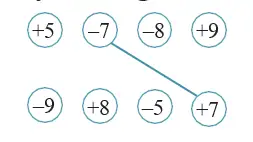
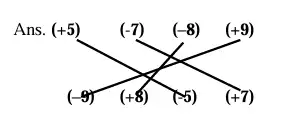
What floor do you reach if you start at Floor and move floors?
- Pair with its opposite.
- The opposite movements cancel.
Comparing Integers Using Floors
Numbers farther to the right are greater; on the building’s vertical floors, higher floors are greater.
Compare Two Integers
- Locate both integers on the number line or floor scale.
- The number farther right, or on the higher floor, is greater.
- For two negative integers, the one closer to zero is greater.


Compare and , and compare and .
- Compare the two negative integers by their distance from zero.
- Compare a positive integer with a negative integer.
Do not assume that a negative integer with a larger absolute value is greater: because is farther below zero.
Starting at Floor , move up floors. What is the target floor?
Write the additive inverse of and show their sum.
Insert or : □ .
Quick recap
- Floor movement: Starting floor plus movement gives the target floor.
- Combined presses: Add all button presses to find the total movement.
- Inverse: A number and its opposite add to zero; is its own inverse.
- Positive integers: Greater positive integers appear higher on the floors.
- Negative integers: The negative number closer to zero is greater.
- Zero: Every negative integer is below , and every positive integer is above .
Bela’s Building of Fun Part-3
Subtraction as Finding the Movement
Starting level plus movement gives the target level; therefore, target level minus starting level gives the movement needed.
Use this to find the signed movement from a starting level to a target level.
Find the Movement
- Identify the starting level and the target level.
- Subtract the starting level from the target level.
- A positive result means move up; a negative result means move down.
What movement takes you from floor to floor ?
- The starting floor is and the target floor is .
- Find the movement.
- Check that the movement reaches the target.
Movement Examples
- From to : , so move up one floor.
- From to : , so move down four floors.
- From to : , so move up four floors.
- Ordinary subtraction: , because ; similarly, and .
Integers and Movement on a Number Line
Integers — Integers are the positive whole numbers, the negative whole numbers, and zero.
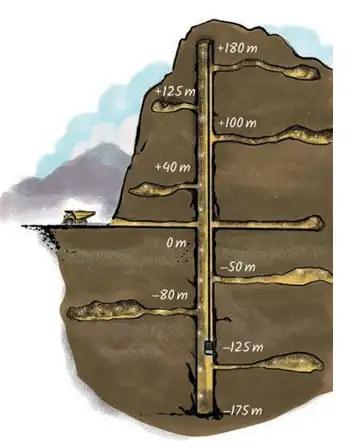
Integers and Levels
- Zero: The ground level is marked .
- Positive levels: Levels above ground are represented by positive integers.
- Negative levels: Levels below ground are represented by negative integers.
- No end: Integers extend without end in both directions: .
Adding and Subtracting Integers
Adding a signed movement to the starting level gives the target level. Movements in the same direction combine by adding their lengths and keeping their direction.
Add the magnitudes and keep their common sign.
Evaluate .
- Both movements are downward, so add their magnitudes and keep the negative sign.
- Add the magnitudes.
- The combined movement is downward.
Examples at Larger Levels
- Two upward movements combine: .
- For subtraction, target minus starting level gives movement: .
- A downward change from to is .
Subtracting a Negative Number
Subtracting a negative number is equivalent to adding the corresponding positive number.
Replace subtraction of a negative number with addition of its positive counterpart.
Evaluate an Expression with a Subtracted Negative
- Rewrite subtraction of a negative as addition of the positive number.
- Add the signed numbers using their directions.
Evaluate .
- Rewrite subtracting as adding .
- Combine the upward movements.
The Infinite Lift and the Number Line
- Infinite lift: Imagine levels extending forever above and below level .
- Number line connection: The lift is like a vertical number line: both extend in two directions from , with positive values one way and negative values the other.
- Subtracting a negative: On the lift, moving from a negative starting level to a higher target level may require upward movement; for example, .
Do not treat subtraction as always taking away a positive amount: subtracting a negative changes to addition, so .
Find the movement from floor to floor .
Evaluate .
Evaluate .
Quick recap
- Subtraction gives the signed movement needed: target level minus starting level.
- Starting level plus movement equals target level.
- Integers include positive whole numbers, negative whole numbers, and zero; they extend endlessly in both directions.
- Adding same-sign integers means adding magnitudes and keeping the common sign.
- Subtracting a negative number is the same as adding the corresponding positive number.
- An infinite lift resembles a number line: both extend in two directions from zero.
Bela’s Building of Fun Part-4
Integers on the Number Line

Starting number movement target number. Equivalently, target number starting number movement needed.
Use this to find the signed movement from a starting number to a target.
Movement examples
- From to : move steps forward, so and .
- From to : move steps backward, so and .
- From to : move steps backward, so and .
Find signed movement
- Identify the starting number and the target number.
- Subtract the starting number from the target.
- A positive result means move right; a negative result means move left.
How must you move from to reach ?
- Find the movement from to .
- The negative sign means the movement is backward.
- Check by adding the movement to the start.
Do not treat a negative number as smaller just because its digits look larger: because lies farther left.
Adding and Subtracting on an Unmarked Number Line

Start at the first number and move by the second number.
Evaluate using a number-line movement.
- Start at and move places left.
- The landing point is .
Subtraction as a missing addend
- The expression asks how far to move from to reach .
- Rewrite it as ; the missing movement is .

| Expression | Result |
|---|---|
Converting Subtraction and Addition
To subtract a number, add its inverse: . Conversely, .
Replace the subtracted number with its inverse and add.
Equivalent expressions
Rewrite subtraction as addition
- Keep the first number unchanged.
- Change subtraction to addition.
- Replace the second number with its inverse.
Evaluate by converting subtraction to addition.
- Change subtraction of into addition of its inverse.
- Add the positive integers.
Do not keep the sign of the subtracted number: subtracting a negative means adding its positive inverse, so .
Which is greater: or ?
Evaluate .
Evaluate by converting subtraction to addition.
Quick recap
- Positive integers lie to the right of zero; negative integers lie to the left.
- Numbers farther right on the number line are greater.
- Signed movement equals target minus starting number.
- For addition, start at the first number and move by the signed second number.
- Subtraction can be rewritten as addition of the subtracted number’s inverse.
- Subtracting a negative number is equivalent to adding its positive opposite.
The Token Model
Using Tokens for Addition
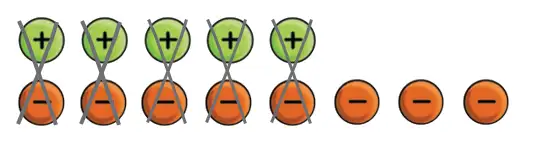
Token model — Positive tokens represent positive integers; negative tokens represent negative integers. A positive and a negative token form a zero pair.
Adding with tokens
- Zero pair: One positive token and one negative token have a combined value of zero, so they can be removed without changing the total.
- Same signs: Keep all tokens; the result has the same sign as the tokens.
- Different signs: Cancel positive-negative pairs; the sign of the remaining tokens gives the answer.
- Floor meaning: Starting at floor , positive tokens represent upward moves and negative tokens downward moves; the net total gives the floor reached.
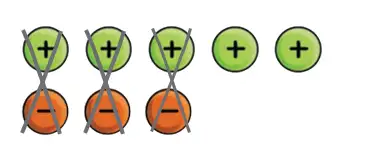
- Example: Five positive and three negative tokens leave two positive tokens, so ; the attendant is on floor .
- Another example: Cancel five pairs in ; three negative tokens remain, so the sum is .
Adding a positive and a negative integer with equal magnitude gives zero; cancelling such a pair leaves the value unchanged.
Use this equation to identify tokens that cancel.
Add integers with tokens
- Put down tokens for both integers.
- Remove as many positive-negative pairs as possible.
- Count the tokens left; their sign is the sign of the sum.
Using Tokens for Subtraction
Subtraction with tokens — Subtracting an integer means removing tokens representing that integer from the starting set.
Subtraction rules
- Remove matching tokens: Subtracting positive tokens means taking positive tokens away; subtracting negative tokens means taking negative tokens away.
- Not enough tokens: Add zero pairs until there are enough tokens of the kind to be removed; the total value does not change.
- Subtract a negative: Removing negative tokens increases the value, but the result need not be positive; for example, .
- Result: Count the tokens left and use their sign.
Subtracting an integer gives the same result as adding its opposite.
Change subtraction to addition of the opposite.
Subtract integers with tokens
- Put down tokens for the first integer.
- Remove tokens matching the integer being subtracted.
- If there are not enough matching tokens, add zero pairs until there are enough.
- Remove the required tokens and read the value of those left.
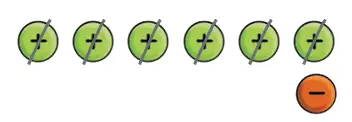
Evaluate using tokens.
- Start with five positive tokens; add one zero pair to make six positive tokens available to remove.
- Remove six positive tokens; one negative token remains.
Do not change the total when adding tokens to help subtraction: add a zero pair, not a single token.
Evaluate .
Evaluate .
Evaluate .
Quick recap
- A positive token and a negative token form a zero pair.
- To add unlike signs, cancel opposite tokens; the remaining tokens determine the sum.
- Starting at floor , the net token value gives the floor reached.
- To subtract, remove tokens representing the number being subtracted.
- If there are too few tokens to remove, add zero pairs without changing the value.
- Subtracting an integer is equivalent to adding its opposite: .
- Subtracting a negative increases the value, but does not guarantee a positive result.
Integers in Other Places Part-1
Credits, Debits, and Bank Balances
Here, is the starting balance, is the total amount credited, and is the total amount debited.
Find a Bank Balance
- Write the starting balance.
- Add each credit and subtract each debit, or add all signed transactions.
- Interpret the sign: positive means money remains; negative means the account is below zero.
What is the final balance after these transactions?
- Start with Rs. and receive a credit of Rs. .
- Pay an electricity bill of Rs. .
- Make a purchase of Rs. .
- Receive a business credit of Rs. .
Starting from zero, an account has credits of Rs. , Rs. , and Rs. , and debits of Rs. , Rs. , and Rs. . Find the balance.
Starting from zero, make debits of Rs. , Rs. , Rs. , Rs. , Rs. , Rs. , Rs. , and Rs. , followed by a credit of Rs. . Find the balance.
Why is a positive bank balance generally better, and when might a negative balance be useful temporarily?
Quick recap
- Credits add money and are represented by positive numbers.
- Debits remove money and are represented by negative numbers.
- Add signed transactions to find the account balance.
- A negative balance means debits exceeded the starting balance and credits.
- Banks may allow temporary negative balances but can charge interest or fees.
Integers in Other Places Part-2
Geographical Cross Sections
Geographical cross section — A side view of a vertical slice through a part of Earth’s surface, showing features above and below sea level.
Heights and depths
- Reference level: Sea level is taken as m.
- Above sea level: Represent elevations using positive numbers.
- Below sea level: Represent depths using negative numbers.
- Cross-section points: m, m, m, m, m, m, and m.
- Order: Decreasing height: ; increasing height: .
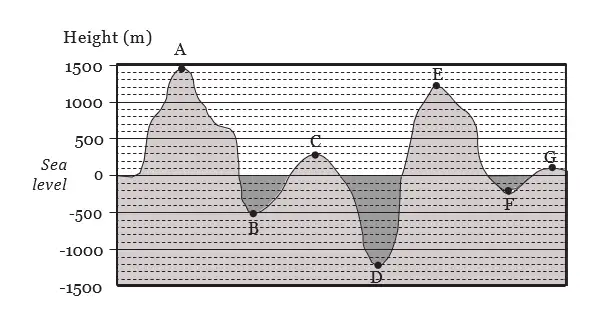
On a vertical number line, the higher point has the greater integer height. Any positive height is above sea level; any negative height is below it.
| Place | Height or depth |
|---|---|
| Mount Everest, highest point above sea level | About m |
| Challenger Deep in the Mariana Trench, lowest known point | About m |
Arrange heights
- Place the heights in order on a number line, with smaller values to the left.
- Read from left to right for increasing order, or right to left for decreasing order.
What is the increasing order of the points in the cross-section?
- Arrange the cross-section points from lowest to highest.
- Compare their heights: .
- Match the values to their points: .
Temperature
Temperature — A measure of how hot or cold something is, commonly recorded in degrees Celsius (C).
Reading temperatures
- Zero: C is the freezing point of water.
- Above zero: A positive reading represents a temperature above C.
- Below zero: A negative reading represents a temperature below C.
- Thermometer: Its scale can continue below zero to show negative temperatures.
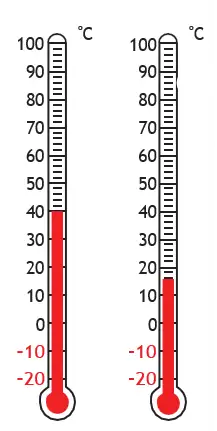
The greater integer represents the warmer temperature. Among negative temperatures, the one closer to zero is greater.
| Time | Temperature |
|---|---|
| 02:00 a.m. | C |
| 11:00 a.m. | C |
| 02:00 p.m. | C |
| 11:00 p.m. | C |
Match the Leh temperatures with the times of day.
- Match the four Leh readings to their times: C, C, C, and C.
- The warmest reading is C, so it fits the afternoon; the coldest is C, so it fits the early morning.
- The remaining readings fit the late morning and late night: C at 11:00 a.m. and C at 11:00 p.m.
Which is higher: a point at m or a point at m? By how much?
At night, the temperature is C; by morning it is C. What is the temperature increase?
Quick recap
- Sea level is the m reference: elevations are positive and depths are negative.
- The cross-section points in increasing order are .
- Mount Everest is about m; Challenger Deep is about m.
- Temperatures use degrees Celsius, and C is the freezing point of water.
- Negative temperatures lie below zero; the one closer to zero is warmer.
- For the Leh readings, the warmest time is 02:00 p.m. and the coldest is 02:00 a.m.
Explorations with Integers
Border sums in integer grids
- Border sum: In each grid, the numbers in each outer row and column add to the same total.
- Example: The first grid has border sum 0, while each border row and column in the second grid sums to .
- Finding the sum: Add the three integers in a border row or column to determine the grid’s border sum.
A number-grid selection pattern
- Selection pattern: Strike out numbers by following the steps shown in the grid until none remain.
- Final step: Add the circled numbers; in the example, their sum is .
- Explore: Repeat the process with different choices or grids and compare the sums.
Integers: order and operations
Integer applications
- Three-number sums: Many different triples can give the same total; for example, .
- Two dice: With faces , the smallest sum is and the largest is . The impossible totals between them are .
- Years: There is no year . Moving between BCE and CE must skip from BCE directly to CE.
- Token strings: Add the values represented by all positive and negative tokens; the illustrated string has total .
Integers on a timeline
- Time as integers: Signed numbers can represent positions in time relative to a chosen year.
- Moving through time: Moving to an earlier or later year can be viewed as a negative or positive change, respectively.
Integer sequences and expressions
Make an expression with value using the integer cards.
- Use the cards with the required addition and subtraction signs.
- Add the negative cards, then subtract the positive cards.
Do not treat subtraction of a negative as subtraction of a positive: .
List the integers strictly between and in increasing order.
Two dice have faces . Which totals between and cannot be rolled?
Evaluate and .
Quick recap
- A border sum is the common total of the top, bottom, left and right border lines.
- Some structured grids have an invariant selection sum when one number is chosen from each row and column.
- To subtract an integer, add its opposite; use magnitudes and signs carefully when adding unlike signs.
- The possible totals of two dice come from adding every pair of face values.
- BCE and CE dates have no year zero: BCE is followed by CE.
- Identify the rule of an integer sequence before extending it.
A Pinch of History
Early Uses of Negative Numbers
Historical development — Negative numbers and zero were first conceived and used in Asia, long before they became widely accepted elsewhere.
| Work or period | Key contribution |
|---|---|
| The Nine Chapters on Mathematical Art, China; completed in the 1st or 2nd century CE | Used red and black rods to represent positive and negative numbers, especially in accounting. |
| Kautilya’s Arthaśhāstra, c. 300 BCE | Discussed credit and debit, including the possibility of a negative account balance. |
| Bakhshālī manuscript, around 300 CE | Used negative numbers in accounting; a special sign was written after the number. |
| Brahmagupta’s Brāhma-sphuṭa-siddhānta, 628 CE | Gave the first general treatment of positive numbers, negative numbers and zero on an equal footing, with rules for arithmetic operations. |
Brahmagupta’s Addition Rules
Integer addition — Brahmagupta’s rules describe addition for positive numbers, negative numbers and zero.
| Numbers added | Rule | Example |
|---|---|---|
| Two positives | Add their values; the result is positive. | |
| Two negatives | Add their absolute values and keep the negative sign. | |
| One positive and one negative | Subtract the smaller absolute value from the larger; keep the sign of the number with the larger absolute value. | |
| A number and its opposite | Their sum is zero. | |
| Any number and zero | The sum is the original number. |
Use these identities to check integer sums.
Adding Integers with Unlike Signs
- Compare the absolute values of the positive and negative numbers.
- Subtract the smaller absolute value from the larger.
- Give the result the sign of the number with the larger absolute value.
Find .
- Compare the absolute values; the negative number has the greater absolute value.
- Subtract the smaller absolute value from the larger and keep the negative sign.
Brahmagupta’s Subtraction Rules
Integer subtraction — Subtraction rules determine the result when one positive or negative number is taken away from another.
| Subtraction | Rule | Example |
|---|---|---|
| Smaller positive from larger positive | The result is positive. | |
| Larger positive from smaller positive | The result is negative. | |
| A negative number | Subtracting a negative is the same as adding its opposite. | |
| A number from itself | The result is zero. | |
| Zero from a number | The number stays unchanged. | |
| A number from zero | The result is the number’s opposite. |
Subtracting a number is equivalent to adding its opposite.
Subtracting Integers
- Change subtraction into addition of the opposite number.
- Apply the integer addition rules to find the result.
Find .
Find .
Do not treat subtracting a negative as subtraction: . The opposite of a number is not always negative; for example, the opposite of is .
Spread and Importance
Brahmagupta’s Contribution
- First general treatment: In 628 CE, Brahmagupta treated positive numbers, negative numbers and zero as equally valid numbers.
- Operations: His treatment gave explicit rules for addition, subtraction, multiplication and division involving these numbers.
- Lasting impact: This framework, described as a ring, helped pave the way for modern algebra.
| Period | Development |
|---|---|
| By the 9th century | Zero and negative numbers had reached the Arab world, where they were accepted and studied further. |
| By the 13th century | These numbers had made their way to Europe. |
| 18th century | Some European mathematicians still rejected negative numbers; Lazare Carnot called them “absurd”. |
| Over time | Zero and negative numbers became essential in mathematics and science, and were accepted as important numbers alongside positive numbers. |
Quick recap
- Ancient Asian mathematical works used negative numbers and zero before their widespread acceptance elsewhere.
- Chinese rods represented positive and negative numbers; Kautilya discussed negative balances, and the Bakhshālī manuscript used a sign after a negative number.
- In 628 CE, Brahmagupta gave the first general treatment of positive numbers, negative numbers and zero on an equal footing, with rules for basic operations.
- For addition with unlike signs, subtract absolute values and keep the sign of the number with the larger absolute value.
- Subtraction can be changed into addition of the opposite: .
- Zero and negative numbers reached the Arab world by the 9th century and Europe by the 13th; their arithmetic framework helped prepare the way for algebra.
Summary
Integers and the Number Line
Integer — An integer is a positive whole number, a negative whole number, or zero.
Types and positions
- Negative integers have a minus sign and lie to the left of zero.
- Positive integers lie to the right of zero; zero is neither positive nor negative.
- Order on the number line: numbers increase as you move right; for example, .
Additive Inverses
Additive inverse — The additive inverse of a number is the number that adds to it to give zero.
A number and its additive inverse cancel each other.
- Examples: the additive inverse of is ; the additive inverse of is .
Adding and Subtracting Integers
For integers with the same sign, add their absolute values and keep the common sign. For opposite signs, subtract the smaller absolute value from the larger and keep the sign of the number with the larger absolute value. A number plus its inverse is zero, and adding zero leaves a number unchanged.
Here, means the distance of from zero.
Subtraction of integers — Subtracting an integer is the same as adding its additive inverse.
Add or subtract integers
- For subtraction, rewrite the expression as addition of the second number’s additive inverse.
- For numbers with the same sign, add their absolute values and keep their sign.
- For numbers with opposite signs, subtract the smaller absolute value from the larger and keep the sign of the larger.
Find .
- Rewrite subtraction as addition of the opposite.
- Both numbers are negative, so add their absolute values and keep the negative sign.
Integers as Positions and Movements
Interpretations
- Addition as position: starting position plus movement gives the target position.
- Addition as change: combining two movements or increases/decreases gives the total movement.
- Subtraction as movement: target position minus starting position gives the movement.
| Context | Positive | Negative |
|---|---|---|
| Money | Credit | Debit |
| Height relative to ground level | Above ground | Below ground |
| Temperature in Celsius | Above water’s freezing point | Below water’s freezing point |
Calculate .
Calculate .
Which is greater: or ?
Common mistake: Among negative integers, a number with a larger absolute value is smaller; for example, because lies farther left.
Quick recap
- Integers include positive numbers, negative numbers, and zero; zero is neither positive nor negative.
- Negative integers lie left of zero, while positive integers lie right of zero.
- A number and its additive inverse add to zero.
- For addition, same signs combine; opposite signs subtract absolute values and keep the sign of the greater absolute value.
- Rewrite subtraction as addition of the subtracted number’s additive inverse.
- Positive and negative integers can represent credits/debits, above/below a reference point, and temperatures above/below freezing.