Class 10 . English . First Flight . Glimpses of India
Chapter 5: Glimpses Of India
Ch 5
English
Class 10
A Baker From Goa
The Bakers and Childhood Memories
- Tradition: Goan elders fondly remember Portuguese-era bread and the village bakers who made it. Traditional furnaces and family baking businesses continued.
- Name: Goan village bakers are known as pader.
- Daily visits: The baker visited at least twice a day, announcing his arrival with the jingling thud of his bamboo staff.
- Children’s excitement: Children ran to meet him for bread-bangles and sometimes special sweet bread; household loaves were usually bought by the maid.
- Routine: He carried a basket on his head, supported it with a bamboo staff, greeted the lady of the house and delivered the loaves.
Bread in Goan Life
- Marriage gifts: Sweet bread called bol was an important marriage gift.
- Feasts: Bread was essential to the charm of parties and feasts.
- Engagements: Sandwiches were prepared for a daughter’s engagement.
- Festivals: Cakes and bolinhas were a must for Christmas and other festivals.
- Importance: The village baker’s furnace was considered essential because bread was part of both everyday life and celebrations.
The Baker’s Dress and Prosperity
- Portuguese days: The baker wore a kabai, a single-piece frock reaching down to the knees.
- In the author’s childhood: Bakers wore a shirt and trousers shorter than full-length trousers but longer than half-pants.
- Local comparison: A person wearing a half-pant reaching just below the knees might be said to be dressed like a pader.
- Accounts and income: Bakers collected bills at the end of the month; monthly accounts were written in pencil on a wall.
- Prosperity: Baking was profitable, and bakers’ families and servants appeared happy and prosperous. Their plump physique was regarded as evidence of this.
The Goan Baker
- Traditional: He carries on an old family profession and uses the familiar bamboo staff and basket.
- Dependable: He visits homes regularly and supplies bread for daily needs and special occasions.
- Prosperous: His baking supports his family and servants, whose plump appearance reflects their comfortable lives.
Tradition and Community Life
The baker is a valued part of Goan village life. His traditional work connects generations and provides bread for everyday needs, celebrations and customs.
- Pader
- A traditional Goan baker.
- Kabai
- A single-piece, knee-length frock worn by bakers.
- Bol
- A sweet bread given as a marriage gift.
- Bolinhas
- A festive food mentioned alongside cakes for Christmas and other festivals.
- Reminiscing
- Thinking fondly about the past.
- Heralding
- Announcing or signalling an arrival.
- Rebuke
- An expression of disapproval or scolding.
- Fragrance
- A scent or pleasant smell.
- Plump physique
- A pleasantly fat body.
- Open testimony
- Clear evidence of a quality.
Why were the children eager for the baker’s arrival?
How did bread feature in important Goan occasions?
What details show that baking was a profitable profession?
Quick recap
- Goan village bakers, known as pader, carried on a traditional family profession.
- The baker visited homes at least twice daily and announced his arrival with a bamboo staff.
- Children eagerly waited for bread-bangles and sometimes special sweet bread.
- Bread was important for marriages, feasts, engagements, Christmas and other festivals.
- Bakers wore the kabai in Portuguese times; the comparison to a pader refers to a half-pant reaching just below the knees.
- Monthly billing and the baker family’s comfortable appearance reflected the profession’s former prosperity.
Coorg
Coorg: Landscape and Climate
- Location: Coorg, also called Kodagu, is Karnataka’s smallest district, between Mysore and Mangalore.
- Landscape: Rolling hills, coffee plantations and spices define the region; evergreen rainforests cover about 30% of the district.
- Climate: Heavy monsoon rain keeps some visitors away. The pleasant visiting season runs from September to March.
- Atmosphere: Coffee-scented air, tree-covered estates and old bungalows contribute to Coorg’s appeal.
People, Origins and Traditions
- People: The Kodavus are described as proud, independent and martial, with distinctive customs.
- Possible origins: One theory links them to Greek descent, suggesting that part of Alexander’s army settled there after being unable to return.
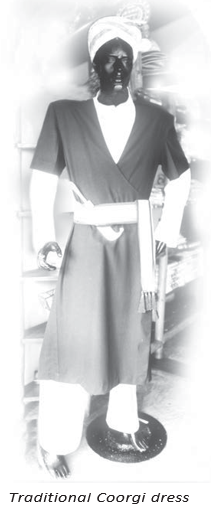
- Arabic connection: Another theory points to Arab descent; the Kodavus’ traditional long black coat, the kuppia, resembles the Arab and Kurdish kuffia.
- Customs: Their martial, marriage and religious rites are distinct from those of the Hindu mainstream.
Hospitality and Military Heritage
- Hospitality: Coorgi homes welcome visitors, and families share stories of courage and valour.
- Military distinction: The Coorg Regiment is among the Indian Army’s most decorated regiments.
- General Cariappa: The first Chief of the Indian Army was a Coorgi.
- Firearms: Kodavus are described as the only people in India permitted to carry firearms without a licence.
River Life and Adventure
- Kaveri: The river receives its water from Coorg’s hills and forests; its clear waters support mahseer fish and other wildlife.
- Wildlife: Kingfishers catch fish, while squirrels and langurs drop fruit into the river. Elephants are bathed and scrubbed by their mahouts.
- Adventure: Visitors can enjoy rafting, canoeing, rappelling, rock climbing and mountain biking; walking trails attract trekkers.
- Animals and birds: Macaques, Malabar squirrels, langurs and slender lorises live among the trees; the narrator gives wild elephants a respectful distance.
Scenic Attractions and Travel
- Brahmagiri Hills: Climbing the hills gives visitors a wide view of Coorg’s misty landscape.
- Nisargadhama: A rope bridge leads to this 64-acre island.
- Bylakuppe: Nearby is India’s largest Tibetan settlement, where visitors may encounter Buddhist monks in red, ochre and yellow robes.
- Getting there: Madikeri is Coorg’s district headquarters and gateway. The nearest airports are Mangalore (135 km) and Bangalore (260 km); railheads are Mysore, Mangalore and Hassan.
- By road: From Bangalore, the two routes are about 250–260 km. The common route goes via Mysore; the other passes through Neelamangala, Kunigal and Channarayapatna.
Nature, Culture and Adventure
Coorg is presented as a remarkable blend of rich natural beauty, distinctive traditions, military pride and outdoor adventure.
- Martial
- Related to war or the military.
- Canopy
- A roof-like covering formed by trees.
- Mainstream
- The widely followed tradition or way of life.
- Tales of valour
- Stories of courage, often in war.
- Most decorated
- Having received many awards for bravery.
- Laidback
- Relaxed and unhurried.
- Rappelling
- Descending a cliff on a rope.
- Trail
- A path formed by people walking.
- Panoramic
- Giving a wide view of an area.
- Mahout
- A person who works with and rides an elephant.
What are the two theories about the origins of the Kodavus?
Mention two features of Coorg’s military heritage.
Name some natural and adventure attractions of Coorg.
Quick recap
- Coorg, or Kodagu, is Karnataka’s smallest district, known for rainforests, coffee and spices.
- Its pleasant season is September to March, following the heavy monsoon.
- The Kodavus are known for distinctive customs, hospitality and a strong martial tradition.
- The Kaveri, Coorg’s forests and hills support rich wildlife and outdoor activities.
- Brahmagiri, Nisargadhama and nearby Bylakuppe are notable attractions.
Tea From Assam
The Journey to Assam
- Rajvir and Pranjol are classmates in Delhi; Pranjol invites Rajvir to spend the summer at his home in Assam.
- Tea on the train prompts Rajvir to mention that more than eighty crore cups of tea are consumed worldwide each day.
- The landscape changes from green paddy fields to vast tea plantations, framed by wooded hills and shade trees.
- Pranjol’s view is less excited than Rajvir’s: he has grown up among tea gardens and says Assam has the world’s largest concentration of plantations.
| Topic | Key details |
|---|---|
| Discovery | No one really knows who discovered tea; the story recounts Chinese and Indian legends about its discovery. |
| Chinese emperor legend | A few leaves from burning twigs supposedly fell into the emperor’s boiled water and gave it a pleasant flavour. |
| Indian legend | The Buddhist ascetic Bodhidharma cut off his eyelids because he felt sleepy during meditation; ten tea plants supposedly grew out of his eyelids, and their leaves were said to banish sleep. |
| Historical references | Tea was first drunk in China, as far back as 2700 B.C.; the words “tea”, “chai” and “chini” come from Chinese. |
| Arrival in Europe | Tea reached Europe in the sixteenth century and was initially used more as medicine than as a beverage. |
At Dhekiabari Tea Estate
- Arrival: At Mariani Junction, Pranjol’s parents meet the boys and drive them to Dhekiabari, the tea estate managed by Pranjol’s father.
- The estate: Neatly pruned tea bushes stretch along the road; workers pluck newly sprouted leaves into bamboo baskets carried on their backs and wear plastic aprons.
- The second flush: Rajvir identifies the sprouting period as the second flush, which lasts from May to July and produces the best tea.
- Rajvir’s preparation: Mr Barua is surprised by Rajvir’s knowledge; Rajvir hopes to learn even more during his visit.
Rajvir
- Curious and observant: he is eager to admire Assam’s scenery and tea gardens.
- Well-prepared: he has read about tea’s legends and history and knows about the second flush.
- Enthusiastic: he looks forward to learning more at the tea estate.
Pranjol
- A native of Assam whose father manages a tea garden.
- Calm and familiar with plantation life; unlike Rajvir, he is not amazed by the tea-country scenery.
- Enjoys reading detective stories.
Mr Barua
- Pranjol’s father and the manager of Dhekiabari Tea Estate.
- He is impressed by Rajvir’s knowledge of tea cultivation and the second flush.
Tea, Knowledge and Discovery
The story presents Assam’s tea-growing landscape and combines the pleasure of travel with curiosity about tea’s origins, history and cultivation.
- Ardent
- Very enthusiastic or passionate.
- Magnificent
- Impressive and beautiful.
- Dwarfing
- Making something seem small by comparison.
- Ascetic
- A person who practises strict self-discipline, often for religious reasons.
- Banished
- Drove away or got rid of.
- Beverage
- A drink.
- Pruned
- Trimmed by cutting away unwanted growth.
- Sprouting
- Beginning to grow new shoots or leaves.
- Flush
- A period when tea bushes produce a new growth of leaves.
What are the two legends about the discovery of tea?
What did Rajvir explain about the second flush?
Quick recap
- Rajvir visits his classmate Pranjol’s home in Assam during the summer vacation.
- Assam has the world’s largest concentration of tea plantations.
- No one knows for certain who discovered tea; the story includes Chinese and Indian legends.
- Tea was first drunk in China around 2700 B.C. and reached Europe in the sixteenth century.
- Tea pluckers gather new leaves at Dhekiabari Tea Estate.
- The second flush, from May to July, yields the best tea.
The Trees (Poem )
Adrienne Rich
- Born in Baltimore, Maryland, USA, in 1929.
- Wrote nearly twenty volumes of poetry.
- She was described as a feminist and radical poet.
The Trees
- The trees are leaving an indoor space for the empty forest.
- Their return will restore shelter for birds and insects and shade from the sun.
- Roots, leaves, twigs and branches struggle to escape the house.
- The branches are compared to patients leaving a clinic: cramped and unsteady after confinement.
- The speaker quietly witnesses the trees’ departure but avoids mentioning it in her letters.
- The fresh night, moon and scent of leaves make nature’s presence vivid; its whispers will soon be gone.
- The trees break through the glass and move into the open night as the wind meets them.
- The moon seems fragmented in the oak’s crown, with its reflected light among the branches.
Key images and interpretations
- Empty forest: At first, no bird can sit, no insect can hide, and the sun cannot bury its feet in shadow.
- Trees inside: They represent nature confined indoors; their escape suggests release and a return to their natural place.
- Man and nature: The poem can be read as nature resisting human control, including the use of plants as indoor decoration while forests are depleted.
- Trees as people: The trees may symbolize people seeking freedom from social restrictions.
- The speaker’s silence: She scarcely mentions the departure in her letters; the unexpected event may be difficult or embarrassing to discuss.
- The moon: It shines whole earlier, then appears in fragments among the oak’s branches; the trees’ movement and breaking glass transform the scene.
- The house: As the trees leave, the indoor space loses the presence and sounds of nature.
| Device | Example | Effect |
|---|---|---|
| Personification | “All night the roots work” | Makes the trees seem determined and purposeful. |
| Simile | Boughs move “like newly discharged patients” | Suggests their awkwardness after long confinement. |
| Imagery | “the smell of leaves and lichen” | Creates a vivid sensory impression of nature reaching indoors. |
| Symbolism | Trees breaking out of the house | Suggests nature, or people, seeking freedom from confinement. |
Freedom and nature’s return
The poem presents nature as struggling against confinement and reclaiming its freedom. The trees may also symbolize people breaking free from restrictions.
- disengage
- Separate or free oneself.
- strain
- Make a strong effort.
- bough
- A large branch of a tree.
- shuffling
- Moving repeatedly from one position to another, often with short steps.
- lichen
- A crusty or bushy growth formed by a fungus and an alga living together.
Homophones
- Homophones: The source uses this term for the word pairs below, which have different meanings and the same spelling; their pronunciation can differ.
- refuse: As a verb, it means “reject”; as a noun, it means “waste.” The pronunciation and stress differ.
- dove: A bird; also the past tense of “dive.” These meanings have different pronunciations.
- invalid: A person who is ill; also something not valid. The pronunciation and stress differ.
Name three things that cannot happen in the empty forest at the beginning.
What do the roots, leaves and twigs do as the trees leave?
Why might the speaker avoid mentioning the trees’ departure in her letters?
Quick recap
- The trees escape their indoor confinement and return to an empty forest.
- The struggle is shown through the movement of roots, leaves, twigs and boughs.
- The branches are compared to patients leaving a clinic after confinement.
- The speaker observes the departure but scarcely mentions it in her letters.
- The moon appears whole earlier and fragmented among the oak’s branches at the end.
- The poem can symbolize nature’s return and the struggle for freedom.
Exercise
Goan Bakers
Key ideas
- Pader: A traditional Goan baker whose arrival was announced by the thud and jingle of a bamboo staff.
- Baking tradition: Traditional furnaces and family knowledge of bread-making continued across generations.
- Portuguese gift: Leavened, oven-baked bread was introduced to India by the Portuguese.
- Bread in Goan life: Bread, cakes and festival foods are part of Goan life.
- Author’s recollection: The author recalls the baker and the fragrance of fresh loaves with nostalgia.
| Point | Personal recollection | Adapted article |
|---|---|---|
| Style | Nostalgic, vivid and based on remembered details. | More factual and focused on the continuity of the baking profession. |
| Shared facts | Traditional bakers and bread-making remain part of Goan life. | Traditional furnaces, bread-makers and family transmission of the profession continue. |
| Picture of the baker | Creates a personal picture through sounds, memories and sensory details. | Presents the baker through the craft, family tradition and door-to-door delivery. |
| Bread’s origin | Recalls Goan bread and baking traditions. | Identifies leavened, oven-baked bread as a Portuguese gift to India. |
Coorg
What the exercise tests
- Recall: The questions ask about Coorg’s location, the Kodavu people’s descent, local life, crops, tourist activities, wildlife and access.
- Coorg: Kodagu lies between Mysore and Mangalore in Karnataka; it is known for coffee, the Kodavus, adventure sports and wildlife, and is about 250–260 km from Bangalore.
- Meaning-matching: Find phrases in the reading that express the same ideas as the six paraphrased sentences.
Language Skills
Collocation — A collocation is a pair or group of words that commonly occur together, such as “unique culture” or “pleasant person.”
Verb-particle word — Some words combine a verb with an adverb or particle to form a new word, such as “upkeep,” “downpour” and “undergo.”
| Point | -ing adjectives | -ed/-en adjectives |
|---|---|---|
| Meaning | Describe something that causes a feeling. | Describe the feeling or state experienced. |
| Examples | An interesting game; an exciting trek. | I am interested; we are excited. |
Do not confuse the cause with the feeling: a book is boring, while a reader may feel bored.
Tea: Speaking and Writing
Tea passage
- History in the passage: British planters began tea plantations in Assam and Darjeeling in the mid-nineteenth century.
- Early reception: Many Indians initially avoided tea, believing it caused disease; tea later became part of British social life.
- Health claims: The passage says research has examined tea’s benefits and that Japanese and Chinese traditions attributed medicinal qualities to it.
Writing and discussion skills
- Personal travel account: Add first-hand observations and impressions to brochure facts to create a vivid picture of a place.
- Group discussion: Compare present-day bread-making with earlier methods, and discuss skills, causes of decline and ways to revive craft-based professions.
- Role-play and advertisement: Present different viewpoints about tea, then use relevant information to create a clear, appealing product advertisement.
Quick recap
- The pader, traditional furnaces and family bread-making are central to the Goan baker exercise.
- Leavened, oven-baked bread is described as a Portuguese gift to India.
- The personal account is nostalgic and sensory; the adapted article is more factual.
- Coorg’s coffee-covered hills, proud Kodavu people, adventure activities and rich wildlife make it a distinctive destination in Karnataka.
- Collocations are natural word partnerships; some words are formed from a verb and a particle.
- -ing describes what causes a feeling; -ed/-en describes the feeling or state.
- Strong travel writing adds personal details to factual information.
English — ALL CHAPTERS
1
A Letter To God
2
Nelson Mandela Long Walk To Freedom
3
Two Stories About Flying
4
From The Diary Of Anne Frank
5
Glimpses Of India
6
Mijbil The Otter: Gavin Maxwell
7
Madam Rides The Bus
8
The Sermons At Benares
9
The Proposal
1
A Triumph of Surgery
2
The Thief’s Story
3
The Midnight Visitor
4
A Question of Trust
5
Footprints without Feet
6
The Making of a Scientist
7
The Necklace
8
Bholi
9
The Book That Saved the Earth