Class 10 . English . First Flight . Two Stories About Flying
Chapter 3: Two Stories About Flying
Ch 3
English
Class 10
His First Flight Part - 1
Story Details
- Author: O’Flaherty.
- Main character: A young seagull who overcomes his fear of flying.
The Seagull’s Fear
- The young seagull remains alone on a cliff ledge after his brothers and sister fly away.
- Afraid his wings will not support him over the sea, he retreats instead of taking off.
- His parents scold him and threaten to leave him without food, but he cannot bring himself to fly.
Hunger Becomes the Turning Point
- After a day without food, the seagull watches his family from the ledge as they stay on the opposite plateau.
- His mother holds a piece of fish just beyond his reach, tempting him to approach.
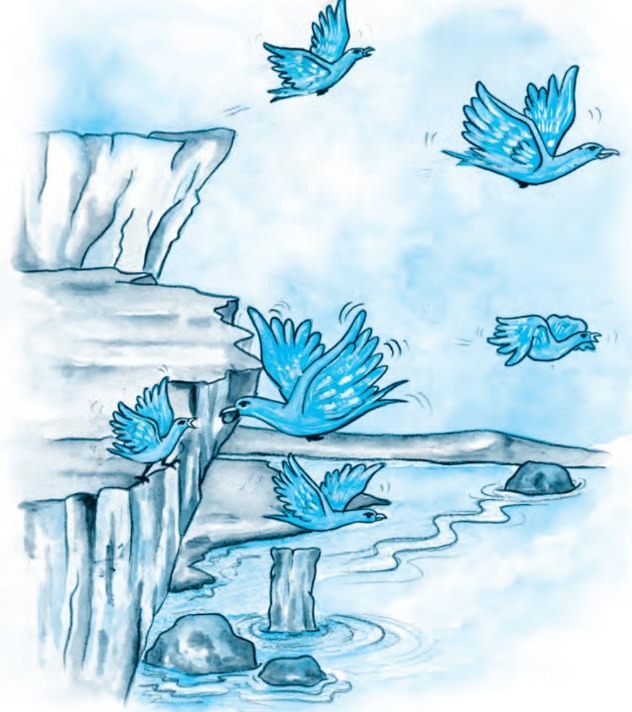
- Driven by hunger, he dives towards the fish and falls from the ledge.
The First Flight
- At first, terror grips him, but the air supports his outstretched wings and he begins to glide.
- He flaps his wings, rises, and joins his family in swooping, banking and diving.
- He discovers that he can fly and enjoys the freedom he had feared.
Landing on the Sea
- His family lands on the sea, which the seagull mistakes for a solid surface.
- When his feet sink, he is frightened; then his belly touches the water and he floats.
- His family praises him and offers him scraps of dog-fish: he has completed his first flight.
The Young Seagull
- Fearful and hesitant: he believes his wings cannot carry him.
- Hungry and dependent: he begs his mother for food.
- Quick to learn: once airborne, he gains confidence and begins to enjoy flying.
The Mother Seagull
- Patient and watchful: she keeps an eye on the young seagull.
- Clever and encouraging: she uses a piece of fish to draw him into his first flight.
Overcoming Fear
The seagull’s first flight shows that fear can hold someone back, but taking action can reveal abilities they already have.
Learning Through Experience
The young seagull learns to fly by taking the risk himself; experience turns terror into confidence and joy.
- Ledge
- A narrow shelf projecting from a cliff or wall.
- Upbraiding
- Scolding or reproaching.
- Preening
- Cleaning and arranging feathers.
- Whet
- Sharpen.
- Derisively
- In a mocking or scornful way.
- Dizzy
- Feeling as though everything is spinning.
- Curveting
- Leaping or moving in a lively, curved way.
- Banking
- Turning in flight by tilting one wing higher than the other.
How does the young seagull overcome his fear of flying?
What happens when the seagull tries to land on the sea?
Quick recap
- The young seagull is afraid to fly while his siblings have already left the ledge.
- His mother’s fish and his hunger lead him to make the leap.
- He first feels terror as he falls, but his wings catch the air.
- He learns to soar, rise and dive, and begins to enjoy flying.
- He floats on the sea and is welcomed by his family.
The Black Aeroplane
A risky choice
- The journey: The narrator flies his old Dakota from France to England at 1:30 a.m., looking forward to seeing his family and having breakfast.
- The storm: Paris Control directs him west. Soon, huge storm clouds block his route; unwilling to turn back, he flies into them.
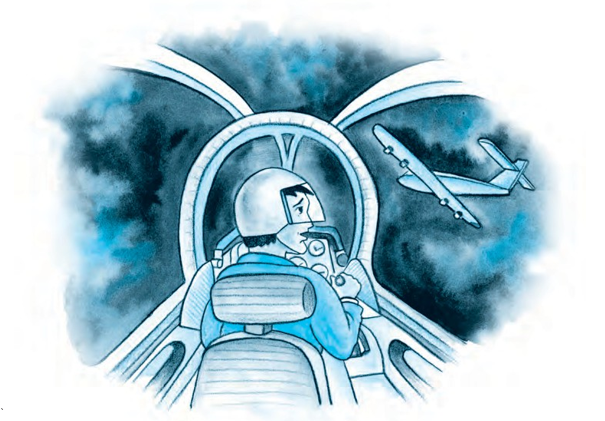
- The danger: Inside the clouds, visibility disappears, the compass and other instruments fail, and the radio stops working. He is lost.
The mysterious guide
- The stranger: A black aeroplane appears beside the Dakota. Its pilot waves and signals the narrator to follow.
- The escape: The narrator follows the stranger through the storm. When his fuel is nearly gone, the strange plane descends, leading him out to a runway.
- The disappearance: After landing safely, the narrator looks for the other plane, but it has vanished.
The unanswered question
- The control tower: A woman tells the narrator that no other aircraft was flying that night and that his was the only one visible on radar.
- The mystery: The story ends without explaining who guided him, creating uncertainty about the black aeroplane and its pilot.
The narrator
- Eager: He risks continuing through the storm because he wants to reach home.
- Resourceful: He checks his map and compass and tries to contact Paris Control when in difficulty.
- Trusting and relieved: He follows the strange pilot and is grateful to reach safety.
Help and mystery
The story shows how unexpected help can appear in a crisis, while leaving the source of that help unexplained. The unexplained black aeroplane creates suspense.
Why did the narrator enter the storm despite the danger?
What made the narrator realize the black aeroplane was mysterious?
Quick recap
- The narrator flies his Dakota from France to England at night.
- He chooses to fly into a storm rather than turn back.
- His compass, instruments and radio fail, leaving him lost.
- A black aeroplane guides him through the storm to a runway.
- The control tower reports no other aircraft was flying that night.
- The identity of the mysterious pilot remains unanswered.
How To Tell Wild Animals ( Poem ) & The Ball Poem
How to Tell Wild Animals
How to Tell Wild Animals — Carolyn Wells
- The poet humorously says that a large, tawny beast that roars as it attacks must be an Asian lion.
- The animal’s identity becomes clear only when the observer is in extreme danger.
- A Bengal tiger is recognised by its black stripes against a yellow background.
- The advice to wait until it eats you makes the identification method absurd and comic.
- A leopard’s spotted coat is its identifying feature.
- The non-standard spellings “lept” and “lep” add a playful, comic sound to the verse.
- A bear is identified by its powerful, tight “hug”.
- Calling a dangerous attack a “caress” creates humour through contrast.
- The poem contrasts the hyena’s supposed smile with the crocodile’s supposed tears.
- The expressions are funny because both animals are predators, and their supposed emotions are used as clues.
- The chameleon is described as a small, earless, wingless lizard.
- Its ability to blend into its surroundings creates the joke that an apparently empty tree may contain a chameleon.
| Device | Example | Effect |
|---|---|---|
| Humour and irony | The animals are identified as they attack or eat the observer. | Turns dangerous encounters into comic situations. |
| Rhyme | “east” / “beast”; “pain” / “again” | Creates a lively, memorable rhythm. |
| Repetition | “lep and lep again”; “very, very hard” | Emphasises the action and strengthens the comic tone. |
| Imagery | “black stripes on a yellow ground” | Gives clear visual clues for identifying the animals. |
Humour in Animal Identification
Carolyn Wells playfully turns animal descriptions into absurd, dangerous identification tests. Exaggeration, wordplay and familiar ideas about animals create the poem’s humour.
The Ball Poem
The Ball Poem — John Berryman
- The boy’s ball falls into the water, and he is overwhelmed by grief; another ball or money cannot replace what this one means to him.
- By experiencing loss, he begins to understand responsibility, the limits of possessions and the need to face loss and carry on.
| Device | Example | Effect |
|---|---|---|
| Symbolism | The lost ball | Represents cherished possessions, memories and the experience of loss. |
| Repetition | “What, what”; “Balls, balls”; “how to stand up” | Emphasises the boy’s distress and the lesson he must learn. |
| Imagery | “Merrily bouncing” into the water | Makes the ball’s movement and the boy’s loss vivid. |
| Enjambment | Thoughts continue across lines without a full stop. | Reflects the flow of the speaker’s observations and the boy’s ongoing experience. |
Learning Through Loss
Losing the ball gives the boy his first experience of accepting an irreversible loss. The poem suggests that possessions cannot always be replaced with money, and that growing up involves learning to face loss and recover.
- Tawny
- Yellowish-brown in colour.
- Discern
- To recognise or identify.
- Hide
- An animal’s skin.
- Peppered
- Covered with spots.
- Caress
- A gentle, affectionate touch.
- Novice
- A beginner or someone inexperienced.
- Nonplus
- To confuse or puzzle.
- Rigid
- Stiff and unable to move freely.
- Intrude
- To enter or interfere where one is not welcome.
- Epistemology of loss
- Understanding what loss means and how to live with it.
- A dime
- Ten cents (U.S.).
- Desperate
- Hopeless.
How does the poet suggest identifying the Asian lion and the Bengal tiger?
Why does the speaker not offer the boy another ball?
What does the boy learn from losing the ball?
Quick recap
- Carolyn Wells uses rhyme, exaggeration and absurd danger to make animal identification comic.
- The Asian lion is tawny and roars; the Bengal tiger has black stripes on yellow.
- The leopard is spotted, the bear hugs tightly, the hyena seems to smile and the crocodile is associated with tears.
- The chameleon is difficult to spot because it blends into its surroundings.
- In John Berryman’s poem, the lost ball represents more than its money value: it holds personal meaning and memories.
- The boy’s grief marks an early lesson in responsibility, accepting loss and learning to carry on.
Exercise
The First Flight: Key Ideas
Questions to Consider
- First attempt: Consider why the young seagull was afraid to fly and whether all young birds are equally timid.
- Human comparison: Compare a young bird’s first flight with a baby’s first steps.
- Motivation: The sight of food suggests that hunger helps the seagull overcome his hesitation.
- Encouragement and effort: Consider why the parents urge him to fly, and whether trying matters even when success is uncertain.
The Black Aeroplane: Key Ideas
Story Questions and the Mystery
- Risk and storm: The narrator flies into the storm rather than turn back to Paris, despite knowing it is dangerous and lacking enough fuel to go around. Inside, the Dakota is tossed about, its compass, instruments and radio fail, and he becomes lost until a strange aeroplane guides him out.
- Landing: The narrator says he was not sorry to leave his old Dakota after landing.
- Control centre: The woman looked at him strangely because the radar showed no other aircraft flying that night; his Dakota was the only one.
- Phantom plane: The helper’s identity is left for discussion: students consider whether the plane was real or imagined and, if real, who might have piloted it.
Words with More Than One Meaning
| Expression | Meaning |
|---|---|
| Black mountains / black clouds near the narrator | The very darkest colour |
| Everything was black inside the clouds / the strange black aeroplane | Without light |
| Black hands and face | Very dirty |
| Give someone a black look | Give an angry or hostile look |
| A black crime | A very wicked or shameful crime |
| Black comedy | Humour involving grim or disturbing subjects |
| Sell goods in black | Sell goods illegally after creating false scarcity by withholding essential goods |
| Beaten black and blue | Badly bruised from being beaten |
| Black tea | Tea without milk |
| A black future | A gloomy or hopeless future |
Expressions and Vocabulary Related to “Fly”
| Point | Control an aircraft | Move using wings |
|---|---|---|
| Meaning | Operate or pilot an aircraft in the air | Move through the air using wings |
| Example | “I was flying my old Dakota aeroplane.” | “The young seagull had been afraid to fly with them.” |
| Phrase | Meaning |
|---|---|
| Fly a flag | Display a flag on a long pole |
| Fly into a rage | Become suddenly very angry |
| Fly along | Move quickly or suddenly |
| Fly high | Be successful |
| Fly the coop | Escape from a place |
Words Describing Flight
- Flight-related words: Swoop, flit, flutter, ascend, float, skim, dart, hover, glide, descend, soar, shoot, sail and flap.
- Not flight synonyms in this exercise: Paddle, ride, sink, spring, stay and fall.
Speaking and Writing Tasks
- Group presentation topics: Development of airplane or motorcar models; birds and their wingspans; or the routes of migratory birds.
- Composition: Describe an early attempt at learning a skill, such as cycling or swimming; make it humorous.
- Narrative paragraph: Recount an experience of being alone or away from home during a thunderstorm.
Quick recap
- The young seagull overcomes his fear when hunger drives him to dive for food; once his wings spread, he discovers that he can fly.
- The black aeroplane’s mysterious helper remains open to discussion in the exercise.
- “Black” may mean the darkest colour, absence of light, or have other context-dependent meanings.
- “Fly” can mean piloting an aircraft or moving through the air using wings.
- Idioms include “fly into a rage” and “fly the coop”; many other words describe movement through the air.
English — ALL CHAPTERS
1
A Letter To God
2
Nelson Mandela Long Walk To Freedom
3
Two Stories About Flying
4
From The Diary Of Anne Frank
5
Glimpses Of India
6
Mijbil The Otter: Gavin Maxwell
7
Madam Rides The Bus
8
The Sermons At Benares
9
The Proposal
1
A Triumph of Surgery
2
The Thief’s Story
3
The Midnight Visitor
4
A Question of Trust
5
Footprints without Feet
6
The Making of a Scientist
7
The Necklace
8
Bholi
9
The Book That Saved the Earth