Class 10 . English . First Flight . The Proposal
Chapter 9: The Proposal
Ch 9
English
Class 10
Lomov Visits Chubukov
Play and Context
Key Facts
- Writer: Anton Chekhov, a Russian short-story writer and dramatist.
- Form: A one-act farce, originally titled *A Marriage Proposal*; written in 1888–89.
- Central idea: Wealthy families seek marriages that also make economic sense; petty quarrels threaten to distract from the proposal.
Farce — A comedy built on exaggerated behaviour and absurd situations, often caused by misunderstandings or quarrels.
Characters
Stepan Stepanovitch Chubukov
- A wealthy landowner and Natalya’s father.
- Warmly welcomes Lomov, but initially suspects he has come to borrow money.
- Becomes overjoyed when he hears the marriage proposal and assumes Natalya will agree.
Natalya Stepanovna
- Chubukov’s twenty-five-year-old daughter.
- Practical and occupied with household work; she is shelling peas when she appears.
- At first, she does not know why Lomov has come and chats about ordinary matters.
Ivan Vassilevitch Lomov
- A wealthy neighbour and landowner; he is thirty-five.
- Large and hearty, but suspicious and highly nervous.
- Visits in formal evening clothes to ask for Natalya’s hand in marriage.
Lomov’s Visit
Lomov Meets Chubukov
- Lomov arrives at Chubukov’s house dressed formally. Chubukov greets him warmly and wonders why he is dressed for an evening occasion.
- Lomov struggles to explain his purpose, becomes excited, and drinks water. Chubukov privately suspects he wants to borrow money.
- Lomov finally asks for Natalya’s hand in marriage. Chubukov is delighted, embraces him, and says he has long hoped for the match.
- Lomov asks whether Natalya will consent; Chubukov confidently assumes she will.
Lomov Waits for Natalya
- While waiting, Lomov reasons that he should marry: he is thirty-five and wants a quiet, regular life.
- He considers Natalya a suitable match because she is a good housekeeper, educated, and not bad-looking—not because he describes romantic love.
- His anxiety is shown through trembling, palpitations, and complaints about a twitching eyebrow and disturbed sleep.
- Natalya enters in an apron, thinking Lomov has come on ordinary business. She talks about lunch, the weather, hay, and her work shelling peas.
- When Lomov tries to explain his purpose, his excitement and nervousness return; the proposal has still not been clearly told to Natalya.
Marriage as a Practical Arrangement
Lomov’s reasons for marrying are practical—age, health, and the need for a settled life. The play presents marriage between wealthy families as a sensible social and economic alliance.
Why does Lomov think he should marry Natalya?
What does Chubukov first suspect Lomov has come to ask for?
Quick recap
- The play is a one-act farce by Anton Chekhov, written in 1888–89.
- Lomov, a wealthy neighbour, visits Chubukov to ask for Natalya’s hand.
- Chubukov first suspects Lomov wants to borrow money, then joyfully accepts the proposal.
- Lomov’s reasons for marriage are practical, and his nervousness is exaggerated for comedy.
- Natalya enters unaware of the proposal and begins with everyday conversation.
Lomov’s And Natalya’s Argument About Oxen Meadows
The Dispute Over Oxen Meadows
The Land-ownership Argument
- Lomov’s claim: He says Oxen Meadows, situated between Natalya’s birchwoods and Burnt Marsh, belong to him.
- Lomov’s explanation: His aunt’s grandmother allowed Natalya’s grandfather’s peasants to use the Meadows free of charge in return for making bricks. They used the land for forty years and began to think of it as their own.
- Natalya’s claim: She says her family has owned the land for nearly three hundred years; her ancestors believed their boundary reached Burnt Marsh.
- Value to Natalya: The five dessiatins are worth about 300 roubles, but she says the principle of fairness matters more than their value.
- Argument grows: Natalya threatens to send her mowers onto the land. Lomov threatens them and insists the Meadows are his.
- Chubukov joins in: He supports Natalya’s claim, arguing that the peasants had not paid Lomov’s grandmother because the land was disputed. He also says Lomov has not seen the plan.
- The quarrel escalates: Lomov calls Chubukov a grabber; Chubukov and Natalya trade family insults with him. They threaten court, and Lomov leaves in distress.
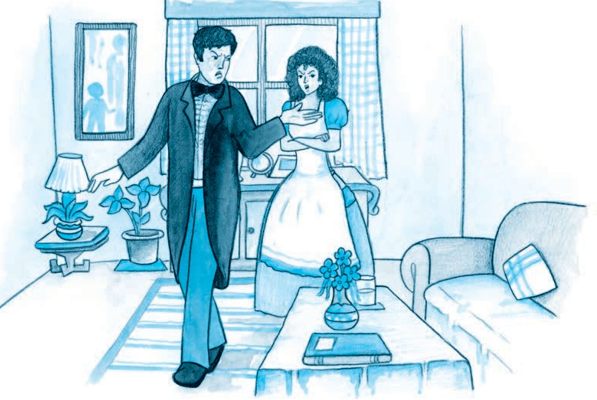
Characters and Meaning
Lomov
- Possessive and argumentative: He repeatedly insists that the Meadows are his and threatens to take the dispute to court.
- Agitated: He shouts, clutches at his heart, and complains of pain and numbness during the quarrel.
Natalya
- Stubborn: She firmly claims the Meadows for her family and refuses to accept Lomov’s account.
- Quick to anger: She threatens to send her mowers and joins in the personal insults when the argument worsens.
Chubukov
- Partisan: He immediately backs Natalya’s claim and challenges Lomov’s right to the land.
- Combative: He joins the quarrel, attacks Lomov’s family, and tells him not to return to the house.
Pride and Petty Quarrels
The characters let pride and possessiveness turn a small land dispute into a fierce personal conflict, exposing the absurdity of their behaviour.
What reasons do Lomov and Natalya give for claiming Oxen Meadows?
How does the argument end?
Quick recap
- Disputed land: Oxen Meadows lie between Natalya’s birchwoods and Burnt Marsh.
- Lomov’s case: He bases his claim on a historical land-use arrangement involving his family and Natalya’s grandfather’s peasants.
- Natalya’s case: She relies on her family’s long-standing belief that the land belongs to them.
- Chubukov: He sides with Natalya and adds his own argument about the disputed land.
- Escalation: Threats and family insults replace calm discussion; Lomov leaves threatening to go to court.
- Main idea: Pride turns a property dispute into an absurd quarrel.
Natalya’s Reaction To The ‘Proposal’ And Fighting Over Dogs
Natalya Learns About the Proposal
- Shock: Chubukov tells Natalya that Lomov had come to propose to her; she is distressed that nobody told her sooner.
- Urgent reaction: She wails, says she is ill and dying, and insists that Lomov be brought back. Chubukov fetches him.
- Reconciliation: Natalya apologises and agrees that Oxen Meadows belong to Lomov, who says he argued on principle.
The Quarrel over Guess and Squeezer
- Topic shift: Natalya changes the subject to hunting. Lomov mentions that his dog Guess has gone lame and that he paid 125 roubles for him.
- Competing claims: Natalya says Squeezer, bought by her father for 85 roubles, is much better. Lomov argues that Squeezer is overshot, meaning its lower jaw is shorter than its upper jaw.
- Insults and evidence: Natalya praises Squeezer’s pedigree and calls Guess old and ugly; Lomov defends Guess and says he would not exchange him for five Squeezers.
- Escalation: They shout and insult each other. Lomov complains that his heart is palpitating, while Natalya refuses to stop arguing.
- Chubukov joins in: He calls Squeezer the district’s best dog but criticises Guess as old and short-muzzled. Lomov recalls Guess keeping pace with the Count’s dog, while Chubukov says Squeezer was left behind because the Count’s whipper-in hit him with a whip.
- Further accusation: Lomov claims Squeezer began worrying a sheep while the dogs were chasing a fox; Chubukov denies it. The quarrel continues as Chubukov teases Lomov about what he remembers.
Natalya
- Emotional: She reacts dramatically when she learns of the proposal and urgently asks for Lomov to return.
- Argumentative: She quickly resumes quarrelling, insisting that Squeezer is better than Guess.
Lomov
- Proud and stubborn: He defends his claim to Oxen Meadows on principle and insists that Guess is superior.
- Anxious: He repeatedly complains of palpitations and other physical discomfort during the quarrel.
Chubukov
- Exasperated: He complains about the burden of having a grown-up daughter and the trouble caused by the quarrels.
- Partisan: He supports Squeezer and joins the argument against Lomov’s claims.
Pride and Trivial Quarrels
The characters’ pride turns a marriage proposal visit into repeated disputes over land and dogs. Their fierce arguments about minor matters create the scene’s humour.
How does Natalya react when she learns that Lomov came to propose?
What starts the quarrel over Guess and Squeezer?
Quick recap
- Natalya learns that Lomov came to propose and urgently asks for him to return.
- She apologises and accepts Lomov’s claim to Oxen Meadows.
- A conversation about hunting turns into a dispute over Guess and Squeezer.
- Natalya, Lomov and Chubukov’s pride makes the dog argument increasingly heated.
- Lomov accuses Squeezer of worrying a sheep; Chubukov denies this and blames Squeezer’s delay on the whipper-in’s whip.
- The scene uses trivial disputes and exaggerated reactions for comedy.
Natalya’ Ready For marry
The Argument and Lomov’s Collapse
The Argument and Lomov’s Collapse
- Natalya and Chubukov mock Lomov’s fitness as a hunter. Lomov retaliates by calling Chubukov an intriguer.
- The insults escalate, and Lomov complains of his heart and other pains before collapsing into an armchair.
- Natalya believes he is dead and panics. Chubukov also cries for help, then realises Lomov is recovering.
The Proposal Is Accepted
The Proposal Is Accepted
- Chubukov puts Lomov’s hand into Natalya’s and tells Lomov that Natalya is willing to marry him; he gives them his blessing.
- Lomov is confused at first, but he and Natalya kiss and express happiness. Chubukov feels relieved.
- Almost immediately, Natalya asks Lomov to admit that her dog Squeezer is better than his dog Guess. They start arguing again, while Chubukov calls for champagne.
Characters and Themes
Lomov
- Nervous and physically sensitive; he repeatedly complains of pains and collapses during the quarrel.
- Eager to marry Natalya, yet quickly drawn back into arguing about their dogs.
Natalya
- Strong-willed and quarrelsome; she argues about the dogs even after agreeing to marry Lomov, who proposed to her.
- Shows affection and fear when she thinks Lomov has died, then accepts his proposal.
Chubukov
- Impatient and dramatic during the dispute, but anxious when Lomov appears to be dead.
- Eager to secure the marriage and quickly gives his blessing.
The Comedy of Quarrelsome Relationships
The characters’ petty disputes continue even at a marriage proposal. The immediate return to arguing about the dogs makes the ending comic and suggests that their married life may be just as argumentative.
How does Chubukov bring about the acceptance of the proposal?
What makes the ending of the play comic?
Quick recap
- Natalya and Chubukov ridicule Lomov, and the argument escalates into insults.
- Lomov collapses; Natalya fears he is dead, but he recovers.
- Chubukov announces that Natalya is willing to marry Lomov and blesses the match.
- Lomov and Natalya kiss and say they are happy.
- They soon resume their argument about Guess and Squeezer, ending the play comically.
Exercise
Understanding the Play
Comic Conflict and Character
- Lomov is anxious, status-conscious and argumentative; he praises Natalya’s practical qualities but soon quarrels with her.
- Natalya is assertive and argumentative, yet her urgency to bring Lomov back after learning of his proposal suggests she wants to marry him.
- Chubukov is quick-tempered and shrewd; his warm welcome changes into insults during the disputes.
- Comic effect comes from rapid shifts between marriage talk, petty quarrels and reconciliation.
| Speaker | Description or insult | What it reveals |
|---|---|---|
| Lomov about Natalya | “An excellent housekeeper, not bad-looking, well-educated.” | He considers her a suitable match and notices her practical qualities. |
| Chubukov about Lomov | “Malicious, doublefaced intriguer.” | His temper changes quickly from welcoming Lomov to insulting him. |
| Lomov about Chubukov | He later calls Chubukov an “intriguer.” | The insult is echoed in their quarrel. |
What does Chubukov first suspect Lomov has come for, and is his later affection entirely sincere?
Does Natalya seem to want to marry Lomov?
Language and Pronunciation
Translation and Register
- Translated tone: Affectionate expressions such as “my angel” and “my treasure” may sound unusually extravagant in contemporary English dialogue.
- Formal address: Full names and respectful forms such as “Stepan Stepanovitch” give the dialogue a formal or translated flavour.
- Style contrast: Older or formal expressions can be contrasted with ordinary modern English phrasing; register affects a character’s tone.
| Word | Syllables | Stressed syllable |
|---|---|---|
| palpitations | 4 | 3rd |
| interfere | 3 | 3rd |
| implore | 2 | 2nd |
| thoroughbred | 3 | 1st |
| pedigree | 3 | 1st |
| principle | 3 | 1st |
| evidence | 3 | 1st |
| misfortune | 3 | 2nd |
| malicious | 3 | 2nd |
| embezzlement | 4 | 2nd |
| architect | 3 | 1st |
| neighbours | 2 | 1st |
| accustomed | 3 | 2nd |
| temporary | 4 | 1st |
| behaviour | 3 | 2nd |
| documents | 3 | 1st |
| Phrase | Meaning |
|---|---|
| You may take it that | You may assume or understand that something is true. |
| He seems to be coming round | He seems to be changing his mind or becoming agreeable. |
| My foot’s gone to sleep | My foot has become temporarily numb or tingling. |
Reported Speech
Direct speech — The exact words spoken by someone, usually enclosed in quotation marks.
Reported speech — A way of conveying someone’s words without repeating them exactly; it usually has a reporting clause and a reported clause.
| Direct speech | Reported speech |
|---|---|
| Statements: “I am tired.” | Use said (that): He said that he was tired. |
| Yes/no questions | Use asked if/whether; change to statement word order. |
| Wh-questions | Keep the question word, but use statement word order. |
| Simple present | Usually changes to simple past when the reporting verb is past. |
| Present perfect | Usually changes to past perfect: “Why haven’t you been here?” → she asked why he hadn’t been there. |
| Present continuous | Usually changes to past continuous: “I am getting…” → he was getting… |
| Simple past | Usually changes to past perfect: “I went…” → she had gone… |
| Pronouns and time/place words | Change to fit the speaker, listener and context: here → there; today → that day; this → that. |
| Respectful wording | Use an adverb such as respectfully in the reporting clause when appropriate. |
Key Rules
- Reporting clause names the speaker and reporting verb, such as “Lomov asked”; the reported clause conveys the words.
- Statements commonly use said or declared; reported questions use asked or another suitable verb.
- Yes/no questions take if or whether; reported questions use subject–verb word order.
- Backshift is common after a past reporting verb; pronouns change according to who is reporting and who is addressed.
- Modal and place/time words often shift: will → would, may → might, here → there and today → that day.
Do not keep question word order in reported questions: write “She asked where he was,” not “She asked where was he.”
Speaking, Writing and Word Play
Discussion Ideas
- Anger management: Anger can harm relationships and lead to rash words or decisions; pausing, listening and speaking calmly can help. Anger can also signal injustice and motivate constructive action when controlled.
- Marriage partner: Consider kindness, tolerance, shared values, attitudes to money, ambition, humour and compatibility—not appearance alone.
- Tagore excerpt: Bimala urges the removal of foreign goods for the country; the narrator objects to forcing traders. Their exchange contrasts patriotic aims with personal freedom.
- Romantic comedy: The proposal, misunderstandings, quarrels and sudden reconciliations resemble familiar romantic-comedy scenes.
| Word | Meaning or pronunciation |
|---|---|
| too / to | Homophones: too means ‘also’ or ‘excessively’; to marks direction or an infinitive. |
| close / close | Same spelling, different pronunciation and meaning: close /kloʊs/ means ‘near’; close /kloʊz/ means ‘shut’. |
| present | As a noun, present can mean a gift; as a verb, it means to show or give, with a different stress pattern. |
Quick recap
- The play’s humour grows from quarrels, insults and sudden changes of mood.
- Lomov praises Natalya as an excellent housekeeper; Chubukov and Lomov trade accusations of being intriguers.
- Chubukov first suspects Lomov wants to borrow money; Natalya’s reaction shows she wants the proposal.
- Direct speech gives a speaker’s exact words; reported speech conveys them through reporting and reported clauses.
- Reported speech often changes tense, pronouns and time or place words; reported questions use statement word order.
- Pronunciation practice focuses on syllable count and word stress; the phrases have idiomatic meanings.
- Word play may use homophones or the same spelling with different meanings and pronunciations.
English — ALL CHAPTERS
1
A Letter To God
2
Nelson Mandela Long Walk To Freedom
3
Two Stories About Flying
4
From The Diary Of Anne Frank
5
Glimpses Of India
6
Mijbil The Otter: Gavin Maxwell
7
Madam Rides The Bus
8
The Sermons At Benares
9
The Proposal
1
A Triumph of Surgery
2
The Thief’s Story
3
The Midnight Visitor
4
A Question of Trust
5
Footprints without Feet
6
The Making of a Scientist
7
The Necklace
8
Bholi
9
The Book That Saved the Earth