SOLUTIONS
2023 BOARD EXAM
CBSE Class 12 Humanities Geography Board Paper 2023 — Set 1 Solutions
2023
Geography
Class 12 Humanities
CBSE EXAMINATION PAPER-2023
GEOGRAPHY
(Solved)
General Instructions :
Read the following instructions carefully and follow them :
- This question paper contains 34 questions. All questions are compulsory.
- This question paper is divided into 4 sections.
- Section A – questions number 1 to 4 are case based questions
- Section B – questions number 5 to 21 are multiple choice questions
- Section C – questions number 22 to 27 are short answer
- Section D – questions number 28 to 34 are long answer
- There is no overall choice given in the question paper. However, an internal choice has been provided in few questions.
- Use of calculator is NOT allowed.
Section A
Read the given passage carefully and answer the questions that follow:
When you fall ill you go to your family doctor or you call a doctor. Sometimes your parents take you to a hospital for treatment. While in school, you are taught by your teachers. In the event of any dispute, legal opinion is obtained from a lawyer. Likewise, there are many professionals who provide their services against payment of their fee. Thus, all types of services are special skills provided in exchange of payments. Health, education, law, governance and recreation etc. require professional skills. These services require other theoretical knowledge and practical training. Tertiary activities are related to the service sector. Manpower is an important component of the service sector as most of the tertiary activities are performed by skilled labour, professionally trained experts and consultants.
In the initial stages of economic development, larger proportion of people worked in the primary sector. In a developed economy, the majority of workers get employment in tertiary activity and a moderate proportion is employed in the secondary sector.
(1) Explain the main difference between secondary and tertiary activities.
[1 Mark](2) Mention any two tertiary activities.
[1 Mark](3) How have tertiary activities related both production and exchange?
[1 Mark]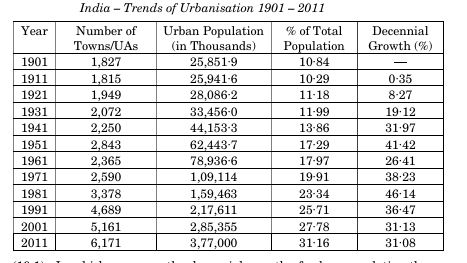
(1) In which year was the decennial growth of urban population the highest in India?
[1 Mark](2) How much was the total urban population in the year 2001?
[1 Mark](3) How much was the total growth of number of towns between the years 1901 to 2011 in India?
[1 Mark](4) Explain any three characteristics of urban settlements in India.
On the given political outline map of the World, seven geographical features have been marked as A, B, C, D, E, F and G. Identify any five with the help of the following information and write their correct names on the lines drawn near them :
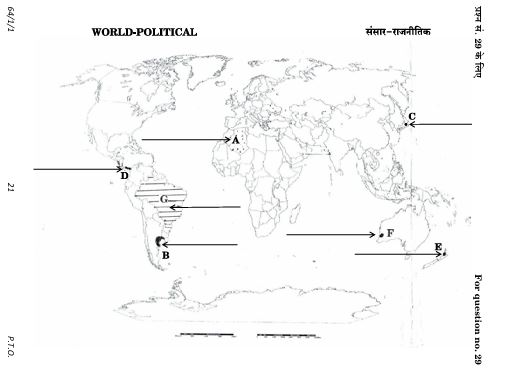
(1) The largest country in Africa
(2) The westernmost station of the Australian Trans-Continental Railway
(3) The largest country in South America
(4) An international airport
(5) An area of extensive commercial grain farming
(6) Which is the largest country in Africa ?
(7) A shipping canal
(8) A major seaport
(9) Name the canal that connects Red Sea to Mediterranean Sea.
(10) Name the canal that connects the Atlantic Ocean to the Pacific Ocean in the West.
(11) Name an area of extensive commercial grain farming in Argentina.
(12) Name a major airport of New Zealand.
(13) Name any one major seaport in Japan.
(14) Name the largest country in South America.
On the given political outline map of India, locate and label any five of the following seven geographical features with appropriate symbols :
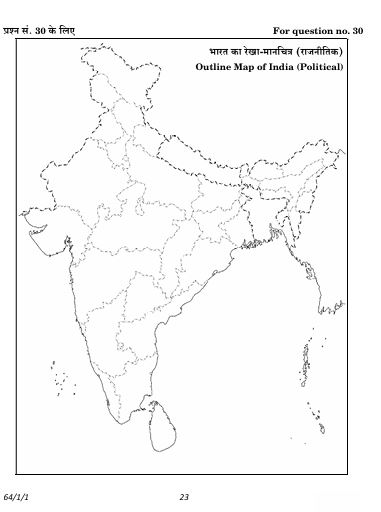
(1) Oil Refineries located in Uttar Pradesh
(2) The state with highest density of population
(3) The easternmost city of India having more than 10 million population
(4) Coal mines located in Tamil Nadu
(5) Name the state of India with highest density of population.
(6) In which place of Uttar Pradesh are oil refineries located ?
(7) In what state are the Khetri copper mines located ?
(8) In which state is Tuticorin seaport located ?
(9) International Airport located in Punjab
(10) Name the leading cotton producing state.
(11) Major seaport located in Odisha
(12) In which place is the international airport of Punjab located ?
(13) Name the easternmost city of India having more than 10 million population.
(14) The leading cotton producing state
Section B
Which one of the following factors is an economic factor affecting the distribution of population in the world?
Which approach of 'human development' was proposed by the International Labour Organisation (ILO) ?
Read the following statements regarding objectives of family planning and choose the correct option:
I. Control the birth rate
II. Spacing the birth of children
III Improving women's health.
IV. Reducing the death rate of children
Which one of the following countries has the highest rank in Human Development Index?
Study the following statements and choose the correct option:
Statement I : With the digitisation of information, telecommunication slowly merged with computers. Statement II : It resulted in integrated networks termed as Internet.
Which one of the following states has the highest population growth rate during 2001 to 2011 decade?
The port designed to receive petroleum, petroleum products and fertilizers is:
The correct answer is Haldia. According to the provided context, Haldia Port is specifically mentioned to handle bulk cargo such as iron ore, coal, petroleum, petroleum products, and fertilizers, making it suitable for this purpose.
Match Column I with Column II and choose the correct option:
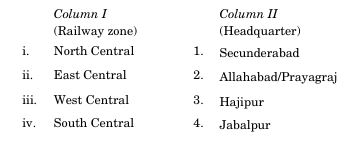
The correct option is 'i 1, ii 2, iii 3, iv 4' because it matches the questions related to the identification of patterns (1 - Primary), the distribution of features (2 - Secondary), and so on, consistent with the context provided about occupational categories and demographic studies.
Read the case study given below and answer
Ramesh has been working in contract as a welder on a construction site in Talcher (coal region of Odisha) for the last two years. He moved with the contractor to various places like Surat, Mumbai, Gandhi Nagar, Bharuch, Jamnagar and so on. He remits 20,000 per year to his father in his native village. The remittances have been mainly used for daily consumption, healthcare, schooling of children, etc. Part of the money is also used in agriculture, purchasing of land and building of houses, etc. The standard of living of Ramesh's family improved significantly.
Fifteen years ago, the situation was not the same. The family was passing through very tough times. Three of his brothers and their families had to survive on three acres of land. The family was highly in debt. Ramesh had to discontinue his studies after ninth standard. He was further hard pressed when he got married.
Simultaneously, he was also impressed by some successful out-migrants of his village who had been working in Ludhiana and supporting their families in the village by sending money and some consumer goods. Thus, due to abject poverty in the family and perceived job promises at Ludhiana, he made a move to Punjab with his friend. He worked there in a woolen factory for six months at the rate of only 20 per day in 1988. Apart from the crisis of managing his personal expenditure from this meagre income, he was also facing difficulty in assimilation to the new culture and environment. Then he decided to change his place of work from Ludhiana to Surat under the guidance of his friend. He learnt the skills of welding in Surat and after that he has been moving to different places with the same contractor. Though the economic condition of Ramesh's family at the village improved, he is bearing the pain of separation of his near and dear ones. He cannot shift them with him, as the job is temporary and transferable.
Which one of the following is the demographic consequence of rural-urban migration?
Read the case study given below and answer
Ramesh has been working in contract as a welder on a construction site in Talcher (coal region of Odisha) for the last two years. He moved with the contractor to various places like Surat, Mumbai, Gandhi Nagar, Bharuch, Jamnagar and so on. He remits 20,000 per year to his father in his native village. The remittances have been mainly used for daily consumption, healthcare, schooling of children, etc. Part of the money is also used in agriculture, purchasing of land and building of houses, etc. The standard of living of Ramesh's family improved significantly.
Fifteen years ago, the situation was not the same. The family was passing through very tough times. Three of his brothers and their families had to survive on three acres of land. The family was highly in debt. Ramesh had to discontinue his studies after ninth standard. He was further hard pressed when he got married.
Simultaneously, he was also impressed by some successful out-migrants of his village who had been working in Ludhiana and supporting their families in the village by sending money and some consumer goods. Thus, due to abject poverty in the family and perceived job promises at Ludhiana, he made a move to Punjab with his friend. He worked there in a woolen factory for six months at the rate of only 20 per day in 1988. Apart from the crisis of managing his personal expenditure from this meagre income, he was also facing difficulty in assimilation to the new culture and environment. Then he decided to change his place of work from Ludhiana to Surat under the guidance of his friend. He learnt the skills of welding in Surat and after that he has been moving to different places with the same contractor. Though the economic condition of Ramesh's family at the village improved, he is bearing the pain of separation of his near and dear ones. He cannot shift them with him, as the job is temporary and transferable.
The main cause of rural-urban migration in India?
Read the case study given below and answer
Ramesh has been working in contract as a welder on a construction site in Talcher (coal region of Odisha) for the last two years. He moved with the contractor to various places like Surat, Mumbai, Gandhi Nagar, Bharuch, Jamnagar and so on. He remits 20,000 per year to his father in his native village. The remittances have been mainly used for daily consumption, healthcare, schooling of children, etc. Part of the money is also used in agriculture, purchasing of land and building of houses, etc. The standard of living of Ramesh's family improved significantly.
Fifteen years ago, the situation was not the same. The family was passing through very tough times. Three of his brothers and their families had to survive on three acres of land. The family was highly in debt. Ramesh had to discontinue his studies after ninth standard. He was further hard pressed when he got married.
Simultaneously, he was also impressed by some successful out-migrants of his village who had been working in Ludhiana and supporting their families in the village by sending money and some consumer goods. Thus, due to abject poverty in the family and perceived job promises at Ludhiana, he made a move to Punjab with his friend. He worked there in a woolen factory for six months at the rate of only 20 per day in 1988. Apart from the crisis of managing his personal expenditure from this meagre income, he was also facing difficulty in assimilation to the new culture and environment. Then he decided to change his place of work from Ludhiana to Surat under the guidance of his friend. He learnt the skills of welding in Surat and after that he has been moving to different places with the same contractor. Though the economic condition of Ramesh's family at the village improved, he is bearing the pain of separation of his near and dear ones. He cannot shift them with him, as the job is temporary and transferable.
Which one of the following is the meaning of remittance?
Which among the following is related to 'truck farming,?
Which among the following is the largest region of 'commercial dairy farming'?
Read the given resources and choose the correct option related to 'community's resources':
I. Village water bodies
II. Village agriculture land
III. Village residential land
IV. Pasture land
Section C
"Human being were able to develop technology after they developed better understanding of natural laws." Evaluate the statement in the context of naturalization of humans.
"The imprints of human activities are created everywhere." Evaluate the statement in context of humanization of nature.
Describe the objective of 'National Mission for Sustainable Agriculture (NMSA) in the development of Indian agriculture.
Mention the main characteristics of the mineral belt of 'South-Western Plateau Region' of India.
Mention the main characteristics of mineral belt of 'North-Western Region' of India.
Section D
"Pipelines are used extensively to transport liquids and gases in the world." Support the statement with appropriate arguments.
Define the term 'international trade'. Describe two types of 'international trade' in the world.
" Attaining sustainable development in the Indira Gandhi Canal (Nahar)
Command area requires major thrust upon the measure to achieve ecological sustainablity," Evaluate the statement.
"India has one of the second largest road networks in the world.''
Support the statement.
India has one of the second largest road networks in the world after the United States. The total length of roads in India is about 6.3 million kilometres, which connects almost all parts of the country. Roads carry nearly 85% of passenger traffic and about 65% of freight traffic. The road network consists of National Highways, State Highways, district roads and rural roads, which link villages with towns and cities. This extensive network plays an important role in the transportation of people and goods. It also promotes trade, industry, regional development and national integration. Hence, the statement is justified that India has one of the second largest road networks in the world.
The total length of roads in India is about 6.3 million kilometres.
India has the second largest road network in the world after the USA.
Roads carry nearly 85% of passenger traffic in the country.
About 65% of freight and goods are transported through roads.
The network includes National Highways, State Highways, district roads and rural roads.
Roads connect rural areas with urban centres.
Road transport supports trade, industry and economic development.
"Indian Railways network is one of the longest in the world."
Support the statement.
Indian Railways network is one of the longest in the world. The total length of railway lines in India is about 68,000 kilometres, which makes it one of the largest railway systems globally. Indian Railways carries millions of passengers every day and transports huge quantities of goods such as coal, food grains and industrial raw materials. It connects remote villages with towns and major cities, thus promoting national integration. Indian Railways is also one of the biggest employers in the world. It plays a vital role in trade, tourism and economic development. Hence, the statement is justified that Indian Railways network is one of the longest in the world.
The total length of Indian Railways network is about 68,000 kilometres.
It is among the largest and longest railway networks in the world.
Indian Railways carries millions of passengers daily.
It transports large quantities of goods and raw materials.
It connects remote rural areas with major cities.
It is one of the largest employers in the world.
It plays an important role in economic and industrial development
Paper Details
CBSE Board Exam 2023
Class
Class 12 Humanities
Subject
Geography
Year
2023
Set
Set 1
Other Years — Geography