Section B
[1 Mark]
-
(A) Quaternary
-
(B) Tertiary
-
(C) Primary
-
(D) Secondary
Explanation: The correct answer is 'Quaternary' because the Quaternary Sector focuses on knowledge-based services, including the consumption of information-related services. This sector is characterized by activities involving the collection, production, and dissemination of information, which aligns with the context provided.
[1 Mark]
-
(A) Mahbub-ul-Haq
-
(B) Ehrlich
-
(C) Amartya Sen
-
(D) Meadows
Explanation: Amartya Sen is the correct answer because he identified an increase in freedom (or decrease in unfreedom) as the main objective of development, emphasizing the importance of freedoms in human development.
[1 Mark]
-
(A) Thomas Malthus
-
(B) Brundtland
-
(C) Griffith Taylor
-
(D) Walter Burley Griffin
Explanation: The correct answer is Thomas Malthus. He proposed in his theory (1798) that population growth would outpace food supply, leading to potential crises such as famine, disease, and war if unchecked.
[1 Mark]
-
(A) Only I, III and IV are correct.
-
(B) Only II, III and IV are correct.
-
(C) Only I, II and III are correct.
-
(D) Only I, II and IV are correct.
Explanation: Only II, III and IV are correct because tertiary activities primarily involve the provision of services rather than the processing of physical raw materials, which is characteristic of secondary activities. The correct points highlight that tertiary activities output services (II), include many specialised services (III), and cite relevant examples (IV). Point I is incorrect as it describes secondary activities.
[1 Mark]
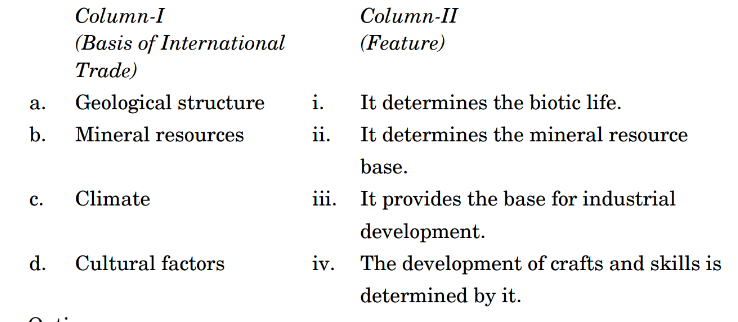
-
(A) a ii, b iii, c iv, d i
-
(B) a iii, b ii, c i, d iv
-
(C) a ii, b iii, c i, d iv
-
(D) a iii, b ii, c iv, d i
Explanation: The correct option that matches the columns accurately is 'a ii, b iii, c iv, d i'. This means that the descriptions and terms in Column-I correspond to their definitions or explanations in Column-II. Each item is matched based on the context provided, ensuring each definition aligns with its corresponding concept.
[1 Mark]
-
(A) Only I, II and IV are correct.
-
(B) Only I, II and III are correct.
-
(C) Only I, III and IV are correct.
-
(D) Only II, III and IV are correct.
Explanation: The correct option is 'Only I, II and IV are correct.' This is because outsourcing generally involves cheap and skilled workers (I), good English language skills (II) which are essential for effective communication in call centers, and a focus on providing customer support and call center services (IV). However, 'III. Highly-skilled well-paid professionals' is not typically associated with the outsourcing context described, as outsourcing often leverages lower-cost labor rather than high-paying professional jobs.
[1 Mark]
-
(A) Goods selling
-
(B) Goods purchasing
-
(C) Goods dumping
-
(D) Goods exchanging
Explanation: Goods dumping is a disadvantage of free trade for developing countries because dumped goods, which are often sold at lower prices, can harm local producers by undercutting their prices. This creates an uneven playing field where domestic industries struggle to compete against cheaper imported goods, leading to negative impacts on the economy.
[1 Mark]
-
(A) Central Government
-
(B) Madhya Pradesh Government
-
(C) Jhabua District Administration
-
(D) Non-Governmental Organisation
Explanation: The correct answer is 'Central Government' because the context specifies that the watershed management programmes in Jhabua district were funded by both the ministries of 'Rural Development' and 'Agriculture', Government of India. This indicates that the central government played a key role in financing these initiatives.
[1 Mark]
-
(A) 149 countries were its members as of 2016
-
(B) The General Agreement on Tariffs and Trade (GATT) was its predecessor
-
(C) India became its member in 1984
-
(D) Its headquarters is located in New York
Explanation: The correct option is 'The General Agreement on Tariffs and Trade (GATT) was its predecessor.' This is correct because the context states that GATT was formed in 1948 and later transformed into the WTO in 1995 to promote free and fair trade among nations. Other options provided are incorrect regarding membership numbers, India's membership date, and the location of WTO headquarters.
[1 Mark]
-
(A) Both (A) and (R) are true and (R) is the correct explanation of (A).
-
(B) Both (A) and (R) are true, but (R) is not the correct explanation of (A).
-
(C) (A) is correct, but (R) is incorrect.
-
(D) (A) is incorrect, but (R) is correct.
Explanation: Both (A) and (R) are true, but (R) is not the correct explanation of (A). Assertion (A) is true as slum settlements typically lack basic necessities. Reason (R) is also true as the Swachh Bharat Mission was launched to improve the quality of life in urban slums. However, the reason does not specifically explain why slum settlements lack necessities; rather, it is an initiative aimed at addressing those issues.
[1 Mark]
-
(A) Nagpur Plan
-
(B) North-South Corridor Plan
-
(C) Golden Quadrilateral Plan
-
(D) Twenty-Year Road Plan
Explanation: The correct answer is the 'Golden Quadrilateral Plan'. This plan involves the construction of a 5,846-km long high-density traffic corridor that connects India's four major metropolitan cities: Delhi, Mumbai, Chennai, and Kolkata. The purpose of this plan is to improve road conditions and minimize the time, distance, and cost of movement between these cities, thereby enhancing road infrastructure in India.
[1 Mark]
-
(A) I, IV, III, II
-
(B) II, I, III, IV
-
(C) I, IV, II, III
-
(D) II, I, IV, III
Explanation: The correct order from oldest to newest based on their evolution is Varanasi (II), Lucknow (I), Jamshedpur (IV), and Bhilai (III). Varanasi is one of the oldest towns with a history spanning over 2000 years, recognized as a significant religious and cultural center. Lucknow has a historical presence but is comparatively newer than Varanasi. Jamshedpur was established in the early 20th century (after 1850), making it newer than both Lucknow and Varanasi. Bhilai, an industrial town developed after independence, is even more recent than Jamshedpur.
[1 Mark]
-
(A) Salem
-
(B) Chandigarh
-
(C) Shillong
-
(D) Nainital
Explanation: The correct answer is Salem. The relevant context identifies Salem as an industrial town, specifically mentioning that it, along with cities like Mumbai and Coimbatore, constitutes a prime motive force of industrial activity, unlike the other options, which are primarily recognized as administrative towns.
[1 Mark]
-
(A) Garrison - Kandla
-
(B) Mining - Singrauli
-
(C) Transport - Modinagar
-
(D) Administrative - Pilani
Explanation: The correct option is 'Mining - Singrauli'. According to the provided context, mining towns have developed in mineral-rich areas such as Singrauli. The other options do not match correctly with their respective categories.
[1 Mark]
-
(A) Regional and Systematic
-
(B) Regional and Systematic
-
(C) Determinism and Possibilism
-
(D) Nature and Human
-
(E) Possibilism and Neo-determinism
-
(F) Nature and Human
-
(G) Possibilism and Neo-determinism
-
(H) Determinism and Possibilism
Explanation: The correct option is 'Nature and Human' because the context emphasizes the integrated study of the physical environment and human activities. It states that human beings are an integral part of nature and that their interactions shape both the environment and cultural development. Therefore, understanding geography requires an inseparable relationship between 'Nature and Human'.
[1 Mark]
-
(A) Earth as home of plant kingdom
-
(B) Earth as home of landforms
-
(C) Earth as home of animal world
-
(D) Earth as home of human beings
Explanation: The correct option is 'Earth as home of human beings' because the context explicitly states that the core concern of geography is to understand the earth as the home of human beings and to study all elements that sustain them. This highlights the relationship between human beings and their physical environment.
[1 Mark]
-
(A) Better understanding of natural laws
-
(B) Invention of fire
-
(C) Invention of wheel
-
(D) Better interaction with nature by advanced technology
Explanation: The correct option is 'Better understanding of natural laws' because the context emphasizes that human beings developed technology after they gained a better understanding of natural laws. This understanding was crucial for the advancement of technology, which is integral to cultural development and the interaction between humans and their physical environment.
Section C
[3 Marks]
Answer: To address water pollution in India, several measures need to be implemented effectively. First, there should be strict enforcement of laws and policies to prevent industrial discharge into water bodies. Awareness campaigns utilizing social media, TV, and print can educate the public about the impacts of pollution. Promoting watershed development, rainwater harvesting, and water recycling would enhance water quality and availability. Additionally, initiatives like the Namami Gange Programme aim to rejuvenate polluted rivers through cleanup efforts and community involvement. Through these combined strategies, the battle against water pollution can be significantly strengthened.
Key Points: Strict enforcement of laws and policies; Awareness campaigns on pollution; Promotion of watershed development and rainwater harvesting; Implementation of water recycling; Namami Gange Programme for river rejuvenation; Community involvement in pollution control measures.
[3 Marks]
Answer: The Bharatmala Project is a comprehensive initiative aimed at enhancing road connectivity across India. It focuses on the development of state roads along coastal and border areas, improving access to non-major ports. Key features include the connectivity program for backward areas and religious tourist locations, the Setubharatam Pariyojana, which plans to construct about 1,500 major bridges and 200 rail over and under bridges. Additionally, Bharatmala emphasizes the District Headquarters connectivity scheme, targeting the development of approximately 9,000 km of newly declared National Highways, and incorporates the Golden Quadrilateral and North-South/East-West corridors to boost intercity travel efficiency.
Key Points: Development of state roads along coastal areas-Connectivity to non-major ports-Setubharatam Pariyojana for bridge construction-District Headquarters connectivity scheme-Construction of 9,000 km of National Highways-Golden Quadrilateral and North-South/East-West corridors
[3 Marks]
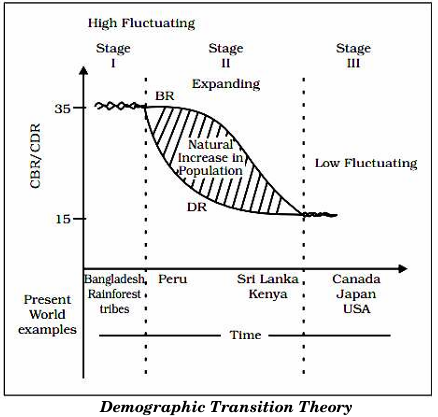
Answer: Demographic Transition Theory (DTT) outlines the transition of a population from high birth and death rates to low birth and death rates as it develops. This process occurs in four stages: 1) pre-transition with high rates, 2) mortality decline with rising births, 3) population growth as death rates drop significantly, and 4) post-transition where both rates stabilize at low levels. Modern societies, characterized by urbanization and literacy, emphasize family planning, contributing to reduced fertility rates. As different countries experience these stages variably, DTT serves as a valuable tool for understanding population dynamics and predicting future growth.
Key Points: Stages of population transition - High birth/death rates initially - Steady decline in mortality and rising birth rates - Population growth during the transition - Urbanization and literacy impact fertility - Family planning becomes significant - Variations among countries in stages of transition
[3 Marks]
Answer: Kolkata Port, situated on the Hugli River and 128 km from the Bay of Bengal, is one of the oldest ports in India, developed during the British era. It has faced significant challenges, such as silt accumulation in the Hugli River, which affects its accessibility. The port serves as a crucial link to several states, including Uttar Pradesh, Bihar, Jharkhand, West Bengal, Sikkim, and the northeastern states. Additionally, it extends its services to landlocked countries like Nepal and Bhutan, enhancing regional trade. Due to competition from other ports like Vishakhapatnam and Paradip, Kolkata’s significance has declined, prompting the establishment of Haldia Port to alleviate congestion.
Key Points: Located on Hugli River-128 km from Bay of Bengal-Oldest port in India-Serves U.P., Bihar, Jharkhand, West Bengal, Sikkim, north-eastern states-Extends services to Nepal and Bhutan-Silt accumulation issue-Declining significance due to other ports-Haldia Port established to reduce congestion
[3 Marks]
Answer: Mumbai Sea Port, the largest port in India, is strategically located near key international shipping routes from regions including the Middle East and North Africa. It features a natural harbor that is approximately 20 km long and 6-10 km wide, boasting 54 berths and the country's largest oil terminal. Its hinterland is expansive, covering parts of Maharashtra, Gujarat, Madhya Pradesh, Uttar Pradesh, and Rajasthan, although the boundaries of this hinterland can overlap with those of other ports, such as Jawaharlal Nehru Port at Nhava Sheva, which functions as a satellite port designed to alleviate congestion at the Mumbai port. This makes Mumbai an integral hub for trade and commerce in India, serving as the main conduit for overseas trade.
Key Points: Mumbai Sea Port is the largest port in India; located near major shipping routes; natural harbor with 54 berths; hinterland includes Maharashtra, Gujarat, M.P., U.P., Rajasthan; boundaries overlap with other ports; Jawaharlal Nehru Port alleviates pressure on Mumbai.
Section D
[5 Marks]
Answer: The agricultural sector in India faces numerous challenges that hinder its growth and development, stemming from both physical and institutional constraints. Firstly, land degradation and fragmentation are significant problems, as overexploitation and urbanization reduce arable land availability. Secondly, water scarcity, exacerbated by erratic rainfall and poor irrigation facilities, affects crop production. Thirdly, underemployment is prevalent, especially in unirrigated regions, leading to seasonal unemployment and insufficient labor opportunities. Fourthly, lack of commercialisation restricts many farmers to subsistence farming, failing to generate sufficient income. Lastly, weak institutional support, including inadequate access to credit and technology, further impedes agricultural productivity. These problems collectively reflect the urgent need for sustainable agricultural policies to ensure food security and enhance the livelihood of millions dependent on agriculture.
Key Points: Land degradation and fragmentation; Water scarcity and poor irrigation; Underemployment in agriculture; Lack of commercialisation; Weak institutional support
[5 Marks]
Answer: Plantation agriculture is characterized by large-scale production of specific crops, primarily in tropical regions. It involves extensive landholding known as estates, where single crop specialization is the norm. Key features include significant capital investment and scientific cultivation methods that enhance productivity. Additionally, plantation agriculture relies on cheap labor and efficient transportation systems for the export of goods. Historically, it was established by European colonizers seeking profit, which has shaped economies in many tropical countries. Important crops include tea, coffee, cocoa, and rubber, among others. The model is often likened to factory production due to its methodical approach, making it a staple in global agriculture.
Key Points: Large estates;Single crop specialization;Significant capital investment;Scientific methods of cultivation;Reliance on cheap labor;Efficient transportation systems for export;Profit-oriented;Introduced by Europeans in colonies;Key crops include tea, coffee, cocoa, rubber.
[5 Marks]
Answer: Nomadic herding, also known as pastoral nomadism, is a subsistence lifestyle where communities rely on livestock for their primary needs, including food, clothing, shelter, and transport. This practice is characterized by the seasonal movement of herders and their animals to find adequate pastures and water sources. Different regions practice nomadic herding based on their environmental conditions. For instance, in tropical Africa, cattle are key livestock, while sheep, goats, and camels thrive in the Sahara and desert areas. Communities such as the Gujjars and Bakarwals in the Himalayas practice transhumance, moving between the plains and mountains according to seasonal changes. Furthermore, nomadic herding is prominent in areas like Mongolia and Central China, the tundra region of Eurasia, and also the Arctic where reindeer herding prevails. This lifestyle is deeply rooted in tradition, as each community maintains its territory and practices, and the number of pastoral nomads has been declining due to modernization and environmental changes, threatening the survival of this unique way of life.
Key Points: Dependence on livestock for basic needs; Seasonal movement based on pasture and water availability; Variations in livestock by region; Communities like Gujjars and Bakarwals practicing transhumance; Key areas include Mongolia, tundra regions, and the Arctic; Threats due to modernization and environmental changes.
[5 Marks]
Answer: Industries can be classified based on the raw materials used to produce goods. One category is agro-based industries, which rely on agricultural products, such as sugar and cotton industries. Another classification is mineral-based industries that utilize minerals; for instance, the iron and steel industries, which use ferrous minerals, or the cement industry, which employs non-metallic minerals. Chemical-based industries use various chemicals as inputs, like the petrochemical industry that relies on petroleum, while the forest-based industries focus on wood products, such as timber and paper. Lastly, animal-based industries involve products derived from animal sources, like dairy or leather industries. Each of these industries plays a vital role in the economy, contributing to different sectors and employment opportunities.
Key Points: 1. Agro-based industries use agricultural products; examples include sugar and cotton industries. 2. Mineral-based industries utilize minerals; iron and steel are examples of ferrous, while cement represents non-metallic. 3. Chemical-based industries rely on natural chemicals like those found in petroleum. 4. Forest-based industries focus on products derived from trees, e.g., timber and paper. 5. Animal-based industries involve animal products such as dairy and leather.
[5 Marks]
Answer: The Jal Kranti Abhiyan, launched in 2015-16 by the Government of India, aims primarily at ensuring water security across the nation. One major objective is to involve local bodies, NGOs, and citizens in raising awareness about water conservation. The initiative focuses on creating Jal Grams in water-stressed villages, identifying model command areas to enhance water management, and promoting sustainable practices. Another key aspect is pollution abatement in water bodies. The campaign also emphasizes the utilization of mass media for awareness, thereby encouraging community participation in achieving overall water security, which significantly impacts food and livelihood security.
Key Points: Involvement of local bodies and citizens- Creation of Jal Grams in water-stressed regions- Identification of model command areas for effective water management- Pollution abatement efforts- Creation of mass awareness through media- Promotion of traditional knowledge in water conservation
[5 Marks]
Answer: Rainwater harvesting in India incorporates various traditional and modern methods aimed at capturing and utilizing rainwater effectively. One method involves watershed management, where rainwater is collected in natural or artificial reservoirs, enhancing groundwater recharge. Another method utilizes lakes (known as Eris), which serve as effective storage for harvested rainwater. Recharge wells are also popular, designed to direct rainwater into aquifers directly, promoting groundwater replenishment. Services wells, found in coastal areas, can also be used for aquifer recharge. In rural regions, particularly in Rajasthan, structures like Kund or Tanka are built to store water, representing local adaptations of rainwater harvesting. Overall, these methods help conserve water resources, reduce dependency on groundwater, and ensure sustainable water availability for communities.
Key Points: Watershed management; Lakes (Eris) for surface storage; Recharge wells for aquifer replenishment; Services wells in coastal areas; Traditional structures like Kund/Tanka in Rajasthan; Benefits: conserving water, reducing groundwater dependency, promoting sustainability.
[5 Marks]
Answer: The population growth in India from 1991 to 2001 reveals significant regional variations across different states and union territories. States like Kerala, Karnataka, and Tamil Nadu exhibited low growth rates, with Kerala having the lowest at 9.4%. In contrast, states with higher growth rates were typically those experiencing urbanization and economic growth. Urban areas, which constituted only 31.16% of the population, have seen faster growth due to improvements in health, hygiene, and economic opportunities. Furthermore, migration patterns also influenced regional population changes, with many rural individuals moving to urban areas for better prospects. Social factors, such as education and healthcare access, further contributed to these disparities in growth rates. Examining the data from 2001 to 2011 would show whether these trends continued or shifted, revealing the dynamic nature of India's demographic landscape.
Key Points: Regional variations in population growth; Low growth states: Kerala, Karnataka, Tamil Nadu; Kerala's growth rate at 9.4%; High growth due to urbanization; Urban population's growth rate; Influences of migration; Social factors affecting growth rates.
[5 Marks]
Answer: India's population distribution is notably uneven due to several interrelated factors. Firstly, physical geography plays a crucial role; regions with fertile soil and favorable climate, such as the Gangetic plains, attract denser populations, while arid areas, like the Thar Desert, have sparse populations. Secondly, socio-economic factors contribute significantly; urban areas provide better job opportunities and amenities, resulting in migration from rural to urban settings. Thirdly, historical factors like colonial settlement patterns have influenced regional development, leading to population concentration in developed areas. Additionally, political stability and infrastructure development attract populations; states with better governance and transport facilities, such as Maharashtra and Gujarat, experience growth. Finally, cultural factors such as religious sentiments and social structures lead to population clustering in specific regions, as seen in areas with significant religious significance. Each of these factors intertwines, resulting in the complex demographic landscape of India.
Key Points: 1. Physical geography - fertile regions attract more population; 2. Socio-economic factors - urban migration for job opportunities; 3. Historical influences - colonial settlement patterns create population centers; 4. Political and infrastructural development - states with better governance experience growth; 5. Cultural factors - population clustering around religious and social communities.
[5 Marks]
Answer: Industries seek to maximize profits by minimizing production costs, which can be achieved through strategic location choices. For instance, a cement factory often locates near limestone quarries to reduce transportation costs associated with raw materials. Similarly, dairy processing plants are situated close to milk supply sources to preserve freshness and minimize logistics expenses. By situating industries closer to raw material sources, labor supply, and markets, businesses can efficiently manage their operation, maintain low overhead costs, and efficiently respond to consumer demands. Moreover, industries employing mass production techniques can scale efficiently, as seen in the electronics sector, where factories benefit from specialized labor skilled in repetitive tasks, further driving down costs. Hence, the strategic location and efficient production methods not only enhance profitability but also foster sustainable industrial practices.
Key Points: Minimizing production costs, Strategic location choices, Examples: cement near limestone quarries, dairy factories close to milk sources, advantages of specialized labor, mass production methods.