Section B
[1 Mark]
-
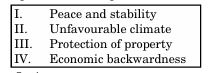
(A) Only I and II are correct.
-
(B) Only II and IV are correct.
-
(C) Only II and III are correct.
-
(D) Only I and III are correct.
Explanation: The correct option is ' Only II and IV are correct.' because pull factors are described in the context as reasons that make a place of destination more attractive. This includes better job opportunities and living conditions (fact II) and social and cultural significance (fact III). Fact I about improved economic and social life is too broad and does not specify pull factors accurately.
[1 Mark]
-
(A) Productivity
-
(B) Empowerment
-
(C) Capability
-
(D) Equity
Explanation: The correct option is 'Capability'. The Capability Approach, associated with Prof. Amartya Sen, emphasizes building human capabilities in health, education, and access to resources as key to increasing human development. This aligns with the given context that outlines various approaches to human development, including the capabilities approach.
[1 Mark]
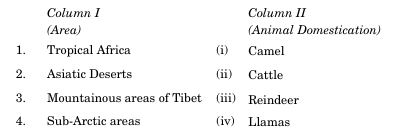
-
(A) 1-(i), 2-(ii), 3-(iv), 4-(iii)
-
(B) 1-(ii), 2-(i), 3-(iii), 4-(iv)
-
(C) 1-(ii), 2-(i), 3-(iv), 4-(iii)
-
(D) 1-(i), 2-(ii), 3-(iii), 4-(iv)
Explanation: Lenders require collateral mainly to mitigate the risk of loan default. If the borrower fails to repay the loan, the lender can seize the collateral to recover some or all of the lost funds, providing a safety net against possible financial risk.
[1 Mark]
-
(A) Both (A) and (R) are true, but (R) is not the correct explanation of (A).
-
(B) (A) is true, but (R) is false.
-
(C) (A) is false, but (R) is true.
-
(D) Both (A) and (R) are true and (R) is the correct explanation of (A).
Explanation: Both (A) and (R) are true, and (R) is the correct explanation of (A). Foot loose industries can be located in various areas as they do not rely heavily on specific raw materials or weight-sensitive costs. While transport accessibility is relevant for their operation, the assertion is true because these industries are flexible in location.
[1 Mark]
-
(A) Primary
-
(B) Tertiary
-
(C) Quaternary
-
(D) Secondary
Explanation: The correct answer is Quaternary. The context states that quaternary activities involve the collection, production, and dissemination of information, indicating that this sector is focused on knowledge-based services and advanced forms of services that utilize specialized knowledge and technical skills.
[1 Mark]
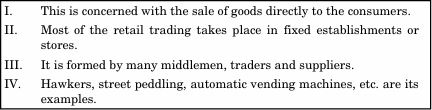
-
(A) Only I, II and III are correct.
-
(B) Only I, II and IV are correct.
-
(C) Only I, III and IV are correct.
-
(D) Only II, III and IV are correct.
Explanation: The correct options are based on the definition and characteristics of retail trading, which is primarily concerned with the sale of goods directly to consumers in various forms, including both store-based and non-store retailing. The characteristics outlined in the question likely involve elements of this definition, thus determining which combinations of the options listed ( I, II III ) accurately reflect the key features of retail trading.
[1 Mark]
-
(A) Iran to India via Pakistan
-
(B) Iran to China via Afghanistan
-
(C) Gulf of Mexico to northeastern USA
-
(D) Hazira to Vijaypur to Jagdishpur
Explanation: The correct answer is 'Gulf of Mexico to northeastern USA,' as the Big Inch pipeline is specifically known for carrying petroleum from the oil wells in the Gulf of Mexico to the northeastern states of the USA, as mentioned in the provided context.
[1 Mark]
-
(A) Both (A) and (R) are true, but (R) is not the correct explanation of (A).
-
(B) (A) is false, but (R) is true.
-
(C) Both (A) and (R) are true and (R) is the correct explanation of (A).
-
(D) (A) is true, but (R) is false.
Explanation: Both (A) and (R) are true and (R) is the correct explanation of (A). The assertion correctly states that countries should be cautious about dumped goods, and the reason explains that dumping can harm domestic producers, which reinforces the need for caution.
[1 Mark]
-
(A) Chhattisgarh
-
(B) Odisha
-
(C) Kerala
-
(D) Punjab
Explanation: The correct option is 'Punjab'. The context clearly states that the groundwater utilization is very high in the states of Punjab, Haryana, Rajasthan, and Tamil Nadu. It mentions that these states utilize a large proportion of their groundwater potential, leading to concerns about meeting future water needs.
[1 Mark]
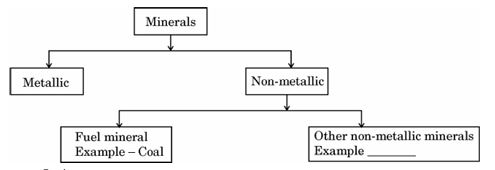
-
(A) Manganese
-
(B) Gold
-
(C) Bauxite
-
(D) Graphite
Explanation: The correct option is Graphite. In the provided context, under the category of 'Other non-metallics', graphite is specifically mentioned as a non-metallic mineral, distinguishing it from the metallic minerals like Gold, Bauxite, and Manganese, which are known for their metal content.
[1 Mark]
-
(A) Guwahati
-
(B) Itanagar
-
(C) Silchar
-
(D) Digboi
Explanation: The correct answer is Silchar. The East-West Corridor connects Silchar in Assam to Porbandar in Gujarat, making Silchar the easternmost station along this corridor.
[1 Mark]
-
(A) Only I, II and III are correct.
-
(B) Only I, III and IV are correct.
-
(C) Only II, III and IV are correct.
-
(D) Only I, II and IV are correct.
Explanation: The correct option is 'Only I, III and IV are correct.' because the Bharatmala scheme focuses on connectivity for backward areas and religious and tourist places (I), the development of state roads along coastal areas (III), and connecting non-major ports (IV). It does not specifically aim to interconnect the four metropolitan cities (II), which is outlined in the Golden Quadrilateral scheme.
[1 Mark]
-
(A) Government of Madhya Pradesh
-
(B) World Health Organisation
-
(C) Government of India
-
(D) Non Governmental Organisation
Explanation: The correct answer is 'Government of India' because the Swachh Bharat Mission (SBM) is part of the urban renewal mission launched by the Government of India to improve the quality of life in urban slums.
[1 Mark]
-
(A) Hepatitis
-
(B) Asthma
-
(C) Pneumonia
-
(D) Deafness
Explanation: Hepatitis is caused by water pollution as it is a water-borne disease resulting from contaminated water, as mentioned in the context. Other diseases like diarrhoea and intestinal worms are also linked to polluted water.
[1 Mark]
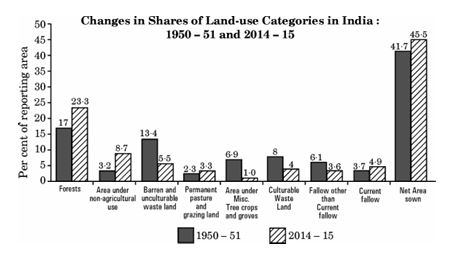
-
(A) Forests
-
(B) Culturable wasteland
-
(C) Barren and unculturable wasteland
-
(D) Permanent pasture and grazing land
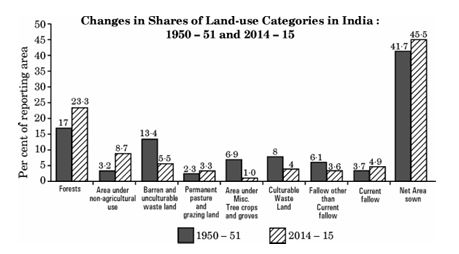
Explanation: Based on the context, both 'barren and unculturable wasteland' and 'culturable wasteland' have experienced significant declines due to increased pressure for agricultural use and non-agricultural development. However, the text indicates a specific mention of a overall decline of 'culturable wasteland', suggesting it has likely faced the most substantial decrease compared to the other categories over this period.
[1 Mark]
-
(A) Area under non-agricultural uses
-
(B) Current fallow
-
(C) Net area sown
-
(D) Barren and unculturable wasteland
Explanation: The category with the highest difference of increase is 'Area under non-agricultural uses.' The context notes that this category has shown the highest rate of increase due to expansion of building activity on agricultural land, indicating significant changes in land use over the years.
[1 Mark]
-
(A) 3·6% (of reporting area)
-
(B) 3·8% (of reporting area)
-
(C) 3·7% (of reporting area)
-
(D) 3·9% (of reporting area)
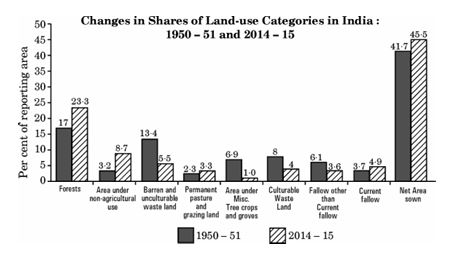
Explanation: The correct answer is 3.6% (of reporting area). This percentage reflects the calculated change in land reporting from the data presented in Fig. 3.1, which indicates shifts in land use over the specified period based on the reporting area.
[1 Mark]
-
(A) Land used for infrastructure
-
(B) Permanent pasture
-
(C) Land used in settlements
-
(D) Desert and ravines
Explanation: The correct answer is 'Desert and ravines' because, according to the provided context, barren and wastelands include desert lands, barren hilly terrains, and ravines, which cannot be brought under cultivation with the available technology.
[1 Mark]
-
(A) Barren land
-
(B) Culturable wasteland
-
(C) Current fallow land
-
(D) Fallow other than current fallow
Explanation: The correct answer is 'Culturable wasteland' because, as stated in the provided context, any land that is left fallow (uncultivated) for more than five years is categorized as culturable wasteland. This type of land can potentially be brought under cultivation after certain reclamation practices.
[1 Mark]
-
(A) Revenue
-
(B) Income Tax
-
(C) Sales Tax
-
(D) Estate
Explanation: The correct option is 'Revenue' because, according to the provided context, land-use records are maintained by the land revenue department in India. This department is responsible for categorizing and recording land use, which distinguishes it from other departments such as income tax or sales tax.
Section C
[3 Marks]
Answer: The use of technology has significantly enabled humanity to overcome various natural obstacles. For instance, in Trondheim, advanced engineering allows for the construction of infrastructures like bridges and tunnels, facilitating movement despite challenging terrains. Similarly, irrigation systems converted arid lands into cultivable areas, enhancing agricultural productivity. Technology facilitates adaptation, marking a transition from reliance on natural cycles to controlled environments. This progression empowers societies to shape their surroundings, enhancing their quality of life and stimulating economic growth.
Key Points: Examples of technology in overcoming obstacles; Impact of technology on infrastructure (bridges, tunnels); Adaptation through irrigation and agriculture; Transition from nature-dependent to controlled environments; Empowerment of societies through technology
[3 Marks]
Answer: Neo-determinism attempts to reconcile the dualistic views of man-environment interactions by introducing a balanced framework. Unlike environmental determinism, which suggests that the environment wholly predetermines human actions, or possibilism, which emphasizes human agency and environmental modification, neo-determinism posits that while the environment influences human behavior, there is also room for human adaptation and innovation within ecological constraints. This perspective acknowledges contemporary environmental issues like climate change and land degradation, advocating for sustainable practices that minimize harm while prioritizing social welfare. Hence, neo-determinism serves as a middle path that promotes a cooperative relationship between human agency and environmental limits, allowing societies to thrive without inflicting irreversible damage on the planet.
Key Points: 1. Reconciliation of environmental determinism and possibilism; 2. Acknowledgment of human influence and environmental constraints; 3. Emphasis on sustainable practices and social welfare; 4. Addressing contemporary environmental challenges like climate change; 5. Promoting a cooperative relationship between humans and nature.
[3 Marks]
Answer: Economic factors significantly influence population distribution across the globe. Firstly, employment opportunities are crucial; regions with thriving industries, like Silicon Valley in the USA, attract a workforce eager for high-paying jobs. Secondly, resource availability plays a vital role; areas rich in natural resources, such as the oil-rich Middle East, draw populations seeking employment in extraction and related services. Lastly, infrastructure development, including transportation and healthcare facilities, can lead to population growth in specific areas, for instance, urban centers like Mumbai in India, where robust infrastructure supports diverse economic activities. These economic factors shape where people choose to live and work.
Key Points: 1. Employment opportunities can attract populations. 2. Resource availability influences population concentration. 3. Infrastructure development impacts population growth in urban areas.
[3 Marks]
Answer: Rural and urban settlements in India exhibit several fundamental differences. Firstly, the population density varies significantly; rural areas tend to have lower population densities, leading to more open spaces, while urban areas are densely populated, resulting in a compact built environment. Secondly, the economic activities differ; rural settlements primarily engage in agriculture and allied activities, whereas urban settlements focus on secondary and tertiary activities like manufacturing and services. Lastly, social structures and relationships vary; rural communities often have close-knit social ties with informal interactions, while urban environments feature more formal and complex relationships due to anonymity and a fast-paced lifestyle.
Key Points: Population density differs; economic activities are varied; social structures and relationships vary
[3 Marks]
Answer: Human development measurement is increasingly nuanced, incorporating various indicators beyond mere income levels. Traditional approaches like the income and welfare models offer foundational insights but fail to encompass the full spectrum of human progress. The capabilities approach is especially vital, emphasizing individuals’ freedoms and capabilities to lead fulfilling lives. Additionally, the Minimum Needs approach addresses essential societal needs. Recent studies linking corruption and policy effectiveness to development highlight the need for comprehensive analysis. International comparisons often challenge stereotypes about cultures affecting development levels, suggesting that systemic factors are more critical than perceived cultural limitations.
Key Points: Income Approach; Welfare Approach; Minimum Needs Approach; Capabilities Approach; Corruption and Policies; International Comparisons; Misleading Cultural Stereotypes
[3 Marks]
Answer: Equity is essential for fostering a just society where everyone has equal access to opportunities. Discrimination based on gender, race, income, or caste often leads to unequal access, which stifles the potential of a significant portion of the population. For instance, despite economic growth in various countries, issues like poverty persist due to unequal distribution of resources. This inequity can hinder overall development. Therefore, concepts such as equity and redistribution must be integrated into development strategies to ensure everyone's well-being and participation, helping to build a more inclusive society.
Key Points: Equity promotes equal opportunities - discrimination limits access - economic growth does not eliminate poverty - integration of equity in development strategies - enhances societal well-being
Section D
[5 Marks]
Answer: Extensive commercial grain farming is predominantly found in semi-arid regions of the midlatitudes, characterized by several prominent features. Firstly, the farms are exceptionally large, often covering vast areas, which allows the cultivation of significant quantities of grains. Secondly, mechanization plays a pivotal role, as the entire farming process, from planting to harvesting, is accomplished using advanced machinery, enabling efficiency and high productivity. Thirdly, wheat serves as the principal crop, although crops like corn, barley, oats, and rye are also cultivated, contributing to agricultural diversity. Fourthly, this farming style is concentrated in specific global regions such as the Eurasian steppes, North American Prairies, Pampas in Argentina, South African Velds, Australian Downs, and New Zealand's Canterbury Plains, which are all known for their favorable climatic conditions for grain production. Finally, extensive grain farming is characterized by lower population density, allowing farmers to focus solely on the large-scale production of grains without the complications of urban proximity affecting operations. In essence, extensive commercial grain farming epitomizes large-scale agriculture, effectively utilizing technology and regional advantages for grain production.
Key Points: Large farm size; mechanized operations; principal crop is wheat; specific global regions; lower population density
[5 Marks]
Answer: Cottage industries and large scale industries differ significantly in various aspects. Cottage industries are small-scale operations typically run from home, focusing on localized production with minimal capital investment. They employ family members or a few local artisans to produce handicrafts, textiles, or food items, such as handwoven baskets or handmade pottery. In contrast, large scale industries involve mass production of goods using advanced technologies and considerable capital investment, often employing specialized labor. The automotive industry exemplifies large scale manufacturing, where assembly-line techniques allow for the production of thousands of vehicles efficiently. While cottage industries emphasize local materials and craftsmanship, large scale industries capitalize on global markets and economies of scale, leading to higher production volumes and lower costs. Each type of industry plays a crucial role in the economy, catering to different market needs and employment opportunities.
Key Points: Definition of cottage industries; Characteristics of cottage industries; Examples such as textiles or crafts; Definition of large scale industries; Characteristics including advanced technology and mass production; Examples such as automotive manufacturing; Comparison of capital investment and workforce; Economic significance of both industries.
[5 Marks]
Answer: The youth population in India faces several pressing challenges, including high rates of illiteracy, particularly among females, school dropouts, malnutrition, mental health issues, substance abuse, and juvenile delinquency. The prevalence of maternal mortality among adolescent mothers and a rising rate of HIV/AIDS infections further exacerbate the situation. To address these issues, two crucial measures can be implemented. Firstly, improving access to quality education and vocational training can empower young people, reduce dropouts, and enhance employability. Initiatives under the National Youth Policy (NYP-2014) can be expanded to address skill development aligned with market demands. Secondly, increasing awareness about health and nutrition through community programs can tackle malnutrition and promote mental wellbeing, thereby fostering a supportive environment for youth development. By emphasizing education and health awareness, we can significantly improve the circumstances faced by the youth in India and enable them to contribute positively to society.
Key Points: Youth facing illiteracy and school dropouts-High maternal mortality and HIV/AIDS challenges-Vocational training as an empowerment tool-Expanding National Youth Policy initiatives-Improving health and nutrition awareness programs
[5 Marks]
Answer: Discrimination on the basis of gender is considered a crime against humanity as it fundamentally denies individuals their basic rights and dignity. It excludes over half of the world's population from opportunities related to education, employment, and political representation, inhibiting overall societal development. Such discrimination perpetuates inequality, manifests in different forms such as low wages for women, and reinforces harmful social constructs. To combat this issue, governments and societies must implement comprehensive measures. Firstly, education campaigns should be established to raise awareness about gender equality, highlighting the importance of inclusion in all spheres of life. Secondly, legal frameworks must be strengthened to protect against gender-based discrimination, ensuring that policies are enforced effectively. By promoting equality and protecting individual rights, societies can advance toward a more just and civilized future.
Key Points: Discrimination is a crime against humanity; it denies rights and dignity; exclusion of women hampers society; education and awareness campaigns; enforce stronger legal frameworks to protect rights.
[5 Marks]
Answer: Nuclear power has increasingly emerged as a viable energy source in India, particularly in light of the country’s growing energy demands and commitment to reducing carbon emissions. The Atomic Energy Commission, established in 1948, marked the beginning of India's journey into nuclear energy. Key minerals for nuclear energy, such as uranium and thorium, are sourced from local deposits in states like Andhra Pradesh and Odisha. Major nuclear projects, including those at Tarapur, Rawatbhata, and Kalpakkam, demonstrate India's commitment to developing this energy sector.
Nuclear energy offers a substantial output of energy with a relatively low environmental impact compared to fossil fuels, supporting India's transition to more sustainable energy practices. Moreover, while the initial costs of establishing nuclear facilities are high, the long-term benefits, including lower operational costs and less environmental degradation, enhance its viability. As India continues to explore and invest in nuclear technology, it positions itself better in the quest for energy security, balancing growth and environmental responsibility. Thus, harnessing nuclear power represents a strategic approach to meet India’s increasing energy requirements while striving for environmental sustainability.
Key Points: Nuclear power as a viable energy source; Role of Atomic Energy Commission; Key minerals: uranium and thorium; Major projects: Tarapur, Rawatbhata, Kalpakkam; Environmental benefits over fossil fuels; High initial costs but lower long-term operational costs; Balanced approach for energy security and sustainability.
[5 Marks]
Answer: Rail transport plays a pivotal role in India's socio-economic development, serving as a backbone for both freight and passenger movement. It facilitates the transportation of goods, including essential commodities, across long distances at relatively low costs. Moreover, the extensive rail network connects remote areas with urban centers, promoting regional development and ensuring accessibility. Railways are also energy-efficient and capable of carrying large volumes of passengers and cargo, reducing road congestion. Additionally, the role of railways in job creation, tourism, and enhancing trade cannot be understated, making it indispensable for India's growth trajectory. Overall, rail transport significantly contributes to enhancing the efficiency and effectiveness of the transport system within the nation.
Key Points: Facilitates freight and passenger transport, Reduces transportation costs, Connects remote areas to urban centers, Promotes regional development, Energy-efficient, Reduces road congestion, Creates jobs, Enhances tourism and trade
[5 Marks]
Answer: Sea ports in India are vital gateways for international trade, facilitating the movement of goods and people across the globe. With approximately 7,517 km of coastline, India boasts twelve major and 200 minor ports that serve as crucial nodes in maritime trade. The strategic location and infrastructure of these ports enable them to handle about 95% of India’s foreign trade by volume and 70% by value. Ports such as Mumbai, Chennai, and Kolkata have historical significance and extensive operational capacity, allowing for efficient docking, loading, and unloading of cargo. The central government regulates major ports, ensuring standardization and efficiency in operations. Additionally, sea routes are cost-effective, providing smooth transport compared to other modes, provided there is no turbulence. The historical development of these ports, rooted in India’s sea-faring tradition, reflects their importance in both trade and cultural exchanges. Overall, the efficient functioning of sea ports not only bolsters India’s economy but also strengthens its global trading relationships.
Key Points: India's extensive coastline (7,517 km) - 12 major and 200 minor ports - 95% of foreign trade by volume through ports - importance of efficient docking and cargo handling - government regulation of major ports - historical significance of ports - cost-effectiveness of sea transport.
[5 Marks]
Answer: Plantation agriculture is characterized by several key features. Firstly, it involves large estates or plantations, which allow for extensive land use dedicated to single crop cultivation. Secondly, significant capital investment is required to establish and maintain these plantations, as they rely on modern machinery and technology. Thirdly, plantation agriculture typically focuses on single crop specialization, ensuring maximum efficiency and productivity. Fourthly, it employs a considerable amount of cheap labor, often sourced from local populations or migrants. Finally, a good system of transportation is essential, linking plantations to markets and facilitating the export of crops like tea, coffee, and rubber. These characteristics contribute to the profit-oriented nature of plantation farming, which was largely introduced by European colonial powers in tropical regions.
Key Points: Large estates or plantations; Large capital investment; Single crop specialization; Cheap labor; Good transportation system