Class 9 . Social Science . Understanding Society India and Beyond Part I . Atmosphere and Climate
Chapter 3: Atmosphere and Climate
Ch 3
Social Science
Class 9
Composition and Structure of the Atmosphere
The Atmosphere
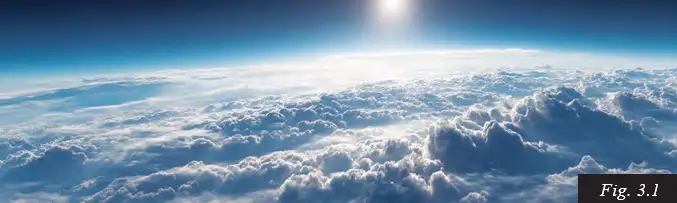
Atmosphere — The atmosphere is the mixture of gases surrounding Earth, held close to the planet by gravity.
Why the Atmosphere Matters
- Life support: Its gases are essential for living beings.
- Protection: It shields Earth from harmful solar radiation, including ultraviolet radiation.
- Temperature regulation: It traps some of the Sun’s energy and prevents it from escaping back into space.
- Weather and climate: It influences temperature, humidity and air pressure.
Gravity — Gravity is the fundamental force of attraction between objects that have mass or energy.
Earth’s gravity — The force of attraction that Earth’s mass exerts on objects on or near its surface.
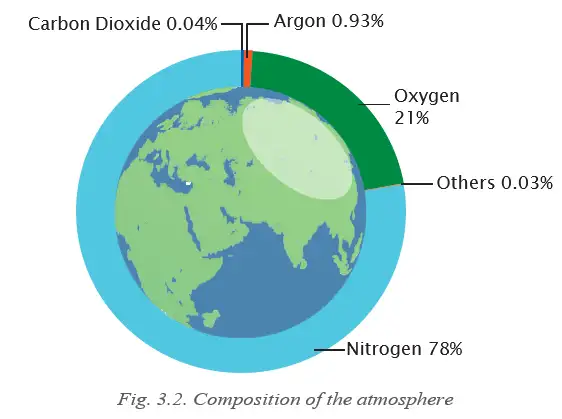
Composition of the Atmosphere
- Main gases: Nitrogen and oxygen are the most abundant gases and are essential to life.
- Other gases: Carbon dioxide, argon, helium, neon, krypton, xenon, ozone and hydrogen occur in smaller quantities.
- Water vapour: Its amount varies, generally from 0.1% to 4.0%; it is important in cloud formation and precipitation.
- Other components: The atmosphere also contains tiny dust particles.
- Variation: Atmospheric composition varies with altitude.
Structure of the Atmosphere
- Layers: The atmosphere is divided into layers according to changes in temperature and density with altitude.
- Density: Air is densest near Earth’s surface and becomes less dense at higher altitudes.
Altitude — The height of a location above mean sea level, which is taken as zero; it is usually measured in metres or feet.
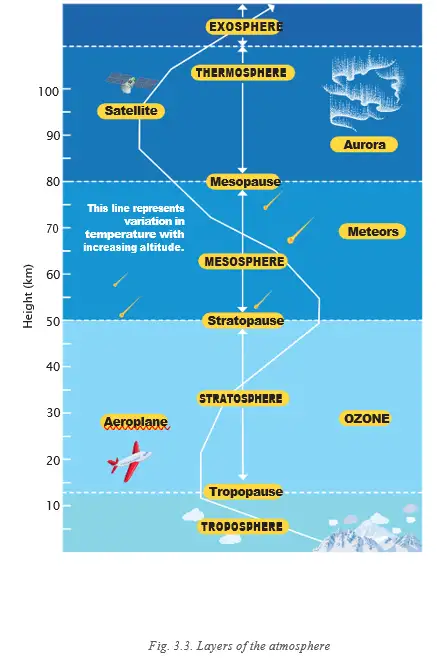
| Layer | Altitude / boundary | Temperature and key features |
|---|---|---|
| Troposphere | Average height about 12 km; ends at the tropopause. | Temperature decreases with altitude. Contains the air we breathe, most water vapour and clouds; nearly all weather occurs here. |
| Stratosphere | Above the troposphere, extending up to 50 km; ends at the stratopause. | Contains ozone, which filters harmful solar radiation, including ultraviolet. Relatively free of clouds and weather disturbances, making it suitable for aeroplanes. |
| Mesosphere | Above the stratosphere, extending up to 80 km. | Temperature decreases with altitude. Most incoming meteorites burn up here. |
| Thermosphere | Extends from 80 to 700 km. | Temperature rises rapidly as gas molecules absorb X-rays and short-wave ultraviolet radiation. Includes the ionosphere; reflects radio waves and is where auroras occur. |
| Exosphere | Uppermost atmospheric layer. | Air is very thin. Light gases such as helium and hydrogen can escape into space because gravity is weak. |
- Temperature pattern: Temperature decreases with altitude only in the troposphere and mesosphere; it rises rapidly in the thermosphere.
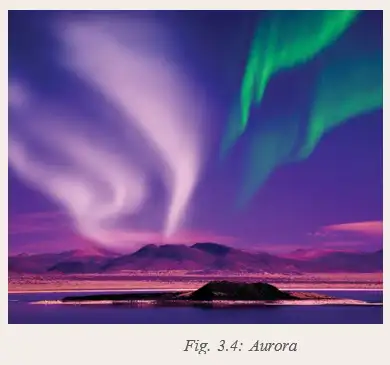
- Auroras: Solar-wind particles are directed towards the magnetic poles and interact with atmospheric gases, producing coloured lights.
Auroras
- Names: The display is called the Aurora Borealis in the Northern Hemisphere and Aurora Australis in the Southern Hemisphere.
- Cause: Charged particles from the Sun (solar wind) are directed towards Earth’s magnetic poles and interact with atmospheric gases; each gas glows in a particular colour.
Air Pressure
Atmospheric pressure — Air exerts force on our bodies, but we do not normally feel it because air presses from all sides and our bodies exert a balancing counter-pressure.
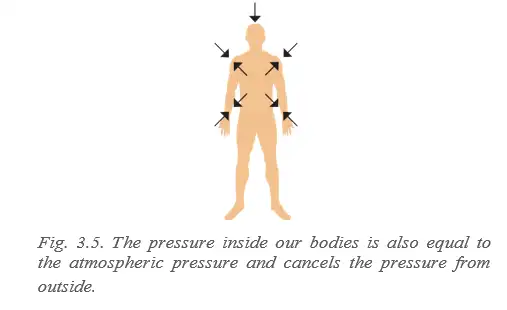
- Tropopause
- Transition zone separating the troposphere and stratosphere.
- Stratopause
- Boundary separating the stratosphere and mesosphere.
- Ionosphere
- Part of the thermosphere that helps reflect radio waves.
- Aurora
- Coloured atmospheric light display near the poles, caused by interactions between solar particles and atmospheric gases.
Quick recap
- The atmosphere is a gravity-held mixture of gases that supports life, protects Earth and helps regulate temperature and climate.
- Gravity is attraction between objects with mass or energy; Earth’s gravity attracts objects near its surface.
- Nitrogen and oxygen are the most abundant atmospheric gases; water vapour generally ranges from 0.1% to 4.0%.
- Air density is greatest near Earth’s surface and decreases with altitude; the atmosphere has five main layers.
- Temperature decreases with altitude only in the troposphere and mesosphere; it rises rapidly in the thermosphere.
- Weather occurs mainly in the troposphere; the stratosphere contains ozone, and most meteorites burn up in the mesosphere.
- The thermosphere reflects radio waves and hosts auroras; thin gases in the exosphere can escape into space.
Weather and Climate
Weather — The hour-to-hour and day-to-day condition of the atmosphere at a place.
Climate — The average weather conditions and variations over a large area for an extended period, usually 30 years or more.
| Point | Weather | Climate |
|---|---|---|
| Time scale | Hours and days; may vary within a day | Usually 30 years or more |
| Pattern | Changes frequently, including from day to day | Average conditions and variations over a large area |
Elements of Weather and Climate
Temperature
- Temperature varies between day and night and across seasons; summers are generally hotter than winters.
- Insolation is incoming solar energy from the Sun intercepted by Earth.
- Latitude effect: Insolation and temperature generally decrease from the equator towards the poles.
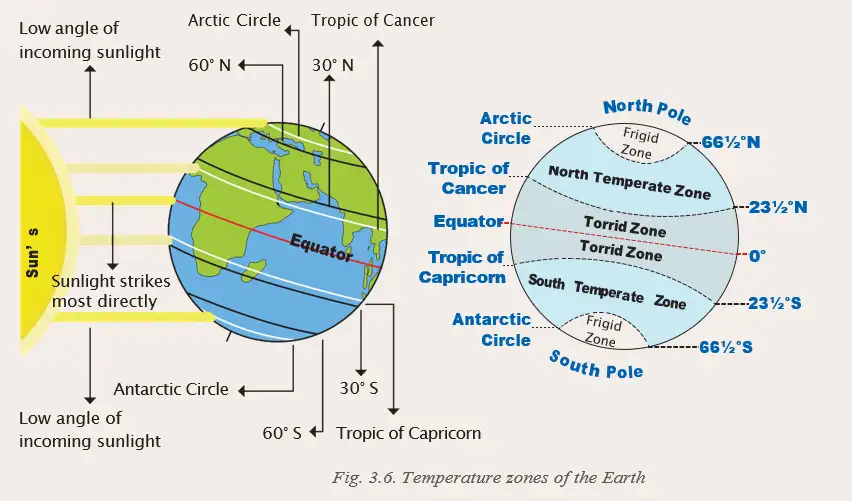
Humidity
- Humidity is the presence of water vapour in the air; water vapour forms when water evaporates from land and water bodies.
- Warm air can hold more water vapour. High humidity can make sweat evaporate slowly and clothes take longer to dry, causing discomfort.
Precipitation
- Precipitation occurs when water vapour condenses in saturated air and falls to Earth under gravity.
- Forms: Drizzle, rain, snow, sleet and hail. Liquid precipitation is called rain, the most common form of precipitation.
- Factors: Prevailing winds, mountains and seasons affect precipitation.
- Effects of rain: It lowers local temperature and supplies most groundwater; a long absence of rainfall can result in a dry climate.
Atmospheric Pressure
- Air pressure is the pressure exerted by the weight of air on Earth's surface.
- Altitude: Pressure is highest at sea level and falls rapidly as altitude increases.
- Temperature and pressure: Warm air rises, creating low pressure; cold, heavy air sinks, creating high pressure.
- Weather association: Low pressure is linked with cloudy, wet weather; high pressure is linked with clear, sunny skies.
- Air movement: Air moves from high-pressure areas towards low-pressure areas.
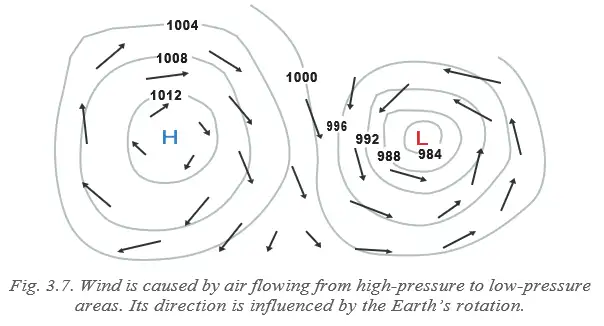
Wind — The movement of air from a high-pressure area to a low-pressure area.
- Strength: Wind can be gentle or strong, from moving dust and leaves to uprooting trees during storms.
- Naming: Winds are named for the direction they come from; a wind coming from the west is a westerly.
| Wind | Speed (km/hr) | Common effects |
|---|---|---|
| Calm | 0–1 | Smoke rises vertically. |
| Light breeze | 6–11 | Wind is felt on the face; leaves rustle and an ordinary vane moves. |
| Strong breeze | 39–49 | Large branches sway; umbrellas are difficult to use. |
| Storm | 103–117 | Rare; usually accompanied by widespread damage. |
Local Winds: Sea Breeze and Land Breeze
| Point | Sea breeze | Land breeze |
|---|---|---|
| Direction and time | Sea to land during the day, especially afternoon | Land to sea during the night |
| Cause | Land warms faster than the sea, forming low pressure over land | Land cools faster than the sea at night |
| Wind speed | Blows towards the low-pressure land area | Low because the land–sea temperature and pressure difference is small |
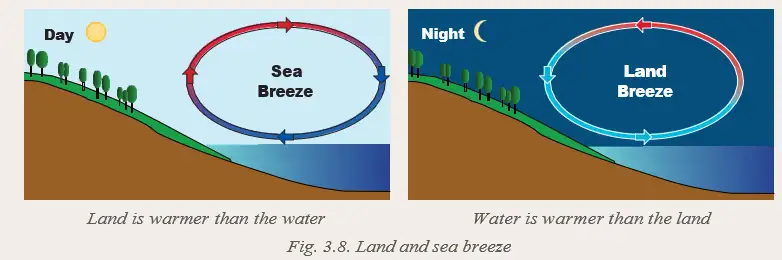
Local Winds and Coastal Climate
- Coastal effect: Sea and land breezes help create moderate climatic conditions in coastal regions.
Seasons
- Season: A part of the year identified by a general pattern in weather over weeks or months.
- Basis: Seasons reflect common monthly atmospheric conditions, such as cool or hot, windy or calm, cloudy or bright, and wet or dry weather.
Quick recap
- Weather changes over hours or days; climate describes long-term average conditions, usually over 30 years or more.
- Temperature generally decreases from the equator towards the poles as insolation decreases.
- Humidity is water vapour in the air; precipitation includes rain, snow, sleet, hail and drizzle, with rain the most common form.
- Warm rising air creates low pressure; cold sinking air creates high pressure, and air moves from high to low pressure.
- Winds are named for where they come from; sea breezes blow sea-to-land by day, and land breezes land-to-sea at night.
- Seasons are based on general weather patterns over weeks or months.
Seasons in India Part-1
Climate of India — India’s climate is broadly classified as tropical monsoon.
Four Seasons Recognised by the IMD
Annual seasonal sequence
- December to early AprilWinter
- April to June; up to July in north-western IndiaSummer or pre-monsoon
- June to SeptemberAdvancing monsoon or rainy season
- October to DecemberPost-monsoon or retreating monsoon
| Season | Key features |
|---|---|
| Winter | December and January are the coldest months. Average temperatures are about 10–15°C in the north-west, rising towards the equator to about 20–25°C in mainland India’s south-east. |
| Summer / pre-monsoon | April is hottest in western and southern India; May is hottest in northern India. Average temperatures across most inland India are 32–40°C. |
| Advancing monsoon | The humid south-west summer monsoon slowly spreads across India in late May or early June. During this season, South India typically receives more rainfall; rain begins to recede from north India in early October. |
| Retreating monsoon | October and November are usually cloudless in north-western India. |
- Regional variation: The Himalayan states, with their more temperate climate, also experience autumn and spring.
Traditional Indian Seasons
Traditional seasons — The traditional Indian calendar divides the year into six astronomical seasons, each roughly two months long.
| Season (Ritu) | Indian calendar months | Gregorian months |
|---|---|---|
| Vasanta (spring) | Chaitra–Vaiśhākha | March–April |
| Grīṣhma (summer) | Jyeṣhṭha–Āṣhāḍha | May–June |
| Varṣhā (rainy season) | Śhrāvaṇa–Bhādrapada | July–August |
| Śharad (early autumn) | Āśhwina–Kārtika | September–October |
| Hemanta (late autumn) | Mārgashīrsha–Pausha | November–December |
| Śhiśhira (winter) | Māgha–Phālguna | January–February |
- Regional variation: Traditional season timing and duration may vary across different parts of India.
- Rainfall records: Kauṭilya’s *Arthaśhāstra* records scientific rainfall measurements and their practical use in managing revenue and relief efforts.
- IMD
- Indian Meteorological Department, which recognises four distinct seasons in India.
- Advancing monsoon
- The rainy season dominated by the humid south-west summer monsoon as it spreads across India.
- Retreating monsoon
- The post-monsoon period when monsoon rains begin to withdraw from parts of India.
What are the four seasons recognised by the IMD, and when do they occur?
Quick recap
- India’s climate is broadly tropical monsoon; the IMD recognises four distinct seasons.
- Winter lasts from December to early April; December and January are the coldest months.
- Summer or pre-monsoon spans April–June, extending to July in north-western India; inland temperatures are generally 32–40°C.
- The humid south-west monsoon spreads across India from late May or early June and generally lasts until September.
- The traditional Indian calendar has six seasons, each roughly two months long.
- The Himalayan states also experience spring and autumn.
Seasons in India Part-2
Monsoon and Its Origins
- Nakshatras
- Twenty-seven equal sections of the sky along the Moon’s path, each associated with a star or group of stars. The Moon passes through roughly one section each day.
Seasonal Monsoon Winds
| Point | South-west monsoon | North-east monsoon |
|---|---|---|
| Season and other name | June to September; summer monsoon | October to February; winter monsoon |
| Wind direction and cause | Moist winds blow from sea to land. India heats faster than the oceans, creating low pressure over land and relatively high pressure over the Indian Ocean. | Cold, dry winds generally blow from land to sea. Land cools faster than the surrounding oceans, creating high pressure over land and low pressure over the seas. |
| Rainfall | Brings most of India’s annual rainfall. | Usually brings little rain to most of India; after crossing the Bay of Bengal, it brings rain to the eastern coast. |
| Important regions | Winds cross the Indian Ocean, Arabian Sea and Bay of Bengal. | Important for south-eastern India, especially Tamil Nadu, Andhra Pradesh and parts of Karnataka. |
Why the South-West Monsoon Brings Rain
- India’s land heats faster than the surrounding oceans during summer.
- Low pressure forms over the Indian subcontinent while the Indian Ocean remains relatively cooler and has higher pressure.
- Winds move from high pressure to low pressure, carrying moist air from ocean to land.
- The moist winds bring widespread rainfall across India.
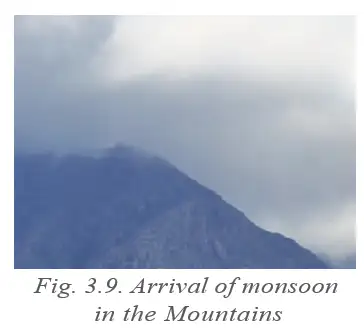
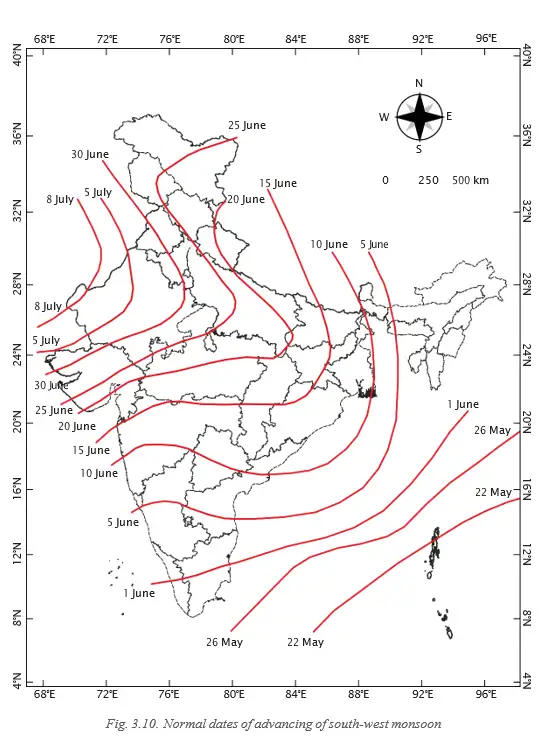
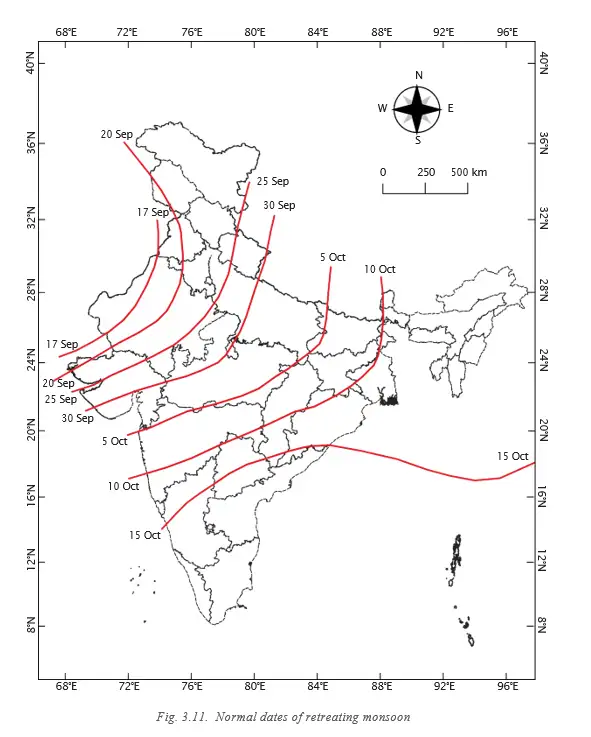
Importance of the Monsoon
Monsoon and People’s Livelihoods
- Monsoon rainfall supports crop growth and water supply.
- Reliable rain supports food production and rural employment.
- Too much rain can cause floods; too little rain can cause drought.
- These effects make the monsoon important to India’s economy, lifestyles and livelihoods.
Monsoon in Literature
- Around the 5th century CEKālidāsa’s *Meghadūtam* refers to the monsoon’s onset over central India and traces the path of monsoon clouds.
Monsoon Prediction Initiatives
How does the south-west monsoon form and bring rain to India?
Why does the north-east monsoon bring rain to parts of south-eastern India?
Quick recap
- Monsoon means the seasonal reversal of wind direction; the name comes from Arabic *mausim*, meaning “season.”
- Kṛṣiparāśara and Varāhamihira’s Bṛhatsaṁhitā describe ancient rainfall prediction methods.
- The south-west monsoon blows from sea to land from June to September and brings most of India’s rainfall.
- The north-east monsoon occurs from October to February and brings rain to parts of the south-eastern coast.
- Monsoon rainfall shapes agriculture, water supply, daily life and livelihoods, while extremes can cause floods or droughts.
- The National Monsoon Mission and Mission Mausam aim to improve weather and climate prediction and services.
Climate Change
Climate Change: Meaning and Causes
Climate change — Long-term changes in weather patterns, including temperature, rainfall and wind, caused mainly by human activities.
Causes, Impacts and Responses
- Human causes: Burning fossil fuels, deforestation and industrial pollution increase greenhouse gases in the atmosphere.
- Greenhouse gases: Carbon dioxide, methane, nitrous oxide and water vapour trap heat; increased heat raises global temperatures.
- Environmental effects: More frequent floods and droughts, melting glaciers, rising sea levels and loss of biodiversity.
- Human effects: Climate change threatens health, agriculture and livelihoods, affecting all sections of society, including women and children.
- Responses: Use renewable energy, save energy, protect forests, reduce carbon footprints and adopt sustainable lifestyles.
Carbon footprint — The total greenhouse gases released into the atmosphere by human activities, such as energy use, transport and producing goods and services.
Everyday Ways to Reduce Your Carbon Footprint
- Transport: Walk or cycle for short trips; use public transport or carpool instead of travelling alone by car.
- Energy: Switch off lights, fans and other appliances when they are not in use.
- Water: Use water carefully and avoid leaving taps running or taking unnecessarily long showers.
- Waste: Reuse and recycle materials; avoid single-use plastics.
Punjab Floods: 2025 Case Study
The Flood Event
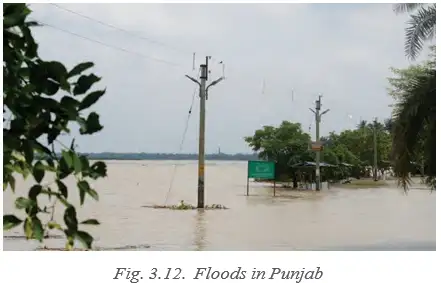
- Event: In 2025, heavy monsoon rains and swollen Satluj, Beas and Ravi rivers caused severe flooding in Punjab.
- Damage: Floods affected villages, farmland, houses and infrastructure such as roads and bridges, causing economic losses, social disruption and environmental damage.
- Response: Relief operations took place as floodwater began to recede in some areas.
| Factor | Natural causes | Human-made causes |
|---|---|---|
| Rain and river levels | Very heavy monsoon rain, intensified by western disturbances, brought extra moisture and rain. | Weak or old river embankments (dhūsī bandh) could not contain the rising water. |
| Water from surrounding areas | Heavy rain in Punjab, Himachal Pradesh and Jammu & Kashmir increased runoff from hills and local rainfall. | Houses and farms built close to rivers reduced the space where floodwater could spread safely. |
| Additional conditions | The Satluj, Beas, Ravi and Ghaggar were already flowing high before the heavy rain. | Silt and mud in rivers and dams reduced their capacity; late or unclear warnings left people unprepared. |
Effects of the Punjab Floods
- People: Lives were lost, and thousands had to leave their homes for relief camps.
- Farming and animals: Floodwater covered farmland and severely damaged paddy crops; poultry and dairy farms were damaged, and cows, buffaloes and chickens became ill or died.
- Infrastructure: Roads, bridges, border fences and some public buildings were damaged.
- Health and sanitation: Murky standing water increased health problems, waterborne diseases and sanitation concerns.
How Flood Risk and Damage Increased
- Heavy monsoon rain and western disturbances → rivers already flowing high receive more water.
- Rain in the hills and local rainfall → rivers overflow and flood nearby areas.
- Weak embankments, settlement near rivers and silt build-up → floodwater causes greater damage.
- Late or unclear warnings → people have less time to prepare and reach safety.
Flood Case Study
- 2025Heavy monsoon rains and swollen rivers caused severe floods in Punjab; relief operations followed as water began to recede in some places.
- Greenhouse gases
- Atmospheric gases such as carbon dioxide and methane that trap heat.
- Carbon footprint
- The total greenhouse gases released by human activities.
- Western disturbances
- Weather systems that brought additional moisture and rain during the Punjab flood case.
- Embankment (dhūsī bandh)
- A raised barrier along a river intended to help contain its water.
Atmosphere, Weather and Climate
The Atmosphere
- Composition: The atmosphere is made mainly of nitrogen and oxygen, with small amounts of water vapour and dust.
- Importance: Atmospheric gases support life; water vapour and dust help in cloud formation and rainfall.
- Layers: From Earth’s surface upward, the layers are Troposphere, Stratosphere, Mesosphere, Thermosphere and Exosphere.
- Basis of layers: These layers are classified by changes in temperature and air density with increasing height.
| Point | Weather | Climate |
|---|---|---|
| Meaning | The daily atmospheric conditions of a place. | The average weather of a place over a long period. |
India’s Climate and Seasons
- Climate type: India has a tropical monsoon climate.
- IMD seasons: The Indian Meteorological Department divides the year into Winter, Summer, Monsoon and Post-monsoon.
How do human activities contribute to climate change?
Name key natural and human-made causes of the 2025 Punjab floods.
What measures can help reduce climate change?
Quick recap
- Climate change is a long-term shift in weather patterns, driven mainly by human activities.
- Greenhouse gases trap heat; increased levels contribute to rising temperatures and extreme weather.
- Reduce carbon footprints through renewable energy, energy saving, forest protection and sustainable everyday choices.
- Punjab’s 2025 floods followed heavy monsoon rain and high rivers; human factors worsened the damage.
- Flood effects included deaths and displacement, crop and animal losses, infrastructure damage and health risks.
- The atmosphere is mainly nitrogen and oxygen and has five layers; weather is daily, while climate is long-term average weather.
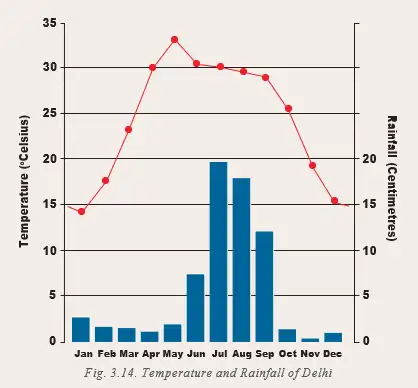
- India has a tropical monsoon climate with four IMD seasons; Delhi’s temperature peaks in May and rainfall in July.
Social Science — ALL CHAPTERS
1
The French Revolution
2
Socialism In Europe And The Russian Revolution
3
Nazism And The Rise Of Hitler
4
Forest Society And Colonialism
5
Pastoralists In The Modern World
1
Understanding Social Science
2
Shaping of the Earth’s Surface
3
Atmosphere and Climate
4
Early Humans and Beginning of Civilisation
5
State and Society up to 1000 CE
6
Democracy
7
Elections
8
Building Blocks in Economics: The Problem of Choice
9
The Price Puzzle: What Drives the Market