Class 9 . Social Science . Understanding Society India and Beyond Part I . Elections
Chapter 7: Elections
Ch 7
Social Science
Class 9
Why do Elections Matter
Why Elections Matter
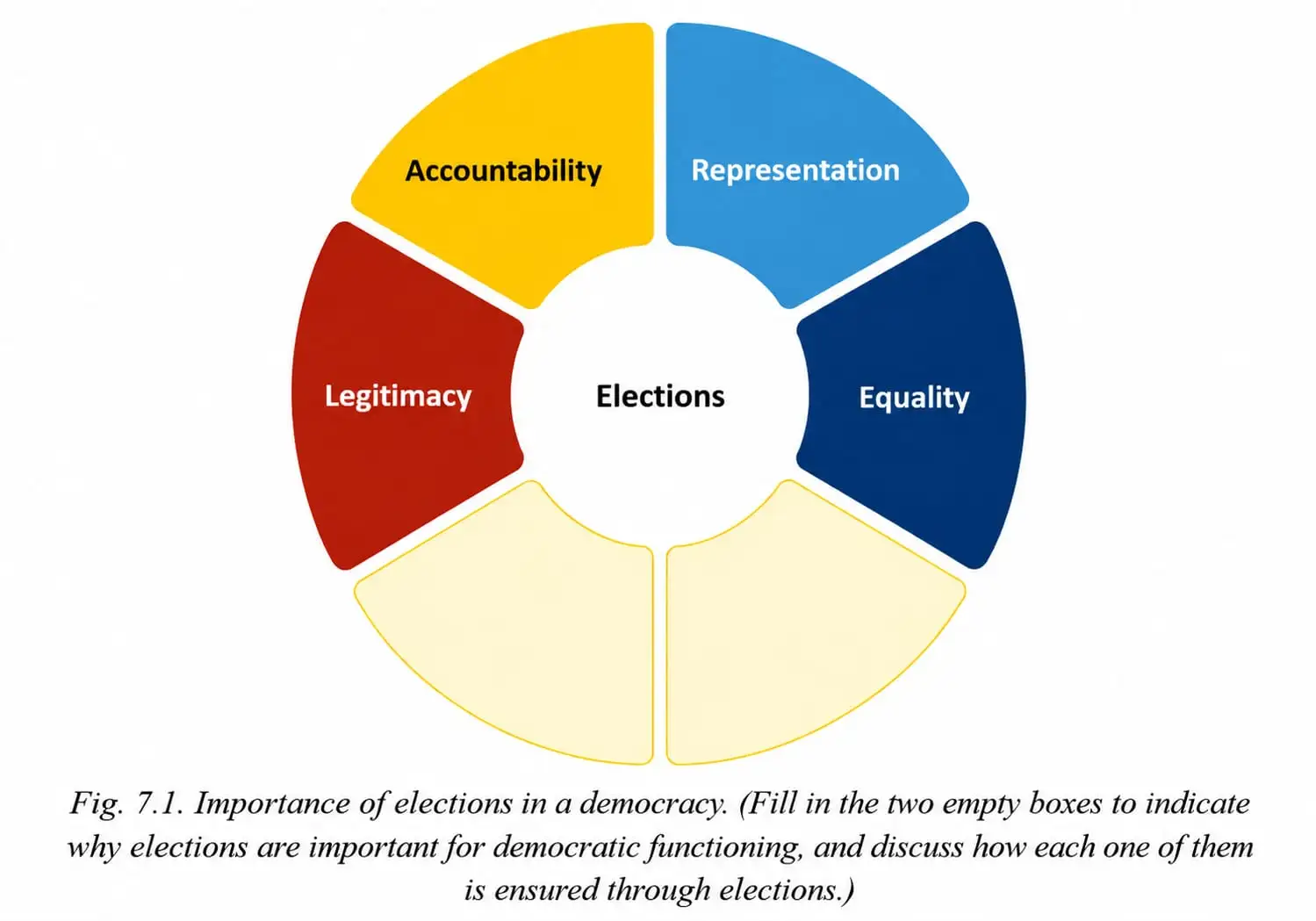
Direct and Indirect Elections
- Direct elections: Citizens vote directly to choose their representatives, as in Lok Sabha and Vidhan Sabha elections.
- Indirect elections: Citizens elect representatives who then choose or elect leaders, as in elections for the President, Vice President and Rajya Sabha.
Conducting Elections in India
- Organisation: Elections across India require coordinated laws, institutions and machinery at national, state and local levels.
- Stakeholders: The Election Commission, political parties, civil society, media and voters all have roles in the electoral process.
- Purpose: These arrangements help ensure that elections are conducted freely, fairly and transparently.
Electoral Systems
| Point | FPTP | Majority system | Proportional representation (PR) |
|---|---|---|---|
| What voters choose | One candidate in their constituency. | One candidate. | A party, rather than an individual candidate. |
| How a winner is chosen | The candidate with the most votes wins, even below 50%. | A candidate must receive more than 50%; if no one does, the top two compete in a second round. | Seats are allotted in proportion to each party’s total votes. |
| Illustrative result | With 40%, 35% and 25% of votes, the party with 40% wins. | With no one above 50% in round one, a second round is held; the winner there forms the government. | With 40%, 35%, 15% and 10% of votes for 100 seats, parties receive 40, 35, 15 and 10 seats. |
| Seat / government outcome | The leading candidate wins the constituency seat. | The second-round winner forms the government. | Seats and political power are shared in proportion to votes. |
State Legislatures and the Vidhan Parishad
- Vidhan Sabha: Each state’s Legislative Assembly is directly elected and makes laws for the state and certain Union Territories.
- Two-house legislatures: Andhra Pradesh, Bihar, Karnataka, Maharashtra, Telangana and Uttar Pradesh have a Vidhan Sabha and a Vidhan Parishad.
- Vidhan Parishad: Its members are elected by Vidhan Sabha members, local bodies, graduates and teachers; the Governor also nominates some members.
Single Transferable Vote (STV)
Minimum votes required for election. Here, V is the total valid votes and S is the number of seats to be filled.
STV vote counting
- Voters mark their candidate preferences.
- Count first-preference votes; declare candidates who reach the quota elected.
- If seats remain, eliminate the candidate with the fewest votes and transfer their ballots to the next preferences.
- Repeat the process until all required candidates are elected.
Why are periodic elections essential in a democracy?
Distinguish between FPTP and proportional representation.
Quick recap
- Elections give citizens a choice and make elected representatives accountable.
- Direct elections let citizens choose representatives; indirect elections use elected representatives to choose leaders.
- India’s elections need laws, coordination and participation by multiple stakeholders to be free, fair and transparent.
- FPTP awards a constituency seat to the candidate with the most votes; PR allocates seats in proportion to votes.
- Lok Sabha and Vidhan Sabha elections use FPTP; Vidhan Parishad elections use PR by STV.
- In STV, candidates reach a quota to win, while eliminated candidates’ votes transfer according to voter preferences.
The Laws Part-1
Laws Governing Elections
| Law | Main areas covered |
|---|---|
| Representation of the People Act, 1950 | Allocation of seats; delimitation of constituencies; preparation and revision of electoral rolls; voting rights for citizens above 18 without discrimination. |
| Representation of the People Act, 1951 | Candidate nominations, election campaigns, voting procedures, electoral offences and corrupt practices, and post-election disputes. |
| Presidential and Vice-Presidential Act, 1952 | Governs elections to the offices of President and Vice-President. |
Purpose of the Two Representation of the People Acts
- Together, the 1950 and 1951 Acts support the integrity, transparency and accountability of India’s electoral process.
- Voting right: Every citizen above 18 years of age has the right to vote without discrimination.
Electoral Offences and Corrupt Practices
Practices Prohibited by the Representation of the People Act, 1951
- Inducements: A candidate, or someone acting with their consent, must not offer a gift, promise or other inducement to make a person contest, withdraw, vote or refrain from voting.
- Appeals for votes: Candidates must not appeal for votes, or ask people not to vote, on grounds of religion, caste, race, community or language.
- Government assistance: Candidates and their representatives must not obtain assistance in favour of the candidate from government-related personnel.
- Personnel covered: This restriction includes gazetted officers, judges and magistrates, armed forces personnel, police personnel and excise officers.
Delimitation Commission
Delimitation — The process of determining the number of seats and fixing the territorial boundaries of constituencies in each state for Lok Sabha and Vidhan Sabha elections.
Why Delimitation Matters
- Changing boundaries: Constituency boundaries are not permanently fixed; they change over time as population density shifts.
- Equal representation: Delimitation aims to keep the ratio of seats to population as close to equal as possible across constituencies.
- Without delimitation: One MP might represent five lakh people while another represents twenty-five lakh, undermining equal representation.
Purpose of Delimitation
- Population density shifts over time
- The population represented by each MP may become unequal
- Constituency seat numbers and territorial boundaries are adjusted
- Representation across constituencies becomes more nearly equal
Constitutional Basis
- Article 82 of the Constitution of India mandates the establishment of a Delimitation Commission.
- India has had four commissions, established in 1952, 1963, 1973 and 2002.
Delimitation Commissions in India
- 1952First Delimitation Commission.
- 1963Second Delimitation Commission.
- 1973Third Delimitation Commission.
- 2002Fourth Delimitation Commission.
What is delimitation, and what is its main purpose?
Which areas are mainly covered by the Representation of the People Acts, 1950 and 1951?
Quick recap
- The Representation of the People Act, 1950 covers seat allocation, delimitation, electoral rolls and voting rights for citizens above 18.
- The Representation of the People Act, 1951 governs nominations, campaigns, voting procedures, offences and post-election disputes.
- The Presidential and Vice-Presidential Act, 1952 governs elections to those offices.
- The 1951 Act prohibits inducements, appeals based on identity, and candidates’ use of specified government-related personnel.
- Delimitation adjusts constituency seats and boundaries to make representation more equal as populations shift.
- Article 82 mandates a Delimitation Commission; commissions were established in 1952, 1963, 1973 and 2002.
The Laws Part-2
Election Commission of India (ECI)
Election Commission of India (ECI) — An autonomous, permanent constitutional body that supervises, directs and controls the entire election process in India.
Constitutional role and administration
- Constitutional basis: Articles 324–329 provide for the ECI and define its powers and duties.
- Elections conducted: The ECI conducts elections to the Lok Sabha, Rajya Sabha, Vidhan Sabha, Vidhan Parishad, and the offices of President and Vice President.
- State-level supervision: A Chief Electoral Officer (CEO) supervises election work in each State; the ECI appoints the CEO from among civil servants in consultation with the State Government.
- Election officials: State officers may be designated as District Election Officers, Returning Officers and Electoral Registration Officers.
Key dates
- 25 January 1950The Election Commission of India was established.
- 25 January every yearNational Voters’ Day is celebrated.
Preparing and Revising Electoral Rolls
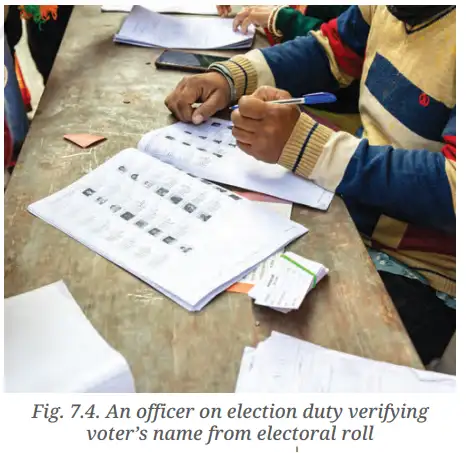
- Electoral roll: The official list of eligible voters for each constituency, organised polling-station-wise; only people listed may vote.
- Preparation: ECI enumerators collect information from households to prepare electoral rolls.
- Special Intensive Revision (SIR): The ECI verifies, updates and corrects rolls to include every eligible voter and exclude ineligible entries.
- Additions: SIR helps include newly eligible voters, especially citizens who have just turned 18.
- Deletions: Names may be removed because of death, change of residence, duplicate enrolment or being permanently untraceable.
- Claims and objections: People can challenge or request changes to the revised roll; the ECI settles these before publishing the final roll.
Scheduling Elections and Managing Political Parties
- Election schedule: The ECI begins election preparations when a legislature completes its five-year term or is dissolved early.
- Scheduling factors: The ECI considers weather, agricultural cycles, school and university examinations, festivals and other conditions across India.
- Party registration: Political parties must be registered with the ECI to contest; independent candidates may also contest.
- Party democracy: The ECI requires political parties to hold organisational elections periodically.
- Party classification: The ECI classifies parties as recognised national, recognised State/regional, or registered-unrecognised parties.
- Symbols and disputes: National and State parties are allotted election symbols; the ECI acts as a quasi-judicial body in disputes over party recognition and symbols.
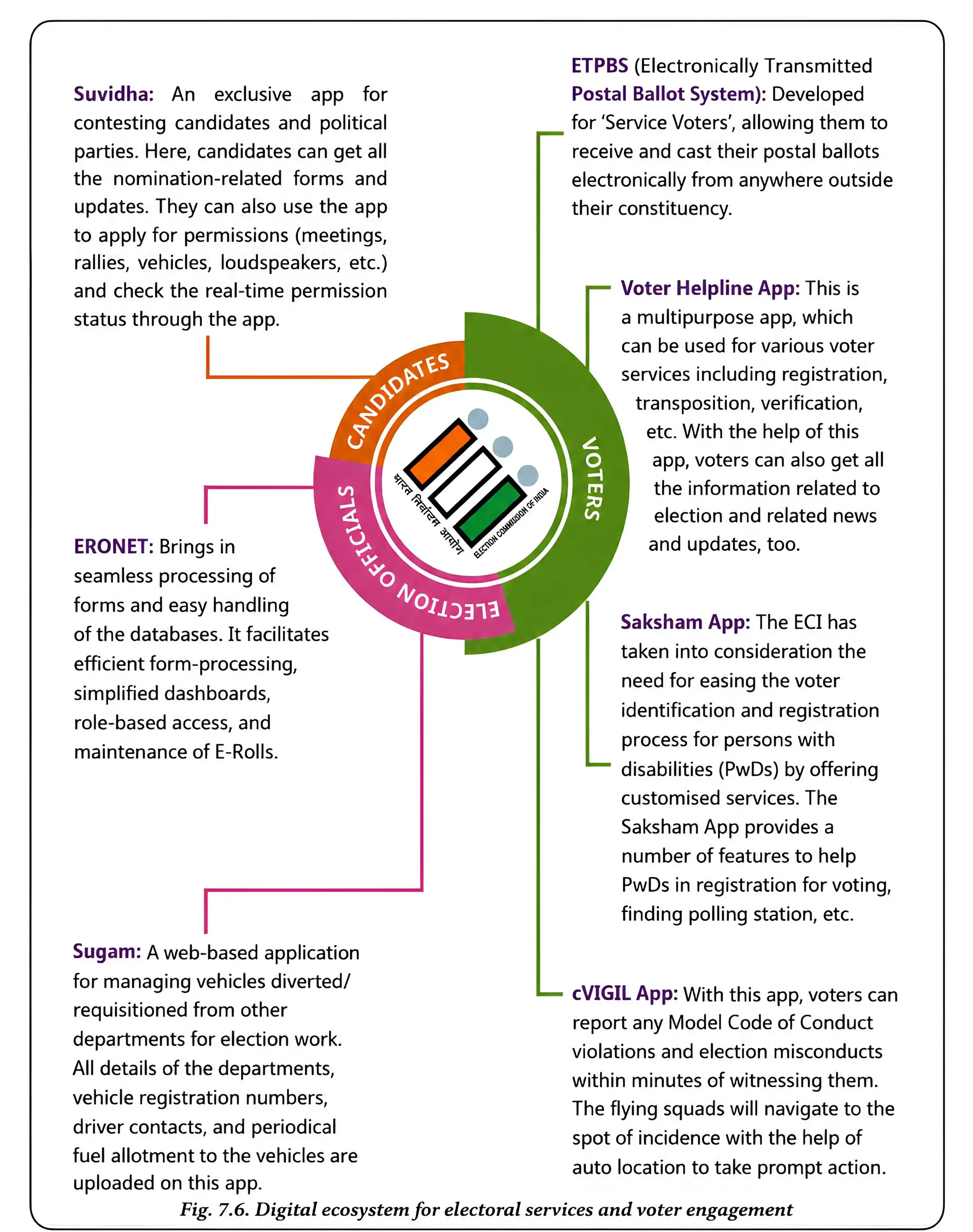
Electronically Transmitted Postal Ballot System (ETPBS) — A system that enables service voters to receive a postal ballot electronically and vote from a chosen location outside their assigned constituency.
Free, Fair and Inclusive Elections
- Why fairness matters: Elections must be impartial and transparent to maintain public trust and democratic value.
- Threats to fairness: Personal favours, inaccurate vote counting and barriers to voting can weaken the democratic value of an election.
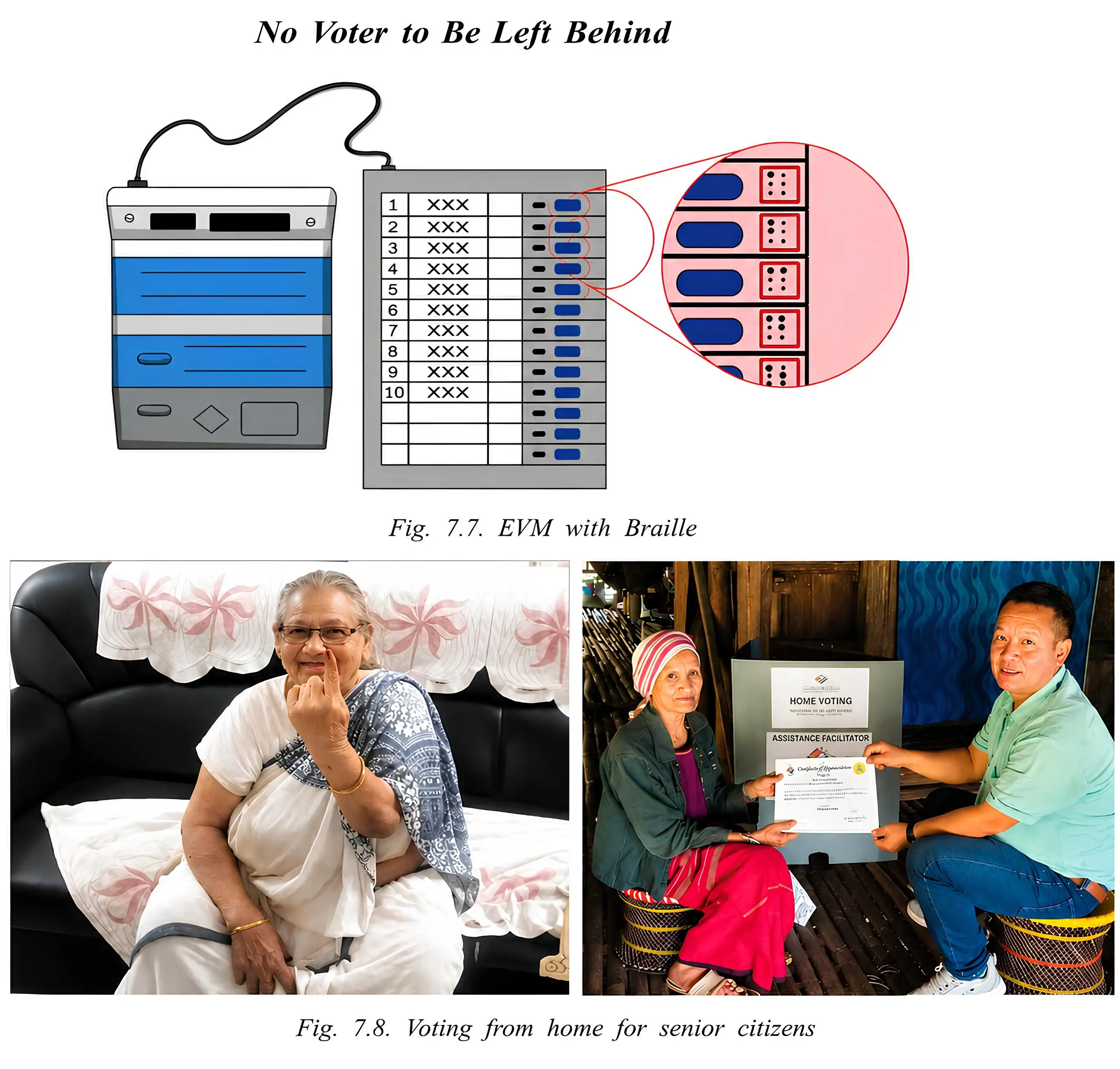
- Inclusive voting: ECI initiatives improve accessibility and use technology to support Persons with Disabilities (PwDs), senior citizens, transgender persons and Particularly Vulnerable Tribal Groups (PVTGs).
- Home voting: In the 2024 General Elections, home voting was extended across India for the first time to senior citizens above 85 and PwDs with a benchmark disability of 40%.
- Voters’ pledge: Citizens pledge to uphold free, fair and peaceful elections and vote fearlessly, without discrimination based on religion, race, caste, community or language, or influence by inducements.
Scale, Technology and International Cooperation
- Scale: The ECI manages elections for over 96.8 crore eligible voters across India’s diverse regions and terrains.
- Election management: Its work includes updating rolls, candidate nominations, regulating campaigns, law enforcement, State coordination, security, counting votes, declaring results and resolving disputes.
- Technology: Information and communication technologies and e-governance support these large-scale election tasks.
- International Election Visitors’ Programme (IEVP): This flagship ECI programme promotes cooperation with election management bodies (EMBs) and international organisations.
- Cooperation agreements: The ECI has signed MoUs with 28 EMBs and three international organisations: IFES, International IDEA and the United Nations.
- Electoral roll
- The constituency- and polling-station-wise list of eligible voters.
- Special Intensive Revision (SIR)
- A process to verify, update and correct electoral rolls.
- ETPBS
- Electronically Transmitted Postal Ballot System for service voters.
- Quasi-judicial body
- An authority that decides disputes, such as those over party recognition and election symbols.
What is the purpose of revising electoral rolls through SIR?
Name important responsibilities of the ECI.
How does the ECI promote inclusive voting?
Quick recap
- The ECI is an autonomous constitutional body established on 25 January 1950; Articles 324–329 provide its constitutional framework.
- Electoral rolls list eligible voters, and SIR updates them while allowing claims and objections.
- The ECI schedules elections, registers and classifies parties, allocates symbols and resolves related disputes.
- Free and fair elections require impartial processes, accurate counting and access for all voters.
- The ECI uses technology to manage elections for over 96.8 crore eligible voters and supports inclusive voting.
- The IEVP promotes cooperation with election bodies and international organisations.
Political Parties Part-1
Political Parties and Democracy
- Democratic role: Political parties help provide governance, accountability and representation.
- Public engagement: Parties bring citizens’ concerns and public issues into political debate and decision-making.
How Parties Work
- Candidate choices: Most election candidates contest as members of political parties, while some run as independents.
- Public agenda: Parties present policies and promises, discuss public issues and seek voters’ support during campaigns.
India’s Multi-Party System
- Many parties: India has numerous political parties that compete in elections.
- Diversity: The multi-party system reflects India’s varied languages, cultures, religions and regions.
Defection
- Meaning: Defection is abandoning or switching from the party under whose banner a candidate was elected.
- Examples: A member may join another party or act independently of the party’s decisions in the legislature.
- Debate: Defection may be seen as political opportunism that threatens stability, or as a way to follow one’s conscience and respond to public expectations.
Anti-Defection Law
Anti-Defection Law
- 1985The Anti-Defection Law was passed through the 52nd Constitutional Amendment Act.
- Political party
- A group that contests elections and presents policies and an agenda.
- Multi-party system
- A political system in which many parties compete in elections.
- Defection
- Leaving or acting against the party on whose ticket a member was elected.
- Whip
- A party’s instruction to its members on how to vote in the legislature.
- Anti-Defection Law
- The law that allows disqualification for specified forms of defection.
What are the main roles of political parties in a democracy?
When can a member be disqualified under the Anti-Defection Law, and who decides?
Quick recap
- Political parties communicate candidates’ policies and election agendas to voters.
- Parties organise public opinion, contest elections and contribute to democratic governance.
- India’s multi-party system reflects its social, cultural and regional diversity.
- Defection means leaving or acting against the party under whose banner a member was elected.
- The Anti-Defection Law was passed in 1985 through the 52nd Constitutional Amendment Act.
- The Speaker or Chairman decides whether a member should be disqualified under the law.
Political Parties Part-2
Recognition of Political Parties
| Criterion | Requirement |
|---|---|
| Vote share plus Lok Sabha seats | At least 6% of valid votes in at least four states in a Lok Sabha or Assembly general election, and at least four Lok Sabha seats from one or more states. |
| Lok Sabha seats across states | At least 2% of Lok Sabha seats, with candidates elected from at least three states. |
| State-party recognition | Recognised as a State Party in at least four states. |
| Criterion | Requirement |
|---|---|
| Assembly vote share plus seats | At least 6% of valid Assembly votes in the state and at least two seats in that Assembly. |
| Lok Sabha vote share plus seat | At least 6% of valid Lok Sabha votes in the state and at least one Lok Sabha seat from that state. |
| Assembly seats | At least 3% of Assembly seats or at least three seats, whichever is more. |
| Lok Sabha seats allotted to the state | At least one Lok Sabha seat for every 25 seats, or fraction thereof, allotted to the state. |
| Vote share | At least 8% of valid votes in the state in a Lok Sabha or Assembly general election. |
Registered Unrecognised Political Party (RUPP) — A registered party that has not met the required vote-share criteria, or has never contested an election since registration.
Coalitions and Political Alliances
Growth of Alliances in India
- 1967The era of single-party-dominated elections in India ended, and an era of alliances began.
- 1975–1977The National Emergency formed the backdrop to the political parties’ alliance.
- 1977Several parties united as the Janata Party, which formed India’s first coalition government at the national level—the Janata Government.
- Since the late 1990sThe BJP-led National Democratic Alliance (NDA) and Congress-led United Progressive Alliance (UPA) became major alliances in national elections.
- 2023The UPA was described as dissolving and being reconstituted as the Indian National Developmental Inclusive Alliance (INDIA).
| Alliance | Leadership / background |
|---|---|
| NDA | Led by the Bharatiya Janata Party (BJP). |
| UPA | Led by the Indian National Congress (INC) until its dissolution in 2023; the alliance was subsequently reconstituted as INDIA. |
- National Party
- A party recognised nationally after meeting at least one Election Commission criterion.
- State Party
- A party meeting at least one recognition criterion within a particular state.
- RUPP
- Registered Unrecognised Political Party.
- Alliance
- An arrangement in which political parties cooperate in elections or government.
State the three criteria for recognition as a National Party.
Why was 1977 important in the growth of coalition politics?
Quick recap
- The Election Commission recognises parties using vote-share and seat-based criteria.
- A party needs to meet any one listed criterion to qualify as a National or State Party.
- RUPPs are registered parties that have not met recognition requirements or have never contested an election.
- Alliances began in India in 1967, and the Janata Party formed the first national coalition government in 1977.
- The BJP-led NDA and Congress-led UPA became major alliances from the late 1990s; the UPA was reconstituted as INDIA in 2023.
Challenges to Free and Fair Elections
Challenges and safeguards
Why elections are challenging to conduct
- Scale: In 2024, India had over 96.8 crore voters, thousands of polling stations and hundreds of political parties.
- Diversity: Elections take place across regions with different socio-economic realities.
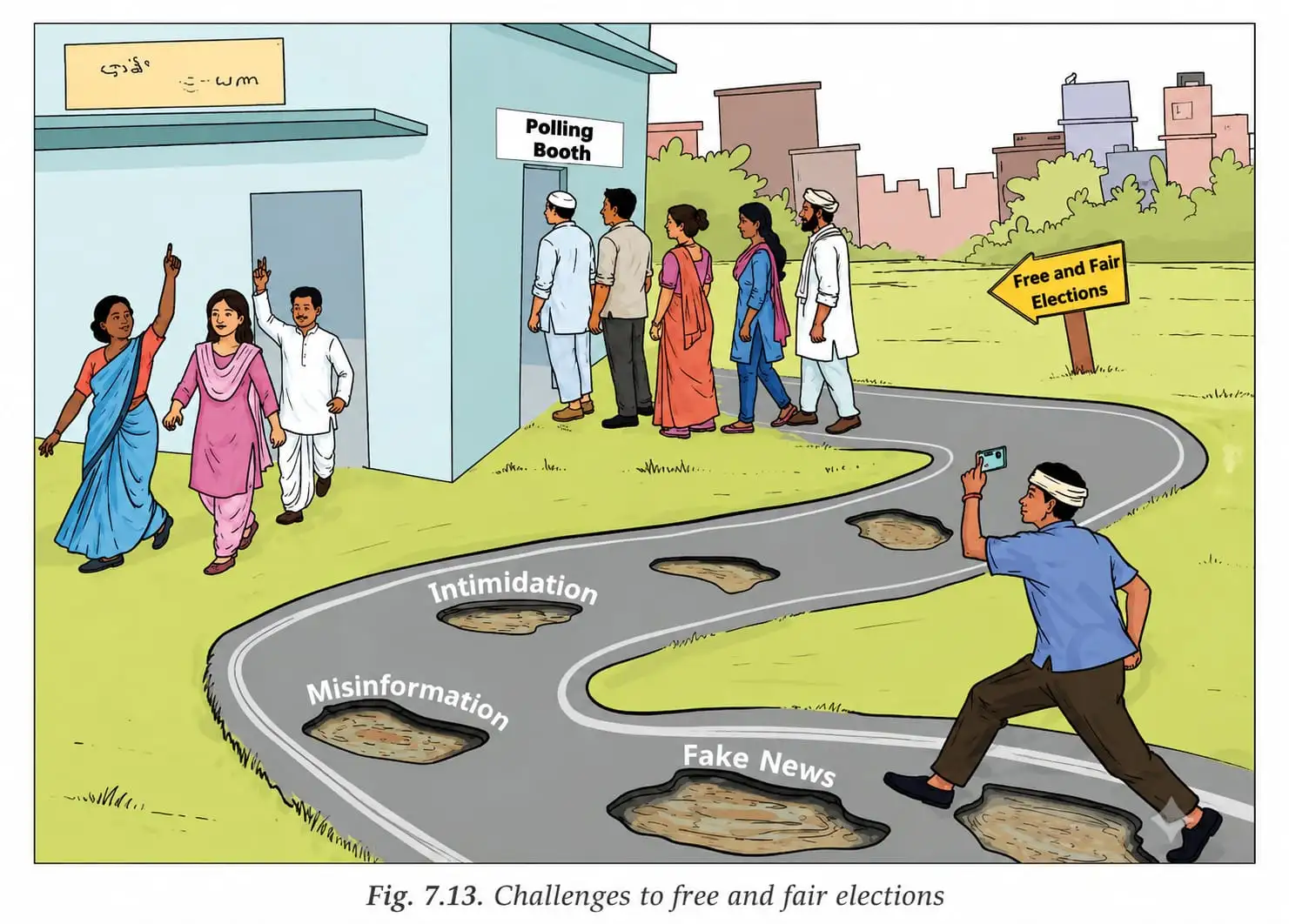
- Obstacles: Misinformation, fake news and intimidation can hinder free and fair elections.
| Measure | Role |
|---|---|
| Representation of the People Acts, 1950 and 1951 | Provide laws that help ensure the election process is free, fair and transparent. |
| Model Code of Conduct | A measure used by the Election Commission of India (ECI) during elections. |
| EVMs and VVPAT | Election tools used as part of the safeguards for conducting elections. |
| Voter-awareness campaigns | Help voters participate with awareness. |
| Citizen vigilance and participation | Support representative elections and a stronger democracy. |
Why elections matter
- Vote: Casting a vote is both a constitutional right and a duty of every citizen.
- Democracy: Elections give every citizen an equal voice in forming a government, making them central to democracy.
- Political parties: By presenting different programmes and policies, parties help voters make informed choices.
- Impartiality: The ECI works to conduct elections impartially at multiple levels despite the challenges.
Institutions supporting elections
- Election Commission of India (ECI): Works to ensure that elections are conducted impartially.
- Delimitation Commission: Along with election laws and the ECI, helps safeguard a free, fair and transparent election process.
- ECI
- Election Commission of India; works to conduct elections impartially.
- Model Code of Conduct
- A set of conduct guidelines used during elections.
- VVPAT
- Voter Verifiable Paper Audit Trail; an election safeguard used alongside EVMs.
- Representation of the People Acts
- The 1950 and 1951 laws that help ensure elections are free, fair and transparent.
Name major challenges to conducting free and fair elections in India.
Mention measures used to support free and fair elections.
Quick recap
- India's large electorate and diversity make conducting elections a major task.
- Misinformation, fake news and intimidation can obstruct free and fair elections.
- Election safeguards include the Representation of the People Acts, the Model Code of Conduct, EVMs and VVPAT.
- Voter awareness, vigilance and citizen participation strengthen elections and democracy.
- Voting is both a constitutional right and a duty; elections give citizens an equal voice.
- The ECI works for impartial elections, while political parties help voters compare programmes and policies.
Social Science — ALL CHAPTERS
1
The French Revolution
2
Socialism In Europe And The Russian Revolution
3
Nazism And The Rise Of Hitler
4
Forest Society And Colonialism
5
Pastoralists In The Modern World
1
Understanding Social Science
2
Shaping of the Earth’s Surface
3
Atmosphere and Climate
4
Early Humans and Beginning of Civilisation
5
State and Society up to 1000 CE
6
Democracy
7
Elections
8
Building Blocks in Economics: The Problem of Choice
9
The Price Puzzle: What Drives the Market