Class 9 . Social Science . Understanding Society India and Beyond Part I . Democracy
Chapter 6: Democracy
Ch 6
Social Science
Class 9
Tracing Democratic Traditions from Early Times
Democracy and India Today
The Constitution and Democracy
- Role: The Constitution safeguards citizens’ rights and guides democratic principles.
- Fundamental Rights: It guarantees and protects these rights for all citizens.
- Equality: It bars discrimination based on religion, race, caste, sex or place of birth.
- Participation: Elections enable citizens to participate at national, state and local levels.
Key Constitutional Dates
- 1946The Constituent Assembly was formed to draft India’s Constitution.
- 1947India attained independence from British colonial rule.
- 26 November 1949The Constitution of India was adopted.
- 26 January 1950The Constitution came into force.
Early Democratic Traditions in India
The Rig Veda and Collective Decision-Making
- Aikyamtya Sūktam: A verse in the Rig Veda highlights shared counsel, common intention and unity within an assembly.
- Democratic values: Its ideas reflect collective thinking, discussion, consensus and shared responsibility.
Bauddha Saṁghas
- Saṁgha: A monastic community established by Gautama Buddha.
- Decision-making: Members debated, chose their leader and made decisions through voting.
Colonial Rule and the Revival of Democratic Ideas
- Foreign invasions disrupted the political and social fabric in some parts of India.
- By the 19th century, British rule covered most of the Indian subcontinent.
- Colonial rule altered political structures and limited people’s participation in governance.
- The struggle for independence revived and strengthened democratic ideas among the people.
The Constituent Assembly and a Flexible Constitution
- Drafting: The Constituent Assembly took 2 years, 11 months and 18 days to draft the world’s longest written Constitution.
- Influences: India’s democratic traditions and the global spread of democratic values shaped the Assembly’s debates.
- Purpose: The Constitution established institutions and processes upholding liberty, equality, justice and fraternity.
- Amendments: Article 368 permits lawful amendments, allowing the Constitution to respond to changing needs while preserving its fundamental values.
| Point | Purpose |
|---|---|
| Fundamental values | Protect liberty, equality, justice and fraternity. |
| Article 368 | Allows lawful amendments so provisions can adapt to changing social and political needs. |
- Constituent Assembly
- The assembly formed in 1946 to draft India’s Constitution.
- Gaṇas or saṁghas
- Early republican states with collective forms of political organisation.
- Article 368
- The constitutional provision for making lawful amendments.
How did early Indian traditions reflect democratic ideas?
Why does the Constitution provide for amendments under Article 368?
Quick recap
- Democracy places power with citizens, who participate through free and fair elections.
- India is the world’s largest democracy and largest participatory democracy.
- Vedic assemblies, early republics and Bauddha Saṁghas show traditions of collective decision-making.
- British colonial rule limited participation; the independence struggle strengthened democratic ideas.
- The Constituent Assembly was formed in 1946 and drafted the world’s longest written Constitution in 2 years, 11 months and 18 days.
- Article 368 allows lawful amendments while the Constitution upholds its fundamental values.
Principles of Democracy
Popular Sovereignty
Popular sovereignty — The people are the ultimate source of a state's power and authority.
How people exercise sovereignty
- Elections: People elect representatives and governments through free and fair elections.
- Universal adult franchise: Every citizen aged 18 or above has the right to vote.
- Secret ballot: Voting is conducted secretly, allowing citizens to choose freely.
Rule of Law
Rule of law — Everyone is subject to the law, and disputes must be resolved through legal procedures rather than force or personal influence.
Essential safeguards
- Equality before law: Every person is treated equally by law, regardless of status, identity or rank.
- Equal protection: People in similar circumstances receive equal treatment without discrimination.
- Due process: No citizen can be punished without following legal procedures and providing a fair chance to defend their rights.
- Purpose: The rule of law prevents misuse of power and supports justice, accountability and public trust.
Fundamental Rights
Protection and enforcement
- Role: Fundamental Rights protect the rights, freedoms and dignity of citizens.
- Enforcement: These rights can be enforced in courts; violations can lead to legal action.
- Nature: They are indivisible and inalienable, but may be subject to reasonable restrictions under procedures established by law.
- Remedies: Citizens can seek constitutional remedies under Articles 32 and 226.
| Fundamental Right | Articles |
|---|---|
| Right to Equality | 14–18 |
| Right to Freedom | 19–22 |
| Right Against Exploitation | 23–24 |
| Right to Freedom of Religion | 25–28 |
| Cultural and Educational Rights | 29–30 |
| Right to Constitutional Remedies | 32 |
Right to Education
- Article 21A: Added in 2009; it guarantees free and compulsory education to children aged 6–14.
Separation of Powers
Separation of powers — Government responsibilities are divided among the legislature, executive and judiciary to prevent power from being concentrated in one organ.
| Organ | Main responsibility |
|---|---|
| Legislature | Makes laws |
| Executive | Implements and enforces laws |
| Judiciary | Interprets laws and checks their constitutionality |
Checks and balances
- Purpose: Each organ has distinct responsibilities, helping institutions work effectively and responsibly.
- Constitutional review: Parliament may amend the Constitution, but the judiciary can review amendments for consistency with its spirit.
- Review of laws: The judiciary can declare a law unconstitutional if it conflicts with constitutional provisions.
- Limits on enforcement: Executive agencies must act under laws and rules made by Parliament, and competent courts can review their actions.
Judiciary and access to justice
- Independence: The judiciary is impartial and independent, safeguards rights and upholds the Constitution.
- Public Interest Litigation (PIL): A legal action brought in court to enforce a public interest and improve access to justice.
Accountability and Transparency
How citizens hold government accountable
- Public scrutiny: Elections, public debates and engagement with civil society let citizens evaluate government actions.
- Ongoing participation: Public involvement strengthens democracy and builds trust between citizens and government.
- Right to Information (RTI) Act, 2005: Allows citizens to seek information from government agencies, supporting transparency.
Key constitutional and legal dates
- 2005The Right to Information Act enables citizens to seek information from government agencies.
- 2009Article 21A was added, guaranteeing free and compulsory education for children aged 6–14.
What is popular sovereignty, and how do citizens exercise it?
How does separation of powers prevent misuse of power?
- Universal adult franchise
- The right of every citizen aged 18 or above to vote.
- Due process
- Fair legal procedures that must be followed before a person is punished.
- Public Interest Litigation (PIL)
- A court action initiated to enforce a public interest.
- Right to Information (RTI)
- A legal right to seek information from government agencies.
Quick recap
- People are the ultimate source of democratic power and exercise it through elections.
- Universal adult franchise gives citizens aged 18 or above the right to vote by secret ballot.
- The rule of law means equality before law, fair legal procedures and no one being above the law.
- The Constitution guarantees six enforceable Fundamental Rights, subject to reasonable restrictions.
- Separation of powers divides responsibilities and enables checks and balances among government organs.
- Elections, public participation, PIL and the RTI Act support accountability, justice and transparency.
Multi-Party System
Multi-party system — A political system in which several parties contest elections and represent different interests and viewpoints.
How it works
- Choice: Voters can choose the party they consider most suitable.
- Party principles: Each party’s ideas, values and principles guide its policies and actions.
- Government: A party, or coalition of parties, securing more than 50% of the seats forms the government.
- Opposition: Parties with fewer seats form the opposition.
- Representation: Parties reflect India’s socio-cultural, political, ideological and regional diversity.
- Legal framework: Political parties function under rules including the Representation of the People Act, 1951.
Safeguarding the Rights of Vulnerable Groups
Government responsibility
- Equal protection: Government must protect all communities, regardless of caste, gender, religion or regional background.
- Equity: Historical inequalities in opportunities and resources make fair distribution especially important for vulnerable groups.
- Non-discrimination: Resources should be distributed equitably, especially to vulnerable sections, without discrimination.
Article 46 — The State must, with special care, promote the educational and economic interests of weaker sections—especially Scheduled Castes and Scheduled Tribes—and protect them from social injustice and all forms of exploitation.
Citizens, Institutions and Democratic Values
Citizens’ role
- Democratic strength: Democracy depends on citizens’ participation, awareness of their rights and duties, and commitment to honesty and fairness.
- Why it matters: Without these qualities, democratic processes and institutions cannot work effectively or produce meaningful outcomes.
| Process | Supporting institution(s) | Democratic value(s) |
|---|---|---|
| Legislative process | Parliament, State legislatures and local bodies | Representation, deliberation and dissent |
| Electoral process | Election Commission of India | Participation and equality |
| Judicial process | Courts | Rule of law, equality and justice |
| Participatory processes | Media and civil society | Debate, discussion and freedom of expression |
| Accountability mechanisms | Comptroller and Auditor General (CAG), Central Information Commission (CIC), Lokpal and Central Vigilance Commission (CVC) | Transparency |
| Decentralisation | Rural and urban local bodies | People’s participation at the grassroots |
| Checks and balances | Written Constitution guarantees division of powers between the Centre and States | Devolution of power |
Civil society — Voluntary groups, NGOs and community associations that function interdependently within society.
Features of Democracy in India
| Feature | Key point or example |
|---|---|
| Popular sovereignty | Identified as a key feature of democracy. |
| Rule of law | Identified as a key feature of democracy. |
| Separation of powers | Identified as a key feature of democracy. |
| Fundamental rights | Identified as a key feature of democracy. |
| Accountability and transparency | Question Hour and auditing government accounts support accountability; the Right to Information promotes transparency. |
| Multi-party system | Several parties contest elections, giving voters choice and representing diverse interests. |
Question Hour — The first hour of a parliamentary session, when members question the government to scrutinise its work and hold it accountable.
Role of Media in Democracy
Media’s democratic role
- Information: Newspapers, news channels and social media keep people informed about developments around the world.
- Public voice: Media raises public concerns and contributes to their resolution through appropriate mechanisms.
- Democratic safeguard: By safeguarding people’s voices and supporting democratic principles, media is often called the fourth pillar of democracy.
How is a government formed in a multi-party system?
What does Article 46 require the State to do?
Why is media called the fourth pillar of democracy?
Quick recap
- Several parties represent diverse interests and give voters a choice; a party or coalition with more than 50% of seats forms the government.
- Political parties function under legal rules, including the Representation of the People Act, 1951.
- Government must protect all communities and distribute resources equitably; Article 46 calls for special care for weaker sections, especially SCs and STs.
- Article 46 also requires protection from social injustice and all forms of exploitation.
- Citizens’ participation, awareness of rights and duties, honesty and fairness help democracy function effectively.
- Democratic processes are supported by institutions and values such as representation, equality, justice, transparency and grassroots participation.
- Question Hour supports accountability, the Right to Information promotes transparency, and media is often called the fourth pillar of democracy.
Types of Democracy
Different Models of Democracy
Democracy — A system of government based on principles such as freedom, equality, participation, rule of law, rights and duties.
Why democratic systems differ
- No single model: Countries organise democracy in different ways while following fundamental democratic principles.
- Main differences: Systems vary in how citizens participate, how political power is structured and whether checks and balances exist.
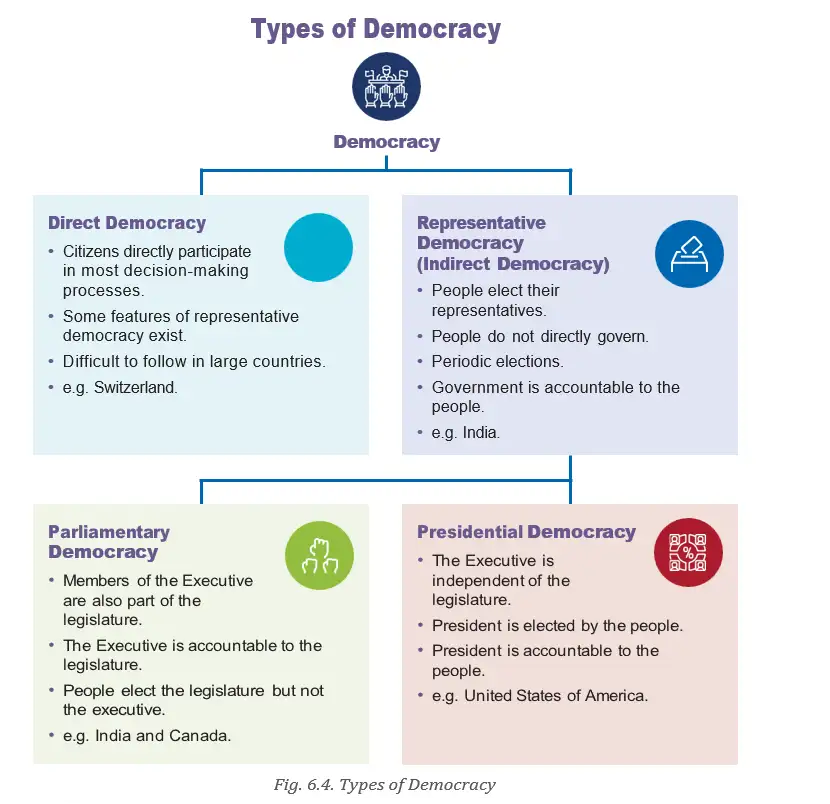
| Type | How decisions are made | Example from the lecture |
|---|---|---|
| Direct democracy | Citizens take part directly in making decisions. | Switzerland |
| Representative democracy | Citizens elect representatives to make decisions on their behalf. | India, Canada, United Kingdom and United States |
| Parliamentary democracy | A representative system in which executive power lies with the Prime Minister or the council of ministers. | India, Canada and United Kingdom |
| Presidential democracy | A representative system in which executive power lies with the President. | United States |
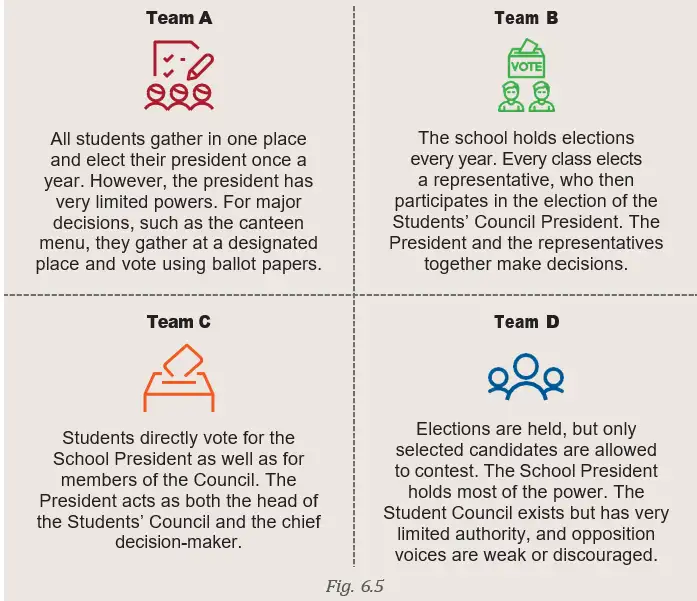
| Point | Parliamentary | Presidential |
|---|---|---|
| Executive power | Held by the Prime Minister or council of ministers. | Held by the President. |
| Examples in the lecture | India, Canada and the United Kingdom. | United States. |
Democracy Across Countries
| Country | Type and system | Executive power / Head of State and Government | Key features |
|---|---|---|---|
| India | Representative; parliamentary | Executive power lies with the Council of Ministers headed by the Prime Minister. President: Head of State; Prime Minister: Head of Government. | Multi-party democracy; written constitution; Fundamental Rights and Duties; federalism |
| Canada | Representative; parliamentary | Executive power lies with the Prime Minister. Governor-General, appointed by the Crown of the UK: Head of State; Prime Minister: Head of Government. | Federalism; multi-party system |
| United Kingdom | Representative; parliamentary democracy with a constitutional monarchy | Executive power lies with the Prime Minister. Monarch: Head of State; Prime Minister: Head of Government. | Unwritten constitution; parliamentary sovereignty; multi-party system |
| Switzerland | Direct democracy | Executive power lies with the Federal Council; the President is Head of Government. | Written constitution; multiple parties |
| United States of America | Representative; presidential | Executive power lies with the President; the President is Head of Government. | Written constitution; two major parties |
- Federalism
- A system in which power and responsibilities are shared between central and state governments. In India, the Constitution assigns subjects to central, state and concurrent lists; residual powers belong to the Centre.
- Sovereignty
- The supreme, final and independent legal authority of a State over its territory and citizens. The term comes from the Latin word superanus, meaning “supreme”.
- Constitutional monarchy
- A system in which a monarch is Head of State while executive power lies with the Prime Minister, as in the United Kingdom example.
Assessing a Country’s Democratic System
- Elections: Does the country hold regular elections, and who chooses the Head of Government?
- Political choice: Are there multiple political parties?
- Public freedoms: How freely can citizens express opinions and criticise the government?
- Overall judgement: Use these features to assess whether a system is democratic, partially democratic or non-democratic.
How do direct and representative democracy differ?
What is federalism?
Quick recap
- Democracies share core principles but can organise participation and political power differently.
- Direct democracy involves citizens in decision-making; representative democracy uses elected representatives.
- Parliamentary systems place executive power with a Prime Minister or council of ministers; presidential systems place it with the President.
- In India, executive power lies with the Council of Ministers headed by the Prime Minister.
- Countries differ in their heads of state and government, constitutions, party systems and distribution of power.
- Federalism shares power between central and state governments; sovereignty is a State’s supreme legal authority.
- Regular elections, political parties and freedom of expression help assess how democratic a country is.
Democracy in Practice: India’s Living Democracy Part-1
The Scale and Diversity of Indian Democracy
India’s democratic reach
- Largest democracy: India is the world’s largest democracy, with more people voting than the total population of many countries.
- Voters: India had over 96.8 crore registered voters in 2024.
- Representation: In 2019, each Member of Parliament represented about 25 lakh people on average.
- Languages and symbols: Elections are conducted in 22 scheduled languages and several others. Election symbols help citizens who cannot read vote independently.
- Polling stations: More than one million polling stations are set up, including in remote areas; some are created for a single voter.
- Political parties: India has over 2,800 registered parties, reflecting social and regional diversity.
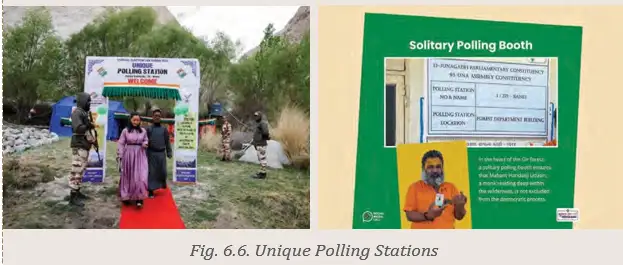
Why Indian democracy is considered living
- Scale and capacity: Regular nationwide elections for a huge population demonstrate the reach and organisational strength of democratic institutions.
- Inclusion: People from different linguistic, religious and socio-economic backgrounds participate within one democratic framework.
- Public participation: The ballot gives communities and regions a way to express their voices and help shape governance.
- Periodic elections: These allow people to choose their representatives; elections are studied in detail in the next chapter.
Participation Beyond Elections
Participatory democracy — A form of democracy in which citizens take part not only in elections but also in shaping policies and governance.
Ways citizens participate
- Mechanisms: Local councils, public consultations and community-led initiatives enable citizens to contribute to decisions.
- Outcome: Active participation can make governance more responsive to people’s needs.
India’s Three-Tier Government and Tribal Provisions
Constitutional structure
- Three tiers: The Union, State and Local governments support administration and democratic participation across the country.
- Autonomous District Councils (ADCs): Established in specific north-eastern regions, they have legislative and judicial authority to help preserve tribal customs.
- PESA Act, 1996: The Panchayats (Extension to Scheduled Areas) Act applies to tribal areas in other states and empowers the Gram Sabha as the primary decision-making body.
- Balance: These arrangements combine a unified national framework with space for diverse community traditions.
Democracy at the Grassroots in India
Jethipura Gram Panchayat, Gujarat
- Location: Jethipura is in Idar Block, Sabarkantha district, Gujarat.
- Recognition: It received the Nanaji Deshmukh Rashtriya Gaurav Gram Sabha Puraskar (NDRGGSP) in 2019 for exemplary performance.
- Effective Gram Sabhas: It conducted meetings effectively, maintained records properly and organised Special Gram Sabhas.
- Local action: The Panchayat acted on education, sanitation, and the welfare of women and children.
- Inclusion: It held Mahila Sabhas, ensured a quorum and encouraged participation by women and marginalised communities, including Scheduled Castes and Scheduled Tribes.
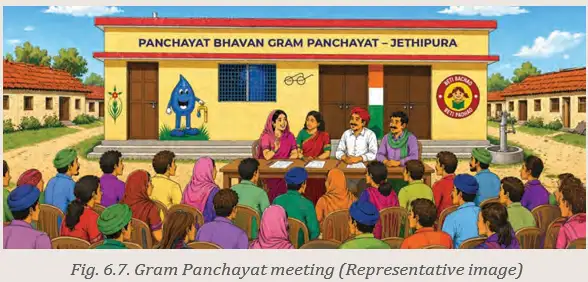
Quorum — The minimum number of members who must be present for an assembly’s meeting proceedings to be valid.
South Manubankul Gram Panchayat, Tripura
- Location: It is in Rupaichari Block, within the Tripura Tribal Areas Autonomous District Council.
- Women’s participation: It promotes women’s involvement in decision-making and supports self-help groups.
- Services and development: It works on health, sanitation, livelihoods, cleanliness, education and social awareness, and helps implement government schemes.
- Recognition: The Ministry of Panchayati Raj recognised it nationally as a “women-friendly panchayat” for its focus on women’s welfare and inclusive development.
How grassroots participation strengthens democracy
- Citizens take part in local self-government and Gram Sabha processes.
- Local bodies hear community needs and include marginalised voices.
- Panchayats act on local priorities and implement development measures.
- Democracy becomes more responsive, inclusive and effective.
- Participatory democracy
- Citizen involvement in governance beyond voting.
- Gram Sabha
- Village-level assembly; under PESA it is the primary decision-making body in covered tribal areas.
- Autonomous District Council (ADC)
- A council in specific north-eastern regions with legislative and judicial authority to protect tribal customs.
- Quorum
- Minimum attendance required for valid meeting proceedings.
How does India make elections accessible to a diverse electorate?
How do the PESA Act and Autonomous District Councils support tribal communities?
Give examples of grassroots participation in Jethipura and South Manubankul.
Quick recap
- India’s democracy combines a vast electorate with institutions that reach remote locations and diverse communities.
- In 2024 India had over 96.8 crore registered voters; in 2019 an MP represented about 25 lakh people on average.
- Participatory democracy includes citizen engagement in governance beyond periodic elections.
- India’s government has Union, State and Local tiers; ADCs and the PESA Act provide protections for tribal self-governance and customs.
- Jethipura and South Manubankul show how inclusive local action can improve community welfare.
- Grassroots participation makes democracy more responsive, inclusive and effective.
Democracy in Practice: India’s Living Democracy Part-2
Democracy Beyond Government
Democratic functioning in everyday life
- Purpose: Democracy promotes participation and fairness, limits the concentration of power, and resolves disagreements peacefully.
- Beyond government: Democratic decision-making can also operate in civil society organisations, socio-religious and community institutions, cooperatives, and trade unions.
- Cooperatives: Members work together for common benefit and share responsibilities and profits equally.
- Citizen–State link: Civil society and community institutions can connect citizens with the State and help make democracy more inclusive and responsive.
Women and the Right to Vote
| Point | Britain and the United States | India |
|---|---|---|
| How voting rights were secured | Women gained full voting rights after decades of protests and movements. | The Constitution extended Universal Adult Franchise to all citizens, men and women alike, without discrimination. |
| Key date | United States: 1920; Britain: 1928. | Universal Adult Franchise took effect when the Constitution came into force in 1950. |
| Continuing issue | Voting rights were gained gradually. | Voting rights do not by themselves ensure equal participation; social prejudices can limit women’s representation in politics. |
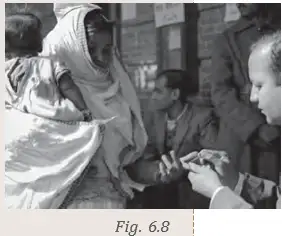
Women’s Reservation in Local Bodies
| Institution | Constitutional provision | Additional state-level provision |
|---|---|---|
| Panchayats | Article 243(d): At least one-third of seats filled by direct election are reserved for women. | 21 States and 2 Union Territories provide 50% reservation in Panchayati Raj Institutions. |
| Municipalities | Article 243(t): At least one-third of seats filled by direct election are reserved for women. | As of 2023, 17 States and 1 Union Territory provide 50% reservation in Urban Local Bodies. |
Why increased representation matters
- Participation: More women can take part directly in decisions that affect their communities.
- Inclusion: Representation helps bring women’s experiences and concerns into public decision-making.
- Responsiveness: A more representative legislature can better consider the needs of different groups.
The Right to Information Act, 2005
Right to Information (RTI) Act — A law that empowers citizens to seek information held by government departments, strengthening accountability and democratic governance.
How the RTI Act was shaped
- Concerns raised: Citizens, journalists, civil society groups, and elected representatives called for greater transparency and accountability.
- Proposal examined: Parliamentary committees considered the concerns; expert groups reviewed the proposal.
- Debate and consultation: Parliament debated the proposal, which was refined through stakeholder consultations.
- Safeguards included: Elected representatives shaped the law, including safeguards for national security and administrative efficiency.
- Law implemented: Parliament passed the RTI Act, which came into force in 2005.
Other ways citizens and communities strengthen democracy
- Public Interest Litigation (PIL): A means through which public concerns can be brought before the courts.
- Campaigns and community organisations: These can give people a voice and help make democracy more responsive.
- Legislation: Laws made by the government help maintain order and regulate society.
Grassroots Democracy
Rural participation and leadership
- Village: A unit of grassroots democracy that enables rural communities to participate in decision-making.
- Chaudhary Charan Singh and Babu Jagjivan Ram: Leaders from rural backgrounds who advocated for the rural poor and other marginalised sections of society.
Key Dates
- 1920Women gained full voting rights in the United States after decades of protest and movements.
- 1928Women gained full voting rights in Britain.
- 1950The Constitution came into force, extending Universal Adult Franchise to Indian citizens without discrimination by sex.
- 2005The RTI Act came into force in India.
- As of 202317 States and 1 Union Territory provided 50% reservation for women in Urban Local Bodies.
- Universal Adult Franchise
- The right of all adult citizens to vote without discrimination.
- Cooperative
- A group whose members work together for common benefit and share profits and responsibilities.
- Legislation
- Laws made by the government.
- Grassroots democracy
- Democratic participation and decision-making at the local community level.
How does women’s reservation strengthen democracy in local bodies?
How does the RTI Act strengthen democratic governance?
Quick recap
- Democracy: It promotes participation and fairness, limits concentrated power, and resolves disagreements peacefully.
- Everyday institutions: Cooperatives, community groups, civil society organisations, and trade unions may use democratic decision-making.
- Voting rights: India extended Universal Adult Franchise to women and men alike when the Constitution came into force in 1950.
- Women’s representation: Constitutional provisions guarantee at least one-third reservation in Panchayats and Municipalities; some States and Union Territories provide 50%.
- RTI: The Act came into force in 2005 and enables citizens to seek information from government departments.
- Grassroots democracy: Villages support local participation; Charan Singh and Jagjivan Ram advocated for rural and marginalised communities.
Challenges to Democratic Practices in India
Challenges to Democracy
Democracy — A system of self-governance through institutions, rules, and practices that enable people to participate in decision-making at local, state, and national levels.
Democracy needs active care
- Beyond elections: Democracy also depends on everyday decisions, responsible conduct, and citizens’ participation.
- Rights and responsibilities: The Constitution guarantees rights, while citizens are expected to exercise them responsibly.
- Weakening democracy: Damaging public property, spreading misinformation, breaking public rules, or ignoring public issues can weaken democratic values.
- Continuing challenges: Illiteracy, fake news, poverty, regionalism, gender inequality, and social discrimination can limit equal participation.
- Public trust: Gaps in implementing laws and policies may reduce people’s trust in institutions.
How misinformation can affect democracy
- False or misleading information spreads through social and digital media
- It can influence public opinion
- People may become confused
- In some cases, misinformation can contribute to conflict
The Emergency, 1975–77
Background and effects
- Background: In the early 1970s, dissatisfaction with Indira Gandhi’s government grew amid rising unemployment, inflation, and allegations of misgovernance.
- Declaration: In June 1975, the government declared a National Emergency on the grounds of internal disturbance.
- Restrictions: A majority of Fundamental Rights were suspended, the press was censored, and many political leaders and activists were arrested.
- Impact: Citizens’ freedoms were restricted and democratic institutions came under severe strain.
- Public mobilisation: Jayaprakash Narayan, a socialist thinker popularly known as Lok Nayak, mobilised students and citizens, especially in Bihar and Gujarat.
Key events
- June 1975National Emergency was declared on the grounds of internal disturbance.
- 1975–77Emergency restrictions affected rights, the press, political leaders, and democratic institutions.
- 1977The Emergency was lifted and general elections were held; the ruling government was defeated.
The Emergency and democratic resilience
- Unemployment, inflation, and allegations of misgovernance increase public dissatisfaction
- Protests and mass movements grow
- Emergency restrictions limit rights, press freedom, and political activity
- The Emergency is lifted and general elections are held in 1977
- Voters defeat the ruling government, demonstrating democracy’s resilience and the importance of safeguards and citizen participation
| Article | Provision |
|---|---|
| Article 352 | National Emergency |
| Article 356 | President’s Rule |
| Article 360 | Financial Emergency |
- Constitutional safeguards and civil liberties are essential to protecting democracy.
- Elections allow citizens to express their will and hold governments accountable.
- Active citizen participation can help defend democratic values.
Democracy and Young Citizens
Informed and responsible participation
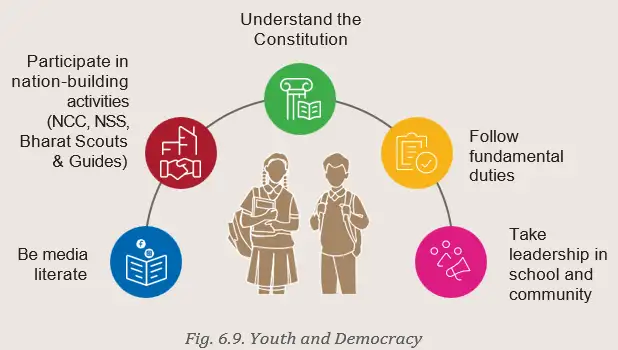
- Stay informed: Newspapers, news programmes, and responsible internet use help citizens understand national and international events.
- Use authentic information: Reliable information supports informed opinions on public issues and a better understanding of democracy.
- Serve and participate: The National Service Scheme (NSS) and National Cadet Corps (NCC) encourage civic responsibility, social awareness, teamwork, and service.
- Act responsibly: Respect others’ rights, follow laws and rules, use social media responsibly, value diversity, and take part in activities that strengthen unity.
- Civic responsibility
- Duties citizens carry out to respect rights, laws, diversity, and the well-being of their community.
- Misinformation
- False or inaccurate information that can mislead people and influence public opinion.
- National Emergency
- A constitutional emergency declared under Article 352.
- Universal adult franchise
- The right of all adult citizens to vote, subject to the law.
- Popular sovereignty
- The principle that ultimate political authority rests with the people.
Foundations and principles of Indian democracy
- Historical roots: The Sabhā and Samiti mentioned in Vedic texts reflected consultation and collective decision-making; these ideas, along with developments from around the world, helped shape modern democracy.
- Constitutional basis: India’s democracy rests on popular sovereignty, universal adult franchise, Fundamental Rights and Duties, the rule of law, and separation of powers.
- Democratic principles: Transparency, participation, inclusion, fairness, equality, accountability, and respect for diverse opinions guide democratic processes.
- Scale and diversity: India is the world’s largest democracy by the scale of citizen participation, particularly its number of registered voters; ensuring deeper inclusion and representation remains important.
- Everyday democracy: Institutions and laws matter, but informed and responsible citizens help democracy remain active and resilient.
What were the major effects of the Emergency of 1975–77?
How did the 1977 election demonstrate the resilience of Indian democracy?
How can young citizens strengthen democracy?
Quick recap
- Democracy is self-governance through institutions and practices that let people participate in decisions at local, state, and national levels.
- Democracy depends on institutions as well as informed, responsible citizens.
- Misinformation can influence public opinion, create confusion, and sometimes contribute to conflict; inequality and poor implementation also pose challenges.
- The 1975–77 Emergency restricted rights and freedoms; the 1977 election demonstrated democratic resilience.
- Articles 352, 356, and 360 concern National Emergency, President’s Rule, and Financial Emergency, respectively.
- Sabhā and Samiti traditions emphasized consultation and collective decision-making; constitutional values and civic participation help keep democracy vibrant.
Social Science — ALL CHAPTERS
1
The French Revolution
2
Socialism In Europe And The Russian Revolution
3
Nazism And The Rise Of Hitler
4
Forest Society And Colonialism
5
Pastoralists In The Modern World
1
Understanding Social Science
2
Shaping of the Earth’s Surface
3
Atmosphere and Climate
4
Early Humans and Beginning of Civilisation
5
State and Society up to 1000 CE
6
Democracy
7
Elections
8
Building Blocks in Economics: The Problem of Choice
9
The Price Puzzle: What Drives the Market