Class 9 . Social Science . Understanding Society India and Beyond Part I . Early Humans and Beginning of Civilisation
Chapter 4: Early Humans and Beginning of Civilisation
Ch 4
Social Science
Class 9
Introduction
Studying the Past Before Writing
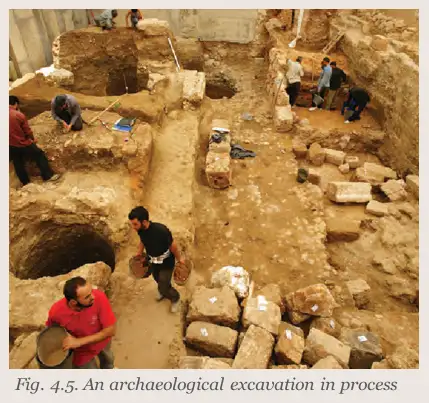
Archaeology — The study of the past through material remains, including human-made objects and other evidence.
Evidence for the Pre-writing Past
- Long human past: Human history goes back much further than the kingdoms and empires commonly studied.
- Pre-writing period: It is reconstructed mainly from archaeological evidence because writing emerged at different times in different regions.
- Artefacts: Tools, implements and other human-made objects help reveal how people lived.
Artefact — A human-made object from the past that can provide evidence about people’s lives.
Early Writing Systems
Harappan Writing
- Names: The Sindhu-Sarasvatī Civilisation is also called the Indus Valley or Harappan Civilisation.
- Script: Harappan inscriptions on objects such as seals and pottery show a pictographic script, also called Sindhu lipi.
- Status: The script has not yet been deciphered, so its written messages remain unknown.
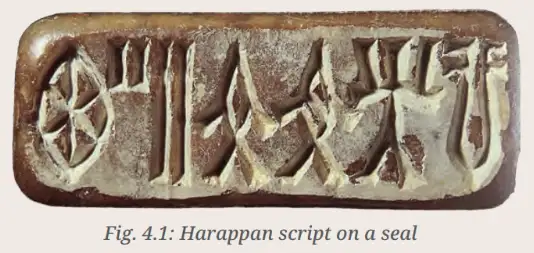
| Point | Harappan | Cuneiform and hieroglyphic |
|---|---|---|
| Associated with | Harappan (Sindhu-Sarasvatī) Civilisation | Cuneiform: Sumerians in Mesopotamia; hieroglyphic: ancient Egypt |
| Status | Undeciphered | Deciphered |
| Historical context | One of the earliest known writing systems | Both flourished around the time of the Harappan Civilisation; their decipherment marks the beginning of the historical period, about 5,000 years ago |
Brahmi Script
- Use: From about 400 BCE, Brahmi was used in parts of southern India and the Ganga Valley in northern India.
- Formalisation: Emperor Aśhoka formalised Brahmi in the 3rd century BCE; it was also used by contemporary Iron Age people across southern India.
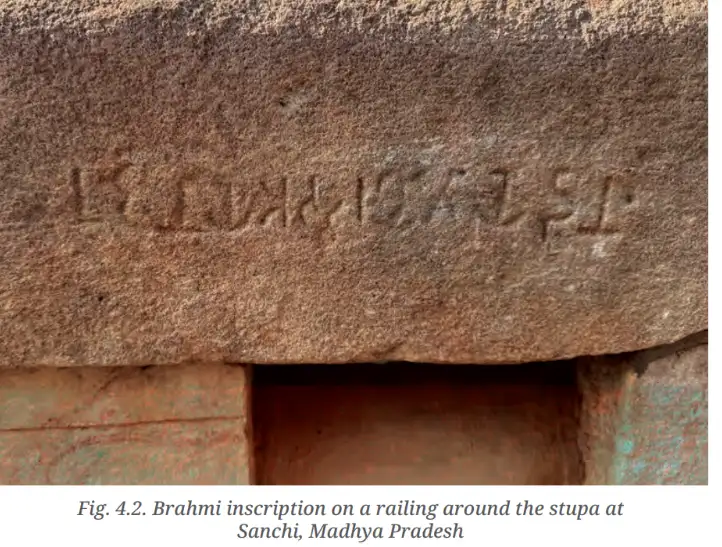
Human History Before and After Writing
| Point | Before writing | After writing |
|---|---|---|
| Share and span of human history | More than 99%: about 3 million to 5,000 years ago | Less than 1%: the last 5,000 years, including the present |
| Main sources | Tools, implements and other artefacts | Material remains and written documents |
| Understanding people | Thoughts and ideas are generally difficult to know | Written records provide names, events and details of social, political and cultural life |
| Dating | Dates of events and cultures are approximate | Written references to events, such as coronations and wars, make dating relatively accurate |
Key Periods
- About 3 million to 5,000 years agoMore than 99% of human history falls before writing.
- About 5,000 years agoThe deciphered early scripts mark the beginning of the historical period.
- About 400 BCEBrahmi was used in parts of southern India and the Ganga Valley.
- 3rd century BCEEmperor Aśhoka formalised Brahmi.
Quick recap
- The pre-writing past is reconstructed mainly through archaeology and artefacts.
- Harappan pictographic writing, or Sindhu lipi, remains undeciphered.
- Sumerian cuneiform and ancient Egyptian hieroglyphics were deciphered; both flourished around the Harappan period.
- More than 99% of human history lies before writing; written records make dating relatively accurate and reveal details of society.
- Brahmi was used from about 400 BCE in parts of southern India and the Ganga Valley, and was formalised by Aśhoka in the 3rd century BCE.
Why Should We Study Early Human History
What Early Human History Helps Us Understand
Evolution and environment
- Study of early human history helps explain humankind’s biological and cultural evolution in relation to changes in climate and the environment.
- Biological evolution describes gradual physical and genetic changes through which early ancestors, including australopithecines, evolved into modern humans, Homo sapiens.
- Cultural evolution explains how humans adapted to their surroundings and used natural resources.
| Type | What it explains |
|---|---|
| Biological evolution | Gradual physical and genetic changes, from australopithecines to Homo sapiens. |
| Cultural evolution | Changes in how humans adapted, including tools, techniques and technology. |
Quaternary Period — The Quaternary is the period covering the last 26 lakh years, including the present.
Cultural Change and the Beginning of Civilisation
Adaptation and livelihood
- Adaptation: Changing climates and environments encouraged humans to develop tools, techniques and technology to use natural resources.
- Changing livelihood: Human life gradually shifted from hunting and gathering to agriculture and food production.
- Surplus: Producing extra food and material goods laid the foundation for civilisation.
From Adaptation to Civilisation
- Changing climate and environment → need to adapt
- Tools, techniques and technology → better use of natural resources
- Agriculture and food production → surplus food and goods
- Surplus production → foundation for civilisation
Early Human Dispersal from Africa
Origins and dispersal
- African origins: It is generally agreed that our earliest ancestors evolved and lived in Africa.
- Homo erectus: An upright or bipedal human ancestor; it was the first hominin to leave Africa.
- Stone tools: Homo erectus used hand axes and cleavers; similar tools found in Asia and Europe indicate dispersal beyond Africa.
- Homo sapiens: Modern humans evolved in Africa and later spread across the world.
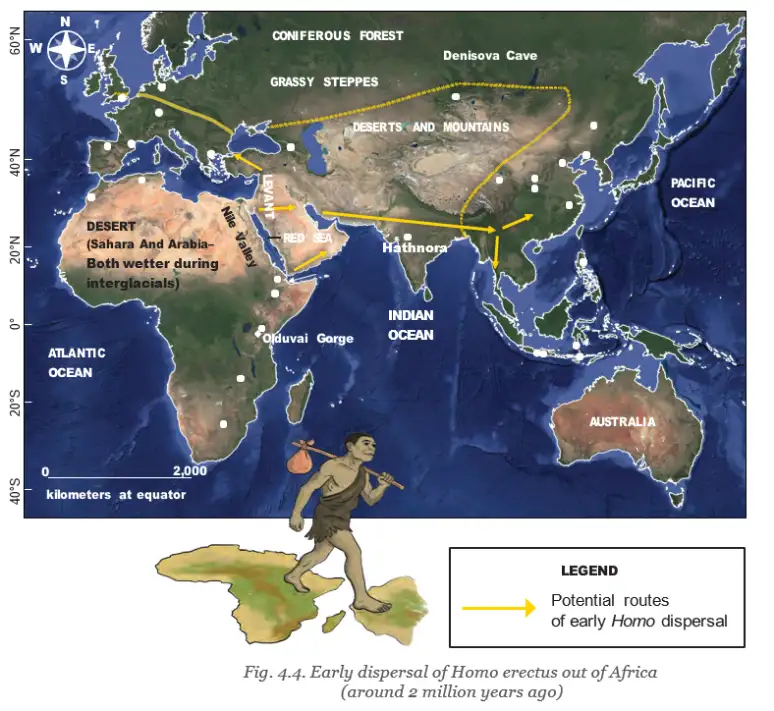
Evolution and Dispersal Dates
- Around 2 million years agoEarly human movement out of Africa began; Homo erectus was the first hominin to leave.
- Between 2 and 0.5 million years agoHomo erectus dispersed beyond Africa; its stone tools are found in parts of Asia and Europe.
- Around 300,000 years agoHomo sapiens evolved in Africa.
- Around 125,000 years agoA major movement out of Africa associated with early Homo sapiens took place.
- Australopithecines
- Early human ancestors; the name combines words meaning “southern” and “primate.”
- Hominin
- A group that includes modern humans and their early human-like ancestors.
- Homo sapiens
- Modern humans, who evolved in Africa around 300,000 years ago.
How We Learn About Our Ancestors
| Evidence | Interpretation | |
|---|---|---|
| Finds | Tools, bones and other objects uncovered at early human sites. | Clues used to reconstruct how people lived in the past. |
| Tool experimentation | Archaeologists make and use similar tools. | Helps explain how early humans created, used and depended on tools in daily life. |
How did surplus production contribute to the rise of civilisation?
What evidence indicates that Homo erectus moved beyond Africa?
Quick recap
- Early human history links biological and cultural evolution with climate and environmental change.
- Biological evolution describes gradual physical and genetic changes from australopithecines to Homo sapiens.
- The Quaternary Period covers the last 26 lakh years, including the present.
- Human adaptation and agriculture led to surplus food and goods, helping establish the foundation for civilisation.
- Homo erectus left Africa first; Homo sapiens evolved in Africa and later spread worldwide.
- Archaeologists use tools, bones, other finds and tool experiments to understand past ways of life.
Who Were Our Human Ancestors Part-1
The Old World and Early Tool Making
Old World — The geographical area of the earliest Palaeolithic human settlements in Africa, Asia and Europe.
Tools and Human Behaviour
- Co-existence: Different kinds of human ancestors lived at the same time.
- Earliest tools: A human ancestor made stone tools around 3.3 million years ago; this marks the beginning of what is called human behaviour.
- Hominins: Human beings came to be known as hominins, or tool makers, because they could make tools using cognitive ability.
- Extra-corporeal limbs: Tools acted as extensions of the body, helping people do tasks their hands alone could not manage.
- Tool use: People made and used tools, then discarded them when they wore out.
Early Tool Making
- Around 3.3 million years agoA human ancestor made the earliest stone tools.
Fossil — Preserved remains, traces or impressions of plants, animals or humans from the distant past, formed when buried remains slowly turn to stone over thousands or millions of years.
Tools, Fossils and Archaeological Evidence
- Tools as evidence: Worn tools were buried in upper layers of the earth and later discovered by archaeologists.
- Fossil formation: Remains of early ancestors could be buried deep underground and gradually become fossils.
- What evidence reveals: Tools and fossils help archaeologists reconstruct human history and understand how early humans lived.
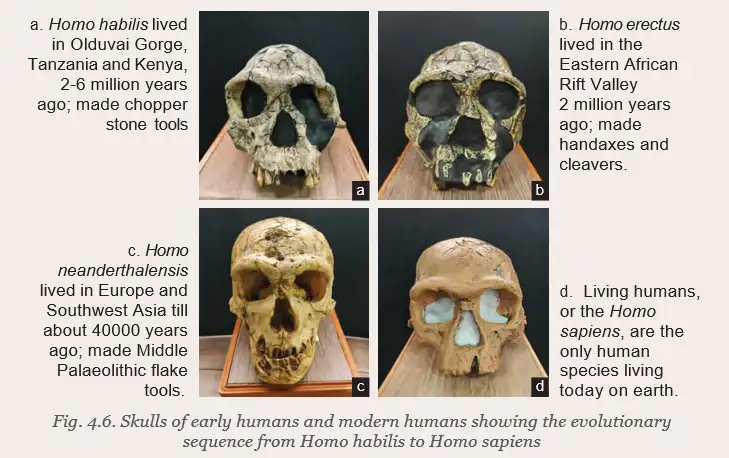
| Point | Homo habilis | Homo erectus | Homo sapiens |
|---|---|---|---|
| Meaning or association | “Handy man”; lived in Africa | Successors of Homo habilis; associated with handaxes and cleavers | Developed complex technologies |
| Location or spread | Especially Olduvai Gorge in Tanzania and Kenya | Among the first to migrate out of Africa and spread into Europe and Asia | Not specified here |
| Tools | A tool-making human ancestor | Invented handaxes and cleavers | All human ancestors made tools; Homo sapiens developed complex technologies |
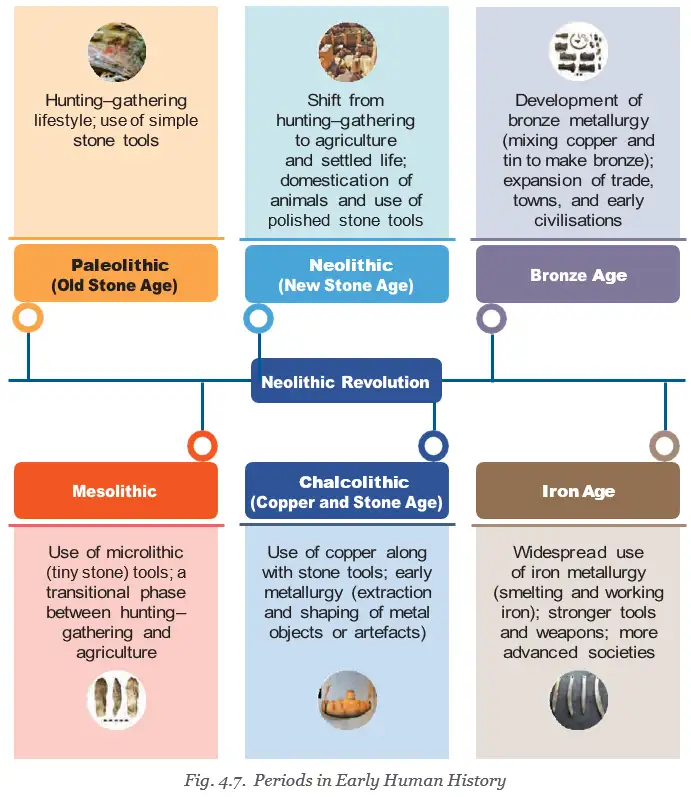
Periods in Early Human History
How Early Human History Is Divided
- Basis of division: Early human history is divided into periods according to technological progress and changes in human life.
- Key changes: Tool development and use, the beginning of agriculture, and changes in lifestyle and settlement patterns mark these stages.
- Sequence: The timeline shown extends from the Palaeolithic to the Iron Age.
Quick recap
- The Old World refers to Africa, Asia and Europe, where the earliest Palaeolithic settlements were found.
- Different human ancestors co-existed; the earliest stone tools date to around 3.3 million years ago.
- Hominins are known as tool makers, and tools functioned as extensions of the body.
- Tools and fossils help archaeologists reconstruct human history and understand early human life.
- Homo habilis lived in Africa; Homo erectus made handaxes and cleavers and was among the first to spread beyond Africa.
- Homo sapiens developed complex technologies; early human periods are classified by technology, agriculture, and changes in lifestyle and settlement.
Who Were Our Human Ancestors Part-2
Palaeolithic Hunter–Gatherers
Palaeolithic — The Palaeolithic, or Old Stone Age, is the earliest of the three broad Stone Age stages; *palaeo* means “old” and *lithic* means “stone”.
| Stage | Meaning |
|---|---|
| Palaeolithic | Old Stone Age |
| Mesolithic | A stage of the Stone Age |
| Neolithic | A stage of the Stone Age |
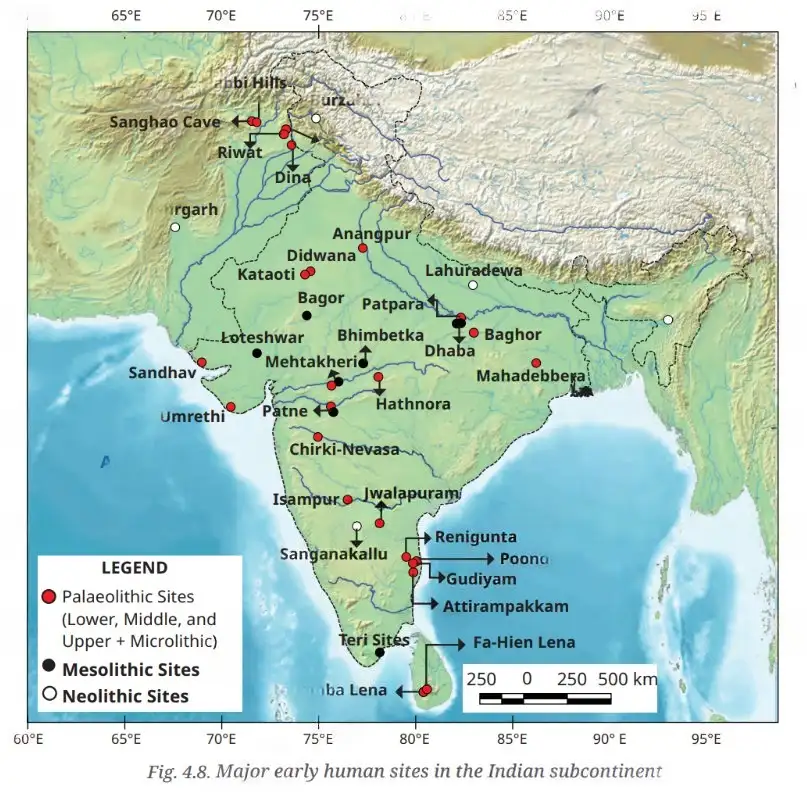
| Site or record | Approximate date |
|---|---|
| Oldest human settlement in the Indian subcontinent | About 2 million years ago |
| Attirampakkam, Tamil Nadu | About 1.5–1.7 million years ago |
| Isampur, Karnataka | About 1.2 million years ago |
Palaeolithic tools and their uses
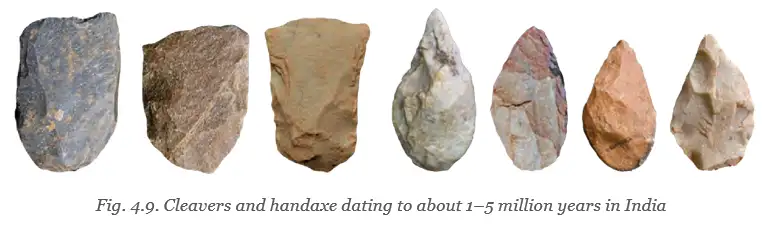
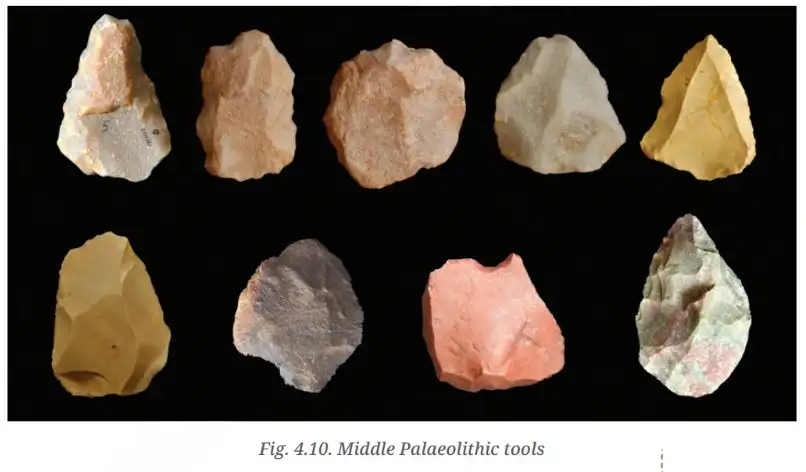
- Finds: Animal fossils and stone tools—including handaxes, cleavers, scrapers and choppers—were found at early sites.
- Materials: Tools were made using stones such as quartzite and limestone.
- Uses: Tools helped people chop meat, dig up tubers, scrape animal skins and cleave bones to obtain protein-rich marrow.
Smaller tools and improved hunting
- Tool types: Scrapers, borers and points were among the smaller stone tools.
- Development: Sharp points were used on projectiles, improving hunting efficiency.
Later Palaeolithic developments
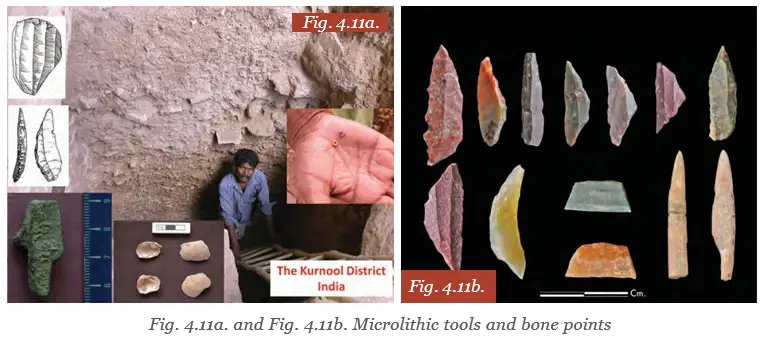
- Weapons and tools: People developed the bow and arrow, parallel-sided blades and microblades made from glassy-textured rocks; freshly made tools were very sharp.
- Hunting: People also hunted small game animals.
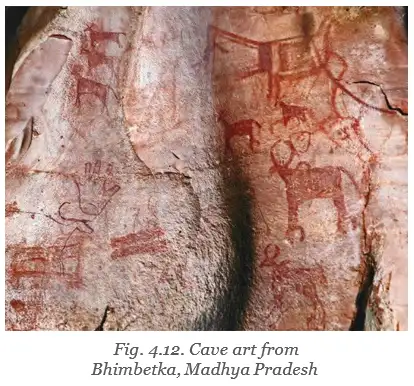
- Symbolic expression: They communicated symbolically, painted cave and rock-shelter walls, and used pigments to decorate their bodies.
- Ornaments: They made beads from stone, bone and shell—the first such bead-making described in the lecture.
Engraving and human dispersal
- Burin: This engraving tool was used to make symbolic designs on bones and shells, including ostrich eggs.
- Microblades: These could be fixed into a handle, making them easier to use.
- Homo sapiens: These developments are associated with our immediate ancestors, who gradually spread across the world, including Australia and the Americas.
Early human sites and dispersal
- About 2 million years agoThe oldest human settlement in the Indian subcontinent dates to this period.
- About 1.5–1.7 million years agoAttirampakkam in Tamil Nadu is dated to this period.
- About 1.2 million years agoIsampur in Karnataka is dated to this period.
- About 50,000–12,000 years agoHomo sapiens gradually spread around the world, including to Australia and the Americas.
Mesolithic Hunter–Gatherers
Climate change and changing ways of life
- Around 12,000 years ago, Earth’s climate became warmer.
- Forests and grasslands spread into areas once covered by ice sheets.
- New landscapes offered more resources, including small game, fish and edible wild grains.
- Human populations grew rapidly—the first population explosion in human history.
Mesolithic environmental change
- Around 12,000 years agoWarming climate transformed environments, expanded forests and grasslands, and increased the range of available resources.
Mesolithic subsistence, art and habitats
- Microliths: A variety of small stone tools helped people collect aquatic food from both marine and freshwater environments.
- Subsistence: Fishing became the mainstay of the Mesolithic subsistence economy.
- Art and shelter: Artistic activity flourished, and people frequently occupied caves and rock shelters.
- Bhimbetka: This World Heritage Site in Madhya Pradesh has hundreds of painted rock shelters showing Mesolithic and earlier human occupation.
- Palaeolithic
- Old Stone Age; an early period associated with stone tools and hunter-gatherers.
- Mesolithic
- Stone Age period in which microlithic tools supported varied food gathering, especially fishing.
- Microlith
- A small stone tool, sometimes fixed into a handle.
- Burin
- A stone engraving tool used to make symbolic designs on bone and shell.
- Homo sapiens
- Our immediate ancestors associated with these later Palaeolithic developments.
How did Palaeolithic stone tools support survival?
What changes followed the climatic warming around 12,000 years ago?
Quick recap
- The Stone Age is broadly divided into the Palaeolithic, Mesolithic and Neolithic.
- Early Indian sites include Attirampakkam and Isampur; their stone tools helped process food and hunt.
- Later Palaeolithic people used bows, blades and microblades and made symbolic art and beads.
- Homo sapiens spread to regions including Australia and the Americas between about 50,000 and 12,000 years ago.
- Around 12,000 years ago, warming expanded habitats and food resources, contributing to rapid population growth.
- Mesolithic people used microliths to gather aquatic food; fishing was central, and Bhimbetka preserves painted shelters.
The Neolithic Revolution
From Food Gathering to Food Production
Neolithic Revolution — The gradual transition from hunting and gathering to a food-producing way of life through farming and animal domestication.
Main Changes
- Background: Familiarity with seasons and food resources helped hunter-gatherers gradually adopt food production.
- Domestication: Selected plants and animals were brought under human control; cultivation and animal husbandry also developed new breeds.
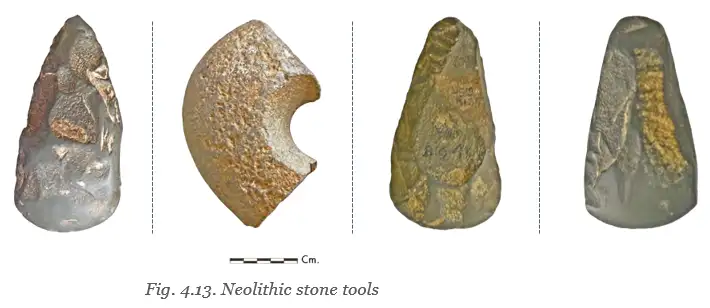
- Tools: Hunter-gatherers made tools to procure food, while Neolithic farmers made tools for food production and processing.
- Crafts and resources: People used varied raw materials and made earthenware pottery in different shapes and sizes.
- Settlements: The first village settlements emerged, laying foundations for the later urban revolution.
A Gradual and Uneven Transition
- Different timings: The shift from hunting and gathering to cultivation and settled agriculture occurred at different periods in different world regions.
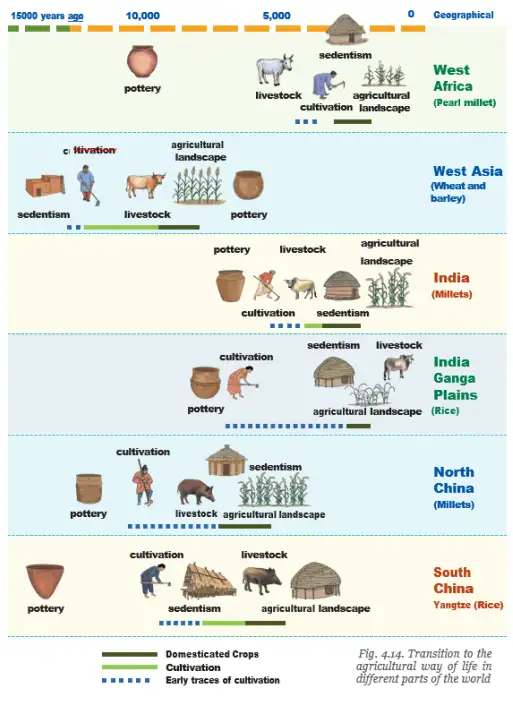
Neolithic Period in the Indian Subcontinent
Mehrgarh
- Location and importance: Mehrgarh, on the Bolan River in present-day Pakistan, is the oldest Neolithic site and earliest agricultural village in the subcontinent.
- Settlement: People built handmade, sun-dried brick houses and granaries, and buried their dead in graves.
- Crafts: They made ornaments from semi-precious stones such as lapis lazuli and carnelian, as well as from shells.
- Farming and herding: They cultivated wheat and barley and raised sheep, goats and Indian cattle, especially the zebu humped bull.
- Copper: Mehrgarh’s people were the first to make copper objects; this marked their entry into the metal age. By about 4000 BCE, they were popularly known as Chalcolithic people.
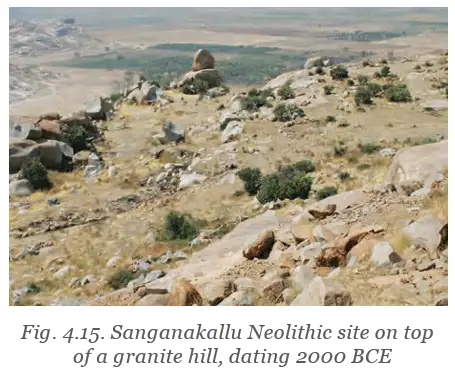
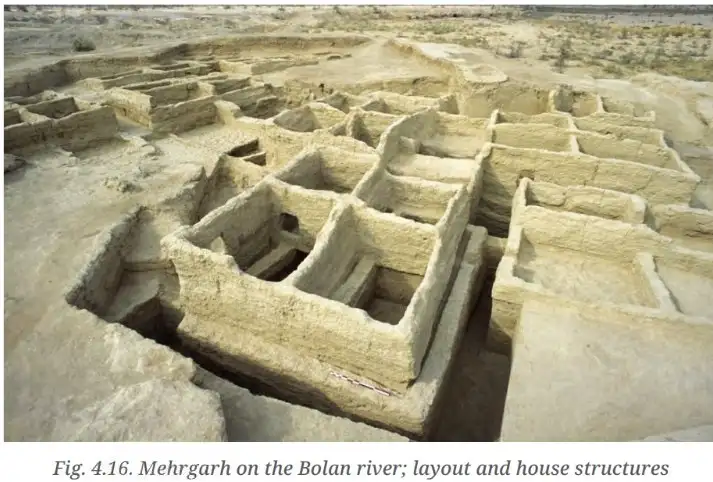
Neolithic Communities across the Subcontinent
- By 2500 BCE: Neolithic agricultural communities occupied most of the Indian subcontinent.
- Livelihood: Cattle, sheep and goat herding went along with cultivating cereals, millets and pulses.
- Cultural contact: In some parts of the country, Neolithic communities interacted with contemporary Chalcolithic cultures.
| Point | Hunter-gatherers | Neolithic farmers |
|---|---|---|
| Food | Obtained food through hunting and gathering | Produced food through cultivation and animal husbandry |
| Tools | Made tools to procure food | Made tools to produce and process food |
| Settlements | The lecture contrasts their food-gathering way of life | Established the first village settlements |
Key Dates
- About 7000 BCEMehrgarh was an early agricultural village in the northwestern subcontinent.
- About 4000 BCEMehrgarh’s people made copper objects and were known as Chalcolithic people, marking entry into the metal age.
- Around 3500 BCEThe Bronze Age Sindhu-Sarasvatī civilisation developed on foundations laid by these communities.
- By 2500 BCEMost of the Indian subcontinent was occupied by Neolithic agricultural communities.
- 2000 BCEThe Sanganakallu Neolithic site on a granite hill dates to this period.
- Domestication
- Bringing selected plants or animals under human control.
- Neolithic Revolution
- The gradual shift to food production through cultivation and animal domestication.
- Chalcolithic
- The copper-using period; Mehrgarh’s people were known by this name by about 4000 BCE.
- Zebu
- The humped Indian cattle raised by the people of Mehrgarh.
What changes marked the Neolithic Revolution?
Describe the Neolithic way of life at Mehrgarh.
Quick recap
- The Neolithic Revolution was a gradual shift from hunting and gathering to food production.
- Domestication, farming and processing tools, pottery and village settlements were key changes.
- The transition occurred at different times across world regions.
- Mehrgarh, on the Bolan River, was the subcontinent’s oldest Neolithic site and earliest agricultural village, dating to about 7000 BCE.
- Mehrgarh’s people cultivated wheat and barley, raised livestock and made copper objects, entering the metal age; they were known as Chalcolithic people by about 4000 BCE.
- By 2500 BCE, Neolithic agricultural communities occupied most of the subcontinent and sometimes interacted with Chalcolithic cultures.
Sindhu–Sarasvati Civilisation
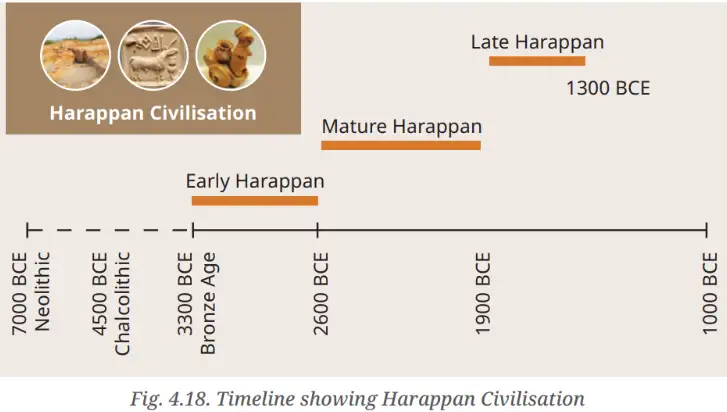
From Early Settlements to the Early Harappan Phase
Foundations of the civilisation
- Earlier background: Neolithic life emerged at Mehrgarh around 7000 BCE and spread through the middle and upper Indus Valley and farther east.
- Copper: Some settlements learned to extract copper from ore around 4000 BCE; these became early Chalcolithic sites and marked the beginning of the Bronze Age in the subcontinent.
- Early Harappan: Regional cultures developed into a culturally connected stage, generally called Early Harappan, before the urban civilisation emerged.
- Continuity: Pottery traditions, semi-precious stone beads, shell bangles, terracotta objects and copper working continued into the later civilisation.
Key dates and periods
- Around 7000 BCENeolithic life emerged at Mehrgarh in the foothills of Baluchistan.
- Between 7000 and 5500 BCESome radio-carbon dates place the beginning of the Pre-Harappan phase at Bhirrana and Kunal in the dried Sarasvati river belt.
- Around 4000 BCECopper extraction and early Chalcolithic settlements developed; regional pottery and craft styles became more evident.
- By 2600 BCETechnological progress and economic integration led to the emergence of Harappan urban centres.
- About 2500 BCEMany regional styles had developed into standard features of the Sindhu–Sarasvati civilisation.
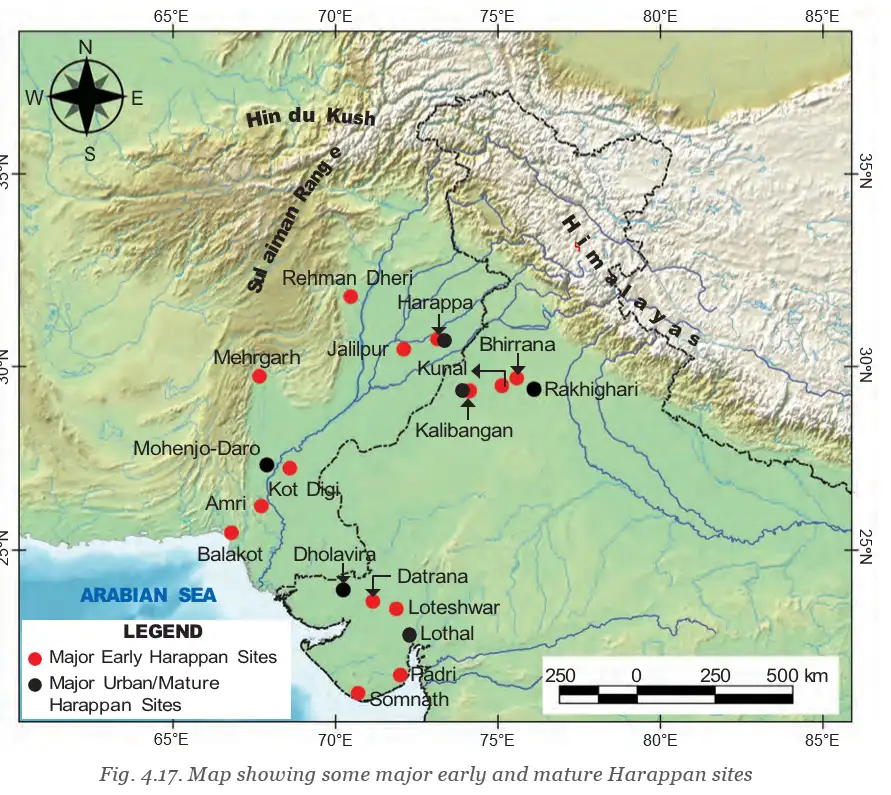
Regional Crafts and Early Developments
Crafts and regional traditions
- Pottery: Large-scale production supported the economy; vessel shapes and painted designs differed across regions.
- Other crafts: Copper work, shell work and the making of semi-precious stone beads developed gradually.
- Bead-making evidence: Early Harappan bead production is known from Harappa in Pakistan, Kunal in Haryana and Datrana in Gujarat.
- Settlement growth: Copper tools used in fertile Indus and Ghaggar–Sarasvati alluvial plains increased productivity and prosperity.
Early signs of Harappan urban culture
- Settlement planning: Perimeter walls around settlements were among the developments that probably began in the Early Harappan stage.
- Seals and script: Early use of seals and the beginnings of Harappan writing are also thought to date to this stage.
- Graffiti and motifs: Pottery graffiti and seals bearing simple geometric or animal designs at Harappa, Rehman Dheri and Kunal foreshadowed later inscribed seals and script.
- Urbanisation: Technological advances and economic integration during the Early Harappan period helped urban centres emerge.
Agriculture, Weights and Trade
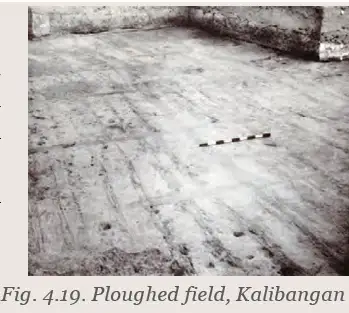
Agriculture at Kalibangan
- Ploughing: Furrows at Kalibangan run both horizontally and vertically, indicating cultivation of two crops.
- Double cropping: This pattern is compared with seasonal Rabi and Kharif cultivation practised today.
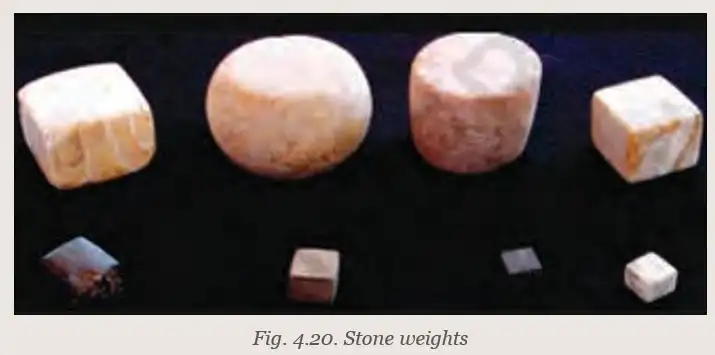
Harappan standard weights — A shared system of measured stone weights used to support organised settlements and efficient interregional trade.
Weight and measurement system
- Smaller units: Weights followed a binary-multiple sequence: .
- Larger denominations: Multiples of ten were used.
- Evidence: Carefully shaped cubical stone weights have been found at several sites.
- Importance: Standard weights helped make long-distance and interregional trade more reliable.
What developments helped the Early Harappan communities grow into urban centres?
What evidence suggests that Harappans practised double cropping?
Quick recap
- Neolithic settlements spread from Mehrgarh; copper extraction around 4000 BCE marked early Chalcolithic development.
- The Early Harappan phase shows cultural continuity in pottery, beads, shell objects, terracotta and copper working.
- Pottery, copper, shell and bead crafts varied across regions and supported community economies.
- Early seals, graffiti, settlement walls and writing likely foreshadowed Mature Harappan culture.
- Technological progress and economic integration helped urban centres emerge by 2600 BCE.
- Kalibangan furrows indicate double cropping; standard weights supported interregional trade.
Bronze Age Civilisations Outside India Part-1
River-valley civilisations and contacts
Four early river-valley civilisations
- Four civilisations: Harappan, Mesopotamian, Egyptian and Chinese civilisations all emerged in river plains.
- Contemporary civilisations: The Mesopotamian, Egyptian and Chinese civilisations existed during the same broad period as the Harappan civilisation.
- Harappan: Developed along the Sindhu and Sarasvatī rivers.
- Mesopotamian: Developed around the Euphrates and Tigris rivers in West Asia.
- Egyptian and Chinese: The Egyptian civilisation developed along the Nile; the Chinese civilisation developed in the Huang He basin in northern China.
- Contact: Mesopotamia was geographically closer to the Indus and Ghaggar-Sarasvatī valleys, supporting strong trade and contacts with the Harappans.
- Limited evidence: There is little tangible evidence of direct contact between the Egyptian or Chinese civilisations and the Sindhu–Sarasvatī civilisation.
| Civilisation | River or region |
|---|---|
| Harappan | Sindhu and Sarasvatī |
| Mesopotamian | Euphrates and Tigris |
| Egyptian | Nile |
| Chinese | Huang He basin |
Mesopotamian civilisation
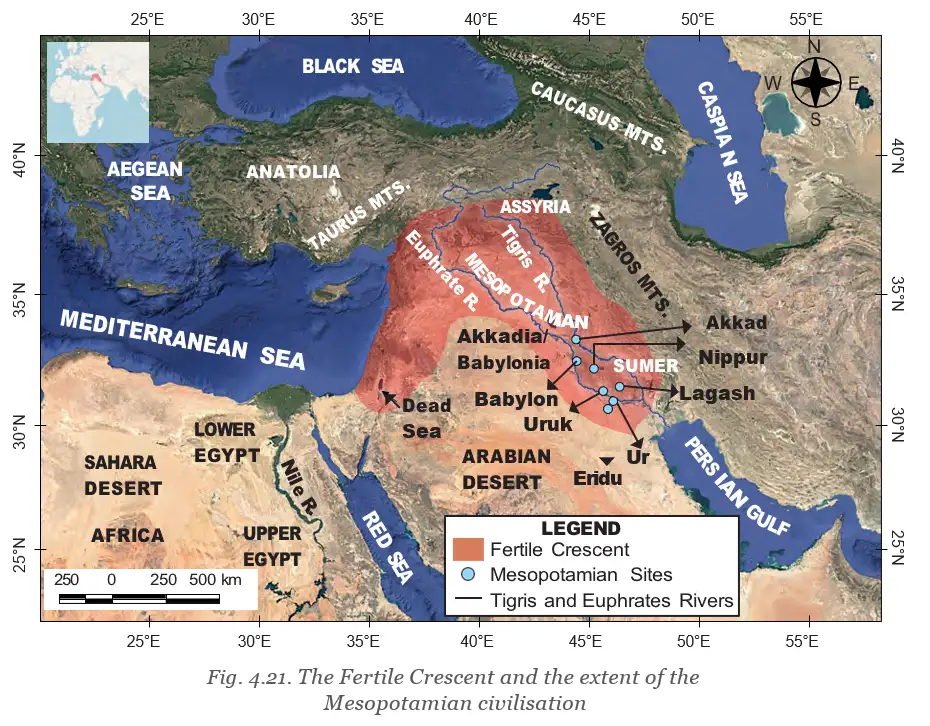
Mesopotamia — The Greek name meaning “the land in between,” for the region drained by the Euphrates and Tigris rivers in West Asia.
Location and early development
- Modern region: Mainly Iraq and Kuwait, with parts of Turkey and southwestern Iran.
- Fertile Crescent: The crescent-shaped foothills of the Zagros and Taurus, from the Mediterranean to the Persian Gulf, noted for strong agricultural potential.
- Early farming: Farming began in the region about 12,000 years before present.
- Copper tools: Arrived around 4500 BCE, improving farming, craft production and trade; farming then spread across the Euphrates–Tigris plains.
Key periods in Mesopotamian development
- About 12,000 years before presentFarming began in the region.
- Around 4500 BCECopper tools arrived, supporting agriculture, crafts and trade.
- From 3500 BCE onwardsThe Sumerian, Akkadian, Assyrian and Babylonian city-based civilisations flourished.
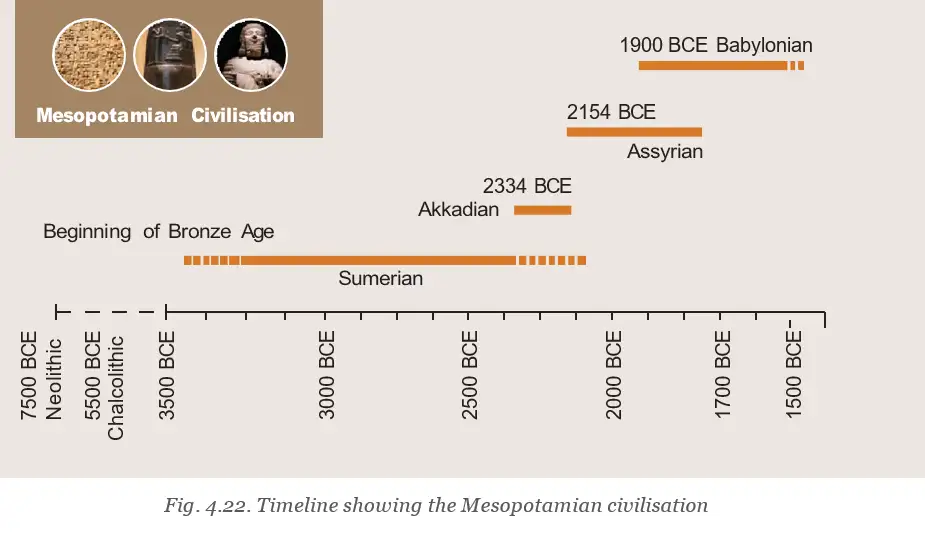
City-state — A sovereign state centred on a city that governs the surrounding territory.
Rise of Mesopotamian city-based civilisations
- Development: Over about 2,000 years, some large cities developed governing systems and became city-states.
- Four major civilisations: Sumerian, Akkadian, Assyrian and Babylonian.
The Sumerians
Sumerian cities and innovations
- Earliest city-based civilisation: Emerged at Ur and other Sumerian cities in southern Mesopotamia, in present-day southern Iraq.
- Irrigation: Sumerians were the first to build dams and canals for irrigation.
- Construction: They first used mud bricks and burnt bricks for houses, defensive walls and other structures.
- Daily life: Most people farmed; metalworking, pottery and textile-making were important crafts. Merchants and traders also worked in the cities.
- Settlement: Kings lived in grand palaces, while other residents generally lived in small brick houses.
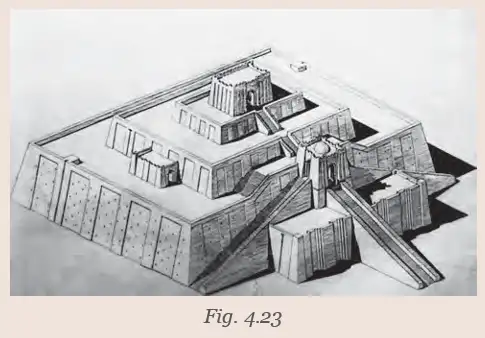
Ziggurat — A multi-storey, stepped pyramid-shaped temple, with the main temple at the top.
Temples and society
- Religion: Sumerians worshipped many gods, believed to control natural forces such as floods and winds.
- City centre: Each city built a grand ziggurat for its chief god, and the city grew around this temple.
- Temple authority: Agriculture, trade and the transport of goods were linked to the temple.
- Social hierarchy: High priests and priestesses controlled access to the sacred temple and were probably part of the ruling class.
- Security and storage: The ziggurat enclosure contained palaces and royal storehouses, and had a single entrance; the complex also served as the city’s treasury.
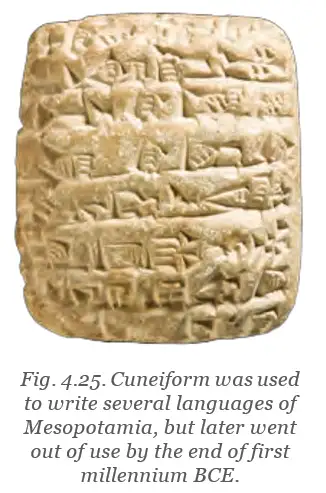
Cuneiform — An early Sumerian writing system made by pressing a wedge-shaped stylus into soft clay tablets.
Cuneiform writing
- Name: “Cuneiform” refers to the wedge-shaped marks in the script; the name comes from the Latin word *cuneus*, meaning “wedge”.
- Material and tool: Scribes pressed a wedge-shaped stylus into soft clay tablets.
| Point | Sumerian | Harappan |
|---|---|---|
| Irrigation and water control | Built dams and canals for irrigation. | Early Harappans built check dams called gabarbands across small streams. |
| Later examples | Canal irrigation supported farming in the river plains. | Dholavira channelled water from nearby streams into connected deep tanks; some tanks were cut into bedrock. |
| Other water-related construction | — | Lothal had a large dockyard made entirely of burnt bricks. |
- Fertile Crescent
- Agriculturally productive crescent-shaped region along the foothills of the Zagros and Taurus.
- City-state
- A city-based sovereign state governing nearby territory.
- Ziggurat
- Stepped temple complex central to a Sumerian city.
- Cuneiform
- Sumerian wedge-mark writing impressed on clay tablets.
Why was Mesopotamia well suited to early farming and trade?
What was a ziggurat, and why was it important in Sumerian cities?
Quick recap
- The four early river-valley civilisations were Harappan, Mesopotamian, Egyptian and Chinese; the latter three were contemporary with the Harappans.
- Mesopotamia lay between the Euphrates and Tigris; its fertile plains supported farming.
- Copper tools arrived around 4500 BCE and helped expand farming, crafts and trade.
- Sumerian, Akkadian, Assyrian and Babylonian city-based civilisations flourished from 3500 BCE onwards.
- Sumerians built irrigation canals and dams, used bricks, and developed cuneiform writing.
- Ziggurats were religious centres closely linked with Sumerian city life and economic authority.
- Harappan water management included gabarbands, Dholavira’s tanks and Lothal’s dockyard.
Bronze Age Civilisations Outside India Part-2
The Beginning of Writing
Early Cuneiform
- c. 3300 BCEThe Sumerians began using cuneiform.
- By 3000 BCECuneiform was widely used across Mesopotamian city-states.
Sumerian Contributions
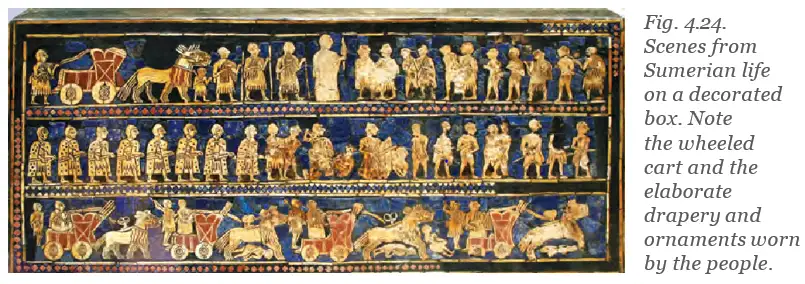
- Inventions: The Sumerians invented the wheeled cart and the sailboat.
- Calculations: They used calculations to build structures and measure agricultural fields.
- Number system: Their system was based on 60; they developed the 60-minute hour, 60-second minute and 360-degree circle.
The Akkadians
Trade with the Harappans
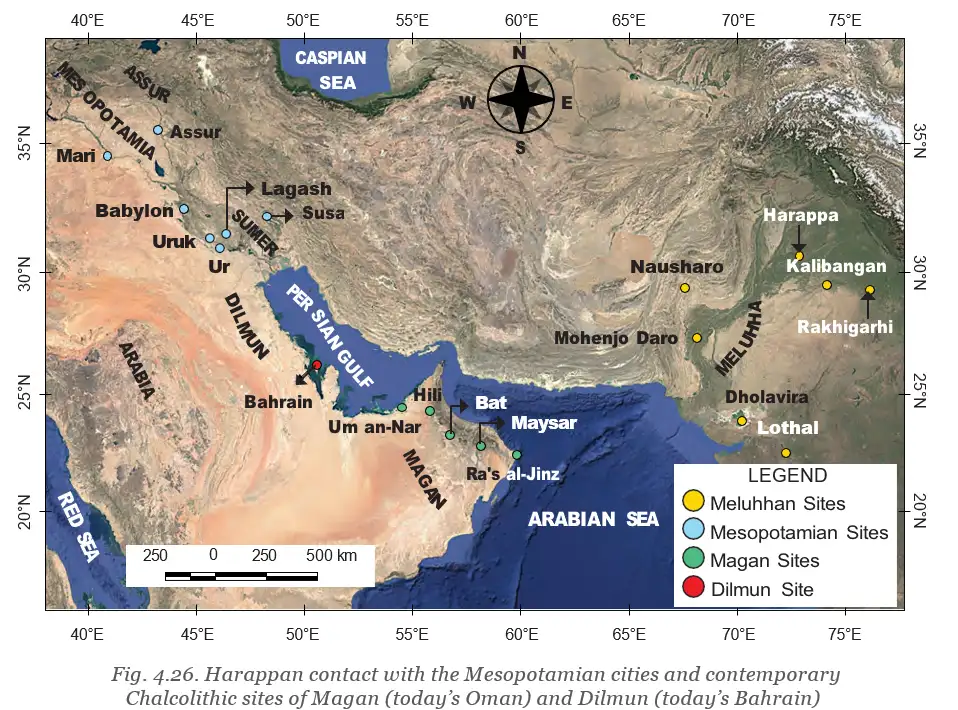
- Trade records: Tablets from the reign of Akkadian king Sargon mention trade with Dilmun, Magan and Meluhha.
- Locations: Meluhha is generally identified with the Sindhu–Sarasvatī civilisation; Dilmun and Magan correspond to present-day Bahrain and the Oman peninsula.
- Goods: Trade with the Harappans included semiprecious stone beads, ivory, timber, gold dust and probably copper.
The Assyrians
- Rise: Assur became a powerful city-state around 2154 BCE, ending Akkadian supremacy.
- Expansion: Assyrian dominance spread across Mesopotamia and into neighbouring regions to the west and south.
- Duration: The Assyrian civilisation remained dominant until the early 1700s BCE.
The Babylonians
The Decline of Babylonian Power
- Repeated attacks by the Hittites and other rising powers weakened Babylonian control.
- Rivals gained advantages through new technologies and more efficient use of natural resources.
- Environmental degradation and pressure on agricultural land added to the strain.
- Internal political and economic problems further weakened Babylonia.
- Babylonia lost its earlier prominence, allowing new powers to emerge in West Asia.
- Cuneiform
- Wedge-shaped writing system impressed on clay tablets.
- Dynastic empire
- An empire ruled by a succession of members of a ruling dynasty.
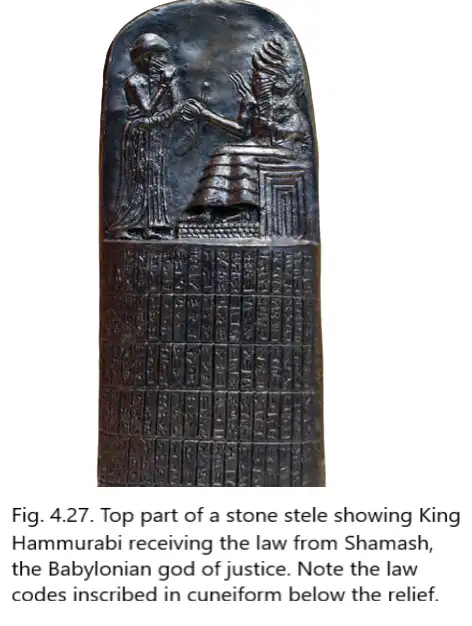
- Code of Hammurabi
- A compilation of rules for civil and social conduct in Hammurabi’s empire.
- Anatolia
- The region of modern-day Turkey where the Hittites established an empire.
What was cuneiform, and what did its tablets record?
What was the significance of Hammurabi’s Code?
Quick recap
- Sumerians began cuneiform around 3300 BCE; it was widely used in Mesopotamia by 3000 BCE.
- Cuneiform was contemporary with the Harappan script; cuneiform is deciphered, while the Harappan script is not yet deciphered.
- Cuneiform tablets preserved literature, laws, education and records of farming and crafts.
- Sumerians invented the wheeled cart and sailboat and developed a base-60 number system.
- Akkadians used cuneiform, built the first dynastic empire and traded with the Harappan region through Meluhha.
- Assyrian power arose from Assur; Babylonia later expanded under Hammurabi and became known for its law code.
- Attacks, technological competition, environmental strain and internal problems weakened Babylonian power.
Egyptian Civilisation Part-1
Sources for Egyptian History
Historical records
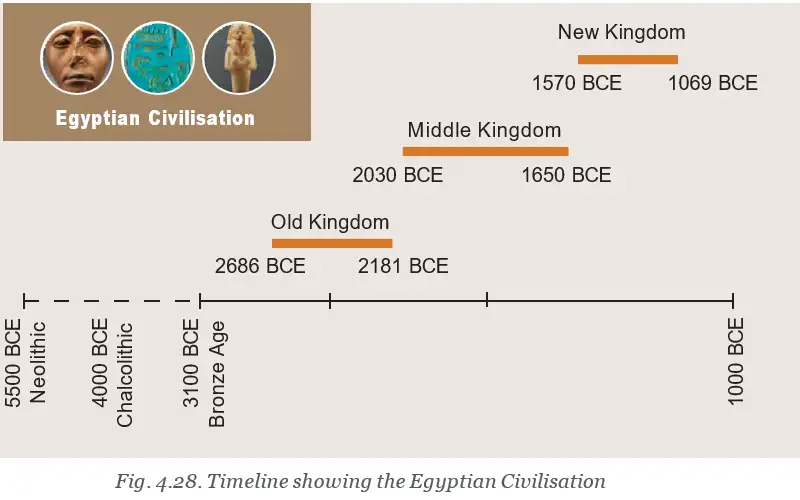
- Early civilisation: Egypt was one of the world’s earliest civilisations and influenced other civilisations.
- Written accounts: Greek and Roman writers knew Egypt; Herodotus visited and wrote about it in the 5th century BCE.
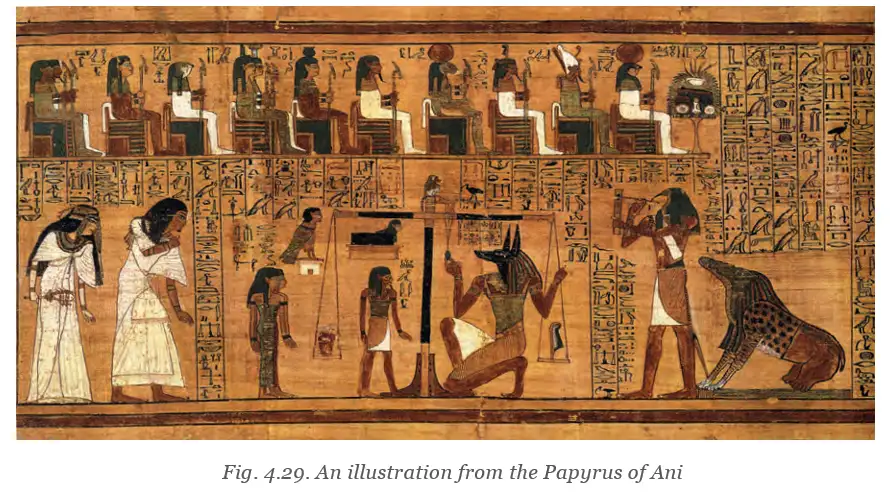
- Papyrus records: Documents preserve stories and practical details, helping reconstruct how Egyptians understood the world.
- Later account: The 19th-century collection *de L’Egypte* also provides details about Egyptian history.
Important dates
- c. 3000 BCECity-states emerged as the population increased and resources became available.
- 2000 BCELibraries stored papyrus scrolls in labelled jars on shelves.
- 5th century BCEHerodotus visited Egypt and wrote about it.
- 1799Pierre Bouchard found the Rosetta Stone while repairing a fort in Egypt.
- 1822Jean-François Champollion deciphered the Egyptian script.
Papyrus and Egyptian Writing
Papyrus — A writing material made by processing the inner trunk of the papyrus plant into sheets.
Papyrus records and stories
- Making sheets: The inner trunk was cut into strips, arranged crosswise, pressed, dried and polished.
- Papyrus Ebers: Named after its discoverer, it lists more than 700 cures and spells from Egyptian medicine.
- Library stories: Libraries dating to 2000 BCE stored scrolls in labelled jars; one jar held the oldest version of *Sindbad the Sailor*.
- Other tales: Stories included animal fables thought to suggest a link with *Aesop’s Fables*, ghost tales, miracles, romances and the oldest known form of *Cinderella*.
Deciphering Egyptian Script
- In 1799, French army engineer Pierre Bouchard found the Rosetta Stone while repairing a fort in Egypt.
- The stone contained three types of writing, including Greek, which people could still read.
- The readable Greek provided a key to understanding the other writing on the stone.
- In 1822, French linguist Jean-François Champollion deciphered the Egyptian script.
Calendar and Funerary Beliefs
| Season | Time of year | Association | Months |
|---|---|---|---|
| Inundation | Autumn | Annual flooding | 4 |
| Peret | Winter | Growing season | 4 |
| Shemu | Summer | Harvest | 4 |
Calendar facts
- Structure: The calendar had three seasons of four months each, making 12 months in total.
- Basis: It was based on the rising of Sirius, also called the Dog Star.
- Accuracy: Its 365-day year was close to the actual year, which is about one-quarter of a day longer.
The calendar year was 365 days.
The Nile and the Growth of Egyptian Settlements
How the Nile supported Egyptian settlements
- Population increased and resources became available.
- City-states emerged around 3000 BCE.
- The Nile watered the land along its banks and flooded every summer.
- The floods deposited rich mud called kemet, which was excellent for growing crops.
Kemet — The Egyptian name for their land, meaning “the black,” from the black soil of the Nile valley.
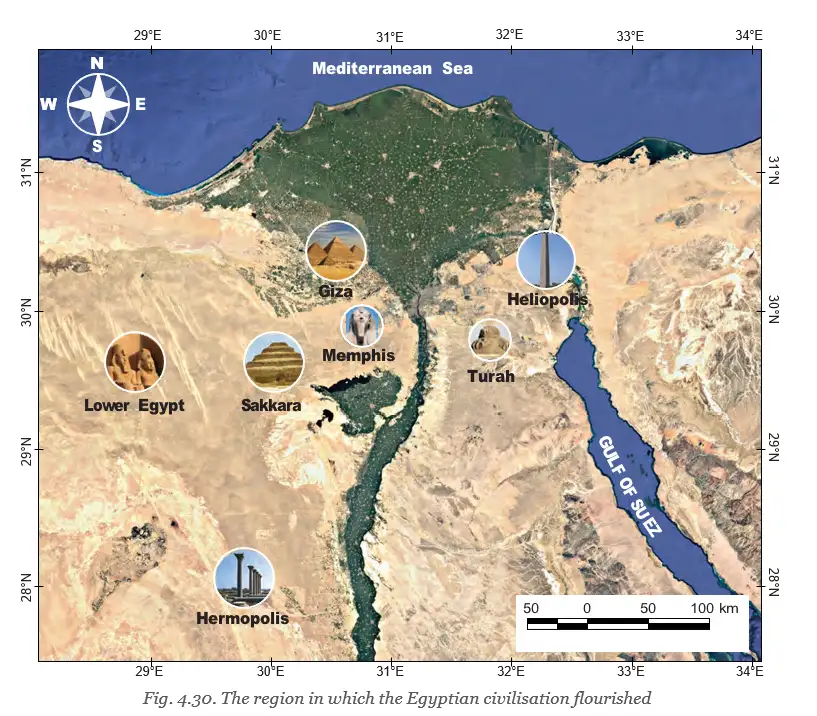
How was Egyptian script deciphered?
Why was the Nile important to early Egyptian settlements?
Quick recap
- Papyrus records preserve stories and practical details that help reconstruct Egyptian history.
- Libraries held varied tales, including early versions of *Sindbad the Sailor* and *Cinderella*; animal fables were thought to suggest a link with *Aesop’s Fables*.
- The Rosetta Stone helped Champollion decipher Egyptian script in 1822.
- The Egyptian calendar had three seasons of four months and a 365-day year.
- Summer floods of the Nile deposited rich mud called kemet, which supported crop growing.
- City-states emerged around 3000 BCE as population increased and resources became available.
Egyptian Civilisation Part-2
Nile Farming, Calendar and Local Government
Managing Nile water
- Water management: About 5,000 years ago, farmers dug ditches to direct Nile water to fields and stored water in reservoirs.
- Calendar: Egyptians counted the days between Nile floods to develop a calendar.
Cooperation and local government
- Ditches and dams needed collective effort.
- Cooperation encouraged organised local communities.
- Local government and an administrative class emerged.
Pharaohs, Pyramids and Mummification
Pharaohs and pyramid building
- Pharaohs: Powerful individuals emerged as rulers of Egypt.
- Burial structures: Pharaohs were buried in underground chambers. A rectangular mastaba was placed above a chamber; mastabas stacked over time developed into pyramids.
- Purpose: Egyptians believed each person had a spiritual double that could live after death if the body was preserved.
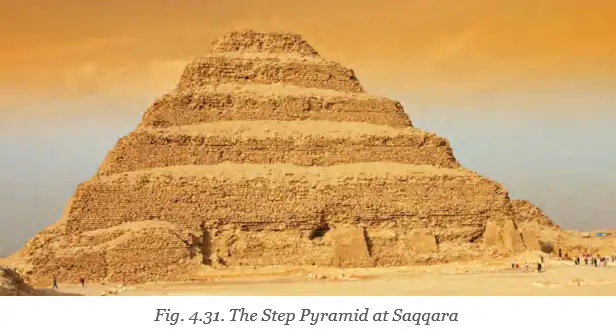
Ka — The spiritual double believed to continue living after death if the body was preserved.
Mummification — The process of preserving a dead body for burial.
Mummification process
- Remove the internal organs, except the heart.
- Dry the body with natron.
- Oil and wrap the body in linen strips.
- Place it in a coffin and bury it with rituals.
Leisure, Festivals and Women
Leisure and festivals
- Leisure: Egyptians swam, canoed, played board games, and enjoyed music and dancing.
- Festivals: Celebrations honoured gods and the pharaoh. A god’s statue was paraded with music, including instruments such as the sistrum.
- Sed festival: Marked a king’s 30th year on the throne; festivals expressed reverence for gods and ruler.
Women in Egyptian society
- Rights: Egyptian women could own property and run businesses, giving them more rights than their Greek or Roman counterparts.
- Cleopatra: Trained to rule from childhood, she became queen at age 18.
Key periods
- About 5,000 years agoFarmers managed Nile water with ditches and reservoirs; Egyptians developed a calendar by tracking floods.
- 69–30 BCECleopatra’s lifespan; she became queen at age 18.
- Mastaba
- Rectangular structure placed above an underground burial chamber.
- Natron
- Substance used to dry the body during mummification.
- Sistrum
- Musical instrument played during festival processions.
Quick recap
- Nile irrigation and water storage supported farming; flood timing helped Egyptians create a calendar.
- Collective work on ditches and dams encouraged local government and an administrative class.
- Mastabas developed into pyramids, connected to beliefs about the afterlife and the ka.
- Mummification preserved the body through organ removal, natron drying, oiling, wrapping and burial.
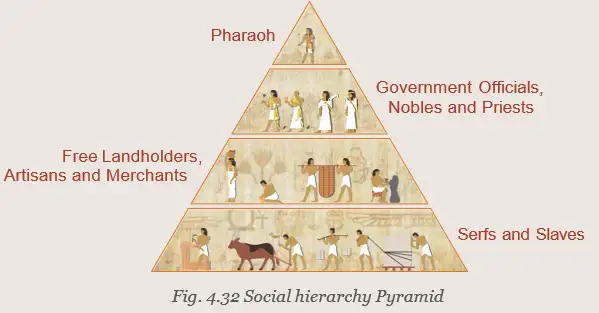
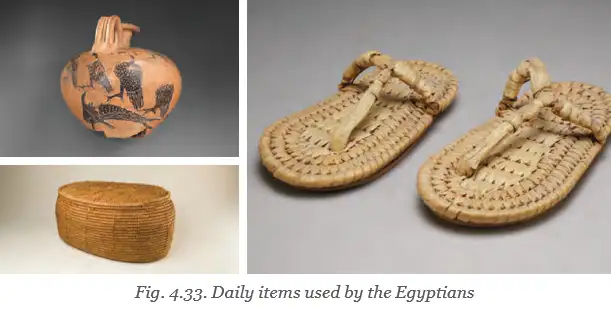
- The Saqqara step pyramid, social hierarchy and everyday objects such as pottery, baskets and sandals are key examples.
- Egyptian leisure included swimming, canoeing, games, music and dancing; festivals honoured gods and pharaohs.
- Egyptian women could own property and run businesses; Cleopatra was trained to rule and became queen at 18.
The Chinese Civilisation
River Valleys and the Rise of Chinese Civilisation
Major Periods and Dynasties
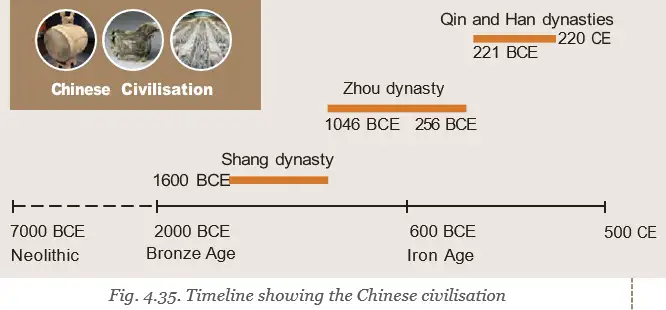
- c. 7000 BCENeolithic cultures developed in the Huang He and Yangtze river valleys.
- 4000–3000 BCESilk was known in China.
- c. 2000 BCECopper and bronze metallurgy brought many settlements, especially in the Yellow River basin, towards the Bronze Age.
- c. 1600 BCEUrban centres began to emerge as agricultural productivity, metallurgy and crafts expanded.
- 1600–1046 BCEThe Shang dynasty ruled during the Bronze Age.
- 1046–256 BCEThe Zhou dynasty ruled during the Bronze Age.
- By 600 BCEIron use became popular across China; the Chinese Iron Age generally dates from this period onwards.
- 221–206 BCEThe Qin dynasty unified China and became its first imperial dynasty; the name China probably derives from Qin (Ch’in).
- 206 BCE–220 CEThe Han dynasty was another important Iron Age dynasty.
Government and Historical Sources
- Zhou rulers: They were both kings and priests, believed to be appointed by heaven; they could be dismissed if their people did not prosper.
- Public officials: Candidates were carefully examined in archery, horsemanship, calculations, writing and music.
- Historical records: Official historiographers recorded events, giving China an abundance of written historical records.
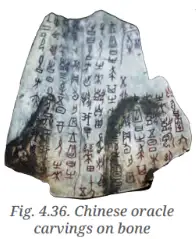
- Oracle bones: Early symbols were inscribed on animal bones and tortoise shells. Heated bones cracked, and people interpreted the patterns to foretell the future; these records reveal early Chinese hopes, desires and fears.
Writing, Crafts and the Great Wall
Logographic script — A writing system in which characters represent whole words or morphemes (the smallest meaningful units), rather than sounds.
- Examples: 人 means person; 木 means tree.
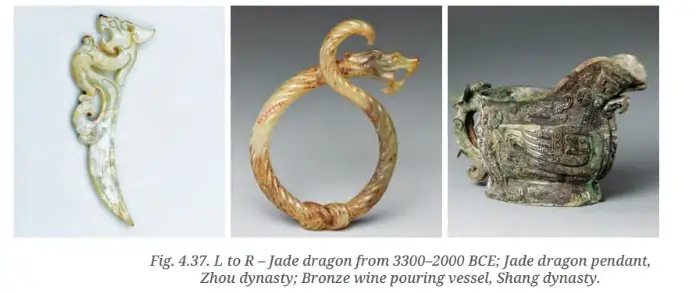
- Jade: Carved objects and figurines served ritual or prestige purposes and may have been used in social transactions. Jade was obtained from outside China because it was not locally available.
- Other crafts: Marble was carved into bird and animal ornaments and bases for wooden pillars. Bronze was used for weapons, tools and elaborate ritual vessels.
- Music and craftsmanship: Jade pieces shaped like objects such as fish could be strung together and struck to produce a clear, lasting musical sound.
The Great Wall
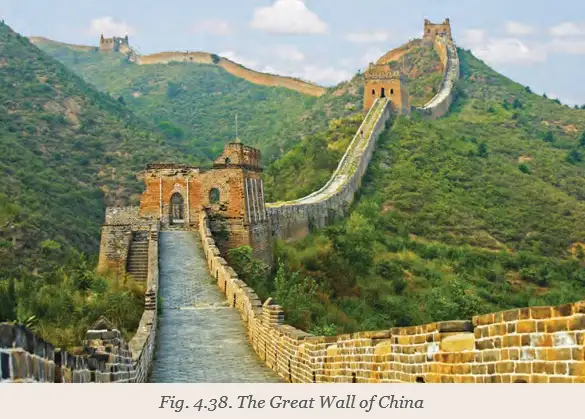
- Purpose: Early walls defended against violent raids by nomadic tribes; separate walls were later joined to form a more effective defence.
- Construction: Wall-building began from 680 BCE under the Zhou and other dynasties. Expansion and repairs continued until the 17th century CE, over a period stretching to about two thousand years.
Trade, Society and Economic Change
Silk and the Silk Route
- 4000–3000 BCESilk was known in China from the Neolithic period and later became an important Bronze Age craft.
- Around the 2nd century BCEUnder the Han, silk became a major external-trade good; the route along which it was traded became known as the Silk Route.
- Social hierarchy: By 1500 BCE, society was highly stratified: the ruling class, nobles and aristocrats ranked above farmers and labourers. This formed the basis of later Chinese social hierarchy.
- Money economy: Metal-based exchange appeared during the Zhou dynasty, and a money economy developed by the 5th century BCE.
- Innovations: China was the first country to introduce paper currency and to develop a civil service selected through public examinations.
How Bronze Age River Civilisations Developed
- Fertile river plains supported agriculture; major Bronze Age civilisations emerged independently in these regions.
- Greater agricultural productivity and the use of new resources encouraged economic growth.
- Economic growth supported urban centres and the development of social and administrative systems.
- Writing enabled records of economic transactions and social activities, and later supported literary and creative works.
- Many cultural ethos have their roots in the Bronze Age civilisations.
- Oracle bones
- Animal bones or tortoise shells bearing symbols, used for divination and valuable as early historical records.
- Logographic script
- Writing in which characters represent words or meaningful units rather than sounds.
- Silk Route
- The trade route associated with the Han-era trade in Chinese silk.
- Dynasty
- A succession of rulers from the same family or ruling line.
What do oracle bones tell us about early China?
How did silk become important to China’s external trade?
Describe early Chinese social hierarchy and key economic developments.
Quick recap
- The Huang He and Yangtze valleys supported early Chinese Neolithic cultures, agriculture and urban growth.
- The Shang and Zhou were major Bronze Age dynasties; iron became popular across China by 600 BCE.
- The Qin dynasty unified China, and the Han was another important Iron Age dynasty.
- Oracle bones and logographic writing are key sources and features of early Chinese civilisation.
- Jade, marble and bronze crafts, silk trade and the Great Wall reflect Chinese skill and organisation.
- Chinese society was hierarchical and developed a money economy, paper currency and examination-based civil service.
- Major Bronze Age civilisations emerged independently in fertile river plains, and many cultural ethos have roots in those civilisations.
Summary
Studying Early Human History
- Importance: Studying early human history helps us understand humanity’s biological and cultural evolution.
- Evidence: Archaeologists use tools, bones, fossils and other remains to reconstruct how early humans lived.
- Environment: Early human history also shows how people adapted to changing climates and surroundings.
Changes in Early Human Life
| Period | Key developments and way of life |
|---|---|
| Palaeolithic | Hunter-gatherers used stone tools such as handaxes, cleavers and scrapers; they lived in caves or open camps. |
| Mesolithic | People developed microlithic tools and occupied temporary settlements near rivers and lakes. |
| Neolithic | Agriculture and animal domestication led to permanent villages; pottery making and weaving also developed. |
| Chalcolithic | Communities used copper along with stone tools and developed early farming communities. |
From Farming Communities to Civilisations
- Agriculture and animal domestication supported permanent villages.
- Early farming communities developed, including those using copper alongside stone tools.
- These developments led to Bronze Age civilisations with urban centres, trade, writing, administration and social organisation.
Early River-Valley Civilisations
Major Civilisations
- Examples: Sindhu–Sarasvatī, Mesopotamia, Egypt and China.
- Development: These civilisations developed independently in fertile river valleys.
- Contributions: They advanced agriculture, writing, architecture, administration and culture.
Quick recap
- Early human history predates writing and is studied through tools, fossils and cave art.
- Humans evolved in Africa and gradually migrated to other parts of the world.
- Palaeolithic hunter-gatherers used handaxes, cleavers and scrapers, and lived in caves or open camps.
- Mesolithic people used microlithic tools and temporary settlements near rivers and lakes.
- Neolithic farming and animal domestication supported permanent villages, pottery making and weaving.
- Chalcolithic communities used copper alongside stone tools; Bronze Age civilisations developed urban centres, trade, writing, administration and social organisation.
- Sindhu–Sarasvatī, Mesopotamia, Egypt and China developed independently in fertile river valleys and contributed to agriculture, writing, architecture, administration and culture.
Social Science — ALL CHAPTERS
1
The French Revolution
2
Socialism In Europe And The Russian Revolution
3
Nazism And The Rise Of Hitler
4
Forest Society And Colonialism
5
Pastoralists In The Modern World
1
Understanding Social Science
2
Shaping of the Earth’s Surface
3
Atmosphere and Climate
4
Early Humans and Beginning of Civilisation
5
State and Society up to 1000 CE
6
Democracy
7
Elections
8
Building Blocks in Economics: The Problem of Choice
9
The Price Puzzle: What Drives the Market