NEET UG . NEET Zoology . Zoology . Biodiversity and Conservation
Chapter 13: Biodiversity and Conservation
Ch 13
NEET Zoology
NEET UG
Biodiversity
Introduction and Meaning of Biodiversity
Examples of Species Diversity
- Examples: Earth has more than 20,000 ant species, 300,000 beetle species, 28,000 fish species and nearly 20,000 orchid species.
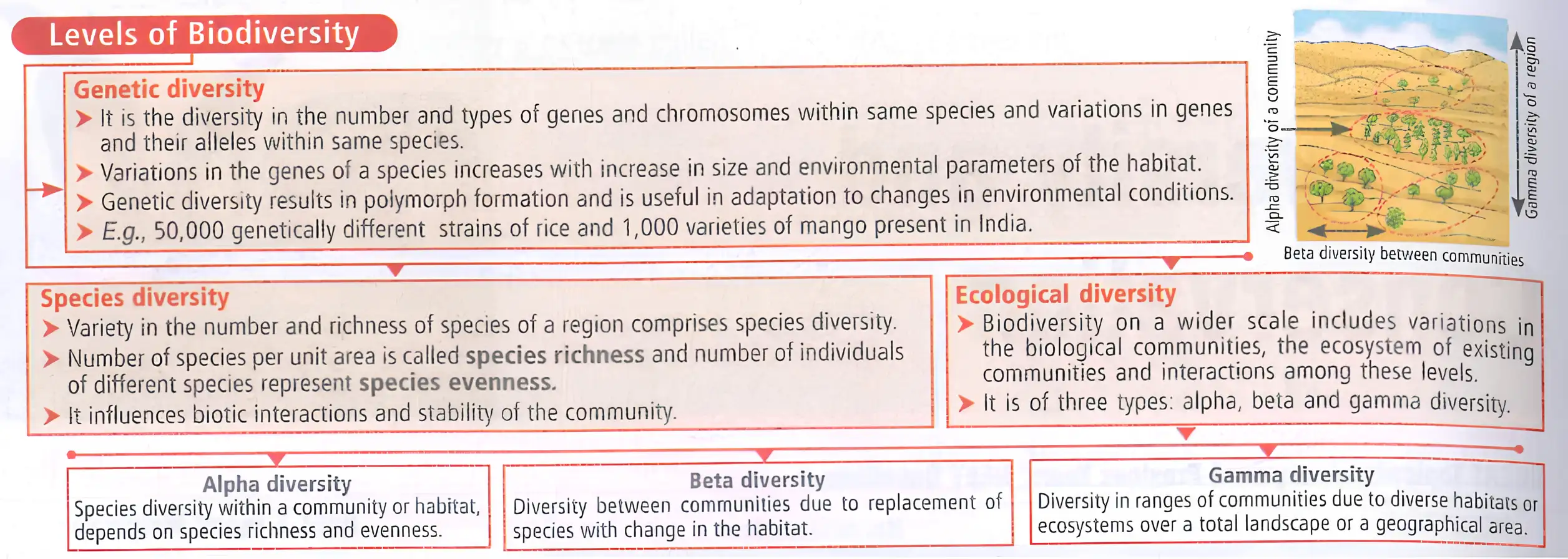
Biodiversity — The variety of ecosystems, species, genetic variants adapted to different climates and environments, and the interactions and processes among them.
Levels and Distribution
- Term: Walter G. Rosen coined “biodiversity” in 1985; sociobiologist Edward Wilson popularised it in 1992.
- Variation by place: Local environmental conditions and each species’ tolerance range determine where it can survive.
- Hierarchical levels: Biodiversity includes genetic, species and ecological diversity.
- Alpha diversity: Diversity within a local habitat; beta diversity: change in diversity between habitats; gamma diversity: diversity across a wider region.
Global Species Estimates and Composition
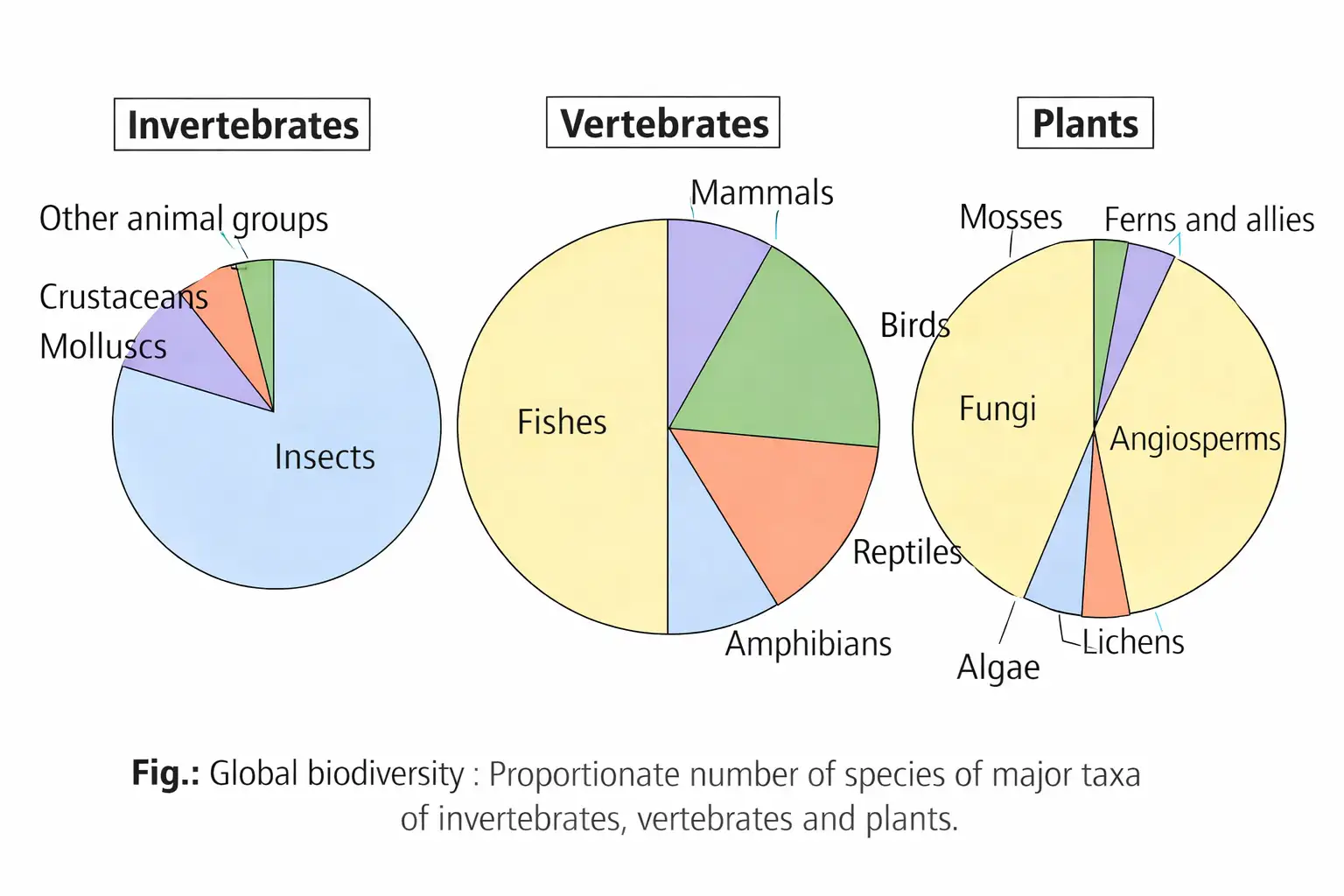
- Described species: IUCN (2004) recorded slightly more than 1.5 million described plant and animal species.
- Estimation method: Since many undiscovered species are expected in the tropics, biologists compare tropical and temperate species richness in an exhaustively studied insect group, then extrapolate that ratio to other groups.
- Total estimate: Estimates range from 20–50 million; Robert May’s more conservative estimate is about 7 million species worldwide.
- Animals and plants: Animals make up more than 70% of recorded species; plants and related groups—including algae, fungi, bryophytes, gymnosperms and angiosperms—make up no more than 22%.
- Insects: They are the most species-rich animal group, comprising more than 70% of animal species—about 7 out of every 10 animals.
- Fungi: The number of fungal species exceeds the combined number of fish, amphibian, reptile and mammal species.
Biodiversity in India
- Global share: India has 2.4% of the world’s land area but 8.1% of its species diversity; it is one of the world’s 12 megadiversity countries.
- Recorded species: Nearly 45,000 plant species and about twice as many animal species have been recorded in India.
- Undiscovered species: Estimates suggest over 100,000 plant species and over 300,000 animal species remain undescribed in India.
- Biogeographical regions: Trans Himalayas, Himalayas, Desert, Semi-arid, Western Ghats, Deccan Peninsula, Gangetic Plain, North East, Marine Coasts and Indian islands.
- Endemic species: Species restricted to a particular region; the Western Ghats, for example, are rich in endemic amphibians.
Patterns of Biodiversity
- Uneven distribution: Species diversity varies across different regions of the world.
- Patterns: Biodiversity is studied through geographic patterns in species richness.
Latitudinal Gradient
Latitudinal gradient in diversity — The general pattern in which species diversity decreases from the equator towards the poles.
Examples and Tropical Richness
- Tropics: The tropical belt, from N to S, generally has more species than temperate or polar regions.
- Birds by latitude: Colombia near the equator has nearly 1,400 bird species; New York at N has 105; Greenland at N has 56. India has more than 1,200 bird species.
- Plant diversity: A tropical forest can have up to 10 times as many vascular plant species as an equal-area temperate forest, such as one in the Midwest of the USA.
- Amazon rainforest: The largely tropical Amazon rainforest in South America has the greatest biodiversity on Earth. It has over 40,000 plant species, 3,000 fish, 1,300 bird, 427 mammal, 427 amphibian and 378 reptile species, plus over 125,000 invertebrate species.
- Undiscovered insects: At least two million insect species may still await discovery and naming in tropical rainforests.
| Factor | How it promotes diversity |
|---|---|
| Long evolutionary time | Tropical regions remained relatively undisturbed for millions of years, unlike temperate regions affected by frequent glaciations; more time allowed greater speciation. |
| Stable, predictable conditions | Less seasonal conditions promote niche specialisation and allow more species to coexist. |
| Greater solar energy | Higher energy availability can increase productivity, indirectly supporting greater diversity. |
Species–Area Relationship
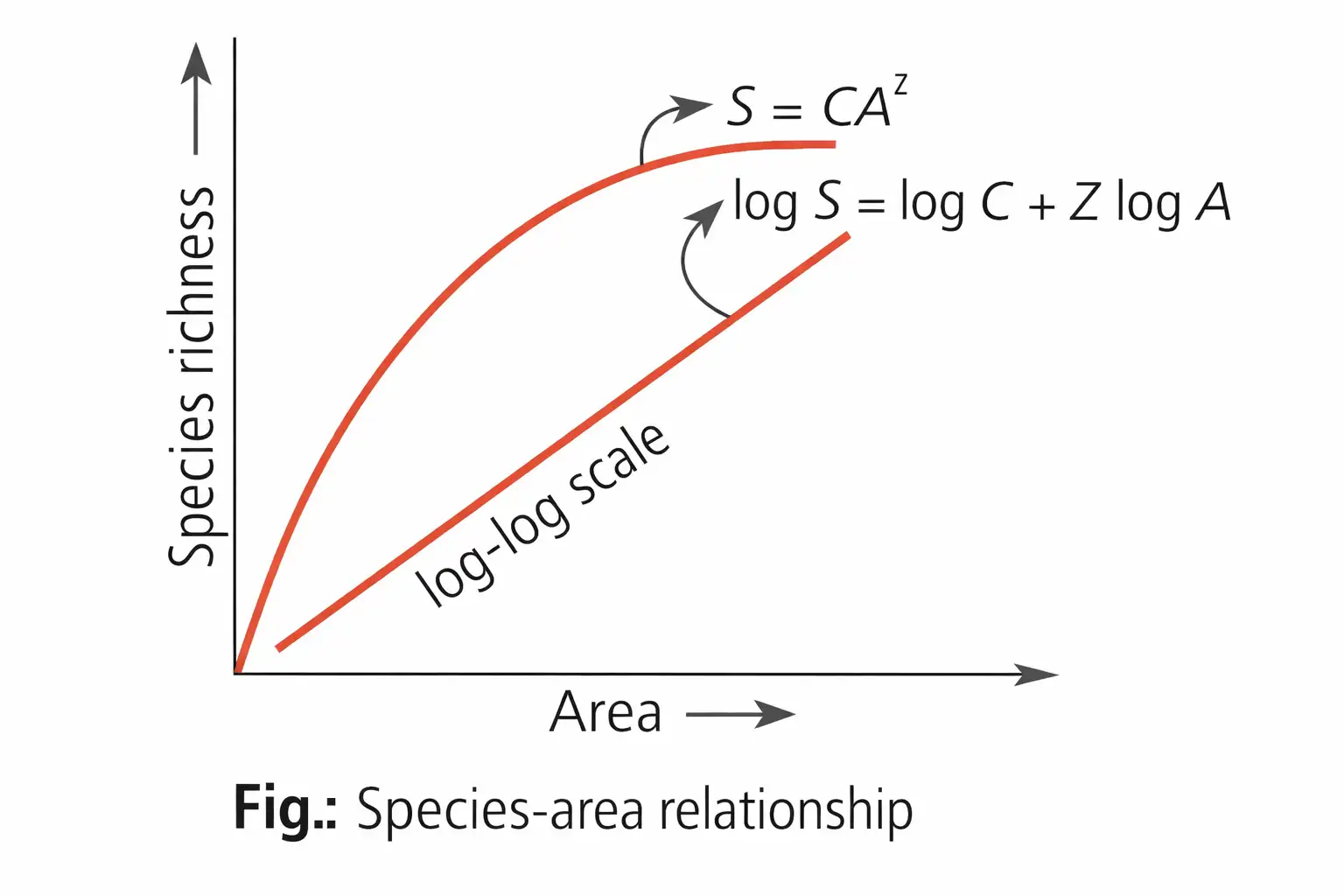
Species–area relationship — Species richness generally increases as the area studied increases, up to a certain limit.
Relationship and Equation
- Proposed by: German naturalist and geographer Alexander von Humboldt.
- Shape: The relationship is a rectangular hyperbola for many taxa; on a log–log scale it becomes a straight line.
- Usual slope: is generally 0.1–0.2 across taxonomic groups and regions; for large areas such as continents, ranges from 0.6–1.2.
Use this straight-line form for the log–log relationship.
Symbols
- : Species richness; : area; : slope or regression coefficient; : y-intercept constant.
Importance of Species Diversity to Ecosystems
| Benefit | Key idea |
|---|---|
| Ecological stability | More diverse ecosystems withstand environmental stress better; alien species are less able to establish, and damage to part of the ecosystem is less likely to degrade the whole. |
| Productivity | Ecosystems with higher biodiversity are generally more productive than those with lower biodiversity. |
| Ecosystem health | Species interactions provide checks, controls, feedbacks and critical links; keystone species can have especially important ecosystem roles. |
Rivet popper hypothesis — Paul Ehrlich’s analogy: species are like rivets holding an airplane (ecosystem) together; losing more rivets progressively weakens the system.
Meaning of the Rivet Analogy
- Gradual loss: Removing a few species may not immediately disrupt ecosystem function, but continued losses can make the ecosystem dangerously weak.
- Unequal importance: Losing species that drive major ecosystem functions (like rivets on the wings) can be more serious than losing less critical species.
Loss of Biodiversity
Evidence and Scale of Loss
- Human impact: Human colonisation of tropical Pacific islands led to the extinction of more than 2,000 native bird species.
- IUCN Red List (2004): Recorded 784 extinctions in the previous 500 years: 338 vertebrates, 359 invertebrates and 87 plants.
- Examples: Dodo (Mauritius), quagga (Africa), thylacine (Australia), Steller’s sea cow (Russia), and Bali, Javan and Caspian tiger subspecies.
- Recent loss: Twenty-seven species disappeared in the 20 years reported by the source; extinction is not random, and amphibians appear particularly vulnerable.
- Threatened species: Over 15,500 species worldwide face extinction risk: 12% of birds, 23% of mammals, 32% of amphibians and 31% of gymnosperms.
Extinction Rates and Events
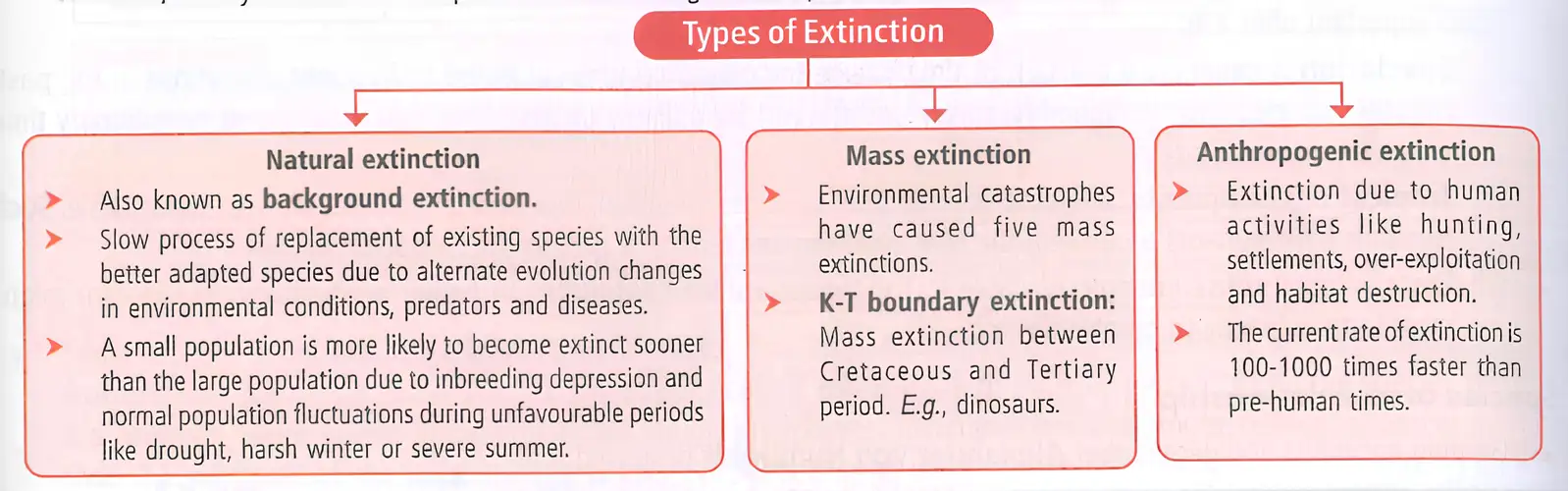
- Mass extinctions: Five episodes occurred during the more than 3 billion years since life originated and diversified.
- Current rate: Species are becoming extinct at an estimated 100–1,000 times the pre-human rate, largely because of human activities.
- Warning: If current trends continue, nearly half of Earth’s species could disappear within the next 100 years.
- Permian event: About 225 million years ago, around 90% of shallow-water marine invertebrates disappeared.
- K–T boundary: Over 60 million years ago, dinosaurs and many other organisms disappeared between the Cretaceous and Tertiary; the event is associated with deposits of iridium, rare on Earth.
- Pleistocene extinctions: Woolly mammoths, mastodons, giant sloths and other mammals disappeared; advancing and retreating ice sheets together with overhunting are considered causes.
Causes of Biodiversity Loss
The Evil Quartet — The four major human-driven causes of biodiversity loss: habitat loss and fragmentation, over-exploitation, alien species invasion and co-extinction.
Habitat Loss and Fragmentation
Habitat Destruction
- Main cause: Destruction of natural habitats is a major driver of plant and animal extinction.
- Examples: Wetland filling, ploughing grasslands, deforestation, and construction of dams and reservoirs.
- Effects: Loss of shelter and endemic species, displacement of animals into unfamiliar areas, and increased exposure to predation.
- Fragmentation: Breaking continuous habitat into isolated patches disrupts species interactions and destroys species in cleared areas and deep, undisturbed forest zones.
- Most affected: Animals requiring large territories, including mammals and birds; migrating animals may go astray and die.
- Rainforests: Tropical rainforests once covered 14% of Earth’s land surface but now cover only 6%. Amazon forest is cleared for soybean cultivation and cattle-raising grasslands; its vast biodiversity has earned it the name “lungs of the planet.”
Over-exploitation
Over-exploitation — Excessive use or harvesting reduces a species’ population until it becomes vulnerable to extinction.
Examples and Effects
- Extinctions linked to over-exploitation: Dodo, passenger pigeon, three tiger subspecies and Steller’s sea cow.
- Current concern: Overharvesting is reducing marine fish populations; commercially important species may become endangered.
Alien Species Invasion
Alien species — A non-native species introduced to a new area; some become invasive and displace local species. Alien species invasion is considered the second major cause of species extinction.
Important Examples
- Water hyacinth (*Eichhornia crassipes*): Introduced into Indian waters to reduce pollution; it clogs wetlands and other water bodies, suppresses other plants and contributes to deaths of aquatic plants and animals.
- Nile perch: Introduced into Lake Victoria in Africa; it eliminated an ecologically unique group of over 200 native cichlid fish species.
- Lantana camara: Introduced as an ornamental plant; it has replaced many forest species in Uttar Pradesh and Madhya Pradesh.
- Eupatorium odoratum: Has reduced populations of *Tectona grandis* in North-East India.
- Parthenium hysterophorus: Has displaced several herbs and shrubs in open plains.
- African catfish (*Clarias gariepinus*): Illegally introduced for aquaculture in India; threatens native catfish such as *Clarias batrachus*.
- Cockroaches: *Periplaneta americana* has replaced *Blatta orientalis* in many places.
- Vulnerability: Island ecosystems are especially at risk because they have small areas and fewer species.
Co-extinction
Co-extinction — When the extinction of one species causes the loss of another species that depends on it through an obligatory relationship.
Examples
- Mutualism: If either *Pronuba yuccaselles* or *Yucca* becomes extinct, the other may also disappear.
- Host–parasite relationship: Extinction of a host fish can eliminate all parasites found exclusively on that fish.
Other Causes of Biodiversity Loss
| Cause | Examples and effects |
|---|---|
| Disturbance and degradation | Natural causes include jungle fires, tree falls, pest outbreaks and insect or locust defoliation. Human causes—tree cutting, deliberate fires, litter collection and overuse of useful products—are more severe. |
| Pollution | Pesticides contaminate surface and groundwater; biomagnification raises their concentration at higher trophic levels and reduces fish-eating birds and falcons. Heavy metals can kill animals; air pollution harms sensitive plants; radiation harms plants and animals; oil spills kill marine algae, fish and seabirds. |
| Intensive agriculture | Agricultural expansion destroys wetlands, grasslands and forests, causing habitat loss and extinctions. Reliance on a few high-yielding varieties reduces genetic diversity. |
| Forestry | Planting economically valuable trees such as sal and teak in pure stands displaces other forest species. Such stands are vulnerable to insect and pathogen attacks. |
IUCN Red List Categories
IUCN Red List categories — Categories used to describe the assessed extinction risk of species or taxa.
| Category | Meaning | Example or note |
|---|---|---|
| Extinct | The taxon has been completely eliminated or has died out. | Dodo |
| Extinct in the wild | The taxon is absent from its natural or expected habitats in the wild. | May persist outside the wild. |
| Critically endangered | Faces an extremely high risk of extinction in the wild and may disappear in the immediate future. | Pygmy hog |
| Endangered | Faces a high risk of extinction in the wild in the near future, often due to habitat decline, predation or poaching. | Lion-tailed macaque |
| Vulnerable | Population is still sufficient but declining, creating a risk of extinction in the medium-term future. | Clouded leopard |
| Lower risk | Threatened species with a comparatively lower extinction risk; they need limited attention to return to flourishing populations. | As described in the source |
| Data deficient | Available information is inadequate for a direct or indirect assessment of extinction risk. | Risk cannot be assessed reliably |
| Not evaluated | The taxon has not been assessed for extinction risk. | No assessment conducted |
| Rare | Naturally small populations that are localised or thinly scattered and vulnerable to pests, pathogens, predators or alien species. | Naturally limited populations |
| Indeterminate | The species is in danger of extinction, but the reason is unknown. | Cause not established |
State the three major ecosystem benefits of biodiversity.
Name the Evil Quartet and explain co-extinction.
Write the species–area equation and define its terms.
Quick recap
- Biodiversity includes genetic, species and ecological diversity; genetic variation is adapted to different environments, and organisms are linked through interactions and processes.
- Global species estimates use tropical–temperate richness comparisons for well-studied groups; the Amazon rainforest has the greatest biodiversity on Earth.
- Species richness generally increases towards the tropics and with area; the species–area relationship is linear on a log–log scale.
- Biodiversity promotes ecosystem stability, productivity and health; the rivet popper hypothesis illustrates the risks of continued species loss.
- Current extinction rates are estimated at 100–1,000 times the pre-human rate, with human activity as the main driver.
- The Evil Quartet is habitat loss and fragmentation, over-exploitation, alien invasions and co-extinction; alien invasions are considered the second major cause of species extinction.
- IUCN Red List categories distinguish different levels and kinds of extinction risk.
Biodiversity Conservation
Biodiversity conservation — Protection, improvement and scientific management of biodiversity to maintain it at an optimum level and provide sustainable benefits to present and future generations.
Why conserve biodiversity?
| Argument | Basis | Examples and key facts |
|---|---|---|
| Narrowly utilitarian | Direct economic benefits from biodiversity | Food (cereals, pulses, fruits), firewood, fibre, construction materials, industrial products (tannins, lubricants, dyes, resins, perfumes) and medicines; over 25% of drugs sold worldwide are plant-derived. |
| Broadly utilitarian | Ecosystem services and intangible benefits | Amazon forest photosynthesis produces an estimated 20% of atmospheric oxygen; bees, bumblebees, birds and bats pollinate plants; nature also offers aesthetic pleasure. |
| Ethical | Every species has intrinsic value, whether or not it is useful to humans | Humans have a responsibility to plant, animal and microbial species sharing the planet. |
Economic value and bioprospecting
- Traditional medicines: About 25,000 plant species contribute to traditional medicines used by native peoples worldwide.
- Bioprospecting: Exploring molecular, genetic and species-level diversity for products of economic importance; biodiversity-rich nations may gain substantial benefits.
Red List and threatened species
Purposes of the Red List
- Awareness: Show the degree of threat to biodiversity and provide a global index of biodiversity decline.
- Identification: Document the number of species facing a high risk of extinction.
- Action: Help set conservation priorities and guide conservation measures.
- Agreements: Provide information about international agreements such as the Convention on Biological Diversity (CBD) and CITES.
| Threat category | Plant | Animal |
|---|---|---|
| Critically endangered | Berberis nilghiriensis | Pygmy hog (Pescua salvana) |
| Endangered | Bentinckia nicobarica | Red panda (Ailurus fulgens) |
| Vulnerable | Cupressus cashmeriana | Black buck (Antelope cervicapra) |
Conservation strategies
| Approach | Where conservation occurs | What it protects |
|---|---|---|
| In-situ | Within the species' natural habitat | Whole ecosystems and biodiversity at all levels, including threatened species |
| Ex-situ | Away from the species' natural habitat | Endangered species and their genetic material through collections and gene banks |
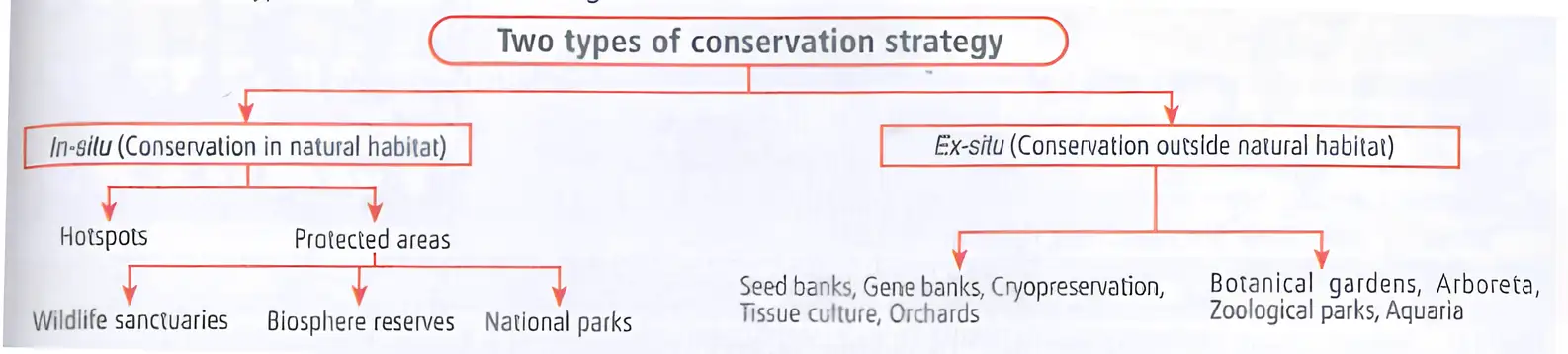
In-situ conservation
In-situ conservation — Protection of threatened species by conserving the whole ecosystem and its biodiversity in the species' natural habitat.
Main forms
- Hotspots: Regions of high conservation importance.
- Protected areas: Include biosphere reserves, organised into core, buffer and transition zones.
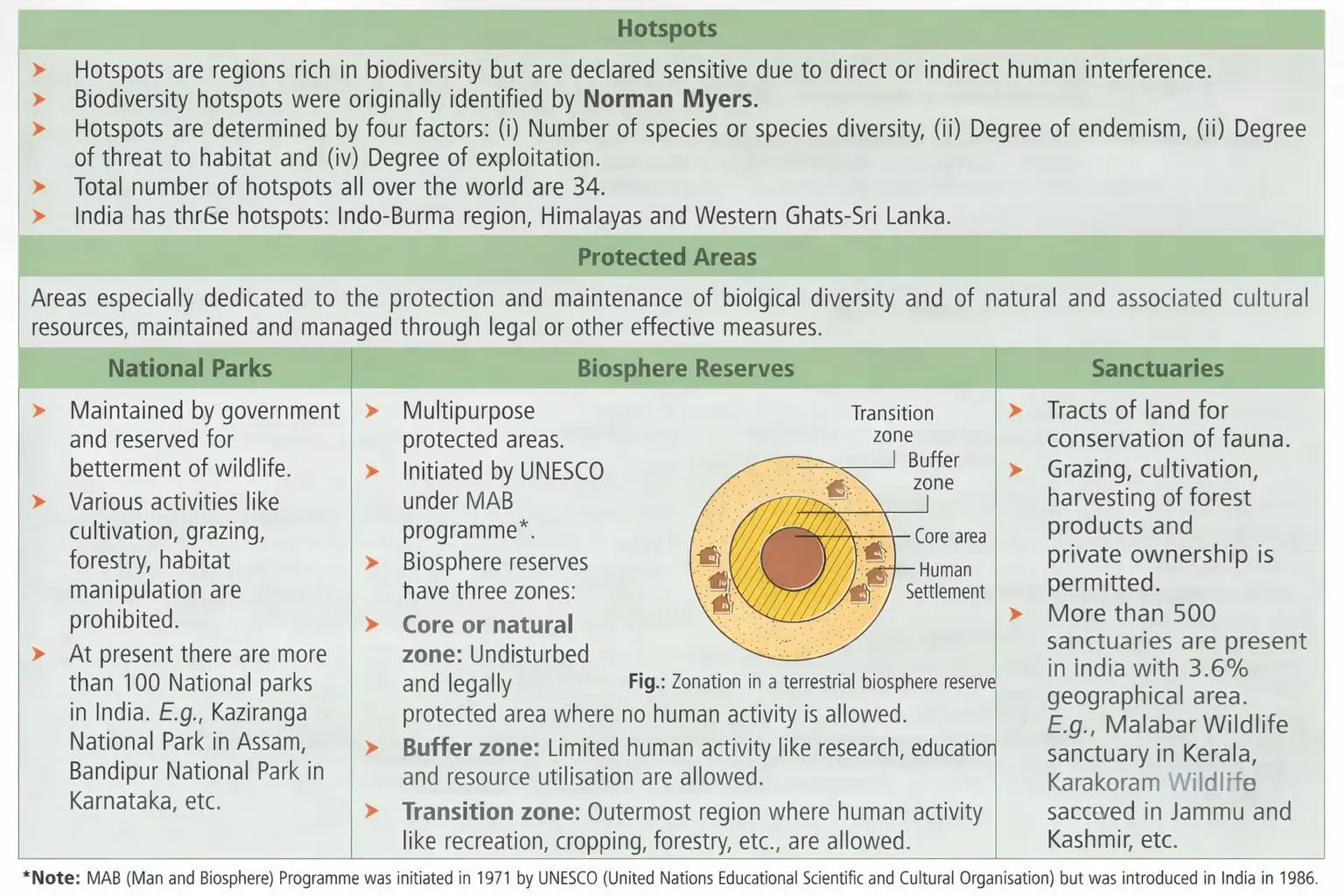
Sacred groves
- Meaning: Forest tracts protected by religious or cultural traditions, where trees and wildlife receive strong protection.
- Value: Sacred groves help rare endemic species flourish; in Meghalaya, they are last refuges for many rare and threatened plants.
- Locations: Khasi and Jaintia Hills (Meghalaya), Aravalli Hills (Rajasthan), Western Ghats (Karnataka and Maharashtra), and Sarguja, Chanda and Bastar areas of Madhya Pradesh.
- Examples: Bishnois protect Prosopis cineraria and black buck; Khecheopalri Lake in Sikkim is a sacred water body.
Ex-situ conservation
Ex-situ conservation — Conservation of endangered plant and animal species away from their natural habitats.
Off-site collections and gene banks
- Live collections: Botanical gardens, zoological parks, wildlife safari parks and arboreta maintain wild or domesticated species.
- Facilities: Botanical gardens and arboreta may have seed banks and tissue-culture facilities; zoos may run captive-breeding programmes.
- Captive breeding: Helps maintain species extinct in the wild; selected individuals may be released as captive populations increase.
- Gene banks: Store viable seeds, live plants, tissue cultures and frozen germplasm with a wide range of genetic variability for breeders and genetic engineers.
| Method | Conditions or purpose | Examples and key points |
|---|---|---|
| Orthodox seed banks | Seeds tolerate drying to about 5% moisture, anaerobic conditions and low temperatures of −10°C to −20°C. | Cereals and legumes. |
| Recalcitrant seeds | Seeds cannot tolerate reduced moisture or low temperatures; short-term storage uses fungicide treatment, humid air and normal oxygen. | Cocoa, jackfruit and coconut. |
| Orchards | Maintain all possible strains and varieties of plants with recalcitrant seeds. | Litchi and oil palm. |
| Tissue culture | Useful for recalcitrant seeds, variable seed progeny, seedless varieties or maintaining a clone. | Callus, embryoids, pollen-grain and shoot-tip cultures; stores many genotypes in little space, enables rapid multiplication of endangered species and supports hybrid rescue. Examples: banana and potato. |
| Cryopreservation | Preserves material indefinitely at −196°C in liquid nitrogen; special techniques are needed for revival. | Embryos, animal cells or tissues, gametes and material from endangered organisms. |
International efforts for biodiversity conservation
Major international milestones
- 1992The Earth Summit in Rio de Janeiro promoted the Convention on Biological Diversity (CBD), signed by 152 nations.
- 29 December 1993The CBD recommendations came into effect.
- May 1994India became a party to the CBD.
- 2002The World Summit in Johannesburg, South Africa, had 190 participating countries pledge to reduce biodiversity loss by 2010.
- 2010Target year to significantly reduce the current rate of biodiversity loss at global, regional and local levels.
- 2012Rio+20 was held in Rio de Janeiro to develop new strategies for sustainable development.
CBD commitments and related initiatives
- CBD commitments: Conserve biodiversity, manage it for sustainable use, and ensure equitable sharing of benefits, including those from genetic resources.
- Agenda 21: Earth Summit blueprint for sustainable development through social, economic and environmental measures in the 21st century.
- NGO support: Organisations such as Greenpeace provide international support for conservation.
- CITES: Convention on International Trade in Endangered Species of Wild Fauna and Flora; helps restrict poaching and trade-related loss of rare species.
- World Conservation Union and WWF: Provide conservation leadership, common approaches and expertise; the World Conservation Union was formerly IUCN.
- UNESCO MAB: UNESCO's Man and Biosphere programme helps establish and maintain biosphere reserves.
- Trade restrictions: Restrictions on trade in animal products are believed to have helped save elephants from extinction.
Biodiversity conservation in India
| Institution or programme | Role |
|---|---|
| Ministry of Environment and Forests | Conducts in-situ conservation. |
| National Bureau of Plant, Animal and Fish Genetic Resources | Manages major ex-situ conservation of biodiversity. |
| ICRISAT, Hyderabad | Conserves germplasm of groundnut, pigeon pea, chickpea, pearl millet and sorghum. |
| Other Indian centres | Maintain hundreds and thousands of present and past varieties of crop plants. |
State the three main arguments for conserving biodiversity.
Differentiate between in-situ and ex-situ conservation.
What are the three major commitments of the CBD?
Quick recap
- Biodiversity conservation protects biodiversity for sustainable benefit to current and future generations.
- The three arguments for conservation are narrowly utilitarian, broadly utilitarian and ethical.
- The Red List records extinction threats, promotes awareness and helps set conservation priorities.
- In-situ conservation includes hotspots, protected areas and sacred groves; ex-situ methods include live collections and gene banks.
- Seed storage depends on whether seeds are orthodox or recalcitrant; other methods include orchards, tissue culture and cryopreservation at −196°C indefinitely.
- CBD commitments are conservation, sustainable use and equitable benefit-sharing; India became a party in May 1994.
- Indian efforts include Ministry-led in-situ conservation, genetic-resource conservation and ICRISAT germplasm preservation.
NEET Zoology — ALL CHAPTERS
1
Structural Organisation in Animals
2
Breathing and Exchange of Gases
3
Body Fluids and Circulation
4
Excretory Products and their Elimination
5
Locomotion and Movement
6
Neural Control and Coordination
7
Human Reproduction
8
Reproductive Health
9
Evolution
10
Microbes in Human Welfare
11
Organism and Population
12
Ecosystem
13
Biodiversity and Conservation