NEET UG . NEET Zoology . Zoology . Evolution
Chapter 9: Evolution
Ch 9
NEET Zoology
NEET UG
Origin of Life
Evolution and the Origin of Life
Biopoiesis — The origin of life on Earth from inanimate (non-living) matter.
Theories for the Origin of Life
| Theory | Main claim | Key detail |
|---|---|---|
| Special creation | A supernatural power created living organisms. | Proposed by Hebrew et al. and supported by Father Suarez; life appeared suddenly and was said not to change. These ideas were strongly challenged in the nineteenth century. |
| Cosmic panspermia | Life came to Earth from outside. | Early Greek thinkers proposed that life-units or spores travelled between planets; panspermia remains an idea favoured by some astronomers. |
| Spontaneous generation (abiogenesis) | Life arose directly from decaying or rotting non-living matter. | Ancient Greek philosophers supported it; examples included organisms arising from Nile mud warmed by the Sun, or from wheat grains and human sweat (Van Helmont). |
| Biogenesis | Life arises only from pre-existing life. | Experiments by Francesco Redi, Lazzaro Spallanzani and Louis Pasteur supported it and disapproved spontaneous generation. |
| Oparin–Haldane theory | Life developed from non-living organic molecules through chemical evolution. | The early Earth’s surface and atmosphere differed greatly from present conditions; spontaneous generation under current conditions is not possible. |
Pasteur and Biogenesis
- Swan-neck flask experiment: Pasteur showed that microorganisms causing fermentation or putrefaction came from the air, not spontaneously from nutrient media.
- Result: Pre-sterilised media did not develop life unless exposed to airborne microorganisms; life comes from pre-existing life.
- Conclusion: Spontaneous generation was dismissed in favour of biogenesis.
Oparin–Haldane Theory and Chemical Evolution
Chemical Theory
- Proponents: Oparin of Russia and Haldane of England proposed that life arose through chemical evolution from pre-existing non-living organic molecules, such as RNA and proteins.
- Other names: Oparin’s proposal is also called the chemical or naturalistic theory and was published in his book *The Origin of Life*.
- Early Earth: Conditions on Earth’s surface and in its atmosphere during the first billion years were radically different from those of today.
- Key condition: Spontaneous generation of life is not possible under present environmental conditions.
Miller’s Experiment
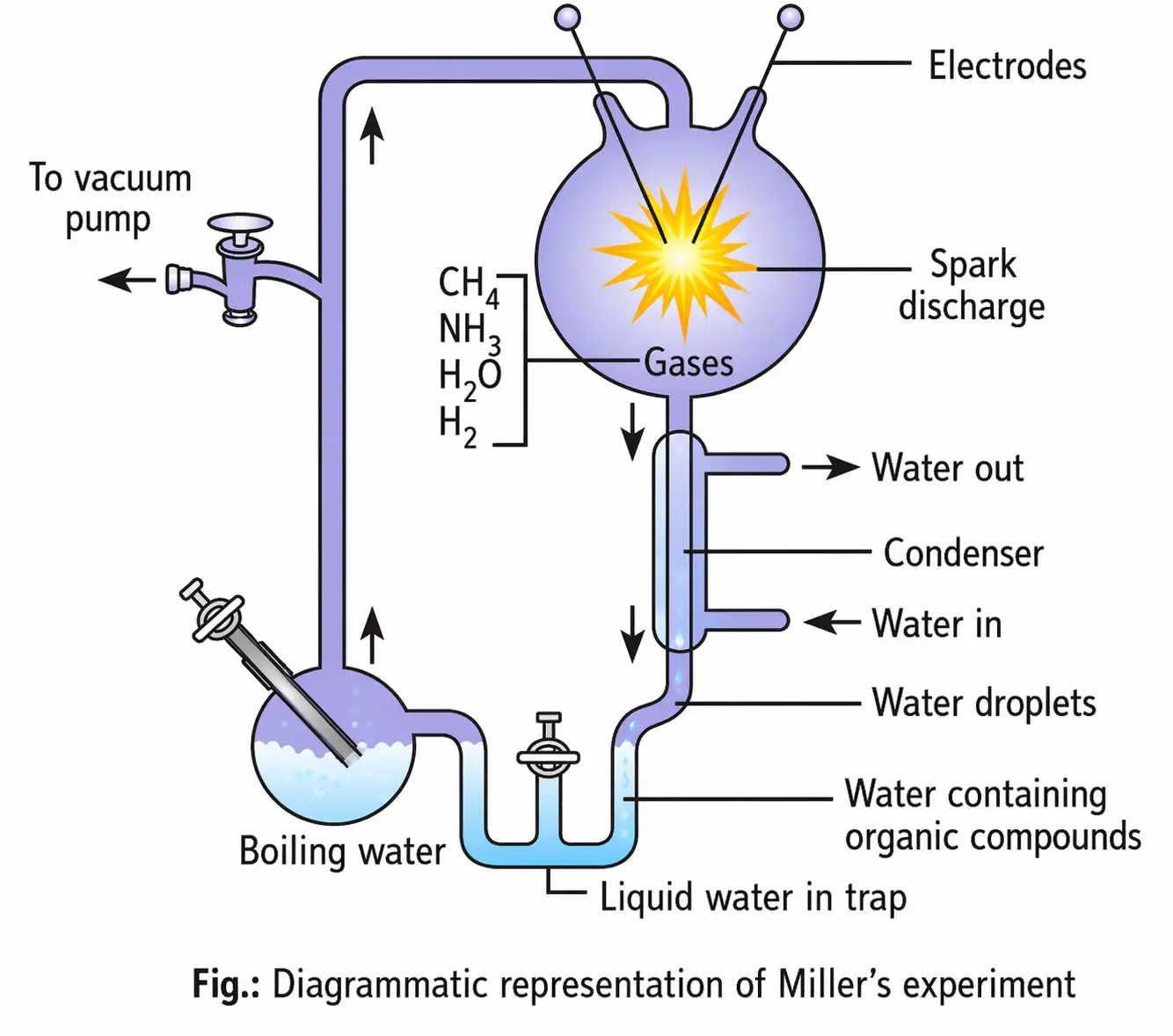
- Year and scientist: In 1953, S. L. Miller, a student of Harold C. Urey, simulated conditions thought to resemble primitive Earth.
- Setup: He passed an electric discharge through a closed flask containing CH₄, H₂, NH₃ and water vapour at 800°C.
- Finding: Amino acids formed; similar experiments also produced sugars, nitrogen bases, pigments and fats.
- Hot dilute soup: Haldane described the early sea, where complex organic substances may have formed, as a “hot dilute soup”.
- Significance: The formation of protein molecules is considered a landmark in the origin of life.
Biological Evolution
From Organic Molecules to Eukaryotic Cells
- About 3 billion years ago: The first non-cellular forms may have been giant molecules such as RNA, proteins and polysaccharides.
- Abiotic macromolecules → protobionts: Molecules formed in primitive oceans gathered into colloidal clusters containing proteins, polysaccharides, lipids and nucleic acids.
- Protobionts: They could grow by absorbing surrounding molecules and show simple metabolism, but could not reproduce.
- Laboratory models: Oparin made coacervates (without a lipid membrane); Sydney Fox made microspheres (microscopic proteinoid bodies with a lipid coat).
- Self-duplicating nucleic acids → nucleoproteins: Mutation gave nucleic acids the ability to self-duplicate; nucleic acids combined with proteins. Nucleoproteins were the first sign of life.
- Nucleoproteins + lipid coat → protocell: A protocell is considered the first form of life.
- Protocells → prokaryotes: Mutations increased complexity and efficiency, leading to the first living beings: single-celled prokaryotes with naked DNA.
- Early nutrition: These prokaryotes were probably anaerobic chemoheterotrophs; some evolved into anaerobic chemoautotrophs that made organic food from inorganic materials by chemosynthesis.
- Examples of chemosynthesis: Iron bacteria and nitrifying bacteria.
- Bacteriochlorophyll → photosynthesis: Some chemoautotrophs developed bacteriochlorophyll and began converting light energy into chemical energy.
- True chlorophyll → oxygenic photosynthesis: Organisms used H₂O as a hydrogen source and released oxygen; cyanobacteria (blue-green algae) are an example.
- Oxygen release → major change: Free oxygen released by cyanobacteria was a revolutionary change in Earth’s history.
- About 1.5 billion years ago: Nuclei, mitochondria and other organelles developed; free-living, metabolically active eukaryote-like cells arose in primitive oceans.
What did Miller’s experiment demonstrate?
Distinguish protobionts, coacervates, microspheres and protocells.
How did early prokaryotes contribute to the development of oxygenic photosynthesis?
Quick recap
- Evolution is orderly change in life forms over time; biopoiesis is the origin of life from non-living matter.
- Special creation, panspermia, spontaneous generation, biogenesis and Oparin–Haldane chemical evolution offer different explanations of life’s origin.
- Pasteur’s swan-neck flask experiment supported biogenesis: microorganisms come from pre-existing life in air, not spontaneously from nutrient media.
- Miller’s 1953 experiment produced amino acids from simulated early-Earth gases using electric discharge at 800°C.
- Organic molecules formed protobionts; nucleoproteins surrounded by a lipid coat formed protocells.
- Early anaerobic prokaryotes included chemoheterotrophs and chemoautotrophs; photosynthetic cyanobacteria released oxygen.
- Non-cellular forms may date to about 3 billion years ago; free-living eukaryote-like cells arose about 1.5 billion years ago.
Evolution of Life Form- A Theory
Darwin’s Observations
Evolution — The gradual change in life forms over generations, producing new forms and sometimes leading to the extinction of older ones.
- Darwin’s voyage: During a round-the-world voyage on the sail ship H.M.S. Beagle, Charles Darwin observed similarities among living forms.
- Past and present life: Living forms resemble one another to varying degrees and share similarities with organisms that lived millions of years ago.
- Change through time: Some life forms became extinct, while new forms arose during different periods of Earth’s history.
Natural Selection
Natural selection — Darwin’s proposed mechanism of evolution in which individuals with advantageous characteristics leave more offspring.
- Variation: Individuals within a population differ in their characteristics.
- Environmental advantage: Variations that help individuals survive conditions such as climate, food availability and other physical factors provide an advantage.
- Differential reproduction: Better-adapted individuals leave more progeny than individuals less suited to those conditions.
- Evolutionary outcome: Nature selects individuals that survive and reproduce more successfully.
Fitness — In Darwin’s theory, fitness ultimately means reproductive fitness: the ability to leave more progeny in a particular environment.
- Key idea: Fitness is measured by reproductive success, not simply by strength or survival alone.
- Selection: Individuals better suited to their environment leave more offspring and contribute more to later generations.
Common Ancestry and Earth’s History
Common ancestry — The idea that existing life forms share ancestors that lived at different times in Earth’s history.
- New types: New types of organisms become recognisable over time as life forms change.
- Shared ancestry: Existing life forms share similarities and trace back to common ancestors.
- Earth’s history: Those ancestors lived in different epochs, periods and eras.
- Geological and biological history: The geological history of Earth closely correlates with its biological history.
Scientists with Similar Conclusions
- Charles Darwin: Developed his observations during a round-the-world voyage on the H.M.S. Beagle.
- Alfred Wallace: A naturalist working in the Malay Archipelago who reached conclusions similar to Darwin’s around the same time.
- Alfred Wallace
- A naturalist working in the Malay Archipelago who reached conclusions similar to Darwin’s around the same time.
- H.M.S. Beagle
- The sail ship on which Darwin made his round-the-world voyage.
- Natural selection
- The process by which individuals better suited to natural conditions leave more offspring.
- Reproductive fitness
- An individual’s success in contributing progeny to future generations.
Do not equate Darwinian fitness only with strength or survival; it ultimately refers to reproductive success.
What is natural selection according to Darwin?
How does Darwin define fitness?
Quick recap
- Darwin observed similarities between living organisms and forms that lived millions of years ago.
- Life has changed gradually; extinctions and new forms have occurred through Earth’s history.
- Populations contain variations, and some variations help individuals survive natural conditions.
- Darwinian fitness means reproductive success; better-adapted individuals leave more progeny.
- Darwin called natural selection a mechanism of evolution.
- Alfred Wallace reached similar conclusions to Darwin around the same time while working in the Malay Archipelago.
- Existing life forms share common ancestors, and biological history correlates with Earth’s geological history.
What are the Evidences For Evolution?
Evidence for evolution
- Evidence from fossils, comparative anatomy and morphology, embryology, and natural selection supports the occurrence and processes of evolution.
- Evolutionary relationships can be inferred from similarities and differences among organisms, including clues to common ancestry.
Palaeontological Evidence
Fossils — Preserved remains of organisms, commonly their hard parts, found in rocks.
What fossils show
- Sedimentary layers form over long periods; fossils in layers of different ages represent organisms that lived at different times.
- Fossil distribution helps identify the geological periods in which life-forms existed; some are restricted to particular time spans.
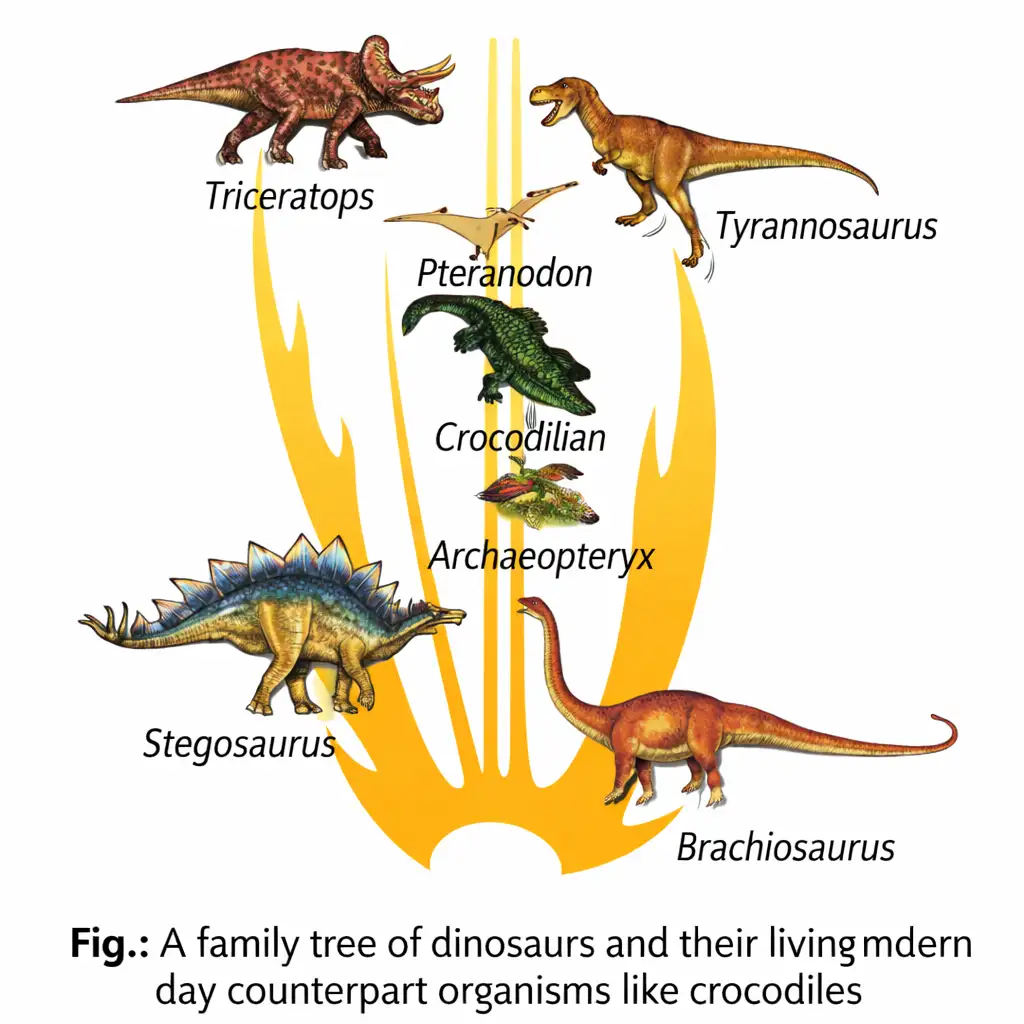
- Geological succession shows vertebrate groups appearing in order: fishes → amphibians → reptiles → birds and mammals.
- Geological time is the chronological history of evolution inferred from fossils, divided into eras, periods, and epochs.
| Type | How preserved | Examples / notes |
|---|---|---|
| Unaltered | Preserved in original or intact form | Woolly mammoths found deep-frozen in Siberian ice for more than 25,000 years; insects or plant parts in amber |
| Petrified | Minerals replace organic or soft parts; hard parts remain preserved | Bones, teeth, shells, and wood; the most common fossil type |
Mass extinction — The death and disappearance of large groups of plants and animals over a short time span.
- Possible causes include a meteor or comet impact, or the drifting, joining, and breaking apart of continents.
- Fossil record shows that life-forms varied over time and provides evidence of mass extinctions.
Comparative Anatomy and Morphology
- Comparative anatomy and morphology examine similarities and differences in body structures among living organisms and those from the past.
- Evolutionary relationships can be interpreted from structural patterns, including whether organisms share common ancestors.
Homology and Divergent Evolution
Homology — Similarity in organs due to common ancestry or embryonic origin and a shared basic structural plan, even when functions differ.
Homologous structures
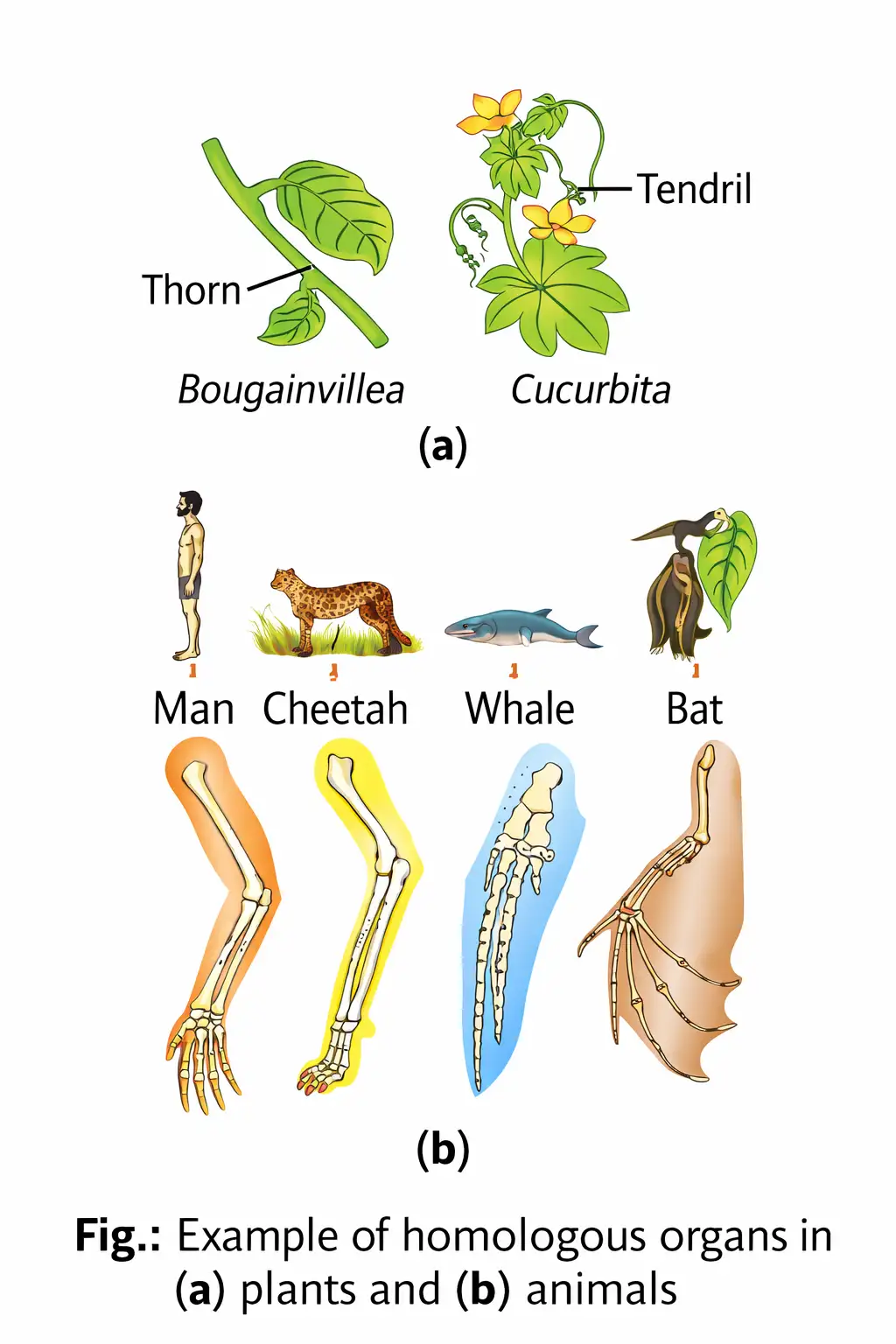
- Mammalian forelimbs of humans, whales, bats, and cheetahs share the same basic bones: humerus, radius, ulna, carpals, metacarpals, and phalanges.
- Different functions arise as the shared structure adapts in different directions to different needs.
- Divergent evolution develops different forms and functions from a common ancestral structure; it is also called adaptive radiation.
- Plant example: Bougainvillea thorn and Cucurbita tendril are homologous structures.
| Vertebrate group | Heart structure / circulation |
|---|---|
| Fishes | Two-chambered, venous and branchial heart; single circulation |
| Amphibians | Three-chambered, arteriovenous heart; pumps mixed blood |
| Reptiles | Structurally three-chambered; ventricle incompletely partitioned |
| Birds and mammals | Four-chambered; ventricle completely partitioned |
- Heart homology is supported by shared position, general organisation, and cardiac muscle structure across vertebrates.
- Increasing complexity in heart structure, from fishes to birds and mammals, supports evolutionary change across vertebrate groups.
Analogy and Convergent Evolution
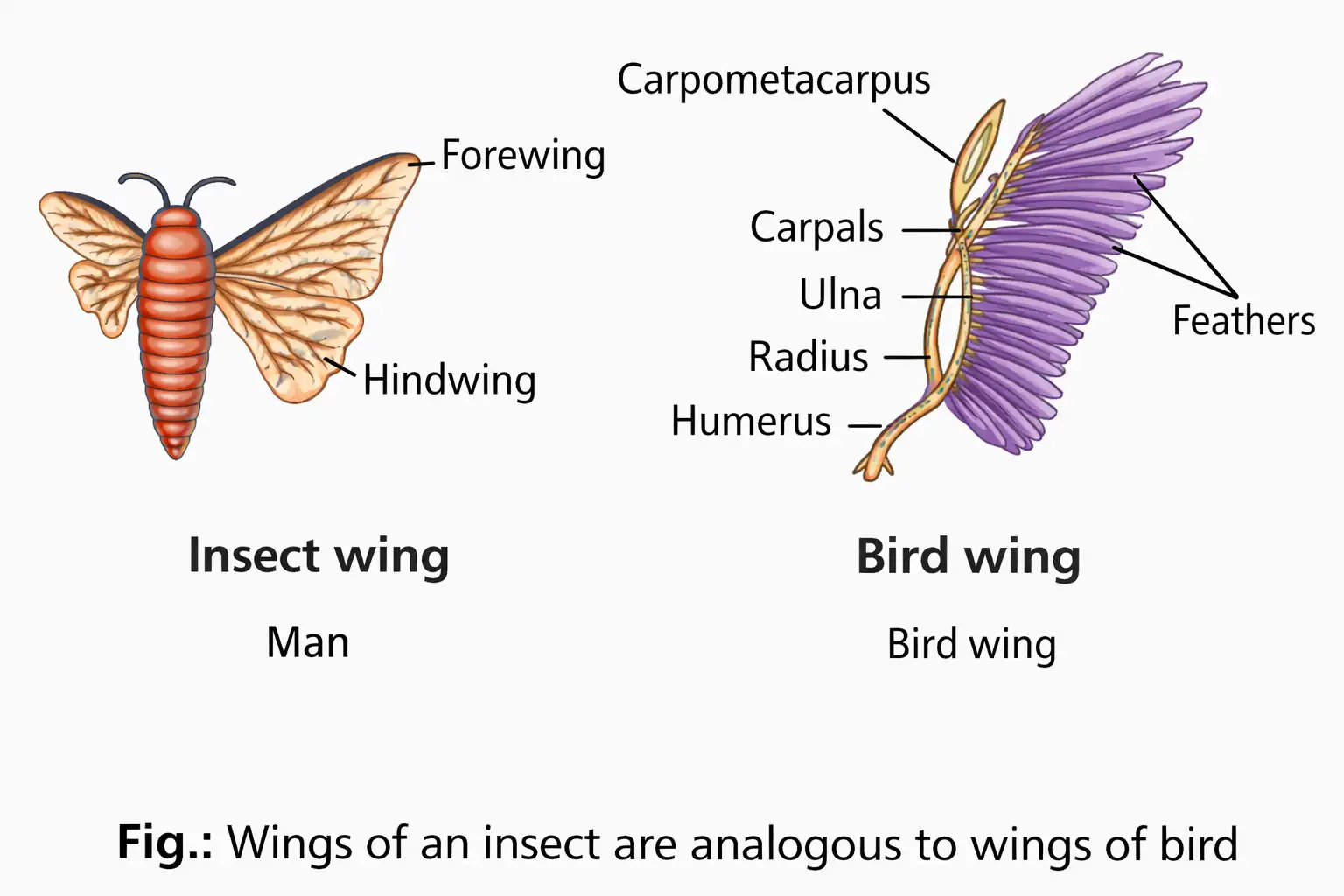
Analogy — Similarity of function in organs that differ in basic structure and developmental origin; also called adaptive convergence or convergent evolution.
Analogous structures
- Convergent evolution occurs when organisms from separate lineages develop similar features because they perform similar functions.
- Examples: butterfly and bird wings; octopus and mammalian eyes; penguin and dolphin flippers.
- Plant example: sweet potato is a modified root, while potato is a modified stem; both are analogous.
- Biochemical evidence: similarities in proteins and genes with corresponding functions among diverse organisms can indicate common ancestry.
| Point | Homologous | Analogous |
|---|---|---|
| Basic structure and origin | Similar | Different |
| Function | May differ | Similar |
| Evolutionary pattern | Divergent evolution | Convergent evolution (adaptive convergence) |
| Example | Forelimbs of humans and whales | Wings of birds and insects |
Connecting links — Organisms that show characteristics of two different taxonomic groups.
- Examples: Protopterus (lungfish) links bony fishes and amphibians; Sphenodon is a primitive reptile with amphibian characters.
Vestigial organs — Reduced organs that do not perform a function in the body but correspond to fully developed functional organs in related animals.
Atavism — Reappearance or renewed functioning of an ancestral feature that had disappeared or become vestigial.
- Examples: the human nictitating membrane is vestigial; movement of the pinna in some people is an atavistic feature.
Embryological Evidence
Shared early development
- Common developmental pattern: multicellular organisms begin as a fertilised egg, or zygote.
- Early sequence: repeated cell divisions form a blastula, which develops into a two-layered gastrula.
- Gastrula layers: the outer layer forms the future ectoderm; the inner layer forms the future endoderm.
- Vertebrate embryos: early embryos of humans, chicks, lizards, frogs, and fishes show marked similarities and can be difficult to distinguish.
Recapitulation theory (Biogenetic Law) — Haeckel’s proposed idea that ontogeny (an organism’s life history) recapitulates phylogeny (its evolutionary history).
Retrogressive metamorphosis — Metamorphosis in which a larva with developed features loses them as it becomes an adult.
- Ascidian example: the free-swimming tadpole larva has chordate features; during metamorphosis it loses the notochord, nerve cord, and myotomes.
- Evolutionary clue: the larval features reveal the ascidian’s chordate nature.
Neoteny — Retention of larval or embryonic traits in the adult body.
- Examples: adult chondrichthyans retain an embryonic cartilaginous skeleton; some adult salamanders retain larval gills.
Natural Selection: Industrial Melanism
Industrial melanism — The increased prevalence of dark-coloured forms in industrial regions where soot darkens their background.
Peppered moth example
- Species: the best-studied example is the peppered moth, *Biston betularia*.
- Forms: *B. betularia typica* is creamy white with dark blotches and spots; *B. betularia carbonaria* is the dark melanic form.
- Origin of dark form: carbonaria is described as a mutant form arising from a mutation in a single gene determining colour.
- Researchers: R.A. Fischer, E.B. Ford, and H.B.D. Kettlewell studied industrial melanism; in 1958, Kettlewell reported melanic forms of 70 moth species from Britain and Europe.
Selection in changing environments
- Before industrialisation, tree bark carried pale lichens → light moths were camouflaged from predatory birds.
- Industrial soot darkened the bark → light moths became more visible and were more often eaten.
- Dark moths were better camouflaged → more survived and reproduced.
- Over generations, dark moth numbers increased while light moth numbers decreased.
Differentiate homologous and analogous organs, giving one example of each.
Explain industrial melanism in the peppered moth.
Define neoteny and give one example.
Quick recap
- Fossils in differently aged sediments reveal the geological succession of life-forms and help establish geological time.
- Homologous organs share origin and basic structure; they indicate common ancestry and divergent evolution.
- Analogous organs share function but differ in origin and structure; they reflect convergent evolution, also called adaptive convergence.
- Embryonic similarities, recapitulation theory, retrogressive metamorphosis, and neoteny are embryological evidence discussed in the lecture.
- Connecting links, vestigial organs, and atavism provide additional clues to evolutionary relationships.
- Industrial melanism shows natural selection: environmental change favours better-camouflaged variants.
What is Adaptive Radiation ?
Adaptive Radiation
Adaptive radiation — Evolution of multiple species from a common ancestral stock within a geographical area, as they adapt to different habitats or ways of life.
Darwin’s Finches
- Location: Galapagos Islands.
- Origin: Different finches descended from common ancestral seed-eating ground finches.
- Diversification: Different feeding habits led to the evolution of different beak forms.
Australian Marsupials
- Pattern: Different marsupial species evolved from an ancestral stock.
- Region: Their diversification occurred within the Australian island continent.
Convergent Evolution
Convergent evolution — Independent evolution of similar adaptations in different evolutionary lineages, often associated with similar habitats or ways of life.
- Example: Australian marsupials and placental mammals show convergent evolution.
- Specific example: The placental wolf and the Tasmanian wolf, a marsupial, evolved similar forms independently.
Parallel Evolution
Parallel evolution — A form of convergent evolution in which similar adaptations develop in closely related species.
- Example: Deer and horses developed a running habit.
- Difference: Deer have two toes; horses have one toe and two vestigial splint bones.
| Point | Adaptive radiation | Convergent / parallel evolution |
|---|---|---|
| Evolutionary pattern | One ancestral stock diversifies into multiple forms. | Different lineages independently develop similar adaptations. |
| Key example | Galapagos finches; Australian marsupials. | Placental and Tasmanian wolves; deer and horses (parallel evolution). |
| Relatedness | Species share a common ancestral stock. | Convergence involves different lineages; parallel evolution occurs in closely related species. |
How do Darwin’s finches illustrate adaptive radiation?
Distinguish convergent evolution from parallel evolution.
Quick recap
- Adaptive radiation is diversification from a common ancestor within a geographical area.
- Galapagos finches evolved different beaks in response to different feeding habits.
- Australian marsupials diversified from an ancestral stock within Australia.
- Convergent evolution is the independent development of similar adaptations in different lineages.
- The placental wolf and Tasmanian wolf are an example of convergent evolution.
- Parallel evolution occurs in closely related species; deer and horses show this in their running adaptations.
Biological Evolution
Lamarck's Theory
| Proposition | Main idea |
|---|---|
| Internal vital force | Organisms and their component parts continually increase. |
| Environment and new needs | Environmental changes create needs that can alter habits and structures; desire is called appetency. |
| Use and disuse | Use develops an organ; disuse leads to degeneration. |
| Inheritance of acquired characters | Lifetime-acquired characters pass to offspring and may accumulate into new species. |
Evidence and Criticism of Lamarckism
Continuity of germplasm — Weismann's theory that only characters influencing germ cells are inherited.
Weismann's Test
- Criticism: August Weismann opposed the inheritance of acquired characters and argued that inheritance depends on germ cells.
- Experiment: He cut off the tails of rats for 22 generations and bred them; tailless offspring were never produced.
Darwin's Theory
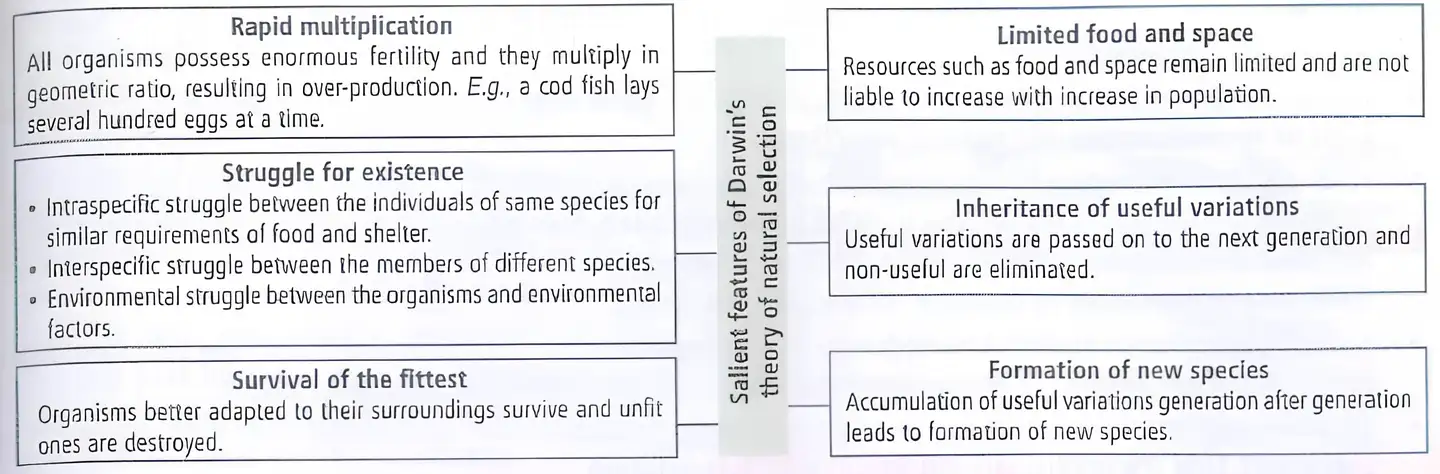
Evidence and Criticism of Darwinism
| Issue | What Darwinism could not explain |
|---|---|
| Types of variation | Darwin did not distinguish somatic variations from germinal variations and treated all variations as heritable. |
| Long-term stability | It could not explain organisms remaining unchanged for millions of years. |
| Discontinuous variation | It could not account for the occurrence of discontinuous variations. |
| Other observations | It could not explain survival of the fittest, effects of use and disuse, or the presence of vestigial organs. |
What is the central claim of Lamarckism, and what did Weismann's rat experiment show?
Name Darwin's two key concepts and give two examples cited as evidence for Darwinism.
Quick recap
- Lamarckism proposes that acquired characters are inherited and accumulate over generations.
- Lamarck's four propositions are internal vital force, environmental needs, use and disuse, and inheritance of acquired characters.
- Weismann's germplasm theory links inheritance to characters influencing germ cells; his rat-tail experiment challenged Lamarckism.
- Darwin and Wallace announced natural selection on June 30, 1858; branching descent and natural selection are its key concepts.
- Examples cited for Darwinism include variation, mimicry, protective colouration, and pollination-related correlations.
- Darwinism was criticised for not distinguishing somatic from germinal variations and for leaving several observations unexplained.
Mechanism of Evolution
Hugo de Vries’ Mutation Theory
Saltation — A single-step, large mutation that can cause speciation, as proposed by Hugo de Vries.
Neo-Darwinism
- Basis: Neo-Darwinism combines Darwin’s theory of natural selection with modern findings in genetics and evolution.
- Genetic variation: Mutation and genetic recombination generate heritable differences within populations.
- Evolutionary factors: Isolation, heredity and natural selection influence changes in populations.
- Outcome: Accumulated changes can lead to the formation of new species.
Quick recap
- Hugo de Vries proposed mutation theory based on *Oenothera lamarckiana*.
- Mutations are sudden, discontinuous, random and directionless in de Vries’ theory.
- Useful mutations may be selected; lethal mutations are eliminated, while less harmful or useless ones may persist.
- Darwin described gradual evolution, whereas de Vries proposed saltation through a large mutation.
- Neo-Darwinism combines Darwinism with later research and includes variation, isolation, heredity, selection and speciation.
Hardy-Weinberg Principle
Hardy–Weinberg Equilibrium
The two allele frequencies and the three genotype frequencies each sum to .
Factors That Change Allele Frequencies
| Process | How allele frequencies change |
|---|---|
| Gene migration | Movement of part of a population to another population changes frequencies in both; alleles are added to the receiving population and lost from the source. |
| Gene flow | Repeated gene migration between populations produces gene flow. |
| Genetic drift | A change in allele frequency caused by chance rather than migration or selection. |
Founder effect — A sharp, chance difference in allele frequencies can arise when a small group establishes a new population; this is the founder effect.
Mutation and New Phenotypes
- Pre-existing variation: Microbial experiments show that selection acting on advantageous mutations already present in a population can produce new phenotypes.
- Long-term effect: Accumulation of such changes over generations may lead to speciation.
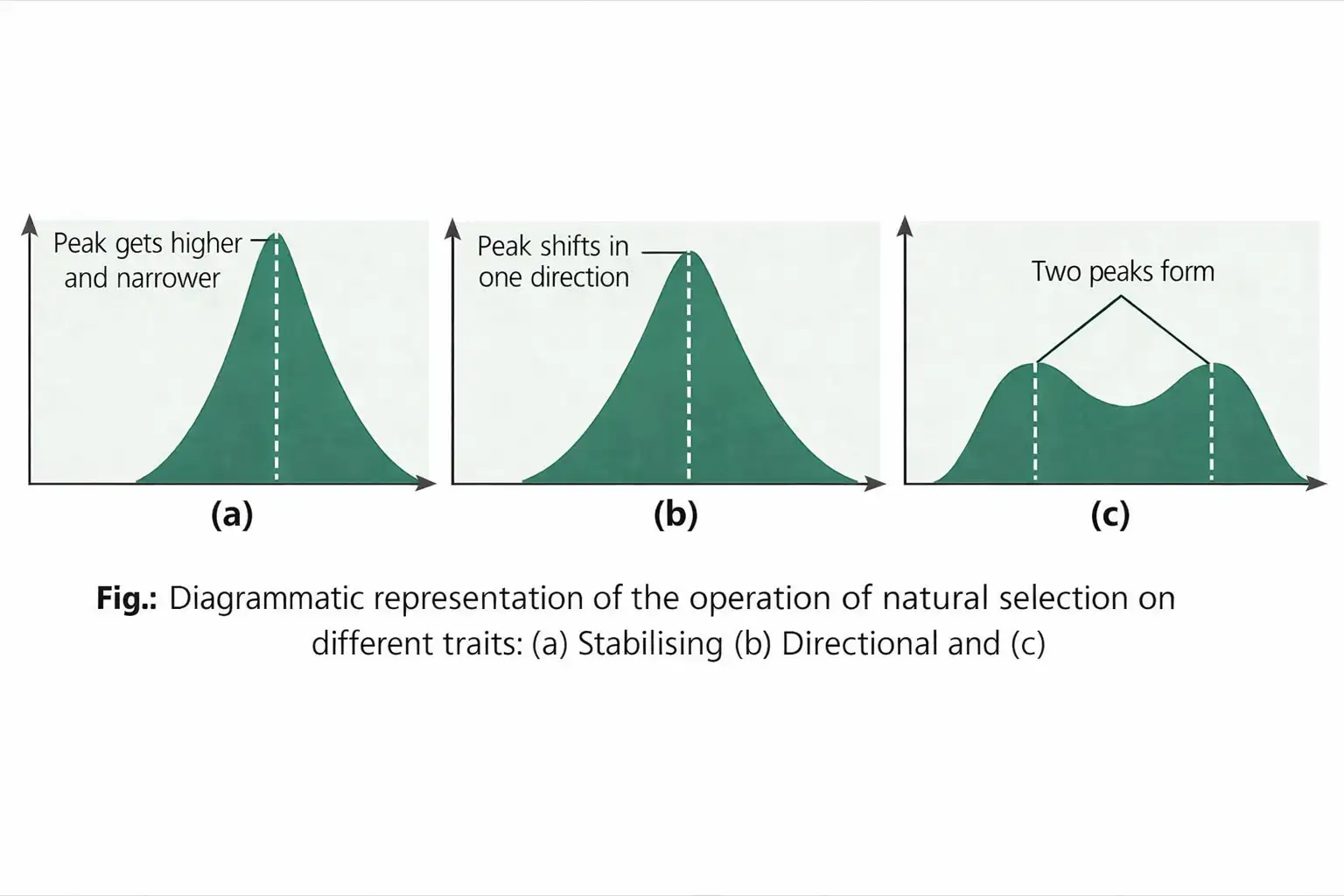
Natural Selection
State the Hardy–Weinberg equations and explain their terms.
Differentiate stabilising, directional and disruptive selection.
Quick recap
- Hardy–Weinberg equilibrium means allele frequencies stay constant under its specified conditions.
- For two alleles, and genotype frequencies are , and .
- Gene migration changes frequencies through movement; repeated migration is gene flow, while chance change is genetic drift.
- The founder effect is a sharp frequency difference in a new population founded by a small group.
- Mutation, recombination, gene flow and drift provide variation that can alter future gene frequencies.
- Natural selection may be stabilising, directional or disruptive.
A brief Account of Evolution
Early Life and the Move onto Land
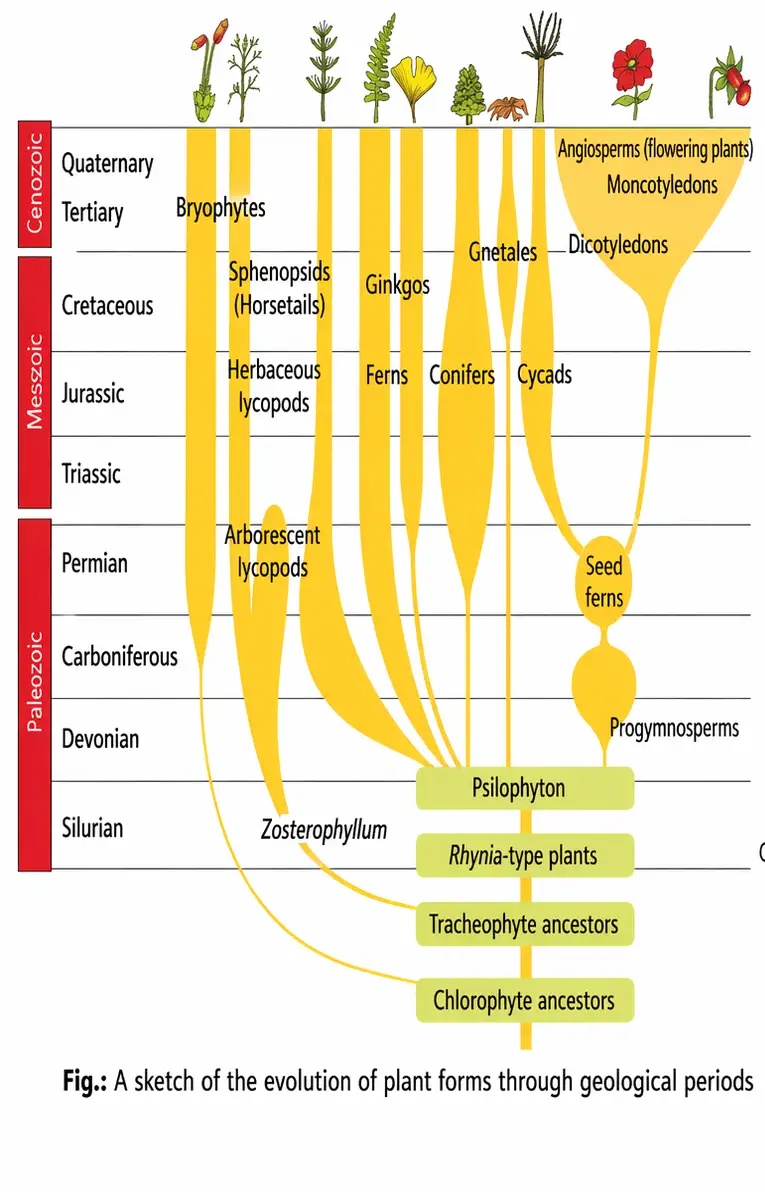
From Finned Fish to Reptiles
- Evolutionary transitions: This section traces how vertebrate lineages adapted as life diversified across aquatic and terrestrial habitats.
- Changing environments: Adaptations to different habitats shaped the course of vertebrate evolution.
Reptile Dominance and Dinosaur Extinction
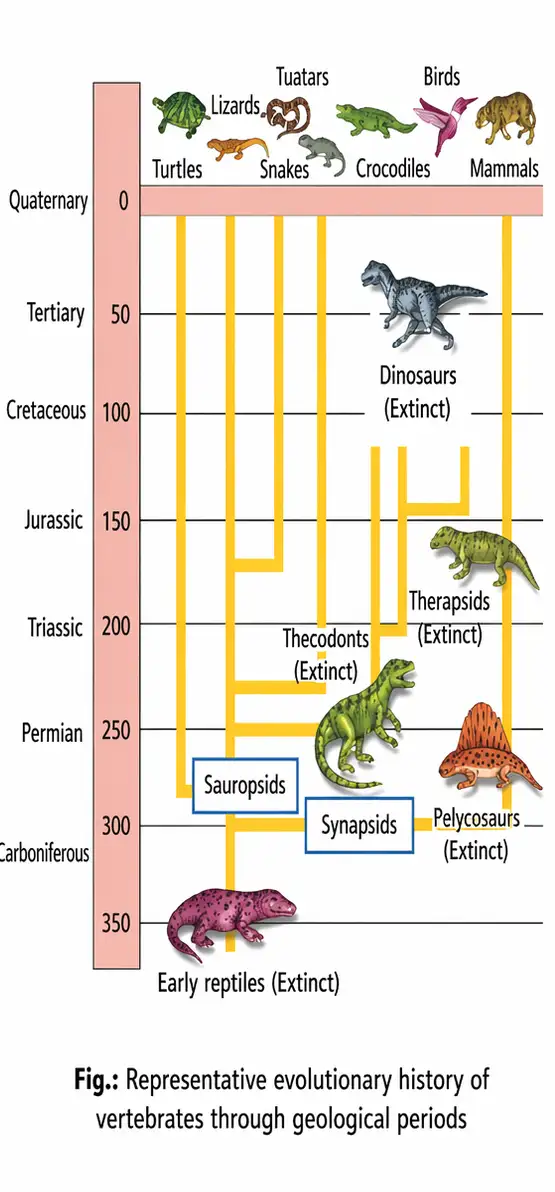
Mammals and Continental Drift
How did reptiles become adapted to life on land compared with amphibians?
What are the proposed explanations for the disappearance of dinosaurs?
Quick recap
- Life began with cellular forms about 2000 mya and gradually developed into multicellular life.
- Plants colonised land before animals; strong-finned fish gave rise to amphibians and then reptiles.
- Thick-shelled reptile eggs resist drying, unlike amphibian eggs.
- Reptiles and dinosaurs dominated for a long period; dinosaurs disappeared about 65 mya for an uncertain reason.
- Mammals were viviparous, protected their young and became widespread after reptiles declined.
- Continental drift affected mammal distribution; pouched mammals persisted in Australia with little competition.
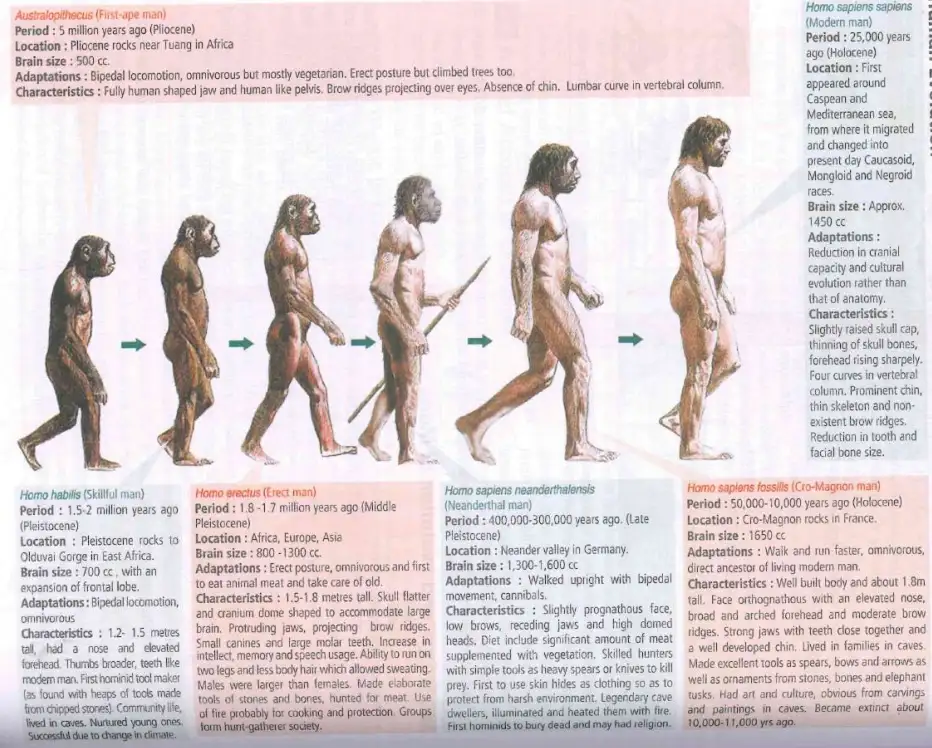
Origin and Evolution of Man
Anthropogenesis — The biological process by which Homo sapiens sapiens emerged as a distinct species from other hominids, great apes and placental mammals.
Early Primates and Hominids
| Stage | Date and place | Key features |
|---|---|---|
| Dryopithecus and Ramapithecus | About 15 million years ago | Both were hairy and walked like gorillas and chimpanzees. Ramapithecus was more human-like; Dryopithecus was more ape-like. |
| Early man-like primates | About 3–4 million years ago; eastern Africa | Fossils found in Ethiopia and Tanzania suggest they walked upright and were no taller than about 4 feet. |
| Australopithecus | About 2 million years ago; East African grasslands | Used stone weapons to hunt but mainly ate fruit. |
| Homo habilis | Date not specified | Identified as the first human-like being (hominid); brain capacity was 650–800 cc and it probably did not eat meat. |
Later Human Evolution
| Stage | Date and place | Key features |
|---|---|---|
| Homo erectus | About 1.5 million years ago; fossils discovered in Java in 1891 | Brain capacity was around 900 cc; it probably ate meat. |
| Neanderthal man | 100,000–40,000 years ago; Near East and Central Asia | Brain size was about 1,400 cc; used hides to protect the body and buried the dead. |
| Homo sapiens | Arose in Africa and spread across continents | Developed into distinct races. Modern Homo sapiens arose during the Ice Age, about 75,000–10,000 years ago. |
Later Developments
- Cave art: Prehistoric cave art developed about 18,000 years ago. Examples are found at Bhimbetka rock shelter in Raisen district, Madhya Pradesh.
- Agriculture and settlements: Agriculture began around 10,000 years ago, and human settlements started.
Quick recap
- Dryopithecus and Ramapithecus lived about 15 million years ago; Ramapithecus was more human-like.
- Upright man-like primates lived in eastern Africa about 3–4 million years ago.
- Australopithecus mainly ate fruit; Homo habilis was the first human-like being (hominid).
- Homo habilis had a brain capacity of 650–800 cc; Homo erectus had about 900 cc and probably ate meat.
- Neanderthals lived 100,000–40,000 years ago, had a brain size of about 1,400 cc, used hides and buried their dead.
- Homo sapiens arose in Africa; modern humans arose during the Ice Age, and cave art and agriculture developed about 18,000 and 10,000 years ago, respectively.
NEET Zoology — ALL CHAPTERS
1
Structural Organisation in Animals
2
Breathing and Exchange of Gases
3
Body Fluids and Circulation
4
Excretory Products and their Elimination
5
Locomotion and Movement
6
Neural Control and Coordination
7
Human Reproduction
8
Reproductive Health
9
Evolution
10
Microbes in Human Welfare
11
Organism and Population
12
Ecosystem
13
Biodiversity and Conservation