NEET UG . NEET Zoology . Zoology . Organism and Population
Chapter 11: Organism and Population
Ch 11
NEET Zoology
NEET UG
Organism and its Environment
Ecology and Ecological Organisation
Ecological levels
- Hierarchy: Biological organisation ranges from macromolecules, cells, tissues and organs to organisms, populations, communities, ecosystems and biomes.
- Ecological hierarchy: The levels of organisation connected with ecological grouping of organisms; the individual organism is its basic unit.
- Origin of term: German biologist Ernst Haeckel coined “ecology” in 1866.
- Indian ecology: Ramdeo Misra is revered as the Father of Ecology in India.
Organism and Its Environment
Physiological ecology — The study of how organisms’ physiological adaptations to their environments support survival and reproduction.
Habitats and environmental conditions
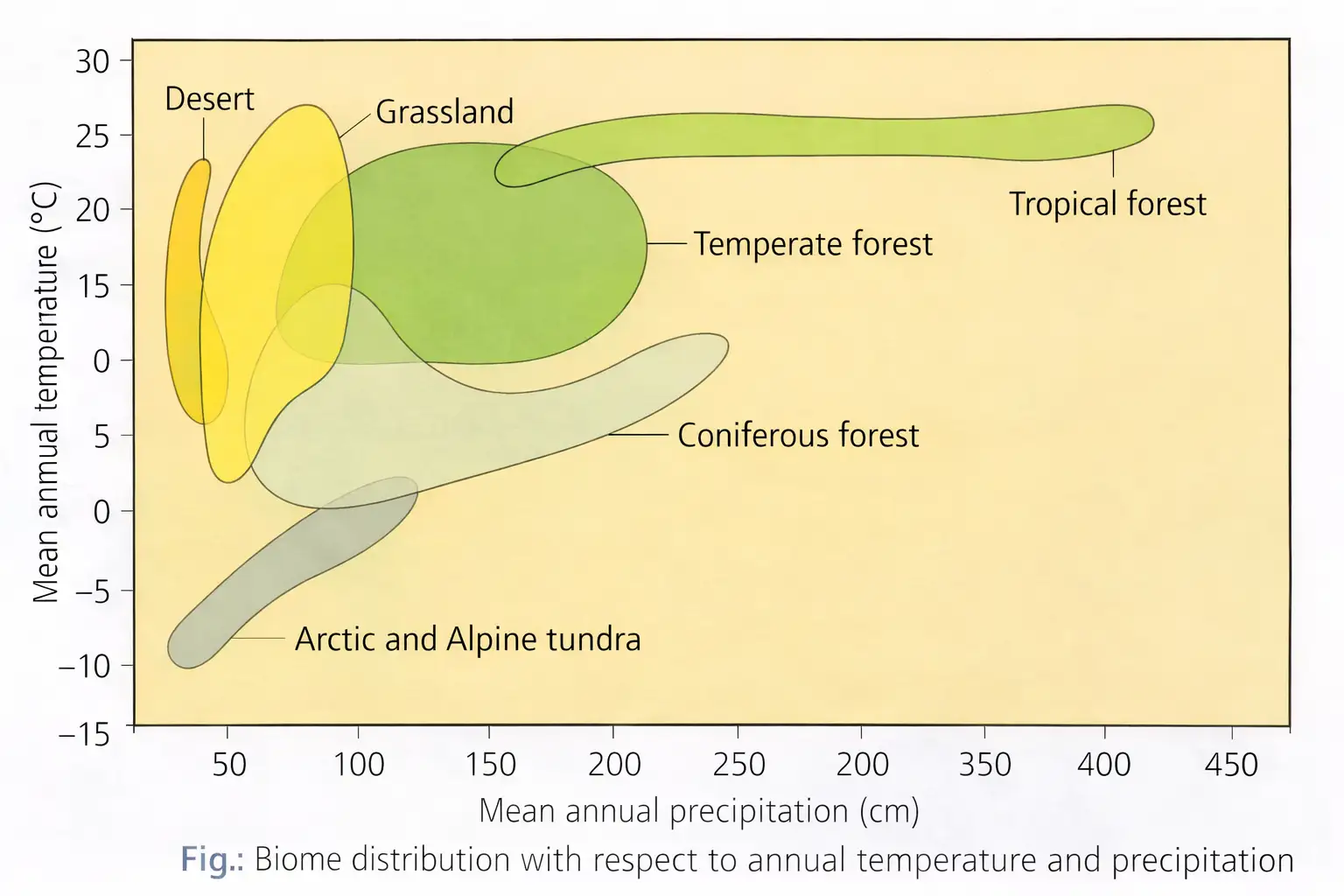
- Biomes: Seasonal and annual variation in precipitation, including rain and snow, helps form deserts, rainforests and tundra.
- Habitat diversity: Regional and local differences within biomes create many habitats.
- Habitats: Life occurs in favourable as well as harsh places, including deserts, rain-soaked forests, deep oceans, trenches, streams, polar regions, mountain tops and thermal springs.
- Microbial habitat: The intestine is a distinctive habitat for hundreds of microbial species.
- Key abiotic factors: Temperature, water, light and soil are major sources of physical and chemical variation.
Habitat, niche and climate
- Biotic habitat factors: A habitat also includes pathogens, parasites, predators and competitors that constantly interact with an organism.
- Adaptation: Natural selection over generations favours traits that improve survival and reproduction in a habitat.
- Niche: An organism’s range of tolerable conditions, resources used and functional role in its ecological system.
- Niche components: Include tolerance, movement, microclimate, food type and availability, shelter, predators and activity timing.
- Species and niche: Each species occupies a distinct niche; no two species occupy exactly the same niche.
- Niche overlap: Sharing resources between two species is called niche overlap.
- Niche density: The abundance of a species’ population within its habitat.
| Feature | Weather | Climate | Microclimate |
|---|---|---|---|
| Meaning | Short-term atmospheric conditions at a given place, such as heat, cold or wind. | Long-term atmospheric conditions of a region. | Climatic conditions at a local scale within a limited area. |
Habitat — The specific place or locality, delimited by physical features and barriers, where a community lives.
| Point | Habitat | Niche |
|---|---|---|
| Meaning | The place where an organism or community lives. | A species’ role and way of using the conditions and resources available in its habitat. |
| Scope | A location with physical features and barriers. | Includes tolerance, food, shelter, movement, predators and activity patterns. |
Major Abiotic Factors: Temperature
Effects of temperature
- Range: Temperatures range from below zero in polar areas and high altitudes to above in tropical deserts during summer; some thermal springs and deep-sea vents exceed on average.
- Physiology: Temperature affects enzyme kinetics and thereby basal metabolism, activity and other physiological functions.
- Distribution: A species’ thermal tolerance strongly influences its geographical distribution.
- Plants: Temperature affects photosynthesis, respiration, reproduction, flowering, water and mineral absorption, growth and development.
- Animals: It affects metabolism, distribution, sex ratio, colouration, growth, development and behaviour.
| Type | Meaning | Examples / note |
|---|---|---|
| Eurythermal | Tolerates a wide range of environmental temperatures. | Most mammals and birds; *Artemisia tridentata*. |
| Stenothermal | Can live within a narrow temperature range. | Examples given include polar bear, lizards, amphibians and plants. |
| Poikilothermal | Body temperature varies with surrounding temperature; also called ectothermic or cold-blooded. | Reptiles and amphibians. |
| Homoiothermal | Maintains a nearly constant body temperature despite changes in ambient temperature; also called endothermic or warm-blooded. | Birds and mammals. |
Major Abiotic Factors: Water
Water and salinity
- Aquatic water quality: Chemical composition and pH are important to aquatic organisms.
- Salinity: Salt concentration is measured in parts per thousand; it is below 5 in inland waters, about 30–35 in the sea and above 100 in some hypersaline lagoons.
- Euryhaline: Organisms tolerate a wide salinity range; example: salmon.
- Stenohaline: Organisms tolerate only a narrow salinity range; example: shark.
- Osmotic problem: Many freshwater animals cannot survive long in seawater, and vice versa, because of osmotic difficulties.
| Type | Habitat and key traits | Examples |
|---|---|---|
| Hygrophytes | Wet habitats; usually soft, moderately tall stems and large, thin leaves with hydathodes for guttation. | Plants of wet areas. |
| Mesophytes | Moist habitats; luxuriant vegetative growth. | Most crop, vegetable and fruit plants. |
| Xerophytes | Dry habitats where water loss through transpiration can exceed water availability. | Acacia, Casuarina. |
Major Abiotic Factors: Light
Effects of light
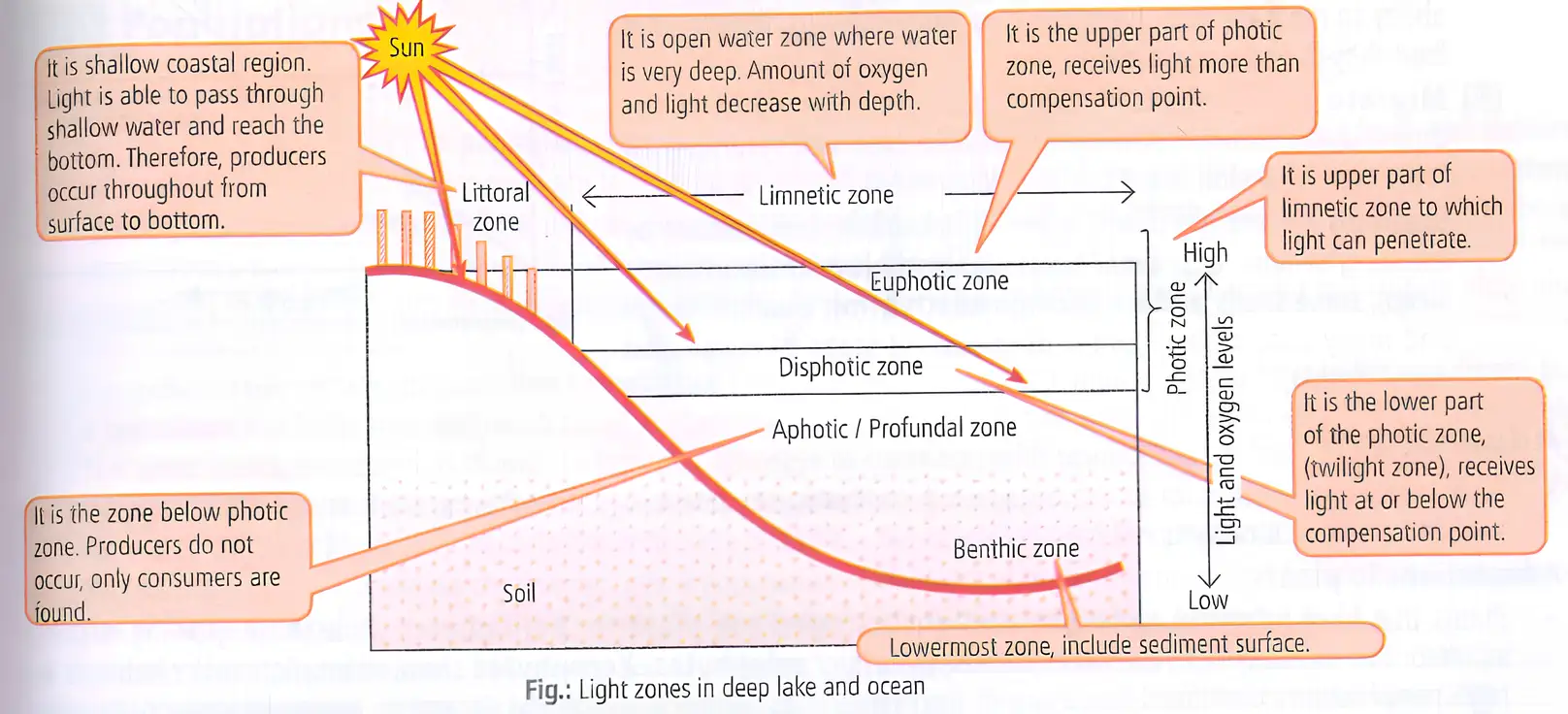
- Light factors: Intensity, duration and quality affect many life processes.
- Photosynthesis: Plants use sunlight as the energy source for food production; forest herbs and shrubs can be adapted to photosynthesise under low light beneath tree canopies.
- Flowering: Many plants depend on sunlight to flower.
- Photoperiod: Daily and seasonal variation in light intensity and duration cues animal foraging, migration and reproduction.
- Deep ocean: Below about 500 m, the environment is perpetually dark and its inhabitants do not experience sunlight as an energy source.
Major Abiotic Factors: Soil
Soil — The upper, weathered, humus-containing part of Earth’s surface that sustains terrestrial plant life.
Soil properties and importance
- Soil formation: Soil varies with climate, weathering, whether it is transported or sedimentary, and the process of soil development.
- Vegetation: Composition, grain size and aggregation affect percolation and water-holding capacity; pH, minerals and topography also help determine local vegetation.
- Aquatic sediments: Sediment characteristics help determine which benthic animals can live in an aquatic environment.
- Soil science: The study of soil is called paedology or pedology.
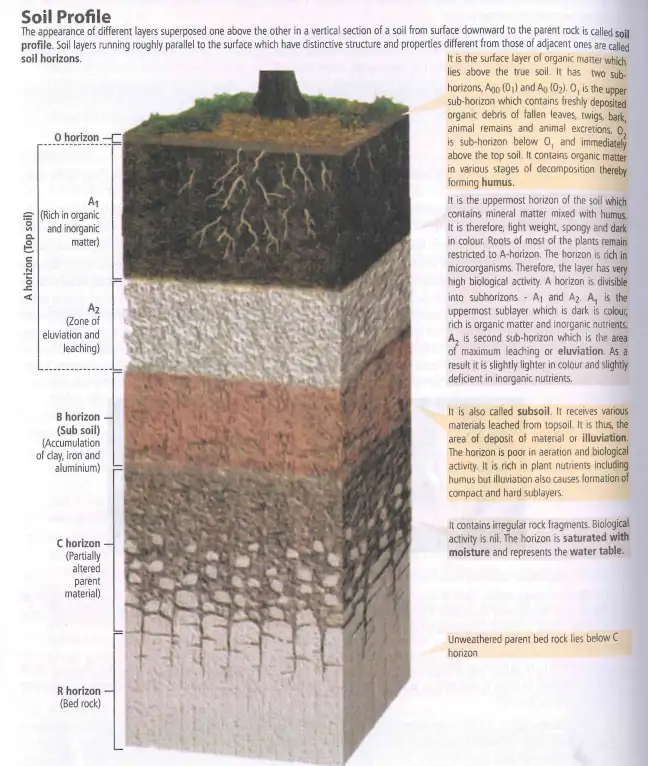
Soil profile — A vertical section showing the soil layers from the surface down to the parent rock.
Soil horizons and composition
- Horizons: A soil may have up to three main horizons—A, B and C—along with a surface litter layer called the O-horizon.
- Profile order: From the surface downward, the named layers are O, A, B and C, followed by parent rock (R).
- Approximate composition: Mineral particles 40%, organic matter or humus 10%, soil air 25% and soil water 25%; soil microflora and fauna vary.
- Minerals: Mineral particles are the chief components of the soil complex and form through rock weathering.
- Particle size: Increasing order is clay, silt, fine sand, coarse sand, gravel; their relative proportions determine whether soil is sandy, clayey or loamy.
| Plant type | Soil or substrate |
|---|---|
| Halophytes | Saline soil |
| Oxylophytes | Acidic soil |
| Psammophytes | Sandy soil |
| Chasmophytes | Rock crevices |
| Lithophytes | Rocks |
Responses to Abiotic Factors
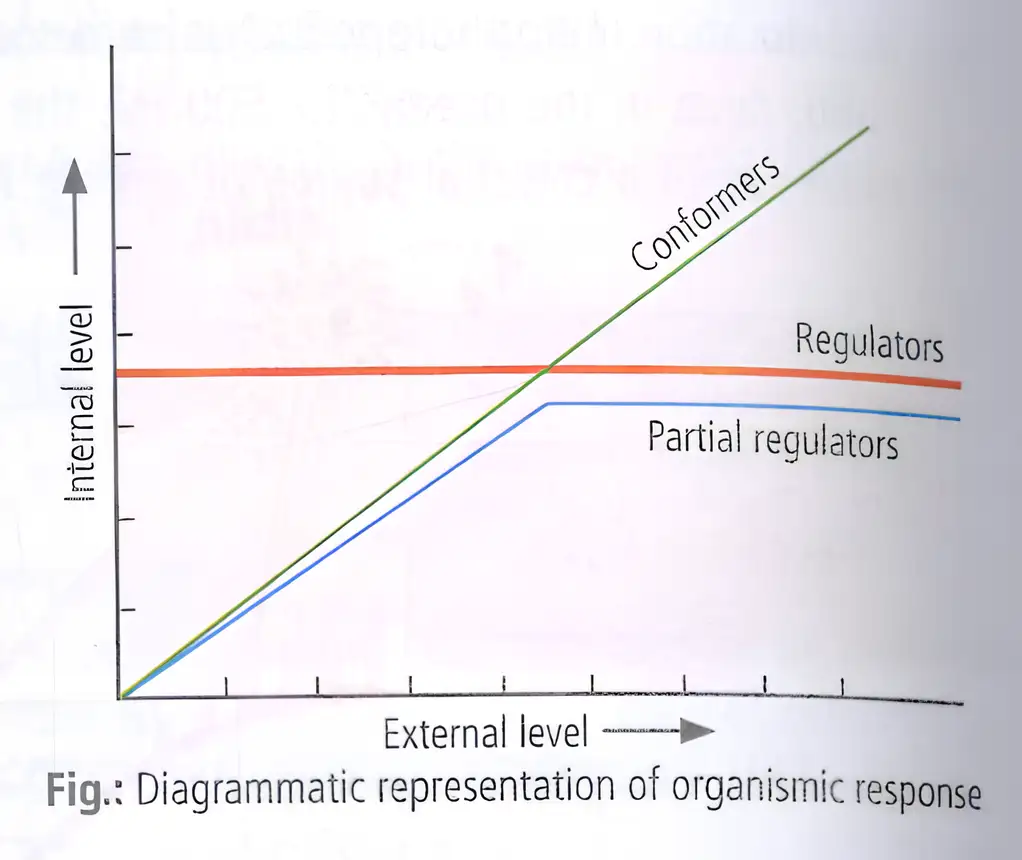
Homeostasis — The process by which an organism keeps its internal environment constant despite major changes in external conditions.
| Response | Meaning | Examples / note |
|---|---|---|
| Regulate | Maintain body temperature and osmotic concentration despite external change. | Birds, mammals, some invertebrates and lower vertebrates. |
| Conform | Cannot maintain thermal and osmotic balance independently of the environment. | About 99% of animals and nearly all plants. |
| Partial regulation | Regulate body functions only within a limited range; beyond it, become conformers. | Some species. |
| Migrate | Temporarily move from an unfavourable habitat to a favourable one, then return. | Seasonal or temporary movement. |
| Suspend | Avoid an unfavourable period by becoming inactive or suspending development. | Hibernation: polar bears; aestivation: some snails and fish; diapause: many zooplanktons. |
Adaptations
Adaptation — A morphological, physiological or behavioural attribute that enables an organism to survive and reproduce in its habitat.
Plant Adaptations
| Type | Meaning / adaptation |
|---|---|
| Heliophytes | Sun plants adapted to bright sunlight. |
| Sciophytes | Shade plants adapted to partial shade or low light. |
| Ephemerals | Xerophytes that escape drought. |
| Annuals | Xerophytes that avoid drought. |
| Succulents | Xerophytes that resist drought. |
| Non-succulent perennials | Xerophytes that endure drought. |
Xerophyte features
- Water conservation: Many desert plants have thick leaf cuticles and stomata in deep pits, reducing transpiration.
- CAM pathway: Some desert plants keep stomata closed during the day through a special photosynthetic pathway called CAM.
- Opuntia: Leaves are reduced to spines; the flattened stem carries out photosynthesis.
Hydrophytes and halophytes
- Hydrophytes: Often have protective, lubricating mucilage; roots may be absent, poorly developed or used for balance, and root caps may be replaced by root pockets.
- Hydrophyte tissues: Xylem is poorly developed or absent; aerenchyma stores air.
- Halophytes: Salt-tolerant plants that obtain water from saline rooting media; found in saline soils, mangroves, coastal dunes and tidal marshes.
- Halophyte features: May be succulent and may secrete salts through salt or chalk glands; some have pneumatophores.
Animal Adaptations
Types and examples
- Short-term adaptations: Temporary responses such as skin tanning or increased heartbeat.
- Long-term adaptations: Permanent traits such as a species-typical beak or claw; animal adaptations to environmental stress are often physiological or behavioural.
- Camouflage: Cryptic appearance that blends an animal into its background, helping it avoid detection by predators or prey; common in insects, reptiles and mammals.
- Mimicry: One species resembles another to gain an advantage, especially against predation. The imitated species is the model; the imitator is the mimic or mimetic.
- Desert mammals: Kangaroo rats (desert rats) rarely drink, have a thick coat that reduces evaporative water loss, and obtain about 90% of their water from metabolism and 10% from food.
- Water conservation: Desert rats minimise water loss by producing nearly solid urine and faeces.
- Behaviour: Desert lizards show behavioural adaptations that help them cope with environmental variation.
| Rule | Statement |
|---|---|
| Allen’s rule | Mammals from colder climates generally have shorter ears and limbs, reducing heat loss. |
| Bergmann’s rule | Birds and mammals tend to be larger in cold regions and smaller in warm regions. |
| Gloger’s rule | Animals tend to have darker skin in warm, humid areas and lighter skin in cool, arid areas. |
| Jordan’s rule | Fish in colder waters tend to have more vertebrae. |
| Rensch’s rule | Birds in cold areas have narrower wings than birds in warmer areas. |
Distinguish eurythermal and stenothermal organisms.
Name the four main responses organisms use to cope with abiotic stress.
State Allen’s and Bergmann’s rules.
Quick recap
- Ecology studies organism–organism and organism–environment interactions; the individual is the basic ecological unit.
- Habitat is the place an organism lives; niche describes its tolerances, resource use and ecological role.
- Temperature, water, light and soil shape habitats and influence organism distribution and function.
- Organisms respond to abiotic stress by regulating, conforming, migrating or suspending activity.
- Plant adaptations include xerophyte water-saving traits and specialised hydrophyte and halophyte features.
- Animal adaptations include camouflage, mimicry, behavioural responses and ecogeographical patterns.
Populations
Population Attributes
Population — A group of individuals of the same species living in a defined geographical area, sharing or competing for resources and potentially interbreeding; ecological populations may also include asexual organisms.
Population-level attributes
- Examples: All cormorants in a wetland, rats in a dwelling, teak trees in a forest, bacteria in a culture, or lotus plants in a pond can form populations.
- Population attributes: Birth rate, death rate, sex ratio and age structure describe populations; they do not describe a single individual.
- Birth and death rates: These are per-capita rates, expressed as changes in population numbers relative to the population size.
- Example: If 20 lotus plants produce 8 new plants in a year, birth rate = offspring per lotus per year.
- Sex ratio: The proportion of males and females in a population; for example, 60% females and 40% males.
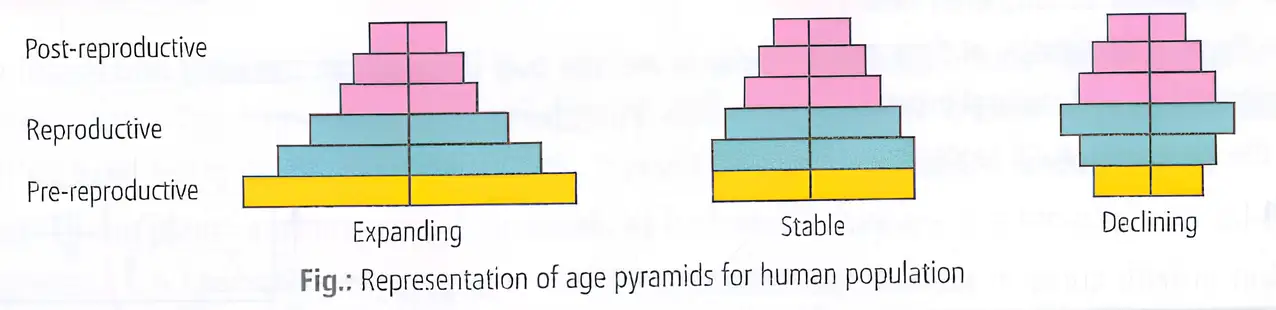
- Age structure: Proportions of individuals in different age groups; it affects natality and mortality.
| Age group | Life phase |
|---|---|
| Pre-reproductive | Juvenile or dependent |
| Reproductive | Adult |
| Post-reproductive | Old age |
Age pyramids and population terms
- Age pyramid: A graph of the percentage of individuals in each age group; human age pyramids commonly display males and females together.
- Local population or deme: A population of organisms inhabiting a particular area.
- Sister populations: Populations of the same kind of organism found in different places.
- Demography: The study of population size.
| Shape | Population pattern |
|---|---|
| Triangular | Young or rapidly growing |
| Bell-shaped | Stable or stationary; growth is nearly zero |
| Urn-shaped | Declining or diminishing |
Population Growth
Population density — The number of individuals of a species per unit area or volume at a given time.
Changes in population density
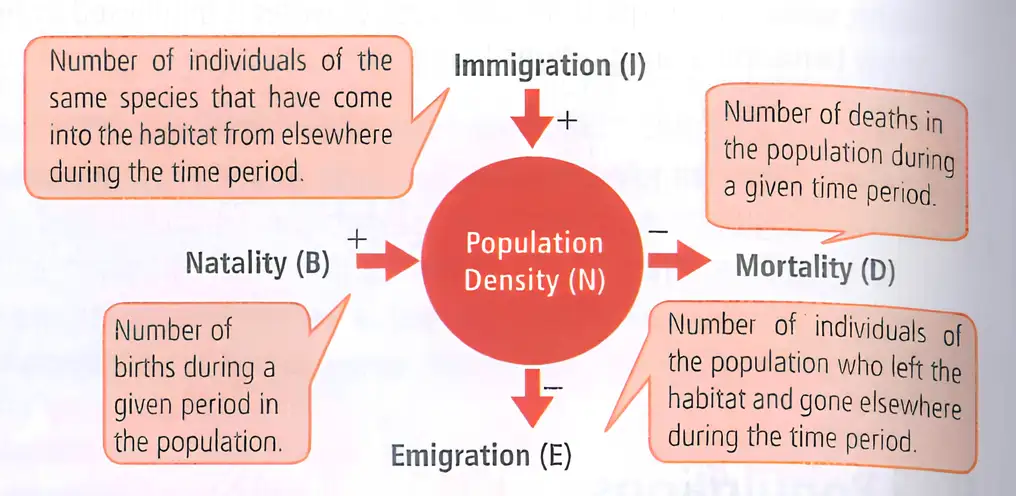
- Density fluctuates over time with food availability, predation pressure, adverse weather and other environmental factors.
- Increase: Natality (births) and immigration (individuals entering) add individuals.
- Decrease: Mortality (deaths) and emigration (individuals leaving) remove individuals.
- Estimating population size: When direct counting is impractical, relative density or indirect signs may be used; tiger censuses may use pug marks and faecal pellets.
Density at the next time point equals current density plus additions minus losses.
Population Growth Models
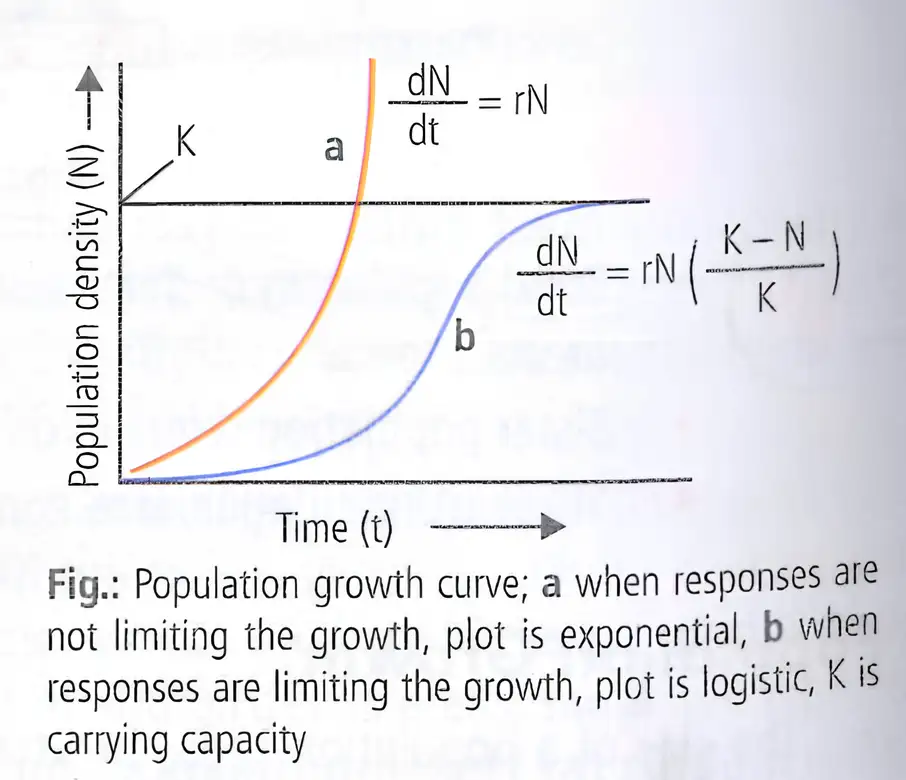
Exponential growth — Rapid, geometric population increase when resources are unlimited, producing a J-shaped growth curve.
Exponential growth
- Conditions: Unlimited resources allow a species to approach its full capacity for population increase.
- Curve: Density rises rapidly with time, creating a J-shaped curve; environmental resistance can eventually cause growth to cease abruptly.
- Intrinsic rate of natural increase: , where is birth rate and is death rate.
- Variables: is population density and is time.
The differential form gives the growth rate; the integral form gives density after time .
Symbols in the exponential model
- : Population density at the initial time; : density after time .
- : Base of natural logarithms, approximately 2.71828.
- : Intrinsic rate of natural increase.
Logistic growth — Growth that accelerates initially and then slows as resources become limiting, forming a sigmoid or S-shaped curve.
Logistic growth
- Carrying capacity (): The maximum population level that the environment can support; it forms the upper asymptote of the S-shaped curve.
- Model: is population density at time , is the intrinsic rate of natural increase, and is carrying capacity.
- Examples: Human populations and laboratory populations of yeast, Drosophila and rabbits may show sigmoid growth.
- Significance: Because resources are finite and eventually limiting for most animal populations, the logistic model is considered more realistic than unlimited exponential growth.
The growth rate declines as population density approaches carrying capacity.
| Point | Exponential growth | Logistic growth |
|---|---|---|
| Resource condition | Unlimited | Finite and limiting |
| Curve | J-shaped | Sigmoid or S-shaped |
| Population limit | No carrying-capacity limit in the model | Levels near carrying capacity |
| Model equation |
Life-History Variation
Reproductive strategies
- Life-history variation: Organisms evolve reproductive strategies that maximise reproductive fitness, also called Darwinian fitness; high represents high potential for population increase.
- Breeding frequency: Some organisms breed once in their lifetime, such as Pacific salmon and bamboo; others breed repeatedly, such as most birds and mammals.
- Offspring number and size: Oysters and pelagic fishes produce many small offspring; birds and mammals generally produce fewer, larger offspring.
- Evolutionary influence: Life-history traits evolve in response to constraints imposed by the habitat's abiotic and biotic components.
Biotic potential — The maximum reproductive capacity of a population under optimal environmental conditions; described by MacArthur and Wilson in 1967.
| Point | r-selected | K-selected |
|---|---|---|
| Typical body size | Small | Large |
| Offspring | Numerous | Few |
| Life span | Short | Long |
| Metabolic rate | High | Low |
Population Interactions
Types and effects of interactions
- Intraspecific interaction: Interaction between individuals of the same species.
- Interspecific interaction: Interaction between organisms of different species.
- Sign convention: = beneficial, = detrimental, and = neither beneficial nor harmful to that species.
| Species A | Species B | Interaction |
|---|---|---|
| Mutualism | ||
| Competition | ||
| Predation | ||
| Parasitism | ||
| Commensalism | ||
| Amensalism |
Predation
Predation — An interaction in which an organism (the predator) captures, kills and eats an organism of another species (the prey).
Ecological importance of predation
- Energy transfer: Predation transfers fixed energy to higher trophic levels.
- Population control: Predators help keep prey populations under control and can reduce competition among prey species, helping maintain community diversity.
- Herbivory: In a broad ecological sense, plant-eating animals also act as predators; a sparrow eating a seed is one example.
- Invasive species: An introduced species may spread rapidly in a new area if its natural predators are absent.
- Biological control: Agricultural pest-control methods can use predators to regulate pest-prey populations.
- Prudent predation: If a predator overexploits its prey, the prey may become extinct and the predator may then die out for lack of food.
| Defence | Examples or effect |
|---|---|
| Camouflage | Cryptically coloured insects and frogs avoid detection. |
| Poison or distastefulness | Monarch butterflies are distasteful to birds because of chemicals acquired as caterpillars by feeding on a poisonous weed. |
| Thorns | Acacia and cactus have morphological defences against herbivores. |
| Defensive chemicals | Plant chemicals can deter feeding, disrupt digestion or reproduction, cause illness, or kill herbivores. |
| Chemical examples | Nicotine, caffeine, quinine, strychnine and opium are plant-produced defences; Calotropis is an example of a defended plant. |
| Cardiac glycosides | Some plants produce highly poisonous cardiac glycosides, so cattle and goats avoid browsing on them. |
Competition
Competition — The active demand by individuals or species at the same trophic level for a common resource.
| Point | Intraspecific | Interspecific |
|---|---|---|
| Competitors | Individuals of the same species | Individuals of different species |
| Relative severity | Usually more severe because needs and adaptations are similar | Usually less severe |
Competition: evidence and outcomes
- Competitive release: A species restricted by a competitively superior species can expand its geographical range when the competitor is removed.
- Competitive exclusion principle: Gause proposed that two closely related species competing for the same resources cannot coexist indefinitely; the inferior competitor is eventually eliminated.
- Limitation: Competitive exclusion is most likely when resources are limiting; later studies caution against treating it as a universal rule.
- Resource partitioning: Competing species may coexist by using resources differently, such as feeding at different times or in different ways.
- Example: MacArthur found that five closely related warbler species coexisted on the same tree by differing in their foraging behaviour.
Parasitism
Parasitism — An interaction in which a parasite obtains food from another species, the host, usually harming it.
Parasitic adaptations
- Adaptations: Parasites may lose unnecessary sense organs or digestive systems, develop adhesive organs or suckers, and have high reproductive capacity.
- Ectoparasites: Feed on the host's external surface; examples include lice on humans, ticks on dogs and copepods on marine fish.
- Parasitic plant: Cuscuta has lost chlorophyll and leaves and obtains nutrition from its host plant.
- Endoparasites: Live inside the host, for example in the liver, kidneys, lungs or red blood cells.
- Endoparasite life cycles: Often complex; body structures may be simplified while reproductive capacity is emphasised.
| Type | Location or host | Examples |
|---|---|---|
| Ectozooparasite | On animals | Leech on cattle; copepods on marine fish; lice on humans |
| Ectophytoparasite | On plants | Aphids, lac insects and red cotton bugs |
| Brood parasite | Uses another bird's nest for raising its offspring | The parasitic bird lays eggs that resemble the host's eggs in size and colour; the host incubates them. |
Commensalism
Commensalism — An interaction in which one species benefits while the other is neither helped nor harmed.
Examples of commensalism
- Epiphytes: Orchids use mango branches for support but make their own food by photosynthesis; they do not obtain nutrients from the tree and are ectocommensals.
- Other examples: Barnacles on whales and cattle egrets with grazing cattle.
- Clown fish and sea anemone: The clown fish gains protection among the anemone's stinging tentacles; the anemone receives no apparent benefit.
Mutualism
Mutualism — A mutually beneficial relationship between two species in which the association is obligatory for both partners.
Mutualism examples and co-evolution
- Lichens: An intimate association between a fungus and photosynthetic algae or cyanobacteria.
- Mycorrhizae: Fungi help plant roots absorb essential soil nutrients; the plant supplies energy-yielding carbohydrates.
- Plant–animal mutualism: Animals pollinate flowers and disperse seeds; plants reward them with pollen, nectar or nutritious fruits.
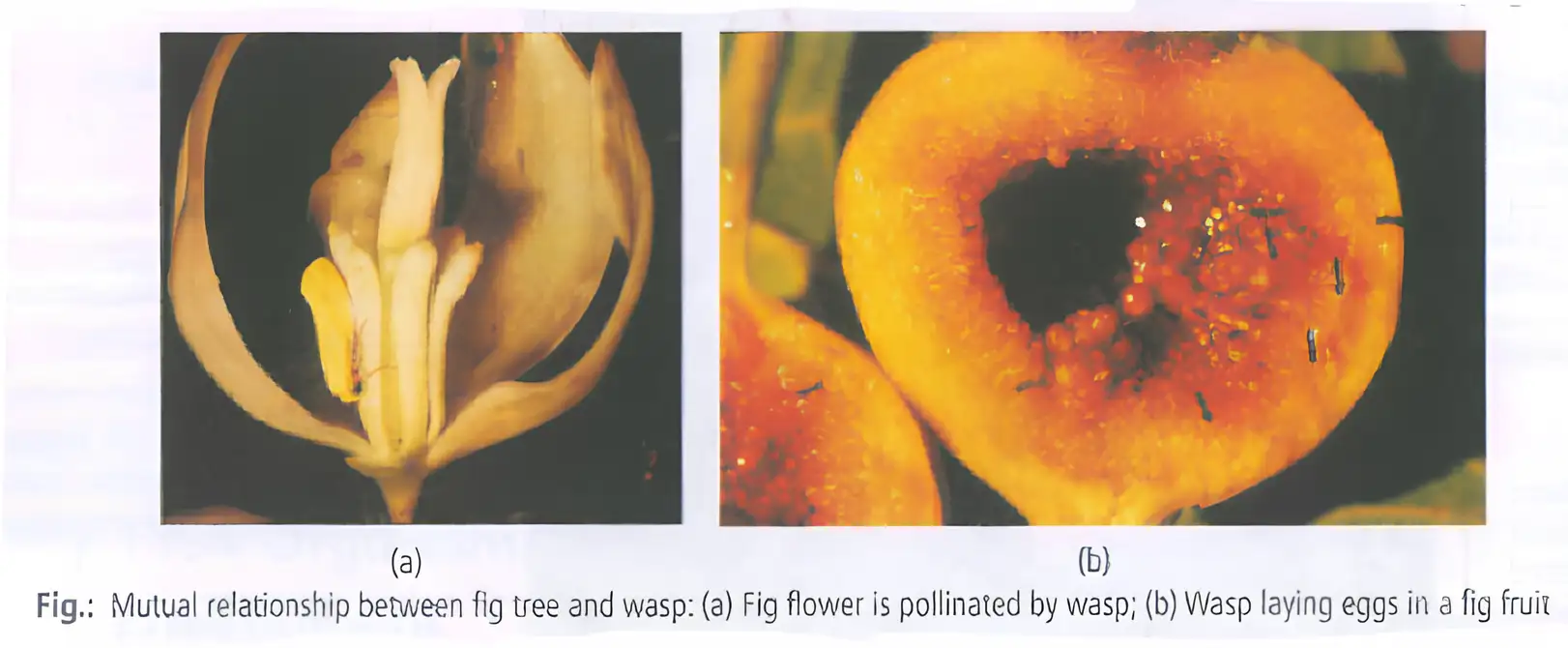
- Co-evolution: The evolution of interacting partners can be closely linked; many fig species have a specific partner wasp.
- Fig and wasp: The wasp pollinates the fig while laying eggs; developing fig seeds provide food for wasp larvae.
Ophrys orchid and pollination
- Sexual deceit: The Mediterranean orchid Ophrys has a petal resembling a female bee in size, colour and markings.
- Pollination: A male bee pseudocopulates with the flower and pollinates it.
Amensalism and Protocooperation
Amensalism — An interaction in which one species is harmed or inhibited while the other is unaffected.
Examples and related interaction
- Amensalism example: Grevillea robusta releases root allochemicals that prevent nearby seedlings from growing.
- Protocooperation: Both species benefit, but the association is facultative and they can live separately.
- Protocooperation examples: Tick bird with rhinoceros; bird with crocodile.
| Point | Mutualism | Protocooperation |
|---|---|---|
| Effect | Both species benefit | Both species benefit |
| Dependence | Obligatory; necessary for existence of both | Non-obligatory; partners can live separately |
State the four processes that change population density and their effects.
Distinguish exponential and logistic growth.
What is resource partitioning? Give an example.
Quick recap
- Population attributes include per-capita birth and death rates, sex ratio and age structure; age pyramids indicate growth pattern.
- Natality and immigration add individuals; mortality and emigration remove them.
- Exponential growth is J-shaped under unlimited resources; logistic growth is S-shaped and approaches carrying capacity .
- Life-history strategies vary in breeding frequency and offspring number and size; r- and K-selected species show contrasting traits.
- Interactions may be beneficial, harmful or neutral; their sign combinations distinguish mutualism, competition, predation, parasitism, commensalism and amensalism.
- Predation regulates prey and transfers energy; competition can lead to exclusion or be reduced by resource partitioning.
- Parasitism harms the host, commensalism benefits one partner without affecting the other, and mutualism benefits both obligatorily.
NEET Zoology — ALL CHAPTERS
1
Structural Organisation in Animals
2
Breathing and Exchange of Gases
3
Body Fluids and Circulation
4
Excretory Products and their Elimination
5
Locomotion and Movement
6
Neural Control and Coordination
7
Human Reproduction
8
Reproductive Health
9
Evolution
10
Microbes in Human Welfare
11
Organism and Population
12
Ecosystem
13
Biodiversity and Conservation