Class 11 PCM . Physics . Physics Part II . Kinetic Theory
Chapter 12: Kinetic Theory
Ch 12
Physics
Class 11 PCM
Introduction
Kinetic Theory of Gases
Development of Kinetic and Atomic Ideas
- 1661Boyle discovered the gas law named after him.
- 19th centuryMaxwell, Boltzmann and others developed the kinetic theory; atomic theory became established more than 150 years after early atomic speculations.
- Early 19th centuryDalton proposed atomic theory; Gay-Lussac stated the law of combining gas volumes.
Molecular Nature of Matter
| State | Typical separation | Particle behaviour |
|---|---|---|
| Solid | A few angstroms; about | Tightly packed; atoms are relatively fixed. |
| Liquid | About the same as in solids | Atoms remain close but can move around, allowing the liquid to flow. |
| Gas | Tens of angstroms | Particles are much freer and can travel long distances between collisions. |
Dalton’s Atomic Theory and Gas Laws
| Law or idea | Statement |
|---|---|
| Definite proportions | A given compound always contains its elements in a fixed proportion by mass. |
| Multiple proportions | If two elements form more than one compound, the masses of one element that combine with a fixed mass of the other are in ratios of small integers. |
| Gay-Lussac’s law of combining volumes | Gases that combine chemically to form a gas do so in volume ratios of small integers. |
| Avogadro’s law | Equal volumes of gases at the same temperature and pressure contain equal numbers of molecules. |
How Avogadro’s Law Helps Explain Gay-Lussac’s Law
- Equal gas volumes at the same temperature and pressure contain equal numbers of molecules.
- Dalton’s theory allows molecules to combine in simple whole-number ratios.
- Therefore, reacting gas volumes occur in small-integer ratios.
Early Atomic Ideas in India and Greece
Ancient Atomic Hypotheses
- 6th century BCEKanada founded the Vaiseshika school, which developed an atomic picture of matter.
- 4th century BCEDemocritus is associated with the Greek atomic hypothesis.
- Mainly 2nd century BCEThe *Lalitavistara* recorded an estimate of atomic size close to the modern order of magnitude.
Quick recap
- Kinetic theory explains gas behaviour through the continual motion of molecules; it helps interpret pressure, temperature and transport properties.
- Atoms are about in size; solids and liquids are closely packed compared with gases.
- Mean free path is the average distance travelled between collisions and is of the order of thousands of angstroms in gases.
- Interatomic forces attract at moderate separations and repel at very close range; gas equilibrium is dynamic.
- Dalton’s theory and Avogadro’s law help explain Gay-Lussac’s small-integer gas-volume ratios.
- Kanada and Democritus proposed early atomic hypotheses, while modern atomic structure includes nuclei, electrons, protons, neutrons and quarks.
Behaviour of Gases
Gas Equation and Molecular Scale
When gases behave simply
- Molecular spacing: Gas molecules are far apart, so their mutual interactions are negligible except during collisions.
- Ideal-gas conditions: Real gases approach ideal behaviour at low pressure and high temperature, when molecules are widely separated.
Here, is absolute temperature in kelvin and is constant for the given sample.
Molecules, moles and the universal gas constant
- Boltzmann constant: The sample constant is proportional to molecule count: , where is the same for all gases.
- Avogadro’s hypothesis: At the same temperature and pressure, equal volumes of gases contain equal numbers of molecules.
- Avogadro number: One mole contains molecules; this is the number in at STP.
- STP: Standard temperature and pressure here are and . At STP, one mole of a gas has a mass in grams equal to its molar mass.
- Mole amount: For gas mass , molar mass , and molecule count , .
- Universal gas constant: .
Equivalent forms relate pressure, volume, temperature, molecule count, moles, number density and mass density. Here is number density and is mass density.
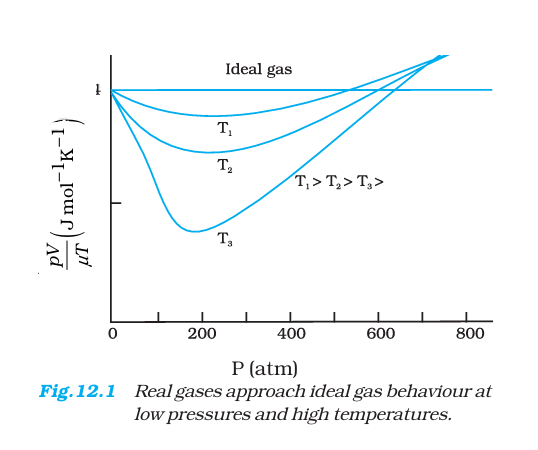
Ideal gas — A theoretical gas that obeys the perfect-gas equation exactly at every pressure and temperature.
Real and ideal gases
- Real gases: No real gas is perfectly ideal; deviations become more noticeable at higher pressures and lower temperatures.
- Reason for ideal-like behaviour: Low pressure or high temperature keeps molecules far apart, making intermolecular interactions negligible.
Gas Laws
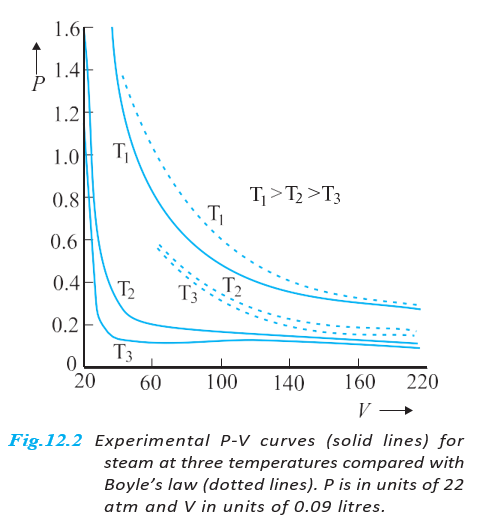
Boyle’s law — For a fixed amount of gas at constant temperature, pressure is inversely proportional to volume.
Keep the gas amount and temperature fixed.
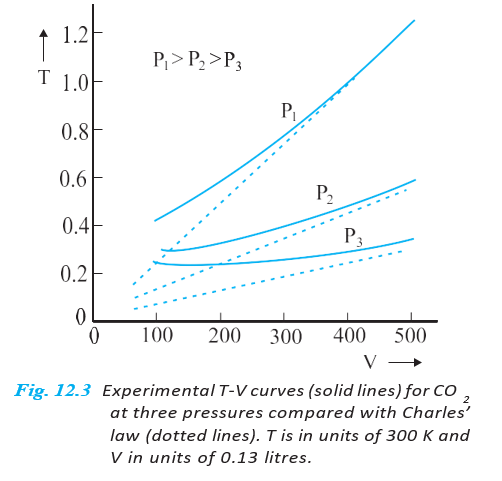
Charles’ law — For a fixed amount of gas at constant pressure, volume is proportional to absolute temperature.
Temperature must be measured on the absolute (kelvin) scale.
Mixtures of Gases
Partial pressure — The pressure a gas in a mixture would exert if it alone occupied the vessel at the same volume and temperature.
For non-interacting ideal gases, the total pressure equals the sum of their partial pressures; each component obeys the gas equation.
Molecular Volume and Gas Spacing
Water vapour: molecular volume fraction
- Density comparison: Liquid water has density ; water vapour at and has density .
- Estimate: For the same mass, vapour occupies times the liquid volume.
- Molecular volume fraction: Treating liquid molecules as closely packed, the fraction of vapour volume occupied by the molecules is approximately .
Estimate the size of a water molecule
- Molecular mass: One mole of water has mass , so one molecule has mass about .
- Molecular volume: Using the density of liquid water, .
- Radius estimate: Modelling a molecule as a sphere, gives .
Average spacing in water vapour
- Volume per molecule: Vapour occupies about times the liquid volume for the same water mass.
- Spacing estimate: A volume increase of about makes a characteristic length increase by ; with molecular radius , the estimated centre-to-centre spacing is .
Partial Pressure: Molecule Count and Density
Neon and oxygen example
- Given: Neon is monatomic, oxygen is diatomic, and their partial-pressure ratio is ; molar masses are and respectively.
- Molecule-count ratio: Both gases share the same vessel volume and temperature, so . Thus .
- Mass-density ratio: , giving .
State Avogadro’s hypothesis and define one mole.
State Boyle’s law and Charles’ law, including the fixed condition for each.
What is Dalton’s law of partial pressures?
Quick recap
- At low pressure and high temperature, real gases approach ideal-gas behaviour.
- The perfect-gas equation is ; .
- One mole contains molecules; STP here means and .
- Boyle’s law applies at constant temperature; Charles’ law applies at constant pressure.
- Dalton’s law: a gas mixture’s total pressure is the sum of its partial pressures.
- Water molecule estimates: radius about ; vapour inter-molecular spacing about .
Kinetic Theory of an Ideal Gas
Molecular Model of an Ideal Gas
Kinetic theory of gases — A gas is modelled as many molecules in continuous random motion, interacting significantly only during collisions.
- Molecular spacing: At ordinary pressure and temperature, molecules are typically separated by distances much larger than their size (about ); intermolecular forces are therefore negligible most of the time.
- Free motion: Between collisions, molecules move in straight lines according to Newton’s first law.
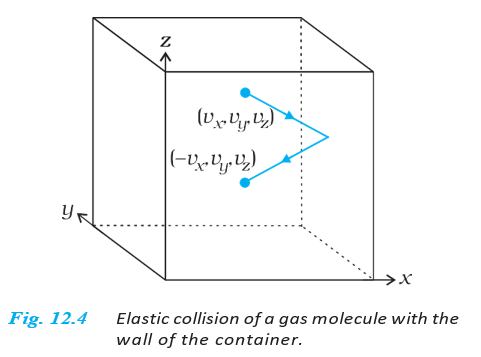
- Collisions: Molecules collide with one another and with container walls; collisions are treated as elastic.
- Conservation: Elastic collisions conserve total kinetic energy, and momentum is conserved.
Pressure of an Ideal Gas
Gas pressure — Pressure arises from molecules transferring momentum to the container walls.
Momentum transfer at a wall
- Velocity reversal: For a molecule with velocity hitting a wall perpendicular to the -axis, only reverses: .
- Momentum transfer: The molecule’s momentum change is ; the wall receives momentum .
- Molecules reaching the wall: In time , molecules in volume can reach it; on average, half are moving toward it.
- Pressure contribution: For a group with the same and number density , momentum transfer is , giving .
Total pressure and isotropic motion
- Velocity distribution: Molecules have different velocities, so add the pressure contributions from all velocity groups.
- Mean square component: For total number density , .
- Isotropy: With no preferred direction, .
- Kinetic-theory pressure: Therefore, , where is the mean square speed.
Here is the number of molecules per unit volume, and is the mass of one molecule.
Assumptions in the pressure derivation
- Vessel shape: The result applies to any vessel; the derivation can be performed for a small planar wall area.
- Uniform pressure: In a gas at equilibrium, pressure is the same throughout.
- Neglected collisions: The derivation ignores intermolecular collisions during the calculation; random collisions preserve the steady velocity distribution.
- Validity: This approximation is reasonable when collisions are not too frequent and collision duration is negligible compared with the time between collisions.
Kinetic Interpretation of Temperature
For a sample of volume with molecules, the ideal-gas internal energy is purely kinetic.
Combining with the ideal-gas equation links molecular kinetic energy to absolute temperature.
What temperature means microscopically
- Average energy: Each ideal-gas molecule has average translational kinetic energy .
- Temperature link: Average kinetic energy per molecule is proportional to absolute temperature and is independent of gas species, pressure, or volume.
- Internal energy: The internal energy of an ideal gas depends only on its temperature.
- Boltzmann constant: connects the macroscopic temperature to molecular kinetic energy.
Gas Mixtures and Molecular Speeds
For non-reactive ideal gases in equilibrium, each gas contributes to the total pressure; molecules of each gas have the same average kinetic energy per molecule.
The rms speed is the square root of mean square speed; is the mass of one molecule.
Example: nitrogen at 300 K
- Molecule mass: For nitrogen, .
- Rms speed: At , .
Example: argon and chlorine at the same temperature
- Average kinetic energy: Argon and chlorine molecules at the same temperature have an energy ratio of .
- Rms speed ratio: ; the lighter argon molecules move faster.
- Mixture composition: The mixture’s mass ratio does not affect these per-molecule energy and speed ratios.
Example: uranium hexafluoride isotopes
- Isotopes: Uranium-235 and uranium-238 in uranium hexafluoride form molecules of masses and , respectively.
- Speed comparison: At the same temperature, the lighter uranium-235-containing molecules move faster: .
- Difference: The speed difference is about ; uranium-235 is the isotope needed for nuclear fission.
Diffusion and porous-wall isotope separation
- Diffusion: At the same temperature, lighter gas molecules move faster; diffusion rate varies inversely with the square root of molecular mass.
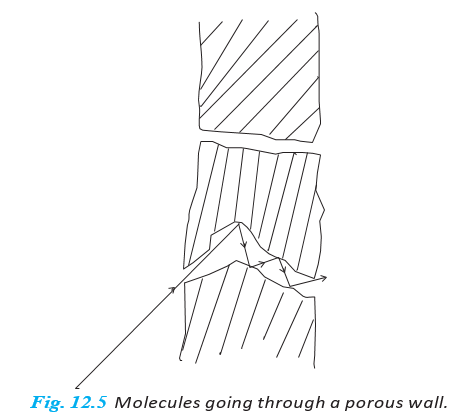
- Porous barrier: Faster, lighter molecules pass through a porous wall more readily, enriching the gas outside in the lighter molecules.
- Isotope enrichment: A thick, narrow porous cylinder allows molecules to pass through its pores individually; repeated stages are needed because the separation is inefficient.
Moving Walls, Compression, and Expansion
Energy transfer in collisions with a moving wall
- Fixed wall: A molecule rebounds with the same speed from a massive wall at rest.
- Wall moving toward a molecule: If the molecule approaches at speed and a massive wall moves toward it at speed , its rebound speed in the stationary frame is .
- Compression: An inward-moving piston transfers energy to gas molecules through collisions, increasing their kinetic energy and the gas temperature.
- Expansion: When gas pushes a piston outward, it transfers energy to the piston; molecular kinetic energy and temperature decrease.
Why a heavy bat helps
- Massive bat: A heavy bat recoils less on impact and behaves more like a firmly held moving wall.
- Effect: When swung toward the ball, it can transfer more energy, making the ball rebound faster.
Obtain the kinetic-theory expression for the pressure of an ideal gas.
What is the average kinetic energy per molecule of an ideal gas at temperature ?
How do rms speeds of two gases at the same temperature compare?
Quick recap
- Gas molecules move randomly and undergo elastic collisions.
- Pressure comes from molecular momentum transfer: .
- The average kinetic energy per molecule is ; ideal-gas internal energy depends only on temperature.
- At equal temperature, molecules of different gases have equal average kinetic energy.
- Rms speed and diffusion rate vary inversely with the square root of molecular mass.
- A moving inward piston adds energy to a gas; an expanding gas transfers energy to the piston.
Law of Equipartition of Energy
Degrees of Freedom and Molecular Energy
Each translational direction contributes one quadratic energy term.
Energy Modes and Equipartition
Energy of a gas molecule
- Thermal equilibrium: A gas with no preferred direction has average translational energy .
- Per direction: Each translational quadratic term has average energy .
- Diatomic rotation: A rigid diatomic molecule has two rotational energy terms, one for each independent rotation axis.
- Vibration: For a one-dimensional vibration with coordinate , the energy is ; the terms represent kinetic and potential energy.
- Total molecular energy: Translation, rotation and vibration contribute as .
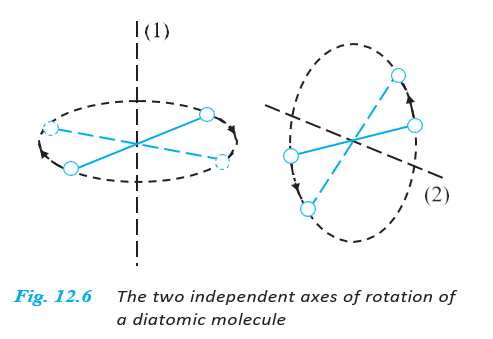
Law of equipartition of energy — At thermal equilibrium, each independent quadratic energy term has average energy .
Applying equipartition
- Translation and rotation: Each translational or rotational degree of freedom contributes .
- Vibrational mode: Each vibration has two quadratic terms, so contributes in total.
- Examples: A monatomic gas has translational modes; a rigid diatomic gas has translational and rotational modes.
- Temperature dependence: The law predicts average energies in classical thermal equilibrium; vibration may need to be included to explain larger measured heat capacities.
Specific Heat Capacity of Gases
- Molar heat capacities: Specific heat capacity describes the heat needed to raise a gas’s temperature; values are considered at constant volume and constant pressure.
- Equipartition: The active degrees of freedom determine a gas molecule’s average energy and hence the gas’s molar specific heats.
- Comparison: Equipartition predictions agree with measurements for many gases; including vibrational modes can explain higher measured values.
Monatomic Gases
Monatomic gas results
- Degrees of freedom: A monatomic molecule has only translational degrees of freedom.
- Molar internal energy: .
- Molar heat capacities: and, for an ideal gas, , so .
- Heat-capacity ratio: .
Diatomic Gases
| Model | Energy modes | ||||
|---|---|---|---|---|---|
| Rigid diatomic | translational + rotational | ||||
| Diatomic with one active vibration | Rigid-molecule modes + vibrational mode |
Polyatomic Gases
Polyatomic gas with vibrational modes
- Modes: The general model has translational, rotational and vibrational modes.
- Molar internal energy: ; each vibration contributes per mole.
- Molar heat capacities: and .
- Heat-capacity ratio: .
| Gas type | () | () | () | |
|---|---|---|---|---|
| Monatomic | ||||
| Diatomic | ||||
| Triatomic |
| Gas type | Gas | () | () | () | |
|---|---|---|---|---|---|
| Monatomic | He | ||||
| Monatomic | Ne | ||||
| Monatomic | Ar | ||||
| Diatomic | |||||
| Diatomic | |||||
| Diatomic | |||||
| Triatomic | |||||
| Polyatomic |
Theory and experiment
- Agreement: Predicted values generally agree well with measured values at ordinary temperatures.
- Discrepancies: Some molecules, including and , have measured heat capacities above predictions that ignore vibration.
- Interpretation: Including vibrational modes can improve the predicted values.
Heat Required at Constant Volume
At fixed volume, use the constant-volume molar heat capacity.
Specific Heat Capacity of Solids
Classical prediction for solids
- Atomic vibration: Each atom in a solid vibrates about its mean position; one-dimensional oscillation has average energy from its kinetic and potential terms.
- Three dimensions: Each atom has average vibrational energy .
- One mole: The total internal energy is .
- Molar specific heat: For a solid, volume change is negligible, so at constant pressure.
| Substance | Specific heat () | Molar specific heat () |
|---|---|---|
| Aluminium | ||
| Carbon | ||
| Copper | ||
| Lead | ||
| Silver | ||
| Tungsten |
Comparison with experiment
- Typical result: The prediction is close to the measured molar specific heats of many solids at ordinary temperature.
- Exception: Carbon differs substantially from the classical prediction.
State the law of equipartition of energy.
Give , and for a rigid diatomic ideal gas.
Quick recap
- Each independent quadratic energy term contributes on average.
- A vibrational mode contributes because it has kinetic and potential energy terms.
- For monatomic gases, , and .
- For rigid diatomic gases, , and .
- For a polyatomic gas with vibrational modes, and .
- The classical prediction for a solid’s molar specific heat is ; carbon is a marked exception among the listed solids.
Mean Free Path
Molecular Collisions and Mean Free Path
Why gas molecules do not travel freely
- Collisions: Gas molecules move rapidly, but their finite size causes collisions that continually change their directions.
- Effect: Diffusion through a room can take considerable time, and a cloud of smoke can remain together for hours.
Mean free path — The average distance travelled by a gas molecule between two successive collisions.
Collision-rate model
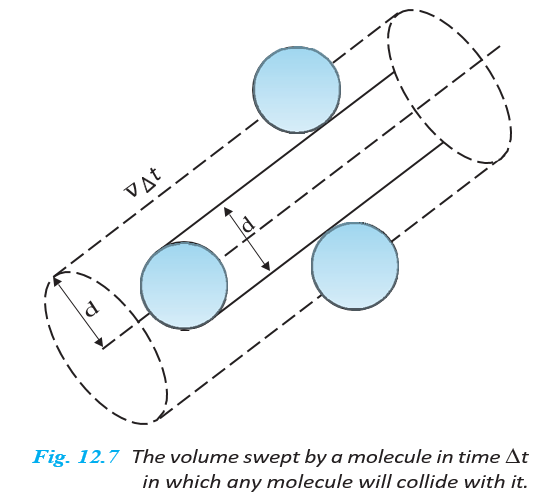
- Molecular diameter: Model molecules as spheres of diameter . A collision occurs when another molecule’s centre comes within distance .
- Swept volume: In time , a molecule moving at average speed sweeps out a cylinder of volume .
- Collision count: For number density , the cylinder contains an average of molecules that can collide with it.
This first estimate treats the other molecules as stationary.
With the stationary-molecule approximation, mean free path equals average speed times average time between collisions.
More accurate mean free path
- Relative motion: In reality, all molecules move, so collision frequency depends on their average relative speed.
- Correction: Accounting for this motion gives a factor of in the denominator of the mean-free-path formula.
Use this result for a gas with number density and molecular diameter .
Estimates and Dependence on Gas Conditions
Air at STP: estimate
- Values: For air, take , , and .
- Estimate: The collision time is about and the lecture's mean-free-path estimate is , approximately .
Water vapour at 373 K
- Number density: Taking the molecular diameter as the same as for air and using , the density is .
- Mean free path: The estimate for water vapour at is about .
Factors affecting mean free path
- Number density: ; fewer molecules per unit volume mean a longer mean free path.
- Molecular size: ; larger molecules have a shorter mean free path.
- Evacuated tube: At very low number density, the mean free path can become comparable to the tube's length.
Significance and Applications
- Relative scale: A typical gaseous mean free path is about times the interatomic distance, approximately .
- Gas behaviour: The relatively large distance between collisions contributes to characteristic gaseous behaviour; gases cannot be confined without a container.
- Kinetic-theory applications: Viscosity, thermal conductivity, and diffusion can be related to microscopic properties such as molecular size; such relations have been used to estimate molecular sizes.
Define mean free path and give its more accurate expression.
Quick recap
- Mean free path is the average distance a molecule travels between successive collisions.
- A molecule sweeps out a collision cylinder of volume .
- Accounting for relative molecular motion gives .
- Mean free path decreases as number density or molecular diameter increases.
- At very low density, the mean free path can approach the length of an evacuated tube.
- Kinetic theory connects viscosity, thermal conductivity, and diffusion to microscopic molecular properties.
Summary
Ideal Gas Equation
Ideal gas equation — It relates the pressure, volume and absolute temperature of a gas.
Here is the number of moles, is the number of molecules, is the universal gas constant, and is Boltzmann's constant.
Constants and real gases
- Gas constant: .
- Boltzmann constant: .
- Real gases: They satisfy the ideal gas equation approximately; the approximation is better at low pressure and high temperature.
Kinetic Interpretation of Temperature
is the number density, is the mass of one molecule, and is the mean square speed.
Combining kinetic theory with the ideal gas equation gives the average translational kinetic energy per molecule and the root-mean-square speed.
What temperature means
- Temperature: It measures the average kinetic energy per molecule, independently of the gas or molecule's nature.
- Gas mixtures: At the same temperature, heavier molecules have lower average speeds than lighter molecules.
Translational Kinetic Energy
is the total translational kinetic energy of gas molecules.
For an ideal gas, pressure and total translational kinetic energy are related by:
Law of Equipartition of Energy
Law of equipartition of energy — In thermal equilibrium at absolute temperature , each independent quadratic degree of freedom has average energy .
| Mode | Degrees of freedom / energy |
|---|---|
| Each translational or rotational degree of freedom | One mode; energy |
| Each vibrational frequency | Two modes (kinetic and potential); total energy |
Specific heats of gases
- Prediction: Equipartition gives molar specific heats that agree with experimental values for several gases.
- Improvement: Including vibrational modes can improve the agreement.
Mean Free Path
Mean free path — The average distance a molecule travels between two successive collisions.
is the number density and is the molecular diameter.
Important Points about Gases
Pressure inside a fluid
- Pressure exists throughout a fluid, not only at its container walls.
- Equilibrium: Any gas layer is balanced because pressure acts equally on both sides.
Molecular spacing and mean free path
- Intermolecular spacing: At ordinary pressure and temperature, it is only about 10 times the interatomic spacing in solids and liquids.
- Mean free path: It is much larger—about 100 times the interatomic distance and 1,000 times the molecule's size.
Equipartition: counting degrees of freedom
- Count quadratic terms: Each quadratic term in a molecule's total energy is one degree of freedom.
- Vibration: Each vibrational mode has two degrees of freedom—kinetic and potential—so its energy is .
Why air does not settle at the bottom of a room
- Air molecules have high speeds and undergo continual collisions.
- Their motion and collisions prevent them from simply falling and settling on the ground.
- Gravity still causes a very small increase in air density at lower heights.
- The effect is small because for ordinary heights is much less than the average kinetic energy .
Do not assume : the average of squared values need not equal the square of their average. For speeds and , while .
Quick recap
- The ideal gas equation is ; real gases approach this behaviour at low pressure and high temperature.
- Gas pressure arises from molecular motion: .
- Average molecular kinetic energy is , so heavier molecules move more slowly at the same temperature.
- The total translational kinetic energy satisfies and .
- Equipartition assigns to each quadratic degree of freedom; each vibrational mode has two.
- Mean free path is ; distinguish it from intermolecular spacing.
Physics — ALL CHAPTERS
1
Units And Measurement
2
MOTION IN A STRAIGHT LINE
3
MOTION IN A PLANE
4
LAWS OF MOTION
5
WORK, ENERGY AND POWER
6
SYSTEMS OF PARTICLES AND ROTATIONAL MOTION
7
GRAVITATION
8
Mechanical Properties Of Solids
9
Mechanical Properties Of Fluids
10
Thermal Properties Of Matter
11
Thermodynamics
12
Kinetic Theory
13
Oscillations
14
Waves