Class 11 PCM . Physics . Physics Part II . Thermodynamics
Chapter 11: Thermodynamics
Ch 11
Physics
Class 11 PCM
Introduction
Heat, Work and Thermodynamics
Energy conversion
- Thermal energy and work can be converted into each other; thermodynamics studies these processes.
- Work to heat: Rubbing palms does work, which warms them.
- Heat to work: Steam in an engine does work on pistons, helping turn the train's wheels.
From the caloric model to heat as energy
- Caloric model: An older idea treated heat as an invisible fluid called caloric, believed to flow between bodies until their temperatures became equal.
- Modern view: Heat is a form of energy, and its transfer can change a system's energy.
- Rumford's experiment (1798): Benjamin Thomson (Count Rumford) observed that boring a brass cannon generated enough heat to boil water.
- Evidence: The heat produced depended on the work done by the horses turning the drill, not on the drill's sharpness; this supported conversion of work into heat.
Thermodynamics — The branch of physics that studies heat, temperature and the conversion of heat into other forms of energy, and vice versa.
Macroscopic description
- Macroscopic science: Thermodynamics describes bulk systems without specifying the molecules that make them up.
- State variables: Measurable quantities such as pressure, volume, temperature, mass and composition can describe a gas's state.
- Microscopic description: A detailed account would specify molecular coordinates and velocities; kinetic theory instead considers the distribution of molecular velocities.
- State variables in the chapter's description: Pressure, volume, temperature, internal energy and entropy; entropy measures disorder, while enthalpy is described as total heat content.
| Point | Mechanics | Thermodynamics |
|---|---|---|
| Main focus | Motion of particles or bodies under forces and torques | The internal macroscopic state of a body |
| Whole-system motion | Studies motion of the system as a whole | Does not focus on motion of the system as a whole |
| Example: fired bullet | Its kinetic energy describes its mechanical state | Temperature relates to its internal, disordered motion |
| Bullet stopping in wood | The bullet's kinetic energy decreases | Energy conversion to heat raises the temperature of the bullet and nearby wood |
Thermal Equilibrium
Thermodynamic equilibrium — A system is in thermodynamic equilibrium when its macroscopic variables do not change with time.
| Point | Mechanical equilibrium | Thermodynamic equilibrium |
|---|---|---|
| Condition | Net external force and torque are zero | Macroscopic variables remain unchanged with time |
| What it describes | Mechanical balance | A system's stable macroscopic state |
Example and role of the wall
- Example: A gas in a closed, rigid, insulated container is in equilibrium if its pressure, volume, temperature, mass and composition remain fixed.
- Adiabatic wall: An insulating boundary that prevents heat transfer between systems; it may still be movable.
- Diathermic wall: A conducting boundary that allows heat transfer between systems.
- Dependence on surroundings: Whether systems reach equilibrium with each other depends on their surroundings and on the kind of wall separating them.
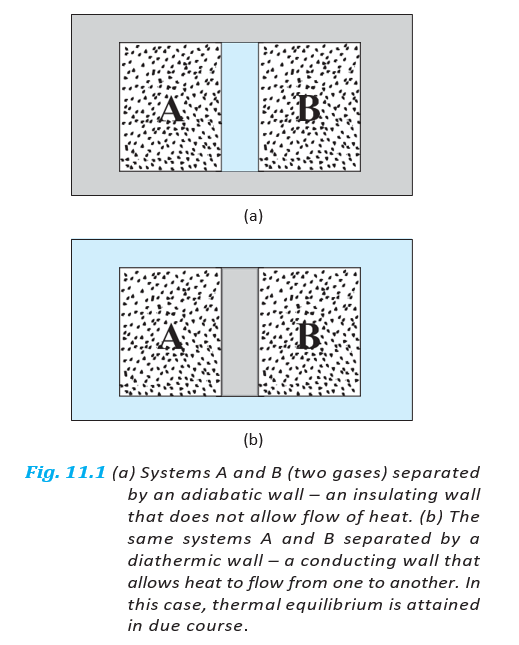
| Point | Adiabatic separation | Diathermic contact |
|---|---|---|
| Energy transfer | No heat flow between the two systems | Heat can flow between the systems |
| Result | Any allowed state of one system can be in equilibrium with any allowed state of the other | System variables change spontaneously until the two systems reach equilibrium with each other |
| After equilibrium | No heat transfer through the insulating wall | No further energy flow between the systems |
Thermal equilibrium — Two systems are in thermal equilibrium when they have the same temperature and there is no net heat flow between them.
Key idea
- Two systems in contact through a diathermic wall: Their macroscopic states may change as energy is transferred.
- Thermal equilibrium: The change stops when both systems have equal temperatures; the Zeroth law provides the basis for this temperature-based test.
What did Rumford's cannon-boring observations suggest about heat?
Distinguish an adiabatic wall from a diathermic wall.
What is the condition for two systems to be in thermal equilibrium?
Quick recap
- Thermodynamics studies heat, temperature and the conversion between heat and other forms of energy.
- Rumford's 1798 cannon-boring observations supported the conversion of work into heat.
- Thermodynamics describes bulk systems using measurable macroscopic variables, not molecular details.
- Mechanical equilibrium means zero net force and torque; thermodynamic equilibrium means macroscopic variables remain constant.
- An adiabatic wall prevents heat transfer; a diathermic wall allows it.
- Systems in thermal equilibrium have equal temperatures and no net heat flow between them.
Zeroth Law of Thermodynamics
Zeroth Law of Thermodynamics
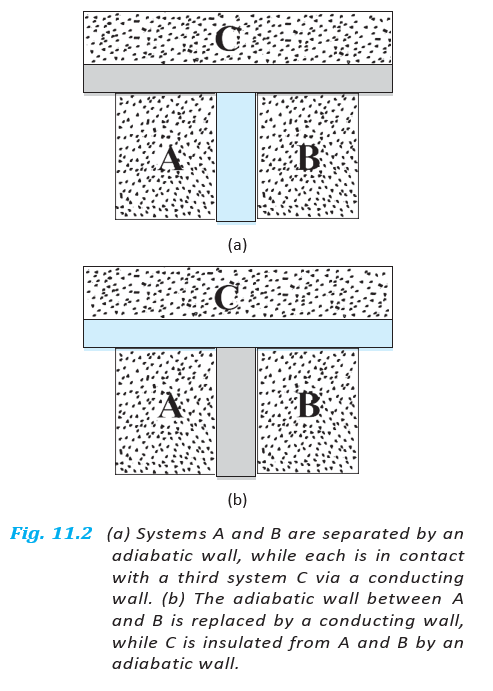
Temperature and Thermal Equilibrium
Temperature — A thermodynamic variable that has the same value in systems in thermal equilibrium.
The Zeroth Law implies equal temperatures for systems in thermal equilibrium.
Temperature in practice
- Hotness: Temperature is a measure of how hot or cold a body is.
- Thermometry: The Zeroth Law provides the basis for assigning temperatures; thermometry deals with constructing temperature scales.
- Heat direction: Heat flows from a higher-temperature body to a lower-temperature body when they are in thermal contact.
- Equilibrium: Heat flow stops once the bodies reach equal temperatures.
- Constraints: Not every macroscopic variable must change during equilibration; for gases in fixed-volume containers, pressure may change while volume stays fixed.
Internal Energy
Internal energy () — The total kinetic and potential energy of a system’s molecules, measured relative to the system’s centre-of-mass frame.
What internal energy includes
- Molecular energy: Includes energy from random molecular motion and intermolecular interactions.
- Not included: The kinetic energy of the system’s overall motion is excluded.
- Gas model: If intermolecular forces are negligible, a gas’s internal energy is mainly the kinetic energy of molecular motion.
- Molecular motion: This can include translational, rotational and vibrational motion.
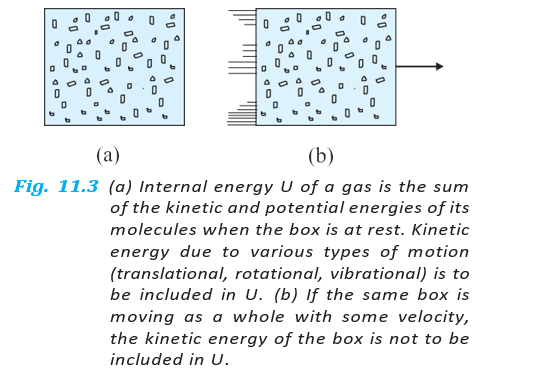
State variable — A property whose value depends only on the system’s present state, not on the path used to reach it.
State variables of a gas
- Examples: Pressure , volume , temperature and internal energy are state variables.
- Path independence: A gas in a given state has the same internal energy regardless of how it reached that state.
Heat, Work and Changes in Internal Energy
Heat — Energy transferred between systems because of a temperature difference.
Work — A mode of transferring energy to or from a system through mechanical interaction.
| Transfer mode | Example | Possible effect |
|---|---|---|
| Heat | A hotter body transfers energy to gas in a cylinder. | The gas’s internal energy increases; heat can flow out if the surroundings are cooler. |
| Work | Pushing a piston down does work on the gas. | The gas’s internal energy increases; the gas can also do work on its surroundings. |
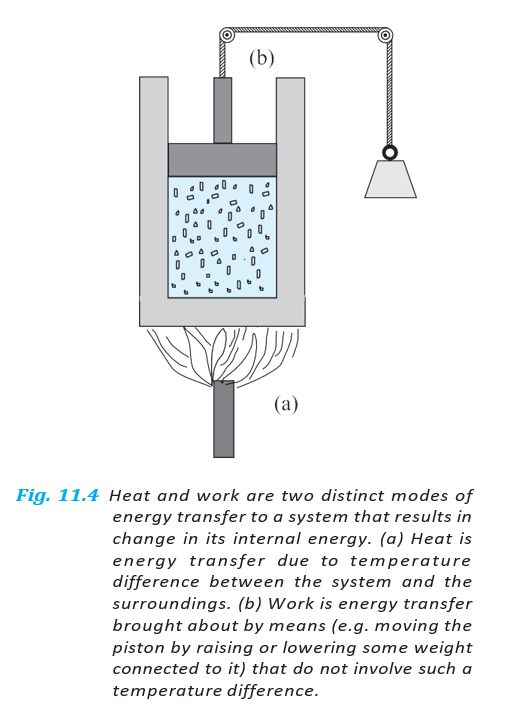
| Point | State variables | Heat and work |
|---|---|---|
| Meaning | Properties describing the system’s state, such as , , and . | Ways energy is transferred to or from the system. |
| Dependence | Depend only on the state, not on the path taken. | Depend on the process; they are not properties stored in a state. |
| Valid statement | A system in a given state has a particular internal energy. | A certain amount of heat may be supplied, or work may be done. |
Do not say that a system “contains” a certain amount of heat or work. A system has internal energy; heat and work describe energy transfer.
State the Zeroth Law of Thermodynamics.
Distinguish internal energy from heat.
Quick recap
- The Zeroth Law says thermal equilibrium with the same third system implies equilibrium with each other.
- Systems in thermal equilibrium have equal temperatures; this underpins temperature measurement.
- Heat flows from higher to lower temperature and stops when temperatures equalise.
- Internal energy is the molecular kinetic and potential energy, excluding the system’s overall kinetic energy.
- Pressure, volume, temperature and internal energy are state variables whose values do not depend on the path.
- Heat and work are energy-transfer modes, not properties contained in a system.
First Law of Thermodynamics
First Law of Thermodynamics — Energy supplied to a system as heat is divided between increasing its internal energy and doing work on the surroundings.
Sign convention and energy balance
- Heat supplied, : energy transferred from the surroundings to the system.
- Work done, : work done by the system on the surroundings.
- Internal energy change, : change in the system’s internal energy.
- Conservation of energy: the heat supplied is accounted for by the changes in internal energy and work.
| Quantity | Dependence |
|---|---|
| Internal energy change, | Depends only on the initial and final states, not on the path. |
| Heat transfer, , and work, | Generally depend on the path taken between the states. |
Special case: no change in internal energy
- If , then .
- Example: In an isothermal expansion of an ideal gas, supplied heat is entirely used to do work.
Work at Constant Pressure
Work done by a gas
- Piston picture: a gas does work when it pushes a movable piston.
- Constant pressure: work is pressure multiplied by the change in gas volume.
Use for a gas changing volume against a constant pressure .
Water changing from liquid to vapour
- Heat supplied: vaporising of water requires .
- Volume change: at atmospheric pressure, the volume changes from to .
- Conclusion: most of the supplied heat increases internal energy; a smaller portion does expansion work.
Heat Capacity and Specific Heat Capacity
Heat capacity — Heat capacity is the heat required to raise a body's temperature by one unit.
For heat supplied and temperature change .
Specific heat capacity — Specific heat capacity is heat capacity per unit mass; it is characteristic of the substance rather than the amount of sample.
Here is mass. The value depends on the substance and its temperature. SI unit: .
Molar specific heat capacity — Molar specific heat capacity is heat capacity per mole of a substance.
Here is the amount of substance in moles. depends on the substance, temperature and conditions of heating. SI unit: .
What heat capacities depend on
- Amount independence: dividing heat capacity by mass or moles gives a quantity independent of sample amount.
- Conditions matter: heat capacities can vary with temperature and with the conditions under which heat is supplied.
Molar Heat Capacity of Solids
Equipartition prediction
- An atom vibrating in one dimension has average energy .
- Vibration in three dimensions gives average energy per atom.
- For one mole, .
- At constant pressure, a solid's volume change is negligible, so .
- Therefore, the predicted molar heat capacity is .
| Substance | Specific heat () | Molar specific heat () |
|---|---|---|
| Aluminium | 900.0 | 24.4 |
| Carbon | 506.5 | 6.1 |
| Copper | 386.4 | 24.5 |
| Lead | 127.7 | 26.5 |
| Silver | 236.1 | 25.5 |
| Tungsten | 134.4 | 24.9 |
Limits of the prediction
- Ordinary temperatures: measured molar heat capacities generally agree with ; carbon is an exception.
- Low temperatures: the agreement with the prediction breaks down.
Specific Heat Capacity of Water
Calorie and water's specific heat
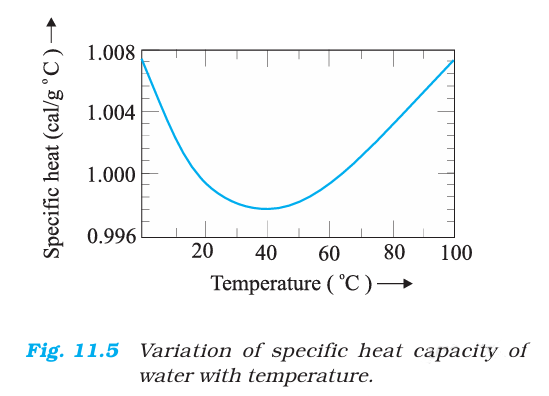
- Temperature dependence: water's specific heat varies slightly with temperature and has a minimum near .
- Precise calorie: is the heat needed to raise of water from to .
- SI value for water: .
- Mechanical equivalent of heat: a conversion factor between calories and joules; the term is unnecessary when energy is expressed in joules.
Specific Heats of an Ideal Gas
| Point | Constant volume () | Constant pressure () |
|---|---|---|
| Condition | Volume stays fixed, so . | Pressure stays fixed; the gas can expand. |
| Heat input | All supplied heat changes internal energy. | Heat changes internal energy and supplies expansion work. |
| Molar heat capacity |
Why Mayer's relation holds
- Ideal-gas internal energy: depends only on temperature, so is the same at constant volume and constant pressure.
- At constant volume: because .
- At constant pressure: the ideal-gas equation for one mole gives .
For one mole of an ideal gas, molar heat capacity at constant pressure exceeds that at constant volume by .
Thermodynamic State Variables and Equation of State
Thermodynamic state variables — Macroscopic variables whose values specify the equilibrium state of a thermodynamic system.
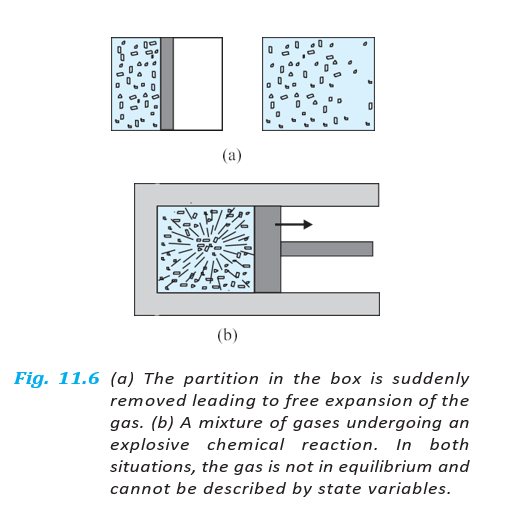
Equilibrium and non-equilibrium states
- Equilibrium gas: its state can be specified by pressure, volume, temperature, mass and, for a mixture, composition.
- Non-equilibrium: pressure or temperature may not be uniform throughout a system.
- Examples: rapid free expansion into a vacuum and a gas mixture undergoing an explosive reaction.
- Return to equilibrium: the system eventually reaches uniform temperature and pressure and thermal and mechanical equilibrium with its surroundings.
Equation of state — A relation connecting the state variables of a system.
For a fixed amount of ideal gas, only two of , and are independent. A constant-temperature pressure-volume curve is an isotherm.
Real gases
- Real-gas behaviour: real gases may have more complicated equations of state than the ideal-gas relation.
| Point | Extensive | Intensive |
|---|---|---|
| Meaning | Indicates the size or amount of the system. | Does not indicate the size of the system. |
| If the system is divided into two equal parts | The value for each part is halved. | The value for each part remains unchanged. |
| Examples | Internal energy , volume , total mass . | Pressure , temperature , density . |
Check scaling when using thermodynamic equations: in , all terms are extensive because is intensive while is extensive.
State the first law of thermodynamics and explain its terms.
Show that for one mole of an ideal gas.
Distinguish between extensive and intensive variables.
Quick recap
- The first law expresses energy conservation: .
- depends on the initial and final states; heat and work generally depend on the path.
- At constant pressure, work is ; when , supplied heat equals work done.
- Specific heat capacity is heat capacity per unit mass; molar specific heat capacity is heat capacity per mole.
- For solids at ordinary temperatures, the predicted molar heat capacity is approximately .
- For an ideal gas, .
- State variables describe equilibrium states; extensive quantities scale with system size, unlike intensive quantities.
Thermodynamic Processes
Quasi-static Process
Types of Thermodynamic Processes
- Classification: Thermodynamic processes are described by the conditions maintained during a change of state, such as fixed temperature, pressure or volume.
- Heat exchange: A process may also be classified by whether heat is transferred between the system and its surroundings.
Isothermal Process
For an ideal gas at constant temperature, from initial volume to final volume .
Adiabatic Process
For an ideal gas, the relation holds throughout an adiabatic process and between any two states on it.
Work done by the gas as it changes from state 1 to state 2.
Isochoric Process
- Isochoric process: The volume remains constant throughout the process.
- Work: Since there is no change in volume, the gas does no work.
- Heat: Heat absorbed by the gas changes its internal energy and temperature.
Isobaric Process
For an ideal gas at constant pressure.
Cyclic Process
- Cyclic process: The system returns to its initial state after a sequence of processes.
- Internal energy: The net change is zero, \u0000, because internal energy is a state variable.
- First law: The total heat absorbed over a cycle equals the net work done by the system.
Quick recap
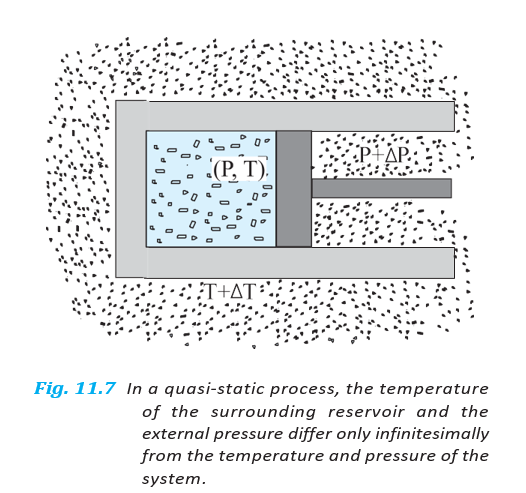
- A quasi-static process passes through equilibrium states with infinitesimal differences from the surroundings.
- Isothermal: temperature is constant, is constant for an ideal gas, and .
- Adiabatic: , is constant, and .
- Isochoric: constant volume means zero work; heat changes internal energy and temperature.
- Isobaric: constant pressure gives .
- In a complete cycle, , so net heat absorbed equals net work done.
Second Law of Thermodynamics
Why the Second Law Is Needed
Second Law of Thermodynamics — A basic law that rules out processes allowed by energy conservation alone but never observed in nature.
Purpose and implications
- First Law: It expresses conservation of energy, but does not determine which energy transformations can actually occur.
- Example: A table could, in principle, cool and transfer energy to a book so it jumps; this has never been observed.
- Heat engines: The Second Law prevents complete conversion of absorbed heat into work, so efficiency cannot be .
- Refrigerators: It also limits performance; a refrigerator's coefficient of performance cannot be infinite.
Statements of the Second Law
| Statement | What it rules out |
|---|---|
| Kelvin–Planck | A process whose sole result is absorbing heat from a reservoir and converting all of it into work; this would be a perfect heat engine. |
| Clausius | A process whose sole result is transferring heat from a colder object to a hotter object; this would be a perfect refrigerator or heat pump. |
- Equivalent statements: The Kelvin–Planck and Clausius statements express the same Second Law; either can be derived from the other.
Reversible and Irreversible Processes
Reversible process — A process that can be reversed so that both the system and surroundings return to their initial states, with no other change anywhere.
Irreversible process — A process that cannot be exactly reversed to restore both the system and surroundings without leaving another change.
| Process | Why it is irreversible |
|---|---|
| Heat spreading through a vessel | Heat flows from its hotter base to cooler parts; it does not spontaneously flow back to reheat the base. |
| Free expansion of a gas | The gas does not spontaneously contract back to its original volume. |
| Combustion | Ignited petrol and air do not spontaneously return to their original mixture. |
| Gas diffusion | Leaked cooking gas spreads through a room and does not spontaneously return to its cylinder. |
| Stirring a liquid | Work becomes internal energy (heat); the reverse would convert heat entirely into work. |
| Friction or viscosity | Mechanical energy is dissipated as internal energy, such as when a body or blade stops. |
Main causes of irreversibility
- Non-equilibrium states: Processes such as free expansion or explosive reactions take the system away from equilibrium.
- Dissipative effects: Friction, viscosity and similar effects convert organised mechanical energy into internal energy.
- Practical reality: Dissipation can be reduced but not completely eliminated, so most natural and practical processes are irreversible.
| Point | Reversible | Irreversible |
|---|---|---|
| Return | System and surroundings can both be restored exactly. | An exact restoration of both is not possible. |
| Conditions | Idealised; must be quasi-static and free of dissipative effects. | Often involves non-equilibrium changes or dissipation. |
| Occurrence | An ideal limiting case. | The rule for most processes in nature. |
Conditions and example of reversibility
- Quasi-static: The system remains in equilibrium with its surroundings at every stage.
- No dissipation: Friction and other dissipative effects must be absent.
- Example: An ideal gas expanding isothermally, quasi-statically, against a frictionless movable piston is reversible.
Reversibility and Heat-Engine Efficiency
Maximum possible efficiency
- Limitation: The Second Law forbids a perfect heat engine with efficiency.
- Reversible engine: An engine operating through ideal reversible processes has the greatest possible efficiency between two reservoirs at temperatures and .
- Real engines: Any irreversibility lowers efficiency below this limiting value.
State the Kelvin–Planck and Clausius statements of the Second Law.
What makes a process reversible?
Why is a reversible heat engine important?
Quick recap
- The First Law conserves energy, but the Second Law restricts which energy transformations occur.
- A heat engine cannot convert all absorbed heat into work; a refrigerator cannot have infinite performance.
- Kelvin–Planck and Clausius are equivalent statements of the Second Law.
- A reversible process restores both system and surroundings; most natural processes are irreversible.
- Irreversibility mainly results from non-equilibrium changes and dissipative effects.
- Reversible engines set the maximum possible efficiency between two reservoirs.
Carnot Engine
Reversible Heat Engines
Reversible process — A reversible process is quasi-static and non-dissipative, and can be reversed without a net change to the system and surroundings.
- Why reversibility matters: Dissipative effects make a process irreversible and lower heat-engine efficiency.
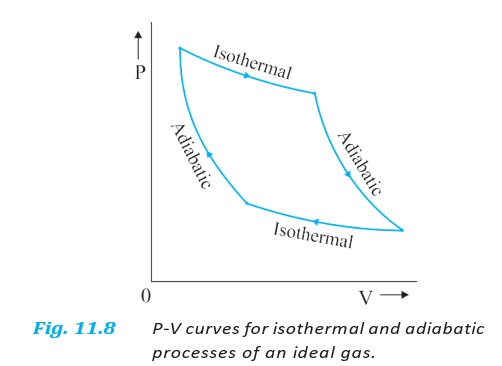
- Reservoir contact: To remain quasi-static with only two reservoirs, heat is absorbed isothermally at and released isothermally at .
- Temperature change: Reversible adiabatic steps change the working substance's temperature without heat exchange or extra reservoirs.
| Process | Role in the cycle |
|---|---|
| Isothermal at | Absorb heat from the hot reservoir |
| Adiabatic | Cool the working substance from to |
| Isothermal at | Release heat to the cold reservoir |
| Adiabatic | Warm the working substance from to |
Carnot engine — A reversible heat engine operating between two temperatures is called a Carnot engine.
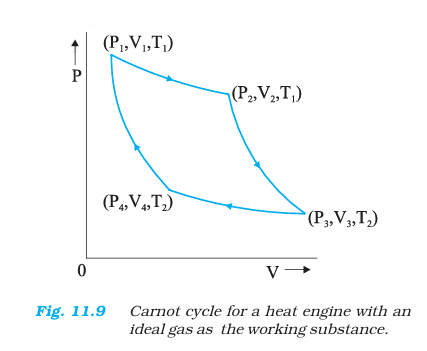
The Carnot Cycle
- Working substance: The derivation uses an ideal gas with amount of substance and heat-capacity ratio .
- Cycle: Four reversible processes return the gas to its initial state.
| Step | Process | Heat and work |
|---|---|---|
| Isothermal expansion at , from to | Heat absorbed equals work done by the gas: | |
| Adiabatic expansion; temperature falls from to | Work done by the gas: | |
| Isothermal compression at , from to | Heat released has magnitude ; the environment does this work on the gas. | |
| Adiabatic compression; temperature rises from to | Work done on the gas: |
The adiabatic work contributions cancel in the net work; the remaining work is heat absorbed minus heat released.
Carnot Efficiency
Efficiency — The efficiency of an engine is its net work output divided by the heat absorbed from the hot reservoir.
Using the isothermal heat expressions gives an efficiency involving volume ratios.
Since is constant during an ideal-gas adiabatic process, the two adiabatic steps give equal isothermal volume ratios.
Maximum efficiency depends only on the absolute temperatures of the reservoirs, not on the working substance.
Use absolute temperatures (kelvin) in ; Celsius temperatures cannot be substituted directly.
Carnot's Theorem
- Maximum efficiency: No engine operating between the same hot and cold reservoirs can be more efficient than a Carnot engine.
- Working-substance independence: All reversible engines operating between the same two temperatures have the same efficiency, regardless of their working substance.
- Contradiction argument: If an irreversible engine were more efficient, coupling it to a reversible engine run backward would extract heat from the cold reservoir and convert it entirely into work, violating the Kelvin–Planck statement of the second law.
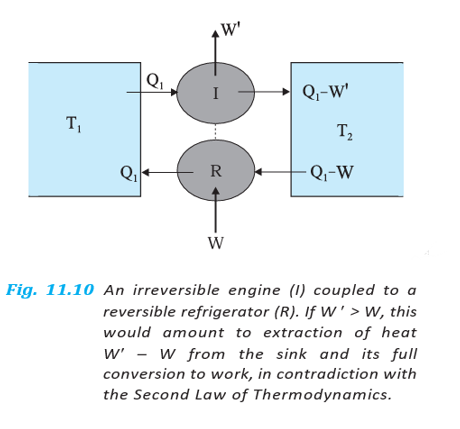
Reversible refrigerator — A Carnot engine run backward absorbs heat from the cold reservoir, takes in work, and releases heat to the hot reservoir.
For any Carnot engine, the heat ratio equals the reservoir-temperature ratio, independent of the working substance.
Thermodynamic temperature scale
- Definition by Carnot relation: The universal relation can define a thermodynamic temperature scale independent of the particular working substance.
- Agreement: For an ideal gas, this universal thermodynamic temperature is the same as the ideal-gas temperature.
State the four processes in one Carnot cycle.
Write Carnot efficiency and state Carnot's theorem.
Quick recap
- A Carnot engine is reversible and operates between two reservoirs.
- Its cycle consists of two isothermal and two adiabatic processes.
- The net work per cycle is .
- Carnot efficiency is , using absolute temperatures.
- No engine between the same reservoirs can exceed Carnot efficiency; reversible-engine efficiency is independent of working substance.
- For a Carnot engine, ; this relation defines a universal temperature scale that agrees with ideal-gas temperature.
Summary
Thermal Equilibrium and Temperature
- Thermal equilibrium: Systems in thermal equilibrium have equal temperatures and no net heat flow between them.
- Zeroth law: If two systems are each in thermal equilibrium with a third system, they are in thermal equilibrium with each other.
Internal Energy, Heat and Work
- Internal energy: It is the sum of the molecular kinetic and potential energies, excluding the kinetic energy of the system as a whole.
- Heat and work: These are modes of energy transfer, not properties stored in a system; internal energy is a state variable.
First Law of Thermodynamics
- First law: Conservation of energy for a thermodynamic system is expressed as , where is work done by the system.
- Meaning: Heat supplied to the system increases its internal energy and/or is converted into work done on the surroundings.
Specific Heat Capacity
Use for a substance of mass heated through a temperature change .
Here, is the amount of substance in moles.
Molar Heat Capacities of an Ideal Gas
- Ideal-gas relation: The molar heat capacities at constant pressure and volume satisfy .
- Heat capacities: applies when volume is fixed, while applies when pressure is fixed.
State Variables and Equations of State
- State variables: Macroscopic quantities such as pressure, volume, temperature and internal energy describe an equilibrium state; their values depend on the state, not the path taken.
- Equation of state: It relates state variables; for an ideal gas, .
- Extensive and intensive: Volume and internal energy are extensive, while pressure and temperature are intensive.
Quasi-Static Processes
- Quasi-static process: An idealised infinitely slow change in which the system remains in thermal and mechanical equilibrium at every stage.
- Conditions: The pressure and temperature differences between the system and its surroundings are infinitesimally small.
Isothermal Expansion of an Ideal Gas
- Isothermal expansion: The temperature remains constant, so an ideal gas obeys .
- Energy transfer: For an ideal gas, , so heat absorbed equals work done: .
Adiabatic Process
Work done by an ideal gas as it changes from to .
Second Law of Thermodynamics
- Second law: It rules out processes that may conserve energy but do not occur spontaneously in nature.
- Heat engines: No heat engine can convert all the heat absorbed from a reservoir into work; its efficiency cannot be 100%.
- Statements: The Kelvin–Planck and Clausius statements express the law in terms of heat engines and heat transfer.
Reversible and Irreversible Processes
- Reversible process: It can be reversed so that both the system and surroundings return to their initial states with no other change.
- Conditions: A reversible process is quasi-static and has no dissipative effects such as friction or viscosity.
- Irreversible processes: They include free expansion, diffusion and processes involving dissipation; most natural processes are irreversible.
Carnot Engine
- Carnot cycle: A reversible engine cycle consists of two isothermal processes connected by two adiabatic processes.
- Efficiency: Between hot and cold reservoirs at temperatures and , the maximum efficiency is .
- Carnot’s theorem: No engine operating between the same temperatures can be more efficient, and Carnot efficiency is independent of the working substance.
Sign Convention for Heat and Work
State the zeroth law of thermodynamics and explain its importance.
Write the first law of thermodynamics using the stated sign convention.
State the Kelvin–Planck statement of the second law.
Quick recap
- Zeroth law: Thermal equilibrium is transitive and gives meaning to temperature.
- First law: Heat supplied is used to change internal energy and do work: .
- State variables: Depend on the state, unlike heat and work, which depend on the process.
- Ideal gas: ; isothermal expansion has , while adiabatic change follows .
- Second law: Heat cannot be fully converted into work in a cyclic engine, nor flow spontaneously from cold to hot.
- Carnot engine: Reversible and maximally efficient between two temperatures; .
- Signs: Positive heat enters the system; positive work is done by the system.
Physics — ALL CHAPTERS
1
Units And Measurement
2
MOTION IN A STRAIGHT LINE
3
MOTION IN A PLANE
4
LAWS OF MOTION
5
WORK, ENERGY AND POWER
6
SYSTEMS OF PARTICLES AND ROTATIONAL MOTION
7
GRAVITATION
8
Mechanical Properties Of Solids
9
Mechanical Properties Of Fluids
10
Thermal Properties Of Matter
11
Thermodynamics
12
Kinetic Theory
13
Oscillations
14
Waves