Class 11 PCM . Physics . Physics Part I . Laws of Motion
Chapter 4: LAWS OF MOTION
Ch 4
Physics
Class 11 PCM
Introduction
Force and Motion
Why force matters
- Force is an external agency that can change a body's state of rest or motion.
- Starting or stopping: A force is needed to set a body at rest in motion or to slow down or stop a moving body.
- Contact forces: A hand, wind or flowing water can exert force through contact.
- Forces at a distance: Gravity can make a released stone accelerate downward; a magnet can attract an iron nail without touching it.
| Force type | How it acts | Example |
|---|---|---|
| Contact | Acts through physical contact | A hand pushing a ball |
| At a distance | Acts without physical contact | Earth's gravity or magnetic attraction |
Aristotle's Fallacy
The mistaken view and its correction
- Aristotle (384–322 B.C.): He argued that an external force is needed to keep a body moving; he suggested air behind an arrow keeps pushing it.
- Why this seems true: Everyday objects eventually stop, so motion appears to require a continuing push or pull.
- The overlooked force: Friction from surfaces opposes motion; in fluids, viscous forces also resist motion.
- Toy-car example: The child’s pull balances friction. The car moves uniformly when the net external force is zero.
- Correct conclusion: Without friction, a body would not need a continuing force to maintain uniform motion.
| Point | Aristotle's view | Galileo's conclusion |
|---|---|---|
| Uniform motion | Needs a continuing external force | Continues without net force if opposing forces such as friction are absent |
| Why everyday objects stop | Motion needs a sustaining force | Friction or other resistance slows and stops them |
Galileo's reasoning
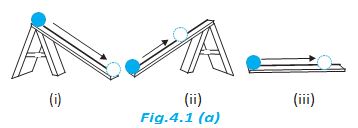
- Inclined plane: A body moving downhill accelerates; moving uphill, it slows. A frictionless horizontal plane is the limiting case, with neither acceleration nor retardation.
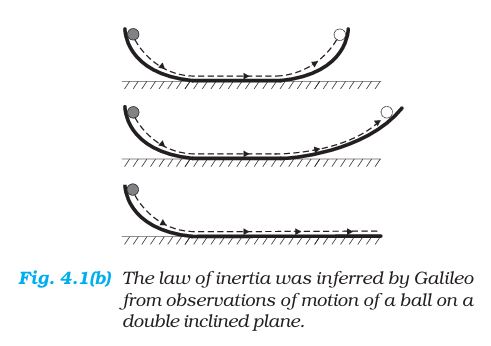
- Double inclined plane: A ball rolling down one smooth slope climbs the other to nearly its starting height; ideally, without friction, it reaches the same height.
- Reducing the second slope: The ball travels farther to reach the same height. If the second slope becomes horizontal, it would travel indefinitely in the ideal frictionless case.
- Real conditions: Friction cannot be completely eliminated, so the ball eventually stops; without friction it would continue at constant velocity.
- Galileo's insight: Rest and uniform linear motion are equivalent states: both have zero net force.
The Law of Inertia
Inertia — The property of a body that resists a change in its state of rest or uniform motion.
Statement and meaning
- Law of inertia: If the net external force on a body is zero, a body at rest remains at rest, and a moving body continues with constant velocity.
- Uniform motion: Constant velocity means constant speed in a straight line; the body's direction does not change.
- Change of state: A non-zero net external force is required to change rest or uniform motion.
- Balanced forces: Individual forces may act, but if they cancel, the net external force is zero.
For a body with zero net external force, velocity remains constant.
Do not confuse the force needed to overcome friction with a force needed to sustain uniform motion. With no net force, uniform motion continues.
Why does a toy car stop when the child releases its string?
State the law of inertia.
Quick recap
- Force changes a body's state of rest or motion and can act through contact or at a distance.
- Aristotle's error: He attributed the stopping of moving bodies to the need for a sustaining force, overlooking friction and resistance.
- Galileo's conclusion: In the absence of friction, motion on a horizontal plane continues uniformly.
- Inertia is resistance to a change in a body's state of rest or uniform motion.
- Law of inertia: Zero net external force means rest remains rest and constant velocity remains constant.
Newton’s First Law Of Motion
Newton’s First Law
Newton’s First Law — A body remains at rest or moves with uniform velocity in a straight line unless compelled to change by a net external force.
- Background: Newton built on Galileo’s law of inertia to formulate the first law of motion.
- Uniform motion: Constant velocity means both speed and direction remain unchanged.
- External force: A net external force changes a body’s state of motion; internal forces alone cannot accelerate the body as a whole.
Early Ideas on Motion in Indian Science
| Term | Meaning | Example or connection |
|---|---|---|
| Nodan | Force due to continuous pressure | Wind pushing a sailing vessel |
| Abhighat | Force due to impact | A potter’s rod striking a wheel |
| Sanskara | Persistent tendency to move or restore shape | Includes the tendency of an elastic body to recover its shape |
| Vega | Tendency to move in a straight line | Closest to inertia; contact with objects, friction and air resistance oppose it |
| Transmitted force | Force passed through a string, rod or similar object | Force transmitted along a connected object |
Motion, Measurement and Waves
- Extended bodies: Translational, rotational and vibrational motion arise from the translational motion of their constituent particles; each particle has a definite small displacement at an instant.
- Example: A falling leaf can move downward as a whole while also rotating and vibrating.
- Position: A particle’s position in space can be specified by distances measured along three axes.
- Bhaskara: In 1150 A.D., he introduced “instantaneous motion” (*tatkaliki gati*), anticipating the modern concept of instantaneous velocity using differential calculus.
- Wave vs current: A current is water-particle motion due to gravity and fluidity; a wave transmits vibrations of water particles.
Inertia and Zero Net Force
Inertia — The tendency of a body to resist a change in its state of rest or uniform straight-line motion.
- Acceleration: Rest and uniform straight-line motion both have zero acceleration.
- Balanced forces: Forces may act on a body but produce no acceleration when their vector sum is zero.
- First-law condition: A non-zero acceleration requires a net external force.
Zero net external force implies zero acceleration; if a body is unaccelerated, its net external force is zero.
Applying the First Law
- Known zero net force: Acceleration is zero; a moving body continues with constant velocity.
- Known zero acceleration: Infer that the net external force is zero, even if individual forces act.
- On Earth: Gravity and forces such as friction or viscous drag are usually present; rest or uniform motion means the forces balance.
A Book Resting on a Table
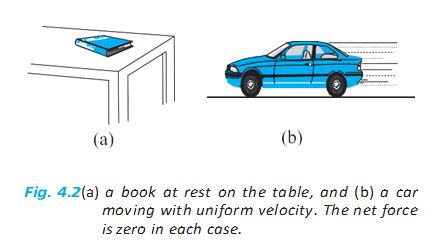
- Forces: The book’s weight acts downward; the table’s normal force acts upward.
- Conclusion: Since the book is observed to be at rest, its acceleration is zero; the first law implies that and are equal in magnitude and opposite in direction.
- Reasoning: Do not use force cancellation as the explanation for why it is at rest; use its observed rest to infer zero net force and then the balance of forces.
A Car Starting and Moving at Constant Speed
- Stationary car: With zero acceleration, the net force is zero.
- Picking up speed: The car accelerates due to a net external force; friction from the road provides the force that accelerates the car as a whole.
- Constant velocity: When the car moves uniformly in a straight line, the net external force is zero.
- Key point: Internal forces within the car cannot account for the acceleration of the car as a whole.
Inertia in a Bus
- Bus starts suddenly: Friction moves the feet with the floor, while the upper body tends to remain at rest due to inertia; the passenger lurches backward relative to the bus.
- Bus stops suddenly: The feet stop with the floor due to friction, while the upper body tends to continue moving; the passenger lurches forward.
- Body response: Muscular forces then move the rest of the body with the feet or bring it to rest.
Astronaut Separated from a Spaceship
- Situation: An astronaut separates from a spaceship accelerating at in interstellar space.
- After separation: With no nearby stars and negligible gravitational attraction from the spaceship, the astronaut has zero net force and therefore zero acceleration.
- Do not confuse: The spaceship’s acceleration does not continue to act on the astronaut after separation.
Why does a passenger lurch backward when a bus starts suddenly?
Quick recap
- A body stays at rest or in uniform straight-line motion unless a net external force acts.
- Zero net external force means zero acceleration; unaccelerated motion indicates balanced external forces.
- Indian ideas included vega (straight-line tendency), motion measurement, and Bhaskara’s tatkaliki gati in 1150 A.D.
- A book at rest has its weight balanced by the table’s normal force.
- Road friction provides the external force that accelerates a car.
- Inertia explains backward and forward lurches when a bus starts and stops.
- An astronaut with zero net force after separation has zero acceleration, regardless of the spaceship’s motion.
Newton’s Second Law Of Motion
Momentum
- Definition: Momentum is the product of a body's mass and velocity: .
- Vector nature: Momentum has the same direction as velocity.
- Effect of mass and speed: Greater mass or speed means greater momentum and generally requires a greater force to stop in the same time.
- Force and momentum: The greater the rate of change of momentum, the greater the force; the same change in momentum in less time requires more force.
Quick recap
- Momentum is mass multiplied by velocity: ; it points in the direction of velocity.
- Newton’s second law states that net force equals the rate of change of momentum; for constant mass, .
- A force changes momentum’s magnitude, direction, or both; its effect depends on how quickly momentum changes.
- For a system, use total external force and centre-of-mass acceleration; do not include internal forces.
- One newton is ; impulse is force multiplied by time and equals the change in momentum.
- A large force acting briefly can produce a finite impulse; impulse is directed along the momentum change.
Newton’s Third Law Of Motion
Force as a Mutual Interaction
Newton’s Third Law of Motion — Whenever one body exerts a force on another, the second body exerts an equal and opposite force on the first.
Key Features of Force Pairs
Forces on Bodies and Systems
Do not say action and reaction cancel on one body: they act on different bodies. They cancel only as internal forces when considering the combined system.
Why do the action and reaction forces not cancel when finding the net force on one body?
Quick recap
- Forces arise from interactions between bodies and occur in pairs.
- The paired forces are equal in magnitude, opposite in direction, and simultaneous.
- Each force acts on a different body; action and reaction do not cancel on one body.
- For a combined system, internal action–reaction forces cancel in pairs.
- A massive body such as Earth can have negligible motion despite experiencing a force.
Conservation Of Momentum
Momentum in an Isolated System
Momentum Conservation in Collisions
Equilibrium of a Particle
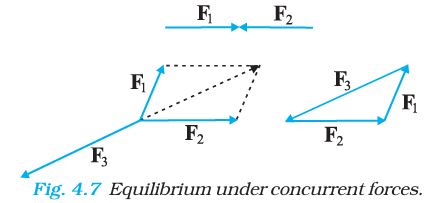
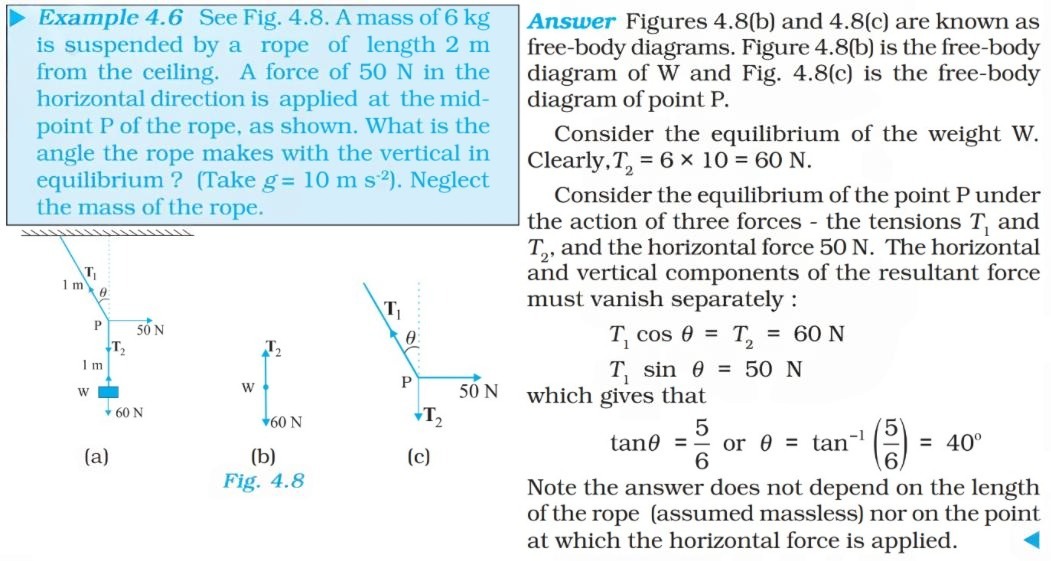
Equilibrium does not mean rest only: a particle in equilibrium may also move with constant velocity.
State the law of conservation of momentum.
Why is total momentum conserved in a collision?
What is the condition for a particle to be in equilibrium?
Quick recap
- An isolated system has no external force acting on it.
- The total momentum of an isolated system remains constant.
- In a collision, the equal-and-opposite interaction forces produce cancelling momentum changes.
- Momentum is conserved in elastic and inelastic collisions; elastic collisions also conserve kinetic energy.
- A particle is in equilibrium when its net external force is zero.
- For equilibrium, force vectors sum to zero and their components separately sum to zero on each axis.
Common Forces In Mechanics
Gravitational Force
Gravitational force — The force of attraction between masses; Earth’s gravity acts on objects on Earth.
- Acts at a distance: Gravity does not require contact or an intervening medium.
- Role: It acts on objects on Earth and governs the motion of celestial bodies.
Contact Forces
Contact force — A force that arises through contact between objects, including solids or fluids.
- Mutual forces: Contacting bodies exert forces on each other, forming action–reaction pairs under Newton’s third law.
- Normal reaction: The component of contact force perpendicular to the surfaces.
- Friction: The component of contact force parallel to the surfaces.
- Examples: A book supported by a table; rigid bodies connected by rods, hinges or other supports.
Forces Exerted by Fluids
- Buoyant force: An immersed solid experiences an upward force equal to the weight of the fluid displaced.
- Other fluid forces: Viscous force and air resistance are contact forces.
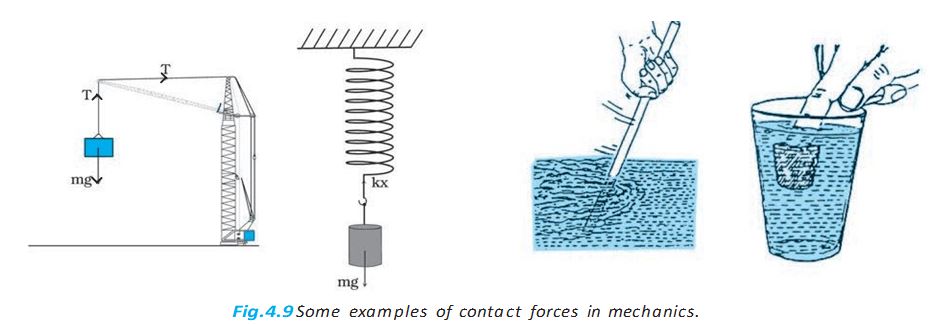
Spring Force and Tension
Spring force — The restoring force produced when a spring is compressed or extended from its unstretched state.
- Small displacements: The restoring force is usually proportional to the compression or extension.
- Direction: The force acts opposite to the displacement from the unstretched state.
- Tension: The restoring force in a string; an inextensible string has a very high force constant.
- Ideal string: For a string of negligible mass, tension is taken as constant throughout and is denoted by .
is the spring force, is displacement from the unstretched state, and is the force constant.
Fundamental Origin of Mechanical Forces
- Four fundamental forces: Gravitational, electrical, strong and weak forces.
- Relevant to mechanics: Gravitational and electrical forces; strong and weak forces act in domains not considered here.
- Microscopic origin of contact forces: They ultimately arise from electrical interactions between charged constituents of different bodies.
- Underlying processes: Elasticity, molecular collisions and impacts can be traced to electrical forces between nuclei and electrons.
- Macroscopic treatment: The microscopic details are complex, so contact forces are treated as distinct types with empirically determined properties.
Do not classify all mechanical forces as contact forces: gravity acts at a distance, while normal reaction, friction, fluid forces, spring force and tension require contact.
What are the normal reaction and friction?
State the spring-force relation and explain its negative sign.
What is the microscopic origin of contact forces?
Quick recap
- Gravity acts at a distance and affects objects on Earth and celestial bodies.
- Contact forces arise through contact; contacting bodies exert mutual forces consistent with Newton’s third law.
- Normal reaction is perpendicular to the contact surfaces; friction is parallel.
- Fluid forces include buoyancy, viscous force and air resistance; buoyancy equals the weight of displaced fluid.
- Spring force follows for small displacements; its direction opposes displacement.
- Tension is the restoring force in a string; it is denoted by and is constant for a negligible-mass string.
- Microscopic origin: Contact forces ultimately arise from electrical interactions.
Friction
Friction and Static Friction
Friction — The component of the contact force parallel to touching surfaces that opposes impending or actual relative motion.
Static friction
- Direction: Friction acts parallel to the contacting surfaces and opposes their relative motion or tendency to move relative to each other.
- Appearance: Static friction arises only when an applied force tends to cause relative motion; without that tendency, it is zero.
- Adjustment: While a body remains at rest, static friction matches the applied force in magnitude and acts oppositely, up to a limiting value.
- Impending motion: Motion that would occur under the applied force if friction were absent; static friction opposes this tendency.
The coefficient of static friction, , depends on the nature of the surfaces. Limiting friction is approximately independent of contact area.
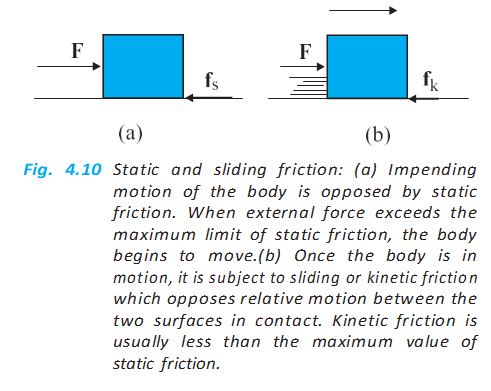
Kinetic Friction
Kinetic friction — Friction that opposes relative motion when two surfaces slide against each other; it is also called sliding friction.
Kinetic friction: key points
- Onset: Sliding begins when the applied force exceeds the maximum static friction.
- Dependence: Kinetic friction is approximately independent of contact area and nearly independent of speed.
- Coefficient: The coefficient of kinetic friction, , depends on the surfaces; experiments show that .
- Status: The laws of static and kinetic friction are useful empirical approximations, not fundamental laws.
For a sliding body of mass , the net force is the applied force minus kinetic friction. If the applied force is removed, friction decelerates the body.
Motion under kinetic friction
- Constant velocity: Net force is zero, so the applied force balances kinetic friction: .
- Applied force removed: Acceleration is ; the body eventually stops.
Friction and Relative Motion
Box in an accelerating train
- Cause of acceleration: Static friction from the train floor accelerates a box that remains stationary relative to the train.
- Without friction: The floor would move beneath the box; due to inertia, the box would not accelerate with the train.
- Required friction: For a box of mass accelerating at , static friction must provide the horizontal force .
The required static friction accelerates the box and cannot exceed its limiting value. On a horizontal floor, .
A train carries a box on its floor. If the coefficient of static friction is , find the maximum train acceleration for which the box does not slip. Take .
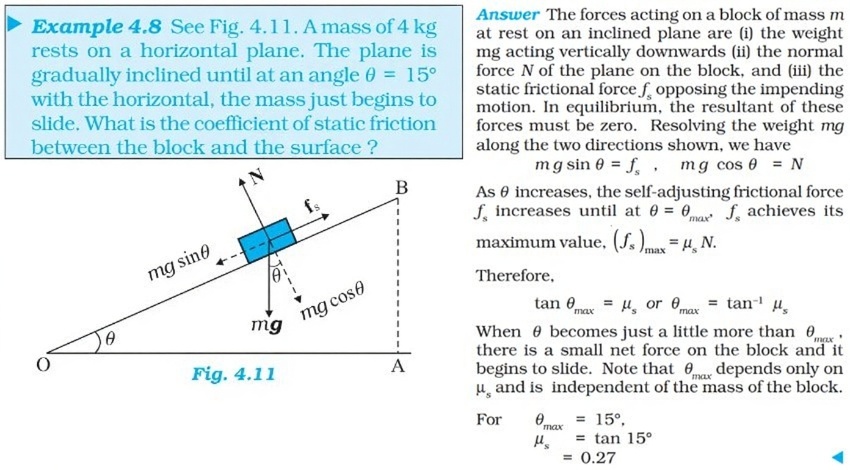
Block at the threshold of sliding on an incline
- At the threshold: Static friction is at its limiting value and opposes the block’s impending slide down the plane.
- Force components: The weight component parallel to the plane acts down the slope; the normal force is perpendicular to the surface.
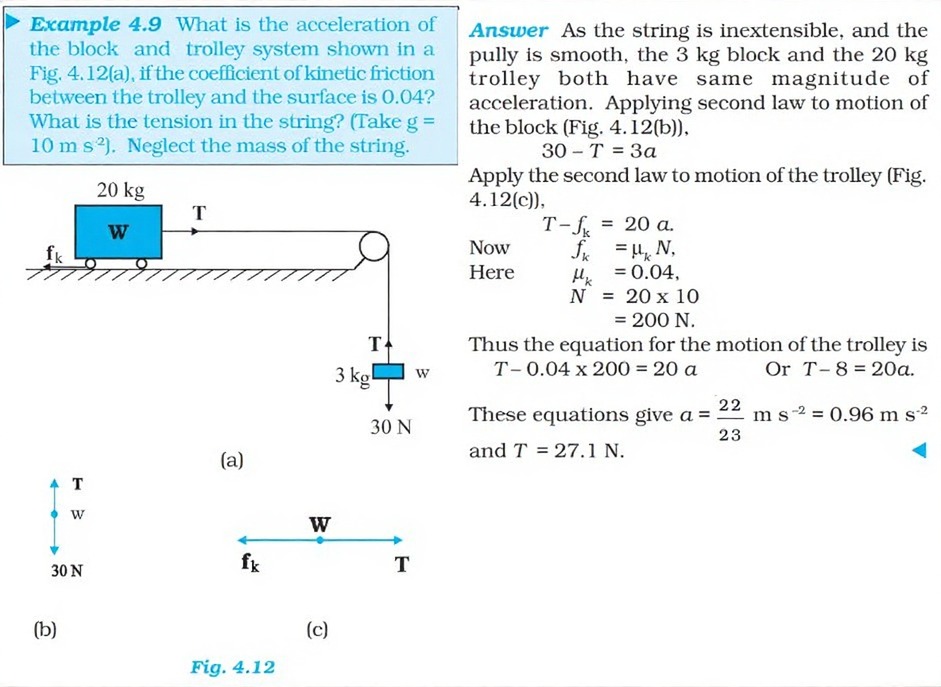
Connected trolley and hanging block
- Force analysis: Draw a separate free-body diagram for each mass; include tension, weight, the trolley’s normal force and friction.
- Friction direction: Friction on the trolley opposes its actual or impending motion relative to the floor; apply Newton’s second law to each body.
Rolling Friction
Rolling friction — Resistance to motion that occurs when a body rolls over a surface.
Rolling friction: key points
- Ideal rolling: For rolling without slipping, the instantaneous contact point has no motion relative to the surface; ideally, friction is zero and the body can roll at constant velocity.
- Real rolling: Slight deformation creates a finite contact area, and the parallel component of the contact force opposes motion.
- Relative size: For the same weight, rolling friction can be two or three orders of magnitude smaller than static or sliding friction; this makes wheels effective.
Uses and Reduction of Friction
Friction in machines and everyday life
- Unwanted effects: Friction opposes relative motion in machines and dissipates energy, often as heat.
- Lubricants: Reduce kinetic friction between moving machine parts.
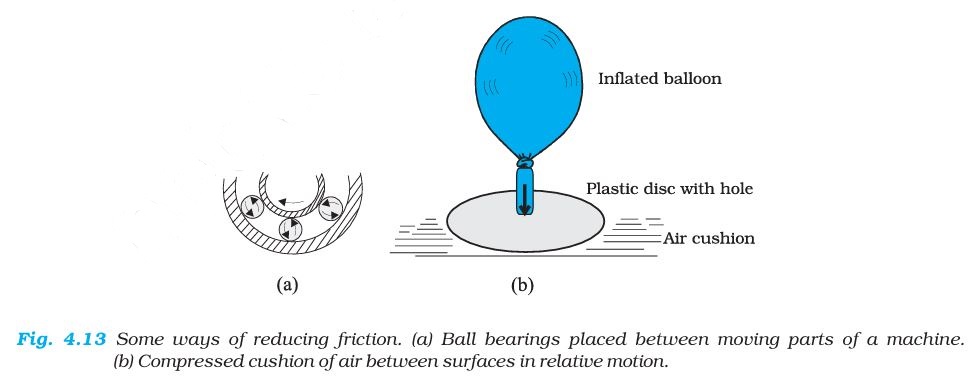
- Ball bearings and air cushions: Ball bearings replace much sliding with low-resistance rolling; a thin air layer separates surfaces and reduces friction.
- Brakes: Kinetic friction is used to stop moving machinery and vehicles.
- Walking and driving: Static friction between feet and ground enables walking; friction between tyres and road provides the external force that accelerates a car. Very slippery roads can prevent a car from moving effectively.
Static friction is not always ; it adjusts as needed up to its maximum, .
Quick recap
- Friction acts parallel to contact surfaces and opposes impending or actual relative motion.
- Static friction adjusts to the needed force up to .
- Kinetic friction is , with .
- For a box carried without slipping by an accelerating train, and .
- Inclined-plane and connected-body problems require free-body diagrams and friction opposite relative motion or its tendency.
- Real rolling friction arises from deformation and is much smaller than sliding friction.
- Friction can waste energy but is essential for braking, walking and accelerating vehicles.
Circular Motion
Centripetal Force
Centripetal force — The net force directed towards the centre that produces the centripetal acceleration of circular motion.
Key points
- Magnitude: For mass moving at uniform speed in a circle of radius , the inward force required is .
- Examples: String tension acts on a rotated stone; gravity acts on a planet orbiting the Sun; friction acts on a car turning on a level road.
- Important: Centripetal force is not a separate kind of force; it is the inward role played by an actual force or the net force.
Use for uniform circular motion.
Car on a Level Road
Forces and maximum speed
- Forces: The car experiences weight downward, normal reaction upward, and friction along the road.
- Vertical balance: There is no vertical acceleration, so and therefore .
- Centripetal force: Static friction supplies the inward force and opposes the car's tendency to slide away from the circular path.
- No slipping: The required friction must not exceed its maximum value, ; using gives .
- Mass independence: The maximum turning speed does not depend on the car's mass.
A larger friction coefficient or turn radius allows a higher speed.
Example: cyclist taking a turn
- Given: , , and .
- Check: The no-slip limit is , but .
- Conclusion: The required friction exceeds the available static friction, so the cyclist slips.
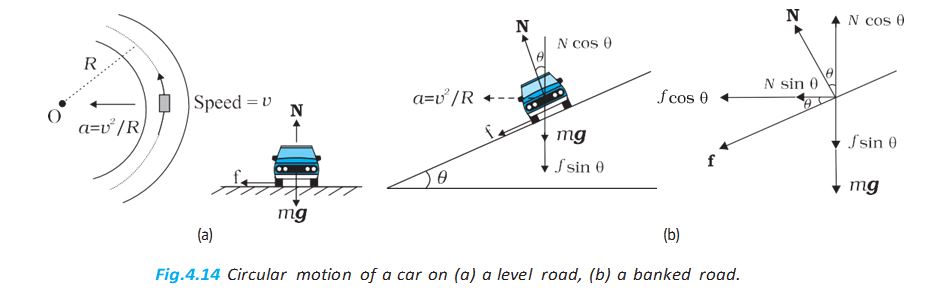
Car on a Banked Road
Force components and limiting speed
- Banking: Tilting the road lets the normal force contribute to the centripetal force, reducing reliance on friction.
- Vertical balance: For the limiting high-speed case, friction acts down the slope; .
- Inward force: The horizontal components provide centripetal force: .
- Friction limit: Since , the maximum speed occurs at .
- Effect of banking: The maximum permissible speed on a banked road is greater than on a level road for the same road conditions.
Applies when friction is at its limiting value and acts down the slope.
At this speed, the normal force alone supplies the needed centripetal force; it avoids tyre wear from friction.
Friction direction and parking
- Below optimum speed: For , friction acts up the slope.
- Parking condition: A car can remain parked on the banked road if .
Example: banked racetrack
- Given: , , , and .
- Optimum speed: With no friction required, .
- Maximum speed: Using the limiting-friction formula, .
What provides centripetal force for a car turning on a level road?
Why is there a friction-free optimum speed on a banked road?
Quick recap
- Centripetal force is the inward net force required for circular motion: .
- On a level road, static friction supplies the centripetal force and .
- Banking lets the normal force contribute to the centripetal force, increasing the possible speed.
- For a banked road, the limiting high-speed formula is .
- The friction-free optimum speed is ; below it, friction acts up the slope.
- A banked road can support a parked car when .
Solving Problems In Mechanics
A systematic approach
Free-body diagram (FBD) — A diagram of a chosen system showing all external forces acting on it; the system can still have a net force.
Steps for solving mechanics problems
- Sketch the assembly, showing its parts, links and supports.
- Choose a convenient part of the assembly as the system.
- Draw its FBD with all forces exerted on it by the environment.
- Mark known forces and treat the remaining forces as unknowns.
- If analysing another system, use Newton’s third law to show the mutual forces as equal and opposite.
Example: block on a yielding floor
After the floor yields
- Choose the system: Treat the block and cylinder together as one system, of total mass .
- External forces: The system’s weight is downward, and the floor’s normal force is upward. The contact forces between block and cylinder are internal and are omitted.
- Apply Newton’s second law: The system accelerates downward, so the net downward force is .
- Action on floor: The system pushes vertically downward on the floor with magnitude .
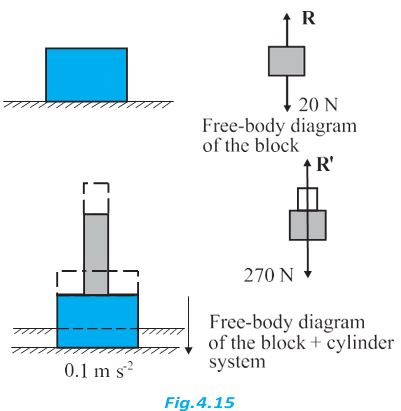
Action–reaction pairs
The weight and normal force on the same object are not an action–reaction pair: both act on that object. They may be equal and opposite when it is at rest, but need not be equal during acceleration.
Why are the block–cylinder contact forces absent from the FBD of the combined system?
What is the action of the block–cylinder system on the floor after it begins accelerating?
Quick recap
- Choose a system, then include all external forces acting on it in its FBD.
- Internal forces are omitted when the interacting bodies are treated as one system.
- Use Newton’s laws to relate the net force to the system’s motion.
- Action–reaction forces act on different bodies and are equal and opposite.
- Weight and normal force on the same body are not an action–reaction pair.
Summary And Points To Ponder
Inertia and Newton’s First Law
Inertia and motion
- Aristotle’s error: A force is not needed to maintain uniform motion; in everyday situations, force is needed to overcome friction.
- Inertia: Galileo’s reasoning from motion on inclined planes led to the idea that bodies resist changes in their state of motion.
- Newton’s first law: A body remains at rest or moves uniformly in a straight line unless acted on by a net external force.
- Equivalent form: If the net external force is zero, acceleration is zero: .
Momentum and Newton’s Second Law
Momentum — A body’s momentum is the product of its mass and velocity; it is a vector in the direction of velocity.
Here, is mass and is velocity.
Newton’s second law — The net external force equals the rate of change of momentum, with the change occurring in the force’s direction.
For constant mass, . The proportionality constant is in SI units.
Using the second law
- Vector law: Force, momentum change and acceleration have directions; acceleration is parallel to the net force.
- System use: For a particle or system, use the total external force; for a system, is the acceleration of the system as a whole.
- Local law: Force at a particular instant determines acceleration at that same instant; acceleration does not depend on the motion’s history.
- Force unit: One newton is the force that gives a mass an acceleration of .
| Quantity | SI unit | Dimensions | Key relation |
|---|---|---|---|
| Momentum | or | ||
| Force | |||
| Impulse | or | Equals change in momentum |
Impulse
Impulse — Impulse is the product of a force and its acting time; it equals the change in momentum.
For a constant force acting over a short interval, impulse measures the resulting momentum change.
Impulsive forces
- Use: Impulse is useful when a large force acts for a very short time and causes a measurable momentum change.
- Approximation: During such a brief force, the body’s position can be treated as unchanged.
Newton’s Third Law
Newton’s third law — When two bodies interact, each exerts an equal and opposite force on the other.
Action–reaction pairs
- Pair of bodies: Force on by is equal in magnitude and opposite in direction to force on by .
- Simultaneous: Action and reaction occur together; neither causes or precedes the other, and either force may be called the action.
- Different bodies: The pair cannot cancel on a single body. Internal action–reaction forces within a body sum to zero.
Conservation of Momentum
Law of conservation of momentum — The total momentum of an isolated system of particles remains constant.
Why momentum is conserved
- Basis: The law follows from Newton’s second and third laws.
Friction
Friction — Friction is the tangential component of contact force that opposes impending or actual relative motion between surfaces in contact.
| Type | What it opposes | Approximate law | Key point |
|---|---|---|---|
| Static friction | Impending relative motion | Self-adjusts up to its maximum | |
| Kinetic friction | Actual relative motion |
Friction facts
- Coefficients: and depend on the pair of surfaces in contact.
- Contact area: The approximate friction laws are independent of the area of contact.
- Notation: is the normal reaction; it is also denoted by in some descriptions.
Interpreting Forces: Points to Ponder
Force, velocity and acceleration
- Direction: Force need not point along velocity; it may be opposite, perpendicular or at another angle. It is parallel to acceleration.
- Momentary rest: If at an instant, force and acceleration need not be zero. At the highest point of an upward-thrown ball, velocity is zero but weight and downward acceleration remain.
- Force at an instant: Force depends on the body’s current situation and surroundings, not on a force carried over from its past motion.
- Released from a train: Just after a stone leaves an accelerated train, it has no horizontal force or acceleration if air effects are ignored; gravity acts vertically.
Identifying the actual force
- Net force: In , is the net force from all external material agencies; describes its effect, not an additional force.
- Centripetal force: This names the inward force providing radial acceleration in circular motion; it is not a new kind of force.
- Source of centripetal force: Identify a real interaction such as tension, gravity, electrical force or friction.
- Force labels: Friction, normal reaction, tension, air resistance, viscous drag, thrust, buoyancy, weight and centripetal force are forces in different contexts. Specify each as “force on by .”
Common force misconceptions
- Static friction: It adjusts as needed up to ; do not assume unless its maximum value is reached.
- Weight and normal reaction: only when the body is in equilibrium; an accelerated lift can have . This equality is unrelated to the third law.
- Action and reaction: These are simultaneous mutual forces on different bodies, not a cause-and-effect sequence.
- Walking: An animate body also needs external force to accelerate; friction from the ground enables us to walk.
Feeling of force
- Physical force vs sensation: The objective force in physics is not the same as a person’s subjective feeling of being pushed.
- Merry-go-round: The body’s parts experience inward forces, yet the rider may feel pushed outward, toward the direction of impending motion.
Why do action–reaction forces not cancel each other?
When does static friction equal its maximum value?
Quick recap
- With zero net external force, a body remains at rest or in uniform straight-line motion.
- Momentum is ; net force is its rate of change.
- Impulse equals the change in momentum: .
- Third-law forces are equal, opposite, simultaneous and act on different bodies.
- An isolated system’s total momentum is conserved.
- Static friction self-adjusts up to its limit; kinetic friction is approximately with .
- Identify real force interactions carefully; force direction need not match velocity.
Physics — ALL CHAPTERS
1
Units And Measurement
2
MOTION IN A STRAIGHT LINE
3
MOTION IN A PLANE
4
LAWS OF MOTION
5
WORK, ENERGY AND POWER
6
SYSTEMS OF PARTICLES AND ROTATIONAL MOTION
7
GRAVITATION
8
Mechanical Properties Of Solids
9
Mechanical Properties Of Fluids
10
Thermal Properties Of Matter
11
Thermodynamics
12
Kinetic Theory
13
Oscillations
14
Waves