Class 11 PCM . Physics . Physics Part I . Motion in a Straight Line
Chapter 2: MOTION IN A STRAIGHT LINE
Ch 2
Physics
Class 11 PCM
Introduction
Motion and Kinematics
Motion — A body is in motion if its position changes with time.
Describing motion
- Kinematics describes motion without considering its causes.
- Rectilinear motion is motion along a straight line.
- Point object approximation: An object's size can be ignored when it is much smaller than the distance it travels.
Instantaneous Velocity and Speed
Instantaneous velocity — The velocity at an instant is the limiting value of average velocity as the time interval approaches zero.
Here, is position and is time; velocity is the rate of change of position with time.
Finding instantaneous velocity
- Graphically: The instantaneous velocity is the slope of the tangent to the position–time graph at that instant.
- Numerically: Calculate average velocity over progressively smaller intervals around the instant; the values approach instantaneous velocity.
- By calculus: Differentiate the position function with respect to time.
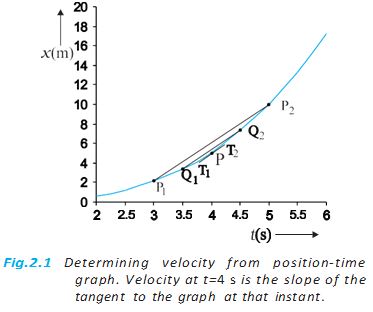
| (s) | Average velocity (m s) |
|---|---|
Worked example: position
- At : , so .
- Limit check: As the interval around shrinks, the average velocity approaches .
For , differentiate to find velocity. With and , the velocity is zero at and at .
For the same position function, between and , the average velocity is .
Speed and velocity
- Instantaneous speed is the magnitude of instantaneous velocity: .
- Example: Velocities and both correspond to a speed of .
- Uniform motion: Velocity is constant, so it equals the average velocity at every instant.
- Finite time interval: Average speed is at least the magnitude of average velocity because total distance is at least the magnitude of displacement.
Do not confuse speed with velocity: speed is non-negative and has no direction, while velocity can be positive or negative in one-dimensional motion.
How is instantaneous velocity obtained from a position–time graph?
Why is average speed over a finite interval greater than or equal to the magnitude of average velocity?
Quick recap
- Motion is a change in position with time; kinematics describes motion without studying its causes.
- Rectilinear motion takes place along a straight line; a sufficiently small object can be treated as a point object.
- Instantaneous velocity is .
- On a position–time graph, instantaneous velocity is the tangent's slope.
- Instantaneous speed is the magnitude of velocity, .
- Over a finite interval, average speed is greater than or equal to the magnitude of average velocity.
Acceleration
Meaning of Acceleration
Acceleration — The rate of change of velocity with time.
- Galileo’s conclusion: For freely falling objects, velocity changes at a constant rate with time.
- Change with distance: The rate of change of velocity with distance is not constant; it decreases as the distance of fall increases.
- What changes: Since velocity has magnitude and direction, acceleration can result from a change in speed, direction, or both.
- Sign: Acceleration can be positive, negative, or zero, depending on the chosen direction and the change in velocity.
Average and Instantaneous Acceleration
Average acceleration — The change in velocity divided by the time interval over which it occurs.
Here, and are velocities at times and . The SI unit is .
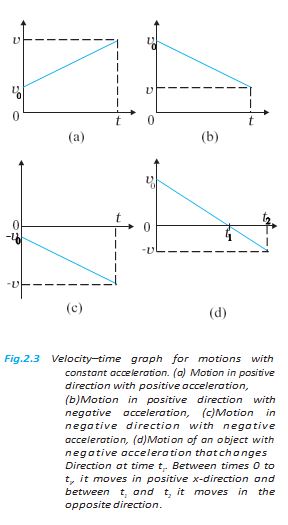
- Velocity–time graph: Average acceleration is the slope of the straight line joining the two points on the graph.
- Instantaneous acceleration: The acceleration at a particular instant; it is the limit of average acceleration as the time interval approaches zero.
- Graphical meaning: Instantaneous acceleration is the slope of the tangent to the – curve at that instant.
Acceleration and Position–Time Graphs
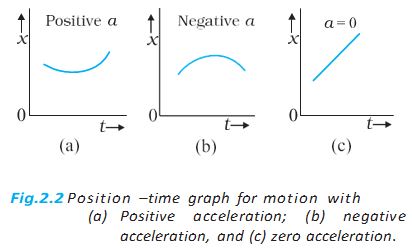
- Positive acceleration: The position–time graph curves upward.
- Negative acceleration: The position–time graph curves downward.
- Zero acceleration: The position–time graph is a straight line, indicating constant velocity.
- Direction matters: Negative acceleration does not automatically mean slowing down; its effect depends on the direction of velocity.
Constant Acceleration
- Constant acceleration: Acceleration has the same value throughout the interval, so average acceleration equals acceleration at every instant.
- Initial and later velocity: If velocity is at and at time , the constant-acceleration relation follows from the definition of average acceleration.
Displacement from a Velocity–Time Graph
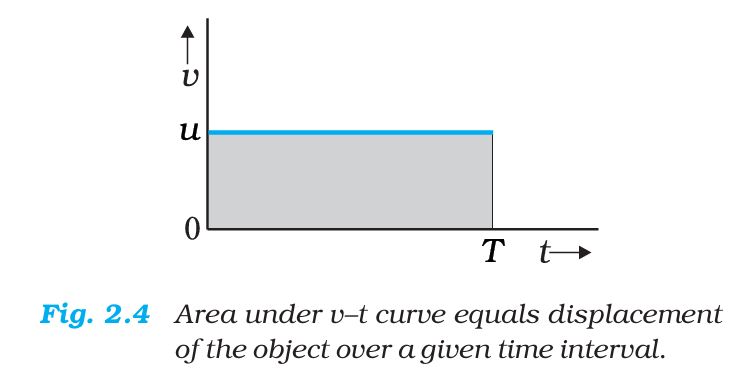
Area under a velocity–time graph — The signed area under a – graph over a time interval represents displacement during that interval.
- Constant velocity: The – graph is horizontal; from to , the area is a rectangle with height and base .
- Displacement: The rectangle area is ; the units are .
For constant velocity over the time interval .
Continuity of Motion
- Graph smoothness: Sharp kinks indicate that a function is not differentiable at those points; realistic motion graphs are smooth.
- Physical meaning: Velocity and acceleration cannot change abruptly at an instant; changes occur continuously.
Define average and instantaneous acceleration.
What does the area under a velocity–time graph represent?
Quick recap
- Acceleration is the rate of change of velocity with time; its SI unit is .
- In free fall, Galileo found the rate of change of velocity with time to be constant, while the rate of change with distance decreases as fall distance increases.
- Average acceleration is ; instantaneous acceleration is .
- Acceleration is the slope of a velocity–time graph; instantaneous acceleration is the tangent’s slope.
- For constant acceleration, .
- The signed area under a velocity–time graph gives displacement; for constant velocity, .
- Positive or negative acceleration alone does not show whether speed is increasing or decreasing; realistic motion changes continuously.
Kinematic Equations For Uniformly Accelerated Motion
Deriving the Equations from a Velocity–Time Graph
Velocity and displacement
- Uniform acceleration: These equations connect initial velocity, final velocity, acceleration, time and displacement when acceleration is constant.
- Velocity: After time , the velocity is .
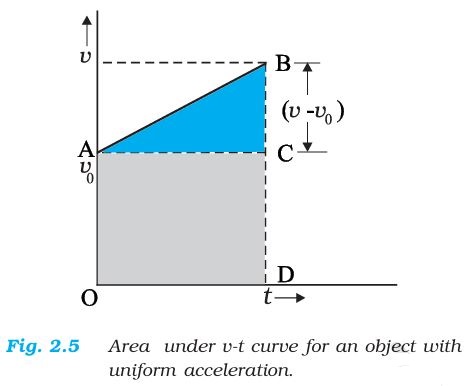
- Graph meaning: On a velocity–time graph, displacement equals the area beneath the graph. For uniform acceleration, this area is a rectangle plus a triangle.
- Displacement: .
- Average velocity: For constant acceleration only, , so .
Use these equations for motion with constant acceleration.
Choosing an equation
- Use when displacement is not needed.
- Use when final velocity is not needed.
- Use when time is not given or required.
Motion from a Non-Zero Initial Position
Initial position — If the object's position at is , its displacement from the starting point is .
The equations allow the initial position to be any coordinate .
Do not use as displacement in the general-coordinate form: displacement is . Choose a sign convention and keep it consistent.
Calculus Derivation
Deriving the equations using calculus
- Start with the definition of acceleration and integrate, taking as constant.
- Use and substitute the velocity expression before integrating from to .
- Apply the chain rule to eliminate time and integrate with respect to position.
When acceleration is not constant
- Important: The three simple kinematic equations above assume constant acceleration.
- Calculus method: The definitions and can still be used for non-uniform acceleration, with acceleration expressed as appropriate for the motion.
Vertical Throw Under Gravity
Ball thrown upward from a building
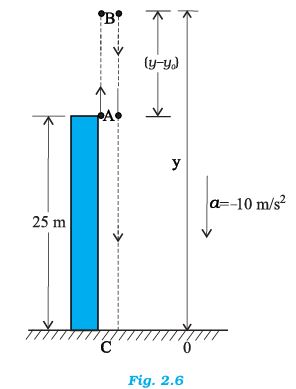
- Sign convention: Take upward as positive. Then gravity gives .
- Given: The ball starts at with ; the ground is at .
- Maximum height: At the highest point, . Using gives , so the ball reaches above ground.
- Time to rise: From , the upward journey takes .
- Time to fall: From the top, the ball falls from with initial velocity zero; gives . Total time is .
Direct calculation of total time
- One equation for the full motion: Substitute the initial and final positions into .
- Calculation: , giving roots and . The physical elapsed time is the positive root, .
- Advantage: This method uses the initial and final coordinates directly; it does not require splitting the path into upward and downward parts.
State the three kinematic equations for constant acceleration when the initial position is the origin.
Why is the acceleration negative for an upward-moving ball when upward is chosen as positive?
Quick recap
- For constant acceleration, .
- Displacement is the area under the velocity–time graph.
- For constant acceleration, and .
- The time-independent equation is .
- For a non-zero initial position, use as displacement.
- Choose a sign convention carefully; gravity is negative when upward is positive.
Example Based On Kinematic Equations
Free Fall
Free fall — Motion of an object under gravity alone, with air resistance neglected.
- Acceleration: Near Earth’s surface, gravity has magnitude .
- Uniform acceleration: For a fall through a height small compared with Earth’s radius, treat as constant.
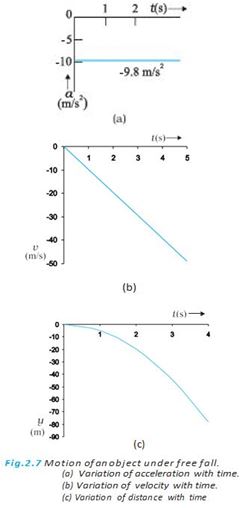
- Sign convention: Taking upward as positive makes downward acceleration negative: .
- Initial conditions: An object released from rest at has .
With upward positive, these give velocity and position against time, and velocity against position.
Galileo’s Law of Odd Numbers
Galileo’s law of odd numbers — For an object falling from rest, distances covered in successive equal time intervals are in the ratio .
Why the distances follow odd numbers
- Equal intervals: Divide the fall into intervals of duration .
- Position after intervals: .
- Distance in interval : The increase in downward distance is proportional to .
- Result: Successive distances are proportional to ; Galileo established this law for free fall.
| Time | Position | Distance in that interval |
|---|---|---|
- Unit reference: is the position coordinate after the first interval; the table expresses later positions and distances in units of .
Stopping Distance
Stopping distance — The distance a vehicle travels while decelerating from its initial speed until it stops.
Use with final velocity ; is negative for deceleration.
- Dependence on speed: For the same deceleration, ; doubling the initial speed makes stopping distance four times greater.
- Example data: Braking distances for one car make were about and at and , respectively—approximately consistent with the squared-speed relation.
- Road safety: Stopping distance is one factor used when setting speed limits, including in school zones.
Why is stopping distance proportional to the square of initial speed?
Quick recap
- Free fall neglects air resistance; near Earth’s surface its acceleration is approximately constant at .
- With upward positive, free-fall acceleration is .
- An object released from rest obeys , , and .
- Distances covered during successive equal time intervals in a fall from rest follow .
- For constant deceleration, stopping distance is .
- At the same deceleration, doubling initial speed quadruples stopping distance.
Summary And Points To Ponder
Position, displacement and speed
Motion — An object is in motion if its position changes with time.
Position and displacement
- Reference axis: Choose an origin and positive direction before assigning signs to position, displacement, velocity or acceleration.
- Position: If right is chosen as positive, positions to the right of the origin are positive and those to the left are negative.
- Displacement: The change in position is ; in one dimension its sign indicates direction.
| Quantity | Average speed | Magnitude of average velocity |
|---|---|---|
| Definition | Total path length divided by elapsed time | Magnitude of displacement divided by elapsed time |
| Comparison | Always greater than or equal to the magnitude of average velocity | Never greater than average speed |
Use the total path length over the elapsed time.
Velocity and acceleration
Instantaneous velocity — Velocity at an instant is the limit of average velocity as the time interval approaches zero.
Its sign indicates the direction of motion in one dimension.
Average acceleration — Average acceleration is the change in velocity divided by the time interval during which it occurs.
Instantaneous acceleration — Acceleration at an instant is the limit of average acceleration as the time interval approaches zero.
The instantaneous velocity and acceleration definitions are exact and valid whether or not acceleration is constant.
| Quantity | Symbol or definition | Dimension | SI unit |
|---|---|---|---|
| Path length | — | ||
| Displacement | |||
| Average velocity | |||
| Instantaneous velocity | |||
| Average and instantaneous speed | Path length/time; instantaneous speed is | ||
| Average acceleration | |||
| Instantaneous acceleration |
Motion graphs
Reading motion graphs
- Velocity–time slope: The slope at an instant gives instantaneous acceleration.
- Velocity–time area: The signed area under the curve between and equals displacement during that interval.
| Motion | – graph | – graph |
|---|---|---|
| Uniform motion | Straight line inclined to the time axis | Straight line parallel to the time axis; acceleration is zero |
| Uniform acceleration | Parabola | Straight line inclined to the time axis |
Kinematic equations for constant acceleration
Kinematic equations — These equations relate displacement, time, initial velocity, final velocity and acceleration in one-dimensional motion with constant acceleration.
Using the equations
- Symbols: is initial velocity, is final velocity, is acceleration, is elapsed time and is displacement.
- Starting position: The equations for assume the object starts at ; if it starts at , replace with .
- Signed values: Each quantity is algebraic and may be positive or negative; substitute signs according to the chosen axis.
Valid only when the magnitude and direction of acceleration remain constant throughout the motion.
Signs, acceleration and common cautions
Interpreting velocity and acceleration
- Speeding up: Acceleration is in the same direction as velocity.
- Slowing down: Acceleration is opposite to velocity; this direction relationship does not depend on the axis orientation.
- Acceleration sign: Its positive or negative sign depends on the chosen positive direction and does not by itself show whether speed is increasing or decreasing.
- Gravity example: If upward is positive, gravitational acceleration is negative. A falling object speeds up, while an object thrown upward slows down.
- Momentary rest: Zero velocity at an instant does not imply zero acceleration. At the highest point of an upward throw, velocity is zero but acceleration remains downward.
Do not decide whether an object is speeding up from the sign of acceleration alone; compare the directions of velocity and acceleration.
Can a particle have zero velocity and non-zero acceleration at the same instant?
What does the area under a velocity–time graph represent?
Quick recap
- Motion is a change in position with time, measured relative to a chosen origin and positive direction.
- Average speed is greater than or equal to the magnitude of average velocity.
- Instantaneous velocity and acceleration are exact definitions: and ; they do not require constant acceleration.
- The slope of a velocity–time graph gives acceleration, and its signed area gives displacement.
- The kinematic equations apply to one-dimensional motion only when acceleration is constant in magnitude and direction.
- Acceleration in the direction of velocity increases speed; acceleration opposite to velocity decreases speed.
Physics — ALL CHAPTERS
1
Units And Measurement
2
MOTION IN A STRAIGHT LINE
3
MOTION IN A PLANE
4
LAWS OF MOTION
5
WORK, ENERGY AND POWER
6
SYSTEMS OF PARTICLES AND ROTATIONAL MOTION
7
GRAVITATION
8
Mechanical Properties Of Solids
9
Mechanical Properties Of Fluids
10
Thermal Properties Of Matter
11
Thermodynamics
12
Kinetic Theory
13
Oscillations
14
Waves