Class 11 PCM . Physics . Physics Part II . Oscillations
Chapter 13: Oscillations
Ch 13
Physics
Class 11 PCM
Introduction
Motion and Its Examples
- Motion: Everyday motions include non-repetitive motion, such as a projectile, and repeated motion, such as a planet’s orbit.
- Examples: A cradle, swing, or clock pendulum moves to and fro; vibrating strings and drum membranes are other familiar examples.
Describing Periodic and Oscillatory Motion
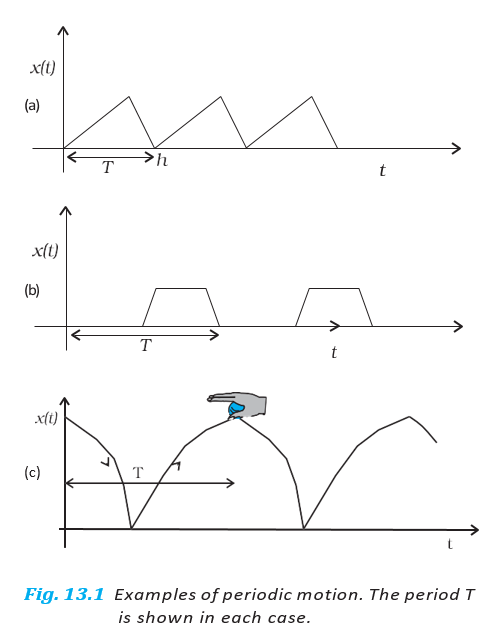
Equilibrium position — A position where the net external force on a body is zero; if left there at rest, the body remains there.
| Point | Periodic motion | Oscillatory motion |
|---|---|---|
| Defining feature | Repeats identically after a fixed time interval | Moves to and fro about a mean position |
| Relationship | May or may not be to-and-fro motion | Every oscillatory motion is periodic |
| Example | Circular motion | Pendulum motion |
Do not assume every periodic motion is oscillatory: circular motion is periodic but is not to-and-fro motion about a mean position.
| Point | Oscillations | Vibrations |
|---|---|---|
| Usual usage | Often used for lower-frequency motion, such as a tree branch moving | Often used for higher-frequency motion, such as a musical string moving |
| Physical difference | No significant difference from vibrations | No significant difference from oscillations |
Simple harmonic motion (SHM) — The simplest oscillatory motion, in which the force is proportional to displacement from the mean position and directed towards it.
Damped and Forced Oscillations
- Damped oscillations: Friction and other dissipative effects gradually reduce the motion, so an oscillating body eventually comes to rest at equilibrium.
- Forced oscillations: An external periodic agency can keep a body oscillating.
Oscillations and Waves
- Medium: A material medium can be viewed as a large collection of coupled oscillators.
- Wave formation: The collective oscillations of a medium’s constituents appear as waves.
- Examples: Water waves, seismic waves, and electromagnetic waves are examples of waves.
Quick recap
- Periodic motion repeats after a fixed interval; oscillatory motion moves to and fro about a mean position.
- Every oscillatory motion is periodic, but periodic motion such as circular motion need not be oscillatory.
- Small displacement from equilibrium can produce a restoring force and oscillations.
- In SHM, the restoring force is proportional to displacement and directed towards the mean position.
- Dissipative effects damp oscillations; an external periodic agency can sustain forced oscillations.
- The average energy of atomic vibrations in a solid is proportional to temperature; collective oscillations in a medium produce waves.
Period and Frequency
Period and Frequency
Frequency — The number of repetitions of a periodic motion per unit time; it is the reciprocal of the period.
Frequency is represented by ; it need not be an integer.
Frequency units and example
- Unit: Frequency has unit , called hertz (). Thus, oscillation per second .
- Heart-beat example: At 75 beats per minute, , so .
Displacement in Oscillatory Motion
Displacement — In oscillations, displacement is any physical quantity that changes with time, not only a change in position.
Displacement variables
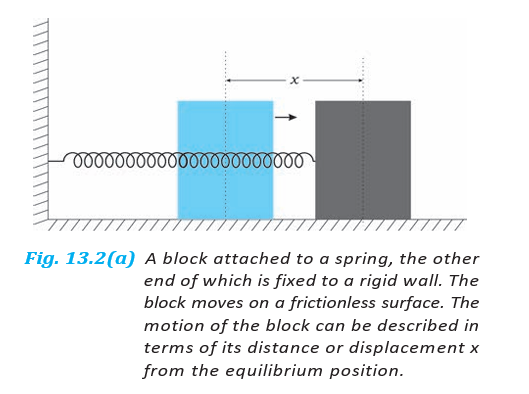
- Position: For a ball moving along a line, its distance from a chosen starting point can be the displacement; the origin is chosen for convenience.
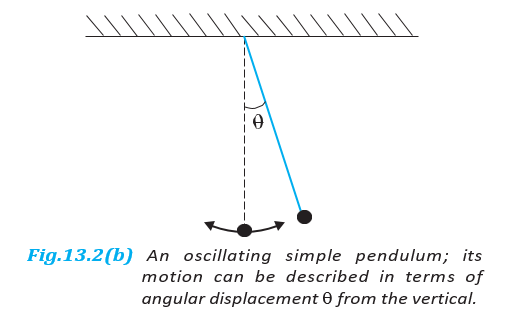
- Oscillators: For a spring-block system, displacement is usually measured from equilibrium; for a pendulum, angular displacement may be measured from the vertical.
- Other examples: Voltage across a capacitor, pressure variations in sound, and changing electric and magnetic fields in light can all act as displacement variables.
- Sign and measurement: A displacement variable can be positive or negative and is recorded as a function of time.
Periodic Functions
Sine and cosine descriptions
- Periodic function: A time-dependent function is periodic if its values repeat after a fixed interval: .
- Cosine example: repeats when its argument increases by ; its period is .
- Same period: has the same period, as does a linear combination .
Here, is the angular frequency.
Fourier result
- Fourier’s result: Any periodic function can be expressed as a superposition of sine and cosine functions with suitable coefficients and different periods.
| Function | Classification | Period or reason |
|---|---|---|
| Periodic | Period ; equivalently . | |
| Periodic | Period ; the component periods are , , and . | |
| Non-periodic | Decreases continuously toward zero and does not repeat. | |
| Non-periodic | Increases continuously and diverges as ; it cannot describe a physical displacement. |
A heart beats 75 times per minute. Find its frequency and period.
Quick recap
- Period is the smallest time for one complete repetition; its SI unit is the second.
- Frequency counts repetitions per unit time: and its unit is hertz.
- In oscillations, displacement can describe any time-varying physical quantity, not just position.
- Sinusoidal functions repeat with period .
- Sums of periodic components repeat when they share a common repeating interval; continuously changing monotonic functions are non-periodic.
- Any periodic function can be represented as a suitable superposition of sine and cosine functions.
Simple Harmonic Motion
Definition and displacement
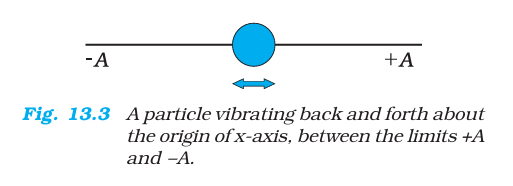
Quantities that describe SHM
| Parameter changed | Effect |
|---|---|
| Amplitude | Changes the maximum displacement. |
| Phase constant | For fixed and , changes the initial phase and starting state. |
| Angular frequency | Changes the period and frequency of oscillation. |
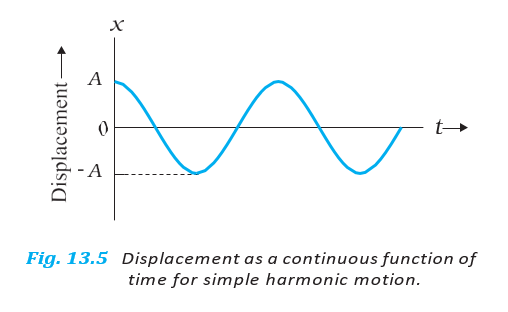
Period and angular frequency
Angular frequency is times the oscillation frequency.
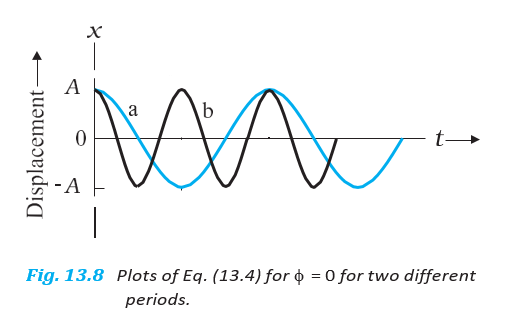
Identifying SHM from a time function
Do not classify every periodic function as SHM. Check that displacement relative to its equilibrium position is a single sinusoidal function of time.
How are the period and angular frequency of SHM related?
Quick recap
- SHM displacement can be written as .
- Amplitude is the maximum displacement; phase is , and phase constant is the phase at .
- In the stated coordinate system, displacement ranges from to .
- Angular frequency, period and frequency satisfy .
- A periodic motion is SHM when displacement from equilibrium is sinusoidal.
- has period and oscillates about .
Simple Harmonic Motion And Uniform Circular Motion
How Uniform Circular Motion Produces SHM
Projection of uniform circular motion — The projection of a particle moving uniformly on a circle onto any diameter executes simple harmonic motion (SHM).
Motion and its projection
- Reference particle: A particle moves anticlockwise at constant angular speed on a reference circle of radius .
- Phase angle: If its initial angular position is , its angle after time is .
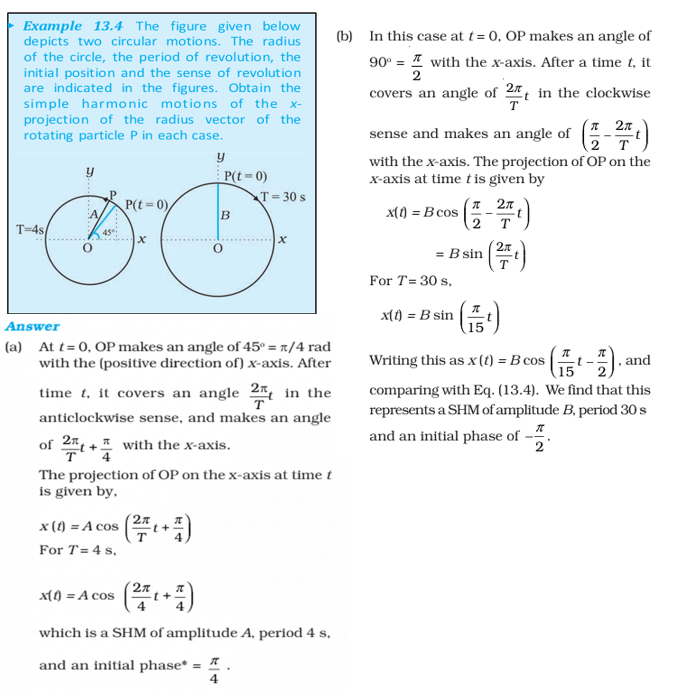
- Projection: The particle’s position along a diameter varies to and fro between and ; hence the projection’s amplitude is .
- SHM equation: The projection along the -axis follows the defining displacement equation for SHM.
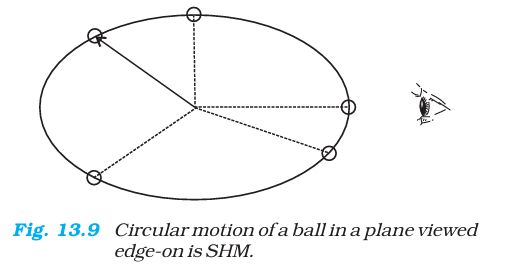
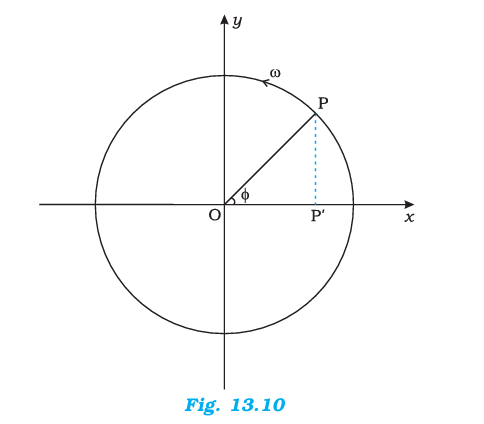
Projections on Different Diameters
Important distinction
- Kinematic connection: SHM can be represented as a projection of uniform circular motion.
- Force distinction: The force producing linear SHM is different from the centripetal force required for uniform circular motion; the connection does not mean the forces are identical.
Angles in Trigonometric Equations
Radian — A radian is the angle subtended at the centre by an arc whose length equals the circle’s radius; angle is dimensionless.
Using angle values
- Default convention: An angle used as a numerical trigonometric argument without a stated unit is understood to be in radians.
- Degrees: State the degree symbol explicitly when using degrees; for example, is not the same as , which means 15 radians.
- Radian notation: The label “rad” is often omitted for numerical angles, including multiples or submultiples of .
How does uniform circular motion produce SHM?
Quick recap
- The projection of uniform circular motion on a diameter executes SHM.
- For circle radius , angular speed and initial phase , .
- The projection on the perpendicular -axis is ; its amplitude is also .
- The - and -projections differ in phase by .
- The SHM force and circular-motion centripetal force are different; the connection is about motion and projection.
- An unstated numerical angle in a trigonometric argument is in radians; degrees must be marked explicitly.
Velocity and Acceleration in Simple Harmonic Motion
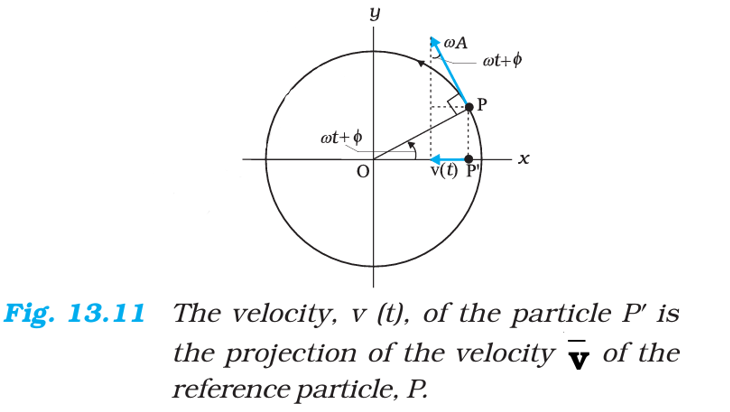
Velocity in Simple Harmonic Motion
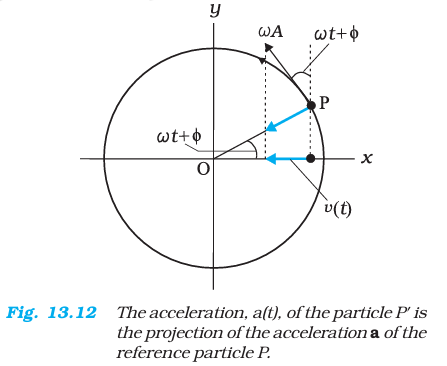
Acceleration in Simple Harmonic Motion
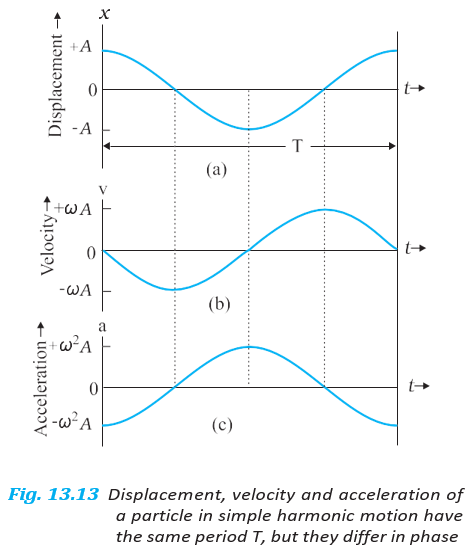
Time Variation and Phase Relationships
Worked example
- Angular frequency and period: and .
- Displacement: .
- Velocity and speed: , so the speed is .
- Acceleration: .
Force Law for Simple Harmonic Motion
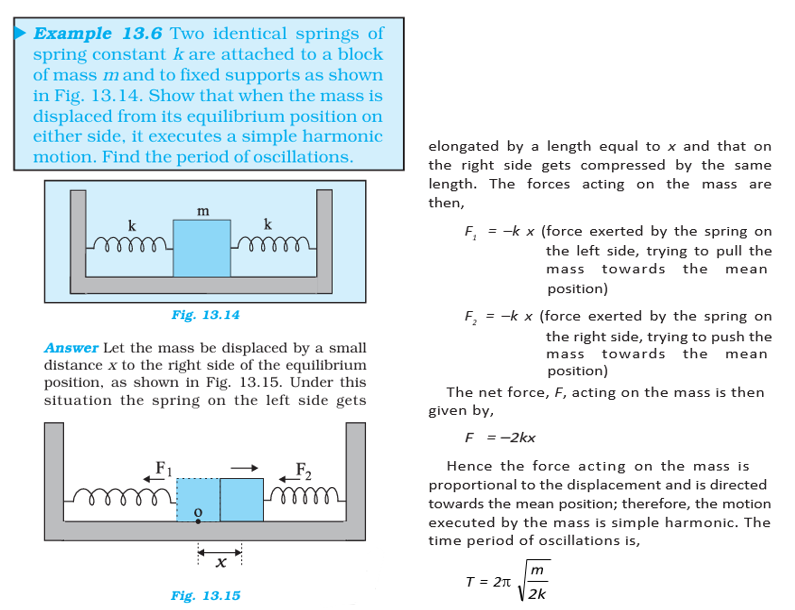
Do not confuse velocity with speed: velocity can be negative according to direction, while speed is the non-negative magnitude of velocity.
Why is the force in SHM called a restoring force?
Quick recap
- Velocity is , with maximum magnitude .
- Acceleration is , so it always points towards the mean position.
- Displacement, velocity and acceleration are sinusoidal and share the same period.
- Velocity differs in phase from displacement by ; acceleration is opposite in phase to displacement.
- The SHM force law is , where and .
- A force proportional to displacement gives a linear harmonic oscillator; additional higher-power terms make the oscillator non-linear.
Energy in Simple Harmonic Motion
Kinetic and Potential Energy in SHM
For displacement .
Potential energy in SHM — The spring's conservative restoring force stores potential energy that depends on the square of displacement from equilibrium.
- Conservative force: The spring force is conservative, so it has an associated potential energy.
- Position: With potential energy chosen as zero at equilibrium, it is zero at the mean position and maximum at the extreme displacements.
- Period: Potential energy also repeats twice per oscillation, so its period is .
- Energy exchange: Between the mean and extreme positions, kinetic and potential energy continually convert into one another.
- Sign: Kinetic energy is never negative because it is proportional to . Spring potential energy is non-negative with the usual zero chosen at equilibrium.
For displacement .
Total mechanical energy — In ideal SHM, the sum of kinetic and potential energy remains constant throughout the motion.
Using , total mechanical energy is independent of time.
| Position | Kinetic energy | Potential energy |
|---|---|---|
| Mean position, | Maximum: | Zero |
| Extreme positions, | Zero | Maximum: |
| Between the limits | Increases as potential energy decreases, and vice versa | Increases as kinetic energy decreases, and vice versa |
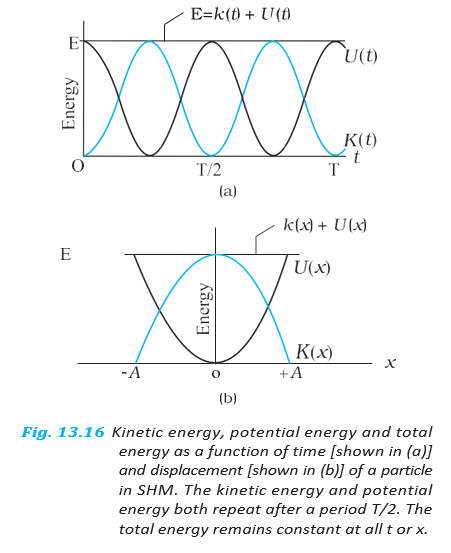
Spring oscillator example
- Given: , , amplitude ; find the energies at .
- Angular frequency: ; the speed magnitude is .
- Kinetic energy: .
- Potential energy: .
- Total energy: , matching .
The Simple Pendulum
Simple pendulum — An ideal simple pendulum is a small bob of mass attached to a massless, inextensible string of length , fixed at one end.
- Motion: The bob moves along a circular arc about the support; its angular displacement from the vertical is , with equilibrium at .
- Forces: Tension acts along the string, while gravity acts vertically downward.
- Gravity components: The radial component is ; the tangential component provides the restoring effect.
- Acceleration: The net radial force provides radial acceleration; the tangential component of gravity causes angular acceleration.
- Restoring torque: Only the tangential component produces torque about the support; the tension and radial component give zero torque.
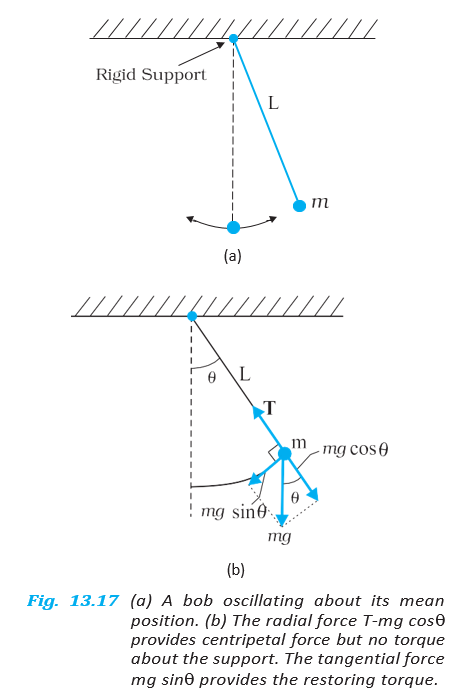
The negative sign indicates that the torque and angular acceleration act to reduce the angular displacement.
Small-angle approximation — For a small angle measured in radians, , so the pendulum's angular acceleration is proportional to and opposite its displacement.
This has the SHM form ; therefore, small oscillations of a simple pendulum are simple harmonic.
| (degrees) | (radians) | |
|---|---|---|
- Moment of inertia: For a massless string and a bob treated as a point mass, .
This result applies to small oscillations and is independent of the bob's mass.
Do not apply the simple-pendulum SHM period formula to large angular displacements: its derivation requires with in radians.
Pendulum example: seconds pendulum
- Meaning: A pendulum that ticks seconds has a period of .
- Length: Rearranging the period formula gives . For and , .
Show that the total mechanical energy of a spring oscillator is constant.
Derive the time period of a simple pendulum for small oscillations.
Quick recap
- For a spring oscillator, and .
- Kinetic and potential energies each have period ; total energy stays constant at .
- At the mean position, energy is all kinetic; at the extremes, it is all potential.
- A pendulum's tangential gravitational force produces the restoring torque .
- For small angles in radians, , making pendulum motion SHM.
- A simple pendulum's small-oscillation period is ; a seconds pendulum has length about .
Summary
Periodic Motion and Its Measures
Periodic motion — Motion that repeats itself after equal intervals of time is periodic.
Period and frequency
- Period (): The least time for one complete cycle; motion repeats after , where is an integer.
- Frequency ( or ): Number of oscillations per unit time; the SI unit is hertz, with .
Use either relation to find the period or frequency.
| Quantity | Symbol | Dimension | SI unit / note |
|---|---|---|---|
| Period | ; least time for repetition | ||
| Frequency | or | ; | |
| Angular frequency | ; | ||
| Phase constant | Dimensionless | Radian; initial phase | |
| Force constant | ; in |
Simple Harmonic Motion
Simple harmonic motion (SHM) — Oscillatory motion in which the restoring force is proportional to displacement and directed towards equilibrium.
Connects period, frequency and angular frequency.
SHM properties
- Circular-motion model: SHM is the projection of uniform circular motion onto a diameter.
- Velocity: ; its amplitude is .
- Acceleration: ; its amplitude is .
| Point | Periodic motion | SHM |
|---|---|---|
| Defining condition | Repeats after a fixed time interval. | Restoring force follows . |
| Relationship | Not every periodic motion is SHM. | SHM is periodic. |
Energy and Oscillator Systems
For a mass attached to a spring of force constant , total mechanical energy remains constant when friction is absent, although kinetic and potential energy vary.
A mass under Hooke's-law restoring force executes SHM; this system is called a linear oscillator.
For small angular displacements, a simple pendulum's motion is approximately SHM.
Further Properties and Conditions
Circular motion and SHM
- Different causes: Circular motion can result from an inverse-square force, as in planetary motion, or from a two-dimensional SHM force .
- Circular path from SHM: The two perpendicular oscillations must differ in phase by ; with initial position and velocity , the particle moves in a circle of radius .
Determining the motion
- Initial conditions: For a given , two independent initial conditions determine linear SHM completely.
- Possible pairs: Initial position and velocity; amplitude and phase; or energy and phase.
- Phase: Once amplitude or energy is specified, the initial position or velocity determines the phase.
Combining oscillations
- Two SHMs: A combination of two SHMs with arbitrary amplitudes and phases is not necessarily periodic.
- Necessary condition: For the combination to be periodic, the lecture states that one frequency must be an integral multiple of the other; this is given as a necessary condition, not a sufficient one.
- Periodic motion: Any periodic motion can be expressed as a sum of infinitely many harmonic motions with suitable amplitudes.
Period and amplitude
- SHM period: For a given oscillator, the period does not depend on amplitude, energy or phase constant.
- Contrast: Planetary orbital periods under gravitation depend on orbital properties, as described by Kepler's third law.
These are equivalent ways to write SHM; the constants are chosen to represent the same motion.
Damped motion
- Strictly: Damped SHM is not strictly simple harmonic because damping changes the motion.
- Approximation: It can be treated as approximately SHM over intervals much shorter than , where is the damping constant.
State the condition for a motion to be SHM.
What two initial conditions can determine linear SHM?
Quick recap
- Periodic motion repeats; and .
- In SHM, and the restoring force is proportional to, and opposite to, displacement.
- SHM has velocity amplitude and acceleration amplitude ; .
- Without friction, total mechanical energy stays constant as kinetic and potential energy exchange.
- A spring oscillator has ; a small-angle pendulum has .
- Two initial conditions determine linear SHM; its period is independent of amplitude, energy and phase.
Physics — ALL CHAPTERS
1
Units And Measurement
2
MOTION IN A STRAIGHT LINE
3
MOTION IN A PLANE
4
LAWS OF MOTION
5
WORK, ENERGY AND POWER
6
SYSTEMS OF PARTICLES AND ROTATIONAL MOTION
7
GRAVITATION
8
Mechanical Properties Of Solids
9
Mechanical Properties Of Fluids
10
Thermal Properties Of Matter
11
Thermodynamics
12
Kinetic Theory
13
Oscillations
14
Waves