Class 11 PCM . Physics . Physics Part I . Work Energy and Power
Chapter 5: WORK, ENERGY AND POWER
Ch 5
Physics
Class 11 PCM
Introduction
Energy — Energy is the capacity to do work.
Physical meanings
- Work: Everyday language calls many activities work; physics gives work a precise definition.
- Energy: In physics, energy is related to the capacity to do work.
- Power: Everyday uses such as a powerful punch loosely suggest speed; physical power has a precise meaning.
- Chapter focus: The chapter develops the physical meanings of work, energy and power; the scalar product is a mathematical prerequisite.
Scalar Product
Multiplication of vectors
- Two products: The scalar product gives a scalar; the vector product gives a vector.
- Scope: This lecture introduces the scalar product; the vector product is studied later.
Scalar product (dot product) — The scalar product of two vectors is the product of their magnitudes and the cosine of the angle between them; its result is a scalar.
Here, is the angle between the vectors. The result has magnitude only, not direction.
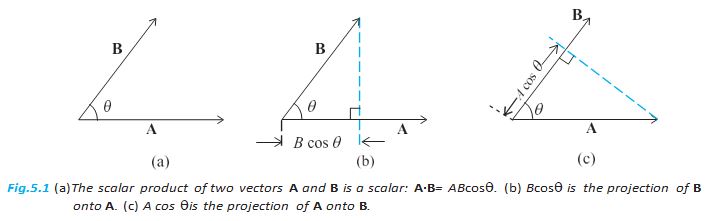
Projection meaning
- Projection form: .
- Interpretation: The dot product is one vector’s magnitude multiplied by the component of the other vector along it.
The scalar product is commutative and distributive; a real scalar factor can be taken outside.
The unit vectors are mutually perpendicular.
For vectors expressed in Cartesian components, multiply corresponding components and add.
Useful results
- Self-product: .
- Perpendicular vectors: If , then .
Example: angle and projection
- Given: and .
- Dot product: .
- Magnitudes: and ; hence and .
- Projection of along : The scalar component is .
Do not treat the dot product as a vector: its result is a scalar, even though both inputs are vectors.
Quick recap
- Energy is the capacity to do work; physics defines work and power precisely.
- The scalar product gives a scalar, while the vector product gives a vector.
- The scalar product is and can be interpreted using vector projections.
- The dot product is commutative, distributive and linear with respect to a scalar factor.
- In components, multiply matching components and add; perpendicular vectors have zero dot product.
- The self-product gives the square of a vector’s magnitude: .
Notions Of Work And Kinetic Energy: The Work-Energy Theorem
Kinetic Energy and the Work–Energy Theorem
From motion to work and energy
- Constant acceleration: For motion along a straight line, , where and are initial and final speeds.
- Multiply by mass: The relation becomes .
- Three dimensions: Using vectors gives , and hence .
- Kinetic energy: The energy of motion is .
Work–energy theorem — The change in a particle’s kinetic energy equals the work done on it by the net force: .
Raindrop example
- Given: A drop falls from rest and reaches ; take .
- Kinetic-energy change: .
- Gravity’s work: .
- Resistive force: , so ; its work is negative because it opposes the fall.
Work
Work — Work is the product of displacement and the component of force along that displacement.
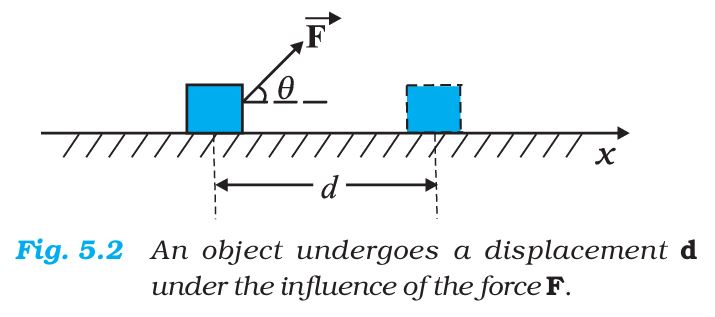
Use the component of force parallel to displacement; equivalently, take the dot product.
When work is zero
- Zero displacement: A person pushing a rigid wall does no work on it; a weightlifter holding a load stationary also does no work on the load.
- Zero force: A block may move on a smooth horizontal table while no horizontal force acts on it.
- Perpendicular force and displacement: If , then ; gravity does no work on a block moving horizontally.
- Circular orbit: For a perfectly circular Moon orbit, gravity is radial while the instantaneous displacement is tangential, so their work is zero.
| Angle between force and displacement | Work | Example |
|---|---|---|
| Positive | Force has a component along the displacement. | |
| Zero | Force is perpendicular to displacement. | |
| Negative | Friction opposing motion; at , . |
Units of work and energy
- Dimensions: Work and energy share dimensions .
- SI unit: The joule () is the SI unit of both work and energy.
| Unit | Equivalent in joules |
|---|---|
| erg | |
| electron volt () | |
| calorie () | |
| kilowatt hour () |
Cyclist and road example
- Work on the cycle: A stopping force acts opposite to the motion over : .
- Work on the road: The cycle exerts an equal and opposite force on the road, but the road has no displacement; work on the road is zero.
- Key distinction: Newton’s third-law forces are equal and opposite, but the work done on each interacting body need not be equal and opposite.
State the work–energy theorem.
Give three conditions under which a force does no work.
Quick recap
- Kinetic energy is .
- The net work done equals the change in kinetic energy: .
- For a constant force, .
- Work is zero for zero displacement, zero force, or perpendicular force and displacement.
- Work is positive when force aids displacement and negative when it opposes displacement.
- Work and energy have dimensions and SI unit joule.
Kinetic Energy
Kinetic Energy
- Kinetic energy: The energy an object possesses by virtue of its motion is .
- Scalar quantity: Kinetic energy depends on an object’s mass and speed, and is always non-negative.
- Work connection: Kinetic energy measures the work an object can do because of its motion.
Work Done by a Variable Force
For small displacement intervals, add the work contributions across the path.
The integral is the limiting sum of force contributions as .
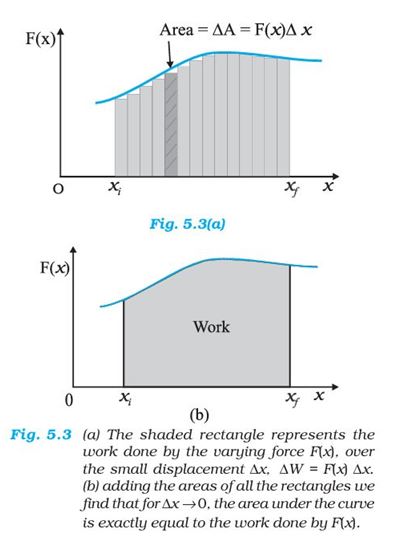
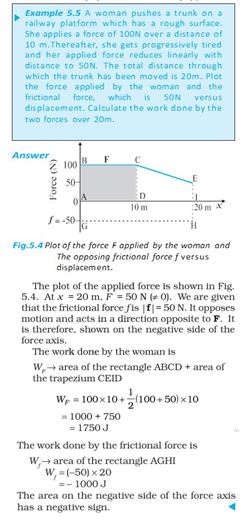
For a force–displacement graph, identify the interval first; the work over that interval is the area under the curve.
Quick recap
- Kinetic energy is a scalar measure of the work an object can do due to its motion.
- For mass and speed , kinetic energy is .
- Because kinetic energy depends on speed squared, a given fraction of kinetic energy is not the same fraction of speed.
- For a variable force, small work contributions are approximately .
- Exact work from to is , the area under the force–displacement curve.
The Work-Energy Theorem For A Variable Force
Work-Energy Theorem for a Variable Force
Work-energy theorem — The work done by a force equals the change in the object's kinetic energy.
Derivation in one dimension
- Start with kinetic energy: ; Newton’s second law gives .
- Relate force and displacement: Differentiating and using gives .
- Integrate: Integrate from the initial to final position to account for a force that varies with position.
The integral is the work done by the variable force over the displacement.
Limits of the theorem
- Interval information: It gives the net change over an interval; it does not provide force and acceleration at each instant as Newton’s second law does.
- Scalar information: Work and kinetic energy are scalars, so the theorem does not preserve the directional information contained in Newton’s second law.
Example: Retarding force varying with position
- Given: A block enters a rough section from to at . Within the section, with ; outside it, .
- Initial kinetic energy: .
- Final kinetic energy: .
- Final speed: Using , the block exits at .
Here, is the natural logarithm: .
The Concept of Potential Energy
Potential energy — Energy stored in a body because of its position or configuration, which can be released and converted into kinetic energy.
When potential energy applies
- Applicable forces: Potential energy applies to forces for which work against the force can be stored and later released.
- Examples: A stretched bowstring stores energy; compressed fault lines in Earth's crust can release stored energy during an earthquake.
- Conservative force: Its work depends only on the initial and final positions, not on the path taken.
In one dimension, force is the negative derivative of potential energy with respect to position.
The work done by a conservative force is the negative of the change in potential energy.
Gravitational Potential Energy Near Earth's Surface
Gravitational potential energy
- Assumption: Near Earth's surface, treat as constant when the height is much smaller than Earth's radius .
- Reference level: Taking the ground as zero potential energy, raising a mass to height stores the work done against gravity.
- Direction: With upward positive, gravity acts downward and is the negative derivative of gravitational potential energy.
For height measured from the chosen zero level, gravitational potential energy is .
Conversion of gravitational potential energy
- A ball raised to height has gravitational potential energy .
- When released, it falls and gains kinetic energy.
- Just before reaching the ground, , so .
| Point | Conservative force | Non-conservative force |
|---|---|---|
| Work | Depends only on initial and final positions. | Depends on the path taken. |
| Example or implication | Gravity: an object released from rest at height reaches speed on any smooth, frictionless incline. | If work depends on the path or other factors, the force is non-conservative. |
Unit and dimensions
- Unit: Potential energy is measured in joules (), the same unit as work and kinetic energy.
- Dimensions: .
State the work-energy theorem for a variable force.
How are potential-energy change and work by a conservative force related?
Quick recap
- For a variable force, .
- The theorem gives interval-wide scalar information, unlike Newton's second law's instantaneous, directional information.
- Potential energy is stored energy associated with position or configuration.
- In one dimension, and conservative-force work is .
- Near Earth's surface, gravitational potential energy is when is constant.
- A body released from rest at height converts into kinetic energy, reaching .
- Potential energy and work share the joule unit and dimensions .
The Conservation Of Mechanical Energy
Mechanical Energy Conservation
How Kinetic and Potential Energy Change
- Work–energy theorem: For a displacement under force , the change in kinetic energy is .
- Conservative force: Its work is balanced by the change in potential energy: .
- Energy balance: Therefore, , so .
- Mechanical energy: The total remains constant, although and can each change during motion.
For motion between initial and final positions, when only conservative forces do work.
Conservative Forces
Conservative force — A force is conservative if its work can be described by a potential-energy function, with .
| Test | Meaning |
|---|---|
| Potential-energy function | The force can be derived from a scalar potential-energy function . |
| Path independence | Work depends only on the initial and final positions: . |
| Closed path | Work over a closed path is zero because the initial and final positions are the same. |
- Mechanical energy is conserved when the forces doing work on the system are conservative.
- A conservative force does zero net work over a complete closed path.
Falling Ball: Gravitational Potential Energy Converts to Kinetic Energy
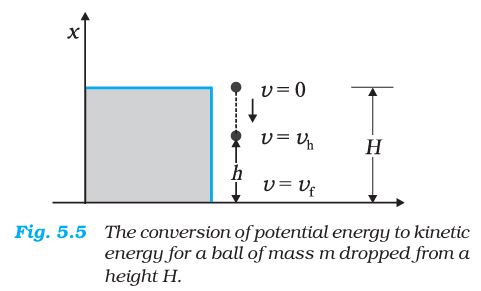
Energy at Different Heights
- At height : The ball starts from rest, so its energy is purely gravitational potential energy: .
- At height : Energy is partly potential and partly kinetic: .
- At ground level: Taking ground as zero potential energy, the energy is fully kinetic: .
- Constant gravity: Gravitational force is conservative, so total mechanical energy is the same at all heights.
For a ball dropped from rest at height , is its speed at ground level and its speed at height .
Energy Conversion as the Ball Falls
- At height : energy is all potential, .
- As the ball descends: potential energy decreases while kinetic energy increases.
- At ground level: energy is all kinetic, .
- Throughout the fall: stays constant.
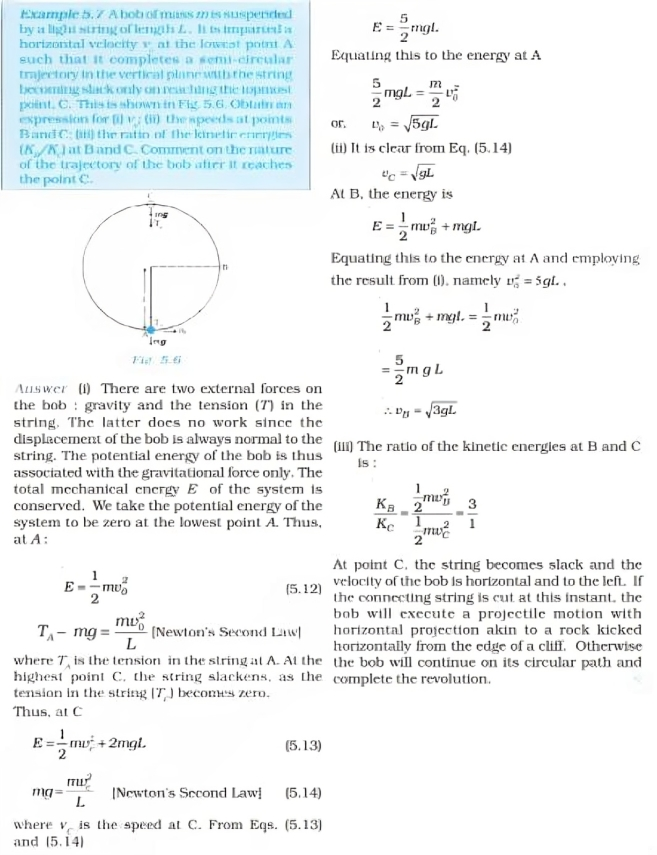
State the principle of conservation of mechanical energy.
A ball is dropped from rest at height . Find its speed at height above the ground.
Quick recap
- For conservative-force work, kinetic and potential energy change by equal and opposite amounts.
- The total mechanical energy remains constant when the forces doing work are conservative.
- A conservative force has path-independent work and does zero work over a closed path.
- During a fall, gravitational potential energy converts into kinetic energy.
- From rest at height , the speed at ground level is .
- At height , the falling ball has .
The Potential Energy Of A Spring
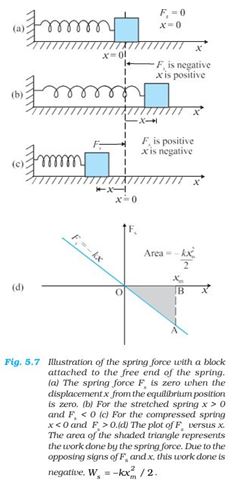
Hooke’s Law and Spring Force
The minus sign shows that the spring force points toward equilibrium.
Work Done by a Spring
The work is zero over a complete return to the starting position.
For extension or compression of magnitude , spring work is negative.
Potential Energy of a Spring
Valid for both extension and compression, with the zero of energy at .
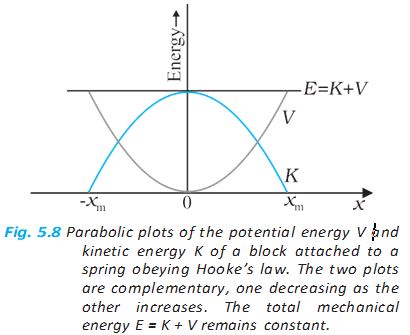
Energy in Spring Motion
For amplitude , this relation holds at every position between and .
The maximum speed occurs at equilibrium; has dimensions .
Spring Compression Example
The lecture’s printed answer of does not match its stated values; substituting them into the energy equation gives approximately .
Conservative Forces and Energy Reference
Why is the spring force conservative?
Where are the speed and kinetic energy maximum during spring motion?
Quick recap
- Hooke’s law is ; the spring force points opposite displacement.
- Spring work depends only on endpoints and is zero over a complete return path.
- With zero potential energy at equilibrium, .
- Without non-conservative work, spring potential and kinetic energy exchange while total mechanical energy stays constant.
- Speed is maximum at equilibrium and equals .
- The zero of potential energy is arbitrary but must be used consistently.
Power
Power: Definition and Measurement
Here, is work and is elapsed time.
Units of power
- SI unit: The watt (), where .
- Horsepower: A unit used to describe the output of vehicles and engines; .
Electrical Energy and Power
The kilowatt-hour
- Meaning: A kilowatt-hour () is a unit of energy, not power.
- Example: A bulb operating for uses of energy.
- Conversion: .
- Bills: Electricity consumption is commonly recorded in units of .
Minimum motor power for an elevator
- Given: An elevator of total mass rises at constant speed ; friction opposes it with .
- Resisting force: Taking , the motor balances .
- Power: .
Collisions
Collision setup
- Collision: A brief interaction between bodies that changes their momenta through impulsive forces.
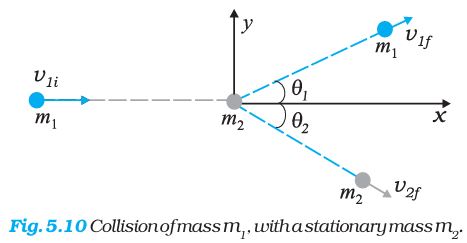
- Standard model: A mass moving with initial velocity strikes a stationary mass ; after impact, the bodies may move in different directions.
- Conservation laws: Linear momentum is conserved in collisions; kinetic energy is conserved only in elastic collisions.
Momentum Conservation and Collision Types
Why momentum is conserved
- Impulses: During a collision lasting , the two bodies exert equal and opposite forces on each other.
- Newton’s third law: The impulses, and therefore the momentum changes, are equal and opposite—even if the forces vary during the collision.
- Result: The total momentum change of the two-body system is zero, so initial total momentum equals final total momentum.
Here, is the force on body 1 from body 2, and is the force on body 2 from body 1.
| Type | Kinetic energy | What happens after collision |
|---|---|---|
| Elastic | Initial and final total kinetic energies are equal; kinetic energy may change during impact. | The deformation is fully relieved without energy loss. |
| Inelastic | Some initial kinetic energy changes into other forms, such as heat or sound. | Deformation is only partly relieved; this is the common intermediate case. |
| Completely inelastic | Kinetic energy is not conserved. | The bodies move together after collision. |
Do not confuse: Momentum is conserved in all collisions (for an isolated system), but kinetic energy is conserved only in elastic collisions.
Define instantaneous power and state its expression for a force.
Why is momentum conserved in a two-body collision?
What distinguishes a completely inelastic collision?
Quick recap
- Power is the rate of work or energy transfer; and .
- Power is a scalar with dimensions ; and .
- ; a kilowatt-hour measures energy, not power.
- In collisions, equal and opposite impulses conserve total momentum.
- Kinetic energy is conserved in elastic collisions; bodies stick together in a completely inelastic collision.
Collisions in One Dimension
Completely Inelastic Collision in One Dimension
Completely inelastic collision — A collision in which the bodies stick together and move with a common final velocity.
- Setup: A body of mass moves at speed and collides with a stationary body of mass .
- Momentum: The joined bodies move at speed ; linear momentum is conserved.
- Kinetic energy: It decreases in a completely inelastic collision; the lost amount is positive.
For a stationary second body before impact.
The difference between initial and final kinetic energies.
Elastic Collision in One Dimension
- Conservation laws: Both linear momentum and kinetic energy are conserved.
- Initial condition: Mass has initial velocity ; mass is initially at rest.
- Final velocities: and are signed velocities along the same line.
For a one-dimensional elastic collision with the second body initially at rest.
- For this setup, the conservation equations also give .
- Use signed velocities: a negative final velocity means the body reverses direction.
The velocities after the collision in terms of the masses and the initial velocity.
| Mass condition | Final velocities | Result |
|---|---|---|
| The first mass stops and the second moves off with its initial speed. | ||
| The heavier mass is nearly undisturbed; the lighter mass rebounds. |
Energy Transfer in Neutron Collisions
Moderator — A material containing light nuclei that slow neutrons through collisions; heavy water () and graphite are examples.
- Purpose: In a nuclear reactor, fast neutrons (typically ) are slowed to about to increase their chance of causing to fission.
- Transfer: In an elastic collision, energy not retained by the neutron is transferred to the moderating nucleus.
- Practical note: Actual energy transfer is often smaller than the head-on estimate because head-on collisions are rare.
is the fraction of the neutron's initial kinetic energy retained; is the fraction transferred to the nucleus.
| Target nucleus | Mass relation | Neutron energy retained | Energy transferred |
|---|---|---|---|
| Deuterium | (about ) | ||
| Carbon | A few times the neutron mass |
One-Dimensional and Two-Dimensional Collisions
One-dimensional (head-on) collision — A collision in which the initial and final velocities of both bodies lie along the same straight line.
- Spherical bodies: A head-on collision with a stationary target occurs when the moving body's path passes through the target's centre.
- Two-dimensional collision: Initial and final velocities lie in a plane; momentum must be conserved as a vector.
Collisions in Two Dimensions
- Plane of motion: Choose the plane containing both final velocity directions as the -plane. Conservation of the -component shows the collision remains in this plane.
- Momentum components: Resolve momentum along the - and -axes to obtain two equations.
Mass initially moves along ; mass is initially at rest. The final directions make angles and with the initial direction.
Solving a Two-Dimensional Collision
- Unknowns: Given , and , there are four unknowns: , , and .
- Inelastic case: The two momentum-component equations alone are insufficient to determine all four unknowns.
- Elastic case: Conservation of kinetic energy adds one equation, but one more condition is still needed; for example, one final angle must be known.
- One-dimensional limit: Setting recovers the one-dimensional momentum equation.
This provides the additional equation for a two-dimensional elastic collision.
Equal-Mass Glancing Collision
- Setup: Two equal-mass billiard balls collide elastically; the target is initially at rest.
- Result: The balls move at right angles after a glancing collision.
- Example: If the target ball moves at , then the cue ball's angle is , since .
Contact Collisions and Scattering
| Point | Contact collision | Scattering |
|---|---|---|
| Interaction | Bodies interact when they touch; smooth spheres are a useful model for marbles, carrom and billiards. | Bodies interact through forces acting at a distance; they need not touch. |
| Examples | Two colliding balls. | A comet passing the Sun or an alpha particle approaching and departing from a nucleus. |
| What determines outgoing motion? | Conservation laws and the collision conditions. | Initial velocities, interaction type, masses, shapes and sizes. |
State the final velocities for a one-dimensional elastic collision when the second body is initially at rest.
What is the relation between the final directions of two equal masses in a glancing elastic collision when one was initially at rest?
Quick recap
- A completely inelastic collision conserves momentum, but kinetic energy decreases.
- In a one-dimensional elastic collision, both momentum and kinetic energy are conserved.
- For equal masses in a one-dimensional elastic collision, the first body stops and the second takes its speed.
- A light nucleus can absorb a substantial fraction of a neutron's kinetic energy; this is the basis of moderation.
- Two-dimensional collisions require separate momentum equations for each direction; elastic collisions also conserve kinetic energy.
- In an equal-mass glancing elastic collision with one body initially at rest, the final velocities are perpendicular.
- Scattering involves interactions at a distance, unlike ordinary contact collisions.
Summary And Points To Ponder
Work–Energy Theorem
Use this relation to connect net work with the change in kinetic energy.
Conservative Forces and Potential Energy
The force is the negative spatial rate of change of potential energy; its work equals the decrease in potential energy.
Mechanical Energy
For a spring, the extension is measured from its equilibrium position.
Scalar or Dot Product
Here, is the angle between the vectors.
The three Cartesian unit vectors are mutually perpendicular and each has unit magnitude.
Dimensions and SI Units
- Work and energy: Both have dimensions and SI unit joule (J).
- Power: Its dimensions are , and its SI unit is watt (W), equal to .
- Other units: , while ; kWh is a unit of energy.
Points to Ponder
State the work–energy theorem and the condition for conservation of mechanical energy.
Why can friction not be assigned a potential energy?
Quick recap
- Net work changes kinetic energy: .
- A conservative force has path-independent work and zero work around a closed path.
- Mechanical energy is conserved when only conservative forces act.
- Gravitational and spring potential energies are and .
- The dot product is and is a scalar.
- Work may be positive or negative; friction does negative work on a moving body.
- Potential-energy zero is chosen by convention; friction has no associated potential energy.
Physics — ALL CHAPTERS
1
Units And Measurement
2
MOTION IN A STRAIGHT LINE
3
MOTION IN A PLANE
4
LAWS OF MOTION
5
WORK, ENERGY AND POWER
6
SYSTEMS OF PARTICLES AND ROTATIONAL MOTION
7
GRAVITATION
8
Mechanical Properties Of Solids
9
Mechanical Properties Of Fluids
10
Thermal Properties Of Matter
11
Thermodynamics
12
Kinetic Theory
13
Oscillations
14
Waves