Class 11 PCM . Physics . Physics Part II . Waves
Chapter 14: Waves
Ch 14
Physics
Class 11 PCM
Introduction
What Is a Wave?
Wave — A wave is a disturbance that propagates without the overall physical transfer or flow of matter.
What waves carry
- Energy and information travel from one place to another with the wave.
- Matter does not travel along with the wave as a whole; particles of a medium typically oscillate near their equilibrium positions.
- Examples: water-surface disturbances move outward while cork pieces bob up and down; sound travels through air without air flowing outward from the speaker.
Waves and communication
- Signals: communication depends on waves carrying information from a source to a detector.
- Example: speech produces sound waves and hearing detects them. A signal may be converted from sound to an electrical signal, then to an electromagnetic wave, and converted back at the receiver.
Main Types of Waves
| Type | Medium required? | Examples / key feature |
|---|---|---|
| Mechanical | Yes; cannot travel through vacuum | Waves on strings, water waves, sound and seismic waves; involve particle oscillations and depend on the medium's elastic properties. |
| Electromagnetic | No; can travel through vacuum | Light, radio waves and X-rays. All have the same speed in vacuum. |
| Matter | Associated with particles of matter | Associated with electrons, protons, neutrons, atoms and molecules; arise in quantum-mechanical descriptions of nature. Electron matter waves are used in electron microscopes. |
All electromagnetic waves have the same speed in vacuum.
Mechanical waves in this chapter
- Medium: a material medium is required; its particles are connected by elastic forces.
- Propagation: motion of one particle disturbs neighbouring particles, passing the disturbance along while each particle oscillates about equilibrium.
- Connection to oscillations: waves in elastic media are intimately connected with harmonic oscillations.
- Scope: this chapter focuses on mechanical waves.
How Disturbances Propagate in a Medium
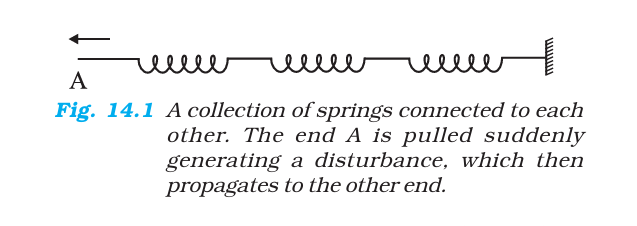
Springs as a model
- Sequence: pulling and releasing one spring disturbs it; its connection disturbs the next spring, so the disturbance travels along the chain.
- Key idea: the disturbance moves from end to end, but each spring makes only small oscillations about its equilibrium length.
- Train analogy: a push passes from one coupled bogie to the next without the whole stationary train being bodily displaced.
Sound waves in air
- Pressure and density: a passing sound wave compresses or expands a small region of air, changing its density by and its pressure by .
- Restoring action: pressure changes produce a restoring force proportional to the disturbance, much like the restoring force of a spring.
- Compression propagation: molecules in a compressed region move toward neighbouring regions, creating compression there and rarefaction in the first region.
- Rarefaction propagation: surrounding air moves into a rarefied region, so the rarefaction passes to neighbouring regions.
- Result: successive compressions and rarefactions carry the sound disturbance through air.
Mechanical waves in solids
- Crystal lattice: atoms or groups of atoms occupy regularly spaced positions and remain in equilibrium due to forces from surrounding particles.
- Restoring forces: displacing one atom while others remain fixed produces forces that tend to return it to equilibrium.
- Spring model: lattice particles can be pictured as endpoints connected by springs; interactions between them allow a disturbance to propagate.
Why does a wave not imply that matter flows along with it?
Distinguish mechanical and electromagnetic waves by their need for a medium.
Quick recap
- A wave is a travelling disturbance that carries energy and information without transporting matter as a whole.
- Mechanical waves require a medium; electromagnetic waves can travel through vacuum; matter waves are associated with particles and arise in quantum mechanics.
- All electromagnetic waves travel at in vacuum.
- In elastic media, waves are intimately connected with harmonic oscillations; elastic interactions pass disturbances between particles oscillating around equilibrium.
- Sound propagates through air as successive compressions and rarefactions caused by changes in pressure and density.
- Restoring forces between atoms in a solid lattice allow disturbances to propagate through the solid.
Transverse And Longitudinal Waves
Classifying Waves by Particle Motion
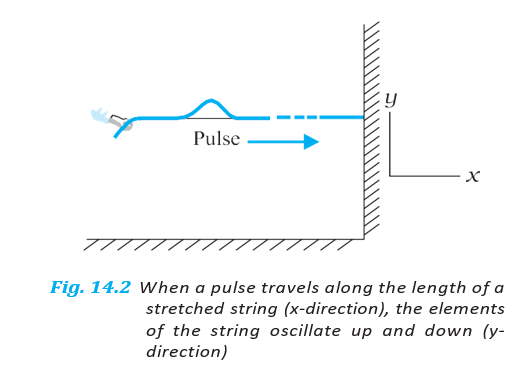
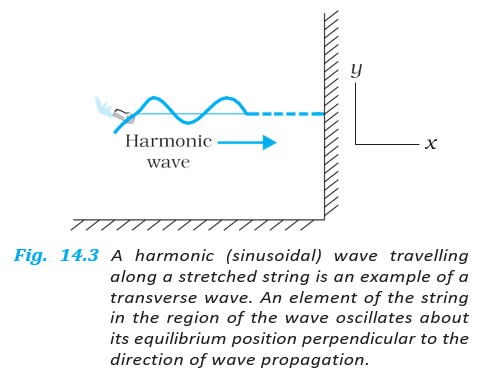
| Point | Transverse wave | Longitudinal wave |
|---|---|---|
| Particle oscillation | Perpendicular to propagation | Along the direction of propagation |
| Typical disturbance | Displacement of string elements up and down | Condensations and rarefactions in air |
| Example | Wave on a stretched string | Sound wave in air |
Viewing a Wave
- Two views: A wave can be described by its shape in space at a fixed instant or by the oscillation of one medium element over time.
Longitudinal Waves and Sound
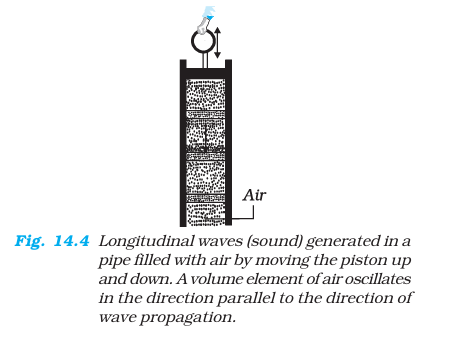
Progressive Waves
- Progressive wave: A travelling disturbance moves from one part of a medium to another without the medium as a whole flowing along with it.
- Transfer: Waves carry energy and information through the medium.
Media That Carry Each Wave Type
- Transverse waves: These require a medium that can sustain shear stress, such as a solid.
- Longitudinal waves: These require compressibility and can travel through solids, liquids and gases.
Waves on Water
| Type | Typical wavelength | Restoring force |
|---|---|---|
| Capillary waves | No more than a few centimetres | Surface tension |
| Gravity waves | Several metres to several hundred metres | Gravity |
Wave-Speed Note
- Speed: transverse and longitudinal waves generally travel at different speeds in the same medium.
| Example | Wave type |
|---|---|
| Kink in a longitudinal spring caused by sideways displacement of one end | Transverse and longitudinal |
| Waves in a liquid-filled cylinder driven by a piston moving back and forth | Longitudinal |
| Waves produced by a motorboat sailing in water | Transverse and longitudinal |
| Ultrasonic waves in air produced by a vibrating quartz crystal | Longitudinal |
Do not confuse the direction a wave travels with the motion of the medium as a whole: the disturbance propagates, while medium particles oscillate about their mean positions.
Why can transverse waves travel through solids but not through air?
Quick recap
- Transverse-wave particles oscillate perpendicular to propagation; longitudinal-wave particles oscillate along it.
- Sound in air travels as condensations and rarefactions.
- Progressive waves carry a disturbance, not the medium as a whole.
- Transverse waves require resistance to shear; longitudinal waves can travel through elastic solids and fluids.
- Capillary waves are restored by surface tension, while gravity waves are restored by gravity.
- Water and ocean waves can combine transverse and longitudinal particle motion.
Displacement Relation in A Progressive Wave
Displacement Function and Direction of Travel
Progressive wave displacement — A progressive wave is described by a function of position and time that gives the medium’s displacement at every point and instant.
For a transverse wave, is displacement and is position. Here, is amplitude, is angular wave number, is angular frequency, and is the initial phase angle.
Interpreting the wave function
- Fixed time: At any instant, displacement varies sinusoidally with position, showing the wave’s shape.
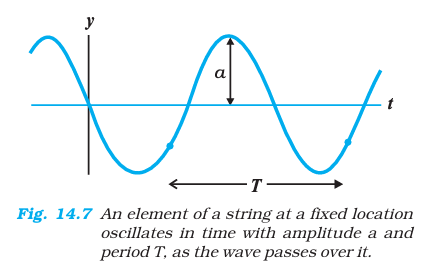
- Fixed position: Displacement varies sinusoidally with time; each medium particle executes simple harmonic motion.
- Equivalent form: A phase-shifted sine wave can be expressed as .
- Coefficient relations: and .
Direction of wave travel
- Positive -direction: travels along ; keeping its phase constant requires to increase as increases.
- Negative -direction: travels along .
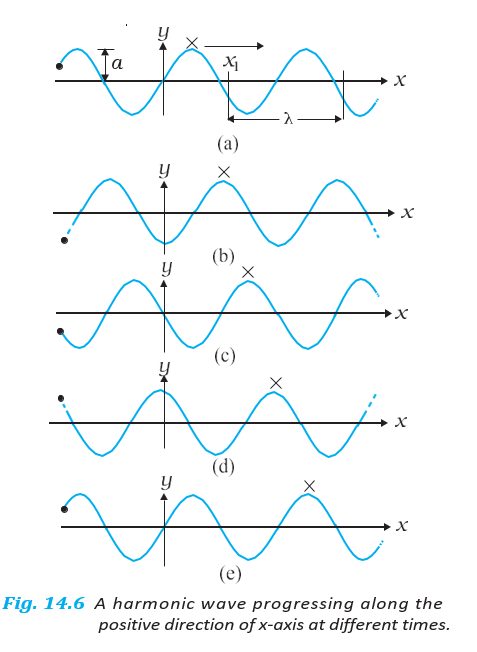
Wave travel versus particle motion
- Wave travel: A crest moves through the medium as the wave progresses.
- Particle motion: Each particle oscillates periodically about its equilibrium position; it does not move along with the crest.
Amplitude and Phase
Amplitude — Amplitude is the maximum displacement of a medium particle from its equilibrium position; it is taken as positive.
Amplitude and phase facts
- Displacement range: Since the sine function varies from to , varies from to .
- Phase: The quantity determines displacement at a given position and instant.
- Initial phase: is the phase at and ; a suitable choice of origin and starting time can make .
Wavelength and Angular Wave Number
Wavelength — Wavelength is the minimum distance between two points having the same phase.
Wavelength facts
- Same-phase points: Consecutive crests or consecutive troughs are separated by one wavelength.
- Angular wave number: is the phase change per unit distance and is also called the propagation constant.
- SI unit: is measured in ; radians may be omitted, giving .
A complete spatial cycle corresponds to a phase change of .
Period, Angular Frequency and Frequency
Period — The period is the time taken by a medium particle to complete one full oscillation.
Frequency quantities
- Angular frequency: measures phase change per unit time; its SI unit is .
- Frequency: is the number of oscillations per second and is measured in hertz ().
- At the origin: For and , .
One complete oscillation corresponds to a phase change of .
Longitudinal Waves
Longitudinal-wave displacement — In a longitudinal wave, particles are displaced parallel to the direction of wave propagation.
Use for displacement along the direction of propagation; the other quantities have the same meanings as in the transverse-wave equation.
Applying the Wave Equation
Example: extracting wave quantities
- Given: in SI units, so , , and .
- Amplitude: .
- Wavelength: .
- Period and frequency: and .
- Displacement: At and , the phase is , equivalent to .
- Result: .
Do not confuse wave propagation with particle motion: the wave travels through the medium, while each particle oscillates about its equilibrium position.
What is the relation between wavelength and angular wave number?
How can the direction of wave travel be identified from the phase?
Quick recap
- A sinusoidal progressive wave is described by .
- The phase with travels along ; the phase with travels along .
- Amplitude is the maximum displacement; phase determines displacement at a given position and instant.
- Wavelength and angular wave number satisfy .
- Period and frequency satisfy and .
- In a longitudinal wave, displacement is parallel to propagation and is represented by .
The Speed of a Travelling Wave
Speed of a Travelling Wave
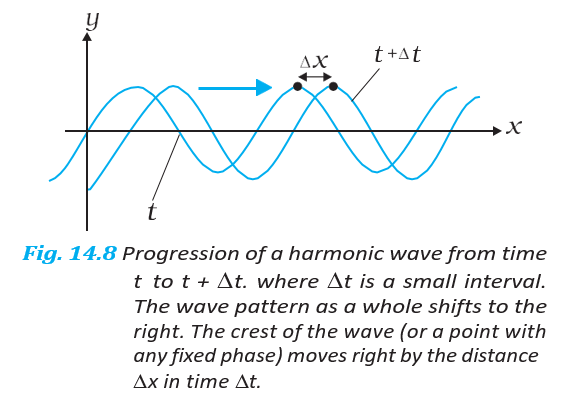
For a fixed phase, remains constant. Differentiating gives the wave speed.
Since and , a wave travels one wavelength during one period.
What determines wave speed?
- Medium: Mechanical wave speed depends on the medium’s elastic properties and its inertia (mass density).
- Frequency and wavelength: For a given medium and wave speed, the source sets the frequency; then .
- Different modes: The same medium can carry transverse and longitudinal waves at different speeds.
Transverse Waves on a Stretched String
The exact result has dimensionless constant . Speed depends on tension and linear mass density, not on the wave’s frequency or wavelength.
String example
- Given: A wire has mass and tension .
- Linear density: .
- Speed: .
Longitudinal Waves and the Speed of Sound
The exact result has dimensionless constant .
When lateral expansion is negligible, the bar is under longitudinal strain and Young’s modulus replaces .
| Medium | Speed () |
|---|---|
| Air at | 331 |
| Air at | 343 |
| Helium | 965 |
| Hydrogen | 1284 |
| Water at | 1402 |
| Water at | 1482 |
| Seawater | 1522 |
| Aluminium | 6420 |
| Copper | 3560 |
| Steel | 5941 |
| Granite | 6000 |
| Vulcanised rubber | 54 |
Why sound is generally faster in liquids and solids
- Compressibility: Liquids and solids are generally much harder to compress than gases, so their bulk moduli are much larger.
- Density: Liquids and solids also have greater density, which tends to reduce wave speed.
- Net effect: Their increase in elastic modulus is greater than the increase in density; therefore and sound speed are generally larger.
Sound Speed in an Ideal Gas
This assumes that pressure changes during sound propagation are isothermal.
Newton’s estimate at standard temperature and pressure
- Air density: One mole has mass and occupies at STP, so .
- Newton’s result: With , .
- Mismatch: This is about below the measured value of because sound-induced pressure changes are too rapid to remain isothermal.
Laplace correction
- Actual process: Sound pressure variations occur rapidly, leaving little time for heat transfer; the changes are adiabatic rather than isothermal.
- Adiabatic relation: For an ideal gas, , where .
- Adiabatic bulk modulus: .
- Corrected speed: The Laplace correction replaces Newton’s by ; for air, and the estimate at STP is .
This formula gives the sound speed in an ideal gas when propagation is adiabatic.
Do not confuse the wavelength relation: , not . For an ideal gas, Newton’s isothermal result is corrected to because sound changes are adiabatic.
Derive the general relation between wave speed, wavelength and frequency.
State the speed of a transverse wave on a stretched string.
Why did Newton’s formula underestimate the speed of sound, and what is the correction?
Quick recap
- A travelling wave’s speed is the speed of any fixed phase point: .
- For progressive waves, and .
- For a stretched string, ; speed depends on tension and linear density.
- Longitudinal-wave speed is ; in a solid bar use Young’s modulus: .
- Newton’s isothermal gas formula is , but sound propagation is adiabatic.
- Laplace’s correction gives , agreeing with measured sound speed more closely.
The Principle of Superposition of Waves
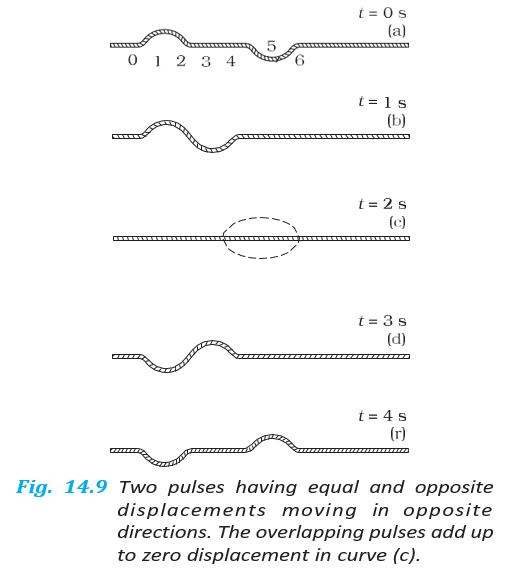
Principle of Superposition
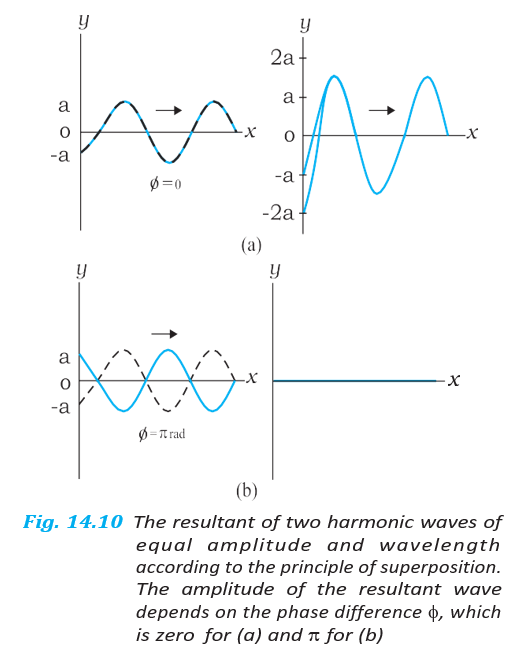
Interference of Two Harmonic Waves
The amplitude magnitude is ; the signed factor in the wave equation also determines its phase.
| Case | Phase difference | Result |
|---|---|---|
| Constructive interference | Waves are in phase; amplitudes add, giving maximum amplitude . | |
| Destructive interference | Waves are completely out of phase; their displacements cancel, giving zero resultant displacement. |
Reflection of Waves
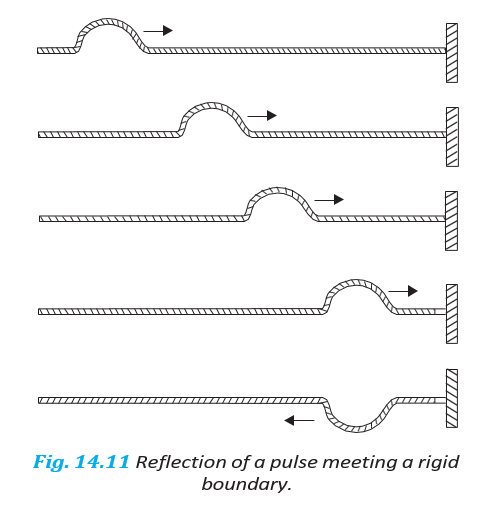
| Point | Rigid boundary | Free/open boundary |
|---|---|---|
| Phase on reflection | Phase changes by (180°); the pulse is inverted. | No phase change; the pulse is not inverted. |
| Boundary displacement | The incident and reflected displacements cancel, keeping the boundary at zero displacement. | With no energy loss, the reflected pulse has the incident pulse’s amplitude; maximum displacement at the boundary is twice the amplitude. |
| Example | A fixed end of a string. | The open end of an organ pipe, or a string attached to a freely moving ring. |
Why a Rigid Boundary Inverts the Pulse
- Boundary condition: A rigid boundary must remain at zero displacement, so the reflected and incident displacements must cancel there.
- Phase change: Cancellation requires a phase difference of between the incident and reflected waves.
- Force explanation: The incident pulse exerts a force on the wall; by Newton’s third law, the wall exerts an equal and opposite force on the string, producing an inverted reflected pulse.
State the principle of superposition of waves.
What happens to a wave reflected at rigid and open boundaries?
Quick recap
- Overlapping wave displacements add algebraically: .
- Wave pulses retain their identities after crossing; equal and opposite pulses can cancel during overlap.
- For two equal-amplitude waves, the resultant amplitude depends on their phase difference: .
- In-phase waves produce constructive interference; waves out of phase by produce destructive interference.
- Reflection at a rigid boundary causes a phase change of ; reflection at a free/open boundary causes none.
- At an interface, waves can be partly reflected and partly transmitted; oblique transmission is refraction.
Standing Waves and Normal Modes
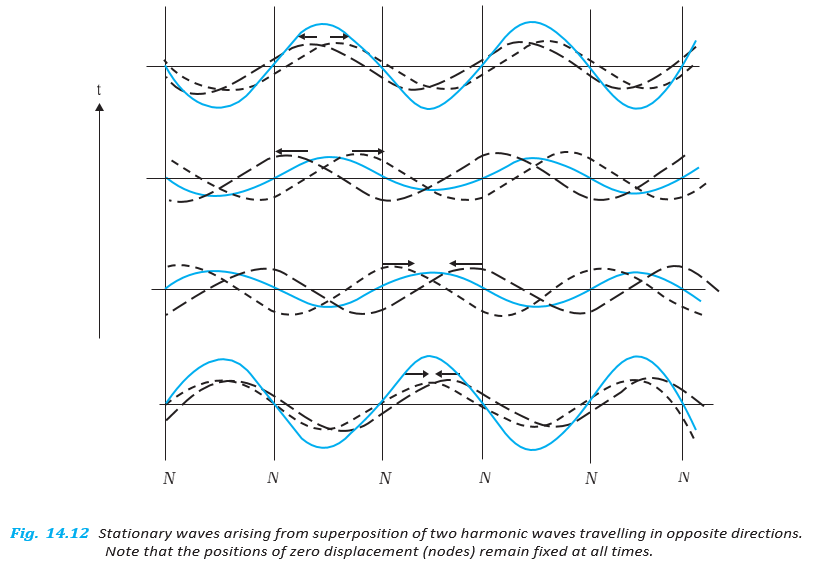
Standing Waves
The amplitude at position is the magnitude of the position-dependent factor.
Nodes, Antinodes and Normal Modes
- Standing waves: They arise when waves of the same frequency and amplitude travel in opposite directions and superpose.
- Fixed pattern: Nodes remain at zero displacement, while antinodes oscillate with maximum amplitude.
- Normal modes: Boundary conditions allow only certain wavelengths and natural frequencies; driving near a natural frequency can produce resonance.
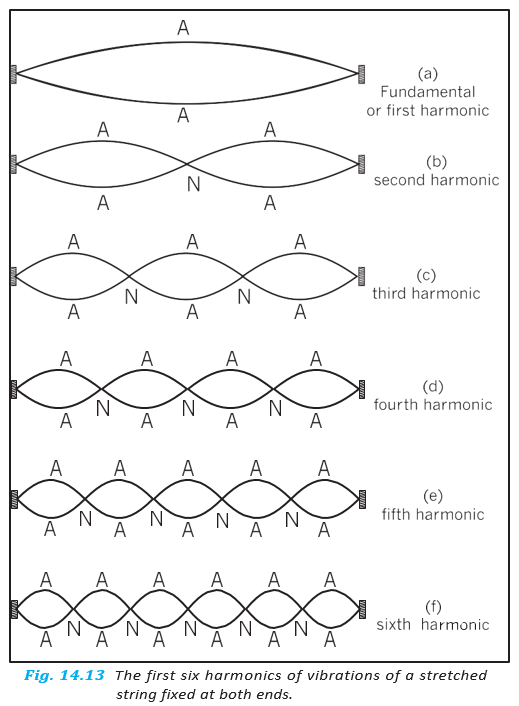
String Fixed at Both Ends
Here , is the string length, and is the wave speed.
| Mode | Frequency | Name |
|---|---|---|
| Fundamental; first harmonic | ||
| Second harmonic | ||
| Third harmonic | ||
| th harmonic |
String Vibrations
- Fundamental: The lowest natural frequency, corresponding to .
- Combined modes: A string can vibrate as a superposition of several normal modes.
- Instruments: Where a sitar string is plucked or a violin string is bowed affects which modes are most strongly excited.
Air Column with One End Closed
Here , is the pipe length, and is the speed of sound.
Harmonics of a Closed-Open Pipe
- Fundamental: The mode has frequency .
- Allowed frequencies:
- Harmonic rule: Only odd harmonics occur: .
Open Pipes, Resonance and Membranes
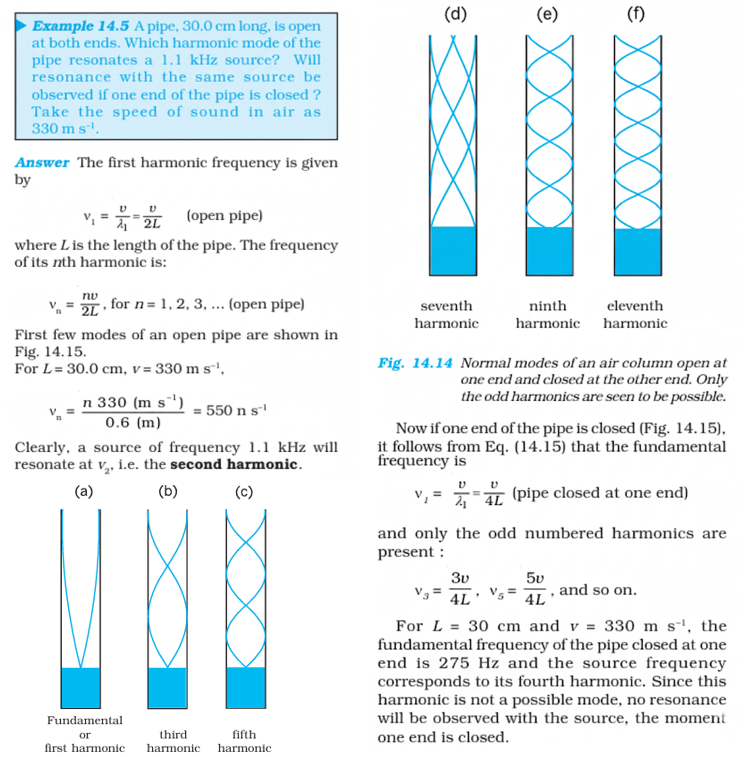
| System | End conditions | Allowed harmonics |
|---|---|---|
| String fixed at both ends | Node at each end | All harmonics |
| Pipe closed at one end | Node at closed end; antinode at open end | Odd harmonics only |
| Pipe open at both ends | Antinode at each end | All harmonics |
What determines the natural frequencies of a standing-wave system?
Why does a closed-open pipe produce only odd harmonics?
Quick recap
- Standing waves form by superposition of equal waves travelling in opposite directions.
- Nodes have zero displacement; antinodes have maximum displacement.
- Boundary conditions determine the permitted normal modes and natural frequencies.
- A string fixed at both ends supports all harmonics: .
- A pipe closed at one end supports only odd harmonics; its fundamental is .
- An open pipe supports all harmonics; resonance occurs when the driving frequency is close to a natural frequency.
Beats
Beats: Meaning and Formation
- Beats: Superposition of two sound waves with close, unequal frequencies produces a sound whose loudness periodically waxes and wanes.
- Use: Musicians listen for beats while tuning instruments; beats disappear when the frequencies match.
Mathematical Explanation
The amplitude factor varies at angular frequency ; the sound intensity reaches successive maxima at twice this rate.
Beat frequency is the number of loudness maxima per second. For either ordering of the two frequencies, use the absolute difference.
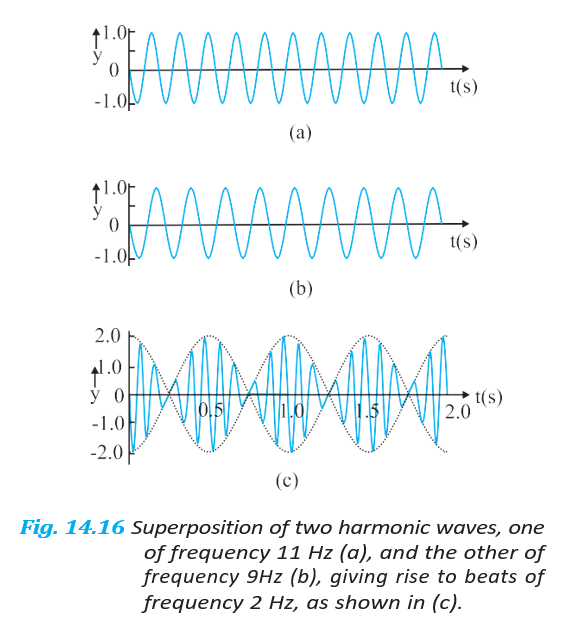
Do not confuse with the beat angular frequency: the amplitude factor contains , but successive intensity maxima occur at , giving .
Application: Tuning Strings
Two tuning strings produce 5 beats per second. After the frequency of string B is increased, the beat frequency falls. If string A is at 427 Hz, find B's original frequency.
Quick recap
- Beats arise from interference between two sound waves with close, unequal frequencies.
- The resultant pitch is close to the average frequency, while loudness waxes and wanes.
- The resultant displacement has a fast oscillation at and a varying amplitude.
- The beat frequency is .
- Increasing a string's tension increases its frequency; whether beats rise or fall reveals which frequency was initially higher.
Summary
Mechanical Waves and Their Types
Mechanical wave — A mechanical wave is a disturbance that travels through a material medium and is governed by Newton’s laws.
Key ideas and wave types
- Energy transfer: A wave transfers energy from one point to another, not matter as a whole; elastic forces couple neighbouring oscillating parts of the medium.
- Transverse wave: Medium particles oscillate perpendicular to the direction of propagation; propagation requires a medium with shear elasticity.
- Longitudinal wave: Medium particles oscillate along the direction of propagation; propagation requires bulk elasticity and is possible in solids, liquids and gases.
- Sound: Sound waves are longitudinal mechanical waves that can travel through solids, liquids and gases.
- Wave versus wind: Wind carries air from place to place; sound travels through air by compressions and rarefactions, without transporting the air as a whole.
Progressive Waves and Wave Quantities
Progressive wave — A progressive wave travels from one point of a medium to another.
Here, is amplitude, is angular wave number, is angular frequency, is phase, and is the phase constant. In a harmonic progressive wave, particles have the same amplitude but generally different phases at an instant.
| Quantity | Meaning | Relation / unit |
|---|---|---|
| Amplitude | Maximum displacement of a particle | Length |
| Wavelength | Distance between consecutive points in the same phase at a given time | |
| Wave number | Angular wave number | ; |
| Period | Time for one complete oscillation of a medium element | ; |
| Frequency | Number of oscillations per unit time | ; |
| Angular frequency | Angular rate of oscillation | ; |
| Wave speed | Speed at which the wave propagates | ; |
Wavelength in stationary waves
- Progressive wave: Wavelength is the distance between two consecutive points in the same phase at a given time.
- Stationary wave: Wavelength is twice the separation between consecutive nodes or consecutive antinodes.
Wave Speeds in Different Media
What determines wave speed?
- Medium dependence: Relative to an observer at rest in the medium, mechanical-wave speed depends on the medium’s elastic and other properties, such as density.
- Source motion: The speed of a mechanical wave in a given medium does not depend on the velocity of its source.
is the string tension and is its linear mass density; is not the oscillation period.
is bulk modulus, is Young’s modulus, is density, is the ratio of specific heats, and is gas pressure. For gases, .
Superposition and Interference
Principle of superposition — When waves travel simultaneously through the same medium, the resultant displacement at any point is the algebraic sum of the individual displacements.
The total displacement is the sum of the individual wave displacements.
Interference of two waves
- Conditions: Two sinusoidal waves travelling in the same direction with equal amplitude and frequency combine into a wave of the same frequency.
- Constructive interference: Waves are in phase when or an integral multiple of .
- Destructive interference: Waves are exactly out of phase when .
For equal amplitude , equal frequency and phase difference , the resultant wave is:
Reflection at Boundaries
| Boundary | Reflected wave | Phase change |
|---|---|---|
| Rigid / closed | Phase reversal | |
| Open | No phase change |
Standing Waves and Normal Modes
Standing wave — A standing wave is formed by the interference of two identical waves travelling in opposite directions.
Features of standing waves
- Node: A fixed point of zero displacement.
- Antinode: A fixed point of maximum displacement.
- Spacing: Consecutive nodes, or consecutive antinodes, are separated by .
- Particle phase and amplitude: Between adjacent nodes, particles have the same phase at a given instant but different amplitudes.
| System | Allowed frequencies / modes | Fundamental and harmonics |
|---|---|---|
| String of length , fixed at both ends | Lowest frequency is the fundamental or first harmonic; is the second harmonic. | |
| Pipe of length , one end closed and one end open | Fundamental frequency is ; the allowed modes are odd harmonics. | |
| Air column open at both ends | Has normal modes of oscillation | Each normal-mode frequency is a resonant frequency. |
Beats
Beats — Beats are periodic variations in resultant amplitude produced by superposing waves of comparable amplitudes and slightly different frequencies.
For two close frequencies and , beat frequency is their positive difference.
| Quantity | Symbol | Dimensions | SI unit | Relation / note |
|---|---|---|---|---|
| Wavelength | Distance between consecutive points in the same phase. | |||
| Propagation constant | ||||
| Wave speed | ||||
| Beat frequency | Difference between two close frequencies. |
How do particle motion and phase compare in progressive and standing waves?
What determines the speed of a mechanical wave in a medium?
Quick recap
- Mechanical waves travel through material media and transfer energy, not matter as a whole.
- Transverse oscillations are perpendicular to propagation; longitudinal oscillations are parallel to it.
- For a progressive wave, .
- Wave speed depends on the medium’s properties, not on the source’s velocity.
- Superposition adds displacements; relative phase determines constructive or destructive interference.
- Rigid-end reflection reverses phase, while open-end reflection does not; standing waves contain nodes and antinodes.
- Strings and air columns have resonant normal modes; beat frequency is .
Physics — ALL CHAPTERS
1
Units And Measurement
2
MOTION IN A STRAIGHT LINE
3
MOTION IN A PLANE
4
LAWS OF MOTION
5
WORK, ENERGY AND POWER
6
SYSTEMS OF PARTICLES AND ROTATIONAL MOTION
7
GRAVITATION
8
Mechanical Properties Of Solids
9
Mechanical Properties Of Fluids
10
Thermal Properties Of Matter
11
Thermodynamics
12
Kinetic Theory
13
Oscillations
14
Waves