Class 11 PCM . Physics . Physics Part II . Mechanical Properties of Fluids
Chapter 9: Mechanical Properties Of Fluids
Ch 9
Physics
Class 11 PCM
Introduction
Fluids and Their Properties
Fluid — A substance that can flow; liquids and gases are fluids.
| Property | Solids | Liquids | Gases |
|---|---|---|---|
| Shape | Definite shape | No definite shape; take container's shape | No definite shape; fill the whole container |
| Volume | Fixed under atmospheric pressure | Nearly fixed under atmospheric pressure | Equal to container volume |
| Compressibility | Very low | Very low; density nearly constant | Much higher; density varies greatly with pressure |
- Shear response: A solid can change shape under shear stress while retaining its volume; a fluid changes shape under very small shear stress.
- Resistance: The shearing stress of fluids is about one-millionth that of solids.
- Pressure and volume: The volume of any material can change under stress, but solids and liquids change volume very little with external pressure.
Pressure
Pressure — The normal force acting per unit area.
- Area matters: For the same force, a smaller contact area produces greater pressure; this explains why a sharp needle pierces skin more readily than a blunt object.
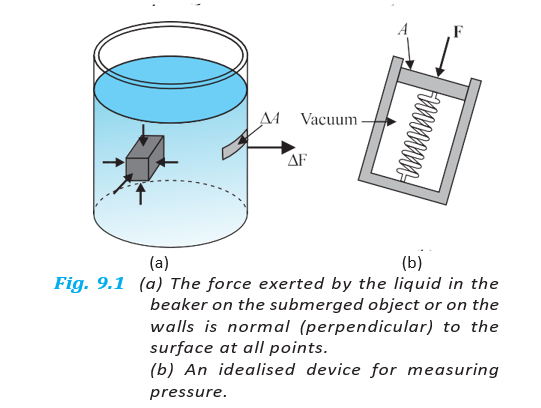
- At rest: A fluid exerts force perpendicular (normal) to any surface in contact with it.
- Why normal? A force component parallel to the surface would make the fluid flow along it, which cannot happen when the fluid is at rest.
- Measurement: An ideal pressure gauge uses a piston and calibrated spring; the fluid's inward force on the piston is balanced by the spring's outward force.
Here, is the normal force on area .
Pressure is defined locally as the limiting force per area as the area becomes infinitesimal.
- Scalar: Pressure is a scalar; its formula uses only the component of force normal to the area, not the full force vector.
- Dimensions: Pressure has dimensions .
- SI unit: The pascal (Pa), where .
- Atmosphere: An atmosphere (atm) is the pressure exerted by the atmosphere at sea level; .
Density and Relative Density
Density — Mass per unit volume of a substance.
Density is positive and scalar; its SI unit is and dimensions are .
- Liquids: They are nearly incompressible, so their density is almost constant as pressure changes.
- Gases: Their density can vary greatly with pressure.
- Water reference: Water's density at () is .
Relative density — The ratio of a substance's density to the density of water at ; it is a positive, dimensionless scalar.
Example: aluminium with relative density has density .
| Fluid | Density () |
|---|---|
| Water | |
| Sea water | |
| Mercury | |
| Ethyl alcohol | |
| Whole blood | |
| Air | |
| Oxygen | |
| Hydrogen | |
| Interstellar space |
Example: Pressure on the Femurs
- Given: Two femurs each have cross-sectional area and support a mass of ; take .
- Total area: ; the downward weight is .
- Result: .
Quick recap
- Fluids flow, have no fixed shape, and offer very little resistance to shear.
- At rest, fluid forces on surfaces are normal; pressure is normal force per unit area.
- Pressure is scalar, with SI unit pascal and dimensions .
- An atmosphere is the pressure exerted by the atmosphere at sea level; .
- Density is mass per volume; liquids are nearly incompressible, while gas density changes substantially with pressure.
- Relative density compares a substance's density with water at and has no units.
- For pressure calculations, use the total normal force divided by the total contact area.
Pascal’s Law
Pressure in a Fluid at Rest
Pascal’s law — In a fluid at rest, pressure at a point is the same in every direction; at the same height, pressure is equal throughout the fluid.
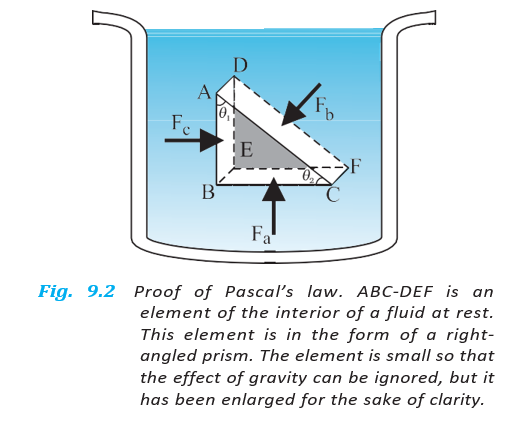
Force equilibrium and the geometry of a small fluid element give equal pressure on each face.
Pressure at the Same Height
- Normal force: Pressure force on any area in or bounding a fluid at rest acts perpendicular to that area.
- Scalar quantity: Pressure has no direction; it is not a vector.
- Horizontal plane: A stationary horizontal fluid element has equal pressure at its ends; unequal pressures would produce a net force and flow.
Variation of Pressure with Depth
Hydrostatic pressure difference — In a fluid at rest, pressure increases with vertical depth because the fluid above exerts weight.
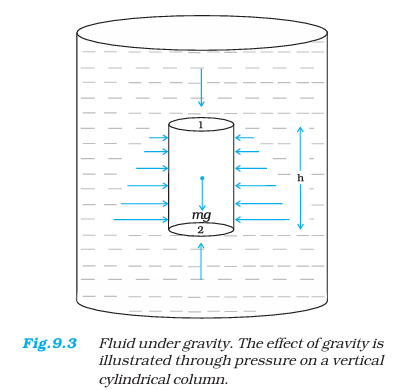
Pressure Difference Across a Fluid Column
- Column forces: For a fluid column of base area and height , pressure at the bottom pushes upward and pressure at the top pushes downward.
- Equilibrium: The net upward pressure force balances the column’s weight; the column mass is .
Point 2 is vertically below point 1 by distance ; is fluid density and is gravitational acceleration.
At depth below a liquid surface exposed to the atmosphere, pressure includes atmospheric pressure.
Gauge pressure — Gauge pressure is the excess above atmospheric pressure at depth : .
What Determines Liquid Pressure?
- Depends on: Pressure difference depends on vertical depth , fluid density , and gravitational acceleration .
- Independent of shape: Pressure at a given depth does not depend on the container’s shape, cross-sectional area, or the amount of liquid.
- Same level: Points at the same horizontal level in the same connected fluid have equal pressure.
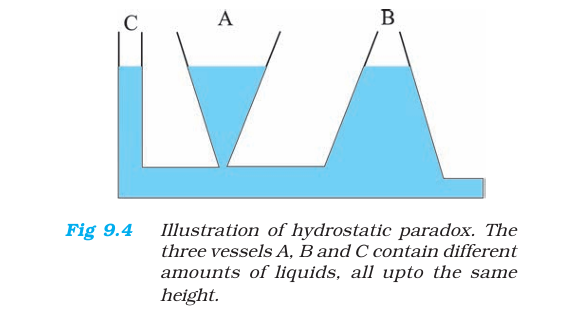
Hydrostatic Paradox
- Observation: Connected vessels of different shapes may hold different amounts of liquid yet have the same liquid level.
- Reason: Bottom pressure depends on liquid height, not vessel shape or total liquid volume; equal bottom pressures require equal levels.
Example: Pressure Underwater
Pressure on a Swimmer at 10 m Depth
- Given: , , , and .
- Calculation: .
- Interpretation: This is about twice the surface pressure; at a depth of , the pressure increase is about , so submarines must withstand enormous pressures.
What is the difference between absolute pressure and gauge pressure?
Why do connected vessels of different shapes have the same liquid level?
Quick recap
- In a fluid at rest, pressure is equal in all directions and its force is normal to a surface.
- Pressure is equal at all points in the same horizontal plane of a stationary fluid.
- For a fluid column, and .
- Absolute pressure at depth is ; gauge pressure is .
- Liquid pressure depends on depth, density, and gravity—not container shape or base area.
- In connected vessels, differently shaped containers reach the same liquid level.
Atmospheric Pressure and Gauge Pressure
Atmospheric Pressure and the Mercury Barometer
Atmospheric pressure — Pressure at a point in the atmosphere equals the weight per unit area of the air column above it.
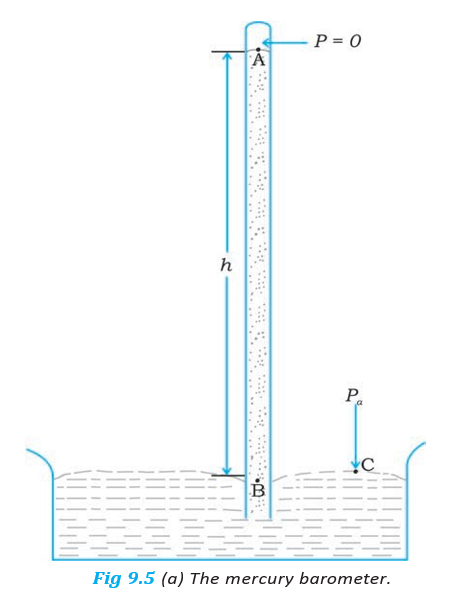
Mercury barometer
- Sea-level pressure: About , or .
- Barometer: Evangelista Torricelli devised the mercury barometer to measure atmospheric pressure.
- Principle: The mercury-vapour pressure above the column is negligible; atmospheric pressure balances the pressure due to the mercury column.
Here, is the mercury density and is the column height.
Pressure units
- Barometer reading: At sea level, the mercury column is about , equivalent to .
- Torr: A pressure equivalent to of mercury is ; .
- Uses: Millimetres of mercury and torr are used in medicine and physiology; bar and millibar are common in meteorology.
Manometers and Gauge Pressure
Open-tube manometer — A U-tube containing liquid measures the pressure difference between a system and the atmosphere.
Manometer basics
- Setup: One end is open to the atmosphere; the other connects to the system being measured.
- Liquid choice: Low-density liquids, such as oil, measure small pressure differences; high-density liquids, such as mercury, measure larger differences.
- Reading: The system’s gauge pressure is proportional to the height difference between the liquid columns.
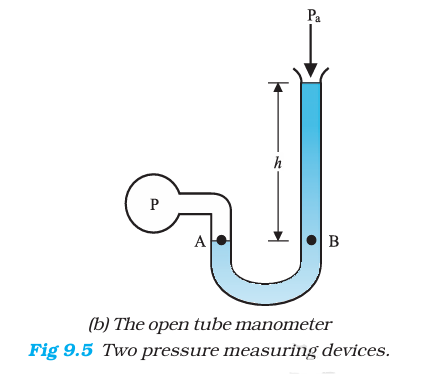
Gauge pressure — Gauge pressure is the pressure measured relative to atmospheric pressure: .
For liquid density and column-height difference , the pressure difference is .
| Point | Liquids | Gases |
|---|---|---|
| Density changes | Very little over wide ranges of pressure and temperature | Considerably with changes in pressure and temperature |
| Usual treatment | Largely treated as incompressible | Compressible |
Pressure in fluids
- Same level: Pressure is equal at the same level in a continuous fluid at rest.
Atmosphere: estimated height and weather clue
- Constant-density estimate: If air density stays at , then gives .
- Actual atmosphere: Air density and decrease with altitude; the atmospheric cover extends beyond with decreasing pressure.
- Storm clue: A fall of or more in mercury-barometer height can signal an approaching storm. Sea-level pressure is not always exactly of mercury.
Pressure at ocean depth: worked results
- Given: At depth , use and .
- Gauge pressure: .
- Absolute pressure: .
- Submarine window: For , net force is because the interior is at atmospheric pressure.
Do not confuse absolute pressure with gauge pressure: absolute pressure includes atmospheric pressure, while gauge pressure is the excess above it.
Pascal’s Law and Hydraulic Machines
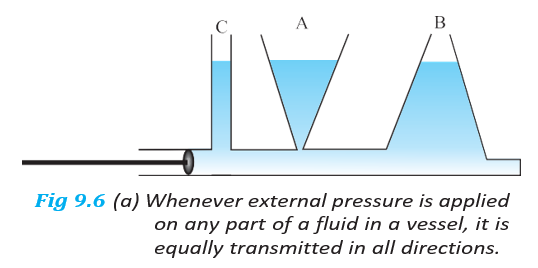
Pascal’s law — An externally applied pressure change to a confined fluid is transmitted undiminished and equally in all directions.
Pascal’s law in action
- Consequence: A pressure change spreads throughout the confined fluid, regardless of the vessel’s shape.
- Applications: Hydraulic lifts and hydraulic brakes use fluid to transmit pressure.
Hydraulic Lift
Working and force multiplication
- Working: A force on the small piston creates pressure in the liquid; the same pressure acts on the larger piston to produce a greater force.
- Mechanical advantage: The applied force is multiplied by the ratio of the large piston’s area to the small piston’s area.
- Movement: Changing the input force moves the platform up or down.
Subscripts and refer to the small and large pistons, respectively.
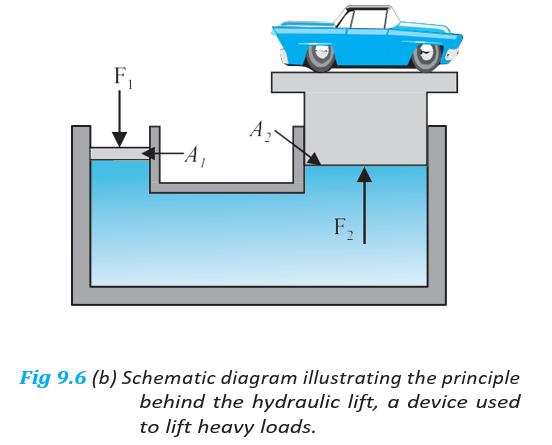
For an incompressible liquid, the volume displaced at one piston equals the volume displaced at the other.
Syringe example
- Force multiplication: Piston diameters are and , so . An input force of produces .
- Piston movement: If the small piston moves inward by , then outward.
- Pressure note: Atmospheric pressure acts on both pistons and cancels when calculating the pressure difference.
Car-lift example
- Given: Piston radii are and ; car mass is and .
- Input force: With , .
- Required pressure: , nearly twice atmospheric pressure.
Hydraulic Brakes
How hydraulic brakes work
- Foot force moves the master piston in the master cylinder.
- Pressure is transmitted through the brake oil to pistons at the wheels.
- The wheel pistons push the brake shoes against the brake lining.
- A small pedal force creates a large retarding force; pressure reaches all four wheels equally, giving equal braking effort.
Quick recap
- Atmospheric pressure is the weight per unit area of the air column above a point; at sea level it is about .
- A mercury barometer measures atmospheric pressure; about of mercury corresponds to one atmosphere.
- Gauge pressure is the pressure above atmospheric pressure: .
- Pressure is equal at the same level in a stationary fluid; liquids are nearly incompressible, unlike gases.
- Pascal’s law states that an applied pressure change in a confined fluid is transmitted undiminished and equally in all directions.
- A hydraulic lift multiplies force according to piston-area ratio, while displaced volumes satisfy .
- Hydraulic brakes use transmitted fluid pressure to apply braking effort equally at all wheels.
Streamline Flow
Fluid Dynamics and Steady Flow
Fluid dynamics — The study of fluids in motion.
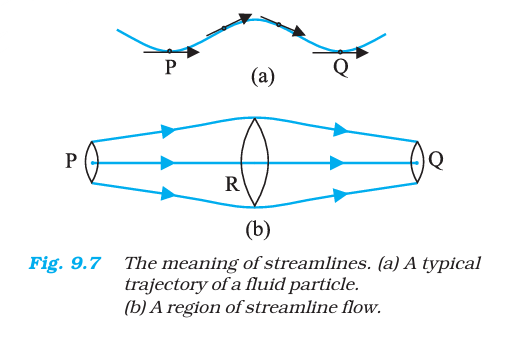
Steady flow — Flow in which the velocity of fluid particles passing any fixed point remains constant with time.
- Velocity variation: In steady flow, velocity may differ from point to point; it is only time-independent at each fixed point.
- Particle paths: Fluid particles follow smooth paths in steady flow, and these paths do not cross.
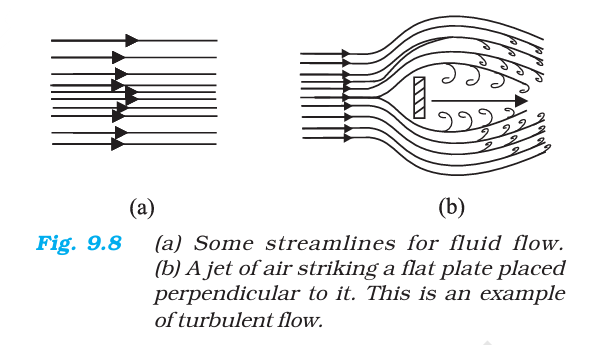
- Speed effect: Flow may be smooth at low speed but lose steadiness as the flow speed increases.
Streamlines
Streamline — A curve whose tangent at every point gives the direction of the fluid velocity at that point.
- Particle path: Under steady flow, a fluid particle moves along a streamline; together, streamlines give a stationary map of the flow.
- No crossing: Two streamlines cannot intersect because the fluid at the crossing would have two possible velocity directions.
Equation of Continuity
Equation of continuity — The mass flow rate is the same through every cross-section of a steady flow, expressing conservation of mass.
- Mass crossing a section: In time , mass passing through area at speed is .
- Volume flow rate: is the volume of fluid passing through a cross-section per unit time.
Density is constant, so the area–speed product and volume flow rate remain constant along the flow.
For incompressible flow, is constant: a narrower section has a higher fluid speed.
Flow through a narrowing pipe
- Cross-sectional area decreases
- Fluid speed increases to keep constant
- The fluid accelerates through the narrower section
- In a horizontal pipe, this acceleration is associated with a change in fluid pressure
Steady flow does not mean velocity is the same everywhere; it means velocity at each fixed point does not change with time.
Laminar and Turbulent Flow
| Type | Flow pattern | Condition / example |
|---|---|---|
| Laminar (streamline) flow | Smooth flow; velocities at different points may have different magnitudes but parallel directions. | Typically occurs at low flow speeds. |
| Turbulent flow | Flow loses steadiness and becomes irregular, with swirling regions. | Occurs beyond the critical speed; fast water passing rocks can form foamy white-water rapids. |
State the equation of continuity for an incompressible fluid and explain its meaning.
Why can two streamlines not cross?
Quick recap
- Fluid dynamics studies fluids in motion; steady flow has time-independent velocity at each fixed point.
- A streamline is tangent to the local velocity, and streamlines cannot cross.
- Mass conservation gives for steady flow.
- For incompressible flow, , so speed rises as cross-sectional area falls.
- In a horizontal pipe, acceleration through a narrower section is associated with a pressure change.
- Flow is generally steady at low speeds and becomes turbulent beyond the critical speed.
Bernoulli’s Principle
Bernoulli’s Principle
Applies between any two points on the same streamline.
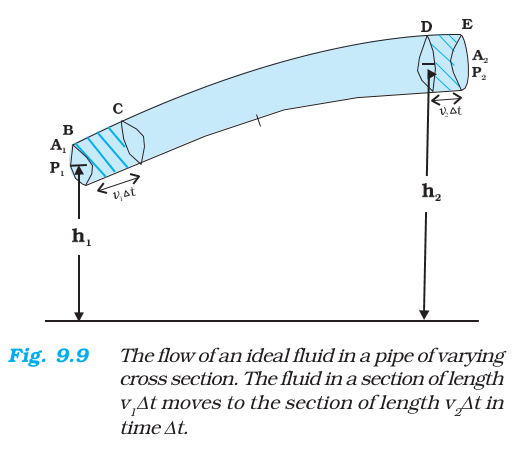
Bernoulli’s equation is not generally valid for viscous, compressible, unsteady or turbulent flow. Viscosity dissipates mechanical energy as heat.
Conditions and static-fluid case
- Ideal-flow conditions: The fluid is incompressible and non-viscous, and its flow is steady and along a streamline; frictional energy losses are neglected.
- Fluid at rest: Setting gives .
- Hydrostatic result: Therefore, , the pressure–height relation for a fluid at rest.
Speed of Efflux: Torricelli’s Law
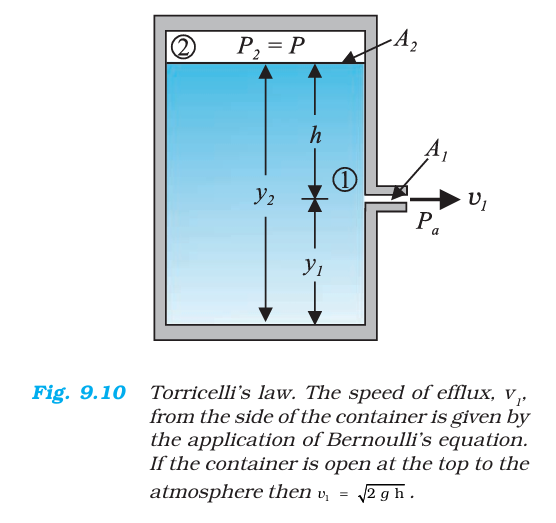
Use when the liquid surface pressure is and the outlet is exposed to atmospheric pressure.
For an open tank, ; the efflux speed equals the speed acquired by a freely falling body through height .
Effect of surface pressure
- Pressurised tank: If the surface pressure greatly exceeds atmospheric pressure, pressure difference can strongly increase the efflux speed; rocket propulsion is one application.
- Open tank: With , the pressure contribution cancels and only the height difference determines the speed.
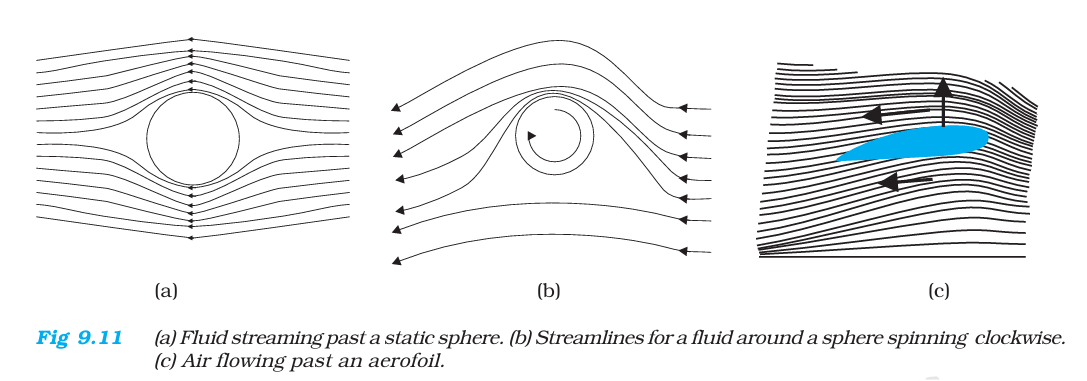
Dynamic Lift
Lift on an aerofoil
- Aerofoil: A shaped solid that produces upward dynamic lift as it moves horizontally through air.
- Pressure difference: Wing orientation crowds streamlines above the wing, making airflow faster there than below.
- Upward lift: Faster airflow above means lower pressure there; the higher pressure below pushes the wing upward.
- Level flight: The lift force balances the aircraft’s weight.
For level flight, the upward pressure force over total wing area balances aircraft weight.
Aircraft example
- Given: Aircraft mass , wing area , air density and average airflow speed .
- Pressure difference: From , the lower-to-upper wing pressure difference is approximately .
- Speed increase: Neglecting the small height difference, , where is the upper-surface speed and the lower-surface speed.
- Estimate: The fractional increase ; airflow above the wing is about faster.
Quick recap
- Bernoulli: Along a streamline, is constant for ideal steady flow.
- Conditions: The fluid is incompressible and non-viscous; flow is steady, with frictional energy loss neglected.
- Static fluid: Bernoulli’s equation reduces to the hydrostatic pressure–height relation.
- Torricelli: For an open tank, efflux speed is .
- Dynamic lift: Faster airflow corresponds to lower pressure; the resulting pressure difference creates lift.
- Magnus effect: Unequal airflow around a spinning ball produces a force and can deflect its path.
Viscosity
Viscosity and Fluid Flow
- Viscosity: A fluid’s internal resistance to motion, arising when adjacent layers move relative to one another.
- Fluid flow: In laminar flow, layers slide smoothly past one another with different speeds.
Coefficient of Viscosity
Example: Liquid Film Between a Block and a Table
- Given: , , and hanging mass .
- Shear force: At constant speed, .
- Result: Using gives .
Viscosity of Different Fluids
- Examples: Water and alcohol are less viscous than thick liquids such as coal tar, blood and glycerine.
- Temperature: A liquid’s viscosity generally decreases as temperature rises, while a gas’s viscosity increases.
Stokes’ Law
- Viscous drag: A sphere moving through a fluid experiences a retarding force opposite to its motion.
- Stokes’ law: For a sphere of radius moving at speed , the drag magnitude is .
Terminal Velocity
For a sphere falling through a viscous fluid.
Example: Copper Ball Falling Through Oil
- Given: , , and .
- Result: Rearranging the terminal-velocity formula gives .
How does viscosity change with temperature in liquids and gases?
What determines the terminal velocity of a sphere in a viscous fluid?
Quick recap
- Viscosity is internal friction between fluid layers in relative motion.
- For laminar flow, shear stress is proportional to strain rate; .
- The SI unit of viscosity is Pa s and its dimensions are .
- Liquid viscosity decreases with temperature, while gas viscosity increases.
- Stokes’ drag on a sphere is and opposes motion.
- A falling sphere reaches terminal velocity when gravity balances drag and buoyancy.
Surface Tension
Surface tension — The surface of a liquid behaves as if it is under tension and tends to minimise its area; surface tension measures this effect.
Free surfaces and surface energy
- Free surface: A liquid has a definite volume but no definite shape, so it forms a free surface in a container. Gases do not have free surfaces.
- Molecules inside: A molecule in the bulk is attracted in all directions by surrounding molecules and has negative potential energy.
- Molecules at the surface: They have fewer neighbours above them, so their potential energy is higher than that of molecules inside the liquid.
- Extra energy: A surface molecule has roughly half the energy needed to remove it entirely from the liquid—about half the heat of vaporisation.
- Example: Water’s heat of vaporisation is about , so the surface-molecule energy is roughly half this value per mole.
- Surface energy: Creating more surface area requires energy; a liquid tends to minimise its surface area when other conditions permit.
- Molecular scale: A liquid’s surface is not perfectly sharp; its density falls rapidly over a distance of a few molecular sizes.
- Examples: Water wets glass, while mercury does not; such behaviour depends on the materials on either side of the interface.
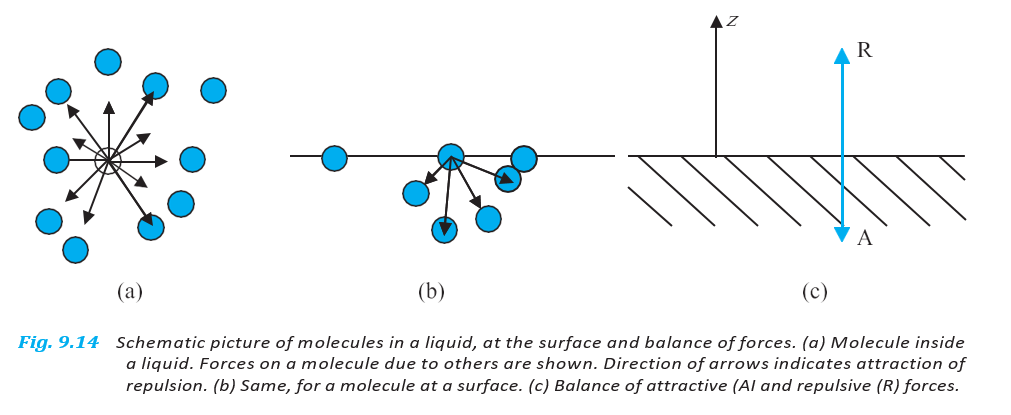
Surface energy and surface tension
- Surface tension, : It is the surface energy per unit area and also the force per unit length acting in the plane of an interface.
- Movable film: A film has two surfaces. Pulling its bar of length through distance increases the total area by .
- Work and energy: The work done against the film’s pull is stored as extra surface energy: .
- Units: Surface tension is measured in , equivalent to .
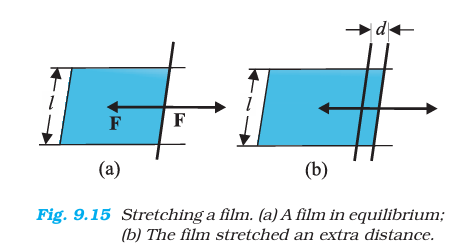
Here is the force on the movable bar and is its length. The factor of accounts for the film’s two surfaces.
Direction and material dependence
- Direction: Surface-tension forces act in the plane of the interface, perpendicular to an imagined line drawn on it.
- Along an internal line: Equal and opposite forces pull on the line from its two sides; at an interface boundary, the force per unit length acts inward.
- Interface dependence: Surface energy depends on both materials forming the interface. Attraction between them lowers it; repulsion raises it.
- Temperature: Surface tension of a liquid usually decreases as temperature increases.
| Liquid | Temperature | Surface tension | Heat of vaporisation |
|---|---|---|---|
| Helium | |||
| Oxygen | |||
| Ethanol | |||
| Water | |||
| Mercury |
Wetting and measurement
- Wetting condition: A fluid sticks to a solid when the solid–fluid surface energy is less than the sum of the solid–air and fluid–air surface energies.
- Measurement idea: A liquid touching a vertical plate pulls it downward; the extra weight needed to just separate the plate from the liquid balances this pull.
- Plate edge: For a plate edge of length , the measured force corresponds to two interface lengths, giving .
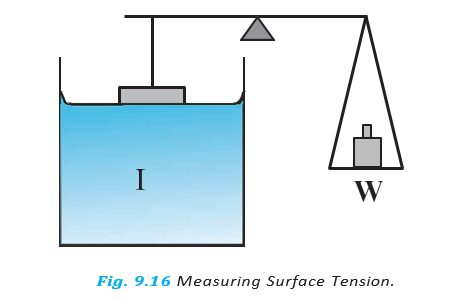
If the added mass is , its weight is . The subscript denotes the liquid–air interface.
Do not omit the factor of for a film or plate edge with two interface lengths; it accounts for the two sides.
Define surface tension and state its SI unit.
How is liquid–air surface tension found using the plate method?
Quick recap
- Surface molecules have greater potential energy than molecules in the bulk; their excess energy is roughly half the heat of vaporisation.
- A liquid tends to minimise its surface area because creating surface area requires energy.
- Surface tension is force per unit length and surface energy per unit area.
- For a two-sided film, ; the factor of represents its two surfaces.
- Surface-tension forces lie in the interface and act perpendicular to an imagined line; surface tension usually decreases as temperature rises.
- For the plate method, .
Angle of Contact
Angle of Contact and Wetting
Angle of contact — The angle between the tangent to the liquid surface at its point of contact and the solid surface, measured inside the liquid; denoted by .
What determines wetting?
- Interface dependence: The angle varies with the particular liquid-solid pair and indicates whether liquid spreads or forms droplets.
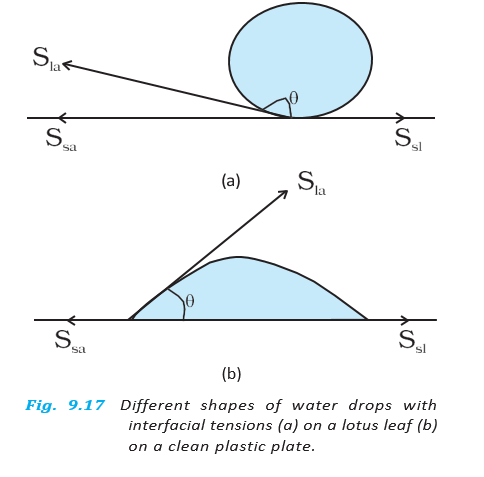
- Interfacial tensions: Let , and denote the liquid-air, solid-air and solid-liquid tensions. Force balance at the contact line gives .
- Acute angle: When , is acute; attraction between liquid and solid is stronger, favouring wetting.
- Obtuse angle: When , is obtuse; liquid molecules attract one another more strongly, so the liquid does not wet the solid.
- Examples: Water forms droplets on a waxy lotus leaf, but spreads on glass or a clean plastic plate. Mercury does not wet most surfaces; kerosene spreads readily.
Wetting agents and water-proofing
- Wetting agents: Soaps, detergents and dyeing substances reduce the contact angle, helping liquids penetrate materials.
- Water-proofing agents: They increase the contact angle between water and fibres, limiting wetting.
Drops, Bubbles and Excess Pressure
Why are drops and bubbles spherical?
- Surface energy: A liquid-air interface has energy, so a fixed volume tends towards the shape with the least surface area.
- Spherical shape: A sphere has the least surface area for a given volume; therefore, small free drops and bubbles are spherical when gravity and other forces are negligible.
Pressure difference across curved surfaces
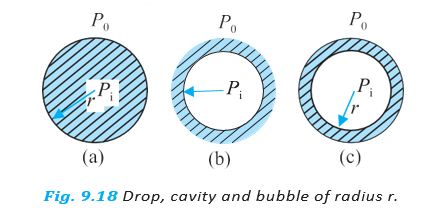
- Liquid drop: The pressure inside a spherical drop exceeds the outside pressure by .
- Air bubble in a liquid: It has one liquid-gas interface, so its inside pressure exceeds the outside pressure by .
- Soap bubble: It has two liquid-air interfaces, so the excess pressure is .
- General rule: Across a curved liquid-gas interface, the convex side is at higher pressure than the concave side.
Use for one liquid-gas interface; is its surface tension and its radius.
A soap bubble has two liquid-air interfaces.
Capillary Rise
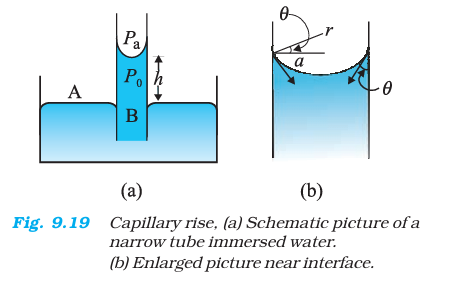
Capillary rise — The rise or fall of a liquid in a narrow tube due to surface tension and the curved liquid surface.
How capillary rise occurs
- Water in glass: Its contact angle is acute, producing a concave meniscus. Pressure just below the meniscus is less than atmospheric pressure.
- Balance: The pressure difference across the meniscus is balanced by the hydrostatic pressure of the raised liquid column.
- Tube radius: Rise increases as the tube radius decreases; in fine capillaries it can be several centimetres.
- Mercury: Its meniscus is convex and , so the liquid level is depressed rather than raised.
For tube radius , surface tension , liquid density and contact angle . A negative value indicates depression.
Example: pressure to form a bubble underwater
- Given: A capillary of diameter is dipped below water. Take , , and .
- Bubble radius: For a hemispherical bubble, equals the tube radius: .
- Outside pressure: .
- Excess pressure: A gas bubble in a liquid has one interface, so .
- Required pressure: .
Do not use for a gas bubble in a liquid: it has one interface and uses . The result applies to a soap bubble with two interfaces.
Quick recap
- The angle of contact describes the liquid-solid wetting behaviour.
- Acute contact angle favours wetting; obtuse contact angle favours droplet formation.
- Surface tension makes free drops and bubbles spherical when gravity is negligible.
- Excess pressure is for one interface and for a soap bubble.
- Capillary height is ; a negative value means depression.
Summary
Fluids: Basic Properties and Pressure
Fluid — A substance that can flow and has no resistance to change of shape; its shape is determined by its container.
| Property | Liquid | Gas |
|---|---|---|
| Compressibility | Largely incompressible | Compressible |
| Shape and volume | Has a free surface of its own | Expands to occupy all available space |
Average pressure — The normal force exerted by a fluid divided by the area on which it acts; pressure is a scalar.
Use the component of force normal to the area.
| Unit or conversion | Equivalent value |
|---|---|
| SI unit | |
| Atmosphere | |
| Bar | |
| Torr | |
| Millimetre of mercury |
Pascal’s law — Pressure at points at the same height in a fluid at rest is equal; an applied pressure change in an enclosed fluid is transmitted undiminished throughout the fluid and to the vessel walls.
Pressure in a Fluid
- Pressure exists throughout a fluid, not only at its boundaries; pressure forces on a fluid element balance when it is in equilibrium.
- Pressure with depth: pressure increases with depth in a fluid of uniform density.
- Gauge pressure is actual pressure minus atmospheric pressure; tyre and blood-pressure gauges (sphygmomanometers) measure it.
For a liquid of uniform density, with atmospheric pressure at its surface.
Gauge pressure is the pressure above atmospheric pressure.
Fluid Flow: Continuity and Bernoulli’s Principle
Continuity equation — In steady flow of an incompressible fluid through a pipe, the volume passing each cross-section per second is constant.
This relation follows from conservation of mass; is flow speed and is cross-sectional area.
Streamline — A map of fluid flow; streamlines cannot intersect in steady flow, because that would give a fluid particle two possible velocities at one point.
Bernoulli’s principle — For steady flow of a non-viscous fluid, the sum of pressure, kinetic energy per unit volume and potential energy per unit volume remains constant along a streamline.
It applies energy conservation to steady, non-viscous fluid flow; real fluids have viscosity, so the result is approximate.
Effect of Viscosity on Bernoulli’s Principle
- Viscous drag dissipates mechanical energy, converting some kinetic energy into heat.
- With viscous effects, Bernoulli’s equation alone does not describe the pressure change; energy loss must be included.
Viscosity and Stokes’ Law
Coefficient of viscosity — The ratio of shear stress to the time rate of shearing strain; it measures a fluid’s resistance to flow.
Shear Response of a Fluid
- Applied shear stress sets the fluid in motion and produces shearing strain that continues to grow with time.
- Viscosity coefficient relates the applied shear stress to the time rate of this shearing strain.
Here, is shear stress and is the time rate of shearing strain.
| Fluid | When temperature rises | Viscosity |
|---|---|---|
| Liquid | Molecules become more mobile | Decreases |
| Gas | Random molecular motion increases | Increases |
Stokes’ law — The viscous drag on a sphere increases with the fluid’s viscosity, sphere radius and speed.
This gives the magnitude of the drag force; its direction opposes the sphere’s motion.
Surface Tension and Physical Quantities
Surface tension — Force per unit length, or surface energy per unit area, acting in the plane of an interface.
Origin of Surface Tension
- Surface molecules have greater potential energy than molecules in the interior, giving the interface excess energy.
- Interface property: surface energy occurs at an interface between two substances, at least one of which is a fluid; it is not a property of a single fluid alone.
| Quantity | Symbol | Dimensions | SI unit or note |
|---|---|---|---|
| Pressure | pascal (Pa); scalar; | ||
| Density | ; scalar | ||
| Specific gravity | — | Dimensionless | ; scalar |
| Coefficient of viscosity | Pa s or poiseuille (Pl); scalar | ||
| Surface tension | ; scalar |
Pressure is not a vector: although defined using force per area, it uses only the force component normal to the area and has no direction.
State Pascal’s law.
Write Bernoulli’s equation and state when it applies.
How does temperature affect the viscosity of liquids and gases?
Quick recap
- A fluid flows and takes the shape of its container; liquids are largely incompressible, while gases expand to fill available space.
- Pressure is a scalar: , and pressure at depth is .
- Pascal’s law describes pressure transmission in enclosed fluids; gauge pressure is .
- For steady incompressible flow, is constant; streamlines do not intersect.
- Bernoulli’s equation expresses energy conservation for steady, non-viscous flow along a streamline.
- An applied shear stress makes a fluid move, so its shear strain grows with time; viscosity relates stress to strain rate.
- Viscosity gives rise to drag; Stokes’ law is .
- Surface tension is force per unit length or surface energy per unit area at an interface.
Physics — ALL CHAPTERS
1
Units And Measurement
2
MOTION IN A STRAIGHT LINE
3
MOTION IN A PLANE
4
LAWS OF MOTION
5
WORK, ENERGY AND POWER
6
SYSTEMS OF PARTICLES AND ROTATIONAL MOTION
7
GRAVITATION
8
Mechanical Properties Of Solids
9
Mechanical Properties Of Fluids
10
Thermal Properties Of Matter
11
Thermodynamics
12
Kinetic Theory
13
Oscillations
14
Waves