Class 11 PCM . Physics . Physics Part I . Systems of Particles and Rotational Motion
Chapter 6: SYSTEMS OF PARTICLES AND ROTATIONAL MOTION
Ch 6
Physics
Class 11 PCM
Introduction
Particles, Extended Bodies and Rigid Bodies
Rigid body — An ideal body whose shape remains unchanged, so the distance between every pair of its particles stays constant.
Types of Motion of a Rigid Body
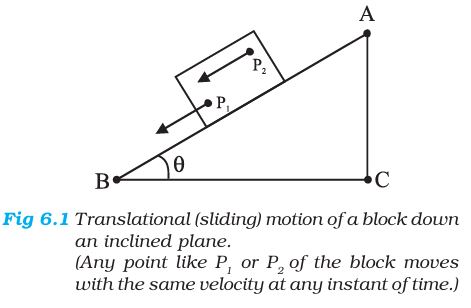
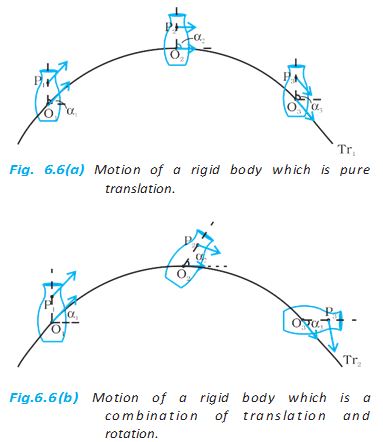
Pure translation — Motion in which every particle of a rigid body has the same velocity at any instant.
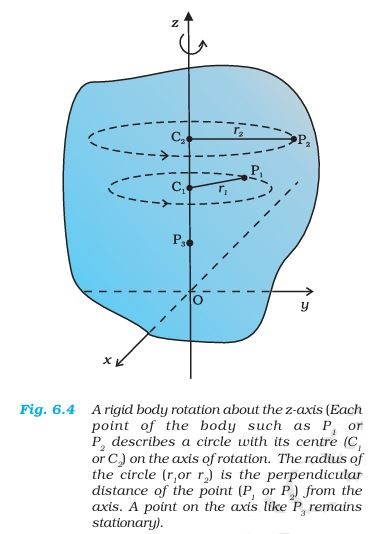
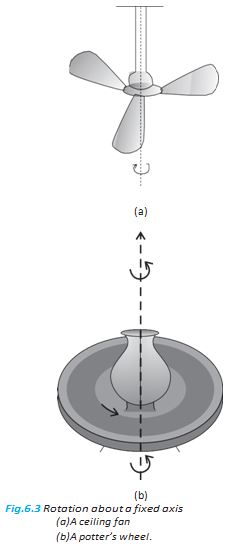
Rotation about a fixed axis — Motion in which a rigid body turns around a fixed straight line, called its axis of rotation.
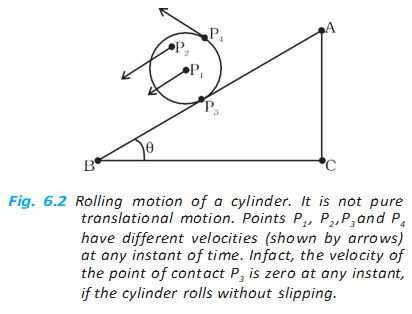
Combined translation and rotation — Motion in which a rigid body moves from place to place while also changing its orientation.
Rotation When the Axis Can Move
Moving-axis rotation
- Top: A spinning top can rotate without translating while its tilted axis moves around the vertical through its fixed contact point.
- Precession: The movement of the top’s axis around the vertical; the axis sweeps out a cone.
- Oscillating fan: Its axis turns while swinging side to side in a horizontal plane about a fixed pivot point.
- General case: One point may remain fixed while the axis moves, always passing through that point.
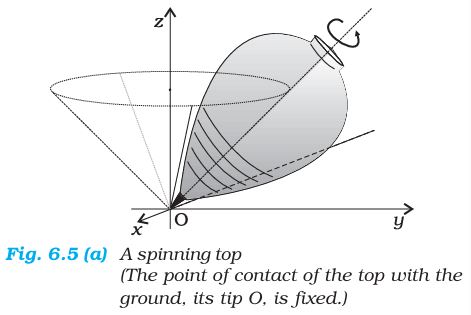
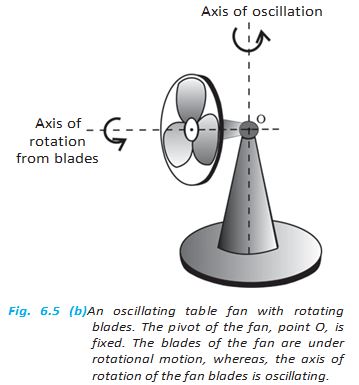
- An unconstrained rigid body may undergo pure translation or combined translation and rotation.
- If constrained so that it cannot translate, a rigid body rotates; the axis may be fixed or may move through a fixed point.
- This chapter mainly considers rotation about a fixed axis.
How can pure translation be distinguished from combined translation and rotation?
What is precession?
Quick recap
- A particle is an ideal point mass; an extended body has finite size and can be treated as a system of particles.
- A rigid body is an idealisation in which distances between all pairs of particles remain constant.
- In pure translation, all points share the same instantaneous velocity and orientation does not change.
- In rotation about a fixed axis, particles trace circles perpendicular to the axis; points on the axis remain stationary.
- Rolling combines translation and rotation; in rolling without slipping, the contact point has zero instantaneous velocity relative to the surface.
- A moving-axis rotation can occur around one fixed point; the top’s axis movement is called precession.
- The chapter mainly studies rotation about a fixed axis.
Centre Of Mass
Centre of Mass of Particles on a Line
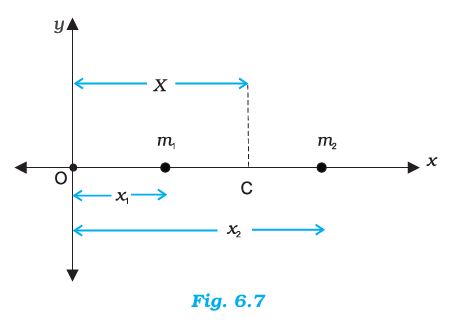
Centre of mass — The centre of mass (COM) is the mass-weighted mean position of a system; it represents the position of the system’s mass distribution.
Two particles on the x-axis
- Mass weighting: The COM lies closer to the particle with greater mass.
- Equal masses: If the two masses are equal, the COM is midway between them.
For particles at positions and with masses and :
When :
Centre of Mass in Two and Three Dimensions
Discrete particle systems
- Total mass: For particles, the total mass is .
- Coordinates: Calculate the COM coordinate separately along each axis, using the same mass-weighted average.
- Equal masses in a plane: For three equal-mass particles, the COM is the triangle’s centroid.
The position of the COM is the mass-weighted average of all particle positions.
For particles with coordinates :
For particles with coordinates :
Here, is the position vector of particle , and is the COM position vector. The sum is a vector sum.
Centre of Mass of a Continuous Body
From particles to a continuous distribution
- Rigid bodies: A rigid body contains an enormous number of closely spaced particles, so treat its mass as continuously distributed.
- Mass elements: Divide the body into small elements at positions ; their weighted sums give approximate COM coordinates.
- Continuous limit: As the elements become infinitesimally small, replace the sums by integrals; is the body’s total mass.
Use these expressions when mass is distributed continuously through a body.
Here, is the position vector of a mass element .
If the origin is at the COM, the mass-weighted position sums and integrals vanish.
Each coordinate’s mass-weighted integral is zero.
Centre of Mass and Symmetry
Homogeneous bodies
- Homogeneous body: A body whose mass is uniformly distributed.
- Symmetry result: For a homogeneous body with regular shape and suitable reflection symmetry, the COM coincides with its geometric centre.
- Examples: This applies to homogeneous thin rods, rings, discs, spheres, and thick rods with circular or rectangular cross-sections.
- Reason: Equal mass elements at opposite positions cancel in the mass-weighted position integral.
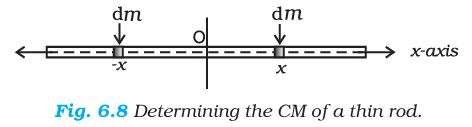
Symmetry argument for a thin rod
- Choose the rod’s geometric centre as the origin.
- For every element at , an equal element lies at .
- Their contributions to cancel.
- Therefore, the COM is at the origin, the rod’s geometric centre.
State the vector formula for the centre of mass of a system of particles.
Where is the COM of a homogeneous thin rod, and why?
Quick recap
- The COM is the mass-weighted mean position of a system.
- For particles, calculate each coordinate by dividing the mass-weighted position sum by total mass.
- For a continuous body, replace particle sums with integrals over mass elements.
- With the COM at the origin, the total mass-weighted position vector is zero.
- For homogeneous bodies with suitable symmetry, the COM is at the geometric centre.
Example Based On Centre Of Mass
Centre of Mass of Unequal Point Masses
Use for particles with masses at position vectors .
For particles in a plane, apply the weighted average separately to the and coordinates.
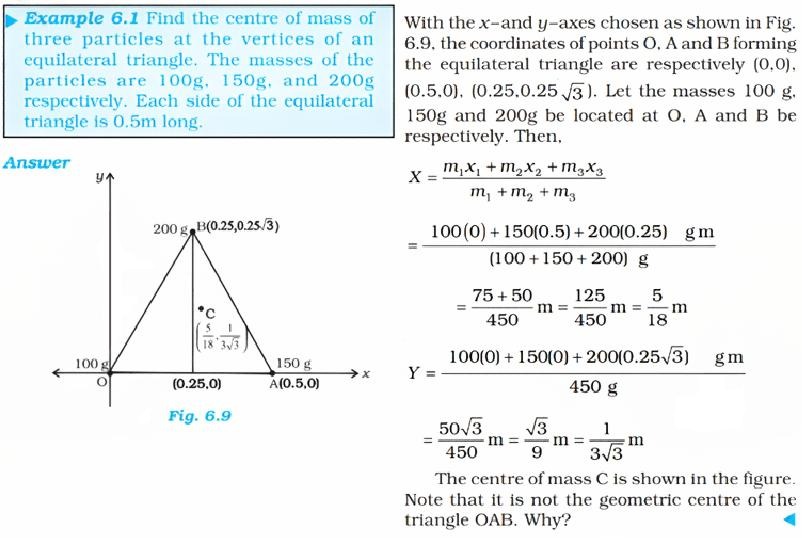
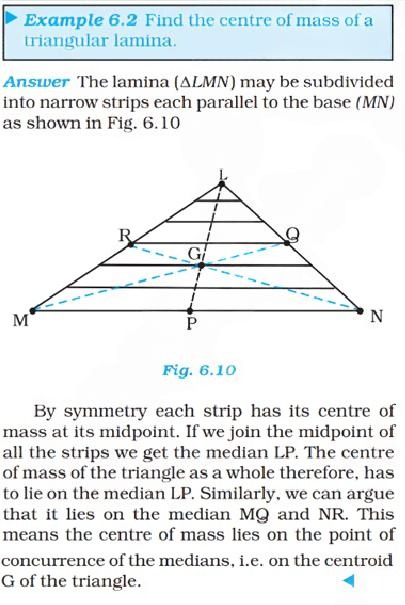
Centre of Mass of a Uniform Triangular Lamina
For triangle vertices with coordinates , and , average the corresponding coordinates.
Centre of Mass of a Composite Lamina
For three equal-mass parts with centres , the composite centre of mass is their coordinate average.
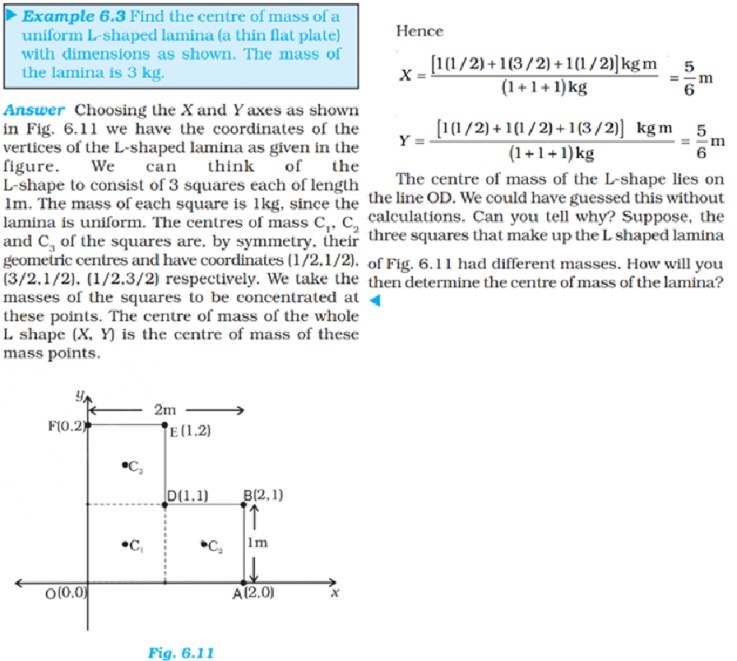
Do not take the ordinary average for unequal masses or unequal parts; weight each position by its mass.
Quick recap
- Centre of mass is the mass-weighted average position of a system.
- For point particles, calculate each coordinate using the masses as weights.
- A uniform triangular lamina has its centre of mass at the intersection of its medians.
- The centroid coordinates of a triangle are the averages of its three vertex coordinates.
- For equal parts of a composite lamina, average the coordinates of their individual centres.
Motion Of Centre Of Mass
Centre-of-Mass Relations
Here, is the total mass, and is the position of particle .
Here, is the velocity of particle and is the COM velocity.
Here, is the acceleration of particle and is the COM acceleration.
External Forces Determine COM Motion
The vector sum of all external forces acting on the system is .
Centre-of-mass equation of motion — A system’s centre of mass moves as if the entire mass were concentrated there and the total external force acted at that point.
Applying the COM Principle
- Extended bodies: Treat a body as a system of particles to find its translational motion through the COM.
- Independent of internal motion: The relation applies to particle systems with internal motion and to rigid bodies, whether translating, rotating, or doing both.
- What is needed: To determine COM motion, only the system’s total mass and external forces are required; the internal forces need not be known.
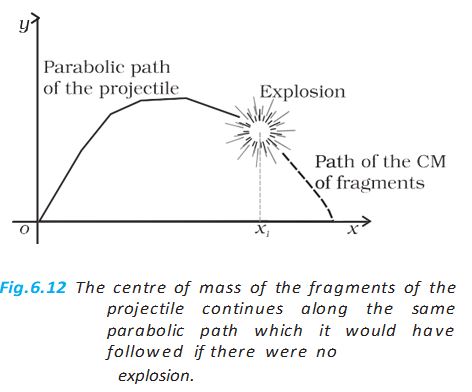
Projectile Explosion Example
- Before and after the explosion: The explosion forces are internal, so they do not change the COM motion.
- External force: Gravity is the external force and remains the same; therefore the COM follows the same parabolic trajectory it would have followed without the explosion.
State the equation of motion of the centre of mass and explain its significance.
Why do internal forces not affect the motion of a system’s centre of mass?
Quick recap
- The COM position is the mass-weighted average of particle positions.
- COM velocity and acceleration are the corresponding mass-weighted averages.
- The equation of COM motion is .
- Internal forces cancel in the total force on a system.
- COM motion can be found without analysing internal forces or rotational motion.
- A projectile’s COM follows its original path even when the projectile explodes.
Linear Momentum Of A System Of Particles
Momentum of a System
Linear momentum — A particle’s linear momentum is the product of its mass and velocity: .
Particle and system momentum
- Newton’s second law: The net force on a particle is the rate of change of its momentum: .
- Total linear momentum: The momentum of a system is the vector sum of the momenta of all its particles.
- Total mass: For particles of masses , the system’s mass is .
Connection to the Centre of Mass
- Centre-of-mass relation: Total momentum equals total mass multiplied by the centre-of-mass velocity: .
- Constant mass: For a system whose total mass remains constant, differentiation gives .
Newton’s Second Law for a System
- External force: The net external force equals the rate of change of the system’s total momentum.
- Internal forces: Particles may interact and have complex individual motions; the change in total system momentum is determined by the net external force.
Conservation of Total Linear Momentum
Law of conservation of total linear momentum — If the net external force on a system is zero, its total linear momentum remains constant.
- Condition: The net external force must be zero; internal interactions may still occur.
- Centre-of-mass motion: With constant total mass, constant momentum means the centre of mass moves at constant velocity in a straight line.
- Components: Momentum conservation means each Cartesian component remains constant.
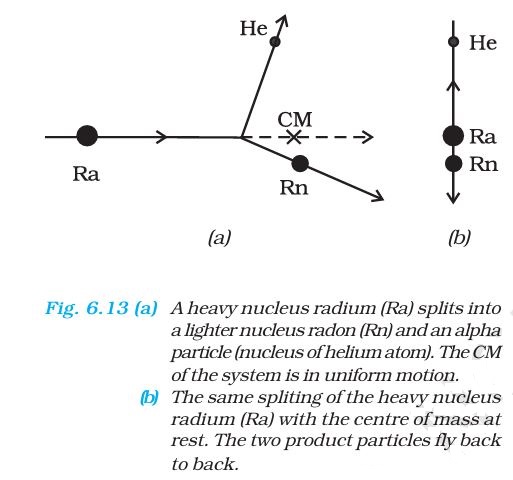
Example: Radioactive Decay
- System: A radium nucleus decays into a radon nucleus and an alpha particle; external forces are negligible.
- Momentum: Total momentum before and after decay is the same, so the products’ momenta together equal the original nucleus’s momentum.
- Centre-of-mass frame: The products move back-to-back when viewed in this frame, and their centre of mass remains at rest.
- Moving original frame: The centre of mass follows the original nucleus’s path; the products’ directions are not necessarily opposite in this frame.
Centre-of-Mass Frame and System Motion
- Centre-of-mass frame: A reference frame in which the centre of mass is at rest; it can simplify the description of motion within a system.
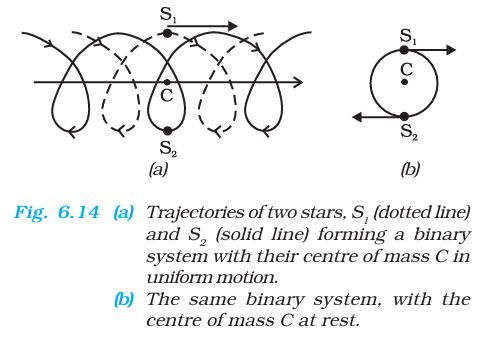
- Binary stars: With no external force, a double star’s centre of mass moves uniformly. In the centre-of-mass frame, two equal-mass stars orbit in circles on opposite sides of the stationary centre of mass.
- Motion decomposition: Each part’s motion can be described as the motion of the centre of mass plus its motion relative to the centre of mass.
State the law of conservation of total linear momentum.
How is total momentum related to the centre-of-mass velocity?
Quick recap
- A particle’s momentum is ; system momentum is the vector sum of all particle momenta.
- For constant total mass, .
- The net external force equals the rate of change of total system momentum.
- If the net external force is zero, total momentum and each Cartesian component are constant.
- With no net external force, the centre of mass moves uniformly in a straight line.
- The centre-of-mass frame simplifies internal motion, such as decay products and binary-star orbits.
Vector Product Of Two Vectors
Definition and Direction
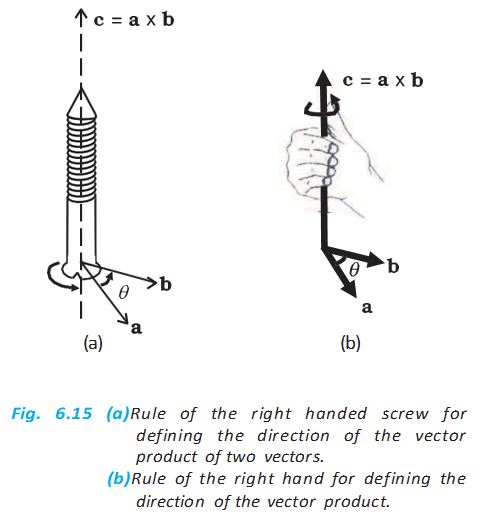
Vector product (cross product) — For vectors and , their vector product is , a vector perpendicular to their plane with magnitude .
Magnitude and direction
- Magnitude: , where and are vector magnitudes and is the smaller angle between them.
- Direction: The result is perpendicular to the plane containing and .
- Right-hand rule: Curl your right-hand fingers from towards through the smaller angle; your thumb gives the direction of .
- Applications: Moment of a force and angular momentum are defined using vector products.
Properties of the Vector Product
- Not commutative: Reversing the order keeps the magnitude but reverses the direction: .
- Parallel vectors: If or , then .
- Self-product: , because the angle between a vector and itself is .
- Distributive: .
- Reflection: Under reflection, both vectors change sign; , so the cross product does not change sign.
| Property | Scalar product | Vector product |
|---|---|---|
| Result | Scalar | Vector |
| Order | ||
| Distributive law |
Unit-Vector Products and Components
Products of Cartesian unit vectors
- Zero products: .
- Positive cyclic order: , , and .
- Reverse order: Reversing a cyclic pair makes the result negative: , , and .
For and :
Expand along the first row to obtain the component form.
Example: Scalar and vector products
- Given: and .
- Scalar product: .
- Vector product: ; reversing the order gives .
Do not treat the cross product as commutative: swapping the vectors changes the sign. The source example's stated conflicts with its worked solution; the solution uses , as shown here.
State the magnitude and direction of .
Why is ?
Quick recap
- The cross product has magnitude and points perpendicular to the plane of its vectors.
- Use the right-hand rule, turning from the first vector to the second through the smaller angle.
- The cross product is anti-commutative and distributive over vector addition.
- A vector crossed with itself is zero; parallel vectors also have zero cross product.
- Cartesian unit-vector products are positive in cyclic order and negative in reverse order.
- Use the component formula or determinant to calculate a cross product.
Angular Velocity And Its Relation With Linear Velocity
Angular Velocity
The magnitude of instantaneous angular velocity is denoted by .
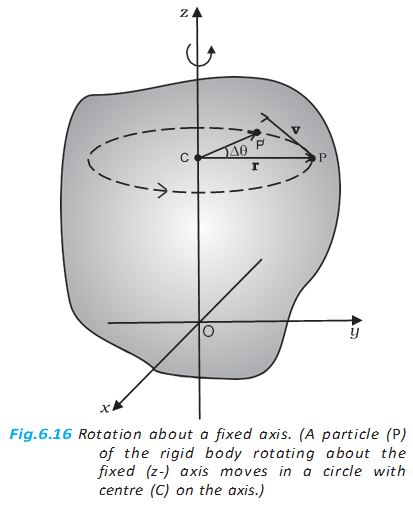
Angular Velocity of a Rigid Body
For particle , is its perpendicular distance from the axis.
Angular Velocity as a Vector
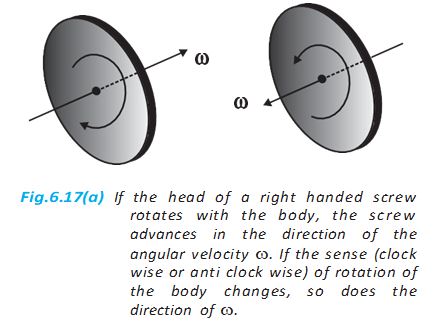
Vector Relation Between Linear and Angular Velocity
Here, is the position vector from the chosen origin; is the perpendicular distance from the axis.
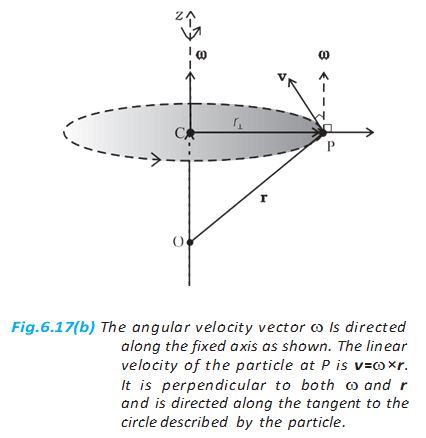
Where the vector relation applies
- Fixed axis: The relation applies to each particle of a rigid body rotating about a fixed axis.
- One fixed point: It also applies to a rigid body rotating with one point fixed, such as a top; take the fixed point as the origin.
Angular Acceleration
For rotation about a fixed axis, use the scalar form.
State the relation between linear velocity and angular velocity in vector form.
Define angular acceleration.
Quick recap
- Instantaneous angular velocity is .
- In fixed-axis rotation, every particle of a rigid body has the same angular velocity.
- A particle’s linear speed is ; particles on the axis have zero speed.
- Angular velocity points along the rotation axis according to the right-hand screw rule.
- The vector relation is , with .
- Angular acceleration is the rate of change of angular velocity: .
Torque And Angular Momentum
Moment of Force (Torque)
Torque (moment of force) — The rotational analogue of force, defined for a force acting at position relative to an origin.
- Application matters: Torque depends on the force’s magnitude, direction and point of application.
- Door example: A force at the hinge line produces no rotation; a perpendicular force at the outer edge is most effective.
- Vector direction: Torque is perpendicular to the plane containing and ; its direction follows the right-hand rule.
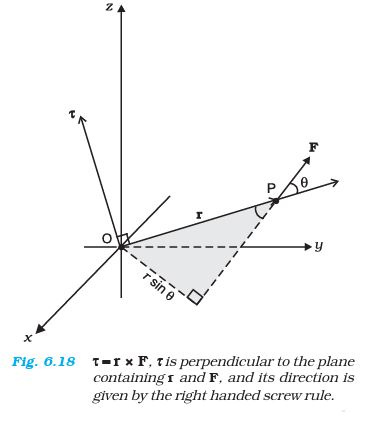
Here, is the angle between and ; is the perpendicular distance from the origin to the force’s line of action, and is the component of force perpendicular to .
Torque: units and special cases
- SI unit: newton metre (); dimensions are .
- Zero torque: if , , or or ; in the last cases, the force’s line of action passes through the origin.
- Direction changes: Reversing either or reverses torque; reversing both leaves its direction unchanged.
- Not work: Torque and work share dimensions, but torque is a vector while work is a scalar.
Angular Momentum of a Particle
Angular momentum — The rotational analogue of linear momentum: a particle’s moment of linear momentum about an origin.
Here, is the angle between and ; is the perpendicular distance from the origin to the momentum’s line of direction, and is the component of perpendicular to .
When angular momentum is zero
- Zero value: if , , or the momentum’s line of direction passes through the origin ( or ).
- Direction: is perpendicular to the plane containing and .
Torque and Rate of Change of Angular Momentum
Single-particle relation
- Differentiate: Apply the product rule to : .
- Momentum relation: For a particle of mass , .
- First term vanishes: , because velocity and momentum are parallel.
- Second term: , using .
The time rate of change of a particle’s angular momentum equals the torque acting on it; this is the rotational analogue of .
When is the torque on a particle zero?
State the relation between torque and angular momentum.
Quick recap
- Torque is the vector product of position and force: .
- Torque magnitude depends on the perpendicular lever arm: .
- Angular momentum is the vector product of position and linear momentum: .
- For a particle, ; is the component of momentum perpendicular to .
- Angular momentum vanishes if momentum is zero or its line of direction passes through the origin.
- For a particle, torque is the rate of change of angular momentum: .
Torque And Angular Momentum For A System Of Particles
Angular Momentum of a System
Total angular momentum — The total angular momentum of a system about a chosen origin is the vector sum of the angular momenta of all its particles.
Particle and system angular momentum
- Particle angular momentum: For particle , use its position vector and linear momentum measured from the same origin.
- Vector sum: Add the individual angular momenta vectorially; their directions matter.
Here, is the position vector from the origin and is the particle's linear momentum.
Sum the angular momentum of every particle in the system.
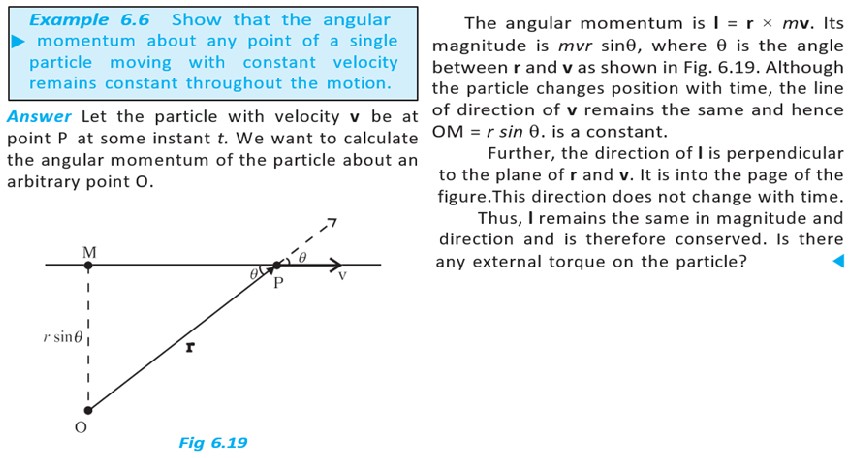
Torque and Change in Angular Momentum
Torque on the system
- Particle torque: The torque on particle about the chosen origin is .
- Forces on a particle: is the vector sum of external forces and forces exerted by the other particles (internal forces).
- Total torque: It is the vector sum of the torques on all particles: .
The torques are calculated about the same origin.
Why internal torque cancels
- Assumptions: Forces between each pair of particles are equal and opposite (Newton's third law) and act along the line joining the particles.
- Result: The torques from each internal action–reaction pair cancel, so and the total torque is .
The time rate of change of total angular momentum equals the net external torque. This holds for rigid bodies and for systems with any kind of internal motion.
Conservation of Angular Momentum
Condition for conservation
- Zero net external torque:
- Therefore,
- Hence, total angular momentum remains constant:
Conservation of the vector means each of its three components remains constant.
| Quantity | Rotational law | Translational law |
|---|---|---|
| System quantity | Total angular momentum | Total linear momentum |
| Rate of change | ||
| Conservation condition | If , then is constant. | If , then is constant. |
Example: Torque from Position and Force
Find the torque about the origin
- Given: and .
- Use: .
- Calculation: .
- Answer: .
Quick recap
- Total angular momentum is the vector sum .
- Torque on a particle is .
- For pairwise equal, opposite, central internal forces, internal torques cancel and .
- The system law is .
- If external torque is zero, total angular momentum and each of its components are conserved.
Equilibrium Of A Rigid Body
Mechanical Equilibrium
Mechanical equilibrium — A rigid body is in mechanical equilibrium when its linear and angular momenta remain constant; it has no linear or angular acceleration.
- Net force changes a body's linear momentum and translational motion.
- Net torque changes a body's angular momentum and rotational motion.
- Complete equilibrium requires both the net force and the net torque to be zero.
| Condition | Equilibrium type |
|---|---|
| Net force is zero | Translational equilibrium |
| Net torque is zero | Rotational equilibrium |
| Both are zero | Mechanical equilibrium |
The vector sum of all forces on the body must vanish.
The vector sum of all torques on the body must vanish.
- Origin independence: If the net force is zero, the rotational-equilibrium condition holds regardless of the origin chosen for calculating torques.
- Why both matter: Zero net force prevents linear acceleration; zero net torque prevents angular acceleration.
Scalar Conditions and Particles
Three-Dimensional Conditions
- Force balance: Each of the three force components must sum to zero.
- Torque balance: Each of the three torque components must sum to zero.
- Total: These give six independent scalar conditions for rigid-body equilibrium.
The force balance must hold along all three coordinate axes.
The torque balance must hold along all three coordinate axes.
Coplanar Forces
- Force balance: For forces in one plane, the sums of force components along two perpendicular in-plane axes must be zero.
- Torque balance: The sum of torque components about the axis perpendicular to the plane must be zero.
- Total: Coplanar rigid-body problems need three scalar equilibrium conditions.
| Point | Particle | Rigid body |
|---|---|---|
| Equilibrium conditions | Only translational equilibrium applies. | Both translational and rotational equilibrium may apply. |
| Force arrangement | Forces act at one point and are concurrent. | Forces may act at different points and produce torque. |
Partial Equilibrium and Couples
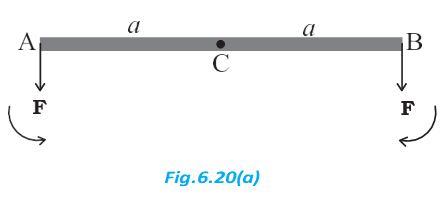
Partial equilibrium — A body is in partial equilibrium when it satisfies either the translational or rotational condition, but not both.
- Equal, same-direction forces at opposite ends: Their torques about the midpoint cancel, but their resultant force is nonzero; the rod has rotational but not translational equilibrium.
- Equal, opposite forces at opposite ends: The resultant force is zero, but the torques act in the same rotational sense; the rod has translational but not rotational equilibrium and can rotate without translating.
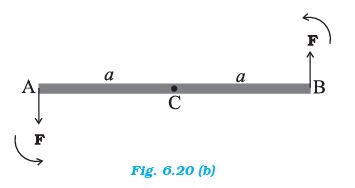
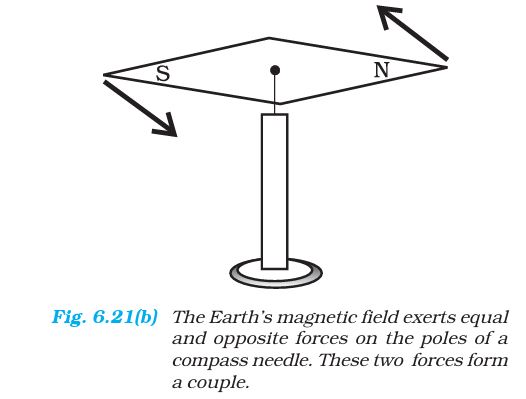
Couple — A pair of equal and opposite forces with different lines of action; it produces rotation without translation.
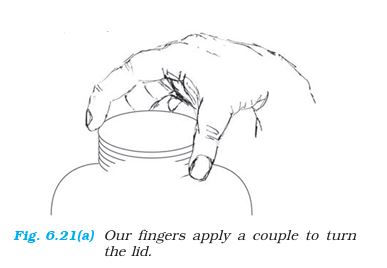
Examples of Couples
- Bottle lid: Fingers exert forces that turn the lid.
- Compass needle: Earth’s magnetic field exerts equal, opposite forces on its north and south poles. Except when the needle points north–south, their lines of action differ and produce a couple.
Levers and the Principle of Moments
Ideal lever — A light rod pivoted at a point along its length, called the fulcrum.
- Forces: The load and effort act on the lever; the support at the fulcrum provides a reaction opposite to their combined direction.
- Reaction torque: The fulcrum reaction has zero moment about the fulcrum because it acts at that point.
- Sign convention: Anticlockwise moments are usually positive and clockwise moments negative.
- Examples: A seesaw and a balance beam are levers.
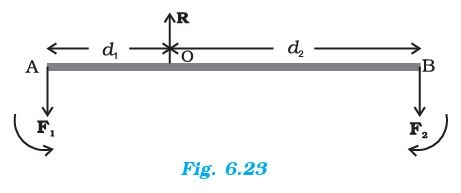
| Term | Meaning |
|---|---|
| Fulcrum | Point where the lever is pivoted. |
| Load | Force or weight to be lifted; in the diagram, this is . |
| Load arm | Distance from the fulcrum to the load; in the diagram, this is . |
| Effort | Applied force used to lift the load; in the diagram, this is . |
| Effort arm | Distance from the fulcrum to the effort; in the diagram, this is . |
For the downward forces shown, the support reaction balances their total.
At rotational equilibrium, the load and effort moments about the fulcrum balance. This remains valid when the forces are not perpendicular to the lever.
- In words: Load arm × load = effort arm × effort.
Mechanical advantage — The ratio of load to effort; a value greater than one means a smaller effort can lift a larger load.
For a balanced lever, mechanical advantage equals the effort-arm to load-arm ratio.
What are the conditions for mechanical equilibrium of a rigid body?
What is a couple, and what does it produce?
State the principle of moments for a balanced lever.
Quick recap
- Mechanical equilibrium requires zero net force and zero net torque.
- Three-dimensional rigid-body equilibrium gives six scalar conditions; coplanar equilibrium needs three.
- A particle requires only force balance; a rigid body may also rotate.
- A couple has equal, opposite forces on different lines of action and causes rotation without translation.
- For a balanced lever, load arm × load = effort arm × effort.
- Mechanical advantage is load divided by effort, equal to effort arm divided by load arm.
Centre Of Gravity
Meaning and Mechanical Equilibrium
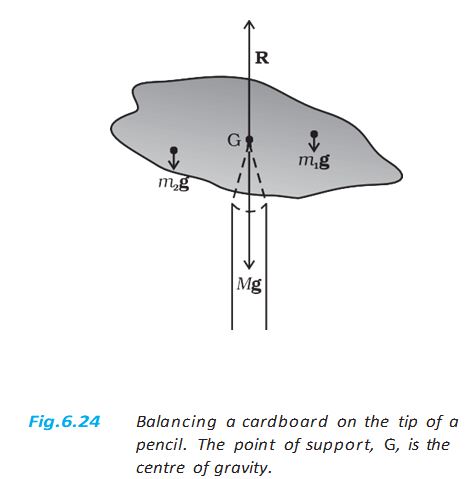
Centre of gravity (CG) — The point of a body about which the total gravitational torque is zero.
Balancing a body
- Balance point: An irregular cardboard balances horizontally when supported at its CG.
- Translational equilibrium: The upward support reaction balances the body's weight, so the net force is zero.
- Rotational equilibrium: The net torque is zero; otherwise, the body would tilt and fall.
- Distributed gravity: Each particle experiences a gravitational force, such as ; their torques about the CG sum to zero.
Gravitational Torque and Centre of Mass
- Position vector: Let be the position vector of particle measured from the CG.
- Torque: The gravitational torque on particle about the CG is .
- Uniform gravitational field: Since is the same for every particle, it factors out of the total-torque sum.
- Result: For non-zero uniform , zero total torque gives . This is the centre-of-mass condition when the origin is at the CG.
| Point | Centre of gravity | Centre of mass |
|---|---|---|
| Meaning | Point where total gravitational torque is zero | Point determined only by the body's mass distribution |
| Dependence | Depends on the gravitational field | Independent of gravity |
| Uniform gravity | Coincides with the centre of mass for a small body | Coincides with the centre of gravity |
| Gravity-free space | Coincides with the centre of mass | Coincides with the centre of gravity |
| Varying gravity | May not coincide with the centre of mass | Remains set by the mass distribution |
Key consequence
- Small bodies: The gravitational field is approximately uniform across the body, so CG and centre of mass coincide.
- Gravity-free space: The lecture states that the CG coincides with the centre of mass in gravity-free space as well as in uniform gravity.
- Extended bodies in varying gravity: The field differs across the body, so CG and centre of mass can be at different points.
- Regular, homogeneous bodies: Their centre of mass gives their CG when the body is small enough for gravity to be treated as uniform.
Locating the CG of an Irregular Body
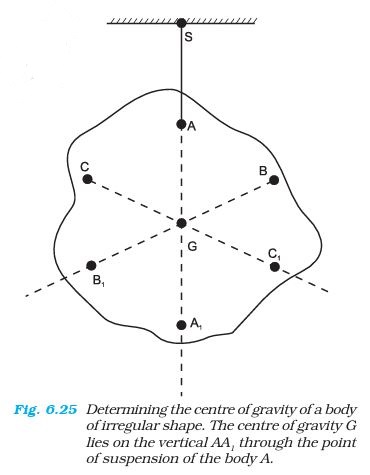
Suspension method
- Suspend the body from a point and mark the vertical line through the suspension point.
- Suspend it from a second point and mark the new vertical line.
- The intersection of the vertical lines locates the CG; repeat from another point if needed.
Why the method works
- Equilibrium when suspended: The CG lies on the vertical line through the suspension point; otherwise, gravity would produce a turning torque.
- Intersection: Vertical lines marked from different suspension points meet at the CG.
- Centre of mass: For a small body in uniform gravity, this method also locates its centre of mass.
When do the centre of gravity and centre of mass coincide?
How can the CG of an irregular body be found by suspension?
Quick recap
- The CG is the point about which the total gravitational torque is zero.
- A body balanced at its CG is in both translational and rotational equilibrium.
- In uniform gravity, the CG coincides with the centre of mass; the lecture also states they coincide in gravity-free space.
- The centre of mass depends on mass distribution, not on gravity.
- If gravity varies across an extended body, its CG and centre of mass may differ.
- The intersection of verticals from different suspension points locates the CG.
Moment Of Inertia
Rotational Kinetic Energy and Moment of Inertia
For particles with masses at perpendicular distances from the axis.
The total kinetic energy of a rigid body rotating about a fixed axis.
| Point | Translation | Rotation about a fixed axis |
|---|---|---|
| Kinetic energy | ||
| Inertia measure | Mass | Moment of inertia |
| Motion variable | Velocity | Angular velocity |
Examples and Standard Values
Simple examples
- Thin ring: Every part of a ring of mass and radius lies at distance from the central perpendicular axis, so .
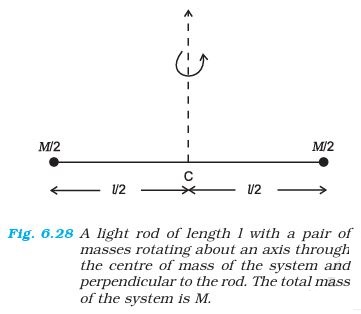
- Two end masses: Two masses at the ends of a negligible-mass rod of length , rotating about its midpoint, have .
| Body | Axis | Moment of inertia |
|---|---|---|
| Thin circular ring, radius | Perpendicular to plane, through centre | |
| Thin circular ring, radius | Along a diameter | |
| Thin rod, length | Perpendicular to rod, through midpoint | |
| Circular disc, radius | Perpendicular to disc, through centre | |
| Circular disc, radius | Along a diameter | |
| Hollow cylinder, radius | Along cylinder axis | |
| Solid cylinder, radius | Along cylinder axis | |
| Solid sphere, radius | Along a diameter |
Rotational Inertia and Radius of Gyration
What affects moment of inertia?
- Rotational inertia: For a chosen axis, moment of inertia measures resistance to a change in rotational motion.
- Mass distribution: Unlike mass, is not fixed for a body; it depends on mass distribution, shape and size, and the axis's position and orientation.
- Radius of gyration: The distance from the axis to a point mass equal to the body's total mass, whose moment of inertia equals that of the whole body.
Here is the body's total mass; depends on the body's geometry and the chosen axis.
Examples of radius of gyration
- Thin rod: About an axis perpendicular to the rod through its midpoint, , so .
- Circular disc: About a diameter, , so .
Units and practical use
- Dimensions: From , the dimensions are and the SI unit is .
- Flywheel: Engines use a disc with large moment of inertia; it resists sudden speed changes, enabling gradual changes and smoother motion.
Why is moment of inertia called the rotational analogue of mass?
Quick recap
- Definition: ; it depends on the body's mass distribution and the chosen axis.
- Energy: Rotational kinetic energy is .
- Analogy: Moment of inertia plays the role of mass in rotational motion.
- Examples: A thin ring about its central perpendicular axis has ; two equal end masses on a light rod have about the midpoint.
- Radius of gyration: , where is the equivalent distance of the body's total mass from the axis.
- Units and use: Dimensions are , SI unit is ; flywheels smooth sudden changes in rotational speed.
Kinematics Of Rotational Motion About A Fixed Axis
Rotational motion about a fixed axis
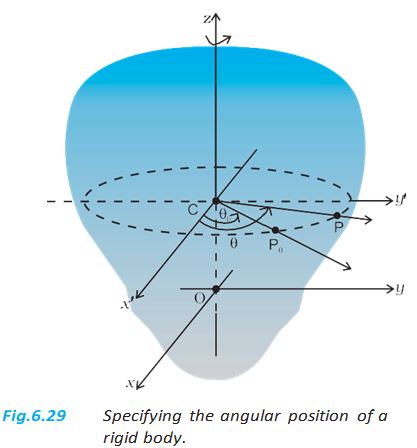
Angular velocity and angular acceleration
Angular displacement changes at this rate.
Angular velocity changes at this rate.
Equations for uniform angular acceleration
Use when time and constant angular acceleration are known.
Use when time is known.
Use when time is not given.
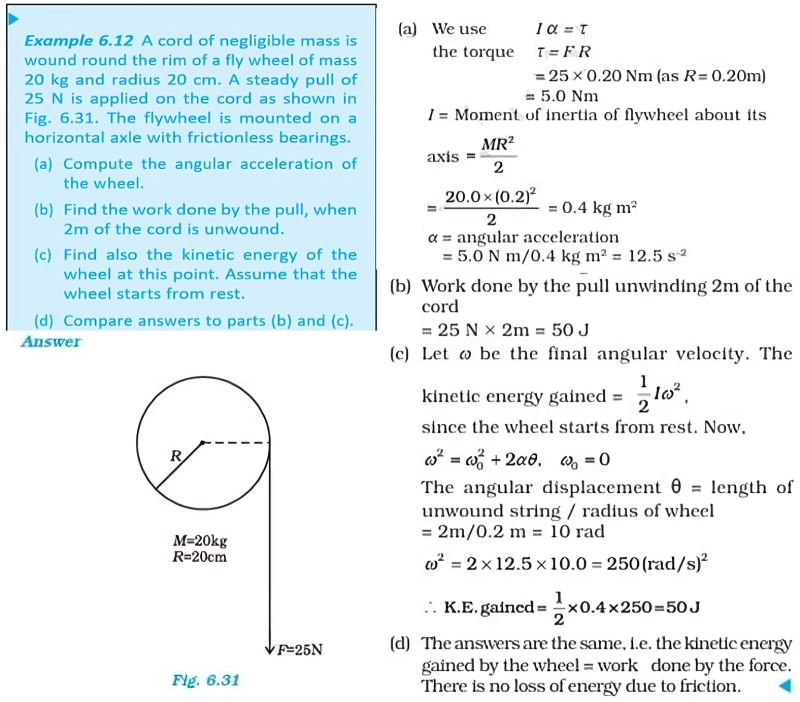
Example: motor wheel
Do not use rpm directly in rotational kinematics with seconds: convert to rad/s first, and express angular displacement in radians when finding revolutions.
Quick recap
- Fixed-axis rotation has one degree of freedom and is described by angular position θ.
- Angular velocity is ω = dθ/dt; angular acceleration is α = dω/dt.
- For constant α, use the three rotational kinematic equations.
- The rotational quantities θ, ω and α correspond to translational x, v and a.
- Convert rpm to rad/s using ω = 2π × rpm/60.
Dynamics Of Rotational Motion About A Fixed Axis
Linear and Rotational Motion: Analogies
| Linear motion | Rotation about a fixed axis |
|---|---|
| Displacement: | Angular displacement: |
| Velocity: | Angular velocity: |
| Acceleration: | Angular acceleration: |
| Mass: | Moment of inertia: |
| Newton's second law: | Rotational law: |
| Work: | Work: |
| Kinetic energy: | Rotational kinetic energy: |
| Power: | Power: |
| Linear momentum: | Angular momentum: |
Torque Components for a Fixed Axis
Which forces and positions matter?
- Relevant torque: Only torque components along the fixed axis cause rotation about that axis.
- Perpendicular torque: It would tend to tilt the axis; constraint forces are assumed to cancel its effect.
- Forces to include: Consider forces in planes perpendicular to the axis. Forces parallel to the axis produce torque perpendicular to it.
- Position vectors: Use only components perpendicular to the axis; components along it produce torque perpendicular to the axis.
Work Done by a Torque
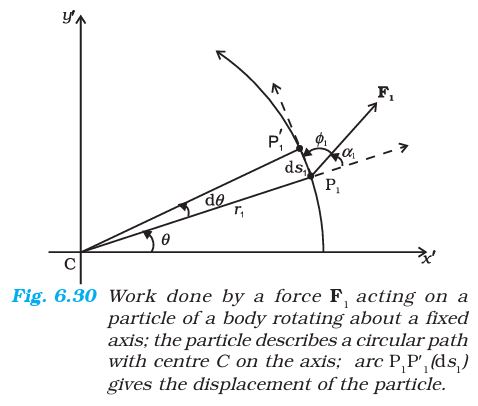
Work from one force
- Circular displacement: For a particle at perpendicular distance from the axis, a small angular displacement gives tangential displacement .
- Torque magnitude: If is the angle between the force and the radius vector, then .
- Work element: Only the tangential component of force does work, so , where .
For rotation through a small angle, the work done by the total external torque is:
Adding torques
- Common angular displacement: Every particle of the rigid body undergoes the same about the fixed axis.
- Total torque: Since the torques lie along the same axis, their signed magnitudes add algebraically: .
- Total work: The work contributions add, giving .
Power in Rotational Motion
Power is the rate of doing work; compare with linear power .
Rotational Form of Newton's Second Law
Torque and angular acceleration
- Rigid-body energy: With no internal motion, the work of external torques increases the body's rotational kinetic energy.
- Constant moment of inertia: Assume stays constant; the body remains rigid and the rotation axis keeps the same position relative to the body.
- Rate of kinetic-energy increase: For , .
- Equating rates: Since and the work rate increases kinetic energy, , giving .
Torque produces angular acceleration; for a given torque, a larger moment of inertia gives a smaller angular acceleration.
| Point | Linear motion | Rotation about a fixed axis |
|---|---|---|
| Driving interaction | Force produces acceleration | Torque produces angular acceleration |
| Law | ||
| Inertia | Mass resists change in linear motion | Moment of inertia resists change in rotational motion |
State the work and power relations for rotation about a fixed axis.
How is Newton's second law expressed for rotation about a fixed axis?
Quick recap
- Fixed axis: Only torque components along the axis are relevant to rotation about it.
- Work: A torque acting through angular displacement does work according to .
- Total torque: Signed torques along the axis add algebraically, and all body particles share the same angular displacement.
- Power: Rotational power is .
- Rotational dynamics: For constant , torque and angular acceleration are related by .
- Analogy: Moment of inertia plays the rotational role of mass, while torque plays the role of force.
Angular Momentum In Case Of Rotation About A Fixed Axis
Angular Momentum of a Particle
Angular momentum — For a particle, angular momentum about a point is the vector product of its position vector and linear momentum: .
Add the angular momenta of all particles in the system.
Particle rotating about a fixed axis
- Position split: Write , where is the projection of the particle onto the fixed axis.
- Velocity: The particle moves tangentially, with speed ; is its perpendicular distance from the axis.
- Axis component: The term is parallel to the axis, whose unit vector is .
- Particle result: , while the remaining term is .
A particle’s angular momentum is not necessarily parallel to the rotation axis or angular velocity; only its axis component is necessarily along the axis.
Angular Momentum of a Rigid Body
Summing the particles’ axis components gives the rigid body’s angular momentum along the fixed axis.
Moment of inertia — For rotation about the chosen axis, , where is each particle’s perpendicular distance from that axis.
The total vector includes both its component along the axis and its component perpendicular to it.
Effect of body symmetry
- Symmetric body: For each moving particle, a diametrically opposite particle has opposite velocity; their perpendicular angular-momentum contributions cancel.
- Result: For a body symmetric about its rotation axis, and .
- Non-symmetric body: In general, ; therefore and total angular momentum is not along the rotation axis.
Torque and Angular Momentum About a Fixed Axis
Torque–angular momentum relation
- General law: The time rate of change of total angular momentum about a point equals the total external torque about that same point: .
- Fixed-axis rotation: Only the external torque component along the fixed axis affects the rotation about that axis.
- Components: For torque , and ; the perpendicular component stays constant.
Since is fixed, gives . For a rigid body with constant , this becomes the fixed-axis form of Newton’s second law for rotation.
Conservation of Angular Momentum
If the net external torque along the axis is zero, the angular momentum component along that axis remains constant. For symmetric bodies, this also means the total angular momentum is constant.
Changing body shape while spinning
- Arms stretched out: Moment of inertia increases, so angular speed decreases to keep constant.
- Arms pulled in: Moment of inertia decreases, so angular speed increases.
- Examples: A person spinning on a swivel chair, acrobats, divers, skaters and dancers use this principle when changing body posture.
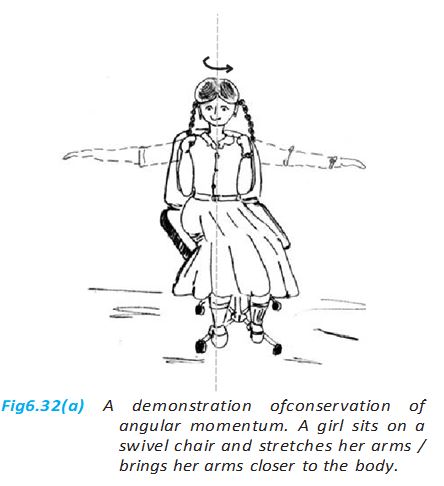
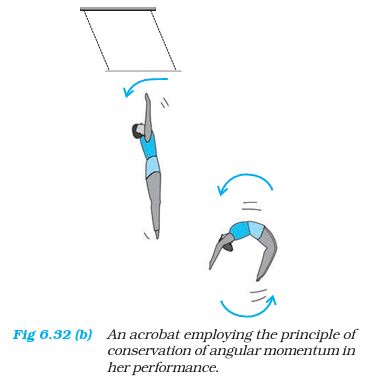
Why does a spinning person rotate more slowly when they stretch their arms outward?
When is total angular momentum parallel to the fixed rotation axis?
Quick recap
- A particle’s angular momentum is ; it need not point along the rotation axis.
- For a rigid body, , with .
- For a symmetric body, perpendicular contributions cancel and ; for a non-symmetric body, they may not.
- The fixed-axis rotational equation is when is constant.
- With zero external torque along the axis, is conserved.
- Increasing slows rotation; decreasing speeds it up when angular momentum is conserved.
Summary And Points To Ponder
Rigid Bodies and Types of Motion
Ideal rigid body — A body whose particles remain at fixed distances from one another, even when forces act on it.
| Condition | Possible motion | Key feature |
|---|---|---|
| Fixed at a point or along a line | Rotation only | For a fixed axis, each particle moves in a circle in a plane perpendicular to the axis; each circle's centre lies on the axis. |
| Not fixed | Pure translation, or translation combined with rotation | In pure translation, every particle has the same velocity at each instant. |
Angular Velocity and Rotational Velocity
- Angular velocity is a vector along the rotation axis; for rotation about a fixed axis, its direction stays fixed.
- Rigid-body rotation gives every point the same angular velocity at any instant.
- Linear velocity of a particle depends on its position vector from an origin on the axis (or the fixed point).
Magnitude of angular velocity.
Vector (cross) product — The cross product of vectors and is a vector perpendicular to both, with direction set by the right-hand rule.
Here, is the angle between the vectors.
For fixed-axis rotation, is measured from an origin on the axis; with one fixed point, measure it from that point.
Centre of Mass and Linear Momentum
Centre of mass — The point whose position is the mass-weighted average of the positions of all particles in the system.
For particles, is the total mass.
is the system's total linear momentum.
Centre-of-Mass Motion
- External forces only: The centre of mass moves as if the entire mass were concentrated there and all external forces acted at that point.
- Internal forces: They are not needed to determine centre-of-mass motion.
- Momentum conservation: If the total external force is zero, the system's total linear momentum remains constant.
Angular Momentum and Torque
Angular momentum about an origin for a system of particles.
The force on each particle includes external and internal forces.
Angular-Momentum Principle
- Internal torque cancellation: Internal forces give zero net torque when Newton's third law holds and each pair of forces acts along the line joining the particles.
- External torque: The rate of change of total angular momentum equals the total external torque.
This result relies on Newton's second law and on the stated condition for internal forces.
Equilibrium and Centre of Gravity
Mechanical equilibrium — A rigid body is in mechanical equilibrium when it is in both translational and rotational equilibrium.
| Condition | Requirement |
|---|---|
| Translational equilibrium | Net external force is zero: . |
| Rotational equilibrium | Net external torque is zero: . |
Centre of gravity — The point about which the total gravitational torque on an extended body is zero.
Centre of Gravity and Centre of Mass
- Coincidence: The centre of gravity coincides with the centre of mass only when the gravitational field is uniform across the body.
- Changing field: If gravity varies from one part of the body to another, the two points need not coincide.
Moment of Inertia and Rotational Energy
Moment of inertia — A body's rotational inertia about an axis, determined by the masses and their perpendicular distances from that axis.
is the perpendicular distance of the th particle from the axis.
For a rigid body rotating with angular speed .
| Quantity | Symbol | Dimensions | SI unit | Key relation |
|---|---|---|---|---|
| Angular velocity | ||||
| Angular momentum | ||||
| Torque | ||||
| Moment of inertia |
Motion and Energy of a Particle System
Centre-of-Mass Decomposition
- Useful viewpoint: Separate a system's motion into translation of its centre of mass and motion relative to that centre.
- Kinetic energy: Total kinetic energy is the centre-of-mass kinetic energy plus the kinetic energy measured about the centre of mass.
is the kinetic energy relative to the centre of mass; is the centre-of-mass speed.
Key Conditions and Relations
| Point | Zero net force | Zero net torque |
|---|---|---|
| Effect | Ensures translational equilibrium | Ensures rotational equilibrium |
| Independence | Can hold without zero net torque | Can hold without zero net force |
| Example | A couple has zero total force | A couple can still have non-zero total torque |
Dependence on Newton's Laws and Origin
- Newton's laws for systems: Applying Newton's second law to a finite-sized body or particle system also depends on Newton's third law for its particles.
- Angular momentum balance: Deriving requires Newton's third law and central internal forces (forces along the line joining each pair).
- Torque origin: Total torque is independent of the origin when the total external force is zero.
Angular momentum and angular velocity are not generally parallel; this relation holds for the simpler case where rotation is about a fixed axis that is an axis of symmetry.
State the two conditions for mechanical equilibrium.
When does the centre of gravity coincide with the centre of mass?
Are angular momentum and angular velocity always parallel?
Quick recap
- A rigid body keeps fixed distances between its particles; its motion may be rotational, translational, or combined.
- For rotation, ; the right-hand rule sets cross-product direction.
- The centre of mass is the mass-weighted position, and its velocity is .
- The rate of change of total angular momentum equals external torque when internal forces satisfy the required conditions.
- Mechanical equilibrium requires both zero net external force and zero net external torque.
- Moment of inertia is , and rotational kinetic energy is .
- Centre-of-mass kinetic energy separates from internal motion; centre of gravity matches centre of mass only in a uniform gravitational field.
Physics — ALL CHAPTERS
1
Units And Measurement
2
MOTION IN A STRAIGHT LINE
3
MOTION IN A PLANE
4
LAWS OF MOTION
5
WORK, ENERGY AND POWER
6
SYSTEMS OF PARTICLES AND ROTATIONAL MOTION
7
GRAVITATION
8
Mechanical Properties Of Solids
9
Mechanical Properties Of Fluids
10
Thermal Properties Of Matter
11
Thermodynamics
12
Kinetic Theory
13
Oscillations
14
Waves