Class 11 PCM . Mathematics . Mathematics . Binomial Theorem
Chapter 7: Binomial Theorem
Ch 7
Mathematics
Class 11 PCM
Binomial Theorem for Positive Integral Indices
Binomial Expansion and Pascal’s Triangle
Binomial — A binomial is an algebraic expression with two terms, such as .
Patterns in a Binomial Expansion
- Number of terms: The expansion of contains terms.
- Powers: The power of decreases from to ; the power of increases from to .
- Total degree: In every term, the exponents of and add to .
- Coefficients: The coefficients make row of Pascal’s triangle and are symmetric.
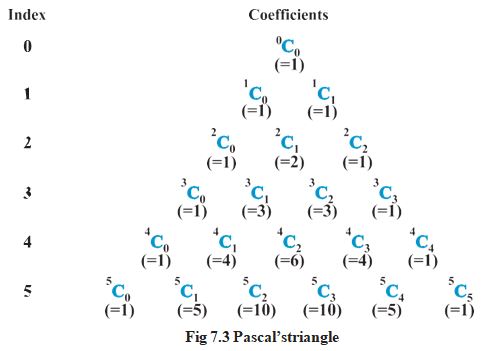
| Index | Coefficients |
|---|---|
Binomial Coefficients
- Notation: The coefficient in position of row is , where .
- Endpoints: .
- Pascal’s rule: for .
- Names: This coefficient array is called Pascal’s triangle; it is also known as Meru Prastara.
Binomial Theorem
Binomial theorem for positive integral indices — The binomial theorem gives the expansion of using binomial coefficients when is a positive integer.
For every positive integer , the coefficient of is . The result can be proved by induction: verify it for , assume it for , multiply by , and combine like terms using Pascal’s rule to obtain the result for .
The th term, counting from the first term, is:
Expand a Binomial
- Identify the two terms and the positive integer index .
- Write the coefficients , or use row of Pascal’s triangle.
- Pair each coefficient with for .
- Simplify each term and combine like terms if needed.
Expand and .
- For , use the coefficients in row : .
- Pair the coefficients with descending powers of and ascending powers of .
- Simplify each term.
- For , apply row coefficients and simplify.
Do not decrease both powers together: in each successive term, the power of decreases while that of increases, and their sum remains .
Expand .
Find the coefficient of in .
Find the coefficient of in .
Quick recap
- The expansion of has terms.
- The power of decreases by while the power of increases by in successive terms.
- The exponents in every term add to .
- Binomial coefficients are given by .
- Pascal’s rule generates each interior coefficient from the two above it.
- The general term is .
Observation
Structure of a Binomial Expansion
Binomial coefficient — The coefficient in a binomial expansion is called a binomial coefficient.
For a non-negative integer , the expansion has terms. In the term indexed by , the exponent of decreases from to , while that of increases from to ; their exponents always add to .
The term corresponding to index is:
Expand a binomial
- Identify the two terms and the power in the expression.
- Write the terms using indices from through .
- Simplify the coefficients, powers, signs and any fractions.
Expand , where .
- Apply the theorem to the two terms, noting that .
- Substitute the five values of .
- Simplify each term.
Special Cases
Special binomial expansions — These are useful forms of the binomial theorem obtained by substituting particular values for and .
In , successive terms alternate in sign because each power of contributes a factor . In with , the alternating sum of the binomial coefficients is zero.
The coefficient sum follows by setting in ; the alternating sum follows by setting in .
Expand a difference
- Treat the difference as a sum with a negative second term.
- Use the binomial theorem and include the sign from each power of .
- Simplify the terms in order from to .
Expand .
- Use alternating signs and the binomial coefficients for power .
- Simplify each term.
Do not make every term of negative: the signs alternate, starting with positive, and the final sign is .
Applications of the Binomial Theorem
Remainder — If an integer can be written as , then division of by has quotient and remainder .
Rewrite a number near a convenient value as a sum or difference before expanding. For with , all terms after the first are positive, so any partial sum gives a lower bound.
For positive , the terms shown after the first are positive.
Prove a remainder using a binomial expansion
- Rewrite the expression to expose a binomial such as .
- Expand and separate terms divisible by the proposed divisor.
- Factor out the divisor and express the result as divisor times an integer plus the remainder.
Prove that leaves remainder when divided by .
- Expand and separate its first two terms.
- Subtract and factor from the remaining terms.
- The sum is an integer, so the expression is for an integer .
Use the binomial theorem to calculate .
Which is larger: or ?
Expand and state its value at .
Quick recap
- The binomial theorem is and has terms.
- In every general term, the exponents of and add to .
- The expansion of has alternating signs.
- The sum of the coefficients in is ; the alternating sum is when .
- Rewrite numbers near convenient values before expanding; positive omitted terms give a lower bound.
- For remainder proofs, express the quantity as divisor times an integer plus the proposed remainder.
Summary
Binomial Theorem
Use for expanding a binomial raised to a positive integer power.
The term containing in the expansion of has coefficient .
| Power | Coefficients |
|---|---|
Expanding a Binomial
- Identify the power and the two binomial terms.
- Write the coefficient row for that power, or use the binomial formula.
- Pair the coefficients with descending powers of the first term and ascending powers of the second.
- Simplify each term and check that the exponents in every term add to the original power.
Expand .
- Use the coefficient row for power four.
- Attach descending powers of and ascending powers of .
- Simplify the terms.
Do not apply the coefficients alone: include the powers of both terms in each term, with exponents adding to .
Expand .
Expand .
Quick recap
- For positive integer , .
- The general term is .
- The coefficient of each term is a binomial coefficient.
- In each term, the power of the first binomial term falls while the power of the second rises.
- Pascal’s triangle arranges binomial coefficients in successive rows.
Formula sheet
Mathematics — ALL CHAPTERS
1
Sets
2
Relations And Functions
3
Trigonometric Functions
4
Complex Numbers And Quadratic Equations
5
Linear Inequalities
6
Permutations And Combinations
7
Binomial Theorem
8
Sequences And Series
9
Straight Lines
10
Conic Sections
11
Introduction To Three Dimensional Geometry
12
Limits And Derivatives
13
Statistics
14
Probability