Class 11 PCM . Mathematics . Mathematics . Sets
Chapter 1: Sets
Ch 1
Mathematics
Class 11 PCM
Introduction , Sets And Their Representations
Sets and Their Elements
Sets are usually named with capital letters and their elements with lowercase letters. Use for “belongs to” and for “does not belong to.”
Representing Sets
| Point | Roster form | Set-builder form |
|---|---|---|
| How it describes a set | Lists its distinct elements | States a property shared by its elements |
| Example | ||
| Best suited to | Sets whose elements can be listed | Sets described by a clear rule, including continuing sets |
In a roster, order does not matter and each distinct element is written only once.
Common roster-form examples
- Divisors: Natural-number divisors of : .
- Vowels: The English vowels in roster form are .
- Odd numbers: The odd natural numbers are .
Use a variable and a condition that precisely identifies the elements of the set.
Common set-builder examples
- Bounded natural numbers: .
- Divisors: describes the natural-number divisors of .
- Squares: .
- Fractions: .
- Word letters: The letters of “PRINCIPAL” form ; repeated letters are written only once.
Converting between forms
- For set-builder to roster form, find every value satisfying the condition and list each once.
- For roster to set-builder form, identify the rule shared by all listed elements.
- Check that the rule includes every listed element and excludes values that do not belong.
Write the solution set of in roster form.
- Factor the equation.
- Set each factor equal to zero to obtain the solutions.
- Write the distinct solutions as a set.
Write in roster form.
- Use the condition that the value is a positive integer whose square is less than .
- The integers from through satisfy the condition, but does not.
- List the values satisfying the condition.
Write in roster form.
Write the set of positive integers that divide in set-builder form.
Match with the condition .
Quick recap
- A set is a well-defined collection; membership is written using and .
- Use capital letters for sets and lowercase letters for their elements.
- Roster form lists distinct elements; order does not matter and repetitions are omitted.
- Set-builder form describes members using a shared property.
- Convert forms by listing values that satisfy the rule or identifying the rule shared by a list.
- Common number-set symbols include , , , and .
The Empty Set , Finite and Infinite Sets
The Empty Set
Empty set — A set with no elements is called the empty, null or void set.
Key points
- Notation: The empty set is written as or .
- Test: A set is empty when no element satisfies its defining condition.
- Examples: There is no natural number strictly between and ; there is no rational solution of .
- More examples: There is no even prime greater than , and no odd solution of .
- Finite status: The empty set is finite; it has elements.
Both symbols denote the set with no elements.
Check whether a set is empty
- Use the defining condition to find the possible elements.
- Check whether any possible element satisfies every condition.
- If none do, the set is empty; otherwise, list its elements.
Is empty?
- Determine whether the set of rational solutions of is empty.
- Solving the equation gives two irrational values, neither of which is rational.
- Therefore, no element satisfies the condition.
Finite and Infinite Sets
Finite set — A set that is empty or has a definite number of elements is finite; any set that is not finite is infinite.
Key points
- Number of elements: counts the distinct elements of ; repetitions are counted only once.
- Finite sets: A set with elements has ; the empty set has .
- Examples: The days of the week and the solutions of are finite sets.
- Infinite examples: The natural numbers, odd natural numbers, integers, primes and points on a line are infinite.
- Roster form: An infinite set with a clear pattern may be written using a few terms and ellipses, such as .
- Limitation: The real numbers cannot be listed in roster form because their elements do not follow one successive listing pattern.
For a finite set, is its number of distinct elements; may be zero.
Classify a set as finite or infinite
- Find all elements that satisfy the defining condition.
- If the elements can be completely counted, the set is finite.
- If the elements continue without end, the set is infinite.
Classify .
- Find the natural-number solutions of .
- The equation is satisfied when or .
- The set has two elements, so it is finite.
Equal Sets
Equal sets — Sets and are equal if they contain exactly the same elements; write .
Key points
- Order: The order in which elements are written does not affect a set.
- Repetition: Repeating an element does not create a new element; for example, .
- Check: To show two sets are equal, verify that every element of each set belongs to the other.
- Unequal sets: If an element belongs to one set but not the other, the sets are unequal; write .
Two sets are equal exactly when membership in one is equivalent to membership in the other.
Compare two sets
- Write the distinct elements of each set, ignoring order and repetitions.
- Check whether each element of the first set occurs in the second, and vice versa.
- If both checks hold, the sets are equal; otherwise, they are unequal.
Are the sets of letters in “ALLOY” and “LOYAL” equal?
- List the distinct letters in each word; repeated letters are included only once.
- Both sets contain precisely the same letters.
- Therefore, the sets are equal.
Is empty?
Is finite or infinite?
Are and equal?
Quick recap
- The empty set contains no elements and is denoted by or .
- A finite set has a definite number of elements; an infinite set does not.
- counts distinct elements, so repetitions do not increase cardinality.
- Infinite sets may use ellipses in roster form when their pattern is clear.
- Equal sets have exactly the same elements, regardless of order or repetition.
- One element belonging to only one of two sets proves that they are unequal.
Subsets And Universal Set
Subsets and Related Set Terms
Subset — A set is a subset of if every element of is also an element of .
Write when every element of belongs to . Every set is a subset of itself, and the empty set is a subset of every set. If and , then . If but , then is a proper subset of , and is a superset of . A one-element set, such as , is a singleton.
Use this definition to test whether every element of the first set is in the second.
How to test a subset
- Check each element of the proposed subset against the other set.
- If every element is present, the subset relation holds; one missing element proves it does not.
- To check for a proper subset, also verify that the sets are unequal.
Is a proper subset of ?
- Let and . Check whether .
- Both elements of occur in : and .
- The sets are unequal, so the subset is proper.
Do not confuse membership with being a subset: says that is an element of , while compares elements of sets. For example, and do not necessarily imply .
Important Subsets of the Real Numbers
Number sets — The real numbers include natural numbers, integers, rational numbers, and irrational numbers.
| Set | Definition or examples |
|---|---|
| Natural numbers | |
| Integers | |
| Rational numbers | Numbers expressible as , where and ; examples include , , and . |
| Irrational numbers | Real numbers that are not rational; examples include , , and . |
| Real numbers | All rational and irrational numbers. |
Every natural number is an integer, every integer is rational, and every rational or irrational number is real. Natural numbers are not a subset of the irrationals.
A rational number has an integer numerator and a nonzero integer denominator; irrationals are the real numbers outside .
Classify a real number
- Check whether the number can be written as for integers with .
- If it can, it is rational; otherwise, if it is real, it is irrational.
- Place it in the larger sets using .
Which of contain ?
- Classify among the listed number sets.
- Since , it is rational; it is also an integer and a real number.
- It is not natural and is not irrational.
Intervals as Subsets of the Real Numbers
Interval — An interval is a subset of containing all real numbers between its endpoints, with endpoint inclusion determined by brackets.
| Interval | Set-builder form | Endpoints |
|---|---|---|
| Open | Neither endpoint included | |
| Closed | Both endpoints included | |
| Half-open | included; excluded | |
| Half-open | excluded; included |
Assume and . Every interval between finite endpoints contains infinitely many real numbers, and its length is . The symbols and are never included as endpoints.
The length is the difference between the upper and lower endpoints, regardless of whether endpoints are included.
Convert between interval and set-builder forms
- Read a round bracket as an excluded endpoint and a square bracket as an included endpoint.
- Translate the left endpoint into a lower bound and the right endpoint into an upper bound.
- Use for excluded endpoints and for included endpoints.
Express in interval notation.
- Write as an interval.
- The lower endpoint is excluded, while the upper endpoint is included.
- Use a round bracket at and a square bracket at .

Do not include an endpoint marked by a round bracket. For example, excludes but includes .
Universal Set
Universal set — The universal set is the basic set of all objects relevant to a particular discussion; the sets considered in that context are its subsets.
The universal set depends on the context: for number-system questions it may be or ; for a study of people, it could be all people in the world. Every set under consideration must lie within the chosen universe.
Each set being discussed is a subset of the chosen universal set.
Choose the universal set
- Identify the context and the objects relevant to the question.
- Let contain all those objects.
- Check that every set being discussed is a subset of .
Are and subsets of ?
- Let the universe be , with and .
- Every element of both and occurs in .
- Thus both sets are subsets of the chosen universe.
If and , is either set a subset of the other?
Write in set-builder form, and find its length.
If and , must ? Give a counterexample if not.
Quick recap
- A subset relation checks whether every element of one set belongs to another; is a subset of every set.
- and together imply ; a proper subset is not equal to its superset.
- , while irrational numbers are real numbers outside .
- Round interval brackets exclude endpoints; square brackets include them.
- A finite interval's length is its upper endpoint minus its lower endpoint.
- The universal set contains all objects relevant to the chosen context.
Venn Diagram And Operations On Sets
Venn Diagrams
Venn diagram — A diagram that represents sets using closed curves, usually circles, inside a rectangle for the universal set.
How to read a Venn diagram
- Rectangle: Represents the universal set ; the sets shown inside it are subsets of .
- Closed curves: Usually circles, each representing a set.
- Elements: An element belongs to the set whose curve contains it; elements outside a curve are not in that set.
Interpreting a Venn diagram
- Identify the rectangle as the universal set.
- Identify each curve and the elements inside it.
- Use an element’s position to determine which sets contain it.
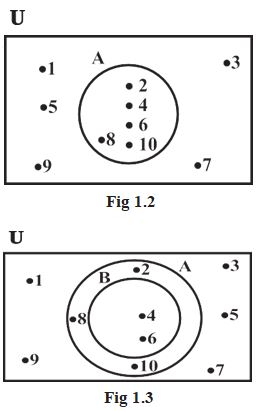
Represent the sets in a Venn diagram.
- Draw a rectangle for the universal set and a circle inside it for .
- Place the elements of in the circle and the remaining elements in the rectangle outside it.
Union of Sets
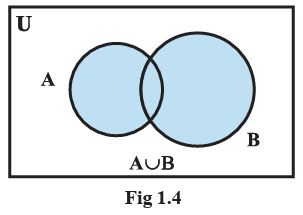
Union — The union of and contains all elements in , in , or in both.
Common elements are included only once; the Venn region includes both sets and their overlap.
Union is commutative, associative and idempotent. The empty set is its identity, and union with the universal set gives the universal set.
If is a subset of , adding to does not add any new elements.
Finding a union
- List the elements of the first set.
- Add each element of the second set that is not already listed.
- Write each element once.
Find .
- Combine the elements of both sets.
- Keep the common elements only once.
Intersection of Sets
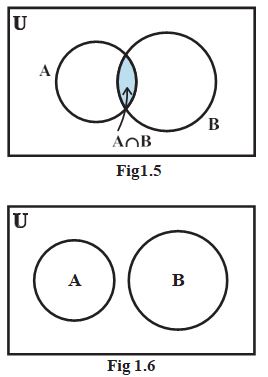
Intersection — The intersection of and contains exactly the elements common to both sets.
In a Venn diagram, the intersection is only the overlap of the sets.
Intersection is commutative, associative and idempotent. The empty set absorbs intersection, the universal set is its identity, and intersection distributes over union.
If is a subset of , every element of is common to both sets, so their intersection is .
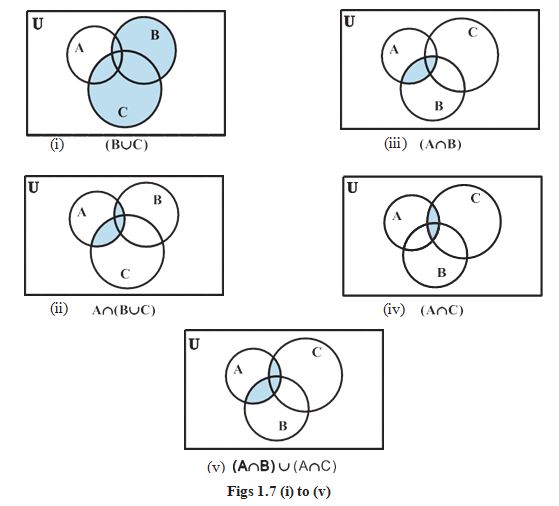
Sets are disjoint when they have no common elements; their intersection is empty.
Finding an intersection
- Compare the elements in the two sets.
- Select only elements that occur in both sets.
- If no elements are shared, the intersection is empty.
Find .
- Select the elements that occur in both sets.
- The shared elements are and .
Difference of Sets
Difference — The difference contains the elements in that are not in .
In a Venn diagram, is the part of outside .
Key facts about difference
- Order matters: In general, .
- Mutually disjoint regions: , , and are pairwise disjoint.
Finding a set difference
- Start with the first set named in the difference.
- Remove every element that also belongs to the second set.
- Write the remaining elements; reverse the order to find the opposite difference.
Find and .
- Remove from the elements also found in .
- The remaining elements of form .
- For the reverse difference, retain elements of not in .
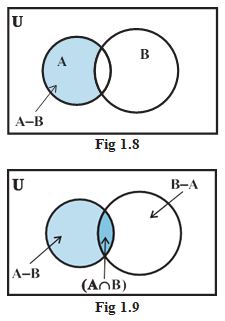
Do not treat difference as commutative: starts with and removes elements in ; reversing the sets can change the result.
Let and . Find and interpret it.
Let and . Find and verify the subset rule.
Let and . Find and .
Quick recap
- A Venn diagram uses a rectangle for the universal set and closed curves for its subsets.
- Union includes elements in either set or both, with shared elements written once.
- Intersection contains only common elements; if , the sets are disjoint.
- If , then and .
- Union is commutative, associative and idempotent; and .
- Intersection is commutative, associative and idempotent; , , and it distributes over union.
- Difference is order-dependent: keeps elements in but not in .
Complement Of A Set
Complement of a Set
Use either form to find the elements of excluded from .
Finding a complement
- Write down the universal set .
- Select the elements of that are not in .
- Write the selected elements as .
Find the complement of with respect to the given .
- Let and . Find .
- Identify the elements of that are not in .
- Collect those elements into the complement.
Taking the complement twice returns the original set.
De Morgan’s Laws and Complement Properties
The complement of a union is the intersection of the complements; the complement of an intersection is the union of the complements.
A set and its complement together make the universal set, and they have no elements in common.
The complement of the empty set is the universal set, and the complement of the universal set is empty.
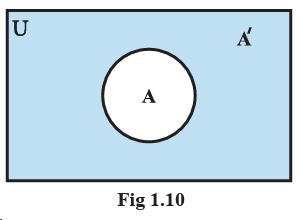
Do not find a complement without knowing the universal set: includes only elements in , not every object outside .
If and , find .
For , and , verify .
If , and , find and compare it with .
Quick recap
- The complement is relative to a universal set: .
- A set and its complement are disjoint and together form .
- The complement of the complement is the original set: .
- De Morgan’s laws: and .
- The empty and universal sets complement each other: and .
Formula sheet
Mathematics — ALL CHAPTERS
1
Sets
2
Relations And Functions
3
Trigonometric Functions
4
Complex Numbers And Quadratic Equations
5
Linear Inequalities
6
Permutations And Combinations
7
Binomial Theorem
8
Sequences And Series
9
Straight Lines
10
Conic Sections
11
Introduction To Three Dimensional Geometry
12
Limits And Derivatives
13
Statistics
14
Probability