Class 11 PCM . Mathematics . Mathematics . Permutations and Combinations
Chapter 6: Permutations And Combinations
Ch 6
Mathematics
Class 11 PCM
Introduction And Fundamental Principle Of Counting
Fundamental Principle of Counting
If successive events have choices respectively, the total number of outcomes is the product of these choice counts.
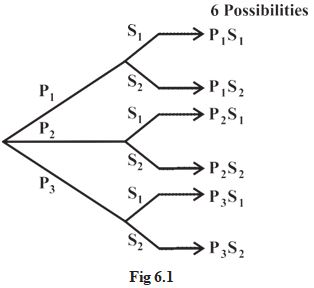
Use when every outcome is formed by making one choice at each successive stage.
Apply the multiplication principle
- Identify the successive choices or positions needed to form one outcome.
- Count the available choices at each stage, adjusting for restrictions such as no repetition.
- Multiply the stage counts.
- If the outcomes belong to separate possible cases, count each case and add the totals.
How many four-letter words can be formed from ROSE without repetition?
- Find the number of four-letter words formed from the letters of ROSE without repeating a letter.
- Fill the first position using any of the four letters.
- After each selection, one fewer letter is available for the next position.
- Multiply the choices for the four positions.
Four different flags are available. How many signals can be made using two flags, one above the other?
How many two-digit even numbers can be formed from if digits may repeat?
Five different flags are available. How many signals using at least two flags can be arranged vertically, without repeating flags?
Do not use the same number of choices at every stage when repetition is forbidden: each selection reduces the remaining choices. If repetition is allowed, the number of choices may stay the same.
Quick recap
- The Fundamental Principle of Counting multiplies the choices at successive stages.
- For stages with choices, the total is .
- With no repetition, reduce the available choices after each selection.
- When repetition is allowed, the choice count can remain the same at each position.
- Count separate outcome cases individually and add their totals.
Permutations
Permutations of Distinct Objects
The number of permutations of distinct objects taken at a time, where and no object is repeated, is .
Use when order matters and objects cannot be reused.
Count distinct arrangements
- Identify the number of objects and positions to fill.
- Count the choices for each position, reducing the available objects after each choice.
- Multiply the choices.
In how many ways can a Chairman and a Vice-Chairman be chosen from 12 people if one person cannot hold both positions?
- Choose a Chairman from the 12 people.
- Choose a different person as Vice-Chairman.
- Multiply the choices for the two distinct positions.
Factorial Notation
Evaluate when and .
- Substitute and into the expression.
- Expand the numerator to expose the common factorial.
- Cancel and simplify.
The Factorial Formula for Permutations
For , the number of permutations of distinct objects taken at a time is .
Use this for arranging of distinct objects when repetition is not allowed.
Use the permutation formula
- Identify the total number of distinct objects and the number selected for arrangement.
- Substitute into the factorial formula.
- Cancel factorials before multiplying.
How many three-letter words can be formed from the letters of NUMBER if no letter is repeated?
- There are six distinct letters and three positions.
- Cancel and multiply the remaining factors.
Do not use combinations when roles or order matter: swapping Chairman and Vice-Chairman gives a different arrangement.
Permutations When Repetition Is Allowed
The number of arrangements of objects taken at a time, when repetition is allowed, is .
Use when each position is filled independently and an object may be used more than once.
Count arrangements with repetition
- Count the available choices for one position.
- Use the same number of choices for every position.
- Write the product as a power.
How many three-letter strings can be formed from the six letters of NUMBER if letters may be repeated?
- Each of the three letter positions has six choices.
- Multiply the independent choices.
| Point | No repetition | Repetition allowed |
|---|---|---|
| Choices per position | Decrease after each choice | Remain for every position |
| Formula | ||
| Three-letter strings from NUMBER |
Evaluate .
If , find .
How many ways can two different positions be assigned to 12 people, with no person holding both positions?
Quick recap
- A permutation is an ordered arrangement; changing the order gives a different arrangement.
- Without repetition, successive choices decrease: .
- Factorial notation means , with .
- For distinct objects, for .
- In particular, and .
- When repetition is allowed, the number of arrangements is .
Permulations When All The Objects Are Not Distinct Objects
Arrangements of Identical Objects
If objects include repeated groups of sizes , with all remaining objects distinct, divide by the factorial of each repeated-group size.
Use when arranging all objects, with identical objects indistinguishable.
Count Arrangements with Repeated Objects
- Count the total number of objects, including repetitions.
- Record the size of each identical group.
- Apply the multiset permutation formula and simplify.
How many different arrangements of the letters of ALLAHABAD are possible?
- ALLAHABAD has 9 letters: 4 As, 2 Ls, and 3 other distinct letters.
- Divide by the permutations within each repeated group.
| Objects | Repeated counts | Number of arrangements |
|---|---|---|
| INSTITUTE | occurs 2 times; occurs 3 times | |
| 4 red, 3 yellow, and 2 green discs | Counts are 4, 3, and 2 |
Do not count identical objects as distinct in the final answer. Divide by for every group of identical objects.
Arrangements of Distinct Objects Taken Part at a Time
Permutation — A permutation is an arrangement in which the order of the selected objects matters.
The number of ways to arrange objects chosen from distinct objects, without repetition, is .
Use when selecting and arranging distinct objects from , without repetition.
Count Ordered Selections
- Check that order matters and repetition is not allowed.
- Identify the number of available objects and positions.
- Evaluate the permutation formula.
How many four-digit numbers can be formed from digits 1 to 9 if no digit is repeated?
- A four-digit number uses four of the nine distinct digits, and order matters.
- Count the ordered selections without repetition.
Restrictions on the First Digit
Leading-Zero Restriction — A numeral cannot begin with ; arrangements with zero in the first position must be excluded.
Count Numerals When Zero Is Available
- Count all ordered selections of the required length.
- Count arrangements with zero fixed in the first position.
- Subtract the invalid arrangements.
How many numbers between 100 and 1,000 can be formed from without repetition?
- Numbers between 100 and 1,000 have three digits. Count all arrangements from the six available digits.
- Subtract arrangements starting with zero; the remaining two places use two of the other five digits.
- Subtract the invalid arrangements from the total.
Do not count a zero-leading arrangement as a valid multi-digit number; it represents a number with fewer digits.
Arrangements with Objects Together
When specified objects must stay together, treat the group as one object, arrange the resulting objects, then multiply by the arrangements within the group.
For distinct objects, if must be together, treat the group as one object.
Count Arrangements with a Required Group
- Replace the required group with one block.
- Arrange the block and remaining objects.
- Multiply by the arrangements within the block.
How many arrangements of DAUGHTER have (i) all vowels together and (ii) the vowels not all together?
- DAUGHTER has eight distinct letters, including three vowels. Treat the vowels as one block, leaving six objects to arrange.
- The three vowels can also be arranged within their block.
- Multiply the block arrangements by the internal arrangements.
- For arrangements where the vowels are not all together, subtract this count from all arrangements.
To count arrangements where a condition does not hold, subtract the arrangements satisfying that condition from the total. Here, is the required count, is the total, and is the excluded count.
| Condition | Count |
|---|---|
| No restriction | |
| Begins with P | |
| All vowels together (four Es and one I) | |
| Vowels not all together | |
| Begins with I and ends with P |
Equations Involving Permutations
Solve for an Unknown in a Permutation Equation
- Expand each permutation using the factorial formula.
- Cancel only factors known to be nonzero under the stated restrictions.
- Solve the resulting equation and keep only values in the allowed range.
Find if and .
- Expand and cancel common nonzero factors, using .
- Solve the quadratic and reject the negative value.
Other Permutation Equations
- Example: If with , cancellation gives , so .
- Check the range: For , the ratio is . The equation would give , which is outside the valid range ; therefore, there is no admissible solution.
How many arrangements can be made from the letters of BALLOON?
How many three-digit numbers can be formed from without repeating a digit?
Find if , where .
Quick recap
- For objects with repeated groups, the number of distinct arrangements is .
- For ordered selections of distinct objects from , use .
- When zero is available for a numeral, subtract arrangements with zero in the first position.
- For a required group to stay together, treat it as one block and multiply by the arrangements inside the block.
- Use total arrangements minus excluded arrangements to count the complement of a condition.
- For permutation equations, expand, cancel only nonzero factors, then check the allowed range.
Combinations
Meaning and Formula for Combinations
Combination — A combination is a selection of objects in which changing their order does not create a new selection.
- Order: Choosing players and gives the same team as choosing and .
- Notation: The number of ways to choose objects from distinct objects is , also written as .
- Examples: A handshake is a pair of people; a chord joining points is determined by a pair of points.
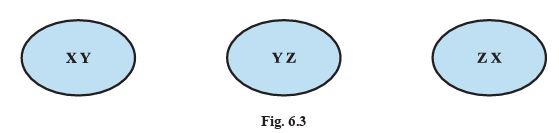
| Selection | Number of combinations |
|---|---|
| Choose 2 from | : , , |
| Handshakes among 12 people | |
| Chords joining 7 points on a circle |
Each selection of objects can be arranged in orders. Thus, permutations count each combination times.
Use to select objects from distinct objects when order is irrelevant; valid for .
- Boundary values: and ; there is one way to select nothing or everything.
- Factorial: and .
- Symmetry: when or .
Find a combination count
- Identify the total number of distinct objects, , and the number selected, .
- Check that order does not matter, then use the combination formula.
- Cancel factorials before multiplying.
If , find .
- Use the combination formula and cancel the common factorial.
- Compare the two combination counts by taking their ratio.
- Solve for , then evaluate the requested coefficient.
Symmetry and Pascal’s Identity
Selecting objects is equivalent to rejecting the remaining objects, so the counts are equal.
The sum of two adjacent combination counts from row equals the corresponding count in row .
Evaluate using Pascal’s identity.
- Apply Pascal’s identity to combine the adjacent counts.
- Evaluate the resulting combination.
Selection with Conditions
Counting strategy
- Independent group choices: Multiply the counts, such as choosing a fixed number of men and women.
- Disjoint cases: Add the counts for each possible composition of the selection.
- Restrictions: Translate “at least” into all permitted cases, or subtract forbidden cases from the total.
| Situation | Calculation | Count |
|---|---|---|
| Committee of 3 from 2 men and 3 women | ||
| Committee with 1 man and 2 women | ||
| 5-member team from 7 boys, no girls | ||
| 5-member team from 4 girls and 7 boys, at least one of each | ||
| 5-member team from 4 girls and 7 boys, at least 3 girls |
A group has 4 girls and 7 boys. How many 5-member teams contain at least 3 girls?
- At least 3 girls allows either 3 girls and 2 boys or 4 girls and 1 boy.
- Multiply choices within each group and add the disjoint cases.
| Condition | Calculation | Count |
|---|---|---|
| Any 4 cards | ||
| All 4 from the same suit | ||
| One card from each suit | ||
| All are face cards | ||
| 2 red and 2 black | ||
| All the same colour |
Choose First, Then Arrange
Selection followed by arrangement — When a task first selects objects and then orders them, multiply the number of selections by the number of arrangements of each selected set.
How many 5-letter arrangements can be formed from INVOLUTE using 3 vowels and 2 consonants?
- In INVOLUTE there are 4 vowels and 4 consonants; choose 3 vowels and 2 consonants.
- Arrange the 5 chosen distinct letters in each selection.
Permutations and Repeated Objects
Counting principles and permutation formulas
- Fundamental counting principle: If one event has choices and a following event has choices, the ordered pair of events has outcomes.
- Factorial: , with .
- No repetition: Permuting of distinct objects uses , where .
- Repetition allowed: Forming a sequence of length from choices, with repetition allowed, gives arrangements.
- Repeated objects: If objects include groups of identical objects of sizes , the distinct arrangements are .
How many distinct words can be made from AGAIN, and what is the 50th in dictionary order?
- AGAIN has 5 letters, with A repeated twice.
- In dictionary order, 24 words start with A, followed by 12 starting with G and 12 starting with I.
- The first 48 words are exhausted; among words beginning with N, the 49th is NAAGI and the next is NAAIG.
How many numbers greater than can be formed using the digits once each?
- Arrange all 7 digits, accounting for three 2s and two 4s.
- Subtract arrangements that begin with 0; after fixing 0, arrange the remaining digits.
- All remaining arrangements are valid 7-digit numbers greater than .
In how many ways can 5 girls and 3 boys sit in a row so that no two boys are together?
- Arrange the 5 girls first.
- There are 6 gaps around the girls; choose and arrange 3 boys in these gaps.
- Multiply the independent arrangements.
Do not distinguish from in a combination. Multiply counts for independent group choices, but add counts for mutually exclusive cases; when arranging a selected group, account for the order separately.
How many ways can 4 points be selected from 9 distinct points?
How many committees with 2 men and 2 women can be formed from 5 men and 6 women?
Evaluate using the symmetry property.
Quick recap
- A combination selects objects without regard to their order.
- for ; .
- and .
- For independent choices multiply; for separate allowed cases add.
- If each selection is then arranged, multiply by the arrangements of its selected objects.
- Repeated identical objects reduce distinct arrangements by dividing by the factorials of their repetition counts.
Formula sheet
Mathematics — ALL CHAPTERS
1
Sets
2
Relations And Functions
3
Trigonometric Functions
4
Complex Numbers And Quadratic Equations
5
Linear Inequalities
6
Permutations And Combinations
7
Binomial Theorem
8
Sequences And Series
9
Straight Lines
10
Conic Sections
11
Introduction To Three Dimensional Geometry
12
Limits And Derivatives
13
Statistics
14
Probability