Class 11 PCM . Mathematics . Mathematics . Straight Lines
Chapter 9: Straight Lines
Ch 9
Mathematics
Class 11 PCM
Slope of a Line
Coordinate Geometry: Key Formulae
Quick coordinate review
- Distance: For and , the distance is units between and .
- Internal division: A point dividing the segment in ratio uses the section formula below; for , and ratio , it is .
- Midpoint: The midpoint is the special case of internal division when .
- Triangle area: If the area is , the three vertices are collinear; the triangle with vertices , and has area square units.
Useful formulae recalled in this lecture.
Inclination and Slope
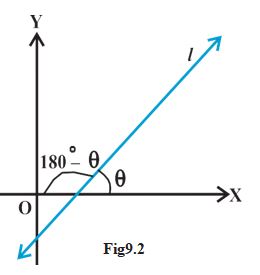
Inclination — The inclination of a line is the angle it makes with the positive direction of the -axis, measured anticlockwise; .
The slope or gradient is when . A line's two angles with the -axis are supplementary.
Key slope properties
- Horizontal line: Inclination ; slope is . The -axis has slope .
- Vertical line: Inclination ; slope is undefined. The -axis has undefined slope.
- Acute inclination: The slope is positive.
- Obtuse inclination: The slope is negative.
Slope from Two Points
Slope through two points — For a non-vertical line through and , slope is the change in divided by the change in .
For either an acute or an obtuse inclination, the slope is the same coordinate ratio. The points must have different -coordinates; if , the line is vertical and its slope is undefined.
Use the same point order in both the numerator and denominator.
Finding slope from two points
- Identify the coordinates of the two points.
- Subtract the first point's -coordinate from the second point's, and do the same with the -coordinates.
- Divide; if the denominator is zero, the line is vertical and the slope is undefined.
Find the slope of the line through and .
- Find the slope of the line through and .
- Substitute the coordinates consistently into the slope formula.
- Simplify the ratio.
Do not reverse the order in only one difference: gives the wrong sign. Reversing both differences leaves the slope unchanged.
Find the slope of the line through and .
Find the slope of the line through and .
Quick recap
- Inclination is measured anticlockwise from the positive -axis and lies between and .
- Slope is ; it is undefined at .
- Horizontal lines have slope ; vertical lines have undefined slope.
- For two points, when .
- An acute inclination gives a positive slope; an obtuse inclination gives a negative slope.
- A triangle has zero area exactly when its three vertices are collinear.
Parallelism and Perpendicularity
Parallel and Perpendicular Lines
Two non-vertical lines are parallel if and only if their slopes are equal. They are perpendicular if and only if their slopes are negative reciprocals.
Key properties
- Parallel lines: Equal inclinations give equal slopes: .
- Perpendicular lines: Their slopes satisfy .
- Special case: Distinct vertical lines are parallel; a vertical line is perpendicular to a horizontal line.
Use these tests for comparing two line directions.
A line through and is perpendicular to a line through and . Find .
- Find the slope through and , then the slope through and .
- Use the perpendicular slope condition and solve for .
Angle Between Two Lines
For two non-vertical lines, the absolute-value formula gives the acute angle between them when . If , they are perpendicular.
The obtuse angle is supplementary to the acute angle.
Choosing the angle
- Acute angle: Use the absolute value in the formula to obtain .
- Obtuse angle: Subtract the acute angle from .
- Perpendicular case: When , the angle is and the tangent formula is undefined.
The angle between two lines is and one line has slope . Find the other slope.
- Let the other slope be ; the angle is , so its tangent is .
- Solve the positive case.
- Solve the negative case.
Horizontal and Vertical Lines
Horizontal line — A horizontal line has a constant -coordinate, is parallel to the -axis, and has slope .
Vertical line — A vertical line has a constant -coordinate, is parallel to the -axis, and has undefined slope.
The constant is the coordinate shared by every point on the line; the sign shows its position relative to the corresponding axis.
Write the equations of the lines through parallel to the coordinate axes.
- A line parallel to the -axis through keeps its -coordinate.
- A line parallel to the -axis through keeps its -coordinate.
Point-Slope and Two-Point Forms
Point-slope form — A non-vertical line with slope through consists of exactly the points that satisfy the point-slope equation.
Two-point form — A line through two points can be written using the slope between those points; if they share the same -coordinate, the line is vertical.
For , use this form. If , use .
(i) Find the equation through with slope . (ii) Find the equation through and .
- For a line through with slope , substitute the point and slope into point-slope form.
- For a line through and , first calculate its slope and then use point-slope form.
Slope-Intercept Form
Intercept meanings
- -intercept : The line crosses the -axis at .
- -intercept : The line crosses the -axis at .
Use the first equation when the -intercept is given and the second when the -intercept is given.
Find the equations of lines with and (i) -intercept ; (ii) -intercept .
- Here the slope is . With -intercept , use .
- With -intercept , use .
Intercept Form and General Equation
Intercept form — A line with non-zero - and -intercepts and passes through and .
General linear equation — An equation represents a line when and are not both zero.
Find the equation of the line with -intercept and -intercept , and identify its general-form coefficients.
- Substitute the intercepts and into intercept form, then clear denominators.
- This result is in general form, with coefficients of and not both zero.
Find the slope of the line through and .
Find the acute angle between lines with slopes and .
Find the equation of the line through and .
Do not apply the slope formulas to a vertical line: its slope is undefined. In the two-point formula, if , write the vertical line as .
Quick recap
- Non-vertical lines are parallel exactly when their slopes are equal; they are perpendicular when the slope product is .
- The acute angle formula is when .
- Horizontal lines have equation and slope ; vertical lines have equation and undefined slope.
- Point-slope form is ; two-point form uses the slope between the two given points.
- For a given slope and intercept, use for the -intercept or for the -intercept.
- Intercept form is ; general form is with and not both zero.
Distance of a Point From a Line
Perpendicular Distance from a Point to a Line
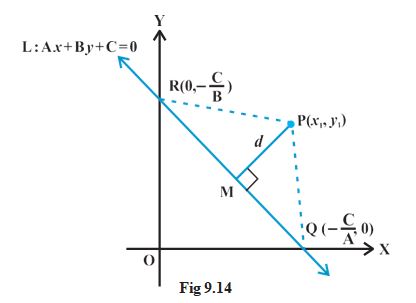
For the line and point , evaluate the line expression at the point and divide its absolute value by the length of the normal vector.
Use when a point and a line in general form are given.
Find the perpendicular distance
- Identify the coefficients of the line and the coordinates of the point.
- Substitute into the distance formula and simplify.
Find the distance of from the line .
- Identify the coefficients in the line.
- Substitute the point coordinates into the formula.
- Simplify the numerator and denominator.
Do not omit the absolute value in the numerator: distance cannot be negative.
Distance Between Parallel Lines
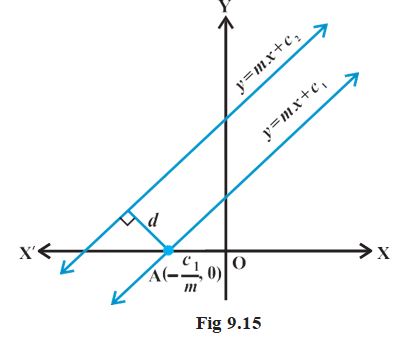
Parallel lines have equal slopes. Write them with common coefficients for and ; their separation is the perpendicular distance from any point on one line to the other.
For and .
For and .
Find the distance between and .
- Read the common coefficients and the constant terms.
- Apply the formula for parallel lines.
Concurrency of Three Lines
Concurrent lines — Three lines are concurrent if they pass through one common point.
Test for concurrency
- Solve two line equations to find their intersection.
- Substitute the intersection into the remaining line.
If , , and are concurrent, find .
- Find the intersection of the first and third lines.
- For concurrency, must satisfy the second line.
- Solve for the parameter.
Distance Measured Along a Given Direction
Distance along a given direction — This is the length from a point to where a specified line through it meets the target line; it need not be the perpendicular distance.
Find distance in a specified direction
- Find the slope of the specified line from its angle to the positive -axis.
- Write its equation through the given point and solve with the target line.
- Find the distance between the starting point and the intersection.
Find the distance from to measured along a line making an angle of with the positive -axis.
- The specified direction has slope . Write the line through .
- Intersect this line with the target line to find .
- Calculate the length from to .
Reflection of a Point in a Line
The reflecting line is the perpendicular bisector of the segment joining a point to its image.
Find the reflected point
- Let the image of be and write the midpoint.
- For a reflecting line , the segment joining the point and its image is parallel to its normal vector .
- Solve the normal-direction and midpoint-on-line conditions together. The slope-product test works only when both slopes are defined.
Find the image of in the line .
- Let the image of be . The reflecting line has slope , so the joining segment has slope .
- The midpoint of the point and its image lies on the reflecting line.
- Solve the two equations for the image coordinates.
Triangle Formed by Two Lines and the -Axis
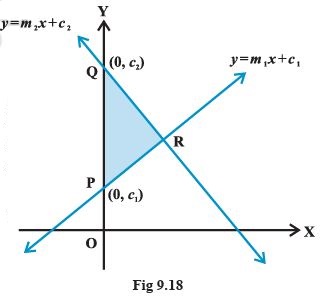
The triangle formed by , , and the -axis has area determined by the differences in their intercepts and slopes.
For lines with different slopes, together with .
Key points
- Vertices on the -axis: The lines meet it at and .
- Intersection of the lines: .
A Line Segment Bisected by a Given Point
If endpoints and have midpoint , their coordinate sums are twice the midpoint coordinates.
Finding the line
- Endpoint conditions: Express each endpoint using its line equation.
- Midpoint conditions: Apply and to find the endpoints.
- Final line: Use the given midpoint and either endpoint to form the line equation.
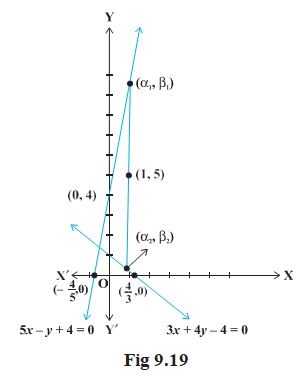
A line segment joining the lines and is bisected at . Find the equation of the line containing the segment.
- Let the segment endpoints on the two lines be and . Use the line equations to express their -coordinates.
- Apply the midpoint conditions and simplify.
- Solve for the endpoints' -coordinates, then find .
- Form the required line through and .
Locus of Points Equidistant from Two Lines
Set the perpendicular distance expressions from a point to the two lines equal. In general, the locus consists of the angle bisectors of the lines.
Show that the locus of points equidistant from and consists of straight lines.
- Equate the distances from a point to the given lines; the denominators are equal.
- Consider both possible equalities from the absolute values.
- Solve both equations to obtain the two straight-line loci.
Practice
Find the perpendicular distance from to .
Find the distance between and .
Find the locus of points equidistant from and .
Quick recap
- For a line , the perpendicular distance from is .
- For parallel lines with common and , the distance is .
- For distance measured in a specified direction, find the intersection with the target line and then calculate the segment length.
- A reflecting line is the perpendicular bisector of the segment joining a point to its image; use a normal-vector condition for all line orientations.
- The area formed by , , and is .
- To find a line segment bisected at a known point, combine each endpoint's line condition with the midpoint formula.
- Equidistance from two lines is found by equating the absolute point-to-line distance expressions.
Formula sheet
Mathematics — ALL CHAPTERS
1
Sets
2
Relations And Functions
3
Trigonometric Functions
4
Complex Numbers And Quadratic Equations
5
Linear Inequalities
6
Permutations And Combinations
7
Binomial Theorem
8
Sequences And Series
9
Straight Lines
10
Conic Sections
11
Introduction To Three Dimensional Geometry
12
Limits And Derivatives
13
Statistics
14
Probability