Lecture 1
Introduction Of Trigonometry and its applications
Reference video · Lecture 1 Introduction Of Trigonometry and its applications
Trigonometry and Its Uses
Definition Trigonometry — The branch of mathematics that studies relationships involving the sides and angles of triangles.
Meaning and Applications Name: The Greek roots *trigon* and *metron* mean “triangle” and “measure.”Uses: Trigonometry is applied in navigation, surveying, engineering, seismology, electric circuits, atomic science, tide prediction and sound analysis.Scope: Earlier study used ratios of sides in right-angled triangles; this chapter extends the idea to trigonometric functions.Directed Angles
Definition Directed angle — An angle measures the rotation of a ray from its initial side to its terminal side about a fixed vertex.
Parts and Direction Vertex: The fixed point about which the ray rotates.Initial side: The ray's starting position; terminal side: its final position.Positive angle: Rotation in the anticlockwise direction.Negative angle: Rotation in the clockwise direction.Amount of rotation: An angle may include one or more complete turns; examples include 360 ° 360° 360° 420 ° 420° 420° − 30 ° -30° − 30° − 420 ° -420° − 420° Degree Measure
Definition Degree — One degree is one three-hundred-sixtieth of a complete revolution.
Degree Subdivisions
Unit Equivalent measure One degree 1 ° = 60 ′ 1° = 60' 1° = 6 0 ′ One minute 1 ′ = 60 ′ ′ 1' = 60'' 1 ′ = 6 0 ′′
Directed Degree Examples Notation: Minutes are written as ′ ' ′ ′ ′ '' ′′ Rotations: Angles such as 180 ° 180° 180° 270 ° 270° 270° 360 ° 360° 360° 360 ° 360° 360° Radian Measure and Arc Length
Definition Radian — One radian is the central angle subtended by an arc whose length equals the circle's radius.
Key Properties Unit circle: Since its radius is 1 1 1 Full revolution: A circle's circumference is 2 π r 2πr 2 π r 2 π 2π 2 π Direction: Anticlockwise radian rotations are positive and clockwise rotations are negative.Arc and angle: In a circle of radius r r r l l l θ θ θ
Find Arc Length or Radius Convert the central angle to radians if it is given in degrees.θ = π 180 d \theta=\frac{\pi}{180}d θ = 180 π d Substitute the known values in the arc-length relationship. Rearrange to find the unknown length or radius.l = r θ , r = l θ l=r\theta,\qquad r=\frac{l}{\theta} l = r θ , r = θ l
Worked example
How far does the tip of a 1.5 1.5 1.5 40 40 40
A minute hand of length 1.5 1.5 1.5 40 40 40 θ = 2 3 ( 2 π ) = 4 π 3 \theta=\frac{2}{3}(2\pi)=\frac{4\pi}{3} θ = 3 2 ( 2 π ) = 3 4 π Use the arc-length formula.l = r θ = 1.5 ( 4 π 3 ) = 2 π cm l=r\theta=1.5\left(\frac{4\pi}{3}\right)=2\pi\text{ cm} l = r θ = 1.5 ( 3 4 π ) = 2 π cm Evaluate using π ≈ 3.14 π≈3.14 π ≈ 3.14 l ≈ 2 ( 3.14 ) = 6.28 cm l\approx2(3.14)=6.28\text{ cm} l ≈ 2 ( 3.14 ) = 6.28 cm Answer: The tip travels
6.28 6.28 6.28 cm.
⚠ Common mistake In l = r θ l=rθ l = r θ θ θ θ θ = π 180 d θ=\frac{π}{180}d θ = 180 π d
Radians as Real Numbers
Definition Radian measure on the unit circle — On a unit circle, the signed arc length from a fixed starting point represents the angle's radian measure.
Real-Number Correspondence Correspondence: Every real number corresponds to a radian measure, and each radian measure corresponds to a real number.Sign: Positive values are measured anticlockwise; negative values are measured clockwise.Converting Between Degrees and Radians
Degree–radian equivalence A full revolution measures 360 ° 360° 360° 2 π 2π 2 π 180 ° = π 180°=π 180° = π
2 π = 360 ∘ , π = 180 ∘ 2\pi=360^\circ,\qquad \pi=180^\circ 2 π = 36 0 ∘ , π = 18 0 ∘
Common Angle Equivalences
Degrees Radians 30 ° 30° 30° π 6 \frac{π}{6} 6 π 45 ° 45° 45° π 4 \frac{π}{4} 4 π 60 ° 60° 60° π 3 \frac{π}{3} 3 π 90 ° 90° 90° π 2 \frac{π}{2} 2 π 180 ° 180° 180° π π π 270 ° 270° 270° 3 π 2 \frac{3π}{2} 2 3 π 360 ° 360° 360° 2 π 2π 2 π
Notation and Approximate Values Convention: An angle written without a degree symbol is understood to be in radians.Approximation: 1 1 1 57 ° 16 ′ 57°16' 57°1 6 ′ 1 ° 1° 1° 0.01746 0.01746 0.01746
Convert an Angle To convert degrees to radians, multiply by π 180 \frac{π}{180} 180 π r = d × π 180 r=d\times\frac{\pi}{180} r = d × 180 π To convert radians to degrees, multiply by 180 π \frac{180}{π} π 180 d = r × 180 π d=r\times\frac{180}{\pi} d = r × π 180 For degree–minute–second answers, use 1 ° = 60 ′ 1°=60' 1° = 6 0 ′ 1 ′ = 60 ′ ′ 1'=60'' 1 ′ = 6 0 ′′ 1 ∘ = 60 ′ , 1 ′ = 60 ′ ′ 1^\circ=60',\qquad 1'=60'' 1 ∘ = 6 0 ′ , 1 ′ = 6 0 ′′
Worked example
Convert 40 ° 20 ′ 40°20' 40°2 0 ′
Convert 20 ′ 20' 2 0 ′ 40 ∘ 20 ′ = 40 1 3 ∘ = 121 3 ∘ 40^\circ20'=40\frac{1}{3}^\circ=\frac{121}{3}^\circ 4 0 ∘ 2 0 ′ = 40 3 1 ∘ = 3 121 ∘ Multiply by π 180 \frac{π}{180} 180 π 121 3 × π 180 = 121 π 540 \frac{121}{3}\times\frac{\pi}{180}=\frac{121\pi}{540} 3 121 × 180 π = 540 121 π Answer: 121 π 540 \frac{121π}{540} 540 121 π radians.
Practice
Convert 6 6 6 π = 22 7 π=\frac{22}{7} π = 7 22
Hint: Multiply by
180 π \frac{180}{π} π 180 , then convert the fractional degree to minutes and seconds.
Key step: 6 × 180 π = 1080 × 7 22 = 343 7 11 ° 6\times\frac{180}{π}=\frac{1080\times7}{22}=343\frac{7}{11}° 6 × π 180 = 22 1080 × 7 = 343 11 7 ° .
Solution: 7 11 ° = 38 ′ 2 11 ′ \frac{7}{11}°=38'\frac{2}{11}' 11 7 ° = 3 8 ′ 11 2 ′ and
2 11 × 60 ′ ′ ≈ 10.9 ′ ′ \frac{2}{11}\times60''≈10.9'' 11 2 × 6 0 ′′ ≈ 10. 9 ′′ . Thus,
6 6 6 radians is approximately
343 ° 38 ′ 11 ′ ′ 343°38'11'' 343°3 8 ′ 1 1 ′′ .
Practice
A central angle of 60 ° 60° 60° 37.4 37.4 37.4 π = 22 7 π=\frac{22}{7} π = 7 22
Hint: Convert the angle to radians, then use
r = l θ r=\frac{l}{θ} r = θ l .
Key step: 60 ° = π 3 60°=\frac{π}{3} 60° = 3 π radians.
Solution: r = 37.4 π / 3 = 37.4 × 3 × 7 22 = 35.7 r=\frac{37.4}{π/3}=\frac{37.4\times3\times7}{22}=35.7 r = π /3 37.4 = 22 37.4 × 3 × 7 = 35.7 cm.
Equal arc lengths in two circles For equal arc lengths, the radii are inversely proportional to their corresponding central angles measured in radians.
r 1 θ 1 = r 2 θ 2 , r 1 r 2 = θ 2 θ 1 r_1\theta_1=r_2\theta_2,\qquad \frac{r_1}{r_2}=\frac{\theta_2}{\theta_1} r 1 θ 1 = r 2 θ 2 , r 2 r 1 = θ 1 θ 2
Practice
Two circles have equal arc lengths. Their central angles are 65 ° 65° 65° 110 ° 110° 110°
Hint: For equal arcs, the radii are inversely proportional to the angles.
Key step: r 1 r 2 = 110 65 \frac{r_1}{r_2}=\frac{110}{65} r 2 r 1 = 65 110 .
Solution: r 1 : r 2 = 22 : 13 r_1:r_2=22:13 r 1 : r 2 = 22 : 13 .
Quick recap
Trigonometry studies relationships between triangle sides and angles and has many scientific and practical applications. Anticlockwise rotation is positive; clockwise rotation is negative. A complete revolution is 360 ° = 2 π 360°=2π 360° = 2 π 1 ° = 60 ′ 1°=60' 1° = 6 0 ′ 1 ′ = 60 ′ ′ 1'=60'' 1 ′ = 6 0 ′′ One radian is subtended by an arc equal in length to the radius; arc length is l = r θ l=rθ l = r θ On the unit circle, signed arc length corresponds to a real-number radian measure. Convert degrees to radians using r = π 180 d r=\frac{π}{180}d r = 180 π d d = 180 π r d=\frac{180}{π}r d = π 180 r For equal arc lengths, r 1 θ 1 = r 2 θ 2 r_1θ_1=r_2θ_2 r 1 θ 1 = r 2 θ 2
Lecture 2
Trigonometric Function
Reference video · Lecture 2 Trigonometric Function
Unit-Circle Definitions and Identities
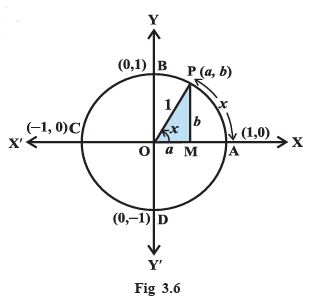
Definition Sine and cosine — For an angle x x x P ( a , b ) P(a,b) P ( a , b ) x x x cos x = a \cos x=a cos x = a sin x = b \sin x=b sin x = b
Unit circle showing angle x x x ( a , b ) (a,b) ( a , b ) P P P Unit-circle identity Since P P P a 2 + b 2 = 1 a^2+b^2=1 a 2 + b 2 = 1 sin 2 x + cos 2 x = 1 \sin^2 x+\cos^2 x=1 sin 2 x + cos 2 x = 1 x x x
Other trigonometric functions Reciprocals: cosec x = 1 / sin x \cosec x=1/\sin x cosec x = 1/ sin x sec x = 1 / cos x \sec x=1/\cos x sec x = 1/ cos x Ratios: tan x = sin x / cos x \tan x=\sin x/\cos x tan x = sin x / cos x cot x = cos x / sin x \cot x=\cos x/\sin x cot x = cos x / sin x Restrictions: cosec x \cosec x cosec x cot x \cot x cot x x = n π x=n\pi x = nπ sec x \sec x sec x tan x \tan x tan x x = ( 2 n + 1 ) π / 2 x=(2n+1)\pi/2 x = ( 2 n + 1 ) π /2 n ∈ Z n\in\mathbb Z n ∈ Z
Find the other trigonometric ratios Use the given ratio and the quadrant to determine the signs of sine and cosine. Use sin 2 x + cos 2 x = 1 \sin^2 x+\cos^2 x=1 sin 2 x + cos 2 x = 1 Calculate the remaining ratios using quotient and reciprocal definitions.
Worked example
If cos x = − 3 / 5 \cos x=-3/5 cos x = − 3/5 x x x
Given cos x = − 3 / 5 \cos x=-3/5 cos x = − 3/5 sin x \sin x sin x sin 2 x = 1 − cos 2 x = 1 − 9 25 = 16 25 , sin x = − 4 5 \sin^2 x=1-\cos^2 x=1-\frac{9}{25}=\frac{16}{25},\qquad \sin x=-\frac{4}{5} sin 2 x = 1 − cos 2 x = 1 − 25 9 = 25 16 , sin x = − 5 4 Take reciprocals of sine and cosine.sec x = − 5 3 , cosec x = − 5 4 \sec x=-\frac{5}{3},\qquad \cosec x=-\frac{5}{4} sec x = − 3 5 , cosec x = − 4 5 Find tangent and cotangent from their quotient definitions.tan x = sin x cos x = 4 3 , cot x = cos x sin x = 3 4 \tan x=\frac{\sin x}{\cos x}=\frac{4}{3},\qquad \cot x=\frac{\cos x}{\sin x}=\frac{3}{4} tan x = cos x sin x = 3 4 , cot x = sin x cos x = 4 3 Answer: sin x = − 4 / 5 , tan x = 4 / 3 , cot x = 3 / 4 , sec x = − 5 / 3 , cosec x = − 5 / 4 \sin x=-4/5,\ \tan x=4/3,\ \cot x=3/4,\ \sec x=-5/3,\ \cosec x=-5/4 sin x = − 4/5 , tan x = 4/3 , cot x = 3/4 , sec x = − 5/3 , cosec x = − 5/4 .
Standard Values and Periodicity
Quadrantal angles Meaning: Angles that are integral multiples of π / 2 \pi/2 π /2 Unit-circle points: At angles 0 , π / 2 , π , 3 π / 2 , 2 π 0,\ \pi/2,\ \pi,\ 3\pi/2,\ 2\pi 0 , π /2 , π , 3 π /2 , 2 π ( 1 , 0 ) , ( 0 , 1 ) , ( − 1 , 0 ) , ( 0 , − 1 ) , ( 1 , 0 ) (1,0),\ (0,1),\ (-1,0),\ (0,-1),\ (1,0) ( 1 , 0 ) , ( 0 , 1 ) , ( − 1 , 0 ) , ( 0 , − 1 ) , ( 1 , 0 )
Standard values
Function 0 0 0 π / 6 \pi/6 π /6 π / 4 \pi/4 π /4 π / 3 \pi/3 π /3 π / 2 \pi/2 π /2 π \pi π 3 π / 2 3\pi/2 3 π /2 2 π 2\pi 2 π sin x \sin x sin x 0 0 0 1 / 2 1/2 1/2 1 / 2 1/\sqrt{2} 1/ 2 3 / 2 \sqrt{3}/2 3 /2 1 1 1 0 0 0 − 1 -1 − 1 0 0 0 cos x \cos x cos x 1 1 1 3 / 2 \sqrt{3}/2 3 /2 1 / 2 1/\sqrt{2} 1/ 2 1 / 2 1/2 1/2 0 0 0 − 1 -1 − 1 0 0 0 1 1 1 tan x \tan x tan x 0 0 0 1 / 3 1/\sqrt{3} 1/ 3 1 1 1 3 \sqrt{3} 3 Undefined 0 0 0 Undefined 0 0 0
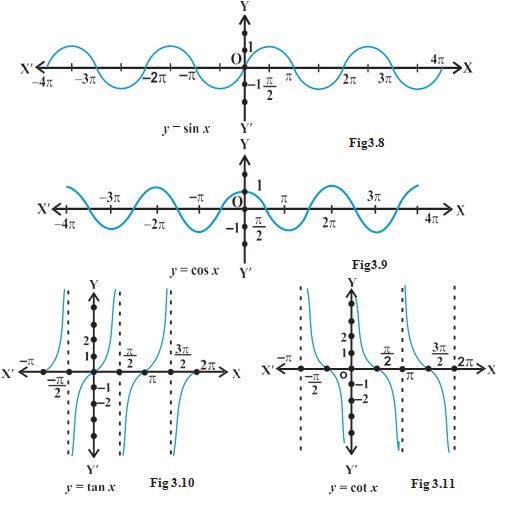
Periodicity Sine and cosine repeat after 2 π 2\pi 2 π π \pi π 2 π 2\pi 2 π
sin ( x + 2 n π ) = sin x , cos ( x + 2 n π ) = cos x , tan ( x + n π ) = tan x , cot ( x + n π ) = cot x \sin(x+2n\pi)=\sin x,\quad \cos(x+2n\pi)=\cos x,\quad \tan(x+n\pi)=\tan x,\quad \cot(x+n\pi)=\cot x sin ( x + 2 nπ ) = sin x , cos ( x + 2 nπ ) = cos x , tan ( x + nπ ) = tan x , cot ( x + nπ ) = cot x
Reduce an angle using periodicity Add or subtract a whole number of periods to obtain a familiar angle.x ⟶ x + 2 n π ( sin , cos , sec , cosec ) x\longrightarrow x+2n\pi\quad(\sin,\cos,\sec,\cosec) x ⟶ x + 2 nπ ( sin , cos , sec , cosec ) For tangent or cotangent, use a whole-number multiple of π \pi π x ⟶ x + n π ( tan , cot ) x\longrightarrow x+n\pi\quad(\tan,\cot) x ⟶ x + nπ ( tan , cot ) Evaluate the resulting standard-angle value.
Worked example
Evaluate cos ( − 1710 ∘ ) \cos(-1710^\circ) cos ( − 171 0 ∘ )
Add five full turns, each equal to 360 ∘ 360^\circ 36 0 ∘ − 1710 ∘ + 5 ( 360 ∘ ) = 90 ∘ -1710^\circ+5(360^\circ)=90^\circ − 171 0 ∘ + 5 ( 36 0 ∘ ) = 9 0 ∘ Use cosine's 360 ∘ 360^\circ 36 0 ∘ 90 ∘ 90^\circ 9 0 ∘ cos ( − 1710 ∘ ) = cos 90 ∘ = 0 \cos(-1710^\circ)=\cos 90^\circ=0 cos ( − 171 0 ∘ ) = cos 9 0 ∘ = 0
Signs, Domains, Ranges and Variation
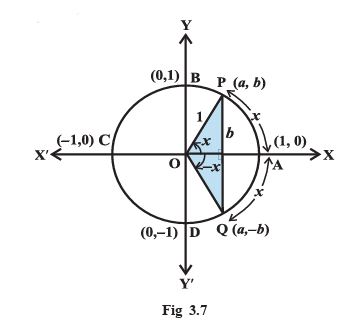
Even and odd properties Cosine and secant are even; sine, cosecant, tangent and cotangent are odd wherever defined.
cos ( − x ) = cos x , sin ( − x ) = − sin x , sec ( − x ) = sec x , cosec ( − x ) = − cosec x , tan ( − x ) = − tan x , cot ( − x ) = − cot x \cos(-x)=\cos x,\quad \sin(-x)=-\sin x,\quad \sec(-x)=\sec x,\quad \cosec(-x)=-\cosec x,\quad \tan(-x)=-\tan x,\quad \cot(-x)=-\cot x cos ( − x ) = cos x , sin ( − x ) = − sin x , sec ( − x ) = sec x , cosec ( − x ) = − cosec x , tan ( − x ) = − tan x , cot ( − x ) = − cot x The points ( a , b ) (a,b) ( a , b ) ( a , − b ) (a,-b) ( a , − b ) x x x − x -x − x
Signs in the quadrants
Function I II III IV sin x \sin x sin x cosec x \cosec x cosec x + + − − cos x \cos x cos x sec x \sec x sec x + − − + tan x \tan x tan x cot x \cot x cot x + − + −
Definition Domain and range — The domain is the set of allowed input angles; the range is the set of values the function can take.
Domains and ranges
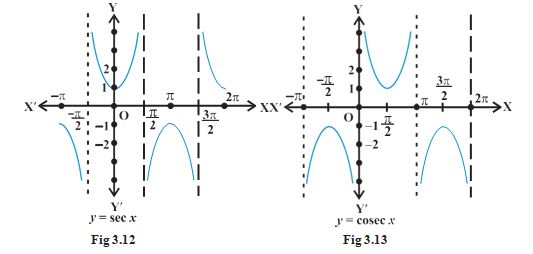
Function Domain Range sin x \sin x sin x cos x \cos x cos x R \mathbb R R [ − 1 , 1 ] [-1,1] [ − 1 , 1 ] tan x \tan x tan x x ≠ ( 2 n + 1 ) π / 2 , n ∈ Z x\ne(2n+1)\pi/2,\ n\in\mathbb Z x = ( 2 n + 1 ) π /2 , n ∈ Z R \mathbb R R cot x \cot x cot x x ≠ n π , n ∈ Z x\ne n\pi,\ n\in\mathbb Z x = nπ , n ∈ Z R \mathbb R R sec x \sec x sec x x ≠ ( 2 n + 1 ) π / 2 , n ∈ Z x\ne(2n+1)\pi/2,\ n\in\mathbb Z x = ( 2 n + 1 ) π /2 , n ∈ Z ( − ∞ , − 1 ] ∪ [ 1 , ∞ ) (-\infty,-1]\cup[1,\infty) ( − ∞ , − 1 ] ∪ [ 1 , ∞ ) cosec x \cosec x cosec x x ≠ n π , n ∈ Z x\ne n\pi,\ n\in\mathbb Z x = nπ , n ∈ Z ( − ∞ , − 1 ] ∪ [ 1 , ∞ ) (-\infty,-1]\cup[1,\infty) ( − ∞ , − 1 ] ∪ [ 1 , ∞ )
Increasing and decreasing behaviour within each quadrant
Function I II III IV sin x \sin x sin x 0 → 1 0\to1 0 → 1 1 → 0 1\to0 1 → 0 0 → − 1 0\to-1 0 → − 1 − 1 → 0 -1\to0 − 1 → 0 cos x \cos x cos x 1 → 0 1\to0 1 → 0 0 → − 1 0\to-1 0 → − 1 − 1 → 0 -1\to0 − 1 → 0 0 → 1 0\to1 0 → 1 tan x \tan x tan x 0 → ∞ 0\to\infty 0 → ∞ − ∞ → 0 -\infty\to0 − ∞ → 0 0 → ∞ 0\to\infty 0 → ∞ − ∞ → 0 -\infty\to0 − ∞ → 0 cot x \cot x cot x ∞ → 0 \infty\to0 ∞ → 0 0 → − ∞ 0\to-\infty 0 → − ∞ ∞ → 0 \infty\to0 ∞ → 0 0 → − ∞ 0\to-\infty 0 → − ∞ sec x \sec x sec x 1 → ∞ 1\to\infty 1 → ∞ − ∞ → − 1 -\infty\to-1 − ∞ → − 1 − 1 → − ∞ -1\to-\infty − 1 → − ∞ ∞ → 1 \infty\to1 ∞ → 1 cosec x \cosec x cosec x ∞ → 1 \infty\to1 ∞ → 1 1 → ∞ 1\to\infty 1 → ∞ − ∞ → − 1 -\infty\to-1 − ∞ → − 1 − 1 → − ∞ -1\to-\infty − 1 → − ∞
Graphs of sine, cosine, tangent and cotangent. Graphs of secant and cosecant, with vertical asymptotes and branches.
Use quadrant signs to complete ratios Determine the signs of sine and cosine from the quadrant. Convert a given cotangent to tangent using reciprocals, then find a missing ratio with an identity.tan x = 1 cot x , sec 2 x = 1 + tan 2 x \tan x=\frac{1}{\cot x},\qquad \sec^2 x=1+\tan^2 x tan x = cot x 1 , sec 2 x = 1 + tan 2 x Use quotient and reciprocal definitions to obtain the remaining functions.
Worked example
If cot x = − 5 / 12 \cot x=-5/12 cot x = − 5/12 x x x
Given cot x = − 5 / 12 \cot x=-5/12 cot x = − 5/12 tan x = − 12 5 , sec 2 x = 1 + tan 2 x = 1 + 144 25 = 169 25 , sec x = − 13 5 \tan x=-\frac{12}{5},\qquad \sec^2 x=1+\tan^2 x=1+\frac{144}{25}=\frac{169}{25},\qquad \sec x=-\frac{13}{5} tan x = − 5 12 , sec 2 x = 1 + tan 2 x = 1 + 25 144 = 25 169 , sec x = − 5 13 Take the reciprocal to find cosine, then use tan x = sin x / cos x \tan x=\sin x/\cos x tan x = sin x / cos x cos x = − 5 13 , sin x = tan x cos x = ( − 12 5 ) ( − 5 13 ) = 12 13 \cos x=-\frac{5}{13},\qquad \sin x=\tan x\cos x=\left(-\frac{12}{5}\right)\left(-\frac{5}{13}\right)=\frac{12}{13} cos x = − 13 5 , sin x = tan x cos x = ( − 5 12 ) ( − 13 5 ) = 13 12 Take the reciprocal of sine to find cosecant.cosec x = 13 12 \cosec x=\frac{13}{12} cosec x = 12 13 Answer: tan x = − 12 / 5 , sec x = − 13 / 5 , cos x = − 5 / 13 , sin x = 12 / 13 , cosec x = 13 / 12 \tan x=-12/5,\ \sec x=-13/5,\ \cos x=-5/13,\ \sin x=12/13,\ \cosec x=13/12 tan x = − 12/5 , sec x = − 13/5 , cos x = − 5/13 , sin x = 12/13 , cosec x = 13/12 .
Practice
Evaluate sin ( 31 π / 3 ) \sin(31\pi/3) sin ( 31 π /3 )
Hint: Reduce the angle by a whole-number multiple of
2 π 2\pi 2 π .
Key step: 31 π / 3 = 10 π + π / 3 31\pi/3=10\pi+\pi/3 31 π /3 = 10 π + π /3 .
Solution: sin ( 31 π / 3 ) = sin ( π / 3 ) = 3 / 2 \sin(31\pi/3)=\sin(\pi/3)=\sqrt{3}/2 sin ( 31 π /3 ) = sin ( π /3 ) = 3 /2 .
Practice
If tan x = 3 / 4 \tan x=3/4 tan x = 3/4 x x x sin x \sin x sin x cos x \cos x cos x
Hint: Use
sec 2 x = 1 + tan 2 x \sec^2 x=1+\tan^2 x sec 2 x = 1 + tan 2 x or a
3 3 3 -
4 4 4 -
5 5 5 triangle; apply quadrant signs.
Key step: In quadrant III, both sine and cosine are negative, while tangent is positive.
Solution: sin x = − 3 / 5 \sin x=-3/5 sin x = − 3/5 and
cos x = − 4 / 5 \cos x=-4/5 cos x = − 4/5 .
Practice
State the domain and range of y = sec x y=\sec x y = sec x
Hint: sec x = 1 / cos x \sec x=1/\cos x sec x = 1/ cos x .
Key step: Exclude angles where
cos x = 0 \cos x=0 cos x = 0 ; since
∣ cos x ∣ ≤ 1 |\cos x|\le1 ∣ cos x ∣ ≤ 1 , secant values have magnitude at least
1 1 1 .
Solution: Domain:
x ≠ ( 2 n + 1 ) π / 2 x\ne(2n+1)\pi/2 x = ( 2 n + 1 ) π /2 for
n ∈ Z n\in\mathbb Z n ∈ Z . Range:
( − ∞ , − 1 ] ∪ [ 1 , ∞ ) (-\infty,-1]\cup[1,\infty) ( − ∞ , − 1 ] ∪ [ 1 , ∞ ) .
Quick recap
On the unit circle, cos x \cos x cos x sin x \sin x sin x The core identity is sin 2 x + cos 2 x = 1 \sin^2 x+\cos^2 x=1 sin 2 x + cos 2 x = 1 Quadrant signs determine whether each trigonometric value is positive or negative. Sine, cosine, secant and cosecant have period 2 π 2\pi 2 π π \pi π Sine and cosine range from − 1 -1 − 1 1 1 1 − 1 -1 − 1 1 1 1 Always exclude inputs where a defining denominator is zero.
Lecture 3
Trigonometric Functions Of Sum And Difference Of Two Angles
Reference video · Lecture 3 Trigonometric Functions Of Sum And Difference Of Two Angles
Sine and Cosine of a Sum or Difference
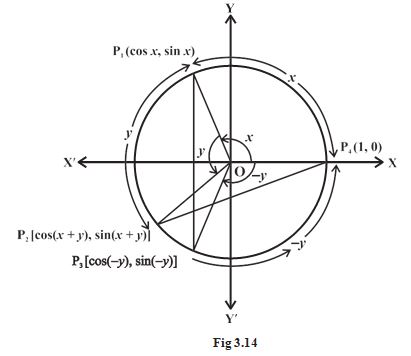
Sum-and-difference identities For all real angles x x x y y y x + y x+y x + y x − y x-y x − y
cos ( x + y ) = cos x cos y − sin x sin y cos ( x − y ) = cos x cos y + sin x sin y sin ( x + y ) = sin x cos y + cos x sin y sin ( x − y ) = sin x cos y − cos x sin y \begin{aligned}\cos(x+y)&=\cos x\cos y-\sin x\sin y\\\cos(x-y)&=\cos x\cos y+\sin x\sin y\\\sin(x+y)&=\sin x\cos y+\cos x\sin y\\\sin(x-y)&=\sin x\cos y-\cos x\sin y\end{aligned} cos ( x + y ) cos ( x − y ) sin ( x + y ) sin ( x − y ) = cos x cos y − sin x sin y = cos x cos y + sin x sin y = sin x cos y + cos x sin y = sin x cos y − cos x sin y Unit-circle diagram illustrating angle addition through point coordinates.
Applying a sum-or-difference identity Identify the two angles and whether they are added or subtracted. Choose the matching sine or cosine identity, keeping its signs in order. Substitute known exact values and simplify.
Worked example
Find the exact value of sin 15 ∘ \sin15^\circ sin 1 5 ∘
Write 15 ∘ 15^\circ 1 5 ∘ 15 ∘ = 45 ∘ − 30 ∘ 15^\circ=45^\circ-30^\circ 1 5 ∘ = 4 5 ∘ − 3 0 ∘ Apply the sine difference identity and substitute exact values.sin 15 ∘ = sin 45 ∘ cos 30 ∘ − cos 45 ∘ sin 30 ∘ = 1 2 ⋅ 3 2 − 1 2 ⋅ 1 2 \sin 15^\circ=\sin45^\circ\cos30^\circ-\cos45^\circ\sin30^\circ=\frac{1}{\sqrt2}\cdot\frac{\sqrt3}{2}-\frac{1}{\sqrt2}\cdot\frac12 sin 1 5 ∘ = sin 4 5 ∘ cos 3 0 ∘ − cos 4 5 ∘ sin 3 0 ∘ = 2 1 ⋅ 2 3 − 2 1 ⋅ 2 1 Combine the terms.sin 15 ∘ = 3 − 1 2 2 \sin15^\circ=\frac{\sqrt3-1}{2\sqrt2} sin 1 5 ∘ = 2 2 3 − 1 Answer: 3 − 1 2 2 \frac{\sqrt3-1}{2\sqrt2} 2 2 3 − 1
Derived Identities and Tangent/Cotangent Formulas
Allied-angle identities These follow by using evenness and oddness, together with the sum-and-difference identities.
sin ( − x ) = − sin x , cos ( − x ) = cos x cos ( π 2 − x ) = sin x , sin ( π 2 − x ) = cos x cos ( π 2 + x ) = − sin x , sin ( π 2 + x ) = cos x cos ( π − x ) = − cos x , sin ( π − x ) = sin x cos ( π + x ) = − cos x , sin ( π + x ) = − sin x cos ( 2 π − x ) = cos x , sin ( 2 π − x ) = − sin x \begin{aligned}\sin(-x)&=-\sin x,&\cos(-x)&=\cos x\\\cos\left(\frac\pi2-x\right)&=\sin x,&\sin\left(\frac\pi2-x\right)&=\cos x\\\cos\left(\frac\pi2+x\right)&=-\sin x,&\sin\left(\frac\pi2+x\right)&=\cos x\\\cos(\pi-x)&=-\cos x,&\sin(\pi-x)&=\sin x\\\cos(\pi+x)&=-\cos x,&\sin(\pi+x)&=-\sin x\\\cos(2\pi-x)&=\cos x,&\sin(2\pi-x)&=-\sin x\end{aligned} sin ( − x ) cos ( 2 π − x ) cos ( 2 π + x ) cos ( π − x ) cos ( π + x ) cos ( 2 π − x ) = − sin x , = sin x , = − sin x , = − cos x , = − cos x , = cos x , cos ( − x ) sin ( 2 π − x ) sin ( 2 π + x ) sin ( π − x ) sin ( π + x ) sin ( 2 π − x ) = cos x = cos x = cos x = sin x = − sin x = − sin x
Evaluating tangent of a compound angle Rewrite the angle using familiar angles or a period identity. Use the tangent sum or difference formula. Substitute exact tangent values and simplify, checking that the denominator is non-zero.
Worked example
Find tan ( 13 π 12 ) \tan\left(\frac{13\pi}{12}\right) tan ( 12 13 π )
Use the period of tangent and split the remaining angle.tan 13 π 12 = tan π 12 = tan ( π 4 − π 6 ) \tan\frac{13\pi}{12}=\tan\frac{\pi}{12}=\tan\left(\frac\pi4-\frac\pi6\right) tan 12 13 π = tan 12 π = tan ( 4 π − 6 π ) Apply the tangent difference formula.tan 13 π 12 = 1 − 1 3 1 + 1 3 \tan\frac{13\pi}{12}=\frac{1-\frac1{\sqrt3}}{1+\frac1{\sqrt3}} tan 12 13 π = 1 + 3 1 1 − 3 1 Simplify the ratio.tan 13 π 12 = 2 − 3 \tan\frac{13\pi}{12}=2-\sqrt3 tan 12 13 π = 2 − 3
⚠ Common mistake Do not use cot x + cot y \cot x+\cot y cot x + cot y cot y − cot x \cot y-\cot x cot y − cot x
Double-Angle and Triple-Angle Identities
Choosing a multiple-angle form Select the identity matching the required function and angle multiple. For tangent, check that the denominator is non-zero before using the formula. Substitute the value of the original angle and simplify.
Worked example
Use the triple-angle identity to evaluate sin π 2 \sin\frac\pi2 sin 2 π x = π 6 x=\frac\pi6 x = 6 π
Apply the triple-angle sine identity.sin 3 x = 3 sin x − 4 sin 3 x \sin3x=3\sin x-4\sin^3x sin 3 x = 3 sin x − 4 sin 3 x Set x = π 6 x=\frac\pi6 x = 6 π sin π 6 = 1 2 \sin\frac\pi6=\frac12 sin 6 π = 2 1 sin π 2 = 3 ( 1 2 ) − 4 ( 1 2 ) 3 \sin\frac\pi2=3\left(\frac12\right)-4\left(\frac12\right)^3 sin 2 π = 3 ( 2 1 ) − 4 ( 2 1 ) 3 Evaluate.sin π 2 = 3 2 − 1 2 = 1 \sin\frac\pi2=\frac32-\frac12=1 sin 2 π = 2 3 − 2 1 = 1
Sum-to-Product and Product-to-Sum Identities
Simplifying with sum-to-product Rewrite the numerator and denominator as sums or differences of two functions. Apply the matching sum-to-product identities. Cancel common factors only when they are non-zero, then simplify.
Worked example
Show that cos 7 x + cos 5 x sin 7 x − sin 5 x = cot x \frac{\cos7x+\cos5x}{\sin7x-\sin5x}=\cot x s i n 7 x − s i n 5 x c o s 7 x + c o s 5 x = cot x
Transform the numerator and denominator into products.cos 7 x + cos 5 x sin 7 x − sin 5 x = 2 cos 6 x cos x 2 cos 6 x sin x \frac{\cos7x+\cos5x}{\sin7x-\sin5x}=\frac{2\cos6x\cos x}{2\cos6x\sin x} sin 7 x − sin 5 x cos 7 x + cos 5 x = 2 cos 6 x sin x 2 cos 6 x cos x Cancel the common factor where the original expression is defined.2 cos 6 x cos x 2 cos 6 x sin x = cos x sin x \frac{2\cos6x\cos x}{2\cos6x\sin x}=\frac{\cos x}{\sin x} 2 cos 6 x sin x 2 cos 6 x cos x = sin x cos x Recognize the quotient.cos x sin x = cot x \frac{\cos x}{\sin x}=\cot x sin x cos x = cot x
⚠ Common mistake For sin x − sin y \sin x-\sin y sin x − sin y 2 cos x + y 2 sin x − y 2 2\cos\frac{x+y}{2}\sin\frac{x-y}{2} 2 cos 2 x + y sin 2 x − y
Using Quadrants and Identities in Problems
Useful reasoning Find missing values: Use sin 2 x + cos 2 x = 1 \sin^2x+\cos^2x=1 sin 2 x + cos 2 x = 1 1 + tan 2 x = sec 2 x 1+\tan^2x=\sec^2x 1 + tan 2 x = sec 2 x Choose the sign: Use the quadrant of the angle; do not select a square root by algebra alone.Prove identities: Transform one side using a suitable compound-angle or sum-to-product identity.Check domain: A tangent or cotangent expression is valid only where its denominator is non-zero.
Finding a compound-angle value from quadrant data Use the identity sin 2 u + cos 2 u = 1 \sin^2u+\cos^2u=1 sin 2 u + cos 2 u = 1 Choose the sign of each value from its angle's quadrant. Substitute into the appropriate sum or difference formula.
Worked example
If sin x = 3 5 \sin x=\frac35 sin x = 5 3 cos y = − 12 13 \cos y=-\frac{12}{13} cos y = − 13 12 sin ( x + y ) \sin(x+y) sin ( x + y )
Use the unit-circle identity and the second-quadrant sign for x x x cos x = − 1 − ( 3 5 ) 2 = − 4 5 \cos x=-\sqrt{1-\left(\frac35\right)^2}=-\frac45 cos x = − 1 − ( 5 3 ) 2 = − 5 4 Find sin y \sin y sin y y y y sin y = 1 − ( − 12 13 ) 2 = 5 13 \sin y=\sqrt{1-\left(-\frac{12}{13}\right)^2}=\frac5{13} sin y = 1 − ( − 13 12 ) 2 = 13 5 Apply the sine sum identity.sin ( x + y ) = 3 5 ( − 12 13 ) + ( − 4 5 ) 5 13 = − 36 65 − 20 65 = − 56 65 \sin(x+y)=\frac35\left(-\frac{12}{13}\right)+\left(-\frac45\right)\frac5{13}=-\frac{36}{65}-\frac{20}{65}=-\frac{56}{65} sin ( x + y ) = 5 3 ( − 13 12 ) + ( − 5 4 ) 13 5 = − 65 36 − 65 20 = − 65 56 Answer: − 56 65 -\frac{56}{65} − 65 56
Practice
Find the exact value of cos 75 ∘ \cos75^\circ cos 7 5 ∘
Hint: Write
75 ∘ = 45 ∘ + 30 ∘ 75^\circ=45^\circ+30^\circ 7 5 ∘ = 4 5 ∘ + 3 0 ∘ .
Key step: Apply the cosine sum identity.
Solution: cos 75 ∘ = cos 45 ∘ cos 30 ∘ − sin 45 ∘ sin 30 ∘ = 6 − 2 4 \cos75^\circ=\cos45^\circ\cos30^\circ-\sin45^\circ\sin30^\circ=\frac{\sqrt6-\sqrt2}{4} cos 7 5 ∘ = cos 4 5 ∘ cos 3 0 ∘ − sin 4 5 ∘ sin 3 0 ∘ = 4 6 − 2 .
Practice
If tan x = 3 4 \tan x=\frac34 tan x = 4 3 π < x < 3 π 2 \pi<x<\frac{3\pi}{2} π < x < 2 3 π sin x 2 \sin\frac x2 sin 2 x cos x 2 \cos\frac x2 cos 2 x tan x 2 \tan\frac x2 tan 2 x
Hint: First determine
cos x \cos x cos x from
1 + tan 2 x = sec 2 x 1+\tan^2x=\sec^2x 1 + tan 2 x = sec 2 x ; then use the half-angle square identities and the quadrant of
x 2 \frac x2 2 x .
Key step: Here
cos x = − 4 5 \cos x=-\frac45 cos x = − 5 4 and
x 2 \frac x2 2 x is in quadrant II.
Solution: sin x 2 = 3 10 , cos x 2 = − 1 10 , tan x 2 = − 3 \sin\frac x2=\frac3{\sqrt{10}},\quad\cos\frac x2=-\frac1{\sqrt{10}},\quad\tan\frac x2=-3 sin 2 x = 10 3 , cos 2 x = − 10 1 , tan 2 x = − 3 .
Practice
Prove that cos 2 x + cos 2 ( x + π 3 ) + cos 2 ( x − π 3 ) = 3 2 \cos^2x+\cos^2\left(x+\frac\pi3\right)+\cos^2\left(x-\frac\pi3\right)=\frac32 cos 2 x + cos 2 ( x + 3 π ) + cos 2 ( x − 3 π ) = 2 3
Hint: Use
cos 2 u = 1 + cos 2 u 2 \cos^2u=\frac{1+\cos2u}{2} cos 2 u = 2 1 + c o s 2 u and combine the two shifted cosine terms.
Key step: The shifted terms combine as
cos ( 2 x + 2 π 3 ) + cos ( 2 x − 2 π 3 ) = 2 cos 2 x cos 2 π 3 = − cos 2 x \cos(2x+\frac{2\pi}{3})+\cos(2x-\frac{2\pi}{3})=2\cos2x\cos\frac{2\pi}{3}=-\cos2x cos ( 2 x + 3 2 π ) + cos ( 2 x − 3 2 π ) = 2 cos 2 x cos 3 2 π = − cos 2 x .
Solution: LHS = 1 2 [ 3 + cos 2 x + 2 cos 2 x cos 2 π 3 ] = 3 2 = RHS \text{LHS}=\frac12\left[3+\cos2x+2\cos2x\cos\frac{2\pi}{3}\right]=\frac32=\text{RHS} LHS = 2 1 [ 3 + cos 2 x + 2 cos 2 x cos 3 2 π ] = 2 3 = RHS .
Quick recap
Use the four sine and cosine sum-and-difference identities as the foundation for the other formulas. Allied-angle identities follow by substitutions; tangent and cotangent formulas are quotients of sine and cosine identities. Double-angle formulas include three equivalent forms for cos 2 x \cos2x cos 2 x 3 x 3x 3 x x x x Sum-to-product formulas simplify sums and differences; product-to-sum formulas convert products into sums. When recovering missing trigonometric values, use the quadrant to select the correct sign. Check denominators and domains before using or simplifying tangent, cotangent, or quotient expressions.
Lecture 4
Summary
Reference video · Lecture 4 Summary
Radian and Degree Measure
Definition Radian measure — An angle of 1 1 1
Arc length and conversion For radius r r r l l l θ \theta θ l = r θ l=r\theta l = r θ radian measure = π 180 × degree measure \text{radian measure}=\frac{\pi}{180}\times\text{degree measure} radian measure = 180 π × degree measure degree measure = 180 π × radian measure \text{degree measure}=\frac{180}{\pi}\times\text{radian measure} degree measure = π 180 × radian measure
Convert degrees to radians Multiply the degree measure by the degree-to-radian factor.θ ∘ × π 180 \theta^\circ\times\frac{\pi}{180} θ ∘ × 180 π Simplify the resulting fraction.
Worked example
Convert 150 ∘ 150^\circ 15 0 ∘
Convert the angle to radians.150 ∘ × π 180 = 5 π 6 150^\circ\times\frac{\pi}{180}=\frac{5\pi}{6} 15 0 ∘ × 180 π = 6 5 π Answer: 5 π 6 \frac{5\pi}{6} 6 5 π radians
Fundamental Identities and Symmetry
Fundamental trigonometric identities These identities relate the six trigonometric functions and are useful for simplifying expressions.
cos 2 x + sin 2 x = 1 , 1 + tan 2 x = sec 2 x , 1 + cot 2 x = cosec 2 x \cos^2x+\sin^2x=1,\qquad 1+\tan^2x=\sec^2x,\qquad 1+\cot^2x=\cosec^2x cos 2 x + sin 2 x = 1 , 1 + tan 2 x = sec 2 x , 1 + cot 2 x = cosec 2 x Periodicity and parity Sine and cosine repeat every 2 π 2\pi 2 π
cos ( 2 n π + x ) = cos x , sin ( 2 n π + x ) = sin x , sin ( − x ) = − sin x , cos ( − x ) = cos x \cos(2n\pi+x)=\cos x,\qquad \sin(2n\pi+x)=\sin x,\qquad \sin(-x)=-\sin x,\qquad \cos(-x)=\cos x cos ( 2 nπ + x ) = cos x , sin ( 2 nπ + x ) = sin x , sin ( − x ) = − sin x , cos ( − x ) = cos x
Simplify using a fundamental identity Identify a matching identity.sin 2 x + cos 2 x = 1 \sin^2x+\cos^2x=1 sin 2 x + cos 2 x = 1 Substitute the identity and simplify.
Worked example
If cos x = 3 5 \cos x=\frac{3}{5} cos x = 5 3 sin 2 x \sin^2x sin 2 x
Apply the identity for sine and cosine.sin 2 x + cos 2 x = 1 \sin^2x+\cos^2x=1 sin 2 x + cos 2 x = 1 Substitute the given value and simplify.sin 2 x = 1 − ( 3 5 ) 2 = 16 25 \sin^2x=1-\left(\frac{3}{5}\right)^2=\frac{16}{25} sin 2 x = 1 − ( 5 3 ) 2 = 25 16 Answer: sin 2 x = 16 25 \sin^2x=\frac{16}{25} sin 2 x = 25 16
Compound-Angle Identities
Sine and cosine of a sum or difference Use these formulas to expand sine or cosine of a sum or difference of two angles.
cos ( x + y ) = cos x cos y − sin x sin y cos ( x − y ) = cos x cos y + sin x sin y sin ( x + y ) = sin x cos y + cos x sin y sin ( x − y ) = sin x cos y − cos x sin y \begin{aligned}\cos(x+y)&=\cos x\cos y-\sin x\sin y\\\cos(x-y)&=\cos x\cos y+\sin x\sin y\\\sin(x+y)&=\sin x\cos y+\cos x\sin y\\\sin(x-y)&=\sin x\cos y-\cos x\sin y\end{aligned} cos ( x + y ) cos ( x − y ) sin ( x + y ) sin ( x − y ) = cos x cos y − sin x sin y = cos x cos y + sin x sin y = sin x cos y + cos x sin y = sin x cos y − cos x sin y Tangent and cotangent of a sum or difference The tangent formulas require the relevant angles to avoid odd multiples of π 2 \frac{\pi}{2} 2 π π \pi π
tan ( x + y ) = tan x + tan y 1 − tan x tan y tan ( x − y ) = tan x − tan y 1 + tan x tan y cot ( x + y ) = cot x cot y − 1 cot y + cot x cot ( x − y ) = cot x cot y + 1 cot y − cot x \begin{aligned}\tan(x+y)&=\frac{\tan x+\tan y}{1-\tan x\tan y}\\\tan(x-y)&=\frac{\tan x-\tan y}{1+\tan x\tan y}\\\cot(x+y)&=\frac{\cot x\cot y-1}{\cot y+\cot x}\\\cot(x-y)&=\frac{\cot x\cot y+1}{\cot y-\cot x}\end{aligned} tan ( x + y ) tan ( x − y ) cot ( x + y ) cot ( x − y ) = 1 − tan x tan y tan x + tan y = 1 + tan x tan y tan x − tan y = cot y + cot x cot x cot y − 1 = cot y − cot x cot x cot y + 1
Expand a sine or cosine of a sum Choose the identity matching the function and sign. Substitute the two angles and evaluate each trig value.
Worked example
Evaluate cos ( π 3 + π 6 ) \cos\left(\frac{\pi}{3}+\frac{\pi}{6}\right) cos ( 3 π + 6 π )
Use the cosine sum identity.cos ( π 3 + π 6 ) = cos π 3 cos π 6 − sin π 3 sin π 6 \cos\left(\frac{\pi}{3}+\frac{\pi}{6}\right)=\cos\frac{\pi}{3}\cos\frac{\pi}{6}-\sin\frac{\pi}{3}\sin\frac{\pi}{6} cos ( 3 π + 6 π ) = cos 3 π cos 6 π − sin 3 π sin 6 π Substitute standard-angle values and simplify.1 2 ⋅ 3 2 − 3 2 ⋅ 1 2 = 0 \frac{1}{2}\cdot\frac{\sqrt{3}}{2}-\frac{\sqrt{3}}{2}\cdot\frac{1}{2}=0 2 1 ⋅ 2 3 − 2 3 ⋅ 2 1 = 0
Allied-Angle Identities
Angles related to a quarter turn A shift by π 2 \frac{\pi}{2} 2 π
cos ( π 2 − x ) = sin x sin ( π 2 − x ) = cos x cos ( π 2 + x ) = − sin x sin ( π 2 + x ) = cos x \begin{aligned}\cos\left(\frac{\pi}{2}-x\right)&=\sin x&\quad \sin\left(\frac{\pi}{2}-x\right)&=\cos x\\\cos\left(\frac{\pi}{2}+x\right)&=-\sin x&\quad \sin\left(\frac{\pi}{2}+x\right)&=\cos x\end{aligned} cos ( 2 π − x ) cos ( 2 π + x ) = sin x = − sin x sin ( 2 π − x ) sin ( 2 π + x ) = cos x = cos x Angles related to a straight or full turn For these identities, track the sign of sine and cosine in the resulting quadrant.
cos ( π − x ) = − cos x sin ( π − x ) = sin x cos ( π + x ) = − cos x sin ( π + x ) = − sin x cos ( 2 π − x ) = cos x sin ( 2 π − x ) = − sin x \begin{aligned}\cos(\pi-x)&=-\cos x&\quad \sin(\pi-x)&=\sin x\\\cos(\pi+x)&=-\cos x&\quad \sin(\pi+x)&=-\sin x\\\cos(2\pi-x)&=\cos x&\quad \sin(2\pi-x)&=-\sin x\end{aligned} cos ( π − x ) cos ( π + x ) cos ( 2 π − x ) = − cos x = − cos x = cos x sin ( π − x ) sin ( π + x ) sin ( 2 π − x ) = sin x = − sin x = − sin x
Evaluate an allied angle Rewrite the angle using a standard multiple of π \pi π Apply the matching identity, then use the sign appropriate to the quadrant.
Worked example
Evaluate sin 5 π 6 \sin\frac{5\pi}{6} sin 6 5 π
Use the straight-turn allied-angle identity.sin ( π − π 6 ) = sin π 6 \sin\left(\pi-\frac{\pi}{6}\right)=\sin\frac{\pi}{6} sin ( π − 6 π ) = sin 6 π Evaluate the standard-angle value.sin π 6 = 1 2 \sin\frac{\pi}{6}=\frac{1}{2} sin 6 π = 2 1
Double- and Triple-Angle Identities
Double-angle identities The expressions for cos 2 x \cos 2x cos 2 x sin 2 x \sin 2x sin 2 x
cos 2 x = cos 2 x − sin 2 x = 2 cos 2 x − 1 = 1 − 2 sin 2 x = 1 − tan 2 x 1 + tan 2 x sin 2 x = 2 sin x cos x = 2 tan x 1 + tan 2 x tan 2 x = 2 tan x 1 − tan 2 x \begin{aligned}\cos 2x&=\cos^2x-\sin^2x=2\cos^2x-1=1-2\sin^2x=\frac{1-\tan^2x}{1+\tan^2x}\\\sin 2x&=2\sin x\cos x=\frac{2\tan x}{1+\tan^2x}\\\tan 2x&=\frac{2\tan x}{1-\tan^2x}\end{aligned} cos 2 x sin 2 x tan 2 x = cos 2 x − sin 2 x = 2 cos 2 x − 1 = 1 − 2 sin 2 x = 1 + tan 2 x 1 − tan 2 x = 2 sin x cos x = 1 + tan 2 x 2 tan x = 1 − tan 2 x 2 tan x Triple-angle identities These formulas express trig functions of 3 x 3x 3 x x x x
sin 3 x = 3 sin x − 4 sin 3 x , cos 3 x = 4 cos 3 x − 3 cos x , tan 3 x = 3 tan x − tan 3 x 1 − 3 tan 2 x \sin 3x=3\sin x-4\sin^3x,\qquad \cos 3x=4\cos^3x-3\cos x,\qquad \tan 3x=\frac{3\tan x-\tan^3x}{1-3\tan^2x} sin 3 x = 3 sin x − 4 sin 3 x , cos 3 x = 4 cos 3 x − 3 cos x , tan 3 x = 1 − 3 tan 2 x 3 tan x − tan 3 x
Use a double-angle formula Choose the form that matches the information given.cos 2 x = 1 − 2 sin 2 x = 2 cos 2 x − 1 \cos 2x=1-2\sin^2x=2\cos^2x-1 cos 2 x = 1 − 2 sin 2 x = 2 cos 2 x − 1 Substitute the known value and simplify.
Worked example
If sin x = 1 2 \sin x=\frac{1}{2} sin x = 2 1 cos 2 x \cos 2x cos 2 x
Apply the double-angle formula in terms of sine.cos 2 x = 1 − 2 sin 2 x \cos 2x=1-2\sin^2x cos 2 x = 1 − 2 sin 2 x Substitute the sine value.cos 2 x = 1 − 2 ( 1 2 ) 2 = 1 2 \cos 2x=1-2\left(\frac{1}{2}\right)^2=\frac{1}{2} cos 2 x = 1 − 2 ( 2 1 ) 2 = 2 1
Sum-to-Product and Product-to-Sum Identities
Sum-to-product identities Use these to rewrite sums or differences of sine and cosine as products.
cos x + cos y = 2 cos x + y 2 cos x − y 2 cos x − cos y = − 2 sin x + y 2 sin x − y 2 sin x + sin y = 2 sin x + y 2 cos x − y 2 sin x − sin y = 2 cos x + y 2 sin x − y 2 \begin{aligned}\cos x+\cos y&=2\cos\frac{x+y}{2}\cos\frac{x-y}{2}\\\cos x-\cos y&=-2\sin\frac{x+y}{2}\sin\frac{x-y}{2}\\\sin x+\sin y&=2\sin\frac{x+y}{2}\cos\frac{x-y}{2}\\\sin x-\sin y&=2\cos\frac{x+y}{2}\sin\frac{x-y}{2}\end{aligned} cos x + cos y cos x − cos y sin x + sin y sin x − sin y = 2 cos 2 x + y cos 2 x − y = − 2 sin 2 x + y sin 2 x − y = 2 sin 2 x + y cos 2 x − y = 2 cos 2 x + y sin 2 x − y Product-to-sum identities Use these to rewrite products of sine and cosine as sums or differences.
2 cos x cos y = cos ( x + y ) + cos ( x − y ) − 2 sin x sin y = cos ( x + y ) − cos ( x − y ) 2 sin x cos y = sin ( x + y ) + sin ( x − y ) 2 cos x sin y = sin ( x + y ) − sin ( x − y ) \begin{aligned}2\cos x\cos y&=\cos(x+y)+\cos(x-y)\\-2\sin x\sin y&=\cos(x+y)-\cos(x-y)\\2\sin x\cos y&=\sin(x+y)+\sin(x-y)\\2\cos x\sin y&=\sin(x+y)-\sin(x-y)\end{aligned} 2 cos x cos y − 2 sin x sin y 2 sin x cos y 2 cos x sin y = cos ( x + y ) + cos ( x − y ) = cos ( x + y ) − cos ( x − y ) = sin ( x + y ) + sin ( x − y ) = sin ( x + y ) − sin ( x − y )
Convert a sum of cosines to a product Match the expression to the sum-to-product identity.cos x + cos y = 2 cos x + y 2 cos x − y 2 \cos x+\cos y=2\cos\frac{x+y}{2}\cos\frac{x-y}{2} cos x + cos y = 2 cos 2 x + y cos 2 x − y Substitute the angles and evaluate the resulting factors.
Worked example
Evaluate cos 75 ∘ + cos 15 ∘ \cos 75^\circ+\cos 15^\circ cos 7 5 ∘ + cos 1 5 ∘
Apply the cosine sum-to-product identity.cos 75 ∘ + cos 15 ∘ = 2 cos 45 ∘ cos 30 ∘ \cos 75^\circ+\cos 15^\circ=2\cos 45^\circ\cos 30^\circ cos 7 5 ∘ + cos 1 5 ∘ = 2 cos 4 5 ∘ cos 3 0 ∘ Evaluate the standard-angle values.2 ⋅ 2 2 ⋅ 3 2 = 6 2 2\cdot\frac{\sqrt{2}}{2}\cdot\frac{\sqrt{3}}{2}=\frac{\sqrt{6}}{2} 2 ⋅ 2 2 ⋅ 2 3 = 2 6 Answer: 6 2 \frac{\sqrt{6}}{2} 2 6
Practice
Convert 7 π 12 \frac{7\pi}{12} 12 7 π
Hint: Multiply by
180 π \frac{180}{\pi} π 180 .
Key step: 7 π 12 × 180 π \frac{7\pi}{12}\times\frac{180}{\pi} 12 7 π × π 180 Solution: 7 π 12 × 180 π = 105 ∘ \frac{7\pi}{12}\times\frac{180}{\pi}=105^\circ 12 7 π × π 180 = 10 5 ∘ .
Practice
If tan x = 1 2 \tan x=\frac{1}{2} tan x = 2 1 tan y = 1 3 \tan y=\frac{1}{3} tan y = 3 1 tan ( x + y ) \tan(x+y) tan ( x + y )
Hint: Use the tangent addition identity.
Key step: tan ( x + y ) = tan x + tan y 1 − tan x tan y \tan(x+y)=\frac{\tan x+\tan y}{1-\tan x\tan y} tan ( x + y ) = 1 − t a n x t a n y t a n x + t a n y Solution: tan ( x + y ) = 1 2 + 1 3 1 − 1 6 = 1 \tan(x+y)=\frac{\frac{1}{2}+\frac{1}{3}}{1-\frac{1}{6}}=1 tan ( x + y ) = 1 − 6 1 2 1 + 3 1 = 1 .
Practice
Express sin x + sin y \sin x+\sin y sin x + sin y
Hint: Use the sum-to-product identity for the sum of sines.
Key step: sin x + sin y = 2 sin x + y 2 cos x − y 2 \sin x+\sin y=2\sin\frac{x+y}{2}\cos\frac{x-y}{2} sin x + sin y = 2 sin 2 x + y cos 2 x − y Solution: sin x + sin y = 2 sin x + y 2 cos x − y 2 \sin x+\sin y=2\sin\frac{x+y}{2}\cos\frac{x-y}{2} sin x + sin y = 2 sin 2 x + y cos 2 x − y .
Quick recap
Arc length is l = r θ l=r\theta l = r θ θ \theta θ Convert degrees to radians by multiplying by π 180 \frac{\pi}{180} 180 π 180 π \frac{180}{\pi} π 180 The fundamental identities are sin 2 x + cos 2 x = 1 \sin^2x+\cos^2x=1 sin 2 x + cos 2 x = 1 1 + tan 2 x = sec 2 x 1+\tan^2x=\sec^2x 1 + tan 2 x = sec 2 x 1 + cot 2 x = cosec 2 x 1+\cot^2x=\cosec^2x 1 + cot 2 x = cosec 2 x Sine is odd, cosine is even, and both repeat with period 2 π 2\pi 2 π Compound-angle identities give formulas for sums and differences; allied-angle formulas handle shifts by multiples of π 2 \frac{\pi}{2} 2 π π \pi π Double- and triple-angle identities and sum/product transformations help rewrite trigonometric expressions.