Class 11 PCM . Mathematics . Mathematics . Linear Inequalities
Chapter 5: Linear Inequalities
Ch 5
Mathematics
Class 11 PCM
Introduction And Inequalities
Why Inequalities Are Needed
Statements that compare quantities
- Equations express exact equality, but many real situations give a limit or range instead.
- Examples: A class’s students may all be shorter than a given height; a room may hold at most a fixed number of tables and chairs.
- Use: Inequalities model limits in mathematics, science, statistics, economics and other fields.
Meaning and Examples of Inequalities
Inequality — A comparison of two real numbers or algebraic expressions using , , or .
Types and meanings
- Numerical: Compares numbers, e.g. and .
- Literal: Includes variables, e.g. , , and .
- Double inequality: Gives two comparisons at once; means is strictly between and .
- Inclusive endpoint: means may equal , but must be less than .
The symbols express less than, greater than, less than or equal to, and greater than or equal to, respectively.
Budget examples
- Rice packets: If each packet costs Rs. 30 and Ravi has Rs. 200, spending on packets is . Since packets are whole units, he cannot spend exactly Rs. 200; hence .
- Registers and pens: At Rs. 40 per register and Rs. 20 per pen, Reshma’s spending for registers and pens is . With Rs. 120 available, .
- Meaning of : The total may be less than Rs. 120 or exactly Rs. 120; that is, or .
Strict, Slack and Linear Inequalities
| Point | Strict | Slack |
|---|---|---|
| Symbols | or | or |
| Boundary value | Not included | Included |
| Example |
When , inequalities , , and are linear in one variable. When and , inequalities , , and are linear in two variables. Expressions containing a nonzero squared-variable term, such as , are quadratic, not linear.
General forms
- One variable: , , or .
- Two variables: , , or .
- Quadratic example: is quadratic in when .
- Scope of this chapter: Linear inequalities in one and two variables.
Classify an inequality
- Identify whether the relation uses a strict or inclusive comparison sign.
- Count the variables and check the highest power of each variable.
- A first-degree expression is linear; a nonzero squared-variable term makes it quadratic.
Classify .
- The comparison sign is inclusive, so the inequality is slack.
- There are two variables, and each appears only to the first power.
- Therefore, it is a slack linear inequality in two variables.
Classify .
Classify .
A notebook costs Rs. 25. If notebooks are bought with at most Rs. 150, write an inequality for the cost.
Do not confuse with : excludes both endpoints, while includes only.
Quick recap
- An inequality compares numbers or expressions using , , or .
- Strict inequalities use or ; slack inequalities use or .
- A linear inequality has only first-degree variable terms.
- Linear inequalities may involve one variable or two variables.
- A nonzero squared-variable term makes the inequality quadratic, not linear.
- Budget limits are modelled with inequalities; “at most” uses .
Algebraic Solutions
Solving Linear Inequalities
Inequality — An inequality compares two numbers or expressions using or .
Solution and solution set — A solution is a value that makes an inequality true; the solution set is the collection of all such values in the stated domain.
Adding or subtracting the same number on both sides preserves the inequality. Multiplying or dividing both sides by a positive number preserves its direction; using a negative number reverses it.
Use these rules to keep each step equivalent to the original inequality.
Solve a linear inequality
- Simplify both sides if needed.
- Collect variable terms on one side and constants on the other by adding or subtracting the same quantity.
- Divide by the variable's coefficient; reverse the sign if the coefficient is negative.
- State the solution set in the required domain.
Solve for real .
- Solve for real .
- Add to both sides, then subtract from both sides.
- Divide by the positive number .
The domain matters
- Real solutions: For , the solution is .
- Natural-number solutions: If counts packets, then ; if zero is allowed, include .
- Integer solutions: The same inequality has solutions .
- Default domain: Unless stated otherwise, solve inequalities over the real numbers.
Do not keep the inequality direction when multiplying or dividing by a negative number; reverse it.
Number-Line Representation
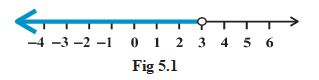
A strict inequality has an open endpoint; an inclusive inequality has a filled endpoint. Shade left for values below the endpoint and right for values above it.
| Inequality | Interval | Endpoint and shading |
|---|---|---|
| Open at ; shade left | ||
| Filled at ; shade left | ||
| Open at ; shade right | ||
| Filled at ; shade right |
Represent the solution on a number line
- Find the boundary value by solving the inequality.
- Mark it with an open circle for or , and a filled circle for or .
- Shade the side containing the solution values.
Solve and graph .
- Solve and graph .
- Collect the variable terms and constants.
- Divide by to get the solution.
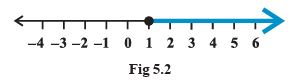
Inclusive endpoint example
- Example: simplifies to .
- Graph: Use a filled circle at and shade to the right; the interval is .
Compound Inequalities and Systems
Compound inequality or system — A compound inequality states two bounds on the same variable, while a system requires the variable to satisfy multiple inequalities simultaneously.
Solve each part and take the intersection: a value belongs to the solution only if it satisfies every inequality.
Solve a compound inequality or system
- For a chained inequality, perform the same operation on all three parts.
- If dividing or multiplying all parts by a negative number, reverse both inequality signs.
- For a system, solve each inequality separately and keep only the overlap.
Solve the system and .
- Solve the system and .
- Solve the first inequality.
- Solve the second inequality; division by reverses the sign.
- Take the overlap of the two solution sets.
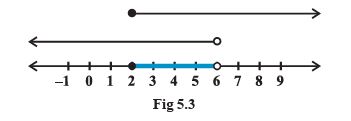
Chained inequality examples
- Example: gives .
- Example: gives .
Applications of Linear Inequalities
Application model — An application inequality translates a condition from a real situation into an inequality, then interprets its solution in context.
Set up and solve an application
- Define the unknown and its units.
- Translate the condition into an inequality or system.
- Solve and apply any restrictions from the context, such as whole-number values.
- State the answer with units and in the context of the question.
A student scored and in two exams. What minimum annual-exam mark gives an average of at least ?
- Let be the annual-exam mark. The average of the three exam marks must be at least .
- Multiply both sides by and simplify.
- Isolate the unknown mark.
Other useful application models
- Consecutive odd natural numbers: Let the smaller be and the next be . For both to exceed and their sum to be below , ; hence .
- Temperature conversion: If and , then degrees Fahrenheit.
- Mixture concentration: Adding litres of acid solution to litres of solution gives a concentration strictly between and when .
Find all pairs of consecutive odd natural numbers, both greater than , whose sum is less than .
A temperature must satisfy . Find the Fahrenheit range if .
A manufacturer has litres of acid solution. How many litres of solution should be added so that the resulting concentration is more than but less than ?
For strict bounds such as “more than” or “less than,” use open endpoints; for “at least” or “at most,” include the endpoint.
Quick recap
- A solution is any value that makes the inequality true; always respect the stated domain.
- Adding or subtracting the same number on both sides preserves the inequality direction.
- Multiplying or dividing by a negative number reverses the inequality sign.
- Use an open endpoint for strict inequalities and a filled endpoint for inclusive inequalities.
- For systems and chained inequalities, keep only values satisfying all conditions.
- Translate word conditions carefully, solve, and interpret the result with its context and units.
Formula sheet
Mathematics — ALL CHAPTERS
1
Sets
2
Relations And Functions
3
Trigonometric Functions
4
Complex Numbers And Quadratic Equations
5
Linear Inequalities
6
Permutations And Combinations
7
Binomial Theorem
8
Sequences And Series
9
Straight Lines
10
Conic Sections
11
Introduction To Three Dimensional Geometry
12
Limits And Derivatives
13
Statistics
14
Probability