Class 11 PCM . Mathematics . Mathematics . Probability
Chapter 14: Probability
Ch 14
Mathematics
Class 11 PCM
Occurrence Of An Event
Events as Subsets of a Sample Space
Use this notation to express that an event contains only outcomes from the sample space.
For two coin tosses, find the event that exactly one head occurs.
- Write the sample space for tossing two coins.
- Choose the outcomes with exactly one head.
- Confirm the event is a subset of the sample space.
Occurrence of an Event
An event occurs exactly when the observed outcome belongs to it.
A die shows . Does the event “a number less than appears” occur?
- Write the sample space and the event of rolling a number less than .
- Check whether the outcome belongs to the event.
- Conclude that the event occurs.
Do not decide occurrence from the event description alone: compare the actual outcome with the event set. An outcome outside means did not occur.
Impossible and Sure Events
The empty set represents an impossible event; the sample space represents a sure event.
For a standard die, classify the event “the result is odd or even.”
- For a standard die, write its sample space.
- Every outcome is either odd or even, so the event includes the full sample space.
- Identify the event as sure.
Simple and Compound Events
Use the number of sample points in to classify an event.
For three coin tosses, classify the event “exactly one head appears.”
- For three coin tosses, list the outcomes with exactly one head.
- Count the sample points in the event.
- Classify the event using its count.
| Event description | Associated subset |
|---|---|
| Exactly one head | |
| At least one head | |
| At most one head |
A die shows . Does the event “a number less than appears” occur?
A coin is tossed twice. Is a simple or compound event?
For a standard die, write the event that the outcome is odd or even, and classify it.
Quick recap
- An event is any subset of a sample space: .
- An event occurs if the observed outcome belongs to it; otherwise, it does not occur.
- The empty set is an impossible event, while the full sample space is a sure event.
- An event with one sample point is simple; one with more than one is compound.
- A sample space with distinct elements has exactly simple events.
Algebra Of Events
Operations on Events
Algebra of events — Events in a sample space can be combined using the set operations complement, union, intersection and difference.
Event meanings
- Complement: or means that event does not occur; it contains outcomes in but not in .
- Union: means “ or or both”; this is an inclusive “or”.
- Intersection: means that both and occur.
- Difference: means “ but not ”; equivalently, .
Here, denotes an outcome and is the sample space.
Finding event combinations
- Write the sample space and list the outcomes in each event.
- For “or”, include outcomes in either event; for “and”, keep only common outcomes.
- For “but not”, remove outcomes of from ; for “not”, take all outcomes outside in .
For the events described, find “ or ”, “ and ”, “ but not ” and “not ”.
- A die is rolled. Let be getting a prime number and be getting an odd number. First write the sample space and events.
- Combine the events using union and intersection.
- Keep outcomes in but not , then find outcomes outside .
Mutually Exclusive Events
Mutually exclusive events — Two events are mutually exclusive if they cannot occur simultaneously.
Events and are mutually exclusive exactly when they have no outcomes in common. In set language, they are disjoint.
Key points
- Disjoint events: If even one outcome belongs to both events, they are not mutually exclusive.
- Simple events: Distinct simple events of the same sample space are always mutually exclusive.
Use this test by checking whether the intersection is empty.
Testing two events
- List or identify outcomes common to both events.
- If the intersection is empty, the events are mutually exclusive; otherwise, they are not.
Which pair is mutually exclusive: odd and even, or odd and less than ?
- On a die, let be an odd result and be an even result. Their sets have no common outcome.
- Now let be a result less than . The outcomes and belong to both and .
Exhaustive Events
Exhaustive events — A collection of events is exhaustive if at least one of them must occur in every performance of the experiment.
Events are exhaustive when their union contains every outcome in the sample space.
Mutually exclusive and exhaustive events — Events are mutually exclusive and exhaustive when they cover the whole sample space and every pair is disjoint.
Both conditions must hold: the events cover and are pairwise disjoint.
Checking a collection of events
- Take the union of all the events and check whether it equals the sample space.
- Check every pairwise intersection for emptiness.
- The collection is mutually exclusive and exhaustive only if both checks pass.
Do , and form mutually exclusive and exhaustive events?
- A coin is tossed three times. Let mean no heads, exactly one head, and at least two heads.
- List the outcomes in each event and see that their union is the sample space.
- The three pairwise intersections are empty.
Two dice are thrown. Let be an even sum, a sum divisible by , a sum less than , and a sum greater than . Which pairs are mutually exclusive?
For a die, let be a result less than , a result greater than but less than , and a result greater than . Are the events exhaustive? Are they mutually exclusive?
Quick recap
- The complement contains all outcomes in that are not in .
- means or or both; means both occur.
- means occurs but does not.
- Events are mutually exclusive exactly when their intersection is empty.
- Events are exhaustive when their union is the entire sample space.
- Mutually exclusive and exhaustive events are pairwise disjoint and together cover .
Axiomatic Approach To Probability
Axioms of Probability
Probability function — A probability function maps every event (subset) of the sample space to a real number in .
For events and , probability is non-negative, the sample space has probability , and probabilities add for mutually exclusive events.
Since and are mutually exclusive, additivity gives ; hence the empty event has probability zero.
Elementary event — A singleton event containing one outcome, , is an elementary event; write as shorthand for .
For , each outcome probability is in , all outcome probabilities sum to , and an event's probability is the sum for its outcomes.
Probability assignments need not be equal
- Coin outcomes: Both , and , satisfy the axioms.
- General assignment: and are valid for any .
- Key condition: Probabilities need not be equal, but they must be non-negative and sum to .
Check a finite probability assignment
- Check that each outcome probability is between and , inclusive.
- Add all outcome probabilities and verify that the total is .
| Probabilities assigned to | Valid? | Reason |
|---|---|---|
| Yes | Each is in and the sum is . | |
| Yes | Each is in and the sum is . | |
| No | Two probabilities are negative. | |
| No | . | |
| No | The sum is , not . |
Is assigning probability to each of six outcomes valid?
- Test equal probabilities of assigned to each of six outcomes.
- Each probability individually lies in .
- Add the six probabilities.
- The total is not , so the assignment is invalid.
Probability of an Event
Probability of an event — The probability of an event is the sum of the probabilities of all outcomes in that event.
Sum the probabilities of the outcomes belonging to event .
Find an event probability
- List the outcomes that make up the event.
- Add the assigned probabilities of those outcomes.
Find the probability that exactly one of the three pens is defective.
- Three pens are classified as defective () or good (); each of the eight outcomes has probability .
- Exactly one defective pen occurs in these three outcomes.
- Add their probabilities.
More event examples
- At least two defective pens: , so .
- Two coin tosses: If , , , and , the probabilities sum to .
- Same result: For , . Exactly two heads is , so .
Equally Likely Outcomes
Equally likely outcomes — Outcomes are equally likely when every elementary outcome has the same probability.
If a sample space has equally likely outcomes and event contains outcomes, its probability is the favourable-outcome count divided by the total-outcome count.
Use only when all outcomes are equally likely; and .
Use the equally likely outcomes formula
- Check that every outcome is equally likely.
- Count the total outcomes and those favourable to the event.
- Divide the favourable count by the total count.
Find the probability of getting exactly one head in two tosses of a fair coin.
- A fair coin is tossed twice; the four outcomes are equally likely. Exactly one head occurs in or .
- There are two favourable outcomes out of four.
- Apply the equally likely outcomes formula.
Do not use unless outcomes are equally likely; otherwise add the individual outcome probabilities.
A sample space has four outcomes with probabilities , , , and . Is this a valid assignment?
Outcomes have probabilities . Find the probability of event .
A fair die is rolled. Find the probability of getting an even number.
Quick recap
- A probability function assigns each event a value in .
- The axioms are non-negativity, , and additivity for mutually exclusive events.
- The empty event has probability .
- For a finite sample space, outcome probabilities sum to ; event probabilities sum the probabilities of included outcomes.
- Outcomes do not have to be equally likely if their probabilities satisfy the axioms.
- For equally likely outcomes, .
Probability Of The Event ‘A or B’
Probability of ‘A or B’
Union of two events — The event ‘ or ’ is the union : an outcome belongs if it is in , in , or in both.
The probability of an event is the sum of the probabilities of its individual sample points.
For any two events, subtract the overlap because it is counted twice when adding their probabilities.
Why the addition law works
- Partition: ; these parts are mutually exclusive.
- Double count: includes twice, while the union includes it once.
- Equally likely outcomes: If all outcomes are equally likely, .
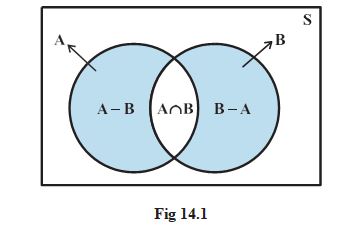
If and are disjoint, then and their union probabilities add.
Finding the probability of ‘A or B’
- Find and .
- Find the overlap and its probability.
- Subtract the overlap from the sum; for disjoint events, the overlap is zero.
Find the probability of or .
- A coin is tossed three times. Let and . Each outcome has probability .
- The common outcomes are and , so the intersection has probability .
- Apply the addition law to find the probability of or .
Do not add and without checking for overlap: subtract unless the events are mutually exclusive.
Probability of ‘not A’
Complement of an event — The complement (also written ) is the event that does not occur.
Properties of a complement
- Disjoint: .
- Exhaustive: , so and together cover the sample space.
- Total probability: Since , the probabilities of an event and its complement add to .
Use this rule to find the probability that an event does not occur.
Finding a complement probability
- Identify the event and find its probability.
- Subtract that probability from .
Find the probabilities of a diamond, not an ace, a black card, not a diamond, and not a black card.
- A card is drawn from a well-shuffled deck of cards. There are diamonds, aces, and black cards.
- Find the probability of a diamond, then its complement.
- Use the complement rule for not an ace.
- A black card has probability one-half, so its complement has the same probability.
Combining union and complement rules
The event that neither nor occurs is the complement of their union.
The exactly-one event consists of two mutually exclusive cases: occurs alone or occurs alone.
Find the probabilities that both fail, at least one fails, and exactly one qualifies.
- Let and be the events that Anil and Ashima qualify. Given their probabilities and the probability that both qualify:
- Find the probability that at least one qualifies.
- Both fail means neither qualifies, so take the complement of the union.
- At least one fails is the complement of both qualifying.
- Exactly one qualifies if Anil alone or Ashima alone qualifies.
A bag contains red, blue, and yellow discs. Find the probabilities of red, yellow, blue, not blue, and red or blue.
A committee of two is selected from two men and two women. Find the probability of selecting no men, one man, and two men.
- Union: Subtract the intersection once to avoid double counting.
- Complement: An event and its complement have probabilities summing to .
Quick recap
- For any event, .
- For any two events, .
- For mutually exclusive events, , so their union probabilities add.
- The complement rule is .
- Neither nor occurs exactly when occurs.
- Exactly one occurs in either disjoint case: or .
Miscellaneous Examples
Probability in Random Arrangements of Cities (Example 9)
Random ordering — A random ordering of distinct objects has equally likely outcomes when every permutation is equally likely.
For distinct objects, there are orders; if all orders are equally likely, then .
Count orders satisfying the condition
- Count all possible orders of the distinct objects.
- Count the orders that satisfy the event, using symmetry or a block when objects must stay together.
- Divide the favourable count by the total count.
For four cities visited in a random order, find the probability of each condition: before ; before before ; first and last; first or second; and immediately before .
- Four cities can be visited in any order.
- By symmetry, half of all orders place before .
- The relative order of is equally likely in ways; only one order has before before .
- If is first and last, fill the middle two positions in orders.
- There are orders with in either the first or second position.
- Treat the adjacent pair as one block; it and can be arranged in ways.
Selecting a Hand of Cards (Example 10)
Combination count — When the order of selected objects does not matter, count selections using combinations.
A hand of cards from cards has possible outcomes. For specified numbers from separate card groups, multiply their combination counts.
Count hands by card groups
- Count all possible hands of the required size.
- Choose the required cards from each group and multiply the combination counts.
- Divide the favourable count by the total; add disjoint cases for an “at least” event.
A seven-card hand is drawn from a standard 52-card deck. Find the probabilities that it contains (i) all four Kings, (ii) exactly three Kings, and (iii) at least three Kings.
- The total number of seven-card hands is the number of ways to choose seven cards from 52.
- For all four Kings, choose all four Kings and three of the 48 non-Kings.
- For exactly three Kings, choose three of the four Kings and four of the 48 non-Kings.
- Exactly three and exactly four Kings are disjoint cases, so add their probabilities.
Do not use permutations for a card hand: card order does not matter, so the total is , not an ordered count.
Addition Rule for Three Events (Example 11)
Inclusion-exclusion — The three-event addition rule calculates the probability of a union by correcting for outcomes counted in multiple events.
For any three events , subtract each pairwise intersection after adding the individual probabilities, then add the triple intersection.
Apply the three-event rule
- Add the probabilities of the three individual events.
- Subtract the three pairwise intersections to correct double counting.
- Add the triple intersection once because it was subtracted too many times.
Added example: for a fair die, let , , and . Find using inclusion-exclusion.
- Added example: for a fair die, let , , and .
- The individual probability sum, pairwise-intersection sum, and triple intersection are as follows.
- Substitute into the three-event rule.
Finishing Orders in a Relay Race (Example 12)
Ordered selection — An ordered selection assigns distinct competitors to specified positions, so changing their order gives a different outcome.
From competitors, the first places can be filled in ways. If a fixed group fills those places in any order, count its internal arrangements.
Count a finishing-order event
- Count the ordered possibilities for the specified finishing places.
- Count favourable orders, allowing all internal arrangements if the group can finish in any order.
- Divide favourable orders by all possible orders.
In a race of five teams, find the probability that (a) finish first, second, and third respectively; (b) they occupy the first three places in any order.
- Five teams can fill the first three places in 60 equally likely ordered ways.
- For to finish first, second, and third respectively, there is one favourable order.
- For to be the first three finishers in any order, count their arrangements.
Core Probability Reminders
Key definitions and rules
- Event: A subset of the sample space; the impossible event is , and the sure event is .
- Event operations: “ or ” is ; “ and ” is ; “ and not ” is .
- Complement: “Not ” is , with .
- Mutually exclusive: Events have no common outcomes when ; then .
- Exhaustive and mutually exclusive: Events cover and have no pairwise overlap: and for .
- Axioms: Outcome probabilities satisfy and ; .
- Equally likely outcomes: For a finite sample space whose outcomes are equally likely, .
- Two-event addition rule: ; the intersection term is zero for mutually exclusive events.
Four distinct books are placed randomly in a row. What is the probability that book is immediately before book ?
A seven-card hand is drawn from a 52-card deck. Find the probability of exactly two Kings.
In a race of six teams, what is the probability that teams and take the first two places in either order?
Quick recap
- Random orders of distinct objects have equally likely outcomes.
- For a card hand, use combinations because the order of cards does not matter.
- For three events, add individual probabilities, subtract pairwise intersections, then add the triple intersection.
- For top-place rankings, use ordered selections: .
- For finite equally likely outcomes, ; for complements, .
- Mutually exclusive events have zero intersection, so their union probability is the sum of their probabilities.
Formula sheet
Mathematics — ALL CHAPTERS
1
Sets
2
Relations And Functions
3
Trigonometric Functions
4
Complex Numbers And Quadratic Equations
5
Linear Inequalities
6
Permutations And Combinations
7
Binomial Theorem
8
Sequences And Series
9
Straight Lines
10
Conic Sections
11
Introduction To Three Dimensional Geometry
12
Limits And Derivatives
13
Statistics
14
Probability