Class 11 PCM . Mathematics . Mathematics . Relations and Functions
Chapter 2: Relations And Functions
Ch 2
Mathematics
Class 11 PCM
Relations And Cartesian Products Of Sets
Cartesian Products of Sets
Cartesian product — For sets and , the Cartesian product is the set of all ordered pairs whose first element is from and second element is from .
Use this to list all pairs in the specified order.
Basic Facts
- Empty set: If either factor is empty, then .
- Example: For and , has pairs.
- Order: Usually, , even though the two products have the same number of elements when both sets are finite.
- Infinite sets: If and are non-empty and at least one is infinite, then is infinite.
If and are finite sets with and elements, respectively, then their Cartesian product has elements.
For sets , , and , taking a Cartesian product with distributes over intersection and union.
The product consists of ordered triplets with each entry chosen from .
Geometric Meaning
- Plane: represents the coordinates of all points in the two-dimensional plane.
- Three-dimensional space: represents the coordinates of all points in three-dimensional space.
- Distinct points: In general, and are different coordinates.
For finite sets, multiply the number of choices for each position.
Forming a Cartesian Product
- Choose each element of the first set in turn.
- For each choice, pair it with every element of the second set.
- Keep the first-set element first and the second-set element second; check the total using the cardinality formula.
For , , and , find .
- Let , , and . Find .
- Find the common elements of and .
- Pair every element of with the sole element of .
- Check using the distributive property: the pairs common to and are the same.
Do not reverse the order of elements: and are generally different, and is generally not .
If , find and .
For and , write and . Are they equal?
If , find and .
Quick recap
- A Cartesian product lists ordered pairs with the first element from the first set and the second from the second set.
- Two ordered pairs are equal exactly when their corresponding entries are equal.
- For finite sets, ; a product with an empty factor is empty.
- Cartesian products distribute over unions and intersections when one factor is fixed.
- Products of three sets form ordered triplets; products of real numbers describe coordinates in two- and three-dimensional space.
Relations
Relations and Their Representations
Relation from A to B — A relation from to is any subset of the Cartesian product ; each ordered pair states that is related to .
Use this to express that a relation from to contains only pairs from .
Key properties
- Ordered pairs: The first element is from and the second is from .
- Rule-based relation: Select the pairs in that satisfy the stated condition.
- Representations: A relation can be written in roster form, set-builder form, or shown with an arrow diagram.
- Example: When each name is related to its first letter, the pairs are: a with Ali; b with Bhanu and Binoy; c with Chandra.
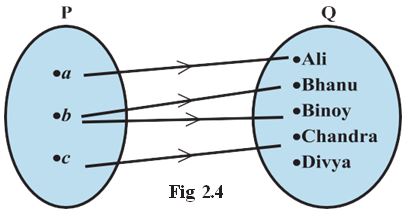
Domain, range, and codomain — The domain contains all first elements in the relation; the range contains all second elements, while the codomain is the entire target set .
For a relation from to , the domain is a subset of , and the range is a subset of the codomain . Elements of the codomain need not occur in the range.
Finding a relation, its domain, and its range
- List the ordered pairs satisfying the rule, using only elements in the specified sets.
- Collect the first coordinates without repetition to get the domain.
- Collect the second coordinates without repetition to get the range; the codomain is the full target set.
Find the domain, range, and codomain of the relation defined by on .
- Let and define a relation on by . List the pairs satisfying the rule.
- The first coordinates form the domain, the second coordinates form the range, and the codomain is all of .
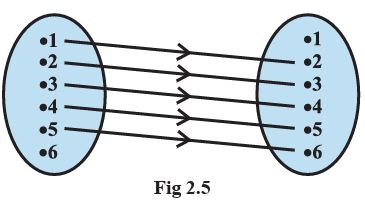
Let and . Write the relation “ is the square of ” in set-builder and roster forms. Find its domain, range, and codomain.
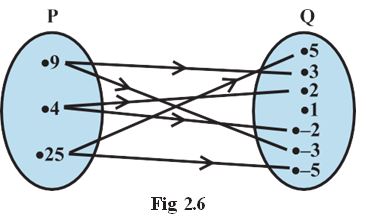
Number of Relations
Every relation from to is a subset of . If and have and elements, respectively, each of the ordered pairs can either be included or excluded.
Use this when and .
Counting relations
- Find the number of ordered pairs in the Cartesian product.
- Count all subsets of ; each subset is one relation.
How many relations are there from to ?
- For and , list the ordered pairs in the Cartesian product.
- Each subset of these four pairs is a relation, so count the subsets.
If and , how many relations can be defined from to ?
Relation on a set — A relation from a set to itself is called a relation on .
Do not confuse the range with the codomain: the range includes only second elements that actually occur in the relation; the codomain is the entire target set.
Quick recap
- A relation from to is any subset of .
- Relations can be written in roster form, set-builder form, or as arrow diagrams.
- The domain and range contain the first and second coordinates that actually occur.
- The codomain is the full target set, so the range may be smaller.
- If and , the number of relations from to is .
- A relation from a set to itself is called a relation on that set.
Function
Functions and their basic terms
Function test — A relation is a function precisely when no two distinct ordered pairs have the same first element and different second elements.
Use this notation to state the input set, target set and output rule.
Testing whether a relation is a function
- Identify every first element in the ordered pairs.
- Check that each first element has an associated second element.
- Reject the relation if any first element is paired with two different second elements.
Is a function?
- Test the relation .
- The inputs each appear once, so each has exactly one image.
- The relation is a function; two inputs sharing the image does not violate uniqueness.
Real-valued and real functions
For defined by , the outputs are odd natural numbers starting from (when ).
Common functions and their graphs
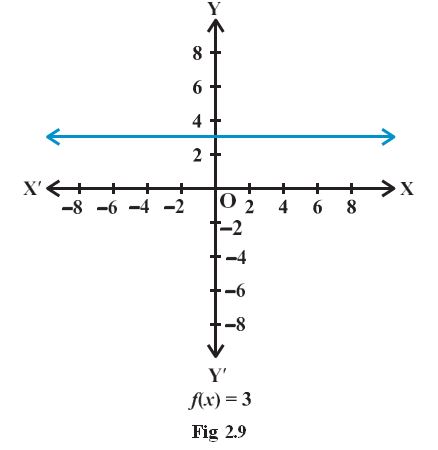
A polynomial has only non-negative integer powers of its variable. Thus and are polynomials, but is not.
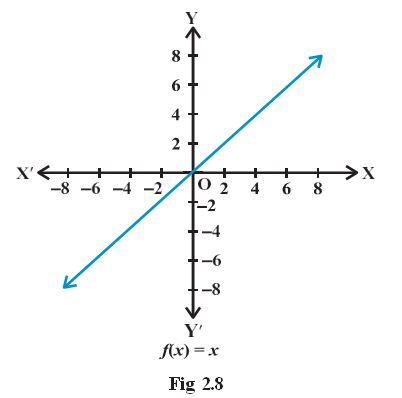
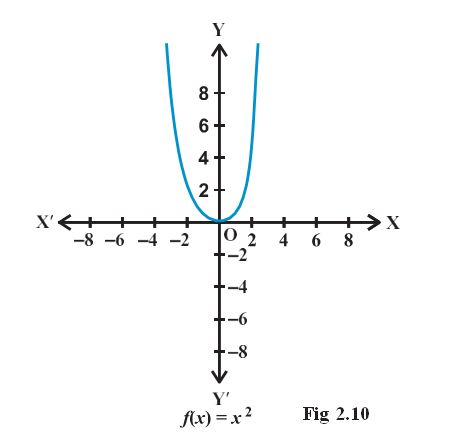
Its graph is an upward-opening parabola with vertex at the origin.
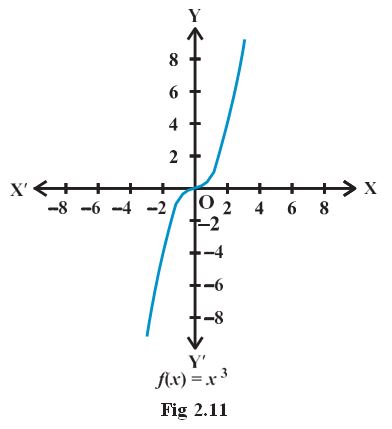
Its domain and range are both ; the graph passes through the origin.
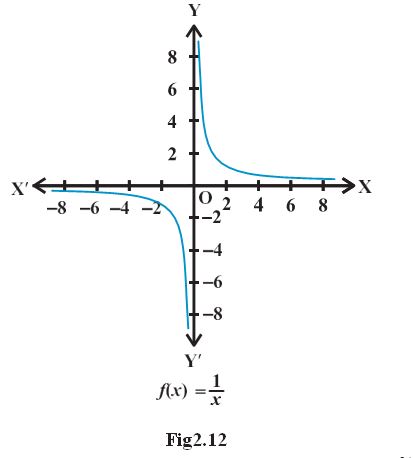
The input and output cannot be zero; the graph has branches in the first and third quadrants.
Making a function table and sketching its graph
- Choose several input values from the domain.
- Substitute each input into the rule to calculate its output.
- Plot the resulting ordered pairs and join them in the shape appropriate to the function.
Make a value table and identify the graph and range of .
- For , substitute the inputs .
- Calculate each output; opposite inputs give equal outputs.
- Plot the pairs; the graph is a parabola, with domain and range .
Modulus, signum and greatest integer functions
Intervals include the left endpoint but exclude the right endpoint.
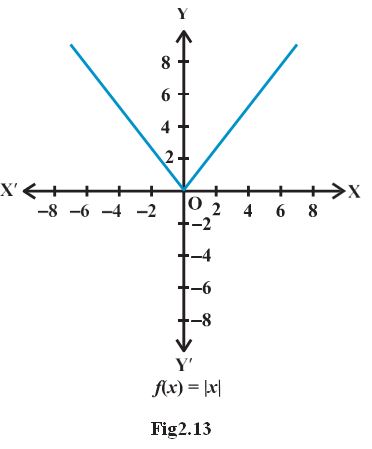
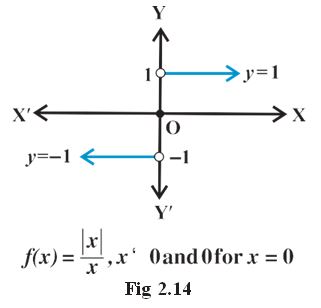
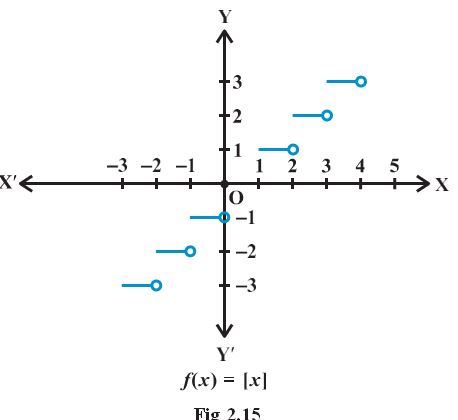
Evaluating piecewise functions
- For modulus, use the input itself if it is non-negative and its negative if it is negative.
- For signum, determine whether the input is positive, zero or negative.
- For greatest integer, locate the unique integer interval .
Evaluate , and at .
- For the input , modulus changes the negative sign.
- The input is negative, so its signum is .
- Since , its greatest integer is .
Algebra of real functions
Apply each operation to the outputs at the same input.
Combining two functions
- Write the two function rules.
- Substitute them into the required pointwise operation and simplify.
- For a quotient, exclude every input where the denominator function is zero.
Find , , and for , .
- Take and .
- Add and subtract the two rules.
- Multiply the rules.
- Divide by and exclude the zero of the denominator.
Do not allow a quotient where the denominator is zero: for , remove every satisfying .
Is a function?
For and , find and on their common domain.
Quick recap
- A function assigns exactly one image to every element of its domain.
- The range is the set of attained outputs and is contained in the codomain.
- Identity, constant, polynomial and rational functions are distinguished by their rules and graph/domain properties.
- The square function has range ; the cube function has range ; the reciprocal function excludes zero from domain and range.
- Modulus gives non-negative magnitude; signum records sign; the greatest integer function rounds down to an integer.
- Function operations are pointwise, and a quotient is defined only where its denominator is non-zero.
Summary And Points To Ponder
Ordered Pairs and Cartesian Products
Cartesian product — The Cartesian product of sets and is the set of ordered pairs whose first element comes from and second element comes from .
Key points
- Ordered pair: The order matters; exactly when and .
- Size: If and , then has elements.
- Empty set: .
- Order of factors: In general, .
- Real products: ; .
Use these formulas to list or count the ordered pairs.
Forming a Cartesian product
- Take each element of the first set in turn.
- Pair it with every element of the second set, keeping the order fixed.
- Count the pairs by multiplying the sizes of the sets.
If and , find and .
- Pair each element of with both elements of .
- Reverse the order of the sets to form .
Do not treat ordered pairs as unordered: for example, and are not the same pair.
Relations
Relation — A relation from set to set is a subset of describing a relationship between the elements in its ordered pairs.
Key points
- Image: If , then is an image of under relation .
- Domain: The set of all first elements in the ordered pairs of .
- Range: The set of all second elements in the ordered pairs of .
Read the first and second coordinates of each pair, respectively.
Finding a relation's domain and range
- List the first coordinates of all ordered pairs and remove repeats to get the domain.
- List the second coordinates and remove repeats to get the range.
For , find the domain and range.
- Collect the first coordinates and remove repeats.
- Collect the second coordinates and remove repeats.
Functions
Function — A function from to is a relation in which every element of has exactly one image in .
Key points
- Notation: Write and when is the image of .
- Domain: The input set ; codomain: the target set .
- Range: The set of actual images, so it is a subset of the codomain.
- Real function: A function whose domain and range are subsets of the real numbers.
Each input in the domain must be assigned one and only one output.
Checking whether a relation is a function
- Check that every element of the stated domain appears as a first coordinate.
- Check that no domain element is paired with more than one output.
Is a function from to ?
- Each domain element has exactly one image.
- Both inputs are represented once as first coordinates, so the relation satisfies the function rule.
A relation is not a function if even one domain element has no image or has more than one image.
Algebra of Functions
Algebra of functions — Functions with the same domain can be combined pointwise using arithmetic operations.
Key points
- Common domain: Let and .
- Sum, difference and product: Evaluate both functions at the same input, then add, subtract or multiply their values.
- Scalar multiple: Multiply each value of by the real constant .
- Quotient: Defined only at inputs where .
For the quotient, exclude any input where the denominator function is zero.
Combining functions
- Substitute the input into each function.
- Apply the required operation to the function values.
- For a quotient, keep only inputs where the denominator value is nonzero.
If and , find and .
- Evaluate both functions at the input.
- Add their values.
- Divide their values; the denominator is nonzero.
If and , find .
For , find its domain and range. Is it a function from ?
If and , find and .
Quick recap
- An ordered pair is determined by its first and second coordinates in that order.
- The Cartesian product contains all possible ordered pairs; its size is the product of the set sizes.
- A relation from to is a subset of ; its domain and range come from first and second coordinates.
- A function assigns exactly one image in the codomain to every element of its domain.
- The range is the set of actual function images and is contained in the codomain.
- Function operations are defined pointwise; a quotient requires a nonzero denominator value.
Formula sheet
Mathematics — ALL CHAPTERS
1
Sets
2
Relations And Functions
3
Trigonometric Functions
4
Complex Numbers And Quadratic Equations
5
Linear Inequalities
6
Permutations And Combinations
7
Binomial Theorem
8
Sequences And Series
9
Straight Lines
10
Conic Sections
11
Introduction To Three Dimensional Geometry
12
Limits And Derivatives
13
Statistics
14
Probability