Class 11 PCM . Mathematics . Mathematics . Introduction to Three Dimensional Geometry

Chapter 11: Introduction To Three Dimensional Geometry

Ch 11

Mathematics

Class 11 PCM

Lecture 1

Coordinate Axes And Coordinate Planes In Three Dimensional Space

Reference video · Lecture 1Coordinate Axes And Coordinate Planes In Three Dimensional Space

Coordinate Axes and Coordinate Planes
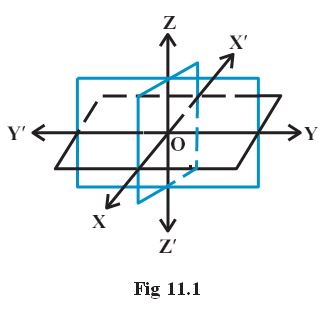
Three coordinate planes intersecting at the origin in three-dimensional geometry.

Coordinates of a Point in Space

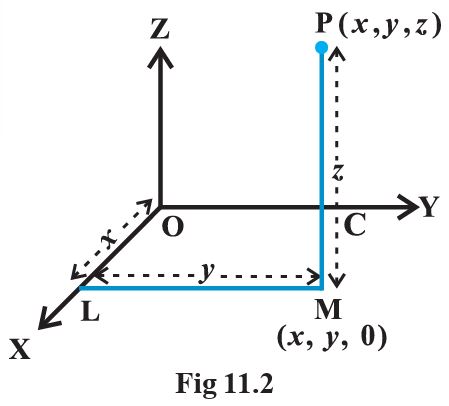
A three-dimensional coordinate diagram showing a point and its projections onto the axes and coordinate plane.
Coordinate notation
P=(x,y,z)P=(x,y,z)

The first, second and third entries are the signed distances from the YZYZ-, ZXZX- and XYXY-planes, respectively.

Locate a Point from Its Coordinates

  1. Mark the signed coordinate xx on the xx-axis.
    A=(x,0,0)A=(x,0,0)
  2. In the XYXY-plane, move parallel to the yy-axis by the signed amount yy to locate the projection.
    M=(x,y,0)M=(x,y,0)
  3. Move perpendicular to the XYXY-plane by the signed amount zz to reach the point.
    P=(x,y,z)P=(x,y,z)
Worked example

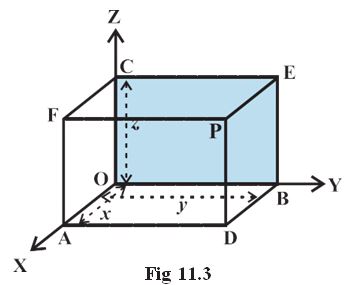
If P=(2,4,5)P=(2,4,5), find the coordinates of FF.

  1. In the coordinate cuboid, if P=(2,4,5)P=(2,4,5), the point FF has the same xx- and zz-coordinates as PP, while its yy-coordinate is zero.
    xF=2,yF=0,zF=5x_F=2,\quad y_F=0,\quad z_F=5
  2. Write the coordinates in the order x,y,zx,y,z.
    F=(2,0,5)F=(2,0,5)
Answer: F=(2,0,5)F=(2,0,5).
A cuboid positioned on the coordinate axes, illustrating points and directions in three-dimensional geometry.

Octants and Coordinate Signs

Practice

Identify the octants containing (−3,1,2)(-3,1,2) and (−3,1,−2)(-3,1,-2).

Hint: Match the signs of each coordinate to the octant table.
Key step: The sign patterns are (−,+,+)(-,+,+) and (−,+,−)(-,+,-).
Solution: (−3,1,2)(-3,1,2) lies in octant II; (−3,1,−2)(-3,1,-2) lies in octant VI.
Practice

State the general coordinate forms of points in the XYXY- and ZXZX-planes.

Hint: Set the coordinate perpendicular to each plane equal to zero.
Key step: The XYXY-plane has z=0z=0; the ZXZX-plane has y=0y=0.
Solution: XYXY-plane: (x,y,0)(x,y,0); ZXZX-plane: (x,0,z)(x,0,z).
⚠ Common mistake

Do not confuse coordinate order: In (x,y,z)(x,y,z), xx, yy and zz are measured from the YZYZ-, ZXZX- and XYXY-planes, respectively.

Quick recap

  • The three mutually perpendicular axes meet at the origin and define the XYXY-, YZYZ- and ZXZX-coordinate planes.
  • A point has coordinates (x,y,z)(x,y,z), its signed distances from the YZYZ-, ZXZX- and XYXY-planes, respectively.
  • The origin is (0,0,0)(0,0,0); points on axes or planes have zero in the corresponding coordinate position.
  • Each point in space corresponds to exactly one ordered triplet of real numbers.
  • The coordinate signs identify the octant: for example, (−,+,+)(-,+,+) is II and (−,+,−)(-,+,-) is VI.
Lecture 2

Distance Between Two Points

Reference video · Lecture 2Distance Between Two Points

Three-Dimensional Coordinate Setup

Axes, coordinate planes and points

  • Axes: The xx-, yy- and zz-axes are three mutually perpendicular lines.
  • Coordinate planes: The pairs of axes determine the XYXY-, YZYZ- and ZXZX-planes; together they divide space into eight octants.
  • Coordinates: A point is written as an ordered triplet (x,y,z)(x,y,z); its coordinates are signed distances from the YZYZ-, ZXZX- and XYXY-planes, respectively.
  • Points on axes: On the xx-axis points have form (x,0,0)(x,0,0); on the yy-axis, (0,y,0)(0,y,0); on the zz-axis, (0,0,z)(0,0,z).

Distance Formula

Definition

Distance between two points — The distance between two points in space is the length of the straight-line segment joining them.
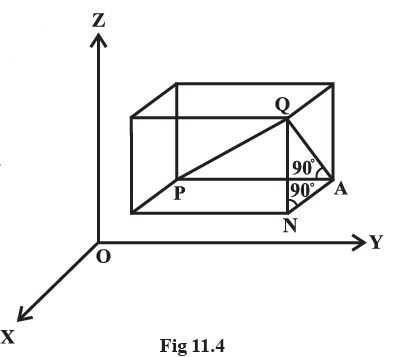
A rectangular cuboid on the coordinate axes, with PQ as a space diagonal.
A rectangular cuboid on the coordinate axes, with PQPQ as a space diagonal.
Three-dimensional distance theorem

For P(x1,y1,z1)P(x_1,y_1,z_1) and Q(x2,y2,z2)Q(x_2,y_2,z_2), apply the Pythagorean theorem to the perpendicular coordinate differences of the cuboid.

PQ=(x2−x1)2+(y2−y1)2+(z2−z1)2PQ=\sqrt{(x_2-x_1)^2+(y_2-y_1)^2+(z_2-z_1)^2}
Distance from the origin
OQ=x2+y2+z2OQ=\sqrt{x^2+y^2+z^2}

Set one point equal to O(0,0,0)O(0,0,0).

Finding the distance

  1. Subtract corresponding coordinates in the same order.
    Δx=x2−x1,Δy=y2−y1,Δz=z2−z1\Delta x=x_2-x_1,\quad \Delta y=y_2-y_1,\quad \Delta z=z_2-z_1
  2. Square the differences, add them, and take the non-negative square root.
    PQ=(Δx)2+(Δy)2+(Δz)2PQ=\sqrt{(\Delta x)^2+(\Delta y)^2+(\Delta z)^2}
Worked example

Find the distance between P(1,−3,4)P(1,-3,4) and Q(−4,1,2)Q(-4,1,2).

  1. Find the distance between P(1,−3,4)P(1,-3,4) and Q(−4,1,2)Q(-4,1,2).
    PQ=(−4−1)2+(1−(−3))2+(2−4)2PQ=\sqrt{(-4-1)^2+(1-(-3))^2+(2-4)^2}
  2. Square and add the coordinate differences.
    PQ=25+16+4=45PQ=\sqrt{25+16+4}=\sqrt{45}
  3. Simplify the radical.
    PQ=35PQ=3\sqrt{5}
Answer: 353\sqrt{5} units
⚠ Common mistake

Keep coordinate differences in a consistent order and square the entire difference. Distance is always non-negative.

Testing Geometric Relationships with Distances

Collinearity test

If P,Q,RP,Q,R are collinear in that order, then PQ+QR=PRPQ+QR=PR. Conversely, this equality shows that the points lie on one line with QQ between PP and RR.

PQ+QR=PRPQ+QR=PR
Right-triangle test

A triangle is right-angled if the square of its longest side equals the sum of the squares of the other two sides.

c2=a2+b2c^2=a^2+b^2

Quadrilateral checks and examples

  • Parallelogram: A quadrilateral with both pairs of opposite sides equal is a parallelogram; alternatively, its diagonals bisect each other.
  • Rectangle: A parallelogram is a rectangle exactly when its diagonals are equal.
  • Not right-angled: For A(3,6,9)A(3,6,9), B(10,20,30)B(10,20,30) and C(25,−41,5)C(25,-41,5), AB2=686AB^2=686, BC2=4571BC^2=4571 and CA2=2709CA^2=2709; no Pythagorean equality holds.
  • Parallelogram, not rectangle: For A(1,2,3)A(1,2,3), B(−1,−2,−1)B(-1,-2,-1), C(2,3,2)C(2,3,2) and D(4,7,6)D(4,7,6), AB=CD=6AB=CD=6 and BC=DA=43BC=DA=\sqrt{43}, while AC=3≠155=BDAC=\sqrt{3}\ne\sqrt{155}=BD.
Worked example

Show that P(−2,3,5)P(-2,3,5), Q(1,2,3)Q(1,2,3) and R(7,0,−1)R(7,0,-1) are collinear.

  1. For P(−2,3,5)P(-2,3,5), Q(1,2,3)Q(1,2,3) and R(7,0,−1)R(7,0,-1), calculate PQPQ.
    PQ=(1+2)2+(2−3)2+(3−5)2=14PQ=\sqrt{(1+2)^2+(2-3)^2+(3-5)^2}=\sqrt{14}
  2. Calculate QRQR.
    QR=(7−1)2+(0−2)2+(−1−3)2=56=214QR=\sqrt{(7-1)^2+(0-2)^2+(-1-3)^2}=\sqrt{56}=2\sqrt{14}
  3. Calculate PRPR and compare the lengths.
    PR=(7+2)2+(0−3)2+(−1−5)2=126=314PR=\sqrt{(7+2)^2+(0-3)^2+(-1-5)^2}=\sqrt{126}=3\sqrt{14}
  4. Since the two shorter lengths add to the longest, the points are collinear.
    PQ+QR=14+214=314=PRPQ+QR=\sqrt{14}+2\sqrt{14}=3\sqrt{14}=PR
Answer: The points are collinear, with QQ between PP and RR.

Loci from Distance Conditions

Definition

Distance locus — A distance locus is the set of points P(x,y,z)P(x,y,z) satisfying a stated distance condition from fixed points.

Equidistant locus

Points equidistant from two distinct fixed points satisfy equality of squared distances; their locus is the perpendicular-bisector plane of the segment joining those points.

PA2=PB2PA^2=PB^2
Sum of squared distances
2x2+2y2+2z2−4x−14y+4z=2k2−1092x^2+2y^2+2z^2-4x-14y+4z=2k^2-109

For A(3,4,5)A(3,4,5), B(−1,3,−7)B(-1,3,-7) and P(x,y,z)P(x,y,z), the condition PA2+PB2=2k2PA^2+PB^2=2k^2 simplifies to:

Forming a distance-locus equation

  1. Let the variable point be P(x,y,z)P(x,y,z) and write its squared distance to each fixed point.
    PA2=(x−a1)2+(y−a2)2+(z−a3)2PA^2=(x-a_1)^2+(y-a_2)^2+(z-a_3)^2
  2. Substitute the condition; for equal distances, set the squared distances equal.
    PA2=PB2PA^2=PB^2
  3. Expand and simplify to obtain the equation of the locus.
Worked example

Find the equation of the set of points equidistant from A(3,4,−5)A(3,4,-5) and B(−2,1,4)B(-2,1,4).

  1. For P(x,y,z)P(x,y,z) equidistant from A(3,4,−5)A(3,4,-5) and B(−2,1,4)B(-2,1,4), equate squared distances.
    (x−3)2+(y−4)2+(z+5)2=(x+2)2+(y−1)2+(z−4)2(x-3)^2+(y-4)^2+(z+5)^2=(x+2)^2+(y-1)^2+(z-4)^2
  2. Expand both sides and cancel matching squared terms.
    10x+6y−18z−29=010x+6y-18z-29=0
Answer: 10x+6y−18z−29=010x+6y-18z-29=0

Centroid of a Triangle in Space

Definition

Centroid — The centroid of a triangle in space is found by averaging the three vertex coordinates separately.

Centroid coordinates
G=(x1+x2+x33,y1+y2+y33,z1+z2+z33)G=\left(\frac{x_1+x_2+x_3}{3},\frac{y_1+y_2+y_3}{3},\frac{z_1+z_2+z_3}{3}\right)

For vertices A(x1,y1,z1)A(x_1,y_1,z_1), B(x2,y2,z2)B(x_2,y_2,z_2) and C(x3,y3,z3)C(x_3,y_3,z_3):

Finding a missing vertex

  1. Substitute the known vertices and centroid into the coordinate-average formula.
    (x1+x2+x33,y1+y2+y33,z1+z2+z33)=(gx,gy,gz)\left(\frac{x_1+x_2+x_3}{3},\frac{y_1+y_2+y_3}{3},\frac{z_1+z_2+z_3}{3}\right)=(g_x,g_y,g_z)
  2. Solve separately for the missing coordinates.
    x3=3gx−x1−x2,y3=3gy−y1−y2,z3=3gz−z1−z2x_3=3g_x-x_1-x_2,\quad y_3=3g_y-y_1-y_2,\quad z_3=3g_z-z_1-z_2
Worked example

Find CC if the centroid of triangle ABCABC is (1,1,1)(1,1,1), A=(3,−5,7)A=(3,-5,7) and B=(−1,7,−6)B=(-1,7,-6).

  1. Let C=(x,y,z)C=(x,y,z). The centroid is (1,1,1)(1,1,1), and A=(3,−5,7)A=(3,-5,7), B=(−1,7,−6)B=(-1,7,-6).
    3−1+x3=1,−5+7+y3=1,7−6+z3=1\frac{3-1+x}{3}=1,\quad \frac{-5+7+y}{3}=1,\quad \frac{7-6+z}{3}=1
  2. Solve the three equations.
    x=1,y=1,z=2x=1,\quad y=1,\quad z=2
Answer: C=(1,1,2)C=(1,1,2)
Practice

Find the distance between A(2,−1,3)A(2,-1,3) and B(−2,2,3)B(-2,2,3).

Hint: Use the three coordinate differences.
Key step: AB2=(−4)2+32+02=25AB^2=(-4)^2+3^2+0^2=25.
Solution: AB=25=5AB=\sqrt{25}=5 units.
Practice

Are A(0,0,0)A(0,0,0), B(1,2,2)B(1,2,2) and C(4,8,8)C(4,8,8) collinear?

Hint: Compare the lengths ABAB, BCBC and ACAC.
Key step: AB=3AB=3, BC=9BC=9 and AC=12AC=12.
Solution: Yes. Since AB+BC=3+9=12=ACAB+BC=3+9=12=AC, the points are collinear, with BB between AA and CC.
Practice

Find the equation of the set of points P(x,y,z)P(x,y,z) satisfying PA=PBPA=PB, where A(0,0,0)A(0,0,0) and B(2,0,0)B(2,0,0).

Hint: Set the squared distances equal, then simplify.
Key step: x2+y2+z2=(x−2)2+y2+z2x^2+y^2+z^2=(x-2)^2+y^2+z^2.
Solution: Expanding gives 4x=44x=4, so the locus is the plane x=1x=1.

Quick recap

  • The xx-, yy- and zz-axes are mutually perpendicular; their coordinate planes divide space into eight octants.
  • Points on the coordinate axes have forms (x,0,0)(x,0,0), (0,y,0)(0,y,0) and (0,0,z)(0,0,z).
  • The distance between P(x1,y1,z1)P(x_1,y_1,z_1) and Q(x2,y2,z2)Q(x_2,y_2,z_2) is (x2−x1)2+(y2−y1)2+(z2−z1)2\sqrt{(x_2-x_1)^2+(y_2-y_1)^2+(z_2-z_1)^2}.
  • For collinear points in order P,Q,RP,Q,R, PQ+QR=PRPQ+QR=PR; use the Pythagorean theorem to test right angles.
  • Equating squared distances from a variable point to two fixed points gives the perpendicular-bisector plane.
  • A triangle's centroid is the coordinate-wise average of its three vertices.

Formula sheet

Coordinate notation
P=(x,y,z)P=(x,y,z)
Distance from the origin
OQ=x2+y2+z2OQ=\sqrt{x^2+y^2+z^2}
Sum of squared distances
2x2+2y2+2z2−4x−14y+4z=2k2−1092x^2+2y^2+2z^2-4x-14y+4z=2k^2-109
Centroid coordinates
G=(x1+x2+x33,y1+y2+y33,z1+z2+z33)G=\left(\frac{x_1+x_2+x_3}{3},\frac{y_1+y_2+y_3}{3},\frac{z_1+z_2+z_3}{3}\right)

Mathematics — ALL CHAPTERS

1

Sets

View

2

Relations And Functions

View

3

Trigonometric Functions

View

4

Complex Numbers And Quadratic Equations

View

5

Linear  Inequalities

View

6

Permutations And Combinations

View

7

Binomial Theorem

View

8

Sequences And Series

View

9

Straight Lines

View

10

Conic Sections

View

11

Introduction To Three Dimensional Geometry

View

12

Limits And Derivatives

View

13

Statistics    

View

14

Probability

View