Class 12 Commerce . Business Studies . Business Studies Part I . Business Environment
Chapter 3: BUSINESS ENVIRONMENT
Ch 3
Business Studies
Class 12 Commerce
Business Environment: Meaning and Importance
Illustration: Dharamveer Kamboj
- Inspiration: Dharamveer Kamboj saw women’s self-help groups struggling to process gooseberries manually and identified a need for an affordable, safer machine.
- Innovation: Despite limited education and repeated setbacks, he developed a multipurpose fruit-and-vegetable processing machine.
- Impact: His invention improved the work of women in the unorganised sector and had social, economic and technological benefits.
Meaning of Business Environment
Business environment — The sum total of all individuals, institutions and other external forces that are beyond a business’s control but can affect its performance.
What it includes
- Forces: Economic, social, political, legal and technological conditions.
- Groups and institutions: Consumers, competitors, suppliers, investors, governments, courts, media and consumer groups.
- Effects: Higher taxes can raise prices; new technology can make products obsolete; political uncertainty can worry investors; changing tastes can shift demand; competition can reduce profit margins.
Features of Business Environment
| Feature | Meaning / example |
|---|---|
| Totality of external forces | The environment is the aggregate of all factors outside the firm. |
| Specific and general forces | Specific forces—customers, investors, competitors and suppliers—affect a firm directly and immediately. General forces—social, political, legal and technological conditions—affect firms more indirectly. |
| Inter-relatedness | Environmental elements influence one another. Greater health awareness and life expectancy increase demand for health products, which can also change lifestyles. |
| Dynamic nature | The environment keeps changing through technology, consumer preferences and new competition. |
| Uncertainty | Frequent changes make future developments difficult to predict, especially in information technology and fashion. |
| Complexity | Many interrelated forces make the overall environment difficult to understand; their separate effects on demand can be hard to measure. |
| Relativity | The environment differs across countries and regions. Saree demand may be high in India but almost absent in France. |
| Point | Specific forces | General forces |
|---|---|---|
| Examples | Customers, investors, competitors, suppliers | Social, political, legal, technological conditions |
| Effect | Direct and immediate effect on individual firms | Broader effect on businesses; may affect a firm indirectly |
Importance of Understanding Business Environment
Why it matters
- Identify opportunities and gain first-mover advantage: Recognising positive external changes early lets a firm act before competitors. Maruti Udyog recognised demand for small cars amid rising petroleum prices and a large middle-class population.
- Identify threats and give early warning: Awareness helps firms prepare for harmful changes. Entry of a foreign multinational with substitute products can prompt Indian firms to improve quality, reduce costs or advertise more aggressively.
- Tap useful resources: Firms obtain finance, machinery, raw materials, power, water and labour from their environment. They need to understand available resources and providers’ expectations.
- Manage the resource exchange: Firms convert inputs into outputs desired by society. They provide goods and services to customers, taxes to government and returns to investors.
- Cope with rapid change: Turbulent markets, weaker brand loyalty, fragmented markets, demanding customers, fast technological change and global competition require suitable responses.
- Support planning and policy formulation: Environmental analysis helps determine future action and decision-making guidelines; new market entrants may require a revised competitive plan.
- Improve performance and long-term success: Firms that monitor their environment and adapt business practices are better positioned to improve performance and continue succeeding.
Business and its environment
- Environment provides inputs: finance, labour, materials, machinery and other resources.
- Business converts inputs into goods and services.
- Business provides outputs and returns to the environment: products to customers, taxes to government and investment returns to investors.
What is business environment?
Differentiate between specific and general forces.
How does understanding the business environment help a firm?
Quick recap
- Business environment includes external forces and groups that can influence a firm’s performance.
- Its features are totality, specific and general forces, inter-relatedness, dynamism, uncertainty, complexity and relativity.
- Understanding the environment helps firms spot opportunities early and prepare for threats.
- Businesses depend on the environment for inputs and provide goods, services and returns back to it.
- Environmental awareness supports adaptation, planning, policy-making and lasting business performance.
Dimensions of Business Environment
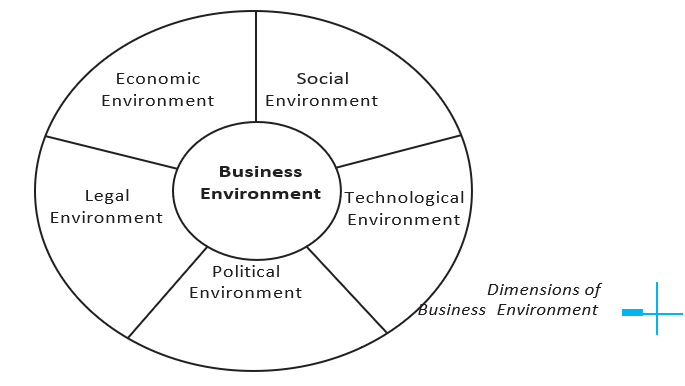
Dimensions of the business environment — The economic, social, technological, political and legal conditions that shape business decisions and performance.
General environment
- General vs specific: These dimensions affect many enterprises at the same time; specific-environment factors relate more directly to an individual enterprise.
- Why monitor them: Awareness helps managers identify opportunities and threats and make better decisions.
- Example: Lighting businesses followed research on energy-efficient bulbs lasting at least twenty times longer than standard bulbs, recognising its effect on growth and profitability.
Economic Environment
Economic environment — Economic factors and conditions that influence business costs, demand, investment and management decisions.
Effects of key economic factors
- Interest rates: Affect demand. Low long-term rates encourage borrowing and spending on houses and cars, benefiting construction and automobile businesses.
- Disposable income: Rising income, often linked to GDP growth, can increase demand for goods and services.
- Inflation: Raises costs such as raw materials, machinery, wages and salaries, putting pressure on businesses.
- Other indicators: Inflation rates, stock-market indices and the value of the rupee can also affect business decisions.
Components of the economic environment
- Economic structure: Relative roles of the private and public sectors; planned outlay in both sectors.
- Growth and income: GNP and per capita income growth, measured at current and constant prices.
- Finance: Rates of saving and investment; money supply; internal and external public debt.
- External sector: Imports and exports, balance of payments and foreign-exchange reserves.
- Production and infrastructure: Agricultural and industrial production trends; expansion of transport and communication facilities.
Social Environment
Social environment — The customs, traditions, values, trends and expectations of society that influence business and consumer behaviour.
How social forces affect business
- Customs and traditions: Long-standing practices create markets; Diwali, Eid, Christmas and Guru Parv increase opportunities for sweets, greeting cards and tailoring businesses.
- Values: Ideas such as individual freedom, social justice, equality of opportunity and national integration shape market choice and expectations of businesses.
- Business implications of values: Freedom of choice, social responsibility and non-discriminatory employment practices.
- Social trends: Can create opportunities or threats. The health-and-fitness trend has increased demand for organic food, gyms, bottled water and food supplements.
Major elements of the social environment
- Preferences and lifestyles: Attitudes to product innovation, lifestyles, occupational distribution and consumer preferences; consumption habits and family composition.
- Quality of life: Concern about quality of life and life expectancy.
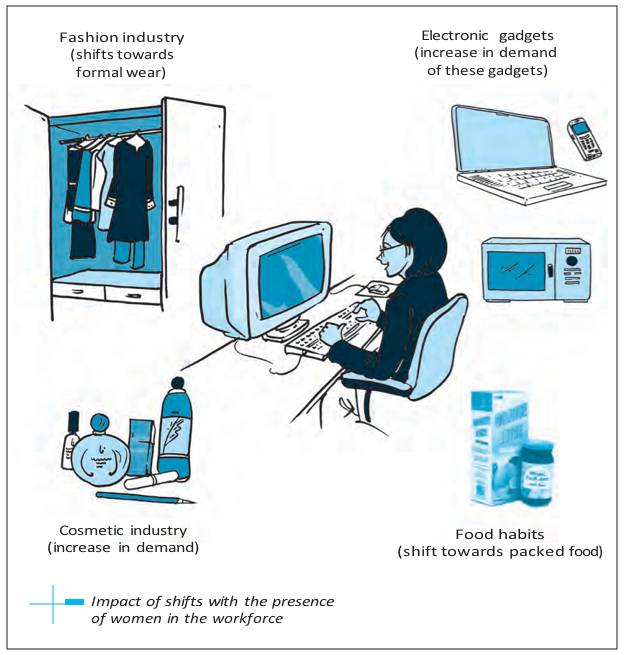
- Population: Birth and death rates, population shifts and changes in the presence of women in the workforce.
- Workforce and education: Expectations from the workforce, the education system and literacy rates.
Technological Environment
Technological environment — Scientific improvements and innovations that create new ways to produce goods and services and operate businesses.
Business impact and examples
- Digital technology: Computers and electronics changed advertising through information kiosks and multimedia web pages.
- Operations: Retailers can link directly with suppliers to replenish stock; manufacturers can use flexible manufacturing systems.
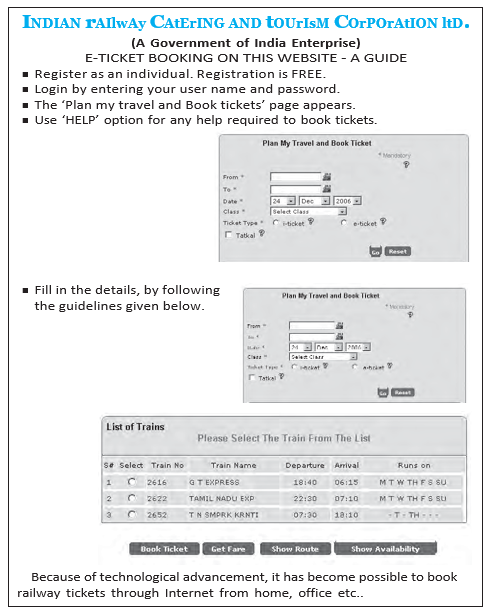
- Customer service: Airlines can publish schedules, destinations and fares online and let customers book tickets.
- Innovation: Advances in lasers, robotics, biotechnology, food preservatives, medicine, telecommunications and synthetic fuels create both opportunities and threats.
- Changing products and industries: Demand shifted from vacuum tubes to transistors, steam locomotives to diesel/electric engines, fountain pens to ballpoint pens, propeller planes to jets, and typewriters to computer-based word processors.
Political Environment
Political environment — Political conditions and government attitudes towards business that influence business confidence and activity.
Why political conditions matter
- Stability and peace: Make business conditions more predictable and encourage long-term investment.
- Political unrest: Creates uncertainty and may threaten law and order, weakening business confidence.
- Government attitudes: Elected representatives and officials can have a positive or negative effect on business.
Major elements of the political environment
- Political system and institutions: The prevailing system, government and allied agencies.
- Ideas and leadership: Dominant ideologies and values of major parties; the nature and profile of political leadership and political personalities’ thinking.
- Political climate: Degree of politicisation of business and economic issues; level of political morality.
- Government and external relations: Ruling-party ideology and practices; extent and nature of government intervention; the country’s relationships with foreign countries.
Legal Environment
Legal environment — The laws, government orders, court judgments and decisions of commissions and agencies that regulate business.
Importance and examples
- Compliance: Businesses must obey laws at central, state and local levels; managers need adequate knowledge of regulations.
- Non-compliance: Can lead to legal problems and harm business performance.
- Consumer protection: Alcoholic-beverage advertising is prohibited; cigarette advertisements and packets must carry the warning “Cigarette smoking is injurious to health.”
- Advertising rules: Baby-food advertisements must state that mothers’ milk is best.
Important Indian laws affecting business
- Business and industry: Companies Act, 2013; Industries (Development and Regulation) Act, 1951.
- Trade and foreign exchange: Foreign Exchange Management Act; Imports and Exports (Control) Act, 1947.
- Factories and labour: Factories Act, 1948; Trade Unions Act, 1926; Workmen’s Compensation Act, 1923; Industrial Disputes Act, 1947.
- Consumers and competition: Consumer Protection Act, 1986; Competition Act, 2002.
- Other requirements: Constitutional provisions and other enactments, as amended by Parliament, also govern business.
How do economic conditions influence business?
Why is political stability important for business?
What is the legal environment, and why must businesses understand it?
Quick recap
- The general business environment consists of economic, social, technological, political and legal dimensions that affect many enterprises.
- Economic conditions such as interest rates, income and inflation shape demand, investment and operating costs.
- Social customs, values and trends influence consumer preferences, business responsibilities and market opportunities.
- Technology changes production, business operations, communication and the products consumers demand.
- Political stability and government attitudes influence predictability, confidence and long-term investment.
- The legal environment includes laws and official decisions; compliance is essential to avoid legal problems.
Economic Environment in India
Economic environment — The macro-level factors related to production and the distribution of wealth that affect business and industry.
Factors shaping the economic environment
| Factor | What it includes |
|---|---|
| Economic development | The country’s stage of economic development. |
| Economic structure | India’s mixed economy, recognising roles for both public and private sectors. |
| Government policies | Industrial, monetary and fiscal policies. |
| Economic planning | Five-year plans, annual budgets and related planning. |
| Economic indices | National income, income distribution, rate and growth of GNP, per capita income, disposable personal income, savings and investment rates, values of exports and imports, and balance of payments. |
| Infrastructure | Financial institutions, banks, transport and communication facilities. |
Why it matters to business
- Business impact: Economic conditions shape the working and performance of enterprises.
- Company reports: Chairpersons’ annual reports commonly assess the national economic environment and its impact on the company.
India’s economy at Independence
Starting conditions
- Economic character: The economy was mainly agricultural and rural.
- Employment: About 70% of the working population worked in agriculture.
- Population: About 85% of people lived in villages.
- Production: Technology was inefficient and had low productivity.
- Health: Communicable diseases were widespread, mortality was high and there was no good public-health system.
Development planning and sector roles
| Objective | Aim |
|---|---|
| Rapid economic growth | Raise living standards and reduce unemployment and poverty. |
| Self-reliance and industrialisation | Build a strong industrial base, emphasising heavy and basic industries. |
| Greater equality | Reduce inequalities in income and wealth. |
| Socialist pattern of development | Promote equality and prevent exploitation of one person by another. |
| Point | Public sector | Private sector |
|---|---|---|
| Assigned role | Led infrastructure industries. | Was broadly responsible for consumer-goods industries. |
| Government approach | Given a leading role in key areas. | Subject to extensive restrictions, regulations and controls. |
Results of planning
- Overall experience: Economic planning produced mixed results.
- State direction: To address economic problems, the government used state control of selected industries, central planning and a reduced role for the private sector.
The 1991 economic reforms
Why reforms were introduced
- Foreign-exchange crisis
- High government deficit
- Prices continued to rise despite bumper crops
- The Government announced a new industrial policy in July 1991 as part of economic reforms
Key dates
- 1991India faced a foreign-exchange crisis, a high government deficit and rising prices.
- July 1991The Government of India announced a new industrial policy.
| Policy measure | What changed |
|---|---|
| Industrial licensing | Compulsory licensing was reduced to six industries. |
| Public-sector reservation | Many previously reserved industries were dereserved; the public sector was limited to four industries of strategic importance. |
| Disinvestment | Disinvestment was carried out in many public-sector industrial enterprises. |
| Foreign capital | Policy was liberalised, foreign equity participation increased, and 100% FDI was permitted in many activities. |
| Foreign technology | Automatic permission was granted for technology agreements with foreign companies. |
| Foreign investment promotion | The Foreign Investment Promotion Board (FIPB) was set up to promote and channel foreign investment. |
| Industrial expansion | Measures were taken to remove obstacles to the growth and expansion of large industrial houses; the small-scale sector was assured help and recognition. |
| Term | Meaning in the 1991 policy |
|---|---|
| Liberalisation | Freed industry from many licensing-system restrictions and controls. |
| Privatisation | Drastically reduced the role of the public sector. |
| Globalisation | Encouraged foreign private participation in India’s industrial development. |
- Disinvestment
- A policy measure carried out in many public-sector industrial enterprises.
- FDI
- Foreign Direct Investment; foreign equity participation, increased under the policy and permitted up to 100% in many activities.
- Dereservation
- Removing an industry from the list reserved for the public sector.
- FIPB
- Foreign Investment Promotion Board, set up to promote and channel foreign investment in India.
State the main objectives of India’s development plans.
What were the three broad directions of the 1991 industrial policy?
Quick recap
- India’s economic environment includes its development stage, economic structure, policies, planning, economic indices and infrastructure.
- Economic indices include the rate and growth of GNP and the values of exports and imports, along with other national and financial measures.
- At Independence, India was predominantly rural and agricultural, with low-productivity technology and serious public-health challenges.
- Development plans aimed at rapid growth, self-reliance, equality and a socialist pattern; public enterprises led in infrastructure while private enterprise faced controls.
- The foreign-exchange crisis, high deficit and rising prices led to the new industrial policy announced in July 1991.
- The policy reduced licensing and public-sector reservation, promoted disinvestment, liberalised foreign investment and technology agreements, and took measures to address obstacles to industrial expansion.
- Liberalisation, privatisation and globalisation summarise the broad direction of the reforms.
India’s LPG Reforms – Liberalization, Privatization and Globalization
Liberalization
- Meaning: Liberalisation aimed to free Indian business and industry from unnecessary government controls and restrictions.
- Key changes: It reduced licensing, eased restrictions on business expansion, pricing and movement of goods, and simplified imports while encouraging foreign capital and technology.
The Economic Crisis of 1991
Crisis Milestones
- 1988–89GNP growth reached a peak of 10.5%.
- 1990–91The fiscal deficit reached 6.6% of GDP amid severe financial and production pressures.
- May 1991The Government leased 20 tonnes of gold to SBI for sale with a repurchase option after six months; the RBI pledged 47 tonnes to the Bank of England for a loan of 600 million US dollars.
Privatization
- Meaning: Privatisation gives the private sector a greater role in nation-building while reducing the role of the public sector.
- Disinvestment: The government transfers part of its ownership in public enterprises to private investors; dilution beyond 51% can transfer ownership and management.
- Measures: The 1991 policy redefined the public sector’s role, provided for disinvestment and referred sick enterprises to the Board of Industrial and Financial Reconstruction.
Globalization
| Feature | What it means |
|---|---|
| Goods and services | Free flow across nations. |
| Capital | Free flow across national borders. |
| Information and technology | Free flow between countries. |
| People | Free movement across borders. |
| Dispute settlement | A commonly accepted mechanism for settling disputes. |
| Governance | A global governance perspective. |
Early Measures to Address the Crisis
Key Reform Dates
- January–September 1991An IMF loan totalling SDR 1.3 billion was negotiated.
- July 1–3, 1991The rupee was devalued by 18%.
- July 1991The New Industrial Policy was announced.
- October 1991An IMF standby credit was negotiated; India Development Bond and Immunity schemes were introduced.
- April 1992A 500 million US dollar Structural Adjustment Loan was negotiated with the World Bank.
Demonetisation
Demonetisation: Main Features
- Tax administration: Declared cash could be deposited or exchanged; holders of unaccounted wealth had to disclose it and pay tax at a penalty rate.
- Tax-compliance signal: It indicated that the Government would no longer tolerate or accept tax evasion.
- Formal savings: Deposits brought savings into the banking system. Though some cash could later be withdrawn, bank schemes could support lending, including at lower interest rates.
- Less-cash economy: Promoted digital payments and formal financial channels, potentially improving tax compliance and reducing evasion.
- Limitations: Digital payments depend on customers having cell phones, merchants having Point-of-Sale (PoS) machines, and internet connectivity.
- Digital inclusion: Despite these limits, digital use can bring people into the formal economy, increase financial savings and reduce tax evasion.
| Group | Relationship to digital transactions |
|---|---|
| Poor | Largely outside the digital economy. |
| Less affluent | Becoming part of it, including through Jan Dhan accounts and RuPay cards. |
| Affluent | Generally conversant with digital transactions. |
| Area | Impact |
|---|---|
| Money and interest rates | Cash transactions declined; bank deposits and financial savings increased. |
| Private wealth | Declined partly because some demonetised notes were not returned and real-estate prices fell. |
| Public-sector wealth | No effect. |
| Digitisation | Digital transactions among new users, including RuPay and AEPS users, increased. |
| Real estate | Prices declined. |
| Tax collection | Income-tax collection rose with increased disclosure. |
What is disinvestment, and when does it transfer ownership and management to the private sector?
State any four indicators of the 1991 economic crisis.
What were the principal aims of demonetisation in 2016?
Quick recap
- Liberalization reduced controls on licensing, business scale, prices, trade and investment.
- The 1991 crisis involved high deficits and debt, inflation, falling production and trade, and critically low foreign-exchange reserves.
- Privatization increased the private sector’s role; disinvestment diluted government ownership and could transfer ownership and management.
- Globalization connects economies through trade, capital, technology, information and people.
- Early reforms included delicensing, opening areas to private and foreign investment, rupee devaluation, and trade and exchange-rate changes.
- Demonetisation in 2016 invalidated Rs. 500 and Rs. 1,000 notes and aimed to curb black money and improve tax compliance.
Key terms and Summary
Key Terms
- Core concepts: The key terms introduce business environment and its economic, social, technological, political and legal dimensions.
- Economic reforms: They also cover liberalisation, privatisation and globalisation (LPG), the major reforms introduced in India from 1991.
Quick Recap
- Business environment: It comprises external forces that affect a firm and is dynamic, complex, uncertain and interrelated.
- Importance: Understanding the environment helps firms identify opportunities and threats, obtain resources, respond to change, plan and improve performance.
- Dimensions: The general environment has economic, social, technological, political and legal dimensions.
- India’s reforms: The 1991 policy introduced liberalisation, privatisation and globalisation after a serious economic crisis.
- Business impact: LPG reforms increased competition, made customers more demanding and required firms to adapt technology, develop human resources and become market-oriented.
Quick recap
- Business environment consists of external forces that can affect business performance.
- Its characteristics include specific and general forces, inter-relatedness, dynamism, uncertainty, complexity and relativity.
- Understanding the environment helps identify opportunities and threats, respond to change, plan and improve performance.
- Its five dimensions are economic, social, technological, political and legal.
- The 1991 reforms introduced liberalisation, privatisation and globalisation.
- Policy changes increased competition and customer demands, requiring adaptation and human-resource development.