Class 12 Commerce . Business Studies . Business Studies Part I . Organising
Chapter 5: ORGANISING
Ch 5
Business Studies
Class 12 Commerce
Introduction
Why Organising Matters
- Plans to action: Organising arranges work and resources so that plans can be implemented and objectives achieved.
- Optimal use: It helps use resources efficiently and enables people to work together towards a common purpose.
- Clear structure: It groups activities, defines roles and establishes relationships between them.
- Clear accountability: Defined roles clarify duties, authority and responsibility for results.
Meaning of Organising
Organising — A process that initiates the implementation of plans by clarifying jobs and working relationships, and deploying resources effectively to achieve specified objectives.
Key Elements
- Coordinate efforts: Bring people’s work together towards shared objectives.
- Assemble resources: Identify and arrange the resources needed for the work.
- Integrate: Combine human efforts and resources into a unified whole.
- Create structure: Design roles for suitably skilled people and define how those roles relate to one another.
Examples
- School fete: Work is divided among groups such as food, decoration and ticketing committees. An official supervises them, while coordination clarifies how each group contributes.
- Wipro: To support customer orientation and growth, Wipro organised subsidiaries by product line, gave each responsibility for its growth, and shifted towards decentralised management.
How does organising help implement plans?
Quick recap
- Organising converts plans into coordinated action.
- It brings human efforts and resources together to achieve specified objectives.
- It clarifies jobs, roles and relationships between roles.
- A clear structure helps reduce ambiguity about duties, authority and responsibility.
- Wipro’s product-line subsidiaries and decentralised management illustrate organising to support business goals.
Steps in the Process of Organising
Organising — Organising is the process of identifying and grouping work, assigning responsibility and authority, and establishing relationships so people can work together effectively to achieve objectives.
Steps in the Process of Organising
| Step | What it involves | Purpose / example |
|---|---|---|
| 1. Identification and division of work | Identify the tasks required by the plan and divide them into manageable activities. | Prevents duplication and shares the workload among employees. |
| 2. Departmentalisation | Group activities that are similar in nature into departments. | Supports specialisation; departments may be based on territory (North, South, West) or product (appliances, clothes, cosmetics). |
| 3. Assignment of duties | Define jobs and allocate them to employees in each department according to their skills and competencies. | Match the nature of each job with the ability of the person best suited to perform it. |
| 4. Establishing authority and reporting relationships | Clarify who gives instructions and to whom each employee is accountable. | Creates a hierarchy and supports coordination among departments. |
Order of the Process
- Identify and divide work
- Group similar activities into departments
- Assign duties to suitable employees
- Establish authority and reporting relationships
Library Example
- Tasks: Unload new books, stock shelves and dispose of packaging.
- Organisation: A supervisor divides the work, groups students, assigns each group a quota and establishes who reports to whom.
- Result: Clear task allocation and reporting help the work get done more quickly and effectively.
Definitions of Organising
| Thinker | Definition focus |
|---|---|
| Louis Allen | Identifying and grouping work, defining and delegating responsibility and authority, and establishing relationships so people can work effectively towards objectives. |
| Theo Haimann | Defining and grouping enterprise activities and establishing authority relationships among them. |
State the four steps in the process of organising.
Why are authority and reporting relationships established?
Quick recap
- Organising converts planned work into manageable tasks and clear working relationships.
- Divide work to avoid duplication and share the workload.
- Group similar activities into departments to encourage specialisation.
- Assign duties according to employees’ skills and competencies.
- Clarify authority and reporting links to create hierarchy and support coordination.
Importance of Organising
Importance of organising — Organising helps an enterprise use its resources and relationships effectively, adapt to change, and achieve survival and growth.
How Organising Benefits an Enterprise
| Benefit | How organising helps |
|---|---|
| Benefits of specialisation | Systematic job allocation lets workers repeatedly perform specific tasks, building experience and specialisation while improving productivity. |
| Clarity in working relationships | Defines who reports to whom and clarifies communication, authority and responsibility, reducing ambiguity. |
| Optimum use of resources | Proper job assignment prevents overlapping and duplicated work, reducing confusion and waste of resources and effort. |
| Adaptation to change | The structure and relationships between managerial levels can be revised to respond to environmental change, supporting stability, survival and growth. |
| Effective administration | Clear jobs and duties reduce confusion and duplication, help work get executed properly and make management easier. |
| Development of personnel | Delegation reduces managers’ routine workload, giving them time to innovate. It also helps subordinates build ability, meet challenges and realise their potential. |
| Expansion and growth | Organising enables new positions, departments, product lines and geographical areas, helping increase customers, sales and profits. |
Overall Effect
- Order: Organising brings order to work and helps remove conflict over tasks and responsibility.
- Teamwork: Clear roles and relationships create an environment that supports cooperation.
- Specialisation
- Gaining expertise by repeatedly performing a specific task.
- Hierarchy
- The order of reporting relationships and authority levels in an organisation.
- Delegation
- Assigning work to subordinates, helping managers reduce routine workload and develop their staff.
Quick recap
- Organising supports an enterprise’s survival, growth and ability to meet challenges.
- Systematic job allocation encourages specialisation and productivity.
- Defined reporting relationships clarify communication, authority and responsibility.
- Proper assignment of work reduces duplication and makes better use of resources.
- Flexible structures help enterprises adapt while maintaining stability.
- Delegation supports managers’ innovation and subordinates’ development.
- Organising enables expansion through new roles, departments, products and territories.
Organisation Structure and its Types
Organisation Structure
Example: Sunita’s Travel Agency
- Operations: Travel counselling, reservations and ticketing, and customer care.
- Sales: Accounts executive.
- Administration: Bookkeeper, cashier and utility personnel.
- Result: Dividing work by function establishes lines of authority and responsibility.
Types of Organisation Structure
- Types: Organisational structures are broadly classified as functional and divisional.
- Basis: The type adopted depends on the nature and range of activities performed by the organisation.
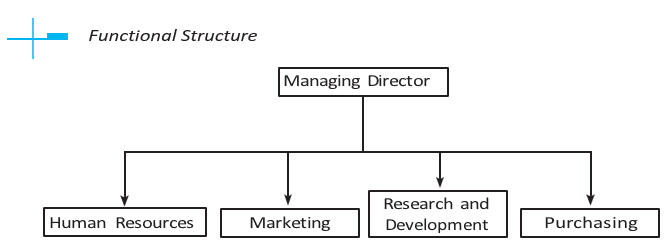
Functional Structure
Advantages of Functional Structure
- Specialisation: Repeated work in a function builds expertise and improves manpower efficiency.
- Coordination and control: Similar tasks within a department are easier to coordinate and supervise.
- Efficiency and profit: Better managerial and operational efficiency can increase profits.
- Lower costs: Less duplication of effort creates economies of scale.
- Training: Employees need to learn a narrower range of skills.
- Attention to functions: Each major function receives focused attention.
Disadvantages of Functional Structure
- Departmental priorities: Functional heads may favour departmental goals over overall enterprise objectives, creating functional empires.
- Coordination difficulties: Information must cross departments, and departmental interests may weaken cooperation.
- Interdepartmental conflict: Departments may disagree when their interests differ; for example, sales may want a customer-friendly design that complicates production.
- Unclear responsibility: Poor separation of responsibilities can intensify conflicts between departments.
- Narrow outlook: Employees with similar skills may struggle to understand other viewpoints, making the structure less flexible.
- Limited leadership preparation: Functional heads may lack broad experience across functions needed for top management roles.
Suitability of functional structure — Best suited to large organisations with diversified activities whose operations require a high degree of specialisation.
Divisional Structure
Advantages of Divisional Structure
- Managerial development: Product specialisation gives divisional heads experience across functions and prepares them for higher positions.
- Accountability: Revenue and costs can be assigned to divisions, supporting performance measurement and responsibility for results.
- Remedial action: Poor divisional performance can be identified and addressed.
- Flexibility and initiative: Autonomous divisions can make decisions faster.
- Growth: New divisions can be added for new product lines without disrupting existing operations.
Disadvantages of Divisional Structure
- Competition between divisions: Disputes may arise over funds, and a division may pursue its profit at others’ expense.
- Higher costs: Repeating similar functions in every division duplicates activities and increases expenditure.
- Division over organisation: A powerful divisional manager may assert independence and neglect the interests of the whole enterprise.
Suitability of divisional structure — Best suited to enterprises producing a wide variety of products using different resources, especially when growth requires more employees, departments and management levels.
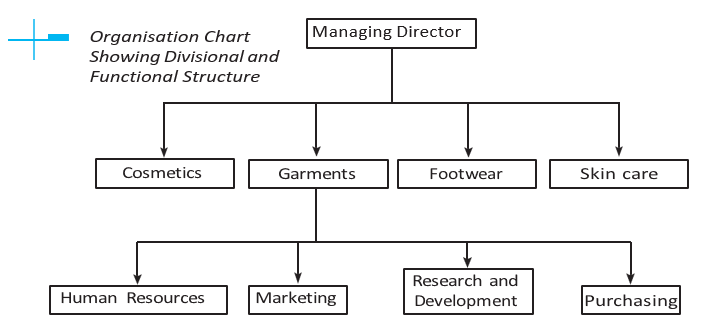
| Point | Functional structure | Divisional structure |
|---|---|---|
| Basis of grouping | Similar functions or jobs | Product lines or separate business units |
| Organisation of functions | Each function is a department serving the enterprise | Each division performs the functions needed for its product |
| Responsibility | Functional heads oversee their departments | Divisional heads are responsible for division performance and profit or loss |
| Main strength | Specialisation and economies of scale | Product focus, autonomy and faster decisions |
| Main challenge | Departmental silos and coordination across functions | Duplicated functions and possible conflict between divisions |
| Suitable when | Operations need high functional specialisation | Many different products use different productive resources |
- Review organisational structure periodically as plans, objectives, size and business conditions change.
- A good structure supports enterprise objectives and allows employees to take initiative and contribute effectively.
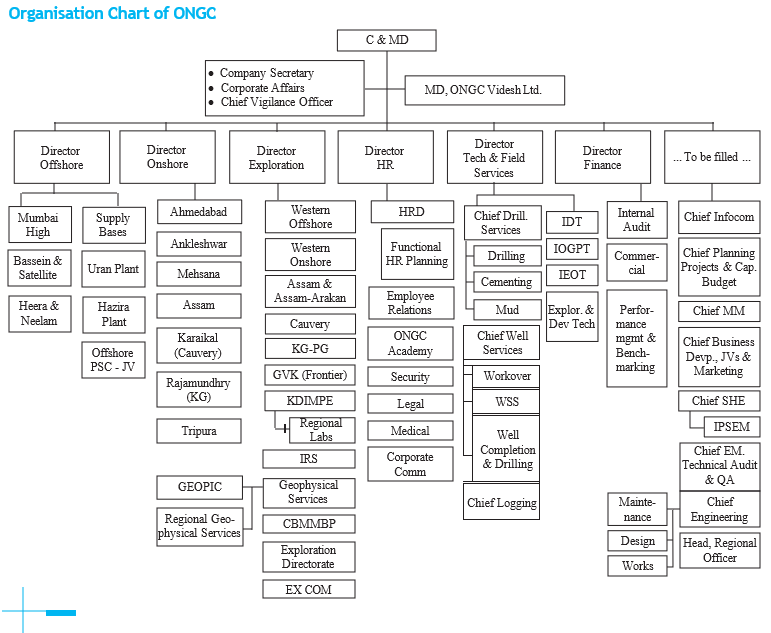
Structural Transformation at ONGC
Why ONGC Changed Its Structure
- Business-group system and shared responsibilities
- Delays, responsibility disputes and group loyalties
- Poor fit between group-based performance measures and field needs
- Asset-based approach with clearer accountability and delegated authority
- A structure of 14 assets and 11 centralised services
State the main advantages and disadvantages of a functional structure.
How does divisional structure support accountability and growth?
Quick recap
- Organisation structure is the outcome of organising; it defines relationships among tasks, people and resources and can improve profitability.
- Span of management affects the number of management levels, while periodic reviews help structures adapt to organisational change.
- Functional structure groups similar jobs and promotes specialisation, but may create departmental silos and coordination problems.
- Divisional structure groups work by product, with each division performing multiple functions and acting as a profit centre.
- Divisional autonomy supports faster decisions and expansion but can duplicate functions and increase costs.
- ONGC moved from business groups to an asset-based structure with clearer responsibility and delegated authority.
Formal and Informal Organisation
Formal Organisation
Louis Allen’s definition — Formal organisation is a system of well-defined jobs, each with a definite measure of authority, responsibility and accountability.
Chester Barnard’s definition — Formal organisation is a system of consciously coordinated activities of two or more people toward a common objective.
Advantages and Limitations of Formal Organisation
Advantages
- Responsibility: Clear relationships make it easier to identify who is accountable.
- Role clarity: Specified duties reduce ambiguity and duplication of effort.
- Unity of command: An established chain of command clarifies reporting relationships.
- Goal achievement: A defined framework helps employees understand their roles and complete organisational work.
- Stability: Specific rules make employee behaviour more predictable.
Limitations
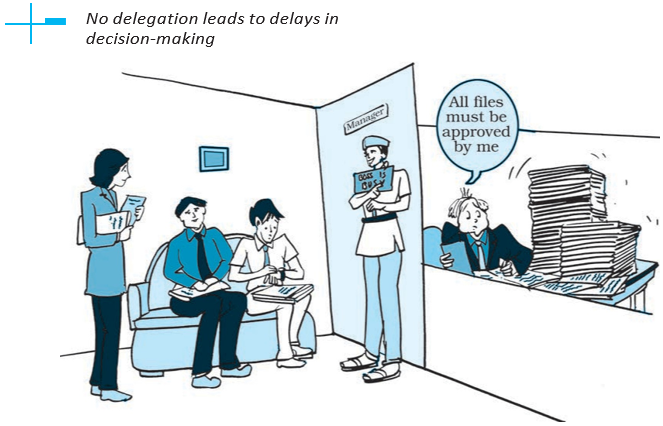
- Delays: Following the chain of command can slow communication and decision-making.
- Limited creativity: Rigid rules and policies may prevent creative employees from receiving recognition or acting on ideas.
- Incomplete picture: Its focus on structure and work does not capture all human relationships within the organisation.
Informal Organisation
Informal organisation — A network of personal and social relationships that arises spontaneously as employees interact beyond their officially defined roles.
Chester Barnard’s definition — An aggregate of interpersonal relationships without a conscious purpose, which may nevertheless contribute to joint results.
Keith Davis’s definition — A network of personal and social relations not established or required by formal organisation, but arising spontaneously as people associate.
Features
- Origin: Develops spontaneously within the formal organisation through employees’ personal interactions.
- Groups: Frequent contact and shared interests can lead employees to form social groups.
- Behaviour: Group norms shape conduct rather than officially prescribed rules.
- Communication: Members develop independent channels, with information able to flow in different directions.
- Structure: Has no fixed form, written rules or definite communication lines; it is fluid and flexible.
| Point | Formal organisation | Informal organisation |
|---|---|---|
| Meaning | Management-created structure of authority relationships. | Social relationship network arising from employee interaction. |
| Origin | Company rules and policies. | Spontaneous social interaction. |
| Authority | Comes from a person’s position in management. | Comes from personal qualities. |
| Behaviour | Directed by rules. | No fixed behaviour pattern; group norms influence conduct. |
| Communication | Follows the scalar chain. | Has no planned route and can flow in any direction. |
| Nature | Rigid. | Flexible. |
| Leadership | Managers are the leaders. | Leaders are chosen by the group and may or may not be managers. |
Advantages, Disadvantages and Management of Informal Organisation
Advantages
- Fast communication: Information spreads quickly and feedback can be received without following formal communication lines.
- Social needs: Employees find like-minded people and gain belongingness, which can improve job satisfaction.
- Support for objectives: Informal networks can compensate for formal-system gaps; management can gauge employee reactions to plans and policies.
Disadvantages
- Rumours: False or harmful information can damage the organisation’s interests.
- Resistance to change: Group opposition may delay or restrict the implementation of change and organisational growth.
- Group pressure: Members may be pressed to conform to norms that conflict with organisational interests.
How management should respond
- Recognise: Informal groups cannot be eliminated altogether; identify the groups and the roles their members play.
- Use constructively: Seek group support and use informal channels to improve communication and organisational performance.
- Work with groups: Take advantage of both formal and informal organisation rather than confronting informal groups.
Quick recap
- Formal organisation is deliberately designed with defined jobs, authority, responsibility and reporting relationships.
- Formal advantages include accountability, clear roles, unity of command, goal achievement and stability; its limits include delays and restricted creativity.
- Informal organisation arises spontaneously through personal relationships beyond official roles, with norms and flexible communication.
- Formal vs informal: Formal authority comes from position and communication follows the scalar chain; informal influence comes from personal qualities and communication can flow in any direction.
- Informal benefits include fast information, social satisfaction and support for organisational goals.
- Informal risks include rumours, resistance to change and pressure to follow harmful group norms; management should recognise and use groups constructively.
Understanding Delegation and Its Importance
Meaning and Nature of Delegation
Delegation — The downward transfer of authority from a superior to a subordinate to perform assigned work within prescribed limits.
How delegation works
- Need: A manager cannot handle all organisational work alone; delegation frees time for high-priority tasks.
- Scope: It extends a manager’s area of operations by getting others to perform work within set limits.
- Subordinates: Delegation offers recognition, responsibility and opportunities to develop initiative.
- Not abdication: A manager remains accountable for assigned work even after authority is delegated.
- Recall: Delegated authority can be withdrawn and given to another person.
Definitions by management thinkers
- Louis Allen: Delegation divides a manager’s work so the manager handles what only their position allows them to do, while others help with the rest.
- Theo Haimann: Delegation means granting subordinates authority to operate within prescribed limits.
Elements of Delegation
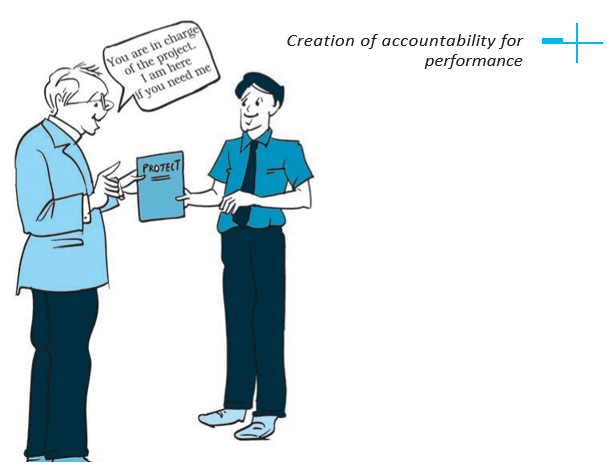
- Louis Allen: Delegation entrusts responsibility and authority to another and creates accountability for performance.
- Three elements: Authority, responsibility and accountability work together to make delegation effective.
| Basis | Authority | Responsibility | Accountability |
|---|---|---|---|
| Meaning | Right to command, make decisions and act within a position’s scope. | Obligation to perform an assigned duty properly. | Answerability for the final outcome of assigned work. |
| Origin | Formal position in the organisation. | Delegated authority and the superior–subordinate relationship. | Responsibility for performance. |
| Delegation | Can be delegated within prescribed limits. | The subordinate assumes it; it cannot be entirely delegated away. | Cannot be delegated. |
| Direction of flow | Downward, from superior to subordinate. | Upward, from subordinate to superior. | Upward, from subordinate to superior. |
Key points about the elements
- Authority: Comes from an individual’s position and the organisation’s scalar chain; it is greatest at the top and decreases down the hierarchy.
- Limits: Laws and organisational rules restrict authority; its scope increases at higher levels of management.
- Responsibility: The subordinate is obliged to perform the duty assigned by the superior.
- Balance: Authority must be commensurate with responsibility. Excess authority may be misused; insufficient authority makes effective performance difficult.
- Accountability: The superior remains answerable for the outcome and should monitor work through regular feedback.
Relationship between the elements
- Authority is delegated to a subordinate.
- The subordinate assumes responsibility for the assigned task.
- Accountability for performance is imposed; the subordinate answers to the superior, who remains ultimately accountable.
Importance of Delegation
| Benefit | How delegation helps |
|---|---|
| Effective management | Reduces the manager’s routine workload, freeing time for important matters and new areas of work. |
| Employee development | Builds employees’ skills and experience, preparing them for complex duties, leadership and future managerial roles. |
| Employee motivation | The trust shown by the superior and responsibility given to the employee build self-esteem, confidence and commitment. |
| Facilitation of growth | Experienced employees can take leading roles in new projects and branches, supporting organisational expansion. |
| Basis of management hierarchy | Authority establishes superior–subordinate relationships and determines reporting lines and the power of each position. |
| Better coordination | Clear powers, duties and answerability prevent overlapping work and duplicated effort, supporting coordination across levels and functions. |
- Scalar chain
- The formal line linking positions and levels of authority in an organisation.
- Authority
- The right to command and make decisions within the scope of a position.
- Accountability
- Answerability for the final outcome of assigned work.
Distinguish between authority, responsibility and accountability.
State any four benefits of delegation.
Quick recap
- Delegation is the downward transfer of authority to a subordinate within prescribed limits.
- Delegation extends a manager’s work capacity but does not remove the manager’s accountability.
- Authority flows downward; responsibility and accountability flow upward.
- Authority should be commensurate with the responsibility assigned.
- Delegation develops and motivates employees while freeing managers for important work.
- Clear delegated powers and duties support hierarchy, growth and coordination.
Understanding Decentralisation and its Importance
Meaning of Decentralisation
Decentralisation — The systematic dispersal of decision-making authority to lower levels of an organisation, while retaining at central levels the authority that should remain there.
Core idea
- Decision authority is shared with lower management levels and placed closer to the point of action.
- Chain of command: decentralisation pushes decision-making down the hierarchy.
- Extent: an organisation is highly decentralised when lower-level decisions are both numerous and important.
- Louis Allen described it as delegating to the lowest level all authority that need not be exercised centrally.
- Henri Fayol linked decentralisation to increasing the importance and role of subordinates.
Centralisation and Decentralisation
| Point | Centralisation | Decentralisation |
|---|---|---|
| Where authority is held | Higher management retains decision-making authority. | Authority is delegated to lower management levels. |
| Decision location | Decisions are made farther from many operational points. | Decisions are made nearer to the points of action. |
| Extent | Organisations may retain more decisions at the top. | The degree varies with how many important decisions lower levels make. |
Finding the right balance
- Relative terms: organisations combine centralisation and decentralisation in different degrees; neither is usually absolute.
- Complete centralisation would place every decision at the apex, making lower management levels unnecessary.
- Complete decentralisation would send every decision to the lowest level, making higher managerial positions unnecessary.
- Practical reality: both extremes are unrealistic, so organisations need a balance between the two.
- Growth and complexity often increase decentralisation: employees close to operations may know more about them than top management.
Importance of Decentralisation
Six benefits
- Selective authority: decentralisation gives capable people autonomy; management chooses which decisions to pass down and which to retain.
- Initiative: freedom to decide builds subordinates’ confidence, self-reliance and judgment; it also reveals potential leaders.
- Future managers: independent assignments provide practical experience, help identify ability and build a pool of employees for promotion.
- Faster decisions: local managers can act without waiting for several approvals, improving responsiveness to changing conditions.
- Clearer communication: shorter decision channels reduce delays and the risk of information being distorted.
- Relief to top management: fewer operational decisions require direct supervision, leaving more time for policy decisions.
- Growth: departmental autonomy encourages initiative and competition, which can raise productivity and support expansion.
- Better control: results can be assessed by level or department; feedback helps identify variances and improve operations.
Control and caution
- Performance systems: tools such as the balanced scorecard and management information systems can support accountability and control.
- Supervision: lower-level freedom operates within limits set by superiors; decentralisation is greatest when little checking of lower-level decisions is needed.
- Risk: departments may pursue their own guidelines at the organisation’s expense, causing disintegration.
- Balance: retain centralised control over major policy decisions while decentralising suitable operating decisions.
Decentralisation in Practice: Johnson & Johnson
Example
- Company structure: Johnson & Johnson operates through about 190 smaller companies, each focused on a product, medical franchise or geographical area.
- Benefits: this model combines the resources of a large group with the focus and agility of smaller businesses.
- Customer focus: individual companies can stay closer to customers and maintain shorter communication lines with customers and employees.
- Talent development: decentralised units give employees opportunities to develop their abilities and take on responsibility.
McNeil company background
- 1879Robert McNeil opened a retail drug outlet in Pennsylvania.
- 1933McNeil Laboratories, Inc. was incorporated in the United States.
- 1959McNeil Laboratories became part of the Johnson & Johnson group.
- 1980McNeil Consumer Healthcare began operations in Guelph, Ontario, Canada.
Delegation and Decentralisation
| Basis | Delegation | Decentralisation |
|---|---|---|
| Nature | Necessary because one person cannot perform every task. | Optional policy choice made at top management’s discretion. |
| Freedom of action | Greater control by superiors; less freedom for the subordinate. | Less direct control; greater freedom for lower-level managers. |
| Status | A process for sharing tasks and authority. | The outcome of a top-management policy to spread authority. |
| Scope | Usually between a manager and their immediate subordinate. | Extends delegation throughout the organisation, potentially to the lowest level. |
| Purpose | Reduces the manager’s workload. | Increases subordinates’ role and autonomy. |
Why is complete decentralisation impractical?
State any three benefits of decentralisation.
Quick recap
- Decentralisation systematically disperses decision-making authority to lower organisational levels.
- Centralisation and decentralisation are relative; practical organisations use a balance of both.
- Decentralisation builds initiative and managerial talent, speeds decisions and eases the operational burden on top management.
- Autonomous departments can support growth and make performance evaluation more accountable.
- Use suitable control systems and keep major policy decisions aligned with the organisation’s overall interests.
- Delegation is a manager’s task-sharing process; decentralisation is a broader policy of spreading authority.
Key Terms and Summary
Key Terms
- Organising
- Defining and grouping activities and establishing authority relationships among them.
- Organisational structure and departmentalisation
- The structure is the framework for managerial and operating tasks; departmentalisation groups activities into departments.
- Delegation
- Transfer of authority from a superior to a subordinate; its elements are authority, responsibility and accountability.
- Functional and divisional structure
- Two organisational structures that group activities by functions or by products, respectively.
- Formal and informal organisation
- Formal organisation is designed by management; informal organisation develops through interaction among people at work.
- Span of management; centralisation and decentralisation
- Span of management is the number of subordinates under a superior. Centralisation and decentralisation are also key terms in this chapter.
Organising: Process and Importance
Organising — The process of defining and grouping activities and establishing authority relationships among them.
Steps in the organising process
- Identify and divide the work
- Departmentalise activities
- Assign duties
- Establish reporting relationships
Importance of organising
- Division of work enables tasks to be allocated across the organisation.
- Clear reporting establishes who reports to whom.
- Resource use supports optimum utilisation of resources.
- Growth and administration help the organisation expand and improve administration.
- Creativity can be encouraged through organised work and responsibilities.
Organisational Structure and Span of Management
Organisational structure — The framework within which managerial and operating tasks are performed; it may be functional or divisional.
Span of management — The number of subordinates working under a superior.
Functional and Divisional Structures
| Point | Functional structure | Divisional structure |
|---|---|---|
| Basis | Groups activities by functions. | Groups activities by products. |
| Advantages | Specialisation; better control; managerial efficiency; easier employee training. | Integration; product specialisation; greater accountability; flexibility; better coordination; more initiative. |
| Disadvantages | Functional empires; conflicts of interest; inflexibility; restricted managerial development. | Departmental conflicts; costly operations; organisational interests may be ignored; greater need for general managers. |
Formal and Informal Organisation
| Point | Formal organisation | Informal organisation |
|---|---|---|
| How it arises | Designed by management to achieve organisational goals. | Develops from interaction among people at work. |
| Advantages | Fixes responsibility; clarifies roles; supports unity of command and effective goal achievement. | Enables speed; fulfils social needs; fills gaps in the formal structure. |
| Disadvantages | May cause procedural delays; may inadequately recognise creativity; has limited scope. | May act as a disruptive force; may resist change; may prioritise group interests. |
Delegation
Delegation — The transfer of authority from a superior to a subordinate.
Elements of delegation
- Authority
- Responsibility
- Accountability
Quick recap
- Organising divides and groups work and sets authority relationships.
- Its four steps are work division, departmentalisation, duty assignment and reporting relationships.
- Organisational structure may be functional or divisional; span is the number of subordinates under a superior.
- Functional structure groups by functions; divisional structure groups by products.
- Formal organisation is management-designed; informal organisation emerges through workplace interaction.
- Delegation transfers authority from superior to subordinate and includes authority, responsibility and accountability.