Class 12 Commerce . Business Studies . Business Studies Part I . Planning
Chapter 4: Planning
Ch 4
Business Studies
Class 12 Commerce
Understanding Planning: Meaning, Concept and Importance
Meaning and Concept of Planning
Planning — Planning is setting objectives for a given time period, developing possible courses of action, and selecting the best alternative to achieve them.
Key Elements of Planning
- Basic managerial function: Planning is the first function of management and provides the basis for other managerial functions.
- Deciding in advance: It determines what is to be done and how it is to be done.
- Goal-focused: Objectives set the destination and guide managerial decisions and actions.
- Choice of action: Managers consider alternatives and choose a suitable course of action.
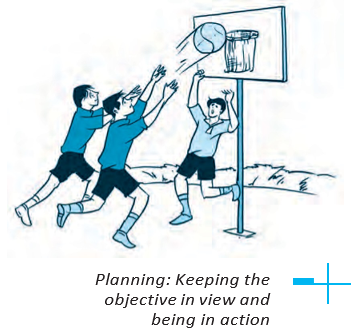
- Bridge to objectives: Planning connects the organisation’s current position with where it wants to be.
- Ends and means: It covers both the desired results and the actions needed to achieve them.
- Time-bound and actionable: Plans need a time frame and must be implemented; otherwise, changing conditions may make them useless.
- All levels: Managers throughout the organisation plan, and members work towards common organisational goals.
- Example—IOCL: IOCL aims for net-zero operational emissions by 2046 and plans to invest Rs. 2 lakh crore; plans and actions are needed to achieve this objective.
Importance of Planning
| Benefit | How planning helps |
|---|---|
| Provides direction | Clarifies goals and required actions, helping employees and departments coordinate their work. |
| Reduces risks of uncertainty | Helps managers anticipate changes and prepare responses, even though changes cannot be eliminated. |
| Reduces overlapping and waste | Coordinates activities, avoids confusion and duplication, and helps identify inefficiencies for correction. |
| Promotes innovative ideas | Turns new ideas into concrete plans that guide future action and business growth. |
| Facilitates decision making | Helps managers assess alternatives and select a viable course using targets and forecasts. |
| Establishes standards for control | Provides goals against which actual performance is compared; deviations can then be identified and corrected. |
Planning as a Basis for Control
- Set goals and standards
- Measure actual performance
- Compare actual performance with standards
- Identify deviations and take corrective action
Define planning.
How does planning help in controlling?
Quick recap
- Planning is the first and a basic function of management; it decides in advance what to do and how to do it.
- It sets objectives, considers alternative actions and selects the best course for a given time period.
- Plans must be implemented and adapted to changing conditions to be useful.
- Planning provides direction, anticipates uncertainty and reduces overlapping or wasteful work.
- It encourages innovation and supports rational decision making.
- Plans establish the standards needed to compare performance and correct deviations.
Features and Limitations of Planning
Features of Planning
Nature and scope
- Purposeful: Planning sets specific goals and the activities needed to achieve them; it has value only when it supports predetermined organisational objectives.
- Primary function: Planning provides the framework for the other management functions, which are carried out within the plans. This primacy does not make the other functions less important.
- Pervasive: Planning is needed at every management level and in every department, though its scope varies.
- Levels: Top management plans for the organisation, middle management plans for departments, and supervisors plan day-to-day operations.
- Continuous: Plans cover a set period, such as a month, quarter or year. A new plan follows as requirements and future conditions change.
- Planning cycle: A plan is framed → implemented → followed by another plan.
- Futuristic: Planning looks ahead by analysing and predicting future conditions; forecasting informs plans. For example, sales forecasts guide annual production and sales plans.
- Decision-making: Planning requires choosing the most appropriate course from available alternatives after examining and evaluating them. With only one possible course, there is no choice to plan.
- Mental exercise: Planning depends on foresight, imagination and sound judgement. It is orderly, logical thinking based on facts and forecasts—not guesswork.
Limitations of Planning
Why planning may fall short
- Rigidity: Specific goals and deadlines can lock managers into a course of action. When circumstances change, inflexible plans may harm the organisation; managers need room to adapt.
- Dynamic environment: Economic, political, physical, legal and social changes—and events such as policy shifts, instability, natural calamities or competition—make the future hard to predict.
- Revisions: Competition may disrupt financial plans and sales targets; since cash budgets depend on sales figures, they may need revision too. Planning cannot anticipate every obstacle.
- Reduced creativity: When top management makes plans and others only implement them, middle managers and employees may have little scope to deviate or take initiative. This can reduce innovation.
- High costs: Planning uses time and money to check facts, make detailed calculations, assess viability and consult experts. Meetings, discussions and investigations add costs, which may exceed the benefits.
- Time-consuming: Preparing plans may take so long that little time remains to implement them.
- No guarantee of success: Plans must be properly made and put into action; an unimplemented plan is meaningless. A plan that worked before may fail under different conditions.
- False security: Relying complacently on past successes while overlooking unknown factors can lead to failure.
- Use with caution: Despite its limits, planning helps analyse future courses of action; it is not a solution to every problem.
Why is planning called a pervasive and continuous function?
State any four limitations of planning.
Quick recap
- Planning focuses on objectives and provides the basis for other management functions.
- It is pervasive across levels and departments, but its scope varies.
- Planning is continuous, forward-looking, and relies on forecasting and choice among alternatives.
- Planning is a logical mental activity based on facts, foresight and judgement.
- Rigid plans, changing conditions, reduced creativity, high costs and delays can limit planning.
- Planning does not guarantee success; plans must be implemented and adjusted with care.
Planning Process and Types of Plans
Planning — Deciding in advance what to do and how to do it; it is a process of decision-making.
Planning Process
Seven Steps in Planning
- Set objectives → Decide what the organisation and its departments or units aim to achieve.
- Develop premises → Agree on assumptions about future conditions and use them as the basis for plans.
- Identify alternatives → List possible courses of action, including routine and innovative options.
- Evaluate alternatives → Weigh each option’s advantages, disadvantages, feasibility and likely consequences.
- Select an alternative → Choose the most viable plan, or combine plans where appropriate.
- Implement the plan → Put it into action and arrange the resources needed.
- Follow up → Monitor progress and check that activities follow the plan and objectives are achieved.
Key Details of the Steps
- Objectives should be clear and communicated throughout the organisation. Departmental and employee objectives align with overall goals; managers should participate and understand their contribution.
- Premises are assumptions about the future on which plans are based. They may draw on forecasts, existing plans and past policy information; all planners should use the same agreed assumptions.
- Forecasts help estimate factors such as product demand, policy changes, interest rates, capital-goods prices and tax rates. Reliable forecasts support successful plans.
- Alternatives should be explored more thoroughly for important projects; wider discussion and idea-sharing can help generate innovative options.
- Evaluation compares each option against the objective. In financial decisions, higher expected returns may involve higher risk; forecasts and detailed financial calculations can inform the choice.
- Selection aims for a feasible and profitable option with the fewest negative consequences. Where numerical analysis is limited, managers use experience, judgement and sometimes intuition.
- Implementation may require other management functions: a production increase, for example, can require more labour and machinery, which must be organised and obtained.
Illustration: Mitticool Plans
- Policy example: Mitticool keeps its products at lower prices so they remain affordable for poorer customers.
- Future plans: The company planned a factory with support from the National Innovation Foundation at IIM Ahmedabad and an eco-friendly clay house using renewable energy instead of electricity.
Types of Plans
| Point | Single-Use Plan | Standing Plan |
|---|---|---|
| Use | For a one-time, non-recurring event or project. | For activities that occur regularly over time. |
| Purpose | Provides a course of action for a particular situation. | Helps routine internal operations run smoothly and improves routine decision-making. |
| Duration and revision | Duration depends on the project; it may be as short as one day. | Usually developed once and modified when business needs change. |
| Includes | Programmes, projects and budgets. | Policies, procedures, methods and rules. |
Planning Level
- Operational planning: Single-use and standing plans form part of operational planning and guide business operations.
- Strategic planning: A strategy is a broad plan prepared by top management, considering resource allocation, priorities, the business environment and competition.
| Type | Meaning / key feature | Example or classification |
|---|---|---|
| Objective | A desired result that guides planning; organisational objectives are set by top management and inform unit objectives. | A sales-increase target for the organisation. |
| Strategy | A broad plan prepared by top management; it considers resource allocation, priorities, the business environment and competition. | Part of strategic planning; not usually classed as single-use or standing. |
| Policy | A general standing plan stating the organisation’s response to a situation. | An institution’s admission policy; Mitticool’s policy of keeping products affordable. |
| Procedure | The steps to follow in particular circumstances. | Steps for reporting production progress; a standing plan. |
| Method | The manner in which a task is to be performed. | A standing plan. |
| Rule | A clearly stated instruction specifying exactly what must be done. | Reporting for work at a specified time; a standing plan. |
| Programme | A single-use plan that lays out steps and procedures for a project or set of tasks. | Opening a new department. |
| Project | A single-use plan similar to a programme, but differing in scope and complexity. | A specific event or undertaking. |
| Budget | A statement of expenses, revenue and income for a specified period. | A single-use plan. |
What are planning premises?
How do single-use and standing plans differ?
Quick recap
- Planning is deciding in advance what to do and how to do it.
- The planning process moves from objectives and premises through alternatives, evaluation and selection to implementation and follow-up.
- Premises are shared assumptions about the future; forecasts help develop them.
- Single-use plans address one-time situations; standing plans support recurring operations.
- Single-use and standing plans are part of operational planning; strategy belongs to strategic planning.
- Programmes, projects and budgets are single-use plans; policies, procedures, methods and rules are standing plans.
- Objectives guide plans, while strategy is a broad top-management plan that considers resources, priorities and the business environment.
Objectives and Strategy in Planning
Objectives
- Objectives: Desired future positions or end results that management seeks to achieve through organisational activities.
- Role: They guide overall planning and should be specific, measurable, and set for a stated time period.
Strategy
Example: Marketing strategy
- Customers and demand: Identify who the customers are and assess demand for the product.
- Distribution: Decide which channels of distribution to use.
- Pricing and promotion: Set the pricing policy and decide how to advertise the product.
What are the three dimensions of a strategy?
Quick recap
- Objectives are the desired end results of organisational activities and the first step in planning.
- Objectives guide planning and should be written, measurable and time-bound.
- Top management usually sets broad objectives, while departments may set their own.
- Strategy is a comprehensive long-term plan for achieving organisational objectives.
- A strategy determines objectives, selects a course of action and allocates resources.
- Strategies account for changes in the business environment and involve major choices about the organisation’s business.
Planning Tools: Policies, Procedures, Methods, Rules, Programmes & Budgets
Policies
- Policies: General statements that guide thinking and managerial decisions towards a particular direction.
- Purpose: They provide a framework for interpreting strategy and responding to recurring situations, while allowing managers some discretion.
Procedures
- Procedures: Routine steps that specify the exact manner and sequence for carrying out activities.
- Purpose: They help implement policies and achieve objectives by guiding employees in particular circumstances.
Methods
- Methods: Prescribed ways of performing a particular task or step in a procedure.
- Benefit: Choosing a suitable method saves time, money, and effort while improving efficiency.
Rules
- Rules: Specific statements that clearly state what must or must not be done.
- Nature: Rules allow no flexibility or discretion and can be changed only through a policy decision.
Programmes
- Programmes: Detailed plans for a project that outline its objectives, tasks, policies, procedures, and rules.
- Resources: They specify the human and physical resources needed to carry out the planned course of action.
Budgets
Here, is estimated cash inflows, is estimated cash outflows, and the result is a cash surplus or deficiency.
How do a policy, procedure and method differ?
What does a programme include?
Why is a budget both a planning and a control tool?
Quick recap
- Policies guide decisions within broad organisational limits; major policies may be shared externally, while minor policies usually contain insider details.
- Procedures give exact chronological steps, generally for insiders, to enforce policy and achieve predetermined objectives.
- Methods specify how to perform a task or procedural step; suitable methods save time, money and effort and increase efficiency.
- Rules specify required or forbidden actions, allow no discretion and usually change only after a policy decision.
- Programmes detail a project's objectives, policies, procedures, rules, tasks, human and physical resources, and budget within a broad policy framework, linking it to the business plan.
- Budgets quantify expected results for planning and control; a cash budget estimates inflows and outflows, with net cash position equal to inflows minus outflows, giving a surplus or deficiency.
Key terms and Summary
Key Terms
- Planning
- Deciding in advance what to do and how to do it.
- Objectives
- Desired future positions that management aims to reach.
- Goals
- Targets or desired results toward which an organisation works.
- Decisions
- Choices made among available courses of action.
- Standards
- Benchmarks used to assess performance during controlling.
- Controlling
- Checking performance against standards to see whether objectives are being achieved.
- Premises
- Assumptions about future conditions used as a basis for planning.
- Assumptions
- Conjectures about what might happen in the future.
- Alternatives
- Different possible courses of action for achieving objectives.
- Strategy
- A broad plan defining an organisation's business and long-term direction.
- Policy
- A general statement that guides thinking or channels effort.
- Procedure
- Routine steps for carrying out activities.
Meaning of Planning
Planning — Planning is deciding in advance what to do and how to do it; it is a basic function of management.
- Purpose: Set objectives and develop an appropriate course of action to achieve them.
- Scope: Objectives may be set for the organisation as a whole and for each department or unit.
Importance of Planning
- Direction: Gives employees a clear sense of what needs to be done.
- Uncertainty: Reduces risks by preparing for possible future conditions.
- Coordination: Reduces overlapping and wasteful activities.
- Innovation: Encourages new ideas and better ways of working.
- Decision-making: Helps managers consider alternatives before choosing.
- Control: Establishes standards against which actual performance can be measured.
Features of Planning
- Objective-focused: Planning is directed towards achieving defined objectives.
- Primary function: It is the starting point for other management functions.
- Pervasive: Planning is required at all levels and in all departments.
- Continuous and futuristic: Plans are made and revised over time with future conditions in mind.
- Decision-making: It involves choosing among alternative courses of action.
- Mental exercise: It requires thought, foresight and analysis.
Limitations of Planning
- Rigidity: Fixed plans may restrict adjustments when circumstances change.
- Reduced creativity: Too much emphasis on following plans can limit initiative.
- Huge costs: Planning requires substantial time, effort and resources.
- Time-consuming: Gathering information and evaluating options can delay action.
- Dynamic environment: Planning does not work effectively in a dynamic environment, where conditions change rapidly.
- No guarantee of success: Even a well-designed plan cannot ensure that objectives will be achieved.
Planning Process
Steps in Planning
- Set objectives: Decide the desired results for the organisation and its units.
- Develop premises: Make assumptions about uncertain future conditions.
- Identify alternatives: List possible courses of action for achieving the objectives.
- Evaluate alternatives: Weigh the advantages and disadvantages of each option.
- Select an alternative: Choose the best plan; this is the key decision-making point.
- Implement the plan: Put the selected course of action into effect.
- Follow up: Monitor progress to check that objectives are being achieved.
Types of Plans
| Plan | Meaning |
|---|---|
| Objectives | Desired future positions that management would like to reach. |
| Strategy | Broad plan outlining the organisation's business and its long-term direction and scope. |
| Policy | General statement that guides thinking or channels effort in a particular direction. |
| Procedure | Routine sequence of steps for carrying out activities. |
| Rule | Specific statement that tells what must be done. |
| Programme | Detailed project plan covering objectives, policies, procedures, rules, tasks, required human and physical resources, and budget. |
| Budget | Plan expressing expected results in numerical terms and quantifying future figures. |
| Point | Policy | Procedure |
|---|---|---|
| What it provides | General guidance for thinking and action | Routine steps to follow |
| Level of detail | Broad | Step-by-step |
| Point | Procedure | Rule |
|---|---|---|
| What it provides | Routine steps to follow | A specific direction on what must be done |
| Level of detail | Step-by-step | Specific |
State the importance of planning.
List the steps in the planning process.
Differentiate between a policy, a procedure and a rule.
Quick recap
- Planning decides in advance what to do and how to achieve objectives.
- Its importance includes direction, lower uncertainty and waste, innovation, better decisions and control standards.
- Planning is primary, pervasive, continuous, future-focused, objective-oriented and a mental exercise.
- Its limitations include rigidity, reduced creativity, huge costs, time consumption, ineffectiveness in dynamic environments and no guarantee of success.
- The planning process runs from setting objectives through premises, alternatives, selection and implementation to follow-up.
- Plans include objectives, strategies, policies, procedures, rules, programmes and budgets.