Class 12 Commerce . Business Studies . Business Studies Part I . Directing
Chapter 7: DIRECTING
Ch 7
Business Studies
Class 12 Commerce
Introduction
Concept and Meaning
- Directing: The process of instructing, guiding, counselling, motivating and leading people to achieve organisational objectives.
- Role: It is a key managerial function that initiates action and continues throughout the life of an organisation.
Characteristics of Directing
- Initiates action: Directing sets organisational activities in motion, while other functions prepare the setting for action.
- Every level: It is performed by managers at all levels wherever superior–subordinate relationships exist.
- Continuous process: Directing continues throughout the life of the organisation, despite changes in managers.
- Flows from top to bottom: It moves down the organisational hierarchy; each manager directs immediate subordinates and receives instructions from a superior.
Quick recap
- Directing means guiding and leading people to achieve organisational objectives.
- It combines instruction, guidance, counselling, motivation, supervision and leadership.
- Directing initiates action after other management functions prepare the setting.
- It is performed at every management level and continues throughout the organisation’s life.
- Direction flows downward through the hierarchy; managers direct subordinates and take instructions from their superiors.
Importance & Principles of Directing
Importance of Directing
Directing — Directing guides employees on what, when and how to work, and ensures instructions are implemented properly.
Why directing matters
- Initiates action: Directing guides employees to begin work toward organisational objectives; supervisor guidance and clarification can help workers meet targets.
- Integrates efforts: It aligns individual and team efforts with organisational goals. A manager’s leadership can help employees see how their combined efforts contribute to performance.
- Develops employee potential: Motivation and effective leadership encourage employees to use their capabilities fully.
- Introduces change: Communication, motivation and leadership reduce resistance and build cooperation. For example, explaining a new accounting system, training staff and offering rewards can encourage acceptance.
- Creates stability and balance: Cooperation and commitment help maintain balance among groups, activities and departments.
Principles of Directing
| Principle | Meaning and application |
|---|---|
| Maximum individual contribution | Use directing techniques to help each employee contribute to their full potential and bring out untapped energies. Suitable monetary and non-monetary rewards can encourage maximum effort. |
| Harmony of objectives | Align employee and organisational objectives. For example, show how improved productivity can support organisational profits and employee rewards. |
| Unity of command | Each employee should receive instructions from only one superior; multiple sources of instructions can cause confusion, conflict and disorder. |
| Appropriateness of direction technique | Choose motivation and leadership techniques to suit employees’ needs, capabilities, attitudes and the situation. Money may motivate some employees, while promotion motivates others. |
| Managerial communication | Give clear instructions at all organisational levels and use feedback to check that subordinates understand them. |
| Use of informal organisation | Recognise informal groups within the formal organisation and use them to make directing more effective. |
| Leadership | Exercise good leadership to influence subordinates positively without creating dissatisfaction. |
| Follow through | Giving an order is not enough: continuously check implementation and difficulties, then modify directions when needed. |
How does directing help an organisation introduce change?
What is the principle of unity of command?
Quick recap
- Directing tells employees what, when and how to work and ensures instructions are implemented properly.
- It initiates action and coordinates employee efforts toward organisational goals.
- It helps employees realise their potential and supports the introduction of organisational change.
- Cooperation and commitment foster stability and balance across groups, activities and departments.
- Directing principles include individual contribution, harmony of objectives and unity of command.
- Use suitable techniques, clear communication, informal groups and positive leadership.
- Follow up on orders, check implementation and modify directions when required.
Elements of Direction: Supervision and Motivation(Part-I)
Elements of Direction
- Directing: Guides, coaches, instructs, motivates and leads employees so they work towards organisational objectives.
- Four elements: Supervision, motivation, leadership and communication.
Supervision
Supervision — As an element of directing, it is guiding employees’ efforts and overseeing work to ensure instructions are followed, resources are used well and targets are met.
| Meaning | Description |
|---|---|
| Element of directing | Every manager supervises subordinates by guiding and overseeing their work. |
| Function of a supervisor | A managerial role at the operative level, immediately above workers; the supervisor has direct contact with them. |
Importance of Supervision
- Guidance and relations: Maintains daily contact with workers and acts as their guide, friend and adviser.
- Link with management: Communicates management’s ideas to workers and carries workers’ problems to management, reducing misunderstandings and conflict.
- Group unity: Settles differences among workers and helps maintain harmony.
- Target achievement: Monitors work against targets and encourages workers to complete tasks.
- Training: Provides on-the-job training and helps develop a skilled, efficient team.
- Morale: Uses supervisory leadership to influence workers and build morale.
- Feedback: Analyses employees’ work, gives feedback and suggests ways to improve their skills.
Motivation
Motivation — The process of stimulating people to act in a desired way and accomplish organisational goals.
| Thinker | Core idea |
|---|---|
| William G. Scott | Stimulating people to action to achieve desired goals. |
| McFarland | Needs, drives and desires direct, control and explain human behaviour. |
| Dubin | A force that moves a person to act and sustains that action. |
| Fred Luthans | A need or deficiency triggers behaviour or a drive directed towards a goal or incentive. |
| Term | Meaning | Example |
|---|---|---|
| Motive | An inner need or state that energises and directs behaviour towards a goal. | Hunger prompts a person to search for food. |
| Motivation | The process of stimulating people to act; it depends on satisfying their needs. | Encouraging an employee to work towards a target. |
| Motivator | A technique or incentive used to motivate people. | Pay, bonus, promotion, praise or responsibility. |
Features of Motivation
- Internal feeling: Needs, urges and desires arise within an individual and influence behaviour.
- Goal-directed: Motivation channels behaviour towards a goal, such as improving performance to earn a promotion.
- Positive or negative: Positive motivation uses rewards; negative motivation may use punishment, withheld increments or threats.
- Complex and individual: People differ in expectations, perceptions and reactions, so the same incentive may not affect everyone equally.
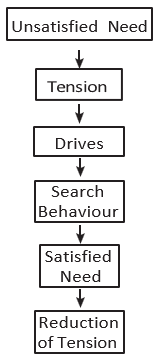
Motivation Process
- Unsatisfied need creates tension.
- Tension stimulates drives.
- Drives lead to search behaviour.
- The person takes action to satisfy the need.
- Need satisfaction reduces tension.
Importance of Motivation
- Improves performance: Satisfied and motivated employees direct greater effort towards their work and organisational goals.
- Improves attitudes: Suitable rewards, encouragement and praise can shift indifferent or negative attitudes towards positive ones.
- Reduces turnover: Meeting employees’ needs helps retain talented staff and saves recruitment and training costs.
- Reduces absenteeism: Better rewards, recognition, working conditions and workplace relations encourage regular attendance.
- Eases change: Employees may accept organisational changes more readily when managers explain the benefits and rewards for them.
Maslow’s Need Hierarchy Theory
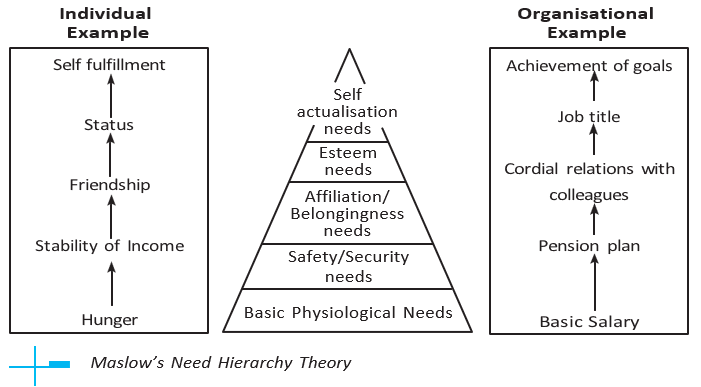
Maslow’s Need Hierarchy Theory — Abraham Maslow’s theory, outlined in a 1943 paper, proposes that people have five levels of needs arranged from basic to higher-level needs.
| Level (lowest to highest) | What the need involves | Examples |
|---|---|---|
| 1. Physiological | Basic needs necessary for living. | Food, water, shelter, sleep; in organisations, basic salary. |
| 2. Safety and security | Protection from physical and emotional harm. | Job security, stable income and pension plans. |
| 3. Affiliation and belonging | Affection, acceptance, friendship and belonging. | Positive relationships and acceptance by a work group. |
| 4. Esteem | Self-respect, autonomy, status, recognition and attention. | Recognition and responsibility at work. |
| 5. Self-actualisation | Becoming what one is capable of becoming. | Growth, self-fulfilment and achievement of goals. |
Assumptions and Use
- Needs influence behaviour: People’s actions are based on their needs; satisfying needs affects how they behave.
- Hierarchy: Needs are arranged from basic to higher levels.
- Satisfied needs: A satisfied need no longer motivates; the next higher-level need may then become motivating.
- Progression: A person moves to a higher level only after the lower-level need is satisfied.
- Use for managers: Identify employees’ current needs to select suitable motivators. The exact classification and hierarchy have been criticised, but needs remain useful for understanding behaviour.
Motivating Employees at Tata Steel
Tata Steel: Motivation Practices and Outcomes
- Participation and development: Involves officers in decisions and supports training, personal development, talent reviews and job rotation.
- Rewards and growth: Links compensation to performance and uses formal reward, recognition and knowledge-management systems.
- Voice and leadership: Offers leadership roles in quality circles and improvement programmes; uses transparent communication and employee dialogues.
- Empowerment and innovation: Encourages freedom to work and innovate, creating ownership and commitment to company goals.
- Outcomes: These practices supported a focused, motivated workforce, target achievement and process improvement; technology and performance-based systems also created new challenges and opportunities.
Financial and Non-Financial Incentives
Incentive — A measure used to motivate people to improve their performance.
| Point | Financial incentives | Non-financial incentives |
|---|---|---|
| Main focus | Direct monetary rewards or benefits measurable in money. | Psychological, social and emotional satisfaction. |
| Examples | Salary, bonus, profit sharing and retirement benefits. | Status, recognition, job enrichment and employee participation. |
| Note | Money can satisfy material needs and may also provide social position and power. | A reward may include money, but its status, recognition or growth value is the main emphasis. |
| Incentive | How it motivates |
|---|---|
| Pay and allowances | Salary includes basic pay, dearness allowance and other allowances; increments or hikes may be linked to performance. |
| Productivity-linked wages | Links wages to increased productivity by an individual or group. |
| Bonus | Extra payment over and above wages or salary. |
| Profit sharing | Gives employees a share in organisational profits, encouraging them to improve performance and increase profits. |
| Co-partnership / stock options | Offers company shares, often at a price below market value; ownership can encourage employees to support organisational growth. |
| Retirement benefits | Provident fund, pension and gratuity provide financial security after retirement and act as incentives during employment. |
| Perquisites and fringe benefits | Benefits in addition to salary, such as car allowance, housing, medical aid and children’s education. |
Non-Financial Incentives
- Status: Job rank, authority, responsibility, recognition, benefits and prestige can satisfy social and esteem needs.
- Organisational climate: The organisation’s characteristics—such as autonomy, reward orientation, employee consideration and willingness to take risks—shape behaviour.
- Career advancement: Skill development and sound promotion policies help employees progress to higher-level jobs.
- Job enrichment: Adds variety, skill, autonomy, responsibility and opportunities for growth, making work more meaningful.
- Recognition: Appreciation motivates employees; examples include congratulations, publicising achievements, awards, certificates, mementos and rewards for useful suggestions.
- Job security: Stability of employment and future income reduces worry and supports effort; excessive security may also lead to complacency.
- Employee participation: Involves employees in decisions affecting them, for example through joint management, work or canteen committees.
- Employee empowerment: Gives subordinates greater autonomy and authority, helping them use their skills and feel their work matters.
Explain the two meanings of supervision.
State Maslow’s five needs in order.
Distinguish financial and non-financial incentives.
Quick recap
- Direction includes guiding, coaching, instructing, motivating and leading, and has four elements: supervision, motivation, leadership and communication.
- Supervision guides and monitors employees and also refers to the operative-level supervisor’s role.
- Motivation is an internal, goal-directed process; an unsatisfied need creates tension and drives action.
- Motivation can be positive or negative, and its effects differ across individuals.
- Maslow’s hierarchy runs from physiological needs through safety, belonging and esteem to self-actualisation.
- Incentives are financial or non-financial; organisations can use both to improve performance and commitment.
Elements of Direction: Leadership and communication(Part-II)
Leadership
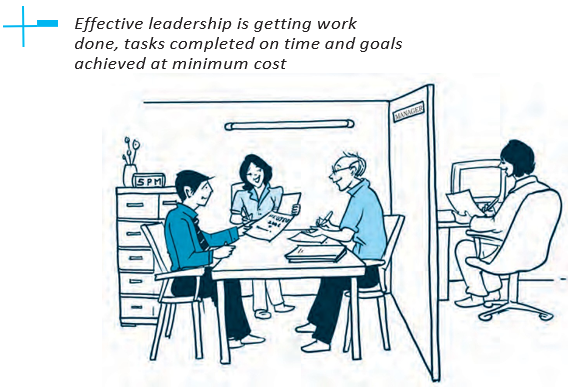
- Leadership: The process of influencing people to strive willingly towards organisational goals.
- Purpose: Leaders guide and motivate people, helping the organisation coordinate efforts and achieve its objectives.
Leader–Follower Relationship
Importance of Leadership
- A manager may possess some, rather than all, qualities of a good leader; leadership qualities can be developed through training and conscious effort.
Leadership Styles
- Leadership styles: Styles are commonly classified according to how a leader uses authority.
- Three styles: The main types are autocratic, democratic and laissez-faire leadership.
- Choice of style: A leader may combine styles according to the situation, such as taking a decision independently during an emergency.
Communication
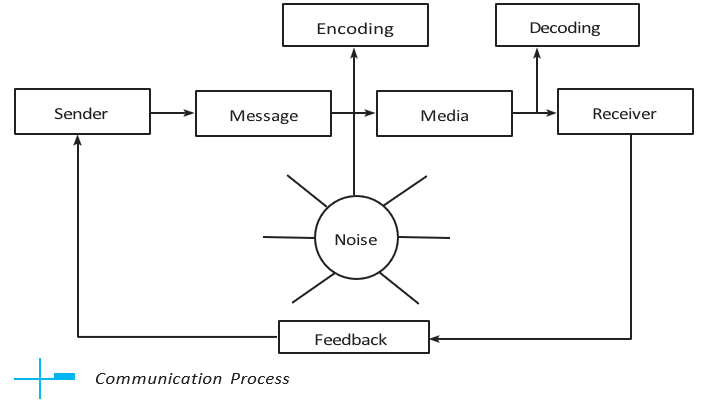
Elements of the Communication Process
Communication Sequence
- Sender forms a message.
- Message is encoded into symbols.
- Channel carries the message.
- Receiver decodes and interprets it.
- Feedback indicates understanding; noise may interfere at any point.
Importance of Communication
Distinguish between autocratic, democratic and laissez-faire leadership.
List the elements of the communication process.
State four ways communication supports management.
Quick recap
- Leadership influences people to willingly pursue common organisational goals.
- Effective leadership depends on both leaders and followers.
- The main authority-based styles are autocratic, democratic and laissez-faire.
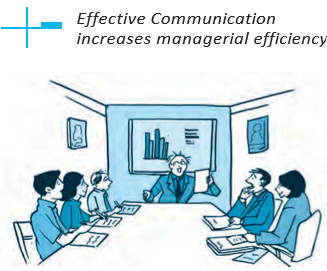
- Communication exchanges information to create common understanding.
- The communication process includes sender, message, encoding, channel, receiver, decoding, feedback and noise.
- Communication supports coordination, decisions, efficient operations, cooperation, leadership and morale; managers spend an estimated 90% of their time communicating.
Formal and Informal Communication
Types of Organisational Communication
Formal communication — Communication that follows official channels designed in an organisation’s structure.
- Participants: It may take place between a superior and subordinate, between a subordinate and superior, or among employees/managers of the same level.
- Form: It may be oral or written, but is generally recorded and filed.
- Main types: Vertical communication flows upward or downward; horizontal (lateral) communication occurs between divisions.
| Type | Direction / participants | Examples |
|---|---|---|
| Upward | Subordinate → superior | Leave application, progress report, request for grants |
| Downward | Superior → subordinate | Meeting notice, work instruction, management guidelines |
| Horizontal / lateral | Between divisions or people at the same organisational level | Production manager discussing delivery schedules, design or quality with marketing manager |
Formal Communication Networks
- Communication network: The pattern through which communication flows within an organisation.
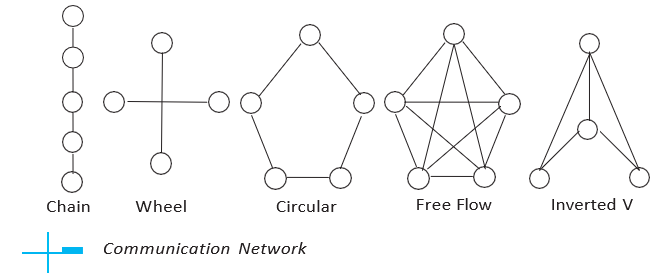
| Network | How communication flows | Key feature |
|---|---|---|
| Single chain | From each superior to subordinate through successive levels | Follows the chain of command |
| Wheel | All subordinates communicate through one superior | The superior is the hub; subordinates do not communicate with one another |
| Circular | Each person communicates with the two adjoining people | Communication moves around a circle and is slow |
| Free flow | Each person can communicate with everyone else | Communication is fast |
| Inverted V | A subordinate communicates with the immediate superior and that superior’s superior | Communication with the higher superior is limited to prescribed matters |
Informal Communication and Grapevine
Informal communication — Communication that takes place without following the organisation’s formal lines of communication.
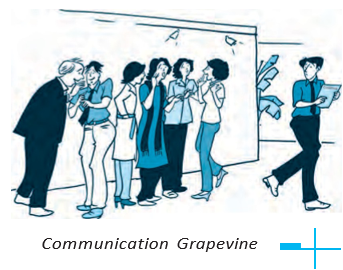
- Grapevine: Informal communication is called the grapevine because it spreads through the organisation in many directions, disregarding levels of authority.
- Why it arises: Employees use it to exchange views and information that may not pass through formal channels.
- Examples: Canteen conversations about a superior’s behaviour or rumours of employee transfers.
- Risks: It spreads rapidly but may become distorted; its source is difficult to identify, and unauthenticated rumours can harm behaviour and the work environment.
- Uses: Managers can receive information quickly and gauge subordinates’ reactions through informal channels.
- Management: Use the helpful aspects of grapevine communication while reducing its harmful effects.
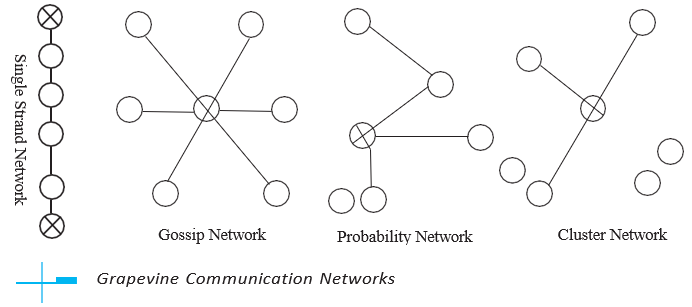
| Network | Pattern |
|---|---|
| Single-strand | Each person communicates with another person in sequence |
| Gossip | Each person communicates with all others on a non-selective basis |
| Probability | A person communicates randomly with others |
| Cluster | A person communicates with selected people they trust; the most popular grapevine network in organisations |
Barriers to Communication
Communication barriers — Obstacles that prevent, filter or distort a message and may create misunderstandings.
Semantics — The branch of linguistics that deals with the meaning of words and sentences.
| Category | Barrier | Meaning / example |
|---|---|---|
| Semantic | Badly expressed message | Inadequate vocabulary, wrong words or omitted words prevent the intended meaning from being conveyed. |
| Semantic | Symbols with different meanings | A word may have different meanings in different contexts; “value” can mean price, esteem or usefulness. |
| Semantic | Faulty translation | An inaccurate translation between languages changes the message. |
| Semantic | Unclarified assumptions | Sender and receiver interpret an instruction differently; “take care of our guest” may mean different things to each. |
| Semantic | Technical jargon | Specialist terms may not be understood by non-specialists. |
| Semantic | Body language and gesture decoding | A mismatch between spoken words and body movements can lead to misinterpretation. |
| Psychological | Premature evaluation | The receiver judges the message before the sender finishes, often due to prejudice or preconceived ideas. |
| Psychological | Lack of attention | A preoccupied receiver may not listen to or understand the message. |
| Psychological | Loss in transmission / poor retention | Messages can be lost or distorted across levels, especially orally; inattentive or uninterested people may also forget information. |
| Psychological | Distrust | When sender and receiver do not trust each other, the intended meaning may not be accepted. |
| Organisational | Unsupportive policy | A policy that discourages open communication, such as excessive centralisation, restricts its flow. |
| Organisational | Rules and regulations | Rigid rules, cumbersome procedures and prescribed channels can obstruct or delay communication. |
| Organisational | Status | Status differences may create distance; a status-conscious manager may discourage subordinates from speaking freely. |
| Organisational | Complex structure | Many managerial levels create more filtering points, increasing delay and distortion. |
| Organisational | Inadequate facilities | Lack of meetings, suggestion or complaint boxes, social gatherings and operational transparency can restrict communication. |
| Personal | Fear of challenge to authority | A superior may withhold information perceived as a threat to their authority. |
| Personal | Lack of confidence in subordinates | A superior who doubts subordinates’ competence may not seek their opinions or advice. |
| Personal | Unwillingness to communicate | A subordinate may avoid communicating if they believe it could harm their interests. |
| Personal | Lack of incentives | Without recognition or reward for useful suggestions, subordinates may not take the initiative to communicate. |
Improving Communication Effectiveness
| Measure | How it helps |
|---|---|
| Clarify ideas before communicating | Study and analyse the issue so the message is clear to the sender and receiver. |
| Communicate according to receiver needs | Adapt the message to the receiver’s education and level of understanding. |
| Consult others before communicating | Involving others in planning can build acceptance and cooperation. |
| Use suitable language, tone and content | Choose understandable, respectful language and a tone that encourages a response. |
| Convey useful and relevant information | Connect the message to listeners’ interests and needs to encourage engagement. |
| Ensure feedback | Ask questions and encourage responses to check understanding and improve communication. |
| Address present and future needs | Meet current commitments while keeping the organisation’s future goals in view. |
| Follow up communication | Review instructions regularly and remove obstacles to their implementation. |
| Be a good listener | Listen patiently and attentively, and show interest in subordinates’ views. |
Distinguish between upward, downward and horizontal communication.
Name the four grapevine networks and identify the most popular one.
List the four broad categories of communication barriers.
Quick recap
- Formal communication follows official channels; informal communication operates outside them and is called grapevine because it spreads in many directions across authority levels.
- Formal communication may be upward, downward or horizontal; networks include single chain, wheel, circular, free flow and inverted V.
- Grapevine networks are single-strand, gossip, probability and cluster; cluster is the most popular in organisations.
- Barriers are semantic, psychological, organisational or personal and can prevent, filter or distort messages.
- Improve communication through clear ideas, receiver-appropriate messages, feedback, follow-up and attentive listening.
Key Terms and Summary
Directing
Directing — A complex managerial function comprising activities designed to encourage subordinates to work effectively.
Elements and Principles
- Elements: Supervision, motivation, communication and leadership.
- Principles: Effective directing is guided by principles related to its purpose and to the direction process.
Supervision
Supervision — An element of directing that is both a process and the functions performed by a supervisor at the operative level.
Role of Supervision
- Work: The supervisor oversees and guides employees’ work.
- Purpose: Supervision helps ensure that workers meet their targets.
Motivation and Incentives
Motivation — The process of stimulating people to act towards desired organisational goals.
Nature and Effect of Motivation
- Nature: Motivation is an internal feeling, mainly based on individual needs, that leads to goal-directed behaviour.
- Effect: Motivation can improve the performance of individuals and groups in an organisation.
| Point | Financial incentives | Non-financial incentives |
|---|---|---|
| Main benefit | Monetary reward | Social or psychological satisfaction |
| Examples | Salary, bonus, profit sharing and pension | Status, promotion, responsibility, job enrichment, job recognition and job security |
| Other forms | Employee participation, delegation and empowerment are non-financial incentives | Employee participation, delegation and empowerment |
Leadership
Leadership — The process of influencing people to strive willingly for group objectives.
Leadership Qualities
- Importance: Leadership is a major factor in an enterprise’s success.
- Qualities: Courage, willpower, judgement, knowledge, integrity, physical energy, faith, moral qualities, fairness, vitality, decisiveness and social skills.
- Limit: No one person necessarily possesses every listed quality, and these qualities do not always ensure success.
Communication
Communication — The exchange of ideas between or among people that creates understanding.
Communication Process
- Source → encoding → channel → receiver → decoding → feedback
| Point | Formal communication | Informal communication |
|---|---|---|
| Nature | Official communication | Unofficial or grapevine communication |
| Examples | Orders, memos, appeals, notes, circulars, agendas and minutes | Rumours and whispers |
| Characteristics | Official communication | Spontaneous, unrecorded, spreads quickly and is usually distorted |
| Management | Occurs alongside informal communication in organisations | Managers should learn to manage informal communication |
Communication Barriers
- Types: Semantic, organisational, language, transmission, psychological and personal barriers.
- Response: Managers should take appropriate measures to overcome barriers and promote effective communication.
Key Terms
- Key terms: Directing; Supervision; Motives; Motivation; Incentives; Self actualisation; Egoistic needs; Leadership Trait approach; Communication; Encoding; Decoding; Feedback; Semanticism; Formal communication; Informal communication; Profit sharing; Copartnership; Quality circles; Stock options.
Quick recap
- Directing encourages employees to work effectively through supervision, motivation, communication and leadership.
- Supervision is both a process and the functions performed by an operative-level supervisor; it helps guide work and meet targets.
- Motivation is internal and need-based; financial and non-financial incentives can support performance.
- Leadership influences people to work willingly towards group objectives, but no single list of traits guarantees success.
- Communication is an exchange of ideas that creates understanding and involves source, encoding, channel, receiver, decoding and feedback.
- Formal communication is official; informal grapevine communication is spontaneous, unrecorded, fast-spreading and usually distorted.
- Communication barriers include semantic, organisational, language, transmission, psychological and personal barriers.