Class 12 Commerce . Business Studies . Business Studies Part I . Principles of Management
Chapter 2: PRINCIPLES OF MANAGEMENT
Ch 2
Business Studies
Class 12 Commerce
Introduction
Toyota’s Guiding Principles
Management principles — Broad guidelines that help an organisation set its vision and decide how to achieve it.
| No. | Guiding principle |
|---|---|
| 1 | Follow the law’s letter and spirit; conduct open, fair business and act as a good global corporate citizen. |
| 2 | Respect local cultures and customs; support economic and social development in communities. |
| 3 | Provide clean, safe products that improve quality of life. |
| 4 | Develop advanced technology and outstanding products and services that meet customers’ needs worldwide. |
| 5 | Encourage creativity and teamwork, supported by mutual trust and respect between management and labour. |
| 6 | Seek growth and harmony with the global community through innovative management. |
| 7 | Work with business partners on research and creativity for stable, long-term mutual benefit; remain open to new partnerships. |
Toyota’s Global Vision 2010
- Focus: Continue innovation and use environment-friendly technologies.
- Relationship with society: Respect and work with different sections of society, building interactive relationships.
Management Principles and Their Development
Nature of management principles
- Purpose: Principles guide management practices and help connect an organisation’s vision with the ways of achieving it.
- Development: They have been studied and refined by management thinkers over time; they continue to evolve.
- Classical contributors: F.W. Taylor, an American mechanical engineer, developed Scientific Management; Henri Fayol, a French mining engineer, developed Administrative Principles.
| Phase | Main ideas and examples |
|---|---|
| 1. Early Perspectives | Large projects in ancient times required planning and sound management. The pyramid built for Egyptian ruler Cheops around 2900 B.C. involved about 100,000 workers for over 20 years. |
| 2. Classical Management Theory | Includes the rational economic view, Scientific Management, administrative principles and bureaucracy. It sought efficient production and organisation during the Industrial Revolution and factory-system growth. |
| 3. Neo-Classical Theory — Human Relations Approach | Developed between the 1920s and 1950s. Emphasised that employees are influenced by social needs, drives and attitudes, not only rules, authority and economic incentives; associated with the Hawthorne Studies. |
| 4. Behavioural Science Approach — Organisational Humanism | Applied psychology, sociology and anthropology to organisations. Chris Argyris, Douglas McGregor, Abraham Maslow and Frederick Herzberg stressed employees’ capacity and creativity. |
| 5. Management Science / Operational Research | Uses research on operations and quantitative techniques to support managerial decisions. |
| 6. Modern Management | Views organisations as complex systems; includes the contingency approach and modern techniques for organisational and human problems. |
| Approach | Main emphasis |
|---|---|
| Rational economic view | People are primarily motivated by economic gains. |
| Scientific Management | Find the best way to carry out production tasks; associated with F.W. Taylor and others. |
| Administrative principles | Find effective ways to combine jobs and people in an organisation; associated with Henri Fayol. |
| Bureaucratic organisation | Reduce inconsistency and ineffectiveness caused by misuse of managerial power; associated with Max Weber. |
Why management principles mattered in the classical era
- Industrial growth: Large-scale factory production relied on organising work effectively.
- Key concerns: Division of labour, specialisation, the relationship between people and machines, and managing workers.
Name the six phases in the evolution of management thought.
How did the Human Relations Approach differ from the classical view of employees?
Quick recap
- Management principles are evolving guidelines that connect organisational vision with action.
- Toyota’s principles include legality, respect for local communities, safe products, innovation, teamwork and long-term partnerships.
- Taylor is associated with Scientific Management; Fayol with Administrative Principles.
- Classical theory includes the rational economic view, scientific management, administrative principles and bureaucracy.
- The Human Relations Approach highlighted employees’ social needs; behavioural science applied social sciences to organisations.
- Management Science uses quantitative decision support, while Modern Management views organisations as complex systems.
Principles of Management: The Concept & Nature
The Concept of Management Principles
| Point | Management | Management principles |
|---|---|---|
| Meaning | The process of carrying out management functions. | Guidelines that help managers make decisions while performing those functions. |
| Role | Planning, organising, staffing, directing and controlling are actions involved in managing. | Principles guide the decisions made while carrying out these actions. |
| Point | Management principles | Principles of pure science |
|---|---|---|
| Rigidity | Less rigid; managers apply them creatively according to the situation. | More rigid in comparison. |
| Point | Principles | Techniques | Values |
|---|---|---|---|
| Meaning | Guidelines for decisions and behaviour. | Procedures or methods made up of steps to achieve goals. | What people consider acceptable or desirable. |
| Basis | Developed through research in technical work situations. | A series of actions used to perform a task. | Formed through common social practice; have moral significance. |
| Relationship | Guide decisions while a technique is being used. | Provide the method for carrying out a task. | Must be respected when applying principles because businesses have social and ethical responsibilities. |
The Nature of Management Principles
| Characteristic | Meaning | Example or application |
|---|---|---|
| Universal applicability | Relevant to all organisations: business and non-business; small and large; public and private sector; manufacturing and services. The extent of application varies with the organisation, activity and scale. | Division of work applies in both a government office and a company, though its extent may differ. |
| General guidelines | Guide action but do not provide ready-made solutions for every complex, changing situation. | In a conflict between departments, a manager may emphasise the organisation’s overall goals. |
| Formed by practice and experimentation | Built from managers’ experience, collective wisdom and testing ideas in work settings. | Discipline is recognised through experience; experiments can test whether better factory conditions reduce worker fatigue. |
| Flexible | Not rigid rules; managers may modify or select principles according to circumstances. | The appropriate balance between centralisation and decentralisation depends on the enterprise. |
| Mainly behavioural | Primarily influence people, while also helping coordinate human and material resources. | Factory orderliness requires matching workflow with the movement of materials and people. |
| Cause-and-effect relationships | Help predict likely results when a principle is applied, though exact prediction is limited because situations and people differ. | An emergency may call for one person to take charge; setting up a factory may benefit from cross-functional participation. |
| Contingent | Application depends on the conditions prevailing at a particular time. | Fair remuneration depends on the employee’s contribution, the employer’s paying capacity and the prevailing wage rate. |
Do not confuse flexibility with contingency: flexibility means managers have discretion to adapt a principle; contingency means its application depends on the prevailing situation.
Illustration: Biocon
- Kiran Mazumdar-Shaw: Recognised biotechnology’s potential and started Biocon India in her garage with Rs. 10,000, in collaboration with Biocon Biochemicals Limited of Ireland.
- Management link: Biocon’s development illustrates how applying management qualities and principles can contribute to organisational success; success is not simply a matter of chance.
Why are management principles general guidelines rather than ready-made solutions?
How do management principles contribute to management as both a science and an art?
Quick recap
- Management principles are broad guidelines for decisions and behaviour, not rigid rules.
- Management is the process of performing management functions; principles guide decisions while those functions are performed.
- Principles differ from techniques (methods) and values (socially acceptable or desirable standards).
- Principles are developed through observation, experimentation and experience; their application requires managerial skill.
- They apply to business and non-business, small and large, public and private, manufacturing and service organisations, but the extent varies.
- Flexibility gives managers discretion; contingency means application depends on prevailing conditions.
Significance of Principles of Management
Significance of management principles — Management principles are useful guidelines that improve managerial behaviour and practices, helping managers perform their responsibilities and make decisions.
Useful Insights into Reality
- Practical understanding: Applying principles improves managers’ knowledge, ability and understanding of real situations.
- Learning from experience: They help managers learn from past mistakes and solve recurring problems quickly, saving time and improving efficiency.
- Example—delegation: Routine decisions can be assigned to subordinates, leaving managers free to handle exceptional situations requiring their expertise.
Optimum Use of Resources and Effective Administration
- Optimum use: Use limited human and material resources to obtain maximum benefit at minimum cost.
- Anticipation: Principles help managers foresee cause-and-effect relationships, reducing waste from trial-and-error decisions.
- Impersonal administration: They limit managerial discretion so decisions are not driven by personal preferences, prejudice or bias.
- Example: Department budgets should reflect each department’s contribution to organisational objectives, not a manager’s personal preference.
Scientific Decisions
- Sound decisions: Decisions should be based on facts, carefully reasoned and justified by their intended purpose.
- Decision quality: They should be timely, realistic, measurable and open to evaluation.
- Objectivity: Principles encourage logic rather than blind faith; decisions based on them are less affected by bias and prejudice.
Meeting Changing Environmental Requirements
- Flexibility: Principles are general guidelines that can be modified to suit a changing business environment.
- Specialisation today: Division of work can extend across a whole business: firms focus on core competencies and divest or outsource non-core activities.
- Examples: Hindustan Lever Limited divested non-core chemical and seed businesses; firms may outsource share-transfer management and advertising.
- Outsourcing trend: Even core processes such as research and development, manufacturing and marketing may be outsourced; this growth includes Business Process Outsourcing (BPO) and Knowledge Process Outsourcing (KPO).
Fulfilling Social Responsibility
- Public expectations: Greater public awareness pushes businesses, especially limited companies, to fulfil social responsibilities.
- Changing interpretation: Principles evolve with society. Equity today includes fair treatment beyond wages, such as customer value, environmental care and dealings with business associates.
- Example: BHEL developed the township of Ranipur in Hardwar (Uttaranchal).
Management Training, Education and Research
- Foundation for learning: Principles form the basis of management theory, training, education and research.
- Courses and assessment: Management aptitude tests and beginner-level MBA and BBA courses rely on knowledge of principles and their application.
- Improving practice: Research based on principles helps develop techniques such as Operations Research (OR), cost accounting, Just in Time, Kanban and Kaizen.
- Management principles improve decisions and practices, but remain flexible and continue to evolve.
- Their significance includes better managerial understanding, resource use, decisions, adaptation, social responsibility and professional learning.
How do management principles help in optimum use of resources and effective administration?
How do management principles help businesses respond to change and meet social responsibilities?
Quick recap
- Principles provide practical insight and help managers solve recurring problems efficiently.
- They guide economical resource use, reduce trial-and-error waste and support impartial administration.
- They encourage timely, logical and objective decisions based on facts.
- Flexible principles help businesses adapt through specialisation, divestment and outsourcing.
- Their evolving interpretation supports businesses in meeting wider social responsibilities.
- They underpin management education, training, research and the development of new techniques.
Taylor’s Scientific Management
Scientific Management
- Approach: Scientific management applies systematic study to business activities instead of relying on rule-of-thumb methods.
- Purpose: It seeks to improve efficiency, productivity and the quality of work through carefully developed methods.
Taylor’s View of Management and Workers
- Management: Taylor believed management should be studied as a discipline and based on trained, qualified managers.
- Workers: He advocated cooperation between management and workers, recognising that each side needs the other for the best results.
Taylor: Key Milestones
Time-and-motion study — A method of analysing a job by dividing it into tasks and measuring the time and movements required for each.
Lijjat Papad: Business with Social Responsibility
Lijjat’s Values and Social Impact
- Business, family and devotion are practised together.
- Members work with shared trust and responsibility.
- Women earn livelihoods and build self-reliance.
- Scholarships support members’ children’s education.
What is scientific management, and what did Taylor mean by finding the “one best way”?
What are the three core values of Lijjat Papad?
Quick recap
- Scientific management belongs to the classical school of management thought.
- Taylor used work analysis and time-and-motion studies to seek the “one best way.”
- Taylor saw trained management and a cooperative workforce as partners.
- Taylor popularised the term “scientific management” in 1911.
- Lijjat Papad combines business with family values and devotion.
- Lijjat supports women’s self-reliance and education through employment and scholarships.
Scientific Management : Principles & Techniques
Scientific management — Managing business activities through standardised tools and methods, and trained personnel, to increase output and quality while reducing costs and waste.
From Rule of Thumb to Science
- Rule of thumb relies on personal judgement and trial and error; different managers may use methods with unequal results.
- Scientific approach defines a problem, develops possible solutions, anticipates consequences, measures progress and draws conclusions.
- F. W. Taylor, the Father of Scientific Management, analysed work in small parts to find methods that save time and increase productivity.
- Example: Applying scientific management at Bethlehem Steel Company led to a three-fold increase in productivity.
Principles of Scientific Management
Science, Not Rule of Thumb
- Principle: Replace individual rules of thumb with one best, scientifically developed method used throughout the organisation.
- Development: Study existing methods, identify effective practices and combine them into a standard method.
- Work-study can improve even a simple task, such as loading iron, by saving human effort, time and materials.
- Application: Complex processes can yield greater savings; internet use can improve internal efficiency and customer satisfaction.
Harmony, Not Discord
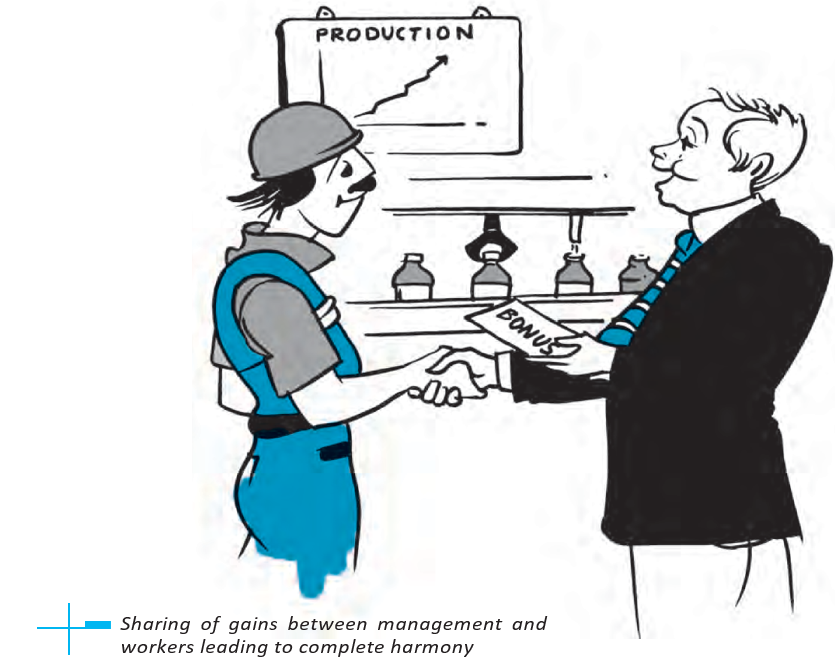
- Principle: Management and workers should work in harmony; conflict harms workers, managers and owners alike.
- Mental revolution: Both sides must change their thinking and recognise their shared interests and importance.
- Management’s role: Share company gains with workers; workers’ role: work diligently and accept beneficial change.
- Shared prosperity: Long-term employer prosperity depends on employee prosperity, and vice versa.
- Example: In the Japanese work culture described, workers may wear black badges during a strike while continuing to work extra hours.
Paternalistic style of management — A management style in which the employer takes care of employees’ needs.
Cooperation, Not Individualism
- Principle: Replace competition and individualism with cooperation between labour and management.
- Management should listen to constructive employee suggestions, reward those that reduce costs and involve workers in important decisions.
- Workers should avoid strikes and unreasonable demands; open communication and goodwill reduce conflict.
- Shared responsibility: Work and responsibility should be divided almost equally, with management supporting workers throughout the day.
- Paternalistic management may prevail when employers care for employees’ needs, as described in the example of Japanese companies.
Development of Each Person to Greatest Efficiency and Prosperity
- Principle: Develop every worker to their highest efficiency and prosperity through scientific selection, suitable work and training.
- Selection and placement: Select employees scientifically and assign tasks suited to their physical, mental and intellectual abilities.
- Training helps employees learn the best method and perform more efficiently.
- Result: Greater efficiency raises production and earnings, benefiting both the worker and the company.
Taylor’s Contribution to Scientific Management
Elements and Mechanisms
- Standardisation: Use time and motion studies to compare tools, combine their best features and adopt one standard until a better one is scientifically established.
- Planning and supervision: Use functional or specialised supervision, separate planning from execution and apply management by exception.
- Tools and methods: Standardise implements and work methods; use slide rules and other time-saving devices, and give workers instruction cards.
- Work allocation and incentives: Assign tasks, offer large bonuses for successful performance and use differential rates.
- Systems: Use mnemonic systems to classify products and implements, a routing system and a modern costing system.
Taylor’s Four Principles
- 1. Develop a true science for each element of work.
- 2. Scientifically select workers.
- 3. Scientifically educate and develop workers.
- 4. Build close, friendly cooperation between management and employees.
Taylor’s Publication and Testimony
- 1911Taylor published *The Principles of Scientific Management*.
- 1912Taylor gave testimony before the U.S. House of Representatives Special Committee.
Techniques of Scientific Management
- Work study: Taylor’s techniques analyse jobs to find efficient methods, set standards and improve productivity.
- Methods: They include standardisation and simplification, method, motion, time and fatigue studies, and differential piece wages.
Functional Foremanship
Functional foremanship — A system that separates planning and execution at the shop-floor level and assigns supervision to eight specialist foremen instead of one general foreman.
Structure and Purpose
- Reason: Taylor found that one foreman could not possess all the qualities required for effective supervision.
- Structure: A factory manager oversees a planning in-charge and a production in-charge; each supervises four specialists.
- Specialisation: Functional foremanship extends division of work and specialisation to the shop floor.
- Workers take orders from the relevant specialists for different production functions.
- Suitable assignment: Technical mastery, intelligence and grit suit planning roles; energy and good health may suit execution roles.
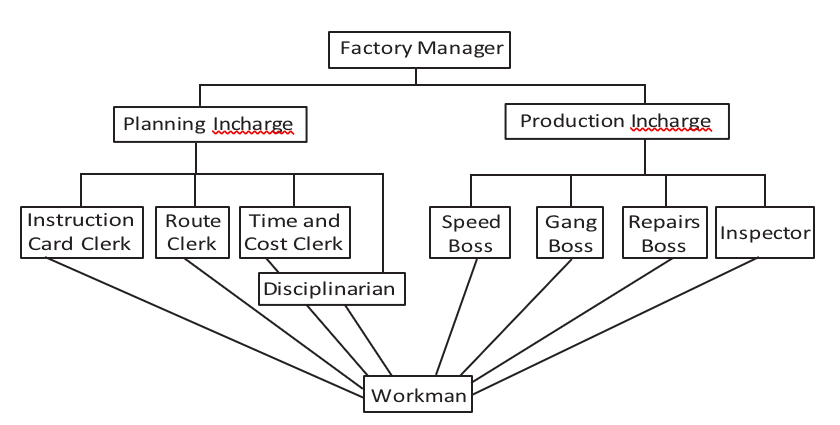
| In-charge | Specialist foreman | Main responsibility |
|---|---|---|
| Planning | Instruction card clerk | Drafts instructions for workers. |
| Planning | Route clerk | Specifies the route of production. |
| Planning | Time and cost clerk | Prepares time and cost sheets. |
| Planning | Disciplinarian | Ensures discipline. |
| Production | Speed boss | Ensures timely and accurate completion of work. |
| Production | Gang boss | Keeps machines and tools ready for workers. |
| Production | Repair boss | Ensures machines and tools remain in proper working condition. |
| Production | Inspector | Checks the quality of work. |
Qualities of a Foreman
- Required qualities: Intelligence, education, tact, grit, judgement, special knowledge, manual dexterity, energy, honesty and good health.
- Why eight specialists? One person is unlikely to possess all these qualities, so functions are assigned to different specialists according to their abilities.
What is meant by functional foremanship?
State Taylor’s four principles of scientific management.
How does Taylor’s principle of harmony differ from cooperation?
Quick recap
- Scientific management replaces trial-and-error rules with standardised, scientifically studied methods.
- Taylor’s principles are science over rule of thumb, harmony, cooperation, and development of every worker.
- Shared prosperity means management and workers benefit together; paternalistic management involves employers caring for employees’ needs.
- Worker development involves scientific selection, suitable job assignment and training.
- Techniques include work-study, standardisation, specialised supervision, task allocation, incentives, routing and costing systems.
- Functional foremanship divides supervision into planning and production, with four specialist foremen under each.
Standardisation and Simplification of Work
Standardisation and Simplification
Standardisation — Setting standards or benchmarks for business activities that must be followed during production.
- Scientific approach: Taylor advocated analysing production methods instead of relying on rule-of-thumb practices; retain and refine the best practices into organisational standards.
- Scope: Standards can cover processes, raw materials, time, products, machinery, methods and working conditions.
- Work study: Method, motion, time and fatigue studies help establish and improve standards.
- Modern practices: Reengineering, kaizen (continuous improvement) and benchmarking also aim to standardise work.
| Objective | What it achieves |
|---|---|
| Fixed products | Reduces a product line to fixed types, sizes and characteristics. |
| Interchangeability | Makes manufactured parts and products interchangeable. |
| Quality | Sets standards of excellence for materials. |
| Performance | Sets performance standards for people and machines. |
| Point | Standardisation | Simplification |
|---|---|---|
| Main aim | Devises standard varieties in place of existing ones. | Eliminates unnecessary diversity, varieties, sizes and dimensions. |
| Result | Creates benchmarks that guide production. | Reduces labour, machine and tool costs; lowers inventories, improves equipment utilisation and increases turnover. |
- Examples: Companies such as Nokia, Toyota and Microsoft have implemented standardisation and simplification; their large market shares are cited as evidence of success.
Method Study
Method study — Finding the one best way to perform a job by examining the activities involved.
- Scope: Covers activities from procuring raw materials to delivering the finished product to the customer.
- Goal: Minimise production costs while maximising product quality and customer satisfaction.
- Tools: Process charts and operations research can help analyse and improve work methods.
- Assembly line: Taylor developed the assembly-line concept using method study; Ford Motor Company applied it successfully.
- Planning an assembly line: Decide the sequence of operations and the placement of workers, machines and raw materials.
Motion Study
Motion study — Examining workers’ movements while doing a job to eliminate unnecessary motions and complete work efficiently in less time.
| Motion type | Meaning / example |
|---|---|
| Productive | Directly contributes to completing the job. |
| Incidental | Supports the work indirectly; for example, going to the stores. |
| Unproductive | Does not contribute to completing the job and should be eliminated where possible. |
- Identification: Taylor used stopwatches, symbols and colours to distinguish different motions.
- Application: Motion study can guide the design of suitable tools and equipment and teach workers how to use them.
- Example: Taylor and his associate Frank Gilbreth reduced bricklaying motions from 18 to 5; productivity increased about fourfold.
Time Study
Time study — Determining the standard time needed to complete a well-defined job.
- How standard time is set: Measure each task element and use several readings to fix the time for the whole task.
- Factors affecting the method: Task volume and frequency, operation cycle time and the cost of time measurement.
- Uses: Determines the number of workers required, helps frame incentive schemes and establishes labour costs.
- Example: At 20 minutes per cardboard box, a worker makes 3 boxes per hour. A 7-hour working period in an 8-hour shift (after one hour for rest and lunch) gives a standard task of 21 boxes.
Fatigue Study
Fatigue study — Determining the amount and frequency of rest intervals needed while completing a task.
- Purpose of rest: Breaks help workers regain stamina and resume work at their capacity, supporting productivity.
- Work shifts: Plants may operate in three shifts of 8 hours; workers also need breaks within a shift, including lunch.
- Heavy manual work: Frequent short pauses can help workers restore energy for optimum contribution.
- Causes of fatigue: Long working hours, unsuitable work, poor relations with a boss and bad working conditions.
- Management response: Remove hindrances to good performance by addressing the causes of fatigue.
Quick recap
- Standardisation sets production benchmarks; simplification removes unnecessary product diversity.
- Simplification can reduce costs and inventories, improve equipment use and increase turnover.
- Method study finds the best way to perform work and improve cost, quality and customer satisfaction.
- Motion study classifies and eliminates unnecessary movements; bricklaying motions were reduced from 18 to 5.
- Time study fixes a job’s standard time using multiple readings and supports staffing, incentives and labour-cost decisions.
- Fatigue study sets suitable rest intervals and addresses conditions that reduce workers’ stamina and performance.
Differential Piece Wage System
Differential Piece Wage System
Taylor’s Example: Schmidt
- Result: Using scientific-management techniques, Schmidt increased pig-iron loading from 12.5 to 47 tons per man per day in box cars at Bethlehem Steel works.
- Wages: His daily wages rose from 1.15 dollars to 1.85 dollars—about 60% more.
Scientific Management as a Unified Approach
- Integrated efficiency: Taylor’s principles and techniques work together to find the best method, set a fair day’s work and reward efficient performance.
- Shared purpose: Managers and workers should cooperate to increase output and share the benefits rather than compete over the surplus.
Mental Revolution
- Meaning: Mental revolution is a change in the attitudes of workers and management from competition to cooperation.
- Shared prosperity: Both sides should aim to increase the company’s surplus, with management sharing part of the gains and workers contributing to the company’s success.
Applications and Later Developments
- Productivity: Bethlehem Steel achieved a threefold increase in productivity through scientific-management principles.
- Assembly line: Taylor’s method-study ideas informed assembly-line production, used successfully by Ford to manufacture the Model T.
- Operations research: Developed during the Second World War to optimise the deployment of war materials, it is now used in business decisions.
- Modern developments: Lean manufacturing, robotics and computers continue the drive to improve efficiency and productivity.
Quick recap
- Work-study standards classify workers; above-standard output earns a higher per-unit wage.
- In the example, the 10-unit standard separates the Rs. 50 and Rs. 40 rates; the daily wage difference is Rs. 190.
- Schmidt raised pig-iron loading from 12.5 to 47 tons per man per day and his wages from 1.15 to 1.85 dollars.
- Mental revolution replaces competition with cooperation and supports sharing surplus between management and workers.
- Operations research, assembly lines, lean manufacturing, robotics and computers are applications or later developments of scientific management.
Fayol’s Principles of Management
Fayol’s Administrative Theory
- Focus: Fayol’s administrative theory explains managerial work and ways to improve managerial efficiency across an organisation.
- Management functions: Fayol described them as planning, organising, commanding, coordinating and controlling.
- Business activities: He classified industrial activities as technical, commercial, financial, security, accounting and managerial.
The 14 Principles of Management
Authority and Responsibility — Authority is the right to give orders and obtain obedience; responsibility is the duty that accompanies it.
Discipline — Discipline means obeying organisational rules and honouring employment agreements.
Unity of Command — Each employee should receive orders from, and be accountable to, only one superior.
Unity of Direction — Activities with the same objective should follow one plan under one head.
Subordination of Individual Interest to General Interest — The organisation’s general interest should take priority over the interest of any one individual or small group.
Remuneration of Employees — Pay and compensation should be fair to employees and affordable for the organisation.
Centralisation and Decentralisation — Centralisation concentrates decision-making authority; decentralisation distributes it among several people or levels.
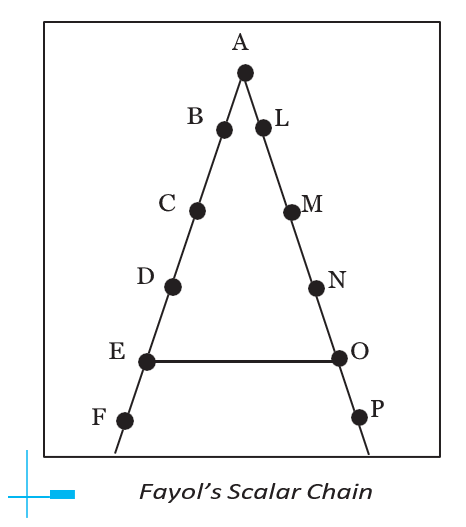
Scalar Chain — The scalar chain is the formal line of authority running from the highest to the lowest organisational rank.
Order — People and materials should be in the right places at the right times.
Equity — Managers should treat employees with fairness, kindness and justice.
Stability of Personnel — Employee turnover should be minimised by providing employees reasonable time and tenure in their positions.
Fayol’s Principles: Then and Now
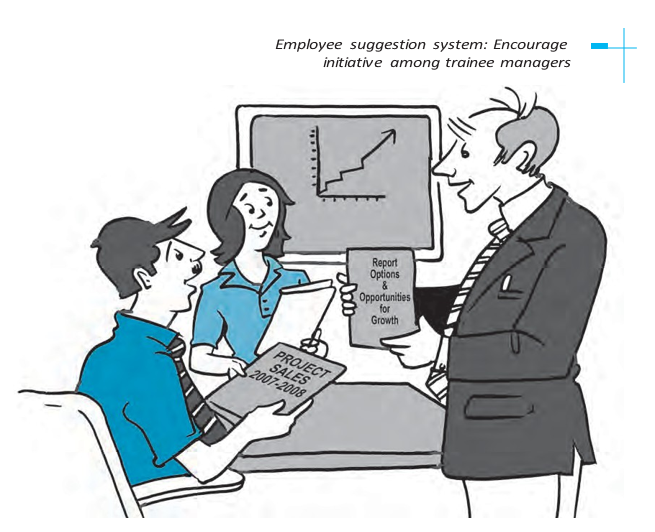
Initiative — Initiative is the ability to think out and carry out a plan through self-motivation.
Esprit de Corps — Esprit de corps means promoting team spirit, unity and harmony among employees.
- Principles are guidelines: Their application may change with the organisation and business environment.
- Key distinctions: Unity of command concerns one employee and one boss; unity of direction concerns one objective, one plan and one head.
- Balance matters: Match authority with responsibility, and balance centralisation with decentralisation.
Differentiate between unity of command and unity of direction.
What is a gang plank in Fayol’s scalar chain?
State Fayol’s principles of authority and responsibility and remuneration.
Quick recap
- Fayol explained managerial work and proposed 14 principles to guide administration.
- Work specialisation, discipline, fair remuneration and stable personnel support organisational efficiency.
- Authority should match responsibility; organisational interest should prevail over individual interest.
- Unity of command means one employee reports to one superior; unity of direction means one plan and head for a shared objective.
- The scalar chain is the formal authority path; a gang plank allows emergency communication across the same level.
- Equity, order, initiative and esprit de corps foster fairness, efficiency and cooperation.
- Fayol’s principles remain relevant, but their application changes with organisational structures and business conditions.
Fayol Versus Taylor - A Comparison
Complementary Contributions
| Basis | Henri Fayol | F. W. Taylor |
|---|---|---|
| Perspective | Top level of management | Shop-floor level of a factory |
| Unity of command | Strongly supported it | Did not consider it essential; under functional foremanship, a worker received orders from eight specialists |
| Applicability | Applicable universally | Applicable to specialised situations |
| Basis of formation | Personal experience | Observation and experimentation |
| Focus | Improving overall administration | Increasing productivity |
| Personality | Practitioner | Scientist |
| Expression | General Theory of Administration | Scientific Management |
How did Fayol’s and Taylor’s approaches differ in their focus?
Quick recap
- Fayol and Taylor made complementary contributions to management.
- Fayol’s perspective was top-level; Taylor’s was shop-floor.
- Fayol supported unity of command; Taylor’s functional foremanship involved orders from eight specialists.
- Fayol’s principles were universal; Taylor’s applied to specialised situations.
- Fayol drew on personal experience; Taylor used observation and experimentation.
- Fayol aimed to improve administration; Taylor aimed to increase productivity.
Keywords & Summary
Key Terms
- Core vocabulary: The terms cover Taylor’s work-study and wage techniques, including functional foremanship, time study and motion study.
- Management concepts: They also include mental revolution and Fayol’s ideas such as unity of command, scalar chain and esprit de corps.
Meaning and Nature of Management Principles
- Meaning: Management principles are broad guidelines for decision-making and behaviour, applied creatively to suit the situation.
- Nature: They are general, flexible and mainly behavioural guidelines, developed through practice and experimentation.
- Application: They express cause-and-effect relationships, apply widely but contingently, and do not provide rigid, ready-made solutions.
Significance of Management Principles
- Managerial insight: Principles help managers understand situations, learn from past mistakes and solve recurring problems efficiently.
- Better decisions: They support optimum use of resources and objective, reasoned decisions while limiting personal bias.
- Wider value: They help businesses adapt to change, fulfil social responsibilities and develop management training, education and research.
Taylor’s Scientific Management
- Scientific management: Taylor proposed using systematic study and standardised methods instead of rule of thumb to improve productivity and reduce waste.
- Key principles: He advocated science over rule of thumb, harmony, cooperation and developing each worker to their greatest efficiency and prosperity.
- Techniques: His methods include functional foremanship, work studies, standardisation and simplification, and differential piece wages.
Fayol’s Management Ideas
- Division of work
- Divide tasks to support specialisation.
- Authority and responsibility
- Authority to give orders should be matched by responsibility.
- Unity of command
- Each employee should receive orders from one superior.
- Unity of direction
- Activities with the same objective should follow one plan and one head.
- Scalar chain
- The formal line of authority from top to bottom; a gang plank can allow direct communication in an urgent case.
- Esprit de corps
- Promote team spirit and unity among employees.
Other Fayol Principles
- Remaining principles: Discipline; subordination of individual interest to general interest; remuneration of personnel; centralisation and decentralisation; order; equity; stability of tenure of personnel; and initiative.
Quick recap
- Management principles are practical guidelines for managerial decisions and action.
- Their nature includes universality, flexibility, behavioural aspects and contingency.
- They support efficiency, resource use, scientific decisions, adaptation and administration.
- Taylor’s approach emphasises scientific methods, cooperation and high productivity.
- Taylor’s techniques include work studies, standardisation and differential wages.
- Fayol outlined management functions, industrial activities, managerial qualities and 14 principles.
- Taylor’s and Fayol’s contributions are different but complementary.