Class 12 Commerce . Business Studies . Business Studies Part I . Controlling
Chapter 8: CONTROLLING
Ch 8
Business Studies
Class 12 Commerce
Understanding the Meaning of Controlling
Controlling in Practice
Departure Control System (DCS)
- Purpose: A DCS automates key airline airport operations, including passenger check-in, boarding passes, baggage acceptance and boarding load control.
- Information: It can retrieve updated passenger reservations from an airline’s computer reservation system through the passenger name record (PNR).
- Tracking: Passenger reservations can be updated to statuses such as checked in, boarded or flown.
- Control link: By tracking operations, the system helps managers spot issues and take corrective action before they harm the business.
Meaning and Nature of Controlling
Controlling — The management function of ensuring that organisational activities follow plans and that resources are used effectively and efficiently to achieve predetermined goals.
Key Features
- Goal-oriented: Controlling seeks planned results and keeps work directed towards organisational goals.
- Pervasive: It is needed by managers at top, middle and lower levels, within their areas of responsibility.
- Universal: Controlling is required in businesses as well as institutions such as schools, hospitals, the military and clubs.
- Corrective: It identifies departures of actual performance from standards, examines their causes and supports corrective action.
- Continuous cycle: Controlling does not simply end management’s work; its findings help improve plans for the next period.
How Controlling Feeds Future Planning
- Compare actual performance with standards
- Identify and analyse deviations
- Take corrective action
- Use lessons from problems to improve future plans
| Point | Planning | Controlling |
|---|---|---|
| Role in the management cycle | Sets objectives and standards in advance. | Checks performance against plans and identifies deviations. |
| Connection | Provides the standards that controlling uses. | Uses its findings to support better planning in the next cycle. |
- Standard
- A planned level or measure of performance used as a basis for comparison.
- Deviation
- The difference between actual performance and the set standard.
- Corrective action
- Action taken to address the causes of a deviation and bring performance towards the plan.
- Pervasive function
- A function required at every level of management and across different types of organisations.
Why is controlling not simply the last function of management?
Quick recap
- Controlling ensures that organisational activities follow plans and resources support predetermined goals.
- It is goal-oriented, pervasive and required at all levels of management and in different kinds of organisations.
- Controlling compares actual performance with standards and identifies deviations.
- Managers analyse deviations and take corrective action.
- Findings from controlling improve planning in the next management cycle.
Importance of Controlling
Managerial control — According to Koontz and O’Donnell, managerial control measures accomplishment against standards and corrects deviations to ensure objectives are achieved according to plans.
Benefits of Controlling
| Benefit | How it helps |
|---|---|
| Accomplishing organisational goals | Measures progress, identifies deviations and indicates corrective action to keep the organisation on track. |
| Judging accuracy of standards | Checks whether standards are accurate and objective; changing organisational or environmental conditions may require their revision. |
| Efficient use of resources | Ensures activities follow predetermined standards, reducing wastage and spoilage. |
| Employee motivation | Clarifies expected work and appraisal standards in advance, encouraging better performance. |
| Order and discipline | Close checks on employee activities discourage dishonest behaviour and help maintain discipline. |
| Coordination in action | Coordinated standards guide departments and employees towards overall organisational objectives. |
Controlling and Goal Achievement
- Measure progress against organisational goals.
- Identify deviations from standards.
- Take corrective action.
- Keep activities on track and help achieve objectives.
Limitations of Controlling
| Limitation | Explanation |
|---|---|
| Difficulty setting quantitative standards | Morale, job satisfaction and human behaviour are difficult to quantify, making performance measurement and comparison harder. |
| Little control over external factors | An enterprise generally cannot control government policies, technological changes or competition. |
| Employee resistance | Employees may view control as a restriction on freedom and object to close monitoring, such as CCTV surveillance. |
| Costly affair | Control takes time, effort and money; small enterprises may not be able to afford expensive systems. |
- Check that the cost of installing and operating a control system does not exceed its benefits.
Example: Control Through Computer Monitoring
- Monitoring: A New York import-export company suspected employee theft. Corporate Defense Strategies (CDS) advised the firm to install software that secretly logged the suspects’ keystrokes and sent encrypted reports.
- Misconduct found: Two employees deleted processed orders from company records, pocketed the revenue and built their own business.
- Outcome: The software revealed their plan to steal electronics; police arrested them when they entered the warehouse.
- Scale: The employees were charged with embezzling 3 million dollars over two and a half years from a firm earning 25 million dollars annually.
- Controlling
- Measuring performance against standards, identifying deviations and taking corrective action.
- Standard
- A predetermined basis for measuring and evaluating performance.
- Deviation
- A difference between actual performance and the set standard.
State four ways controlling benefits an organisation.
Explain any two limitations of controlling.
Quick recap
- Controlling measures accomplishment against standards and corrects deviations to help achieve planned objectives.
- It supports goal achievement, accurate standards, efficient resource use, employee motivation, discipline and coordination.
- Qualitative areas such as morale, satisfaction and behaviour can be difficult to measure.
- Businesses generally have little control over external factors such as government policy, technology and competition.
- Employee resistance and high costs can limit control systems.
- Control-system costs should not exceed the benefits they provide.
Relationship between Planning and Controlling
How Planning and Controlling Are Related
Planning and controlling — They are inseparable management functions: planning sets the standards, while controlling checks performance against them and helps keep events aligned with plans.
| Point | Planning | Controlling |
|---|---|---|
| Main role | Prescribes the course of action and desired performance. | Evaluates whether decisions have been translated into desired action. |
| Basis | Sets performance standards. | Uses the standards set by planning to measure actual performance. |
| Time focus | Forward-looking: plans are based on forecasts about future conditions. | Backward-looking when it reviews past performance and identifies deviations. |
| How they connect | Without control, plans cannot be checked or corrected. | Without plans and standards, there is no basis for control. |
Two-way relationship
- Planning enables control: Plans provide the standards needed to measure performance and identify deviations.
- Control improves planning: Information from past performance and corrective action helps managers plan better for the future.
- Both time directions: Planning looks ahead but uses past experience; controlling looks back but aims to improve future performance.
Plan sets; control checks
Planning sets the target; controlling checks progress and feeds lessons back into future plans.
The Controlling Process
Controlling process — A systematic sequence for setting standards, measuring performance, comparing results, analysing deviations and taking corrective action.
Five steps
- Set performance standards.
- Measure actual performance.
- Compare actual performance with standards.
- Analyse deviations and their causes.
- Take corrective action.
1. Setting Performance Standards
Performance standards — Benchmarks or criteria against which actual performance is measured and towards which an organisation works.
Types and qualities of standards
- Quantitative standards: Expressed numerically, such as cost, revenue, units produced or sold, and time taken.
- Qualitative standards: Describe less directly measurable aims, such as improving goodwill or employee motivation.
- Make them measurable: Use precise quantities wherever possible; define qualitative aims through observable measures.
- Keep them flexible: Standards may need revision when internal or external business conditions change.
- Example: Reduce defects from 10 to 5 per 1,000 units by the end of the quarter.
| Production | Marketing | Human Resource Management | Finance and Accounting |
|---|---|---|---|
| Quantity | Sales volume | Labour relations | Capital expenditures |
| Quality | Sales expense | Labour turnover | Inventories |
| Cost | Advertising expenditures | Labour absenteeism | Flow of capital |
| Individual job performance | Individual salesperson’s performance | — | Liquidity |
2. Measuring Actual Performance
Measurement methods and examples
- Reliable measurement: Make it objective and, as far as possible, use the same units as the standards.
- Methods: Personal observation, sample checking and performance reports.
- Timing: Measure during work where possible, not only after completion; for example, check parts before assembly or monitor air safety continuously.
- Employee performance: A superior may prepare a performance report.
- Company performance: Ratios such as gross profit ratio, net profit ratio and return on investment may be calculated periodically.
- Marketing and production: Track units sold or market share; production efficiency can be assessed through units produced and defective units.
- Sample checking: Large organisations may inspect randomly selected products when checking every item is impractical; small organisations may check each item.
3. Comparing Performance with Standards
- Comparison: Place actual results against the standards to reveal deviations between actual and desired performance.
- Easier comparison: Quantitative standards make differences straightforward to identify; for example, compare a worker’s weekly output with the weekly target.
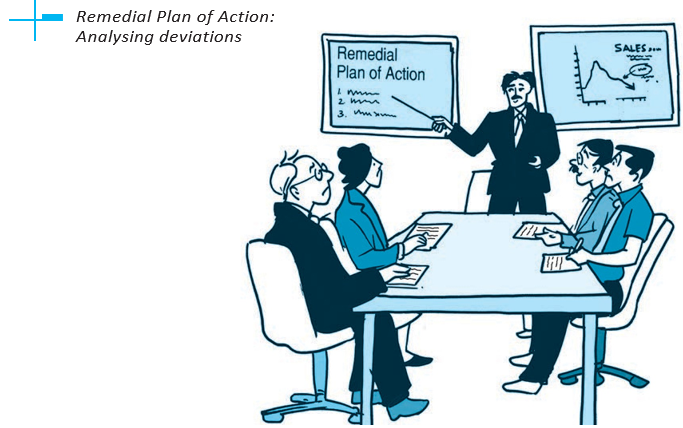
4. Analysing Deviations
Deviation — The difference between actual performance and the standard or desired result.
How managers analyse deviations
- Set an acceptable range: Some deviation is expected, so determine the limits within which results are acceptable.
- Prioritise key areas: Deviations in important business areas need more urgent attention than those in less significant areas.
- Find the cause: Possible causes include unrealistic standards, defective processes, inadequate resources, structural drawbacks, organisational constraints and external factors beyond the organisation’s control.
- Act on the cause: Identify the exact cause before choosing corrective action; report deviations and causes to the appropriate level.
| Point | Critical Point Control | Management by Exception |
|---|---|---|
| Meaning | Focus control on key result areas (KRAs) critical to organisational success. | Bring only significant deviations beyond permissible limits to management’s attention. |
| Reason | Checking every activity is neither easy nor economical; failure at a critical point can harm the whole organisation. | Trying to control everything can result in controlling nothing. |
| Example | A 5% rise in labour cost may matter more than a 15% rise in postal charges. | If a 2% rise in labour cost is acceptable, report rises beyond 2%; a 5% deviation needs immediate priority. |
Advantages of these approaches
- Saves time and effort: Managers deal with significant deviations rather than every small issue.
- Focuses attention: Managerial talent is directed towards important areas and critical problems receive timely action.
- Supports delegation: Routine issues can be handled by subordinates, supporting delegation of authority and improving employee morale.
5. Taking Corrective Action
When and how to correct performance
- Within limits: No corrective action is needed when deviations remain within the acceptable range.
- Beyond limits: Important deviations need prompt attention to prevent recurrence and help achieve standards.
- Examples: Train employees if production targets are missed; add workers or equipment and allow overtime if a project is behind schedule.
- Revise standards if needed: When a deviation cannot be corrected through managerial action, the standards themselves may need revision.
- Performance standard
- A benchmark used to assess actual performance.
- Deviation
- The difference between actual performance and the standard.
- Critical Point Control
- Concentrating control on key result areas crucial to success.
- Management by Exception
- Bringing significant deviations beyond permissible limits to management’s attention.
Explain why planning and controlling are interdependent.
What is management by exception?
Quick recap
- Planning establishes standards; controlling checks performance against them.
- Planning and controlling are interdependent and both draw on past experience while influencing future performance.
- The control process has five steps: set standards, measure, compare, analyse deviations and correct.
- Standards may be quantitative or qualitative; make them measurable and flexible.
- Use critical point control for key result areas and management by exception for significant deviations.
- Correct deviations beyond acceptable limits, or revise standards when required.
Key Terms and Summary
Controlling — The process of ensuring that actual activities conform to planned activities.
Importance of Controlling
- Goals: Helps the organisation accomplish its objectives.
- Standards: Helps judge whether performance standards are accurate.
- Resources: Supports their efficient utilisation.
- Morale and discipline: Boosts employee morale and promotes order and discipline.
- Coordination: Aligns different activities so they work towards common targets.
Limitations of Controlling
- External factors: An organisation cannot control factors outside its control system.
- Employee resistance: Employees may resist the control system.
- Cost: Controlling can be expensive, particularly for small organisations.
- Quantitative standards: Some performance areas cannot easily be measured quantitatively, reducing the effectiveness of control.
Control Process
- Set performance standards
- Measure actual performance
- Compare actual performance with standards
- Analyse deviations
- Take corrective action
Planning and Controlling
| Point | Planning | Controlling |
|---|---|---|
| Role in management | Initiates the management process | Completes the management process |
| Relationship | Plans provide the basis for control | Checks whether activities follow plans |
| Connection | Planning and controlling are inseparable; without control, plans may go astray | Control depends on plans and helps keep their execution on track |
Techniques of Managerial Control
| Type | Techniques |
|---|---|
| Traditional | Personal observation; statistical reports; breakeven analysis; budgetary control |
| Modern | Return on investment (ROI); ratio analysis; responsibility accounting; management audit; PERT and CPM; Management Information System (MIS) |
Other Key Terms
- Control approaches: Critical point control; management by exception.
- Named techniques: Breakeven analysis; budgetary control; return on investment; ratio analysis; responsibility accounting; management audit; PERT and CPM; Management Information System.
State the steps in the control process.
Give two limitations of controlling.
Quick recap
- Controlling ensures actual activities conform to planned activities.
- It supports goal achievement, accurate standards, efficient resource use, morale, discipline and coordination.
- External factors, employee resistance, high costs and difficulty setting quantitative standards limit control.
- The control process moves from setting standards to corrective action.
- Planning starts management; controlling completes it, and both depend on each other.
- Traditional techniques include personal observation, statistical reports, breakeven analysis and budgetary control.
- Modern techniques include ROI, ratio analysis, responsibility accounting, management audit, PERT and CPM, and MIS.