Class 12 Commerce . Business Studies . Business Studies Part II . Financial Management
Chapter 9: Financial Management
Ch 9
Business Studies
Class 12 Commerce
Introduction
Why Financial Decisions Matter
Tata Steel’s acquisition of Corus
- Companies and deal: In 2007, Tata Steel, India’s biggest private-sector steel producer, acquired Corus, a Dutch steel company, in a deal worth USD 12 billion.
- Scale: It was the largest overseas private-sector transaction by an Indian company at the time; the acquired business was named Tata Steel Europe in 2010.
- Financing: Tata Steel raised over USD 8 billion in debt and arranged about Rs. 36,500 crore through debt, equity, a combination of both and internal accruals.
- Structure: Tata Steel UK, a special purpose vehicle (SPV), was set up to pay for the deal. Tata Sons Ltd. invested USD 1 billion in preference shares, matched by an equal investment from Tata Steel.
- Significance: The financing mix affected Tata Steel’s capital structure. A decision of this scale can affect risk, profitability, shareholders and employees, so it requires careful planning.
Business Finance
Business finance — The money required to carry out the activities of a business.
Why businesses need finance
- Business stages: Finance is needed to establish, operate, modernise, expand or diversify a business.
- Assets: It funds tangible assets such as machinery, factories and buildings, and intangible assets such as trademarks, patents and technical expertise.
- Daily operations: It pays for materials, bills and salaries, and supports cash collection from customers.
- Importance: Adequate finance is essential for a business’s survival and growth.
Financial Management
Financial management — The process of making decisions about the optimal procurement and effective use of finance.
Main aims
- Procurement: Identify and compare sources of finance by their costs and associated risks.
- Deployment: Invest funds so that returns exceed the cost of obtaining them.
- Balance: Reduce the cost of funds, keep risk under control and ensure funds are available when needed.
- Efficiency: Avoid keeping finance idle; the quality of financial management strongly affects a business’s future.
Importance of Financial Management
- Financial health: Financial decisions shape a firm’s financial position and health, as reflected in its Balance Sheet and Profit and Loss Account.
- Long-term effect: Financial statements reflect earlier decisions; future statements depend on both past and current decisions.
- Overall goal: Mobilise financial resources at lower cost and deploy them in the most lucrative activities.
| Area affected | Effect or example |
|---|---|
| Fixed assets | Capital budgeting changes their size and composition; investing Rs. 100 crore in fixed assets increases the fixed-asset base by that amount. |
| Current assets | Investment in fixed assets can increase working-capital needs. Credit and inventory decisions affect receivables, inventory and total current assets. |
| Short-term and long-term funds | The choice of proportions affects liquidity and profitability. A business seeking more liquid assets may raise relatively more long-term finance; the text assumes current liabilities cost less than long-term liabilities. |
| Long-term financing mix | Financing decisions determine how much long-term finance comes from debt, equity share capital and preference share capital. |
| Profit and Loss Account | More debt raises future interest expense; greater reliance on equity may mean higher dividend payments. Expansion can affect many Profit and Loss Account items. |
Objective of Financial Management
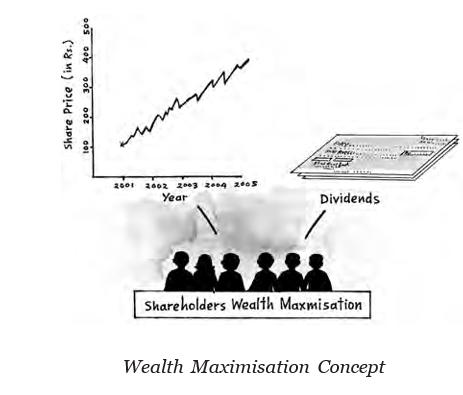
Wealth-maximisation concept — The primary objective of financial management is to maximise shareholders’ wealth by maximising the current market price of the company’s equity shares.
How financial decisions create shareholder value
- Choose an investment, financing or working-capital option.
- Select the most efficient option from the available alternatives.
- Ensure the benefits of the decision exceed its costs.
- Add value to the company and support an increase in the market price of its equity shares.
Applying the objective
- Investment decision: Invest in a new machine when its expected benefits exceed its cost, creating value.
- Financing decision: Choose a way to obtain finance that reduces its cost and increases the value created.
- Shareholder gain: Shareholders benefit when the market value of their shares rises; decisions that lower share prices are poor financial decisions.
- Efficient decision-making: Compare alternatives and select the one that best contributes to shareholder wealth.
What is the primary objective of financial management?
Quick recap
- Business finance is the money needed to establish, operate, modernise, expand or diversify a business.
- Financial management aims at optimal procurement and effective use of funds.
- It seeks lower financing costs, controlled risk, timely availability of funds and avoidance of idle finance.
- Financial decisions affect assets, the financing mix and Profit and Loss Account items.
- The main objective is to maximise shareholders’ wealth by increasing the market price of equity shares.
- A decision creates value when its benefits exceed its costs.
Financial Decisions
Three Financial Decisions and Investment Choice
Financial management — The process of selecting the best investment and financing alternatives for a firm.
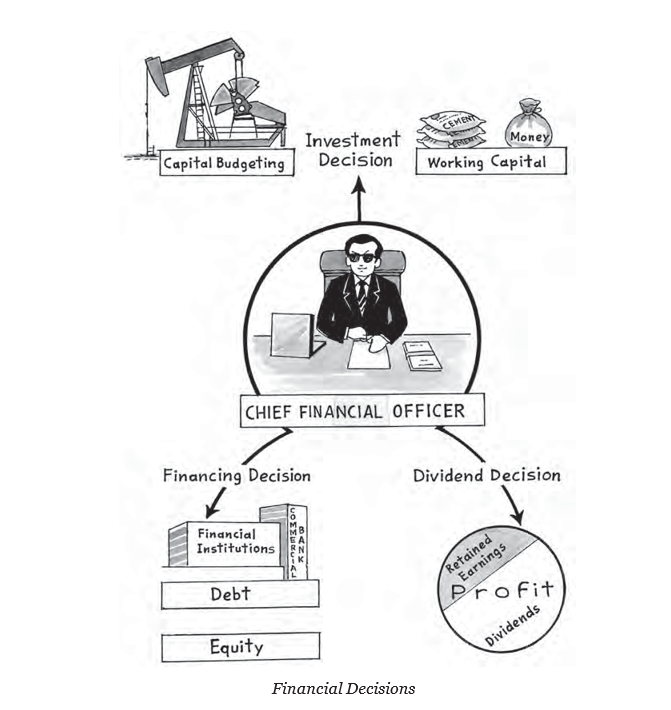
- Three broad decisions: Investment, financing and dividend decisions.
- Investment decision: Chooses how the firm’s funds are invested in different assets.
- Purpose: Allocate scarce resources to investments that can earn the highest possible return for investors.
Long-Term and Short-Term Investment Decisions
| Point | Long-term (Capital budgeting) | Short-term (Working capital) |
|---|---|---|
| Focus | Commit funds to assets on a long-term basis | Decide the levels of cash, inventory and receivables |
| Examples | Replace a machine, acquire a fixed asset or open a new branch | Manage cash, inventory and receivables |
| Effect | Affects long-run earning capacity, asset size, profitability and competitiveness | Affects day-to-day operations, liquidity and profitability |
| Key concern | Often involves large investments that are difficult or costly to reverse | Efficient cash, inventory and receivables management supports sound working capital |
Why Capital Budgeting Decisions Matter
- High stakes: These decisions often involve large sums and can be difficult or costly to reverse.
- Long-run impact: They influence the firm’s earning capacity, asset size, profitability and competitiveness.
- Careful judgment: A wrong decision can severely damage the firm’s financial position; decisions should be made by people who understand them thoroughly.
Factors Affecting Capital Budgeting Decisions
| Factor | What to assess | How it guides the decision |
|---|---|---|
| Cash flows of the project | Expected cash receipts and payments over the investment’s life | Carefully analyse their amounts before considering the project |
| Rate of return | Expected returns from each proposal and the risk involved | The most important criterion; with equal risk, a 12% return is normally preferred to a 10% return |
| Investment criteria involved | Investment amount, interest rate, cash flows and rate of return | Apply capital budgeting techniques to evaluate proposals before selecting a project |
Project Selection
- Several projects: Evaluate each proposal carefully and select or reject it according to expected returns.
- One project: Assess its viability using its rate of return and compare it with the industry average.
- Capital budgeting techniques: Use suitable techniques to assess investment proposals before making a selection.
Distinguish between capital budgeting and working capital decisions.
Name the three factors affecting capital budgeting decisions. Which is the most important?
Quick recap
- Financial management covers investment, financing and dividend decisions.
- Investment decisions determine how a firm allocates funds among assets to seek the highest possible return.
- Long-term investment decisions are capital budgeting; short-term decisions concern working capital.
- Capital budgeting affects long-run earning capacity, asset size, profitability and competitiveness, and may be costly to reverse.
- Evaluate proposals using project cash flows, rate of return—the most important criterion—and investment criteria.
Financing Decision
Meaning and Scope of Financing Decision
Factors Affecting Financing Decisions
- Financial risk
- Risk of defaulting on fixed debt payments, such as interest or principal repayment.
- Floatation cost
- The cost incurred in raising funds from a source.
- Cost of capital
- The overall cost of the funds used by the firm.
What is a financing decision, and what does it determine?
How do high fixed operating costs affect the financing choice?
Quick recap
- Financing decisions select the amount and sources of a firm’s long-term funds.
- Funds may come from shareholders’ funds or borrowed funds; the firm chooses a suitable mix.
- Debt requires fixed interest and principal payments, so greater debt increases financial risk.
- Compare sources by cost, risk and floatation cost; debt is often cheaper, partly because interest is tax-deductible.
- Cash flow strength, fixed operating costs and control concerns influence the preferred financing mix.
- Capital-market conditions affect how easily a firm can issue equity.
Dividend Decision
Meaning and Importance of the Dividend Decision
Why do companies with strong growth opportunities often pay smaller dividends?
State any four factors that affect the dividend decision.
Quick recap
- Dividend is the part of profit distributed to shareholders.
- The dividend decision balances shareholders’ current income with funds retained for future growth.
- Earnings, their stability, and available cash affect the company’s ability to pay.
- Growth needs, shareholder preferences, taxes, and expected share-price reactions influence payout choices.
- Capital-market access, legal rules, and loan terms can limit or shape dividend payments.
Financial Planning
Meaning and Purpose
- Meaning: Financial planning is the preparation of a financial blueprint for an organisation’s future operations.
- Purpose: It matches the firm’s fund requirements with the availability of funds to support smooth operations.
Objectives of Financial Planning
| Point | Financial planning | Financial management |
|---|---|---|
| Focus | Forecasts fund requirements and availability in light of financial decisions. | Chooses the best investment and financing alternatives by weighing costs and benefits. |
| Objective | Supports smooth operations by matching fund needs and availability. | Aims to increase shareholders’ wealth. |
| Relationship | It is an important planning process, but is not a substitute for financial management. | Makes investment and financing decisions for the business. |
Forecasting Fund Needs
- Changing operations: A decision such as expanding capital investment may increase the scale of operations, expenses and revenues.
- Forecast: Financial planning estimates which items are likely to change and the amount and timing of future fund needs.
- Prepare in advance: It anticipates possible fund shortages and surpluses so the business can respond before they arise.
Types and Time Periods
- Long-term planning: Covers long-term growth and investment, especially capital expenditure programmes.
- Short-term planning: Covers near-term financial needs, usually through budgets.
- Time period: Financial plans typically cover three to five years; plans for one year or less are generally called budgets.
Financial Planning Process
- Sales forecast: Financial planning usually begins by estimating sales for the planning period.
- Estimate requirements: Forecast financial statements and determine the funds needed for fixed and working capital.
- Identify funding: Estimate profits and retained earnings, determine external fund requirements, identify their sources, and prepare cash budgets.
Importance of Financial Planning
Planning for Alternative Sales Outcomes
- Forecast different possible sales outcomes (for example, growth of 10%, 20% or 30%).
- Estimate how expenses and other financial needs would differ in each situation.
- Prepare alternative financial plans so management can choose suitable actions for each outcome.
Debt and Financial Planning
State the two main objectives of financial planning.
How does financial planning help coordinate business functions?
Why should a business not rely only on a lender’s willingness to provide a loan?
Quick recap
- Financial planning estimates the funds a business needs, when it needs them and where they will come from.
- Its two objectives are timely availability of funds and avoiding unnecessary fundraising or idle surplus.
- Long-term plans focus on growth and capital expenditure; budgets cover detailed plans for one year or less.
- The process moves from sales forecasts to projected statements, profit estimates, external funding and cash budgets.
- Planning prepares a business for uncertainty, coordinates functions and links investment decisions with financing.
- Borrowing should reflect cash flow and industry volatility; loan approval alone does not show that debt is manageable.
Capital Structure
Meaning and Measurement
- Capital structure: The mix of owners’ funds and borrowed funds used to finance a business.
- Owners’ funds: Include equity and preference share capital, reserves and surplus, and retained earnings.
- Borrowed funds: Include loans, debentures and public deposits.
Debt, Equity and Financial Risk
- Debt: Borrowed funds require interest payments and repayment of principal, creating fixed financial obligations.
- Equity: Shareholders’ funds do not require fixed payments of returns or repayment of capital.
- Financial risk: The risk of failing to meet fixed payment obligations increases as a firm uses more debt.
Optimal Capital Structure and Financial Leverage
- Optimal capital structure: The debt–equity mix that maximises the value of the equity shares and shareholders’ wealth.
- Financial leverage: The proportion of debt in total capital; it may be expressed as Debt/Equity or Debt/(Debt + Equity).
- Balance: More debt can lower the cost of funds but increases financial risk, so the mix must balance risk and return.
EBIT–EPS Analysis and Trading on Equity
| Item | Situation I | Situation II | Situation III |
|---|---|---|---|
| EBIT | Rs. 4,00,000 | Rs. 4,00,000 | Rs. 4,00,000 |
| Interest | Nil | Rs. 1,00,000 | Rs. 2,00,000 |
| EBT | Rs. 4,00,000 | Rs. 3,00,000 | Rs. 2,00,000 |
| Tax | Rs. 1,20,000 | Rs. 90,000 | Rs. 60,000 |
| EAT | Rs. 2,80,000 | Rs. 2,10,000 | Rs. 1,40,000 |
| Number of Rs. 10 shares | 3,00,000 | 2,00,000 | 1,00,000 |
| EPS | Rs. 0.93 | Rs. 1.05 | Rs. 1.40 |
Why Company X’s EPS Rises
- RoI: , which is above the 10% interest rate.
- Result: Since the return earned on funds exceeds the cost of debt, greater borrowing increases EPS: Rs. 0.93 → Rs. 1.05 → Rs. 1.40.
- Conclusion: Company X has favourable financial leverage; using debt can enhance equity shareholders’ earnings.
| Item | Situation I | Situation II | Situation III |
|---|---|---|---|
| EBIT | Rs. 2,00,000 | Rs. 2,00,000 | Rs. 2,00,000 |
| Interest | Nil | Rs. 1,00,000 | Rs. 2,00,000 |
| EBT | Rs. 2,00,000 | Rs. 1,00,000 | Nil |
| Tax | Rs. 60,000 | Rs. 30,000 | Nil |
| EAT | Rs. 1,40,000 | Rs. 70,000 | Nil |
| Number of Rs. 10 shares | 3,00,000 | 2,00,000 | 1,00,000 |
| EPS | Rs. 0.47 | Rs. 0.35 | Nil |
Why Company Y’s EPS Falls
- RoI: , below the 10% cost of debt.
- Result: Borrowing reduces EPS: Rs. 0.47 → Rs. 0.35 → nil.
- Conclusion: Company Y has unfavourable financial leverage; trading on equity is inadvisable.
When is financial leverage favourable?
Why can increased debt be risky even when it raises EPS?
Do not assume that more debt always raises EPS: the effect depends on whether the firm’s RoI is above or below the cost of debt.
Quick recap
- Capital structure is the mix of owners’ funds and borrowed funds.
- Debt is usually cheaper than equity, but its compulsory payments increase financial risk.
- Financial leverage can be measured as or .
- Optimal capital structure maximises shareholders’ wealth by balancing risk and return.
- Trading on equity raises EPS when RoI exceeds the cost of debt; it can lower EPS when RoI is below that cost.
Factors Affecting the Choice of Capital Structure
Meaning of Capital Structure
- Capital structure: The financing pattern or mix of owners’ funds and borrowed funds used by a firm.
- Measurement: It may be expressed as the debt–equity ratio, Debt/Equity, or as debt’s share of total capital, Debt/(Debt + Equity).
Factors Affecting the Choice
Shows how many times earnings before interest and taxes cover the interest obligation.
Compares cash profits available with cash required for debt service and preference dividends.
Interest deductibility lowers the effective cost of debt. For example, with a 10% debt rate and a 30% tax rate, the after-tax cost is 7%.
Do not use ICR alone to judge debt capacity: it covers interest using EBIT, but does not indicate cash balances or cover principal repayment obligations.
How do ICR and DSCR differ?
When is trading on equity likely to increase EPS?
- Financial risk
- Risk of being unable to meet fixed financial charges, including interest, preference dividends and repayment obligations.
- Business risk
- Risk related to business operations; it rises with higher fixed operating costs.
- Trading on equity
- Using debt to increase returns to equity shareholders when RoI exceeds the cost of debt.
Quick recap
- Choose the debt-equity mix after assessing cash flows and fixed payment commitments.
- Higher ICR and DSCR generally indicate better capacity to meet financial obligations; DSCR also includes repayment commitments.
- Debt can raise EPS when RoI exceeds its cost, but may reduce EPS when RoI is lower.
- Tax benefits and a low debt rate make borrowing more attractive, while rising financial risk limits debt use.
- Keep borrowing capacity for flexibility; consider control, floatation costs and regulatory requirements.
- Market conditions and industry ratios inform financing choices, but industry norms should not be followed blindly.
Fixed and Working Capital
Meaning of Fixed and Current Assets
Fixed assets — Assets held for more than one year, usually for much longer, such as land, buildings, machinery, furniture and vehicles.
Current assets — Assets that normally convert into cash or cash equivalents within one year, such as inventory, debtors and bills receivable.
| Point | Fixed assets | Current assets |
|---|---|---|
| Time period | Remain in the business for more than one year | Normally convert into cash or cash equivalents within one year |
| Examples | Plant, machinery, land and buildings | Inventory, debtors and bills receivable |
Management of Fixed Capital
Fixed capital — Funds invested in a firm’s long-term assets.
Investment decisions
- Management means allocating capital among long-term assets and projects; these are also called investment or capital budgeting decisions.
- Scope includes acquiring, expanding, modernising and replacing assets; examples include buying machinery, starting a product line, or investing in new production techniques.
- Long-term spending on advertising campaigns or research and development can also be a capital budgeting decision when it has lasting business effects.
- Financing should come from long-term sources such as equity or preference shares, debentures, long-term loans and retained earnings. Fixed assets should not be financed with short-term sources.
Why Fixed-Capital Decisions Matter
- Long-term growth: Investment in long-term assets can generate future returns and shape the firm’s prospects.
- Large funds: A substantial share of capital may be committed to a project, so careful analysis of funding sources and interest costs is needed.
- Risk: Large fixed-asset investments affect the firm’s overall returns and long-term business risk.
- Irreversibility: Reversing a decision or abandoning a heavily funded project can cause heavy losses; evaluate details carefully before investing.
Factors Affecting Fixed-Capital Requirements
| Factor | Effect on fixed-capital need | Example or explanation |
|---|---|---|
| Nature of business | Manufacturing usually needs more than trading | Manufacturers need plant and machinery; traders generally do not. |
| Scale of operations | Larger scale increases the requirement | A large organisation needs bigger plants and more space. |
| Choice of technique | Capital-intensive methods increase the requirement; labour-intensive methods reduce it | Greater reliance on machinery requires more investment in fixed assets. |
| Technology upgradation | Faster obsolescence increases replacement needs | Computers become obsolete and need replacement sooner than furniture. |
| Growth prospects | Expected growth usually raises the requirement | A firm may build extra capacity in advance to meet anticipated demand. |
| Diversification | Adding new activities increases the requirement | A textile company starting cement production needs investment in new fixed assets. |
| Financing alternatives | Leasing can reduce funds needed for outright asset purchase | Lease rentals allow use of an asset without paying its full purchase cost upfront; this can suit high-risk businesses. |
| Level of collaboration | Sharing facilities reduces each firm’s investment | Businesses may jointly establish a facility or use another organisation’s ATM. |
- Capital budgeting
- Planning and evaluating investments in long-term assets or projects.
- Fixed capital
- Funds invested in long-term assets.
- Current assets
- Assets expected to convert into cash or cash equivalents within one year.
Why must fixed-capital decisions be evaluated carefully?
How can leasing and collaboration lower fixed-capital requirements?
Quick recap
- Fixed assets are long-term assets; current assets normally turn into cash within one year.
- Fixed capital is the investment in long-term assets, managed through capital budgeting decisions.
- Fixed assets should be financed with long-term sources, not short-term funds.
- Fixed-capital decisions affect growth, funds committed, business risk and the possibility of losses if reversed.
- Business type, scale, technique, technology, growth and diversification influence fixed-capital needs.
- Leasing and collaboration can reduce the amount each firm must invest in fixed assets.
Working Capital
Current Assets and Liquidity
Current assets — Assets expected to be converted into cash or cash equivalents within one year; they support the smooth day-to-day running of a business.
Key features
- Liquidity means how quickly an asset can be converted into cash without losing value.
- Returns on current assets are generally lower than returns on fixed assets.
- Liquidity and profitability must be balanced: too little investment in current assets can make it difficult to meet payment obligations.
| Order | Current asset |
|---|---|
| 1 | Cash in hand / cash at bank |
| 2 | Marketable securities |
| 3 | Bills receivable |
| 4 | Debtors |
| 5 | Finished goods inventory |
| 6 | Work in progress |
| 7 | Raw materials |
| 8 | Prepaid expenses |
Current Liabilities and Net Working Capital
Current liabilities — Payment obligations due within one year, such as bills payable, creditors, outstanding expenses and advances received from customers.
Net working capital (NWC) — The excess of current assets over current liabilities; it is the part of current assets financed through long-term sources.
Current assets are financed partly by current liabilities and partly by long-term sources; the excess financed by long-term sources is NWC.
Factors Affecting Working Capital Requirements
| Factor | Effect on working capital requirement |
|---|---|
| Nature of business | Manufacturing generally needs more than trading because raw materials must be processed before sale. Trading often sells goods quickly, while services usually need little or no inventory. |
| Scale of operations | A larger scale generally requires more inventory and debtors, so working capital needs are higher. |
| Business cycle | Boom: higher sales and production increase the requirement. Depression: lower activity reduces it. |
| Seasonal factors | Peak season raises activity and working capital needs; lean season lowers them. |
| Production cycle | A longer time from receiving raw materials to finished goods ties up funds for longer and increases the requirement. |
| Credit allowed | More liberal customer credit increases debtors and raises working capital needs; terms depend on competition and customers’ creditworthiness. |
| Credit availed | More credit received from suppliers reduces the firm's working capital requirement. |
| Operating efficiency | Efficient materials management and faster inventory, debtors and finished-goods turnover reduce funds tied up and lower the requirement. |
| Availability of raw materials | Reliable, continuous supply allows lower stocks. Uncertain supply or longer lead time requires more stock and working capital. |
| Growth prospects | Higher expected growth requires more working capital to support increased production and sales. |
| Level of competition | Strong competition may require larger finished-goods stocks for urgent orders and more liberal customer credit, increasing the requirement. |
| Inflation | Rising prices increase the funds needed to maintain production and sales. The increase varies by component and its share of total working capital. |
- Lead time
- Time between placing an order for materials and receiving them.
- Production cycle
- Time between receipt of raw materials and their conversion into finished goods.
- Inventory turnover
- A measure of how efficiently inventory is used and replaced; higher turnover can reduce funds tied up in stock.
- Debtors turnover
- A measure of how efficiently amounts due from customers are collected; better turnover can reduce funds tied up in receivables.
Do not assume that a 5% inflation rate raises every working-capital component by 5%; changes depend on each component’s price movement and its share of the total requirement.
Define net working capital and give its formula.
How do credit allowed and credit availed affect working capital?
Quick recap
- Current assets are expected to turn into cash within one year; greater liquidity generally means faster conversion without loss of value.
- Current assets offer liquidity but generally lower returns than fixed assets, so firms balance liquidity with profitability.
- Current liabilities are due within one year; net working capital is the excess of current assets over current liabilities.
- Manufacturing, large-scale, boom-period, peak-season and long-cycle operations generally require more working capital.
- Customer credit allowed raises working capital needs; supplier credit availed reduces them.
- Efficiency, reliable materials supply and shorter lead times can reduce working capital tied up in operations.
- Growth, competition and inflation can raise working capital needs, though inflation affects components by different amounts.
Key Terms and Summary
- Financial management
- Optimal procurement and effective use of a business’s finance.
- Wealth maximisation
- The primary objective of financial management: maximising shareholders’ wealth.
- Financial planning
- Preparing a financial blueprint for an organisation’s future operations.
- Capital structure
- The mix of owners’ funds and borrowed funds used to finance a business.
- Capital budgeting
- Decisions about allocating funds to long-term assets or projects.
- Working capital
- Funds invested in current assets to support day-to-day business operations.
Business Finance and Financial Management
Business finance — Money needed to establish, operate, modernise, expand or diversify a business.
Financial Management
- Procurement: Identify available sources of finance and compare their costs and associated risks.
- Usage: Apply the funds effectively to meet the organisation’s needs.
Objectives and Financial Decisions
Three Basic Financial Decisions
- Investment decision: Select how to allocate funds among assets and projects.
- Financing decision: Decide the sources and mix of funds used to finance the business.
- Dividend decision: Decide how much profit to distribute to shareholders and how much to retain.
Objective and Related Terms
- Wealth maximisation: The primary aim; the market price of the company’s shares is linked to its financial decisions.
- Trading on equity: Using borrowed funds with a fixed cost in an effort to increase returns to equity shareholders.
Financial Planning and Its Importance
- Purpose: Ensure sufficient funds are available at the right time for future operations.
- Availability: Make funds available whenever they are required.
- Economy: Avoid raising resources unnecessarily.
- Importance: Helps the business handle uncertainty about fund availability and timing, supporting smooth operations.
Capital Structure
Capital structure — The proportionate mix of owners’ funds and borrowed funds used to raise a firm’s finance.
Factors Affecting Capital Structure
- Cash flow and debt capacity: Cash flow position, Interest Coverage Ratio (ICR) and Debt Service Coverage Ratio (DSCR).
- Returns and costs: Return on Investment (RoI), cost of debt, tax rate, cost of equity and flotation costs.
- Risk and choice: Risk considerations, flexibility and control.
- External conditions: Regulatory framework, stock market conditions and the capital structure of other companies.
Fixed Capital and Working Capital
| Point | Fixed capital | Working capital |
|---|---|---|
| Investment | Funds invested in long-term assets. | Funds invested in current assets. |
| Purpose | Supports long-term business needs; allocation to long-term assets or projects is an investment (capital budgeting) decision. | Supports smooth, day-to-day business operations. |
| Asset characteristics | Long-term assets influence long-run growth, profitability and risk. | Current assets are usually more liquid but contribute less to profits than fixed assets. |
Factors Affecting Fixed Capital Requirement
- Business and production: Nature of business, scale of operations and choice of technique.
- Change and growth: Technology upgradation, growth prospects and diversification.
- Funding and cooperation: Financing alternatives and level of collaboration.
Factors Affecting Working Capital Requirement
- Business conditions: Nature of business, scale of operations, business cycle and seasonal factors.
- Production and credit: Production cycle, credit allowed to customers and credit availed from suppliers.
- Operations and supply: Operating efficiency and availability of raw materials.
- Market and growth: Growth prospects, level of competition and rate of inflation.
What are the two objectives of financial planning?
What is capital structure?
How do fixed and working capital differ?
Quick recap
- Financial management focuses on obtaining finance optimally and using it effectively.
- Its primary objective is to maximise shareholders’ wealth through sound investment, financing and dividend decisions.
- Financial planning aims to provide funds on time while avoiding unnecessary fundraising.
- Capital structure is the mix of owners’ and borrowed funds; its choice depends on financial, risk and external factors.
- Fixed capital funds long-term assets; investment in them is addressed through capital budgeting decisions.
- Working capital funds current assets and supports smooth day-to-day operations.