Class 12 Commerce . Business Studies . Business Studies Part II . Consumer Protection
Chapter 11: Consumer Protection
Ch 11
Business Studies
Class 12 Commerce
Introduction
ATM Service Case
Consumer Forum decision
- Complaint: On May 4, 2017, a consumer filed a petition after three ATM withdrawals failed because the machines had no cash; photos and video recordings were submitted as evidence.
- Bank's argument: The bank claimed that ATM internet connectivity meant the user was not directly its client during the transaction.
- Decision: The forum rejected this argument and held that non-availability of cash could amount to a deficiency in banking service.
- Award: The bank was ordered to pay Rs. 2,500: Rs. 1,500 for mental harassment and Rs. 1,000 for legal expenses.
Consumer Protection: Meaning and Context
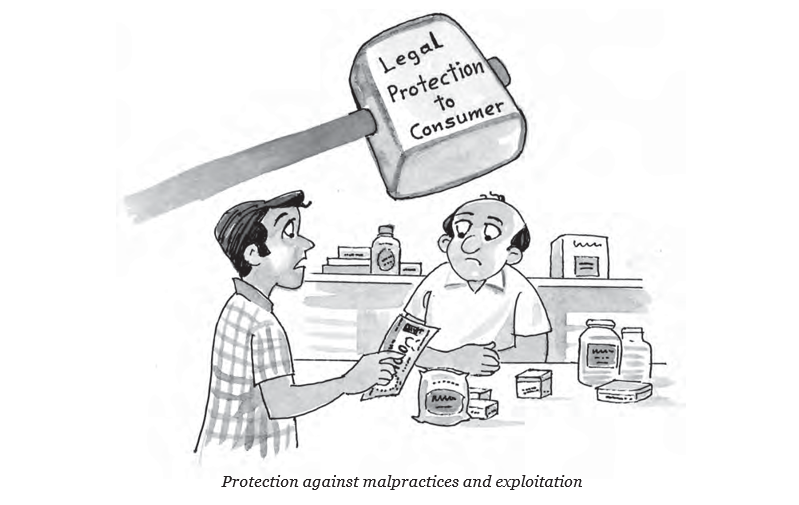
Consumer protection — Measures that safeguard consumers’ interests from unfair business practices and help provide swift redressal of their grievances.
Why consumer protection matters
- Consumer role: Everyone is a consumer of goods or services and needs to be informed about their rights.
- Consumer Protection Act, 2019: Replaced the 1986 Act and widened the framework for addressing consumer concerns.
- Risk of weak protection: Competition and the drive to increase sales may encourage businesses to use exploitative or unfair practices.
- Possible harm: Consumers may face unsafe or adulterated goods, misleading claims, spurious products, overpricing, hoarding or black-marketing.
- Market shift: The older seller-focused idea of caveat emptor (“let the buyer beware”) has shifted towards caveat venditor (“let the seller beware”).
- Consumer's position: Consumers are often described as “king” in a free-market economy; the law provides legal protection for their interests.
Key Consumer Protection Dates
- May 4, 2017A consumer petition was filed over three failed ATM transactions caused by lack of cash.
- 2019The Consumer Protection Act, 2019 replaced the Consumer Protection Act, 1986.
Importance of Consumer Protection
Practices consumers need protection from
- Adulterated goods: Products mixed with inferior or harmful substances.
- Counterfeit goods: Products of lesser value sold in place of the real product; duplicate goods are also listed as a separate unfair practice.
- Sub-standard and defective goods: Products that fail prescribed quality standards or do not work properly.
- Faulty weights and measures: Devices or practices that give consumers less than the quantity paid for.
- Hoarding and black-marketing: Restricting supply can create scarcity and raise prices.
- Overcharging: Charging more than a product’s Maximum Retail Price (MRP).
- Misleading advertisements: False claims that exaggerate a product’s or service’s quality, grade or standard.
- Inferior services: Service quality falls below the conditions agreed with the consumer.
Need for Consumer Protection
Protection aims to ensure
- Physical safety: Protection from unsafe products and related injury or health risks.
- Access to information: Consumers can make informed choices about goods and services.
- Corporate social responsibility: Businesses provide goods of fair quality and quantity at fair prices.
- Consumer satisfaction: Products and services meet consumers’ needs and expectations.
- Social justice and trusteeship: Business resources and decisions should serve society fairly.
- Business survival and growth: Fair treatment supports lasting customer relationships and sustainable business.
How protection is achieved
- Consumer awareness: Educate consumers about their rights and responsibilities.
- Grievance redressal: Provide ways to resolve consumer complaints.
- Collective action: Consumers can unite in associations to protect and promote their interests.
- Shared responsibility: Effective protection needs both a judicial system and active, informed consumers.
Importance from the Consumer’s Point of View
Three reasons consumers need protection
- Consumer ignorance: Many consumers do not know their rights or available remedies; education helps build awareness.
- Unorganised consumers: Consumer organisations can represent and promote consumers’ interests. Protection remains necessary until these groups become strong enough.
- Widespread exploitation: Consumers need safeguards against unsafe or defective goods, adulteration, misleading advertising, hoarding and black-marketing.
Importance from the Business Point of View
| Reason | Business relevance |
|---|---|
| Long-term interest | Satisfied customers return, recommend the business and help expand its customer base; customer satisfaction supports long-term profit. |
| Use of society’s resources | Businesses use resources belonging to society, so they should supply goods and services that serve the public interest and maintain public confidence. |
| Social responsibility | Consumers are important stakeholders whose interests businesses must consider alongside those of other groups. |
| Moral justification | It is a business’s moral duty to avoid exploiting consumers through unsafe or defective products, adulteration, misleading advertising, hoarding or black-marketing. |
| Avoiding government intervention | Unfair trade practices may invite government action and damage a company’s image; voluntary fair practices help protect both consumers and the business. |
- Caveat emptor
- “Let the buyer beware” — the traditional seller-market approach.
- Caveat venditor
- “Let the seller beware” — the consumer-market approach that places responsibility on sellers.
- Adulterated goods
- Goods mixed with inferior or harmful substances.
- Consumer redressal
- Processes for resolving consumer grievances and providing remedies.
State three reasons why consumer protection is important from the consumer’s point of view.
Give three reasons why consumer protection is in a business’s interest.
Quick recap
- Consumer protection safeguards consumers from unfair practices and supports speedy grievance redressal.
- The Consumer Protection Act, 2019 replaced the 1986 Act and widened the response to consumer concerns.
- Consumers need protection from unsafe, defective, adulterated, counterfeit and overpriced goods, as well as misleading advertising and inferior services.
- Consumer protection promotes safety, information, fair prices, satisfaction, social justice and business growth.
- Consumer ignorance, disorganisation and widespread exploitation make protection necessary.
- Businesses benefit through customer loyalty and public confidence, and avoid moral failures, government action and reputational harm.
The Consumer Protection Act, 2019
Purpose and Scope of the Act
Consumer Protection Act, 2019 — A law that protects and promotes consumers’ interests through speedy, inexpensive redressal of grievances.
Coverage
- Territory: Extends to the whole of India.
- Businesses: Applies to all types of businesses, including manufacturers, traders and e-commerce firms.
- Transactions: Covers the supply of goods and provision of services.
Purpose of consumer protection
- Consumer interests and rights need protection.
- The Act provides a route for grievances to be heard.
- Speedy, inexpensive redressal helps protect consumers from exploitation.
Who Is a Consumer?
Consumer — A person who buys goods or avails services for consideration, whether paid, promised, partly paid and partly promised, or payable under a deferred-payment scheme.
Who is included or excluded?
- Included users: A user of the goods or beneficiary of the service is covered if using it with the buyer’s approval.
- Transaction channels: Covers offline and online purchases, electronic transactions, teleshopping, direct selling and multilevel marketing.
- Excluded: A person obtaining goods or services for resale or a commercial purpose is not treated as a consumer.
| Point | Consumer | Not a consumer under the Act |
|---|---|---|
| Purpose of purchase | Personal use or use with the buyer’s approval | Resale or commercial purpose |
| Consideration | Paid, promised, partly paid and partly promised, or deferred | Not covered if goods or services are obtained for resale or commercial purpose |
Important Terms and Definitions
- Complaint
- A written allegation seeking relief for matters such as restrictive trade practices, defects, service deficiencies, overcharging, or goods or services dangerous to life and safety.
- Complainant
- May be one or more consumers, a voluntary consumer association, Central or State Government, the Central Authority, a legal heir or representative, or a parent or representative of a minor.
- Defect
- A fault, imperfection, shortcoming or inadequacy in the quality, nature or manner of performance of goods or a product.
- Deficiency
- A fault or inadequacy in a service; it includes negligence, an act or omission, or withholding relevant information that causes consumer loss or injury.
- Injury
- Harm illegally caused to a person’s body, mind or property.
- Product liability
- A manufacturer’s or seller’s responsibility to compensate for harm caused by a defective product or deficient service.
| Term | Meaning |
|---|---|
| Spurious goods | Goods falsely claimed to be genuine. |
| Unfair trade practice | A practice to promote the sale, use or supply of goods or services by falsely representing their quality, standard, quantity, composition, style or model. |
| Restrictive trade practice | A practice that manipulates prices or the flow of market supplies in a way that imposes an unjustified cost on consumers. |
| Product | An article, goods, substance, raw material or extended cycle of a product, in gaseous, liquid or solid form, with intrinsic value and capable of delivery as an assembled product or component, produced or manufactured for trade. It excludes human tissues, blood, blood products and organs. |
| Product seller | A person involved in business in importing, selling, distributing, leasing, installing, preparing, labelling, marketing, repairing, maintaining or otherwise placing a product for commercial use; the term also includes a service provider. |
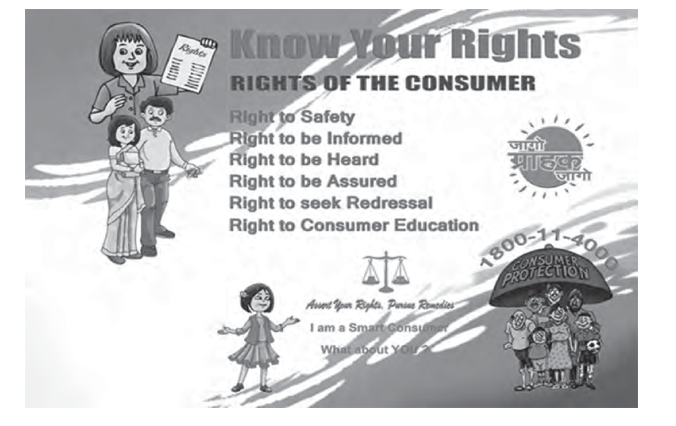
Six Consumer Rights
| Right | What it means | Example or application |
|---|---|---|
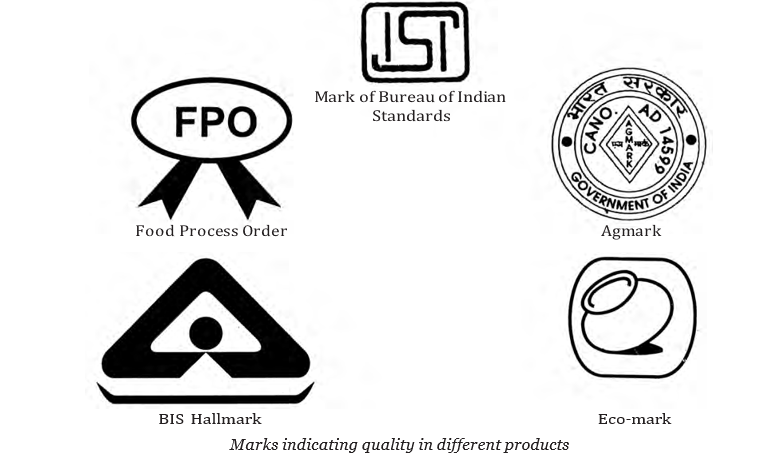
| Right to safety | Protection from goods and services hazardous to life, health or property. | Choose electrical appliances that meet safety standards; an ISI mark indicates conformity with quality specifications. |
| Right to be informed | Access to complete product information, including ingredients, date of manufacture, price, quantity and directions for use. | Manufacturers are required to provide relevant information on product packaging and labels. |
| Right to be assured | Freedom to access a variety of products at competitive prices and choose among them. | Marketers should offer choices across quality, brands, prices and sizes. |
| Right to be heard | The right to make a complaint and have it heard when dissatisfied with goods or services. | Businesses may set up consumer service and grievance cells; consumer organisations also assist. |
| Right to seek redressal | The right to relief from unfair or restrictive trade practices and unscrupulous exploitation when goods or services fall short of expectations. | Relief may include product replacement, removal of a defect, or compensation for loss or injury. |
| Right to consumer education | The right to gain knowledge and remain informed about consumer rights and available relief. | Consumer organisations and some businesses help educate consumers. |
Who is a consumer under the Consumer Protection Act, 2019?
State the six consumer rights provided under the Act.
What relief may a consumer receive when a product falls short of expectations?
Quick recap
- The Consumer Protection Act, 2019 applies throughout India to businesses supplying goods or services, including e-commerce firms.
- Consumers buy or avail goods or services for consideration; approved users and beneficiaries are included, but resale or commercial-purpose buyers are excluded.
- A complaint is a written allegation seeking relief; defects relate to goods, while deficiencies relate to services.
- Unfair trade practices rely on false representations; restrictive trade practices manipulate prices or supply to impose unjustified costs.
- The six rights are safety, information, assurance, being heard, redressal and consumer education.
- Redressal can include replacement, defect removal and compensation for loss or injury.
Consumer Responsibilities
Consumer responsibility — The duties consumers should fulfil while choosing, purchasing, using and consuming goods and services.
Why consumer responsibilities matter
- Legal protection: The Consumer Protection Act empowers consumers to fight unscrupulous, exploitative, unfair and restrictive trade practices by sellers.
- Shared responsibility: Consumer rights alone cannot achieve effective protection; consumers must understand and fulfil their responsibilities.
Responsibilities of Consumers
| Responsibility | What the consumer should do |
|---|---|
| Be informed | Know the goods and services available so you can make an intelligent, wise choice. |
| Choose standardised goods | Look for quality marks such as ISI on electrical goods, FPO on food products and Hallmark on jewellery. |
| Use products safely | Understand product risks, follow the manufacturer's instructions and use goods safely. |
| Read labels | Check details such as price, net weight, and manufacturing and expiry dates. |
| Assert yourself | Speak up to ensure you receive a fair deal. |
| Deal honestly | Choose legal goods and services; do not support black-marketing, hoarding or other unscrupulous practices. |
| Ask for proof of purchase | Obtain a cash memo for goods or services as evidence of the transaction. |
| Complain when necessary | Approach the appropriate consumer forum about poor-quality goods or deficient services—even if the amount involved is small. |
| Form consumer societies | Help educate consumers and safeguard their interests through consumer societies. |
| Protect the environment | Avoid waste, littering and actions that contribute to pollution. |
Ways and Means of Consumer Protection
| Means | Role and examples |
|---|---|
| Self-regulation by business | Ethical firms serve customers fairly because it is in their long-term interest; many set up customer-service and grievance cells. |
| Business associations | Associations such as FICCI and CII set codes of conduct and guidelines for members dealing with customers. |
| Consumer awareness | Informed consumers can challenge unfair practices and use available reliefs. The Department of Consumer Affairs, Government of India, runs the Jago Grahak Jago campaign. |
| Consumer organisations | They educate consumers, protect their interests and can press businesses to avoid malpractices and exploitation. |
| Government | Government action includes consumer-protection laws, a national helpline and mechanisms for grievance redressal. |
Government protection in India
- National Consumer Helpline: The Government of India provides the toll-free number 1800114000 for consumer assistance.
- Consumer Protection Act, 2019: The Act provides for the Central Consumer Protection Authority (CCPA).
- CCPA: It deals with violations of consumer rights, unfair trade practices and false or misleading advertisements prejudicial to consumers' interests.
- Grievance redressal: Consumer disputes are handled through a three-tier machinery at the district, state and national levels.
- Cash memo
- Proof of purchase for goods or services.
- Grievance cell
- A business unit set up to address customers' problems and complaints.
- CCPA
- Central Consumer Protection Authority; the authority provided for under the Consumer Protection Act, 2019.
- Consumer society
- An organisation that helps educate consumers and safeguard their interests.
Why should consumers ask for a cash memo?
Name the five main means of consumer protection.
What is the role of the CCPA under the Consumer Protection Act, 2019?
Quick recap
- The Consumer Protection Act empowers consumers to challenge unscrupulous, exploitative, unfair and restrictive trade practices.
- Consumers should choose standardised goods, check labels, understand risks and follow safe-use instructions.
- Deal honestly, seek fair treatment, keep a cash memo and complain about shortcomings—even when the amount is small.
- Consumer protection can come from ethical businesses, business associations, informed consumers, consumer organisations and government.
- The Consumer Protection Act, 2019 provides for the CCPA and a three-tier grievance-redressal system.
- The National Consumer Helpline number given in the lecture is 1800114000.
Redressal Agencies Under the Consumer Protection Act
Three-Tier Redressal Machinery
Consumer redressal machinery — The Consumer Protection Act, 2019 provides three levels of commissions to address consumer grievances: District, State and National.
| Commission | Value of consideration paid | Appeal from its order |
|---|---|---|
| District | Does not exceed Rs. 50 lakh | To the State Commission within 45 days; appeal may be on facts or law. |
| State | Exceeds Rs. 50 lakh but does not exceed Rs. 2 crore | To the National Commission within 30 days. |
| National | Exceeds Rs. 2 crore | To the Supreme Court of India within 30 days. |
District Commission: Procedure
- Mediation: If settlement seems possible, the Commission may ask parties to consent to mediation within five days. With written consent, it refers the dispute for mediation.
- Unsuccessful mediation: If mediation fails, the Commission continues hearing the complaint.
- Defective goods: If testing or analysis is needed, it obtains and seals a sample, then sends it to the appropriate authority.
- Service disputes: It considers the complainant’s evidence and may require relevant information, documents or records from the service provider.
State and National Commissions
- State Commission: Established by the respective State Government and ordinarily functions at the state capital.
- National Commission: Has territorial jurisdiction over the whole country.
Reliefs Available to Consumers
Orders a Commission May Issue
- Repair or remedy: Direct removal of a defect in goods or deficiency in service.
- Replacement or refund: Replace defective goods with defect-free goods, or refund the price or service charges.
- Compensation: Award reasonable compensation for loss or injury caused by the opposite party’s negligence, and compensation under product liability.
- Punitive damages: Award punitive damages where appropriate.
- Unfair practices: Order discontinuance of unfair or restrictive trade practices and prevent their repetition.
- Hazardous goods or services: Prohibit sale, order withdrawal from sale, stop manufacture of hazardous goods, or prevent offering hazardous services.
- Finality: A Commission’s order is final if none of the parties appeals it.
- Appeal ladder: District → State → National → Supreme Court of India.
Consumer Organisations and NGOs
Non-governmental organisation (NGO) — A non-profit organisation that works to promote people’s welfare, has its own constitution and operates independently of government interference.
Functions of Consumer Organisations and NGOs
- Educate: Explain consumer rights through training programmes, seminars and workshops.
- Publish: Share information on consumer problems, legal decisions, available reliefs and related matters.
- Test products: Compare competing brands in accredited laboratories and publish results.
- Promote action: Encourage consumers to oppose exploitative, unscrupulous and unfair trade practices.
- Provide legal help: Offer legal assistance and advice to consumers seeking remedies.
- Represent consumers: File complaints in consumer courts on consumers’ behalf.
- Act for the public: Initiate consumer-court cases in the general public interest, not only for an individual.
Example
- Consumer Unity and Trust Society (CUTS): A consumer organisation based in Jaipur.
What is the pecuniary jurisdiction of the three consumer commissions?
State four kinds of relief a consumer commission may order.
How do consumer organisations protect consumer interests?
Quick recap
- The 2019 Act establishes District, State and National consumer commissions.
- Under the 2021 Rules, jurisdiction depends on the value of consideration paid.
- Appeals proceed upward: District to State, State to National, and National to the Supreme Court.
- District Commission may use mediation, test goods, and seek records in service disputes.
- Commissions can order repairs, replacement, refunds, compensation and action against unfair or hazardous practices.
- Consumer organisations and NGOs educate, assist and represent consumers; CUTS is based in Jaipur.
Key Terms and Summary
Key Terms
- Consumer protection
- Measures that safeguard consumers from exploitation and help protect their interests.
- Redressal mechanism
- The system through which consumers can seek a remedy for grievances or loss.
- Consumer rights
- Legal entitlements that protect consumers when they buy or use goods and services.
- Consumer responsibilities
- The duties consumers should observe while purchasing, using and consuming goods and services.
- Mediation
- A way of resolving a dispute with the help of a neutral third party.
Importance of Consumer Protection
| Point | Consumers | Business |
|---|---|---|
| Why protection matters | Consumers may be ignorant, unorganised and exploited by sellers. | It is in the long-term interest of business. |
| Wider responsibility | Protection helps safeguard consumer interests. | Business uses society’s resources and has a social responsibility. |
| Justification and outcomes | Protection can help consumers avoid exploitation. | It has moral justification and helps avoid government intervention in business functioning. |
Legal Protection to Consumers
Key Indian Legislation
- Consumer Protection Act, 1986
- Indian Contract Act, 1872
- Sale of Goods Act, 1930
- Essential Commodities Act, 1955
- Agricultural Produce (Grading and Marking) Act, 1937
- Prevention of Food Adulteration Act, 1954
- Standards of Weights and Measures Act, 1976
- Trade Marks Act, 1999
- Competition Act, 2002
- Bureau of Indian Standards Act, 1986
Consumer Rights
Six Rights under the Consumer Protection Act, 1986
- Right to safety
- Right to be informed
- Right to choose
- Right to be heard
- Right to seek redressal
- Right to consumer education
Consumer Responsibilities
Consumer responsibilities — Consumers should keep their responsibilities in mind while purchasing, using and consuming goods and services, alongside exercising their rights.
Ways and Means of Consumer Protection
- Self-regulation by business
- Business associations
- Consumer awareness
- Consumer organisations
- Government
Redressal Agencies under the Consumer Protection Act
Three-tier redressal machinery — The Consumer Protection Act provides consumer dispute agencies at District, State and National levels.
| Level | Agency named in the Act |
|---|---|
| District | District Forum |
| State | State Commission |
| National | National Commission |
Possible Reliefs
- Remove the defect in goods.
- Replace a defective product.
- Refund the price paid.
- Pay compensation for the loss suffered.
Consumer Organisations and NGOs
- Role: Consumer organisations and non-governmental organisations (NGOs) actively help protect and promote consumers’ interests in India.
Quick recap
- Consumer protection matters because consumers may be ignorant, unorganised and exploited; it also benefits business in the long term.
- Several Indian laws provide consumer protection, including the Consumer Protection Act, 1986.
- The six consumer rights are safety, information, choice, being heard, redressal and consumer education.
- Consumer protection can be advanced by business, associations, awareness, consumer organisations and government.
- The Act provides District, State and National redressal agencies, which may order remedies such as repair, replacement, refund or compensation.
- Consumer organisations and NGOs help protect and promote consumer interests.