Class 12 Commerce . Business Studies . Business Studies Part I . Nature and Significance of Management
Chapter 1: NATURE AND SIGNIFICANCE OF MANAGEMENT
Ch 1
Business Studies
Class 12 Commerce
Introduction to Management: Based on “Management at Tata Steel”
Management in Practice: Tata Group
What the Tata example shows
- Effective management helps large enterprises operate, grow and remain profitable through coordination at all levels.
- Values and trust guide Tata companies; the Tata Code of Conduct expresses their business principles.
- Worker welfare: Tata provided workers gratuity and provident-fund benefits before these became mandatory.
- Stakeholder responsibility includes balancing economic prosperity, environmental care and community benefits.
- Social initiatives include community programmes and protecting children’s rights.
- Environmental responsibility includes reducing carbon emissions and developing high-performance steel for fuel-efficient vehicles and energy-efficient buildings.
- ISO 14001: Tata Steel’s Environmental Management Systems meet ISO 14001 standards at all its main manufacturing sites.
Management Is Needed in Every Organisation
Organisations and common goals
- Organisation: people working together to achieve shared goals; examples include schools, hospitals, shops and corporations.
- Universal need: management is required in small or large, profit or non-profit, service or manufacturing organisations.
- Purpose: management helps individuals make their best contribution towards group objectives.
- Deliberate process: successful organisations achieve goals through planned management, not by chance.
Management in Namchi Designer Candles
Smita Rai’s example
- Enterprise: Smita Rai developed her candle-making skill into Namchi Designer Candles, creating work for local women.
- Management work: she plans a Diwali collection, arranges funds and recruits workers, communicates with suppliers to meet delivery deadlines, and seeks customer feedback.
- Key idea: a manager’s day includes several connected activities directed towards the organisation’s goals.
Definitions of Management
Management — A process of working with people and coordinating resources and activities to achieve organisational objectives effectively and efficiently.
| Author | Main emphasis |
|---|---|
| Harold Koontz and Heinz Weihrich | Create and maintain an environment where people in groups efficiently achieve selected aims. |
| Robert L. Trewelly and M. Gene Newport | Plan, organise, actuate and control operations, coordinating human and material resources to attain objectives effectively and efficiently. |
| Kreitner | Work with and through others to achieve organisational objectives efficiently, using limited resources in a changing environment. |
Core points from the definitions
- Process: management consists of a series of related functions performed by managers.
- Group effort: managers work with and through people to direct individual contributions towards common objectives.
- Resources: management coordinates human and material resources, including when resources are limited.
- Changing conditions: management operates in an environment that can change.
- Different levels: all managers perform management functions, but the time they give to each function varies; top-level managers spend more time planning and organising.
Why is management necessary in all kinds of organisations?
How does Smita’s work illustrate management as a process?
Quick recap
- Management is a deliberate process for achieving organisational goals.
- It is needed in all kinds and sizes of organisations.
- Managers work with people and coordinate human and material resources.
- Management functions are connected, though managers at different levels allocate time differently.
- Tata’s example highlights coordination, trust, worker welfare and responsibility to stakeholders.
- Tata Steel’s main manufacturing sites meet ISO 14001 environmental-management standards.
- Smita’s candle enterprise illustrates management activities in everyday work.
Concept of Management: Effectiveness & Efficiency
Meaning of Management
Management — Management is the process of getting things done to achieve organisational goals effectively and efficiently.
Management as a Process
- Common objective: Management guides people performing different tasks towards a shared organisational goal.
- Process: It involves the primary functions of planning, organising, staffing, directing and controlling.
- Two aims: Complete tasks and achieve goals while using resources carefully and keeping costs low.
Effectiveness and Efficiency
Effectiveness — Effectiveness means completing the assigned task and achieving the intended goal; it focuses on the end result.
Efficiency — Efficiency means doing a task correctly with minimum resources and cost, by making good use of inputs to produce outputs.
Efficiency: Inputs and Outputs
- Inputs: Money, materials, equipment and people required to perform a task.
- Efficiency rises: When fewer resources are used for the same output, or greater benefits are obtained from the same inputs.
- Why it matters: Efficient resource use reduces costs and can ultimately increase profits.
| Point | Effectiveness | Efficiency |
|---|---|---|
| Main concern | Achieving the goal or completing the task | Using resources correctly and minimising cost |
| Focus | End result | Relationship between inputs and outputs |
| Key question | Was the target achieved? | Was it achieved with minimum resources and cost? |
Balancing Effectiveness and Efficiency
Why Both Matter
- Interrelated aims: Effectiveness and efficiency are different but connected; both are needed for good management.
- Balance: Managers should achieve goals while using as few resources as possible, without allowing cost-cutting to prevent goal achievement.
- Efficiency alone is insufficient: High efficiency is usually associated with high effectiveness, but undue emphasis on efficiency without achieving goals is undesirable.
- Poor management: It is due to both inefficiency and ineffectiveness.
| Situation | Assessment | Reason |
|---|---|---|
| A company produces its target of 5,000 units, but power failures require double shifts and raise labour and electricity costs. | Effective, but not sufficiently efficient | The target is achieved, but more inputs and higher costs are used for the output. |
| A business cuts resource use but fails to produce its target; goods do not reach the market and demand declines as competitors enter. | Efficient, but ineffective | Costs are controlled, but the production goal and market need are not met. |
Distinguish between effectiveness and efficiency.
Why must management balance effectiveness and efficiency?
Quick recap
- Management guides people’s efforts towards common organisational goals.
- Management is a process involving planning, organising, staffing, directing and controlling.
- Effectiveness means completing tasks and achieving goals; it focuses on results.
- Efficiency means performing tasks correctly while minimising resource use and costs.
- Good management balances effectiveness with efficiency; neither alone is sufficient.
- Poor management is due to both inefficiency and ineffectiveness.
Characteristics of Management
Management Is a Goal-Oriented Process
- Common goals: Management unites individual efforts to achieve an organisation’s clearly stated objectives.
- Different aims: A retail store may seek to increase sales, while the Spastics Society of India aims to educate children with special needs.
Management Is All-Pervasive
- Universal activity: Management is required in all organisations, whether economic, social or political.
- Common work: Managers perform similar activities across countries, though their methods vary with culture, tradition and history.
Management Is Multidimensional
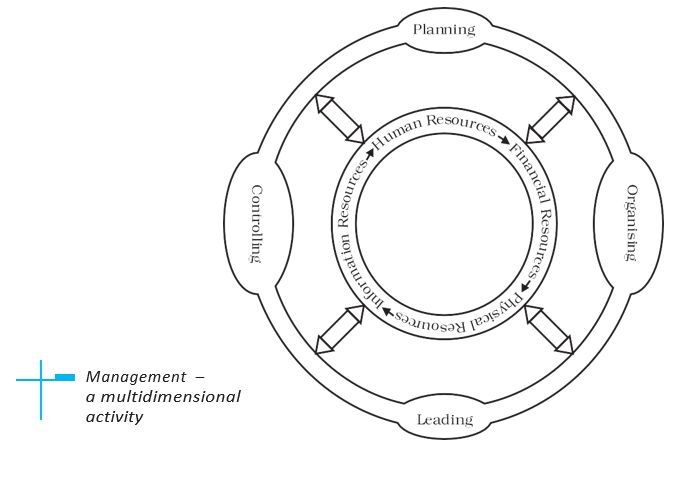
Management Is a Continuous Process
- Ongoing process: Management consists of related functions that continue as the organisation operates.
- Simultaneous functions: Managers perform planning, organising, staffing, directing and controlling continuously; the time spent on each varies.
Management Is a Group Activity
- Shared effort: An organisation brings together people with different needs and purposes, who work towards a common organisational goal.
- Teamwork: Management aligns individual efforts and supports members’ growth as their needs and opportunities change.
Management Is a Dynamic Function
- Adaptability: Management adjusts the organisation and its goals to changes in the external environment.
- Changing conditions: Social, economic and political factors affect organisations; McDonald’s changed its menu to suit the Indian market.
Management Is an Intangible Force
- Invisible force: Management cannot be seen, but its presence is felt in the way an organisation functions.
- Evidence of management: Targets are met according to plans, employees are satisfied, and work is orderly rather than chaotic.
- Organisational results: These outcomes reveal the effect of effective management.
Quick recap
- Management unites organisational effort towards clear goals.
- Management is needed in all types of organisations, though practices can vary.
- Its three dimensions are management of work, people and operations.
- Planning, organising, staffing, directing and controlling form a continuous process.
- Management coordinates diverse members towards shared goals and supports their development.
- Management adapts to environmental changes and is recognised by its results.
Objectives & Importance of Management
Objectives of management — Objectives are the desired results of an activity, derived from the basic purpose of the business.
- Balance: Management must achieve the organisation’s different objectives effectively and efficiently.
- Classification: Objectives are organisational, social, and personal (individual).
Organisational Objectives
- Responsibility: Management sets and achieves objectives across business areas while considering shareholders, employees, customers, and government.
- Economic purpose: Use human and material resources to the greatest possible advantage.
- Main objectives: Survival, profit, and growth.
| Objective | Meaning and importance | Examples or indicators |
|---|---|---|
| Survival | The basic objective; the business must earn enough revenue to cover its costs. | Revenue covers costs. |
| Profit | Survival alone is insufficient. Profit covers costs and business risks and provides an incentive for continued successful operation. | Earning a surplus from business operations. |
| Growth | The business must use its growth potential to improve its long-term prospects and remain in the industry. | Higher sales, more employees or products, and increased capital investment. |
Social Objectives
Social objectives — The creation of benefits for society and the fulfilment of an organisation’s social obligations.
- Purpose: Create economic value consistently for different groups in society.
- Examples: Use environment-friendly production, provide employment to underprivileged groups, and support community facilities such as schools and healthcare.
ITC E-Choupal: Social Responsibility in Practice
- Initiative: ITC created E-Choupal to connect rural farmers with direct marketing and digital information.
- Market access: It reduces multiple intermediaries, wasteful handling, and unnecessary transaction costs.
- Information: Farmers receive real-time, customised knowledge to improve decisions and align farm output with market demand.
- Benefits: Better quality and productivity, improved price discovery, and greater farmer empowerment.
- Local support: The village lead farmer, or Choupal Sanchalak, helps farmers use the computer terminal.
- Smart Cards: They identify farmers for customised website information; online transactions are captured to reward farmers based on usage volume and value.
- Scale: E-Choupal is described as the single-largest information technology-based intervention by a corporate entity in rural India.
- Significance: It is a leading Harvard Business School case study on using modern technology for the benefit of rural communities.
Personal Objectives
Personal objectives — The individual goals employees seek to satisfy through their membership in an organisation.
- Different needs: Employees may seek competitive salaries and perks, peer recognition, or personal growth and development.
- Management’s role: Reconcile personal goals with organisational objectives to promote harmony within the organisation.
Importance of Management
| Importance | How management contributes |
|---|---|
| Achieves group goals | Gives individual efforts a common direction so they contribute to the organisation’s overall goals. |
| Increases efficiency | Improves productivity and reduces costs through better planning, organising, directing, staffing, and controlling. |
| Creates a dynamic organisation | Helps people adapt to a changing environment and overcome resistance to change, helping the organisation maintain its competitive edge. |
| Achieves personal objectives | Motivation and leadership help individuals meet personal goals while contributing to organisational objectives; they also build team spirit, cooperation, and commitment. |
| Develops society | By helping organisations meet the needs of different groups, management supports quality goods and services, employment, beneficial technology, and wider growth and development. |
What are the three economic objectives of an organisation?
How does E-Choupal demonstrate the fulfilment of social objectives?
State any three ways management is important.
Quick recap
- Management objectives are organisational, social, and personal.
- The core economic objectives are survival, profit, and growth.
- Social objectives include responsible production, inclusive employment, and community support.
- ITC’s E-Choupal connects farmers to direct markets and useful digital information; it is a major rural IT intervention and a Harvard Business School case study.
- Management aligns employees’ personal goals with organisational objectives.
- Management helps achieve group goals, improve efficiency, adapt to change, and support society.
Nature of Management: Art, Science and Profession
Nature of Management
- Historical roots: Organised activity dates back to ancient civilisations, while modern organisations developed more recently.
- Development: Management practices grew from experience in government and commerce as trade and organisations expanded.
- Modern study: Management has evolved through practical experience and theoretical study into a dynamic subject.
Management as an Art
| Feature | How management shows it |
|---|---|
| Theoretical knowledge | Managers study management principles and knowledge in areas such as marketing, finance and human resources. |
| Personalised application | Managers apply principles to specific situations using their own judgement and management style. |
| Practice and creativity | Experience, initiative, imagination and innovation help managers put principles into practice effectively. |
Successful Management as an Art
- Application: A manager uses learned principles skilfully in the realities of each situation.
- Development: Study, observation and experience help managers understand problems and develop suitable approaches.
- Performance: Managers share basic principles, but their ability to apply them creatively distinguishes more successful managers.
Management as a Science
| Feature | How management shows it |
|---|---|
| Systematised knowledge | Management has its own theories, principles, terms and concepts, and draws on Economics, Sociology, Psychology and Mathematics. |
| Observation and experimentation | Management principles have developed through repeated observation and experimentation in different organisations. |
| Universal validity | Management principles are not universally exact; they must be adjusted to the situation. |
Why Management Is an Inexact Science
- Human behaviour: Management deals with people, so results cannot be predicted or reproduced as precisely as in exact sciences.
- Adaptation: Principles offer standardised guidance, but managers must modify their application according to the situation.
- Examples: Scientific Management principles were developed by F.W. Taylor; Functional Management principles were developed by Henri Fayol.
- Use: Management principles support managerial training and development, even though their outcomes are not exact.
| Point | Art | Science |
|---|---|---|
| Focus | Personal, creative application of knowledge | Organised principles and knowledge |
| Role in management | Managers practise and apply knowledge skilfully | Principles guide managers’ decisions and practice |
| Relationship | Complements science | Complements art; neither excludes the other |
Management as a Profession
| Professional feature | How management compares |
|---|---|
| Well-defined body of knowledge | Largely present: management has systematic principles taught in colleges and institutes, supported by books and journals. |
| Restricted entry | Not met: anyone may be appointed or called a manager; a specific degree is not legally required, though training and qualifications are desirable. |
| Professional association | Partly present: associations such as AIMA (All India Management Association) exist, but membership is not compulsory and they lack statutory backing. |
| Ethical code of conduct | Partly present: some managers’ associations have codes, but they do not bind all managers through compulsory membership. |
| Service motive | Not fully met as a defining requirement: management pursues the organisation’s goals, which may include profit for a business or service for a hospital. Profit maximisation is not a fixed objective of management and is changing; efficient management can also serve society through good-quality products at reasonable prices. |
Management’s Professional Features and Social Role
- Education: Management is taught in institutions, including the Indian Institutes of Management (IIMs); entry to many programmes is through examinations.
- No mandatory licence: Unlike doctors or lawyers, managers do not need a specific professional degree to practise.
- Changing objectives: A business may seek profit, while a hospital may provide service; profit maximisation is not a fixed objective of management and is fast changing.
- Societal benefit: Effective management can serve society by providing good-quality products at reasonable prices.
Do not call management a fully developed profession: it has organised knowledge and some professional associations, but entry is not legally restricted and membership in associations is voluntary.
Why is management called an inexact science?
Why is management not considered a full-fledged profession?
How do art and science complement each other in management?
Quick recap
- Art: Managers apply knowledge personally, creatively and skilfully through practice.
- Science: Management has organised knowledge and principles developed through observation and experimentation.
- Inexactness: Human behaviour makes management outcomes difficult to predict or reproduce precisely.
- Application: Management principles guide decisions but must be adapted to particular situations.
- Profession: Management has some professional features, but unrestricted entry and voluntary associations mean it does not meet all criteria.
- Objectives: Management’s goals vary by organisation; profit maximisation is not a fixed objective and is changing.
- Relationship: Art and science complement each other in effective management.
Levels of Management and Functions of Management
Levels of Management
Levels of management — Positions in an organisation’s hierarchy, linked by authority and responsibility, that assign people different roles in completing tasks.
- Hierarchy: Each person is responsible for completing assigned tasks and has authority to make decisions within their role.
- Relationship: Authority and responsibility connect superiors with subordinates.
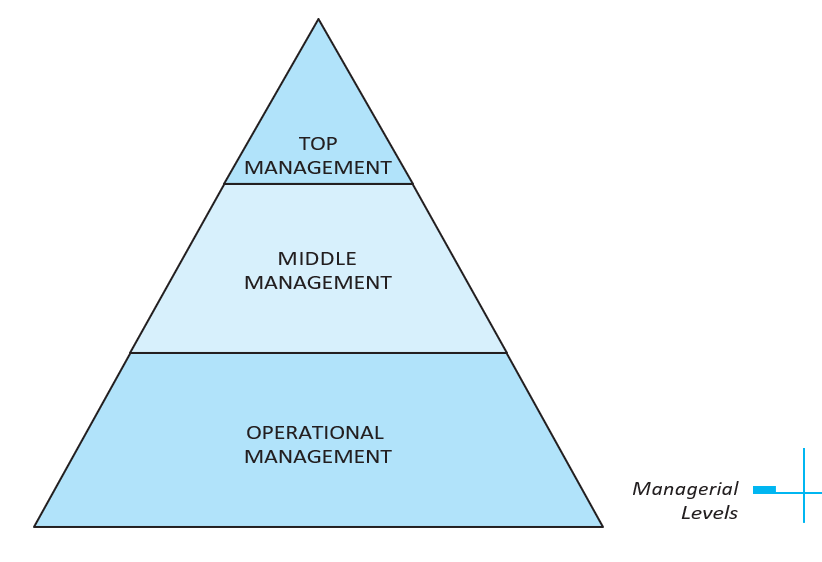
- Three levels: Organisations generally have top, middle, and supervisory (operational) management.
| Level | Who belongs | Main responsibilities |
|---|---|---|
| Top management | Senior executives: chairperson, CEO, COO, president, vice-president, and functional heads such as the CFO or vice-president (marketing). | Integrate and coordinate departments; analyse the business environment; set overall goals and strategies; take responsibility for the organisation’s welfare, survival, activities, and impact on society. The role is complex and demanding, requiring commitment. |
| Middle management | Division or department heads, such as a production manager; subordinate to top managers and superior to first-line managers. | Link top and lower management; interpret policies; implement and control plans; ensure staff are available; assign duties and responsibilities; motivate employees; coordinate with other departments; oversee first-line managers’ activities. |
| Supervisory or operational management | Foremen and supervisors. | Directly oversee workers and pass on middle-management instructions; help maintain output quality and safety, minimise material waste, and support efficient production. Workmanship and output also depend on workers’ hard work, discipline, and loyalty. |
Functions of Management
Management — The process of planning, organising, directing, and controlling organisational members’ efforts and using resources to achieve specific goals.
| Function | Meaning and key activities | Example or key point |
|---|---|---|
| Planning | Decide in advance what is to be done and who will do it; set goals and determine an efficient and effective way to achieve them. | For candle production, decide quantities, variety, and colours, then arrange resources and suppliers. Planning cannot prevent problems, but can anticipate them and prepare contingency plans. |
| Organising | Assign duties, group tasks, establish authority and reporting relationships, and allocate the resources needed to carry out a plan. | Determine what activities and resources are needed, who will do each task, and where and when it will be done. Group tasks into departments or work units. Suitable structures vary with the nature of the business and support efficient operations and effective results. |
| Staffing | The human resource function: ensure the right people, with suitable qualifications, are available in the right jobs, places, and times. Includes recruitment, selection, placement, and training. | A software company such as Infosys needs systems analysts and programmers. |
| Directing | Lead, influence, and motivate employees to perform assigned tasks; includes communication and supervision, as well as leadership and motivation. | Create an atmosphere that encourages employees to do their best. Motivation creates an environment in which employees want to work; effective praise and criticism can bring out their best performance. |
| Controlling | Monitor organisational performance towards goals; set standards, measure actual performance, compare it with standards, and take corrective action for deviations. | Identify critical activities and outputs, how and where to measure them, and who has authority to correct deviations. |
Leadership — Influencing others to do what the leader wants them to do.
Usual order of management functions
- Planning
- Organising
- Staffing
- Directing
- Controlling
How the functions work in practice
- Interrelated: Functions are usually presented in sequence, but managers rarely perform them in isolation; activities overlap and it may be difficult to identify where one ends and another begins.
Quick recap
- Authority and responsibility link people in an organisational hierarchy.
- The three management levels are top, middle, and supervisory (operational).
- Top management sets goals and strategies; middle management interprets and implements them; supervisors oversee workers.
- Planning sets goals and anticipates problems; organising assigns and groups work and resources.
- Staffing is the human resource function; directing leads and motivates employees; controlling measures performance and corrects deviations.
- Leadership means influencing others to do what the leader wants; management functions are interconnected and often overlap.
Coordination (Part 1): Meaning, Essence of Management
Meaning and Definitions of Coordination
- Meaning: Coordination is the orderly synchronisation of people’s efforts to pursue a common purpose.
- Unity of action: It aligns group efforts so tasks are carried out in a suitable amount, at the right time and with the required quality.
Coordination as the Essence of Management
- Binding force: Coordination brings harmony to individual efforts in pursuit of common organisational goals.
- Inherent role: It is not merely a separate managerial task; coordination is implicit throughout management.
Coordination Across Management Functions
Coordination Through the Management Process
- Planning for the whole organisation
- Organising and staffing according to the plans
- Directing employees to execute the plans
- Controlling actual work and correcting discrepancies
- Unity of action towards common objectives
- Coordination synchronises efforts so that different activities contribute to one common purpose.
- It is the essence of management because it runs through and connects every management function.
- Effective coordination aligns the amount, quality, timing and sequence of work.
Why is coordination called the essence of management?
How does coordination operate throughout the management process?
Quick recap
- Coordination synchronises individual and departmental efforts towards shared objectives.
- L. Bech, McFarland and Theo Haimann each emphasise orderly, harmonious group effort.
- Coordination connects the activities and functions of an interdependent organisation.
- It is the essence of management, not an isolated function.
- Coordination begins at planning and continues through organising, staffing, directing and controlling.
- It aligns the amount, quality, timing and sequence of work while minimising conflict.
Coordination (Part 2): Characteristics & Importance
Coordination — Coordination is the deliberate process of integrating the efforts of people and departments so they work together towards common organisational goals.
Characteristics of Coordination
- Integrates group efforts: Brings different interests and activities together, giving everyone a common focus and aligning work with plans.
- Ensures unity of action: Acts as a binding force between departments so their actions support shared organisational goals.
- Continuous process: Begins during planning and continues through organising, staffing, directing and controlling.
- All-pervasive function: Needed at every level and across departments because their activities depend on one another.
- Responsibility of all managers: Top, middle and operational managers coordinate with their respective teams and with other levels.
- Deliberate function: Managers consciously guide people’s efforts; cooperation without coordination may waste effort, while coordination without cooperation may cause dissatisfaction.
Coordination is the essence of management
- Not a separate function: Coordination is present in every management function and helps an organisation achieve its objectives effectively and efficiently.
- Example: Purchasing suitable fabric supports production; production aligned with market demand supports sales. Poor coordination can cause overlap, disorder and falling sales.

Importance of Coordination
- Why it is needed: People and departments depend on one another for information and resources, yet may differ in approach, timing, effort or interests.
- Main purpose: Reconcile these differences and harmonise individual goals with organisational goals.
Three reasons coordination is important
- Growth in size: More employees with different habits, backgrounds and goals → harder to integrate their work → coordination aligns individual efforts with organisational objectives.
- Functional differentiation: Departments develop distinct goals and working styles → isolated decisions can conflict (for example, marketing discounts may reduce finance revenue) → coordination links departmental activities to common goals.
- Specialisation: Specialists focus on their own professional criteria and may resist others’ advice → differences in approach and opinion can cause conflict → an independent coordinating effort reconciles these differences.
Dabbawallas: Excellence through Coordination
How the lunch-delivery network works
- Collection: A dabbawalla picks up a home-prepared tiffin and takes it to the nearest railway station.
- Sorting and transport: Tiffins are sorted by destination, loaded onto trains and carried to stations near their destinations.
- Final delivery: Another dabbawalla collects the tiffin at the destination station and delivers it to the customer’s office.
- Coordination at scale: Local distribution sectors, workers with detailed knowledge of their area, and groups network to complete the delivery chain.
What makes the system effective
- Simple resources: The service uses little technology and low capital, relying on bicycles, wooden carriages and local trains.
- Local expertise: Each sector has a worker familiar with its addresses; new employees learn under experienced seniors.
- Punctuality: Careful timing and coordinated hand-offs enable reliable deliveries, with delays avoided even by a few minutes.
- Recognition: The Dabbawalla service is described as a Six Sigma business enterprise.
Management in the Twenty-first Century
- Global context: Expanding international and intercultural links, supported by communication technology, make organisations increasingly global.
- Hard skills: Global managers still need analysis, strategy, engineering and technology skills.
- People skills: Success also depends on understanding teams, organisations and motivation.
- Cultural adaptability: Managers should adapt to different cultures and become productive across countries and work settings.
- Evolving role: Modern global management combines technical expertise, soft management and people skills, and the ability to learn from different cultural experiences.
- Unity of action
- The alignment of activities towards a common purpose.
- Functional differentiation
- Division of organisational work into departments, divisions and sections.
- Specialisation
- Concentrating expertise on particular tasks or professional areas.
- Global manager
- A manager able to combine technical and people skills while adapting to different cultures.
Why is coordination called the essence of management?
Explain how functional differentiation makes coordination necessary.
How do the Dabbawallas demonstrate coordination?
Quick recap
- Coordination integrates group efforts and ensures unity of action towards common goals.
- It is continuous, all-pervasive, deliberate and the responsibility of every manager.
- Coordination is essential because organisations grow, divide work into functions and employ specialists.
- The Dabbawallas show how a low-technology network can achieve reliable service through coordinated hand-offs.
- Global managers need technical expertise, people skills and cultural adaptability.
Key terms and Summary
- Management
- The process of planning, organising, staffing, directing and controlling resources to achieve organisational goals.
- Process
- A series of interrelated functions carried out to achieve a goal.
- Efficiency
- Doing a task correctly while using minimum cost.
- Effectiveness
- Doing the right task, completing activities and achieving goals.
- Art and science
- Management combines organised knowledge with the skillful application of that knowledge.
- Coordination
- Achieving unity of action among interdependent activities and departments.
Concept and Efficiency
Management — Management is the process of planning, organising, staffing, directing and controlling enterprise resources efficiently and effectively to achieve organisational goals.
| Point | Effectiveness | Efficiency |
|---|---|---|
| Focus | Doing the right task, completing activities and achieving goals | Doing the task correctly |
| Resource use | Completing activities and meeting objectives | Achieving results with minimum cost |
Characteristics of Management
- Goal-oriented: Management directs efforts towards organisational goals.
- All-pervasive: It is needed across organisations and at different levels.
- Multidimensional: It involves managing work, people and operations.
- Continuous: Its functions are performed on an ongoing basis.
- Group activity: It coordinates the efforts of people working together.
- Dynamic: It adapts to changes in the organisation’s environment.
- Tangible force: Management is described as a tangible force in an organisation.
Objectives and Importance
Objectives of Management
- Three objectives: Organisational, social and personal.
Importance of Management
- Group goals: Helps people work towards shared objectives.
- Efficiency: Improves the use of resources.
- Dynamic organisation: Helps the organisation respond to change.
- Personal objectives: Supports the achievement of individual goals.
- Society: Contributes to the development of society.
Nature of Management
| Point | Science | Art |
|---|---|---|
| Nature | An organised body of knowledge | Skillful application of knowledge |
| Management | Uses an organised body of knowledge | Requires skill in applying that knowledge |
Management as a Profession
- Professional character: Management has many professional features, but it does not meet every requirement of a profession.
Levels of Management
| Level | Main focus |
|---|---|
| Top management | Determines organisational objectives and policies. |
| Middle management | Works to achieve objectives through the efforts of other managers. |
| Supervisory or operational management | Directly oversees the efforts of the workforce. |
Functions of Management
- Interrelated functions: All managers perform planning, organising, staffing, directing and controlling.
Management Functions: POSDC
Remember the sequence: Planning → Organising → Staffing → Directing → Controlling.
Coordination
Coordination — Coordination is the process of achieving unity of action among an organisation’s interdependent activities and departments.
- Coordination is the essence of management.
- Management brings together resources and people to achieve organisational goals effectively and efficiently.
Quick recap
- Management is a process for achieving organisational goals efficiently and effectively.
- Effectiveness means doing the right task, completing activities and achieving goals; efficiency means doing tasks correctly at minimum cost.
- Management is goal-oriented, all-pervasive, multidimensional, continuous, a group activity, dynamic and described as a tangible force.
- Its objectives are organisational, social and personal; it supports group goals, efficiency, personal goals and society.
- Management combines science and art and is professional in character to a large extent, but not fully.
- The three levels are top, middle and supervisory or operational management.
- Managers perform planning, organising, staffing, directing and controlling; coordination is the essence of management.