Class 12 Commerce . Business Studies . Business Studies Part I . Staffing
Chapter 6: Staffing
Ch 6
Business Studies
Class 12 Commerce
Understanding the meaning of Staffing
Human Resources as Organisational Assets
- Human capital: Employees contribute expertise, innovation, leadership, entrepreneurial ability and managerial skills.
- Organisational asset: These capabilities support a company’s long-term success and competitive position.
Need for Staffing
- Right people: Organisations need suitable employees to perform their work and achieve their objectives.
- Continuity: Staffing meets workforce needs as organisations start, expand or replace employees who leave or move to other roles.
Meaning and Scope of Staffing
Staffing in a New Enterprise
- Planning and organising establish the organisation’s structure.
- The structure helps management identify workforce requirements at different levels.
- Management determines the number and types of personnel needed.
- Recruitment, selection and training help fill the required roles.
Staffing as a Continuous Function
- New enterprise: Staffing follows planning and organising, once the work and organisational structure have been decided.
- Existing enterprise: Staffing continues as new jobs arise and existing employees may leave.
Define staffing and state its main activities.
Quick recap
- Staffing means putting people to jobs and keeping organisational positions filled.
- It obtains, utilises and maintains a satisfactory workforce.
- Its scope includes workforce planning, recruitment, selection, placement and employee development and appraisal.
- Infosys recognises human resources as valuable assets and includes them on its balance sheet.
- Staffing follows planning and organising in a new enterprise and is continuous in an existing one.
Importance of Staffing
Why Staffing Matters
- Organisational performance: The ability to achieve objectives depends greatly on the competence, motivation and performance of employees.
- Growing importance: Technological progress, larger organisations and complex human behaviour make effective staffing increasingly important.
Benefits of Proper Staffing
- Competent workforce: Staffing helps discover and obtain suitable personnel for different jobs.
- Performance and growth: Placing the right person in the right job supports higher performance and continuity through succession planning.
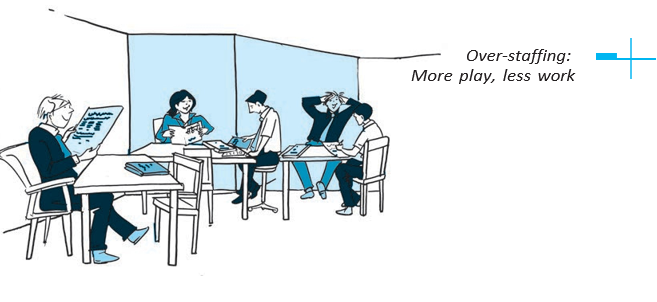
- Effective use of people: It helps avoid overstaffing and underutilisation, while anticipating shortages that could disrupt work.
Consequences of Inefficient Staffing
- Wastage: Unsuitable or insufficient staffing can waste materials, time, effort and energy.
- Poor results: It can reduce productivity and product quality, making profitable sales difficult.
- Higher costs: Inadequate staffing and training can increase labour costs and operational disruption.
Staffing as Part of Human Resource Management
- Management function: Staffing is a generic responsibility of managers and is closely linked to organising, as people are needed to fill established positions.
- Human element: It manages the people whose competence, motivation and performance influence organisational success.
Human Resource Department and Its Duties
State four benefits of proper staffing.
How are staffing and organising related?
Quick recap
- Staffing fills organisational positions with suitable people and keeps them filled.
- Technology, organisational growth and complex human behaviour increase staffing’s importance.
- Good staffing improves competence, performance, continuity, utilisation, job satisfaction and morale.
- Poor staffing can increase wastage and reduce productivity, quality and profitable sales.
- All managers perform staffing; larger organisations may use specialist HR departments.
- HR duties include recruitment, job analysis, rewards, training, labour relations, welfare and legal support.
Evolution of HumanResource Management
Evolution of Human Resource Management
- Early development: The trade union movement led to labour welfare officers acting as links between owners and workers.
- Personnel management: Factory growth created a need for personnel officers and managers to hire, select and place employees.
- Modern HRM: The human relations approach and technological change highlighted people as valuable resources requiring development and training.
Staffing: Meaning and Nature
- Staffing function: Staffing is an inherent part of human resource management and concerns establishing working relationships with people for organisational purposes.
- Line and staff activity: It is both a manager’s essential responsibility and an advisory function of the Human Resource Department.
Staffing Process
- Purpose: Staffing is a sequence of activities for meeting an organisation’s manpower requirements at the right time.
- Scope: The process covers finding potential employees, choosing suitable candidates, placing and familiarising them, and supporting their development and career progress.
1. Estimating Manpower Requirements
2. Recruitment
- Recruitment: The process of searching for prospective employees and encouraging them to apply for jobs in the organisation.
- Candidate pool: It uses job and candidate requirements to attract applicants through suitable internal or external sources.
3. Selection
| Point | Recruitment | Selection |
|---|---|---|
| Main action | Attracts prospective employees to apply | Chooses the most suitable applicants |
| Result | Creates a pool of candidates | Identifies candidates to whom employment may be offered |
4. Placement and Orientation
- Placement: Assigning the selected employee to the position for which they were chosen.
- Orientation: Introducing the employee to colleagues and familiarising them with the workplace, rules and organisational policies.
- Importance: This initial experience can affect an employee’s job performance and decision to remain with the organisation.
5. Training and Development
- Employee learning: Training improves job-related skills and knowledge, while development supports broader growth and preparation for future responsibilities.
- Organisational value: Learning strengthens competence and performance, helping organisations improve effectiveness and retain talented employees.
6. Performance Appraisal
- Meaning: Performance appraisal evaluates an employee’s current or past performance against predetermined standards.
- Process: It involves defining the job, assessing performance and providing feedback so employees understand their results.
7. Promotion and Career Planning
- Career planning: Organisations should address employees’ long-term career interests and encourage them to develop their potential.
- Promotion: Promotion moves an employee to a position with greater responsibility and usually brings higher pay, status and job satisfaction.
8. Compensation
- Meaning: Compensation includes all forms of pay and rewards provided to employees.
- Direct payments: Wages, salaries, incentives, commissions and bonuses may be time-based, performance-based or combined.
- Indirect payments: Benefits include employer-paid insurance and vacations.
Factors Affecting Staffing
- Labour market: The supply and demand for particular skills, unemployment and labour-market conditions affect staffing.
- Organisation: Company image, policy and human resource planning costs influence staffing decisions.
- External conditions: Legal and political considerations, technological developments and the general economic environment also affect recruitment, selection and training.
Quick recap
- HRM evolved from labour welfare and personnel management, with developments dating back to the Industrial Revolution.
- Staffing is both a management function performed by line managers and an advisory function of the HR Department.
- Manpower estimation compares workload needs with the available workforce to identify understaffing, overstaffing or optimal staffing.
- Recruitment attracts applicants; selection chooses the most suitable candidate and can enhance the selected person’s self-esteem and prestige.
- Placement assigns an employee to a job; orientation familiarises them with the workplace, colleagues and rules.
- The staffing process includes training and development; in small organisations, it also includes appraisal, promotion and career planning, and compensation.
- Compensation includes direct and indirect rewards; direct pay may be time-based, performance-based or a combination.
Aspects of staffing
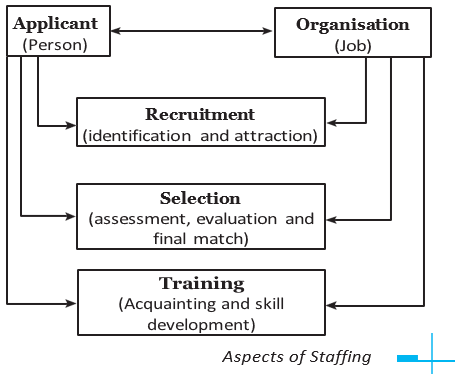
Staffing: Three Aspects
- Three aspects: Recruitment, selection and training are the three aspects of staffing.
- Order: Recruitment attracts applicants and precedes selection; training is also an aspect of staffing.
Recruitment
Recruitment — The process of searching for prospective employees and encouraging them to apply for jobs in an organisation.
- Purpose: Attract a suitable number of candidates with the qualifications needed for available jobs.
- Role: Locate potential candidates and invite them to apply; recruitment comes before selection.
- Common means: Newspapers, job-advertisement papers, professional publications, notice displays, employment centres and campus interviews.
Sources of Recruitment
- Recruitment activities: Identify labour sources → assess their suitability → choose suitable source(s) → invite applications.
- Two sources: Vacancies may be filled from within the organisation (internal) or from outside it (external).
Internal Sources
| Point | Transfer | Promotion |
|---|---|---|
| Meaning | Move an employee to another job, department or shift, usually without a substantial change in status or responsibility. | Move an employee from a lower job to a higher position with greater responsibility, status, facilities and pay. |
| Movement | Generally horizontal; duties or working conditions may change, but salary need not change. | Vertical movement to a higher level. |
| Uses / effects | Fills shortages from surplus departments, can help avoid termination or resolve grievances, and can develop employees across jobs. | Improves motivation, loyalty and job satisfaction; may create further promotion opportunities at lower levels. |
| Key condition | Check that the employee can perform the new job. | Fills higher positions with employees already working in the organisation. |
Merits of Internal Recruitment
- Motivation: Promotion prospects encourage employees to learn, perform better and work with commitment and loyalty.
- Reliable selection: Existing employees are known and can be assessed accurately and economically, simplifying selection and placement.
- Training value: Transfers can prepare employees for higher jobs; internal recruits generally need no induction training.
- Better staff distribution: Transfers move employees from surplus departments to those with shortages.
- Lower cost: Filling jobs internally is cheaper than recruiting externally.
Limitations of Internal Recruitment
- Less fresh talent: Heavy reliance on internal hiring can limit new ideas and talent entering the organisation (‘inbreeding’).
- Complacency: Employees may become lethargic if promotions are expected automatically after a set period.
- Limited availability: A new enterprise has no existing staff to promote, and no organisation can fill every vacancy internally.
- Weaker competition: Internal hiring may reduce the spirit of competition among employees.
- Productivity risk: Frequent transfers may lower organisational productivity.
External Sources
- Why needed: Existing employees may be too few or may not meet job requirements, so all vacancies cannot be filled internally.
- Main benefit: External recruitment broadens the choice of applicants and brings fresh talent into the organisation.
| Source | How it works / best suited for | Merit or limitation |
|---|---|---|
| Direct recruitment | A vacancy notice is displayed at the enterprise; applicants gather on a specified date and are selected on the spot. Common for casual unskilled or semi-skilled work. | Inexpensive; useful for rush work or when permanent workers are absent. Casual (‘badli’) workers are paid daily wages. |
| Casual callers | Unsolicited applicants’ details are kept on file and screened when vacancies arise. | Reduces recruitment costs. |
| Advertisement | Vacancies appear in newspapers or trade and professional journals; often used for senior positions. | Provides job and organisation details and a wide choice, but may attract many unsuitable applicants. |
| Employment exchanges | Government-run exchanges link job-seekers and employers, especially for skilled and unskilled operative jobs. | In some cases, notifying vacancies is legally compulsory; records may be outdated and candidates unsuitable. |
| Placement agencies and management consultants | Agencies maintain candidate databases, match applicants nationwide and recommend suitable people; consultants recruit technical, professional and managerial staff, especially middle- and top-level executives. | Useful where extensive screening is needed; agencies charge fees, and recruiters may attract executives from other firms. |
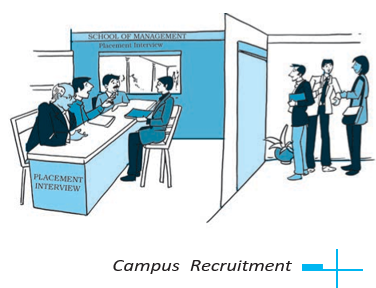
| Campus recruitment | Organisations recruit technical, professional and managerial candidates through colleges, universities and institutes. | An established practice that gives access to qualified personnel through institutional links. |
| Employee recommendations | Current employees refer applicants, including friends and relatives. | Background may be known; employees can provide preliminary screening because they know both the candidate and organisation. |
| Labour contractors | Contractors, who are themselves employees of the organisation, maintain links with labourers and supply unskilled workers at short notice. | If the contractor leaves, workers recruited through them may also leave. |
| Television advertising | Vacancies are broadcast with job requirements, desired qualities and an organisation profile. | Enables detailed publicity about the role and employer. |
| Web publishing | Job websites share information about job-seekers and job openings. | A widely used source for both prospective employees and recruiting organisations. |
Merits of External Recruitment
- Qualified personnel: Can attract trained and qualified applicants for vacant jobs.
- Wider choice: Wide advertising can bring in many applicants, giving management more options.
- Fresh talent: Adds new people when current staff are insufficient or do not meet job specifications.
- Competitive spirit: Outside applicants encourage existing employees to improve their performance.
Limitations of External Recruitment
- Staff dissatisfaction: Existing employees may feel their promotion opportunities have been reduced.
- Time-consuming: The organisation must publicise vacancies, wait for applications and then begin selection.
- Costly: Advertising and processing applications require substantial expenditure.
Differentiate between transfer and promotion.
State two merits and two limitations of internal recruitment.
Give two merits and two limitations of external recruitment.
Quick recap
- Staffing has three aspects: recruitment, selection and training.
- Recruitment searches for prospective employees and encourages them to apply; it precedes selection.
- Internal recruitment uses transfers and promotions; transfers are generally horizontal, promotions vertical.
- Internal recruitment can motivate employees and reduce cost, but may limit fresh talent and competition.
- External sources include direct recruitment, casual callers, advertisements, exchanges, agencies, campuses, referrals, contractors, television and web publishing.
- External recruitment widens choice and brings new talent, but can take more time and money and frustrate current staff.
Selecting
Meaning and Purpose of Selection
- Meaning: Selection identifies and chooses the best-suited person from among prospective candidates for a job.
- Purpose: A systematic assessment helps the organisation choose a candidate with the potential to perform successfully in the role.
Selection Tests
| Point | Aptitude test | Trade test |
|---|---|---|
| Measures | Potential to acquire skills | Actual skills already possessed |
| Focus | Future capacity to learn | Current knowledge and proficiency |
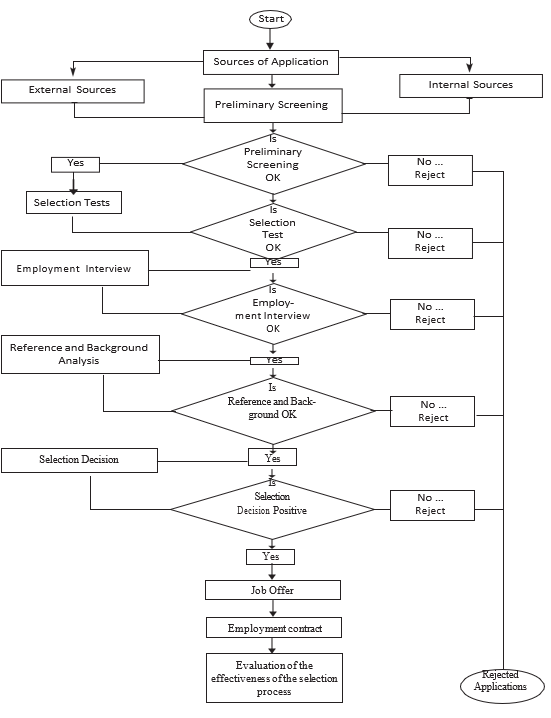
Steps in the Selection Process
Employment Contract: Typical Headings
- Job details: Job title, duties and responsibilities.
- Employment terms: Start date of continuous employment and basis for calculating service; pay rates and allowances.
- Working conditions: Hours of work, leave rules and sickness provisions.
- Procedures and rules: Grievance, disciplinary and work rules.
- Ending employment: Termination of employment.
Attestation Form
- Timing: Completed after the job offer is accepted, as part of employment documentation.
Current Hiring and Retention Practices
Hiring Trend Mentioned
- 2016LinkedIn Talent Solutions’ India Recruiting Trends study reported rising use of employee referrals as a source of quality hires.
Talent Competition and Retention
- Recruitment growth in BPO, telecom and retail → demand for workers rises faster than supply.
- Talent shortage and attrition → companies compete to retain strong employees.
- Retention response → mid-term and out-of-turn raises of 15–20%; some hikes reached 40%, with bonuses or quarterly increments for top teams.
- Reported attrition → IT rose from 18% to 22%; BPO rose from 46% to 50%; manufacturing talent exits averaged 8–12%.
- Cost of losing an employee → replacement hiring is expensive, and a new employee may take up to six months to acquire the required skills.
Ways to Retain Talent
- Identify risk: Spot employees who may be tempted to leave.
- Support development: Offer learning and development opportunities, especially to freshers.
- Offer experience: Some employers send employees abroad for short postings, sometimes linked to a one-year bond.
Consequences of Selection Decisions
List the main steps in the selection process.
How does an aptitude test differ from a trade test?
What are accept errors and reject errors?
Quick recap
- Selection chooses the best-suited applicant and is ultimately evaluated through job performance.
- Selection tests measure intelligence, aptitude, personality, existing skills and interests.
- The process runs from preliminary screening to employment contract, with medical fitness checked before the job offer.
- Contracts commonly state duties, pay, hours, leave, procedures and termination terms.
- Referrals and technology help companies find candidates; talent shortages and attrition drive retention measures.
- Correct selection matches prediction with performance; accept and reject errors can be costly.
Training and Development
Meaning of Training and Development
Training and development — A planned effort to improve employees’ current or future performance by building their knowledge, skills, abilities or attitudes.
Why it matters
- Changing work: Technological and economic change requires organisations to adapt their products, services, work methods and job skills.
- Complex jobs: As jobs become more complex, employees need to keep upgrading their capabilities.
- Shared benefit: Training and development support the effectiveness of both the organisation and its employees.
Benefits of Training and Development
| Benefit | How it helps |
|---|---|
| Systematic learning | Avoids the wasted time and money associated with hit-and-trial learning. |
| Higher productivity | Improves the quantity and quality of work, contributing to higher profits. |
| Future managers | Prepares employees to take over managerial responsibilities in an emergency. |
| Morale and retention | Raises employee morale and reduces absenteeism and employee turnover. |
| Adaptability | Helps the organisation respond effectively to technological and economic change. |
| Benefit | How it helps |
|---|---|
| Career improvement | Stronger skills and knowledge can improve career prospects. |
| Higher earnings | Improved individual performance can help employees earn more. |
| Safety and efficiency | Better machine-handling skills make employees more efficient and less prone to accidents. |
| Satisfaction and morale | Training can increase employees’ job satisfaction and morale. |
Training, Education and Development
| Point | Training | Development |
|---|---|---|
| Meaning | Increases knowledge and skills for specific jobs. | Learning and growth that develop the employee more broadly. |
| Purpose | Helps an employee perform a current or intended job better. | Supports overall growth, maturity and the realisation of potential. |
| Orientation | Job-oriented. | Career-oriented. |
| Time span | Usually short-term. | An ongoing process. |
| Relationship | Focuses on specific work capabilities. | Includes training and extends beyond job performance to personal growth. |
Education — A process that increases employees’ knowledge and understanding and develops their ability to interpret ideas and reason logically.
Scope of Education
- Broader scope: Education is wider than training and develops understanding of basic principles, analysis, synthesis and objectivity.
- Reasoning: It develops a logical, rational mind that can identify relationships and understand phenomena rather than simply provide fixed answers.
- Focus: Training is more closely linked to organisational goals; education develops broader understanding.
Terms Used in Organisations
- Learning and Development (L&D): Used by some organisations to highlight learning for both the individual and the organisation.
- Human Resource Development (HRD): Another term used by some organisations for this field.
Do not treat training, education and development as identical: they overlap, but training targets job skills, education broadens understanding, and development supports overall growth.
State any four benefits of training and development to an organisation.
Distinguish between training and development.
Quick recap
- Training and development improve employee performance by building knowledge, skills, abilities or attitudes.
- Complex jobs and rapid technological and economic change increase the need for employee training.
- Organisations gain systematic learning, productivity, future managers, morale and adaptability.
- Employees gain career prospects, earning potential, safety, efficiency and satisfaction.
- Training focuses on specific job performance; development supports ongoing, broader growth.
- Education broadens knowledge, understanding and reasoning; it has a wider scope than training.
Training Methods
Training methods — Ways used to develop employees’ knowledge and skills; they are broadly classified as on-the-job or off-the-job methods.
| Point | On-the-job | Off-the-job |
|---|---|---|
| Where it occurs | At the workplace while the employee is working | Away from the actual workplace |
| Learning approach | Learning by doing | Learning before doing |
On-the-Job Methods
| Method | How it works | Purpose or key benefit |
|---|---|---|
| Apprenticeship programmes | A trainee works for a prescribed period under an experienced master worker; trainees may be trained together for a uniform period. | Develops higher-level skills for skilled trades such as plumbing, electrical work and iron-working. Slow learners may need extra training. |
| Coaching | A superior or senior manager guides the trainee, agrees on goals, advises how to achieve them and periodically reviews progress. | Improves behaviour and performance; often prepares the trainee to succeed the manager and take over some duties. |
| Internship training | An educational institution and a business firm jointly provide training; students continue their studies while working in a factory or office. | Combines formal study with practical knowledge and work skills. |
| Job rotation | The trainee shifts between departments or jobs and participates in each department’s operations. | Builds a broad view of the business, tests aptitude, encourages cooperation across departments and helps with promotions, replacements and transfers. |
Off-the-Job Methods
| Method | How it works | Purpose or key benefit |
|---|---|---|
| Classroom lectures and conferences | Present specific information, rules, procedures or methods; audiovisuals and demonstrations may support the presentation. | Clarifies difficult points and can improve interest and retention. |
| Films | Use films to present information and demonstrate skills. | Useful for skills that are difficult to show through other methods; especially effective with conference discussions. |
| Case study | Trainees analyse a real organisational problem, identify causes, develop alternatives, choose a solution and decide how to implement it. | Develops problem analysis and decision-making skills using actual management situations. |
| Computer modelling | A computer simulates aspects of the work environment and job realities. | Allows practice without the risks or high costs of making mistakes in real work. |
| Vestibule training | Training takes place away from the actual work floor, using the equipment, materials and files employees will use on the job. | Provides realistic practice, especially for work involving sophisticated machinery or equipment. |
| Programmed instruction | Specific skills or knowledge are divided into meaningful units arranged in a logical sequence, from simple to complex; trainees answer questions or fill in blanks. | Enables structured, step-by-step learning. |
Do not confuse vestibule training with on-the-job training: it uses actual job equipment, but training occurs away from the work floor.
Distinguish between on-the-job and off-the-job training.
How does job rotation benefit trainees and the organisation?
What is vestibule training?
Quick recap
- Training methods are classified as on-the-job (learning by doing) or off-the-job (learning before doing).
- On-the-job methods are apprenticeship, coaching, internship training and job rotation.
- Apprenticeship develops trade skills; coaching guides performance and may groom a successor.
- Internships combine continued study with practical workplace experience; job rotation builds broad organisational understanding.
- Off-the-job methods include lectures, films, case studies, computer modelling, vestibule training and programmed instruction.
- Case studies build problem-solving skills, while computer modelling permits practice without real-world risk.
- Vestibule training uses job equipment away from the work floor; programmed instruction proceeds from simple units to complex ones.
Key Terms and Summary
Meaning and Importance of Staffing
- Meaning: Staffing is the managerial function of filling and keeping filled the positions in an organisation’s structure.
- Importance: It provides the right people for organisational work, and the quality of human resources strongly affects the achievement of goals.
Staffing and Human Resource Management
- Management responsibility: Staffing is a function performed by all managers to ensure that positions are filled with qualified people.
- Specialised function: As organisations grow, human resource specialists support managers in handling people-related activities.
Evolution of HRM
- Industrial beginnings: HRM developed through related changes dating back to the Industrial Revolution, including the rise of trade unions and labour welfare roles.
- Changing roles: Factory growth brought personnel officers and managers; later, human relations and technological change expanded the focus to employee skills and development.
Staffing Process
Staffing process — The sequence of activities used to meet an organisation’s manpower requirements at the right time.
Main staffing stages
- Estimate manpower requirements
- Recruit prospective candidates
- Select suitable candidates
- Place the employee and provide orientation
- Train and develop employees
Estimating Manpower Requirements
- Job requirements: Each job needs a person with appropriate educational qualifications, skills and prior experience.
- Analysis: Estimating requirements involves workload analysis and workforce analysis.
Recruitment — The process of searching for prospective employees and encouraging them to apply for jobs in the organisation.
Selection — The process of choosing suitable candidates from the pool developed through recruitment.
Placement and Orientation
- Placement: Assigning the employee to the position for which they were selected.
- Orientation: Introducing the new employee to other employees and familiarising them with organisational rules and policies.
Training and Development in Staffing
- Career growth: Employees seek opportunities to build a career, not merely to hold a job.
- Learning: Training and development help employees learn and progress within the organisation.
Sources of Recruitment
- Internal sources: Vacancies may be filled through transfers or promotions of existing employees.
- External sources: Organisations may recruit outside candidates through methods such as advertisements, employment exchanges, placement agencies, campus recruitment and online job platforms.
- Choice of source: Internal and external sources provide different ways to attract applicants for available positions.
Selection Process
- Assessment stages: Selection generally moves from preliminary screening and employment tests to interviews and reference checks.
- Appointment stages: The process continues with a selection decision, medical examination, job offer and contract of employment.
Training and Development
- Training: Training increases employees’ skills and abilities to perform specific jobs, improving current performance or preparing them for another role.
- Development: Development is an ongoing process that supports broader employee growth and realisation of potential.
- Value: Training and development benefit both employees and organisations by strengthening skills, performance and career prospects.
Training Methods
- Performance appraisal
- Assessment of an employee’s work and performance.
- Assessment tests
- Tests used during selection to assess candidates’ abilities, aptitude, personality, trade skills or interests.
- Personnel management
- The traditional approach to managing people at work, superseded by HRM.
- Human Resource Management
- The broader management of the human element through specialised employee-related activities.
- Recruitment
- Searching for prospective employees and encouraging them to apply.
- Selection
- Choosing candidates from the pool created through recruitment.
Quick recap
- Staffing fills and maintains organisational positions with suitable people.
- Staffing is performed by managers and may be supported by a specialist HR department.
- The staffing process includes estimating needs, recruitment, selection, placement, orientation, training and development.
- Recruitment sources are internal (transfers and promotions) or external.
- Selection uses screening, tests, an interview, checks and further hiring stages through an employment contract.
- Training builds job-specific skills; education increases knowledge; development supports employee growth.