Class 12 PCM . Mathematics . Mathematics Part I . Application of Derivatives

Chapter 6: Application Of Derivatives

Ch 6

Mathematics

Class 12 PCM

Lecture 1

Introduction

Reference video · Lecture 1Introduction

Introduction

What derivatives help us find

  • Applications: Derivatives are used in science, engineering, and social sciences to describe how quantities change.
  • In this chapter: Applications include rates of change, tangents and normals, turning points, local maxima and minima, increasing/decreasing intervals, and approximations.

Rate of Change of Quantities

Definition

Rate of change — If y=f(x)y=f(x), then dydx=f′(x)\frac{dy}{dx}=f'(x) measures the rate at which yy changes with respect to xx. At x=x0x=x_0, the rate is f′(x0)f'(x_0).

Chain rule for related rates

If xx and yy both depend on time tt, then the rate of change of yy with respect to xx is the ratio of their time rates, provided dxdt≠0\frac{dx}{dt}\ne 0.

dydx=dydtdxdt\frac{dy}{dx}=\frac{\frac{dy}{dt}}{\frac{dx}{dt}}
Time-rate chain rule
dydt=dydxdxdt\frac{dy}{dt}=\frac{dy}{dx}\frac{dx}{dt}

Use when quantities change with time and their rates are linked through another variable.

Interpreting rates

  • Positive derivative: dydx>0\frac{dy}{dx}>0 means yy increases as xx increases.
  • Negative derivative: dydx<0\frac{dy}{dx}<0 means yy decreases as xx increases.
  • Units: A rate carries the units of the changing quantity divided by the units of the variable, such as cm2/s\text{cm}^2/\text{s}.

Solving related-rate problems

  1. Write an equation connecting the quantities that change.
  2. Differentiate with respect to time, using the chain rule.
  3. Substitute the known rates and values at the specified instant.
  4. State the result with its sign and units.
Worked example

How fast is the cube’s surface area increasing?

  1. A cube’s volume increases at 9 cm3/s9\text{ cm}^3/\text{s}. Find the rate of increase of its surface area when its edge is 10 cm10\text{ cm}.
  2. Let the edge be xx. Then V=x3V=x^3 and S=6x2S=6x^2.
  3. Differentiate the volume relation with respect to time.
    dVdt=3x2dxdt=9⇒dxdt=3x2\frac{dV}{dt}=3x^2\frac{dx}{dt}=9\quad\Rightarrow\quad \frac{dx}{dt}=\frac{3}{x^2}
  4. Differentiate the surface-area relation and substitute x=10x=10.
    dSdt=12xdxdt=12x(3x2)=36x=3.6\frac{dS}{dt}=12x\frac{dx}{dt}=12x\left(\frac{3}{x^2}\right)=\frac{36}{x}=3.6
Answer: 3.6 cm2/s3.6\text{ cm}^2/\text{s}

Common rate models

  • Circle: A=πr2A=\pi r^2, so dAdr=2πr\frac{dA}{dr}=2\pi r; if the radius changes with time, dAdt=2πrdrdt\frac{dA}{dt}=2\pi r\frac{dr}{dt}. For r=5 cmr=5\text{ cm}, dAdr=10π cm\frac{dA}{dr}=10\pi\text{ cm}.
  • Circular wave: If drdt=4 cm/s\frac{dr}{dt}=4\text{ cm}/\text{s} and r=10 cmr=10\text{ cm}, then dAdt=2π(10)(4)=80π cm2/s\frac{dA}{dt}=2\pi(10)(4)=80\pi\text{ cm}^2/\text{s}.
  • Rectangle: P=2(x+y)P=2(x+y) and A=xyA=xy, so dPdt=2(dxdt+dydt)\frac{dP}{dt}=2\left(\frac{dx}{dt}+\frac{dy}{dt}\right) and dAdt=ydxdt+xdydt\frac{dA}{dt}=y\frac{dx}{dt}+x\frac{dy}{dt}.

Marginal Cost and Marginal Revenue

Definition

Marginal cost and marginal revenue — Marginal cost is the instantaneous rate of change of total cost with output; marginal revenue is the instantaneous rate of change of total revenue with units sold.

Marginal quantities
MC=dCdx,MR=dRdx\mathrm{MC}=\frac{dC}{dx},\qquad \mathrm{MR}=\frac{dR}{dx}

For cost C(x)C(x) and revenue R(x)R(x), differentiate with respect to the number of units xx.

Worked example

What is the marginal cost at three units?

  1. The cost function is C(x)=0.005x3−0.02x2+30x+5000C(x)=0.005x^3-0.02x^2+30x+5000. Find the marginal cost at x=3x=3.
  2. Differentiate the cost function.
    MC=dCdx=0.015x2−0.04x+30\mathrm{MC}=\frac{dC}{dx}=0.015x^2-0.04x+30
  3. Evaluate at x=3x=3.
    MC(3)=0.015(32)−0.04(3)+30=30.015\mathrm{MC}(3)=0.015(3^2)-0.04(3)+30=30.015
Answer: The marginal cost is approximately Rs. 30.02.

Marginal revenue example

  • Revenue function: If R(x)=3x2+36x+5R(x)=3x^2+36x+5, then MR=dRdx=6x+36\mathrm{MR}=\frac{dR}{dx}=6x+36.
  • At five units: MR(5)=6(5)+36=66\mathrm{MR}(5)=6(5)+36=66, so the marginal revenue is Rs. 66.
Practice

A rectangle has x=10 cmx=10\text{ cm} and y=6 cmy=6\text{ cm}. Its length decreases at 3 cm/min3\text{ cm}/\text{min} while its width increases at 2 cm/min2\text{ cm}/\text{min}. Find the rates of change of its perimeter and area.

Hint: Use dPdt=2(dxdt+dydt)\frac{dP}{dt}=2\left(\frac{dx}{dt}+\frac{dy}{dt}\right) and dAdt=ydxdt+xdydt\frac{dA}{dt}=y\frac{dx}{dt}+x\frac{dy}{dt}.
Key step: Substitute dxdt=−3\frac{dx}{dt}=-3 and dydt=2\frac{dy}{dt}=2.
Solution: dPdt=2(−3+2)=−2 cm/min\frac{dP}{dt}=2(-3+2)=-2\text{ cm}/\text{min} and dAdt=6(−3)+10(2)=2 cm2/min\frac{dA}{dt}=6(-3)+10(2)=2\text{ cm}^2/\text{min}.
Practice

A circular wave has radius 10 cm10\text{ cm} and expands at 4 cm/s4\text{ cm}/\text{s}. At what rate is its area increasing?

Hint: Differentiate A=πr2A=\pi r^2 with respect to time.
Key step: Use dAdt=2πrdrdt\frac{dA}{dt}=2\pi r\frac{dr}{dt}.
Solution: dAdt=2π(10)(4)=80π cm2/s\frac{dA}{dt}=2\pi(10)(4)=80\pi\text{ cm}^2/\text{s}.
Practice

If R(x)=3x2+36x+5R(x)=3x^2+36x+5, find the marginal revenue at x=5x=5.

Hint: Differentiate R(x)R(x) with respect to xx.
Key step: MR=6x+36\mathrm{MR}=6x+36.
Solution: MR(5)=6(5)+36=66\mathrm{MR}(5)=6(5)+36=66, or Rs. 66.
⚠ Common mistake

Do not substitute changing quantities before differentiating. First differentiate the relationship with respect to time, then substitute the values and rates for the stated instant.

Quick recap

  • The derivative gives the instantaneous rate of change of one quantity with respect to another.
  • For quantities depending on time, use the chain rule to connect their rates.
  • A positive rate indicates increase; a negative rate indicates decrease.
  • Related-rate answers must include appropriate units and the sign of the change.
  • Marginal cost and marginal revenue are derivatives of total cost and total revenue with respect to output.
Lecture 2

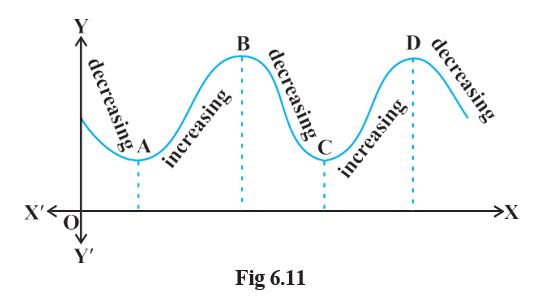
Increasing and Decreasing Functions

Reference video · Lecture 2Increasing and Decreasing Functions

Meaning and definitions

Definition

Increasing on an interval — A function ff is increasing on an interval II if x1<x2x_1<x_2 in II implies f(x1)<f(x2)f(x_1)<f(x_2).

Definition

Decreasing on an interval — A function ff is decreasing on an interval II if x1<x2x_1<x_2 in II implies f(x1)>f(x2)f(x_1)>f(x_2).

Related definitions

  • Constant: ff is constant on II if f(x)=cf(x)=c for every x∈Ix\in I, where cc is fixed.
  • At a point: ff is increasing or decreasing at x0x_0 if it has that property on an open interval containing x0x_0.
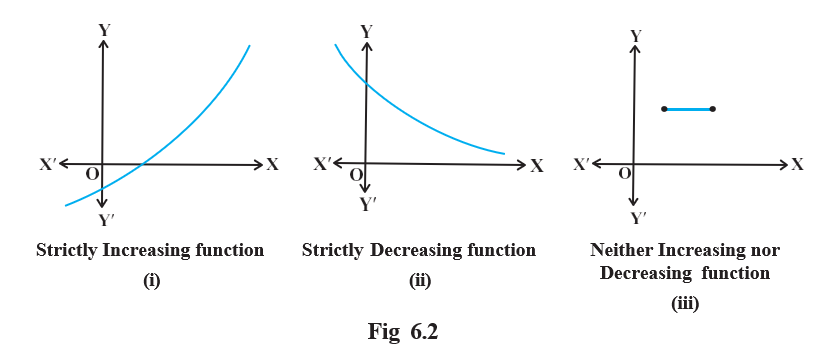
  • Graph: Moving from left to right, an increasing graph rises and a decreasing graph falls.
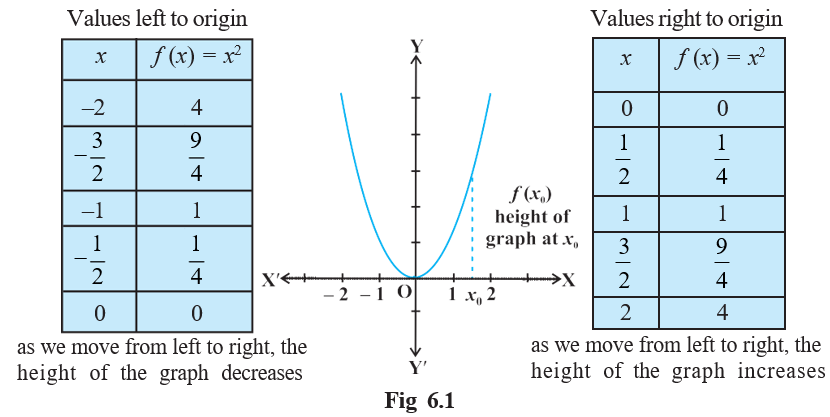
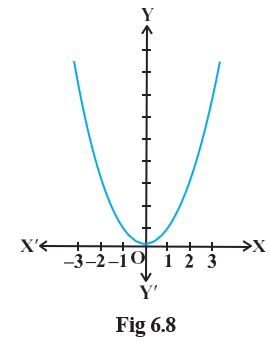
  • Example: f(x)=x2f(x)=x^2 decreases for x<0x<0 and increases for x>0x>0.
The graph of f(x)=x² decreases to the left of the origin and increases to the right.
The graph of f(x)=x2f(x)=x^2 decreases to the left of the origin and increases to the right.
Graphs illustrating strictly increasing, strictly decreasing, and neither behaviour.

The first derivative test

First derivative test

If ff is continuous on [a,b][a,b] and differentiable on (a,b)(a,b), then f′(x)>0f'(x)>0 throughout (a,b)(a,b) implies that ff is increasing on [a,b][a,b]; f′(x)<0f'(x)<0 implies decreasing. If f′(x)=0f'(x)=0 throughout (a,b)(a,b), then ff is constant on [a,b][a,b].

Mean Value Theorem link

For x1<x2x_1<x_2, the Mean Value Theorem gives a point cc between them such that f(x2)−f(x1)=f′(c)(x2−x1)f(x_2)-f(x_1)=f'(c)(x_2-x_1). Since x2−x1>0x_2-x_1>0, the sign of f′(c)f'(c) determines the sign of the change in function value.

Derivative sign conditions
f′(x)>0,f′(x)<0,f′(x)=0f'(x)>0,\qquad f'(x)<0,\qquad f'(x)=0

Use the sign of the derivative on an interval to determine monotonicity.

Using the test

  • Critical points: Find where f′(x)=0f'(x)=0 or f′(x)f'(x) is undefined; use these points to split the domain into intervals.
  • Sign analysis: Determine the sign of f′(x)f'(x) separately on each interval.
  • Endpoints: Continuity can allow monotonicity on an interval's interior to extend to its endpoints.
  • Sufficient condition: The test gives a sufficient condition; an increasing function can have f′(x)=0f'(x)=0 at isolated points.

Find increasing and decreasing intervals

  1. Differentiate the function.
    f′(x)f'(x)
  2. Find points in the domain where the derivative is zero or undefined.
    f′(x)=0orf′(x) undefinedf'(x)=0\quad\text{or}\quad f'(x)\text{ undefined}
  3. Split the domain at these points and test the derivative sign on each interval.
  4. Classify positive-derivative intervals as increasing and negative-derivative intervals as decreasing.
    f′(x)>0⇒increasing,f′(x)<0⇒decreasingf'(x)>0\Rightarrow\text{increasing},\qquad f'(x)<0\Rightarrow\text{decreasing}

Worked sign-chart example

Worked example

For f(x)=4x3−6x2−72x+30f(x)=4x^3-6x^2-72x+30, find the intervals of increase and decrease.

  1. Differentiate the function.
    f(x)=4x3−6x2−72x+30,f′(x)=12x2−12x−72f(x)=4x^3-6x^2-72x+30,\qquad f'(x)=12x^2-12x-72
  2. Factor the derivative and find its zeros.
    f′(x)=12(x2−x−6)=12(x−3)(x+2),x=−2,3f'(x)=12(x^2-x-6)=12(x-3)(x+2),\qquad x=-2,3
  3. The critical points split the real line into three intervals; the derivative signs are positive, negative, then positive.
    (−∞,−2):+(−2,3):−(3,∞):+(-\infty,-2):+\qquad (-2,3):-\qquad (3,\infty):+
  4. Apply the derivative test on each interval.
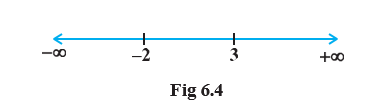
    f′(x)>0 on (−∞,−2) and (3,∞),f′(x)<0 on (−2,3)f'(x)>0\text{ on }(-\infty,-2)\text{ and }(3,\infty),\qquad f'(x)<0\text{ on }(-2,3)
Answer: Increasing on (−∞,−2)(-\infty,-2) and (3,∞)(3,\infty); decreasing on (−2,3)(-2,3). Thus, ff is neither increasing nor decreasing on all of R\mathbb{R}.
Number line split at the critical points -2 and 3.
Number line split at the critical points −2-2 and 33.

Standard examples and applications

Useful results

  • Linear function: For f(x)=7x−3f(x)=7x-3, f′(x)=7>0f'(x)=7>0, so ff is increasing on R\mathbb{R}.
  • Cubic function: For f(x)=x3−3x2+4xf(x)=x^3-3x^2+4x, f′(x)=3(x−1)2+1>0f'(x)=3(x-1)^2+1>0, so it is increasing on R\mathbb{R}.
  • Cosine: Since (cos⁡x)′=−sin⁡x(\cos x)'=-\sin x, cos⁡x\cos x decreases on (0,π)(0,\pi) and increases on (π,2π)(\pi,2\pi); it is neither increasing nor decreasing on (0,2π)(0,2\pi).
  • Quadratic: For f(x)=x2−4x+6f(x)=x^2-4x+6, f′(x)=2(x−2)f'(x)=2(x-2); it decreases for x<2x<2 and increases for x>2x>2.
Practice

Find the increasing and decreasing intervals of f(x)=x2−4x+6f(x)=x^2-4x+6.

Hint: Differentiate and locate the point where f′(x)=0f'(x)=0.
Key step: f′(x)=2x−4=2(x−2)f'(x)=2x-4=2(x-2) changes sign at x=2x=2.
Solution: f′(x)<0f'(x)<0 for x<2x<2 and f′(x)>0f'(x)>0 for x>2x>2. Therefore, ff decreases on (−∞,2)(-\infty,2) and increases on (2,∞)(2,\infty).
Practice

For f(x)=sin⁡3xf(x)=\sin 3x on [0,π/2][0,\pi/2], find the increasing and decreasing intervals.

Hint: Use f′(x)=3cos⁡3xf'(x)=3\cos 3x and solve cos⁡3x=0\cos 3x=0 in the domain.
Key step: The interior critical point is x=π/6x=\pi/6; f′(x)>0f'(x)>0 before it and f′(x)<0f'(x)<0 after it.
Solution: Increasing on [0,π/6][0,\pi/6] and decreasing on [π/6,π/2][\pi/6,\pi/2].
Practice

Find where f(x)=sin⁡x+cos⁡xf(x)=\sin x+\cos x increases and decreases on [0,2π][0,2\pi].

Hint: Solve f′(x)=cos⁡x−sin⁡x=0f'(x)=\cos x-\sin x=0 and test the derivative signs.
Key step: The critical points are x=π/4x=\pi/4 and x=5π/4x=5\pi/4; the derivative signs are positive, negative, positive.
Solution: Increasing on [0,π/4][0,\pi/4] and [5π/4,2π][5\pi/4,2\pi]; decreasing on [π/4,5π/4][\pi/4,5\pi/4].
⚠ Common mistake

Do not judge monotonicity from the derivative at just one point: check its sign on each interval between critical points. A derivative equal to zero at one isolated point does not make a function constant.

Quick recap

  • Increasing means x1<x2⇒f(x1)<f(x2)x_1<x_2\Rightarrow f(x_1)<f(x_2); decreasing reverses the function-value inequality.
  • A positive derivative throughout an interval indicates increase; a negative derivative indicates decrease.
  • A function with f′(x)=0f'(x)=0 throughout an interval is constant there.
  • Find points where the derivative is zero or undefined, split the domain, and test the derivative sign on each interval.
  • Use continuity to include appropriate endpoints when describing monotonicity.
  • For f(x)=x2f(x)=x^2, the function decreases for x<0x<0 and increases for x>0x>0.
Lecture 3

Maxima and Minima

Reference video · Lecture 3Maxima and Minima

Optimisation and Extreme Values

Why find maxima and minima?

  • Optimisation uses derivatives to find highest or lowest function values, such as maximum profit, maximum height, or minimum distance.
  • Turning point is where a graph changes from increasing to decreasing or from decreasing to increasing.
  • Grove profit: If profit is P(x)=ax+bx2P(x)=ax+bx^2, finding the number of trees per acre that maximises profit is an optimisation problem.
  • Ball height: For h(x)=60+x−x260h(x)=60+x-\frac{x^2}{60}, where xx is horizontal distance in metres, find the greatest height.
  • Helicopter distance: For the path y=x2+7y=x^2+7 and a soldier at (1,2)(1,2), find the point on the path nearest to the soldier; minimise the distance.
Definition

Absolute maximum and minimum — On an interval II, f(c)f(c) is an absolute maximum if f(c)≥f(x)f(c)\geq f(x) for every x∈Ix\in I; it is an absolute minimum if f(c)≤f(x)f(c)\leq f(x) for every x∈Ix\in I.

Extrema depend on the domain

  • Extreme value means either an absolute maximum or an absolute minimum; the point cc where it occurs is an extreme point.
  • Square function: f(x)=x2f(x)=x^2 on R\mathbb{R} has minimum 00 at x=0x=0, but no maximum. On [−2,1][-2,1], its maximum is 44 at x=−2x=-2.
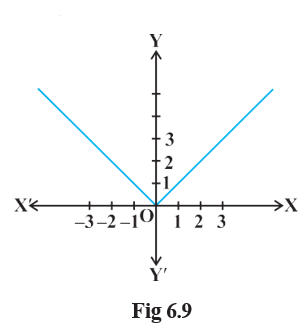
  • Absolute-value function: f(x)=∣x∣f(x)=|x| on R\mathbb{R} has minimum 00 at x=0x=0 and no maximum; it is not differentiable at 00.
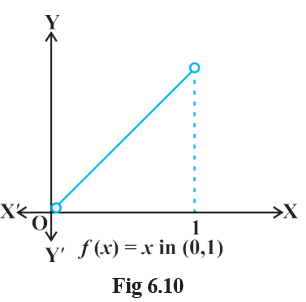
  • Open interval: f(x)=xf(x)=x on (0,1)(0,1) has neither a maximum nor a minimum because neither endpoint is included.
  • Monotonic function: On a closed interval, an increasing or decreasing function reaches its extrema at the endpoints.
Extreme Value Theorem

Every continuous function on a closed interval [a,b][a,b] attains both an absolute maximum and an absolute minimum.

Monotonic functions

  • Monotonic means that a function is either increasing throughout an interval or decreasing throughout it.
  • Endpoints matter: A monotonic function on a closed interval attains its maximum and minimum at the interval's endpoints.
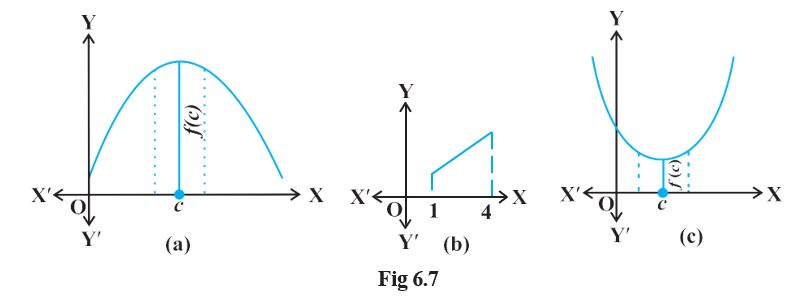
Graphs illustrating function values and extrema on an interval.
Worked example

For h(x)=60+x−x260h(x)=60+x-\frac{x^2}{60}, find the maximum height of the ball.

  1. Differentiate the ball's height function.
    h(x)=60+x−x260,h′(x)=1−x30h(x)=60+x-\frac{x^2}{60},\qquad h'(x)=1-\frac{x}{30}
  2. Set the derivative to zero to locate the turning point.
    1−x30=0⇒x=301-\frac{x}{30}=0\quad\Rightarrow\quad x=30
  3. The derivative is positive before 3030 and negative after 3030, so the height reaches a maximum there.
    h′(x)>0 for x<30,h′(x)<0 for x>30h'(x)>0\text{ for }x<30,\qquad h'(x)<0\text{ for }x>30
  4. Evaluate the height at the turning point.
    h(30)=60+30−30260=75h(30)=60+30-\frac{30^2}{60}=75
Answer: The maximum height is 7575 metres, reached at horizontal distance x=30x=30 metres.
The graph of f(x)=x² has its minimum at the origin.
The graph of f(x)=x2f(x)=x^2 has its minimum at the origin.
The graph of f(x)=|x| has its vertex at the origin.
The graph of f(x)=∣x∣f(x)=|x| has its vertex at the origin.
The graph on (0,1) excludes both endpoints.
The graph on (0,1)(0,1) excludes both endpoints.

Local Maxima, Minima, and Critical Points

Definition

Local maximum and local minimum — An interior point cc is a local maximum if its function value is at least as large as nearby values; it is a local minimum if its value is at most as large as nearby values.

Local extrema condition
f(c)≥f(x),f(c)≤f(x)f(c)\geq f(x),\qquad f(c)\leq f(x)

For some h>0h>0, compare f(c)f(c) with values at nearby points x∈(c−h,c+h)x\in(c-h,c+h), with x≠cx\ne c.

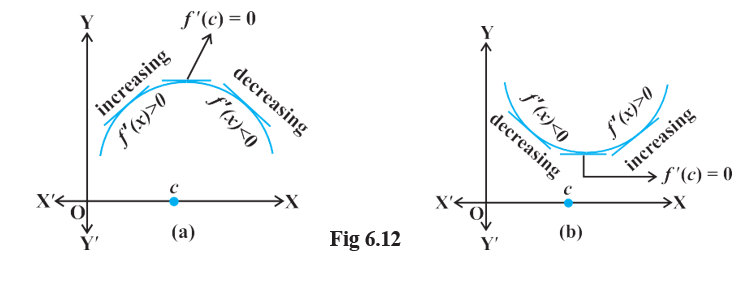
Turning points are local valleys or hills where the graph changes direction.
Necessary condition for an interior extremum

If a function has a local maximum or minimum at an interior point cc, then either f′(c)=0f'(c)=0 or ff is not differentiable at cc.

Definition

Critical point — A point in the domain where f′(c)=0f'(c)=0 or f′(c)f'(c) does not exist is called a critical point.

Critical points are candidates, not guarantees

  • Necessary, not sufficient: An interior local extremum must occur at a critical point, but a critical point need not be an extremum.
  • Counterexample: For f(x)=x3f(x)=x^3, f′(0)=0f'(0)=0, but the function has neither a local maximum nor a local minimum at x=0x=0.

First Derivative Test

First Derivative Test

At a critical point cc where ff is continuous, classify the point by checking whether f′f' changes sign as xx passes through cc.

Classifying a critical point
Sign change in f′(x)f'(x)Conclusion
+→−+\to -Local maximum at cc
−→+-\to +Local minimum at cc
No sign changeNeither local maximum nor local minimum; called a point of inflection in this test

Apply the First Derivative Test

  1. Find critical points in the domain.
    f′(x)=0orf′(x) is undefinedf'(x)=0\quad\text{or}\quad f'(x)\text{ is undefined}
  2. Check the sign of f′f' immediately to the left and right of each point.
    f′(x) on either side of cf'(x)\text{ on either side of }c
  3. Use the sign change to classify the point; evaluate f(c)f(c) if the extreme value is required.
    f(c)f(c)
Graphs illustrating local extrema and critical points, including a stationary point without an extremum.
Practice

Find the maximum and minimum values, if any, of f(x)=x2f(x)=x^2 on R\mathbb{R}.

Hint: Use x2≥0x^2\geq 0 and consider whether the function is bounded above.
Key step: f(0)=0f(0)=0 and f(x)≥0f(x)\geq 0 for all real xx.
Solution: The minimum value is 00 at x=0x=0. There is no maximum value on R\mathbb{R}.
Practice

Does f(x)=∣x∣f(x)=|x| have an extremum at x=0x=0?

Hint: Compare its value at zero with values on both sides.
Key step: ∣x∣≥0|x|\geq 0 for all real xx, with equality at x=0x=0.
Solution: Yes. It has a local and absolute minimum value 00 at x=0x=0, although it is not differentiable there.
Practice

Classify the critical point x=0x=0 of f(x)=x3f(x)=x^3 using the First Derivative Test.

Hint: Check whether f′(x)f'(x) changes sign through zero.
Key step: f′(x)=3x2f'(x)=3x^2 is positive on both sides of zero.
Solution: There is no sign change in f′f', so x=0x=0 is neither a local maximum nor a local minimum; it is a point of inflection in this test.
⚠ Common mistake

Do not assume f′(c)=0f'(c)=0 guarantees an extremum. Check the derivative's sign on both sides, include points where the derivative is undefined, and respect the function's domain.

Quick recap

  • Absolute extrema compare a function value with all values on its domain; local extrema compare only nearby values.
  • A continuous function on a closed interval attains both an absolute maximum and an absolute minimum.
  • A monotonic function is either increasing or decreasing; on a closed interval, its extrema occur at endpoints.
  • At an interior local extremum, either f′(c)=0f'(c)=0 or the derivative does not exist.
  • A critical point is only a candidate for an extremum, not a guarantee.
  • A derivative sign change +→−+\to - gives a local maximum; −→+-\to + gives a local minimum.
  • If the derivative does not change sign at a critical point, there is no local extremum there.
Lecture 4

Maxima and Minima(continuation)

Reference video · Lecture 4Maxima and Minima(continuation)

First Derivative Test and Critical Points

First derivative sign test
+→−⇒maximum,−→+⇒minimum,+→+ or −→−⇒no extremum+\to-\Rightarrow\text{maximum},\qquad -\to+\Rightarrow\text{minimum},\qquad +\to+\text{ or }-\to-\Rightarrow\text{no extremum}

Check the derivative immediately to the left and right of a critical point cc.

Apply the first derivative test

  1. Find every critical point of the function.
    f′(x)=0orf′(x) does not existf'(x)=0\quad\text{or}\quad f'(x)\text{ does not exist}
  2. Determine the sign of f′(x)f'(x) on each side of each critical point.
  3. Classify the point from the sign change and evaluate f(c)f(c) for the extreme value.
    +→−:maximum,−→+:minimum+\to-:\text{maximum},\qquad -\to+:\text{minimum}
Worked example

Find all local maxima and minima of f(x)=x3−3x+3f(x)=x^3-3x+3.

  1. Differentiate and find the critical points of f(x)=x3−3x+3f(x)=x^3-3x+3.
    f′(x)=3x2−3=3(x−1)(x+1)=0⇒x=1,−1f'(x)=3x^2-3=3(x-1)(x+1)=0\quad\Rightarrow\quad x=1,-1
  2. At x=1x=1, the derivative changes from negative to positive, so this is a local minimum.
    f(1)=1f(1)=1
  3. At x=−1x=-1, the derivative changes from positive to negative, so this is a local maximum.
    f(−1)=5f(-1)=5
Answer: The local maximum value is 55 at x=−1x=-1; the local minimum value is 11 at x=1x=1.

Second Derivative Test

Second derivative test

If f′(c)=0f'(c)=0 and f′′(c)<0f''(c)<0, then f(c)f(c) is a local maximum value. If f′(c)=0f'(c)=0 and f′′(c)>0f''(c)>0, then f(c)f(c) is a local minimum value. If f′′(c)=0f''(c)=0, the test gives no conclusion.

Second derivative test: local maximum
f′(c)=0,f′′(c)<0f'(c)=0,\qquad f''(c)<0

Use at a stationary point where the function is twice differentiable.

Second derivative test: local minimum
f′(c)=0,f′′(c)>0f'(c)=0,\qquad f''(c)>0

Use at a stationary point where the function is twice differentiable.

Inconclusive second derivative test
f′(c)=0,f′′(c)=0f'(c)=0,\qquad f''(c)=0

If both derivatives meet these conditions, classify the point using the first derivative test.

Apply the second derivative test

  1. Solve f′(x)=0f'(x)=0 to find stationary points.
    f′(x)=0f'(x)=0
  2. Evaluate the second derivative at each point.
    f′′(c)f''(c)
  3. Use its sign to classify the point; if it is zero, return to the first derivative test.
    f′′(c)<0⇒maximum,f′′(c)>0⇒minimumf''(c)<0\Rightarrow\text{maximum},\qquad f''(c)>0\Rightarrow\text{minimum}
Worked example

Find the local maximum and local minimum values of f(x)=3x4+4x3−12x2+12f(x)=3x^4+4x^3-12x^2+12.

  1. For f(x)=3x4+4x3−12x2+12f(x)=3x^4+4x^3-12x^2+12, find stationary points and the second derivative.
    f′(x)=12x(x−1)(x+2)=0⇒x=0,1,−2;f′′(x)=36x2+24x−24f'(x)=12x(x-1)(x+2)=0\Rightarrow x=0,1,-2;\qquad f''(x)=36x^2+24x-24
  2. Evaluate the second derivative at the stationary points.
    f′′(0)=−24,f′′(1)=36,f′′(−2)=72f''(0)=-24,\qquad f''(1)=36,\qquad f''(-2)=72
  3. Classify the points and evaluate the function values.
    f(0)=12,f(1)=7,f(−2)=−20f(0)=12,\qquad f(1)=7,\qquad f(-2)=-20
Answer: There is a local maximum value 1212 at x=0x=0. The local minimum values are 77 at x=1x=1 and −20-20 at x=−2x=-2.

Non-differentiable and Stationary Inflexion Points
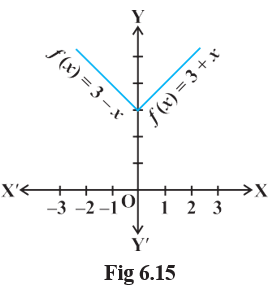
The two line segments f(x)=3-x and f(x)=3+x meet at the local minimum.
The two line segments f(x)=3−xf(x)=3-x and f(x)=3+xf(x)=3+x meet at the local minimum.
⚠ Common mistake

Do not conclude that f′(c)=0f'(c)=0 guarantees an extremum. If f′′(c)=0f''(c)=0, or if the derivative does not exist, use the first derivative test.

Optimization: Minimum Sum of Squares

Sum of squares for a fixed sum
S(x)=x2+(k−x)2S(x)=x^2+(k-x)^2

For positive numbers xx and k−xk-x with sum kk.

Set up a one-variable optimization

  1. Let one number be xx and express the other using the fixed sum.
    x+(k−x)=kx+(k-x)=k
  2. Form the objective function and differentiate it.
    S(x)=x2+(k−x)2S(x)=x^2+(k-x)^2
  3. Solve for a stationary point and verify it gives the required extreme.
    S′(x)=0,S′′(x)>0S'(x)=0,\qquad S''(x)>0
Worked example

Find two positive numbers whose sum is 1515 and whose sum of squares is minimum.

  1. Let the numbers be xx and 15−x15-x; write their squared sum.
    S(x)=x2+(15−x)2=2x2−30x+225S(x)=x^2+(15-x)^2=2x^2-30x+225
  2. Find the stationary point and check that it is a minimum.
    S′(x)=4x−30=0⇒x=152,S′′(x)=4>0S'(x)=4x-30=0\Rightarrow x=\frac{15}{2},\qquad S''(x)=4>0
  3. The two numbers are equal; their sum of squares is the minimum.
    15−x=152,Smin⁡=2(152)2=225215-x=\frac{15}{2},\qquad S_{\min}=2\left(\frac{15}{2}\right)^2=\frac{225}{2}
Answer: The numbers are 15/215/2 and 15/215/2; the minimum sum of squares is 225/2225/2.

Optimization: Shortest Distance to a Parabola

Distance from (0,c)(0,c) to y=x2y=x^2
D(k)=k+(k−c)2,k≥0D(k)=\sqrt{k+(k-c)^2},\qquad k\ge0

Use the ordinate kk of a point on the parabola as the variable.

Minimize distance to the parabola

  1. Represent a point on the parabola using its ordinate kk.
    h2=kh^2=k
  2. Write the distance from (0,c)(0,c) and differentiate with respect to kk.
    D(k)=k+(k−c)2D(k)=\sqrt{k+(k-c)^2}
  3. Find the stationary ordinate and substitute it into the distance function.
    D′(k)=2k−2c+12k+(k−c)2D'(k)=\frac{2k-2c+1}{2\sqrt{k+(k-c)^2}}
Worked example

Find the shortest distance from (0,2)(0,2) to the parabola y=x2y=x^2.

  1. For the point (0,2)(0,2), express the distance to the parabola in terms of kk.
    D(k)=k+(k−2)2D(k)=\sqrt{k+(k-2)^2}
  2. Set the derivative equal to zero to find the minimizing ordinate.
    D′(k)=2k−32k+(k−2)2=0⇒k=32D'(k)=\frac{2k-3}{2\sqrt{k+(k-2)^2}}=0\Rightarrow k=\frac{3}{2}
  3. Evaluate the distance at this ordinate.
    D(32)=32+(−12)2=72D\left(\frac{3}{2}\right)=\sqrt{\frac{3}{2}+\left(-\frac{1}{2}\right)^2}=\frac{\sqrt{7}}{2}
Answer: The shortest distance is 7/2\sqrt{7}/2.

Geometric Optimization Applications

Sum of squared pole distances
S(x)=x2+a2+(L−x)2+b2S(x)=x^2+a^2+(L-x)^2+b^2

For pole heights aa and bb at the ends of a segment of length LL, let xx be the distance from the first end.

Trapezium area
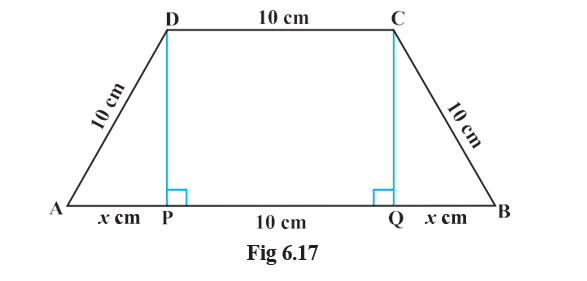
A(x)=12(20+2x)100−x2=(x+10)100−x2A(x)=\frac{1}{2}(20+2x)\sqrt{100-x^2}=(x+10)\sqrt{100-x^2}

The parallel sides are 1010 and 10+2x10+2x; the height is 100−x2\sqrt{100-x^2}.

Cylinder dimensions and curved surface area
H=h(r−x)r,S(x)=2πxH=2πhr(rx−x2)H=\frac{h(r-x)}{r},\qquad S(x)=2\pi xH=\frac{2\pi h}{r}(rx-x^2)

Here rr and hh are the cone's radius and height, and xx is the cylinder's radius.

Optimize a geometric quantity

  1. Choose one variable to describe the unknown position or dimension, respecting its allowed range.
    0≤x≤L0\le x\le L
  2. Use the geometric constraints to express the objective quantity in that variable.
  3. Find stationary points and check the derivative test and any domain boundaries.
    F′(x)=0F'(x)=0
Worked example

Prove that the inscribed right circular cylinder with greatest curved surface area has radius half the cone's radius.

  1. For a cone of radius rr and height hh, write the cylinder height and curved surface area.
    H=h(r−x)r,S(x)=2πhr(rx−x2)H=\frac{h(r-x)}{r},\qquad S(x)=\frac{2\pi h}{r}(rx-x^2)
  2. Differentiate and solve for the stationary radius.
    S′(x)=2πhr(r−2x)=0⇒x=r2S'(x)=\frac{2\pi h}{r}(r-2x)=0\Rightarrow x=\frac{r}{2}
  3. The second derivative is negative, confirming the maximum.
    S′′(x)=−4πhr<0S''(x)=-\frac{4\pi h}{r}<0
Answer: The maximum occurs at x=r/2x=r/2; hence the cylinder's radius is half the cone's radius.
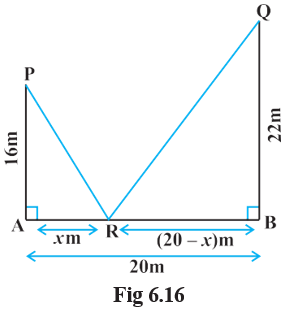
A point on the segment between the two pole bases is chosen to minimize the sum of squared distances to the pole tops.
An isosceles trapezium with perpendiculars from its top corners to the longer base.
Practice

Two vertical poles of heights 1616 m and 2222 m stand 2020 m apart. Where on the segment joining their bases should RR be placed to minimize RP2+RQ2RP^2+RQ^2?

Hint: Let AR=xAR=x; use Pythagoras for both distances and minimize their sum of squares.
Key step: Form S(x)=x2+162+(20−x)2+222S(x)=x^2+16^2+(20-x)^2+22^2 and solve S′(x)=0S'(x)=0.
Solution: S(x)=2x2−40x+1140S(x)=2x^2-40x+1140, so S′(x)=4x−40=0S'(x)=4x-40=0 gives x=10x=10. Also S′′(x)=4>0S''(x)=4>0. Place RR 1010 m from the base of the 1616 m pole.
Practice

Three sides of a trapezium other than its base are each 1010 cm. Find its maximum area.

Hint: Use A(x)=(x+10)100−x2A(x)=(x+10)\sqrt{100-x^2} and keep only feasible values of xx.
Key step: Solve A′(x)=0A'(x)=0, where A′(x)=100−10x−2x2100−x2A'(x)=\frac{100-10x-2x^2}{\sqrt{100-x^2}}.
Solution: 2x2+10x−100=02x^2+10x-100=0 gives x=5x=5 or x=−10x=-10; discard the negative length. Then A(5)=1575=753 cm2A(5)=15\sqrt{75}=75\sqrt{3}\text{ cm}^2, the maximum area.
★ Remember
  • First derivative test: +→−+\to- gives a local maximum; −→+-\to+ gives a local minimum.
  • Second derivative test: At f′(c)=0f'(c)=0, f′′(c)<0f''(c)<0 gives a maximum and f′′(c)>0f''(c)>0 gives a minimum; zero is inconclusive.
  • Optimization: Build a one-variable objective from the constraints, respect its domain, and verify the candidate extreme.

Quick recap

  • A critical point may occur where f′(x)=0f'(x)=0 or where f′(x)f'(x) does not exist; classify it by testing derivative signs around it.
  • At a stationary point, f′′(c)<0f''(c)<0 gives a local maximum and f′′(c)>0f''(c)>0 gives a local minimum; if f′′(c)=0f''(c)=0, use the first derivative test.
  • For 3+∣x∣3+|x|, the non-differentiable point x=0x=0 is a local minimum with value 33; a stationary point such as x=1x=1 for 2x3−6x2+6x+52x^3-6x^2+6x+5 need not be an extremum.
  • For two positive numbers with fixed sum, the sum of squares is minimized when they are equal.
  • From (0,c)(0,c) to y=x2y=x^2, the minimizing ordinate is k=c−1/2k=c-1/2 and the shortest distance is 4c−1/2\sqrt{4c-1}/2 for 1/2≤c≤51/2\le c\le5.
  • For the given pole problem, the sum of squared distances is minimized when RR is 1010 m from either end; the trapezium's maximum area is 753 cm275\sqrt{3}\text{ cm}^2.
  • An inscribed cylinder has greatest curved surface area when its radius is half the cone's radius.
Lecture 5

Maximum and Minimum Values Of A Function In A Closed Interval

Reference video · Lecture 5Maximum and Minimum Values Of A Function In A Closed Interval

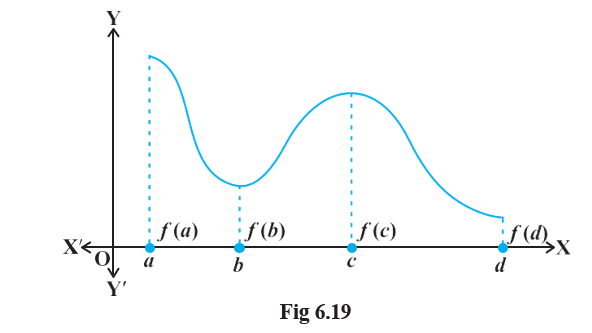
Absolute and Local Extrema

Definition

Absolute maximum and minimum — The absolute maximum (greatest) or minimum (least) value is the largest or smallest function value over the entire interval.

Key points

  • Absolute maximum: A value f(c)f(c) is an absolute maximum on an interval if f(c)≥f(x)f(c)\geq f(x) for every xx in the interval.
  • Absolute minimum: A value f(c)f(c) is an absolute minimum on an interval if f(c)≤f(x)f(c)\leq f(x) for every xx in the interval.
  • Local extrema: A local maximum or minimum is greatest or least only compared with function values near the point.
  • Endpoints matter: A function may attain an absolute extremum at an endpoint, even when the endpoint is not a local extremum under the usual interior-point definition.
  • Open vs closed interval: For f(x)=x+2f(x)=x+2, the domain (0,1)(0,1) has neither an absolute maximum nor an absolute minimum; on [0,1][0,1], the absolute minimum is 2=f(0)2=f(0) and the absolute maximum is 3=f(1)3=f(1).
A continuous curve on a closed interval, with local extrema at interior points and absolute extrema possibly at endpoints.
Worked example

Find the absolute maximum and minimum values of f(x)=2x3−15x2+36x+1f(x)=2x^3-15x^2+36x+1 on [1,5][1,5].

  1. Differentiate f(x)=2x3−15x2+36x+1f(x)=2x^3-15x^2+36x+1 on [1,5][1,5].
    f′(x)=6x2−30x+36=6(x−2)(x−3)f'(x)=6x^2-30x+36=6(x-2)(x-3)
  2. The interior critical points are x=2x=2 and x=3x=3; also include endpoints x=1x=1 and x=5x=5.
    x∈{1,2,3,5}x\in\{1,2,3,5\}
  3. Evaluate the function at every candidate.
    f(1)=24,f(2)=29,f(3)=28,f(5)=56f(1)=24,\quad f(2)=29,\quad f(3)=28,\quad f(5)=56
  4. Compare the values to identify the least and greatest.
    24<28<29<5624<28<29<56
Answer: Absolute minimum: 2424 at x=1x=1. Absolute maximum: 5656 at x=5x=5.

Existence and Critical-Point Results

Extreme Value Theorem

If ff is continuous on the closed interval [a,b][a,b], then it attains both an absolute maximum and an absolute minimum somewhere in [a,b][a,b].

Interior Extremum Condition

If ff is differentiable at an interior point cc where it attains an absolute maximum or minimum, then f′(c)=0f'(c)=0. This is a necessary condition, not a sufficient one.

Critical points

  • Critical point: An interior point where f′(x)=0f'(x)=0 or f′(x)f'(x) does not exist, provided f(x)f(x) is defined there.
  • Candidate set: Check every critical point inside the interval and both endpoints.
  • Continuity requirement: The guarantee of absolute extrema applies when the function is continuous on the entire closed interval.

Closed-Interval Method

  1. Find all interior points where the derivative is zero or undefined, with the function itself defined.
    f′(x)=0orf′(x) undefinedf'(x)=0\quad\text{or}\quad f'(x)\text{ undefined}
  2. Add both endpoints of the interval.
    a, ba,\ b
  3. Evaluate the function at every candidate point.
    f(x)f(x)
  4. The largest candidate value is the absolute maximum; the smallest is the absolute minimum.
Candidate Values on the Closed Interval
max⁡x∈Cf(x),min⁡x∈Cf(x)\max_{x\in C} f(x),\qquad \min_{x\in C} f(x)

Let CC contain all interior critical points and both endpoints, aa and bb. Compare the function values at these candidates.

⚠ Common mistake

Do not omit endpoints or points where the derivative is undefined. Also, f′(c)=0f'(c)=0 only identifies a possible interior extremum; compare function values to decide.

Practice with Nondifferentiability and Distance

Practice

Find the absolute maximum and minimum of f(x)=12x4/3−6x1/3f(x)=12x^{4/3}-6x^{1/3} on [−1,1][-1,1].

Hint: Check the endpoints, the point where f′(x)=0f'(x)=0, and where f′f' is undefined.
Key step: For x≠0x\ne0, f′(x)=2(8x−1)x2/3f'(x)=\frac{2(8x-1)}{x^{2/3}}, so the interior candidates include x=18x=\frac18 and x=0x=0.
Solution: Candidate values: f(−1)=18f(-1)=18, f(0)=0f(0)=0, f(18)=−94f(\frac18)=-\frac94, and f(1)=6f(1)=6. Thus the absolute maximum is 1818 at x=−1x=-1, and the absolute minimum is −94-\frac94 at x=18x=\frac18.
Practice

A helicopter flies along y=x2+7y=x^2+7. Find its nearest distance to a soldier at (3,7)(3,7).

Hint: Minimise the squared distance from (x,x2+7)(x,x^2+7) to (3,7)(3,7); taking the square root preserves the location of the minimum.
Key step: The squared distance is g(x)=(x−3)2+x4g(x)=(x-3)^2+x^4, and g′(x)=2(x−1)(2x2+2x+3)g'(x)=2(x-1)(2x^2+2x+3). The quadratic factor is always positive, so gg is minimised at x=1x=1.
Solution: At x=1x=1, g(1)=5g(1)=5, so the nearest distance is 5\sqrt{5}.

Why can a continuous function on an open interval fail to attain an absolute maximum or minimum?

Answer: An open interval excludes its endpoints, so a function may approach its greatest or least limiting value without attaining it. For example, f(x)=x+2f(x)=x+2 on (0,1)(0,1) has neither an absolute maximum nor an absolute minimum.

Quick recap

  • A continuous function on a closed interval attains both absolute extrema.
  • At a differentiable interior absolute extremum, f′(c)=0f'(c)=0.
  • Check points where f′=0f'=0, points where f′f' is undefined, and both endpoints.
  • Evaluate the function at every candidate and compare the values.
  • For f(x)=x+2f(x)=x+2, the open interval (0,1)(0,1) has no absolute extrema, while [0,1][0,1] has minimum 22 and maximum 33.
  • Absolute extrema describe the whole interval, while local extrema concern only nearby points.
Lecture 6

Miscellaneous Examples

Reference video · Lecture 6Miscellaneous Examples

Rates of Change and Motion — Related Rates in Geometry and Motion Examples 30–32

Definition

Rate of change — If y=f(x)y=f(x), then dydx\frac{dy}{dx} is the rate of change of yy with respect to xx; f′(x0)f'(x_0) is the rate at x=x0x=x_0.

Chain rule for related rates

If xx and yy both depend on time tt, then dydx=dy/dtdx/dt\frac{dy}{dx}=\frac{dy/dt}{dx/dt} when dxdt≠0\frac{dx}{dt}\ne0. Differentiate relations between changing quantities with respect to time.

Definition

Velocity — For position xx depending on time tt, velocity is v=dxdtv=\frac{dx}{dt}; a body is instantaneously at rest when v=0v=0.

Find stopping time and distance

  1. Differentiate position to find velocity.
    v=dxdtv=\frac{dx}{dt}
  2. Solve v=0v=0; distinguish the starting time from the later stopping time.
    v=0v=0
  3. Substitute the stopping time into the position function to find displacement from the start.
    x=x(tstop)x=x(t_{\mathrm{stop}})
Worked example

A car's position is x=t2(2−t3)x=t^2\left(2-\frac{t}{3}\right) metres. Find when it stops and the distance from its starting point.

  1. Differentiate the position function.
    x=t2(2−t3),v=dxdt=4t−t2=t(4−t)x=t^2\left(2-\frac{t}{3}\right),\qquad v=\frac{dx}{dt}=4t-t^2=t(4-t)
  2. Set velocity to zero; t=0t=0 is the start, so the later stopping time is t=4t=4 seconds.
    t(4−t)=0⟹t=0,4t(4-t)=0\quad\Longrightarrow\quad t=0,4
  3. Find the position when the car stops.
    x(4)=42(2−43)=323 mx(4)=4^2\left(2-\frac{4}{3}\right)=\frac{32}{3}\text{ m}
Answer: It stops after 44 seconds and travels 323\frac{32}{3} m from PP to QQ.
Definition

Related rates — When quantities depend on time and are linked by a geometric or physical relation, differentiate that relation with respect to time to connect their rates.

Cone volume and related rate
V=13πr2h,dVdt=dVdhdhdtV=\frac{1}{3}\pi r^2h,\qquad \frac{dV}{dt}=\frac{dV}{dh}\frac{dh}{dt}

For a cone with semi-vertical angle α\alpha, use the fixed relation tan⁡α=rh\tan\alpha=\frac{r}{h} to express volume using one variable before differentiating.
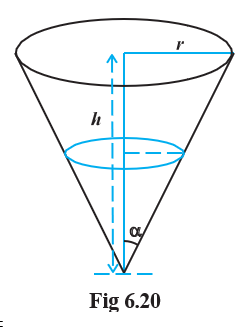
Cone geometry: water radius r, depth h, and semi-vertical angle α.
Cone geometry: water radius rr, depth hh, and semi-vertical angle α\alpha.
Worked example

Water enters an inverted cone at 5 m3/h5\text{ m}^3/\text{h}. Its semi-vertical angle is tan⁡−1(0.5)\tan^{-1}(0.5). Find the water-level rise rate at depth 44 m.

  1. The angle condition gives r=h2r=\frac{h}{2}; substitute into the cone volume.
    tan⁡α=0.5=rh,V=13π(h2)2h=πh312\tan\alpha=0.5=\frac{r}{h},\qquad V=\frac{1}{3}\pi\left(\frac{h}{2}\right)^2h=\frac{\pi h^3}{12}
  2. Differentiate with respect to time.
    dVdt=πh24dhdt\frac{dV}{dt}=\frac{\pi h^2}{4}\frac{dh}{dt}
  3. Substitute the inflow rate and the water depth h=4h=4 m.
    5=π4(4)2dhdt⟹dhdt=54π=3588 m/h5=\frac{\pi}{4}(4)^2\frac{dh}{dt}\quad\Longrightarrow\quad \frac{dh}{dt}=\frac{5}{4\pi}=\frac{35}{88}\text{ m/h}
Answer: The water level rises at 3588\frac{35}{88} m/h, using π=227\pi=\frac{22}{7}.
Similar triangles for a shadow

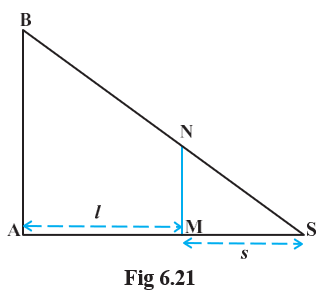
For a 66 m lamp post and a 22 m person, the person-and-shadow triangle is similar to the lamp-and-full-shadow triangle. If ll is the person's distance from the post and ss the shadow length, then sl+s=26\frac{s}{l+s}=\frac{2}{6}, so l=2sl=2s.

Similar triangles formed by a lamp post, a person, and the person's shadow.
Shadow growth rate
dldt=2dsdt\frac{dl}{dt}=2\frac{ds}{dt}

Differentiate l=2sl=2s with respect to time; the shadow grows at half the person's walking speed.

Worked example

A 22 m man walks away from a 66 m lamp post at 55 km/h. How fast does the shadow length increase?

  1. Use the similar-triangle relation and differentiate with respect to time.
    l=2s,dldt=2dsdtl=2s,\qquad \frac{dl}{dt}=2\frac{ds}{dt}
  2. Substitute the man's walking speed.
    5=2dsdt⟹dsdt=52 km/h5=2\frac{ds}{dt}\quad\Longrightarrow\quad \frac{ds}{dt}=\frac{5}{2}\text{ km/h}
Answer: The shadow length increases at 52\frac{5}{2} km/h.

Increasing and Decreasing Functions — Examples 33–34

Definition

Monotonicity — A function is increasing on an interval if x1<x2x_1<x_2 implies f(x1)<f(x2)f(x_1)<f(x_2); it is decreasing if x1<x2x_1<x_2 implies f(x1)>f(x2)f(x_1)>f(x_2). It is constant if f(x)=cf(x)=c throughout the interval.

Derivative sign test

If f′(x)>0f'(x)>0 on an interval, ff is increasing there; if f′(x)<0f'(x)<0, it is decreasing. The non-strict conditions f′(x)≥0f'(x)\ge0 and f′(x)≤0f'(x)\le0 imply non-decreasing and non-increasing behaviour, respectively.
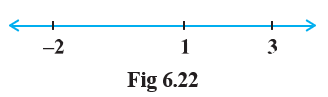
Critical values -2, 1, and 3 split the real line for a derivative sign test.
Critical values −2-2, 11, and 33 split the real line for a derivative sign test.

Find intervals of increase or decrease

  1. Differentiate and factor the derivative.
    f′(x)f'(x)
  2. Find zeros and points where the derivative is undefined; split the domain at these values.
    f′(x)=0f'(x)=0
  3. Test the derivative sign in each interval: positive means increasing and negative means decreasing.
    f′(x)>0orf′(x)<0f'(x)>0\quad\text{or}\quad f'(x)<0
Worked example

Find the intervals of increase and decrease for f(x)=310x4−45x3−3x2+365x+11f(x)=\frac{3}{10}x^4-\frac{4}{5}x^3-3x^2+\frac{36}{5}x+11.

  1. Differentiate and factor.
    f(x)=310x4−45x3−3x2+365x+11,f′(x)=65(x−1)(x+2)(x−3)f(x)=\frac{3}{10}x^4-\frac{4}{5}x^3-3x^2+\frac{36}{5}x+11,\qquad f'(x)=\frac{6}{5}(x-1)(x+2)(x-3)
  2. The zeros divide the real line into four intervals; the signs of f′f' in order are negative, positive, negative, positive.
    (−∞,−2):−,(−2,1):+,(1,3):−,(3,∞):+(-\infty,-2):-,\quad(-2,1):+,\quad(1,3):-,\quad(3,\infty):+
  3. Apply the derivative sign test.
    Increasing: (−2,1),(3,∞);decreasing: (−∞,−2),(1,3)\text{Increasing: }(-2,1),(3,\infty);\quad\text{decreasing: }(-\infty,-2),(1,3)
Answer: Increasing on (−2,1)(-2,1) and (3,∞)(3,\infty); decreasing on (−∞,−2)(-\infty,-2) and (1,3)(1,3).

Inverse-tangent example

  • Derivative: For f(x)=tan⁡−1(sin⁡x+cos⁡x)f(x)=\tan^{-1}(\sin x+\cos x), f′(x)=cos⁡x−sin⁡x2+sin⁡2xf'(x)=\frac{\cos x-\sin x}{2+\sin 2x}.
  • Sign: On (0,π4)(0,\frac{\pi}{4}), the denominator is positive and cos⁡x>sin⁡x\cos x>\sin x; hence f′(x)>0f'(x)>0 and ff is increasing.
⚠ Common mistake

Do not infer monotonicity on an entire domain from a derivative sign at one point. Split the domain at every critical number and test each interval.

Rates of Change of Area — Example 35

Rate of change of disc area
A=πr2,dAdt=2πrdrdtA=\pi r^2,\qquad \frac{dA}{dt}=2\pi r\frac{dr}{dt}

For a disc whose radius changes with time, differentiate the area formula using the chain rule.

Expanding disc example

  • Substitution: At r=3.2r=3.2 cm and drdt=0.05\frac{dr}{dt}=0.05 cm/s, dAdt=2π(3.2)(0.05)=0.320π\frac{dA}{dt}=2\pi(3.2)(0.05)=0.320\pi cm2^2/s.

Optimization: Maximum and Minimum Values — Examples 36–37

Definition

Critical point — A point cc in the domain of ff is critical if f′(c)=0f'(c)=0 or ff is not differentiable at cc.

First derivative test

At a continuous critical point cc, a change in f′f' from positive to negative gives a local maximum; a change from negative to positive gives a local minimum. If f′f' does not change sign through cc, there is neither a local maximum nor a local minimum; the source identifies such a point as a point of inflexion.

Second derivative test

If f′(c)=0f'(c)=0 and f′′(c)<0f''(c)<0, then f(c)f(c) is a local maximum; if f′(c)=0f'(c)=0 and f′′(c)>0f''(c)>0, then f(c)f(c) is a local minimum. If f′′(c)=0f''(c)=0, the test is inconclusive; use the first derivative test.

Definition

Absolute extrema — On a closed interval, the absolute maximum and minimum are the greatest and least function values among the endpoints and all critical points in the interval.

Find absolute extrema on a closed interval

  1. Find critical points in the interval: where the derivative is zero or undefined.
    f′(x)=0orf′(x) is undefinedf'(x)=0\quad\text{or}\quad f'(x)\text{ is undefined}
  2. Evaluate the function at each critical point and both endpoints.
    f(a),f(b),f(c1),…f(a),\quad f(b),\quad f(c_1),\ldots
  3. The largest value is the absolute maximum; the smallest is the absolute minimum.
    max⁡f(x),min⁡f(x)\max f(x),\qquad \min f(x)
Definition

Optimization — Optimization uses derivatives to find the maximum or minimum value of a quantity subject to given conditions.

Open-box volume
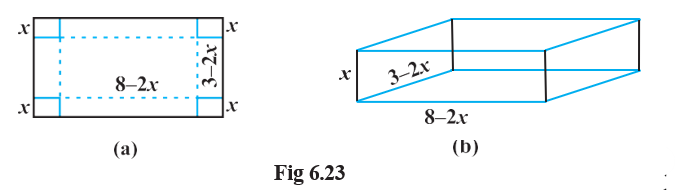
V(x)=x(3−2x)(8−2x),0<x<32V(x)=x(3-2x)(8-2x),\qquad 0<x<\frac{3}{2}

Cut squares of side xx metres from each corner of a 3 m×8 m3\text{ m}\times8\text{ m} sheet; the box has height xx, breadth 3−2x3-2x, and length 8−2x8-2x.

A rectangular sheet folded into an open box after equal corner squares are removed.

Optimize a quantity

  1. Express the quantity as a function of one variable and state its feasible domain.
    Q=Q(x)Q=Q(x)
  2. Find stationary points and discard values outside the domain.
    Q′(x)=0Q'(x)=0
  3. Use a derivative test to classify each candidate, then evaluate the quantity there.
    Q′′(x)<0Q''(x)<0
Worked example

Find the maximum volume of an open box made by cutting equal squares from a 33 m by 88 m sheet.

  1. Expand and differentiate the volume function.
    V(x)=x(3−2x)(8−2x)=4x3−22x2+24x,V′(x)=12x2−44x+24V(x)=x(3-2x)(8-2x)=4x^3-22x^2+24x,\qquad V'(x)=12x^2-44x+24
  2. Solve for stationary points; x=3x=3 is outside the feasible range.
    V′(x)=0⟹x=3,23;0<x<32V'(x)=0\quad\Longrightarrow\quad x=3,\frac{2}{3};\qquad 0<x<\frac{3}{2}
  3. Confirm the feasible stationary point gives a maximum.
    V′′(x)=24x−44,V′′(23)=−28<0V''(x)=24x-44,\qquad V''\left(\frac{2}{3}\right)=-28<0
  4. Evaluate the maximum volume.
    V(23)=20027 m3V\left(\frac{2}{3}\right)=\frac{200}{27}\text{ m}^3
Answer: Cut squares of side 23\frac{2}{3} m; the maximum volume is 20027 m3\frac{200}{27}\text{ m}^3.
⚠ Common mistake

A stationary point outside the physical domain is not a valid solution. Here x=3x=3 makes the box breadth negative.

Optimization: Maximum Profit — Example 37

Definition

Profit — Profit is total selling revenue minus total cost; maximize the profit function to find the most profitable output.

Revenue, cost, and profit
S(x)=x(5−x100),C(x)=x5+500,P(x)=S(x)−C(x)S(x)=x\left(5-\frac{x}{100}\right),\qquad C(x)=\frac{x}{5}+500,\qquad P(x)=S(x)-C(x)

If each of xx items sells for Rs. 5−x1005-\frac{x}{100} and total cost is Rs. x5+500\frac{x}{5}+500, profit is revenue minus cost.

Worked example

A manufacturer sells each of xx items for Rs. 5−x1005-\frac{x}{100} and has total cost Rs. x5+500\frac{x}{5}+500. How many items should be sold to maximize profit?

  1. Form the profit function.
    P(x)=5x−x2100−(x5+500)=245x−x2100−500P(x)=5x-\frac{x^2}{100}-\left(\frac{x}{5}+500\right)=\frac{24}{5}x-\frac{x^2}{100}-500
  2. Find the stationary output and verify it is a maximum.
    P′(x)=245−x50=0⟹x=240,P′′(x)=−150<0P'(x)=\frac{24}{5}-\frac{x}{50}=0\quad\Longrightarrow\quad x=240,\qquad P''(x)=-\frac{1}{50}<0
  3. Evaluate the maximum profit.
    P(240)=245(240)−2402100−500=76P(240)=\frac{24}{5}(240)-\frac{240^2}{100}-500=76
Answer: Sell 240240 items; the maximum profit is Rs. 76.
Practice

A sphere's radius increases at 0.20.2 cm/s. Find the rate of increase of its volume when r=3r=3 cm.

Hint: Differentiate V=43πr3V=\frac{4}{3}\pi r^3 with respect to time.
Key step: dVdt=4πr2drdt\frac{dV}{dt}=4\pi r^2\frac{dr}{dt}.
Solution: dVdt=4π(3)2(0.2)=7.2π cm3/s\frac{dV}{dt}=4\pi(3)^2(0.2)=7.2\pi\text{ cm}^3/\text{s}.
Practice

Find the intervals of increase and decrease of g(x)=x3−3xg(x)=x^3-3x.

Hint: Differentiate and test signs on either side of the critical numbers.
Key step: g′(x)=3(x−1)(x+1)g'(x)=3(x-1)(x+1); the critical numbers are −1-1 and 11.
Solution: g′(x)>0g'(x)>0 on (−∞,−1)(-\infty,-1) and (1,∞)(1,\infty), and g′(x)<0g'(x)<0 on (−1,1)(-1,1). Thus gg increases on the outer intervals and decreases on (−1,1)(-1,1).
Practice

A rectangle has perimeter 2020 m. Find the dimensions giving the greatest area.

Hint: Let one side be xx; the other is 10−x10-x.
Key step: A(x)=x(10−x)A(x)=x(10-x) has stationary point x=5x=5, with A′′(x)=−2<0A''(x)=-2<0.
Solution: The rectangle is a 55 m by 55 m square; its maximum area is 25 m225\text{ m}^2.

Quick recap

  • Differentiate position with respect to time to obtain velocity; a later zero of velocity can indicate a stopping time.
  • For related rates, first connect the quantities, then differentiate with respect to time.
  • The sign of f′f' determines intervals of increase and decrease.
  • At a critical point, a change in f′f' from positive to negative gives a local maximum; negative to positive gives a local minimum. No sign change means neither, and is identified here as a point of inflexion.
  • For absolute extrema on a closed interval, compare function values at critical points and endpoints.
  • In optimization, verify candidates satisfy the physical or practical domain and use a derivative test to classify them.

Formula sheet

Time-rate chain rule
dydt=dydxdxdt\frac{dy}{dt}=\frac{dy}{dx}\frac{dx}{dt}
Marginal quantities
MC=dCdx,MR=dRdx\mathrm{MC}=\frac{dC}{dx},\qquad \mathrm{MR}=\frac{dR}{dx}
Derivative sign conditions
f′(x)>0,f′(x)<0,f′(x)=0f'(x)>0,\qquad f'(x)<0,\qquad f'(x)=0
Local extrema condition
f(c)≥f(x),f(c)≤f(x)f(c)\geq f(x),\qquad f(c)\leq f(x)
First derivative sign test
+→−⇒maximum,−→+⇒minimum,+→+ or −→−⇒no extremum+\to-\Rightarrow\text{maximum},\qquad -\to+\Rightarrow\text{minimum},\qquad +\to+\text{ or }-\to-\Rightarrow\text{no extremum}
Second derivative test: local maximum
f′(c)=0,f′′(c)<0f'(c)=0,\qquad f''(c)<0
Second derivative test: local minimum
f′(c)=0,f′′(c)>0f'(c)=0,\qquad f''(c)>0
Inconclusive second derivative test
f′(c)=0,f′′(c)=0f'(c)=0,\qquad f''(c)=0
Sum of squares for a fixed sum
S(x)=x2+(k−x)2S(x)=x^2+(k-x)^2
Distance from (0,c)(0,c) to y=x2y=x^2
D(k)=k+(k−c)2,k≥0D(k)=\sqrt{k+(k-c)^2},\qquad k\ge0
Sum of squared pole distances
S(x)=x2+a2+(L−x)2+b2S(x)=x^2+a^2+(L-x)^2+b^2
Trapezium area
A(x)=12(20+2x)100−x2=(x+10)100−x2A(x)=\frac{1}{2}(20+2x)\sqrt{100-x^2}=(x+10)\sqrt{100-x^2}
Cylinder dimensions and curved surface area
H=h(r−x)r,S(x)=2πxH=2πhr(rx−x2)H=\frac{h(r-x)}{r},\qquad S(x)=2\pi xH=\frac{2\pi h}{r}(rx-x^2)
Candidate Values on the Closed Interval
max⁡x∈Cf(x),min⁡x∈Cf(x)\max_{x\in C} f(x),\qquad \min_{x\in C} f(x)
Cone volume and related rate
V=13πr2h,dVdt=dVdhdhdtV=\frac{1}{3}\pi r^2h,\qquad \frac{dV}{dt}=\frac{dV}{dh}\frac{dh}{dt}
Shadow growth rate
dldt=2dsdt\frac{dl}{dt}=2\frac{ds}{dt}
Rate of change of disc area
A=πr2,dAdt=2πrdrdtA=\pi r^2,\qquad \frac{dA}{dt}=2\pi r\frac{dr}{dt}
Open-box volume
V(x)=x(3−2x)(8−2x),0<x<32V(x)=x(3-2x)(8-2x),\qquad 0<x<\frac{3}{2}
Revenue, cost, and profit
S(x)=x(5−x100),C(x)=x5+500,P(x)=S(x)−C(x)S(x)=x\left(5-\frac{x}{100}\right),\qquad C(x)=\frac{x}{5}+500,\qquad P(x)=S(x)-C(x)

Mathematics — ALL CHAPTERS

1

Relations And Functions

View

2

Inverse Trigonometric Functions

View

3

Matrices

View

4

DETERMINANTS 

View

5

Continuity And Differentiability

View

6

Application Of Derivatives

View

7

Integrals

View

8

APPLICATION OF INTEGRALS

View

9

DIFFERENTIAL EQUATIONS

View

10

VECTOR ALGEBRA

View

11

Three Dimensional Geometry

View

12

Linear Programming

View

13

Probability

View

14

Proofs In Mathematics

View

15

Mathematical Modelling

View