Lecture 1
Introduction
Reference video · Lecture 1 Introduction
Vector Approach to Three-Dimensional Geometry
Chapter focus Approach: Vector algebra provides a simple way to study geometry in three-dimensional space, alongside Cartesian methods.Topics ahead: Direction cosines and ratios; equations of lines and planes; angles between lines and planes; shortest distance between skew lines; distance from a point to a plane.Direction Cosines and Direction Ratios
Definition Direction angles — The angles a directed line makes with the positive x x x y y y z z z α \alpha α β \beta β γ \gamma γ
Definition Direction cosines — The cosines of a directed line's direction angles are its direction cosines, written l l l m m m n n n
Direction-cosine properties For a directed line, l = cos α l=\cos\alpha l = cos α m = cos β m=\cos\beta m = cos β n = cos γ n=\cos\gamma n = cos γ l 2 + m 2 + n 2 = 1 l^2+m^2+n^2=1 l 2 + m 2 + n 2 = 1
l = cos α , m = cos β , n = cos γ , l 2 + m 2 + n 2 = 1 l=\cos\alpha,\quad m=\cos\beta,\quad n=\cos\gamma,\quad l^2+m^2+n^2=1 l = cos α , m = cos β , n = cos γ , l 2 + m 2 + n 2 = 1 Definition Direction ratios — Any three numbers proportional to the direction cosines of a line are called its direction ratios (direction numbers).
Direction-ratio properties If ( a , b , c ) (a,b,c) ( a , b , c ) ( k a , k b , k c ) (ka,kb,kc) ( k a , k b , k c )
Find direction cosines from direction ratios Find the length of the direction-ratio triple.a 2 + b 2 + c 2 \sqrt{a^2+b^2+c^2} a 2 + b 2 + c 2 Divide each direction ratio by this length.( a a 2 + b 2 + c 2 , b a 2 + b 2 + c 2 , c a 2 + b 2 + c 2 ) \left(\frac{a}{\sqrt{a^2+b^2+c^2}},\frac{b}{\sqrt{a^2+b^2+c^2}},\frac{c}{\sqrt{a^2+b^2+c^2}}\right) ( a 2 + b 2 + c 2 a , a 2 + b 2 + c 2 b , a 2 + b 2 + c 2 c ) Reverse all signs if the opposite direction is required.( l , m , n ) ↦ ( − l , − m , − n ) (l,m,n)\mapsto(-l,-m,-n) ( l , m , n ) ↦ ( − l , − m , − n )
Worked example
Find the direction cosines of a line whose direction ratios are ( 2 , − 1 , − 2 ) (2,-1,-2) ( 2 , − 1 , − 2 )
Find the direction cosines of a line with direction ratios ( 2 , − 1 , − 2 ) (2,-1,-2) ( 2 , − 1 , − 2 ) 2 2 + ( − 1 ) 2 + ( − 2 ) 2 = 3 \sqrt{2^2+(-1)^2+(-2)^2}=3 2 2 + ( − 1 ) 2 + ( − 2 ) 2 = 3 Divide each direction ratio by the length.( l , m , n ) = ( 2 3 , − 1 3 , − 2 3 ) (l,m,n)=\left(\frac{2}{3},-\frac{1}{3},-\frac{2}{3}\right) ( l , m , n ) = ( 3 2 , − 3 1 , − 3 2 ) Check that the squares sum to one.4 9 + 1 9 + 4 9 = 1 \frac{4}{9}+\frac{1}{9}+\frac{4}{9}=1 9 4 + 9 1 + 9 4 = 1 Answer: ( l , m , n ) = ( 2 3 , − 1 3 , − 2 3 ) (l,m,n)=\left(\frac{2}{3},-\frac{1}{3},-\frac{2}{3}\right) ( l , m , n ) = ( 3 2 , − 3 1 , − 3 2 ) for this orientation; the opposite orientation has all signs reversed.
⚠ Common mistake Do not treat direction ratios as a unique triple: any nonzero proportional triple works. Direction cosines, however, must satisfy l 2 + m 2 + n 2 = 1 l^2+m^2+n^2=1 l 2 + m 2 + n 2 = 1
Direction Cosines and Ratios Between Two Points
Definition Direction of a line segment — For points P ( x 1 , y 1 , z 1 ) P(x_1,y_1,z_1) P ( x 1 , y 1 , z 1 ) Q ( x 2 , y 2 , z 2 ) Q(x_2,y_2,z_2) Q ( x 2 , y 2 , z 2 ) P P P Q Q Q P Q → \overrightarrow{PQ} P Q
Direction ratios between points A direction-ratio set for P Q PQ P Q ( x 2 − x 1 , y 2 − y 1 , z 2 − z 1 ) (x_2-x_1,y_2-y_1,z_2-z_1) ( x 2 − x 1 , y 2 − y 1 , z 2 − z 1 ) ( x 1 − x 2 , y 1 − y 2 , z 1 − z 2 ) (x_1-x_2,y_1-y_2,z_1-z_2) ( x 1 − x 2 , y 1 − y 2 , z 1 − z 2 )
Find direction cosines between two points Subtract the coordinates of the starting point from the ending point.( x 2 − x 1 , y 2 − y 1 , z 2 − z 1 ) (x_2-x_1,y_2-y_1,z_2-z_1) ( x 2 − x 1 , y 2 − y 1 , z 2 − z 1 ) Find the length of this difference triple.d = ( x 2 − x 1 ) 2 + ( y 2 − y 1 ) 2 + ( z 2 − z 1 ) 2 d=\sqrt{(x_2-x_1)^2+(y_2-y_1)^2+(z_2-z_1)^2} d = ( x 2 − x 1 ) 2 + ( y 2 − y 1 ) 2 + ( z 2 − z 1 ) 2 Divide each difference by the length.( l , m , n ) = ( x 2 − x 1 d , y 2 − y 1 d , z 2 − z 1 d ) (l,m,n)=\left(\frac{x_2-x_1}{d},\frac{y_2-y_1}{d},\frac{z_2-z_1}{d}\right) ( l , m , n ) = ( d x 2 − x 1 , d y 2 − y 1 , d z 2 − z 1 )
Worked example
Find the direction cosines of the line directed from P ( − 2 , 4 , − 5 ) P(-2,4,-5) P ( − 2 , 4 , − 5 ) Q ( 1 , 2 , 3 ) Q(1,2,3) Q ( 1 , 2 , 3 )
Find the direction cosines from P ( − 2 , 4 , − 5 ) P(-2,4,-5) P ( − 2 , 4 , − 5 ) Q ( 1 , 2 , 3 ) Q(1,2,3) Q ( 1 , 2 , 3 ) ( 1 − ( − 2 ) , 2 − 4 , 3 − ( − 5 ) ) = ( 3 , − 2 , 8 ) (1-(-2),2-4,3-(-5))=(3,-2,8) ( 1 − ( − 2 ) , 2 − 4 , 3 − ( − 5 )) = ( 3 , − 2 , 8 ) Find the distance between the points.d = 3 2 + ( − 2 ) 2 + 8 2 = 77 d=\sqrt{3^2+(-2)^2+8^2}=\sqrt{77} d = 3 2 + ( − 2 ) 2 + 8 2 = 77 Divide the coordinate differences by the distance.( l , m , n ) = ( 3 77 , − 2 77 , 8 77 ) (l,m,n)=\left(\frac{3}{\sqrt{77}},-\frac{2}{\sqrt{77}},\frac{8}{\sqrt{77}}\right) ( l , m , n ) = ( 77 3 , − 77 2 , 77 8 ) Answer: ( l , m , n ) = ( 3 77 , − 2 77 , 8 77 ) (l,m,n)=\left(\frac{3}{\sqrt{77}},-\frac{2}{\sqrt{77}},\frac{8}{\sqrt{77}}\right) ( l , m , n ) = ( 77 3 , − 77 2 , 77 8 ) for the direction from
P P P to
Q Q Q .
Collinear Points
Definition Collinear points — Three points are collinear if they lie on the same straight line.
Collinearity test using direction ratios If direction-ratio triples for two segments sharing a point are proportional, the segments are parallel; since they share a point, their endpoints lie on the same line.
A B → ∥ B C → ⟹ A , B , C are collinear \overrightarrow{AB}\parallel\overrightarrow{BC}\;\Longrightarrow\;A,B,C\text{ are collinear} A B ∥ B C ⟹ A , B , C are collinear
Test whether three points are collinear Find direction-ratio triples for two segments with a common endpoint.A B → = ( x B − x A , y B − y A , z B − z A ) , B C → = ( x C − x B , y C − y B , z C − z B ) \overrightarrow{AB}=(x_B-x_A,y_B-y_A,z_B-z_A),\quad\overrightarrow{BC}=(x_C-x_B,y_C-y_B,z_C-z_B) A B = ( x B − x A , y B − y A , z B − z A ) , B C = ( x C − x B , y C − y B , z C − z B ) Check whether one triple is a scalar multiple of the other.B C → = k A B → \overrightarrow{BC}=k\overrightarrow{AB} B C = k A B If they are proportional, conclude that the three points are collinear.A , B , C are collinear A,B,C\text{ are collinear} A , B , C are collinear
Worked example
Show that the points A ( 2 , 3 , − 4 ) A(2,3,-4) A ( 2 , 3 , − 4 ) B ( 1 , − 2 , 3 ) B(1,-2,3) B ( 1 , − 2 , 3 ) C ( 3 , 8 , − 11 ) C(3,8,-11) C ( 3 , 8 , − 11 )
For A ( 2 , 3 , − 4 ) A(2,3,-4) A ( 2 , 3 , − 4 ) B ( 1 , − 2 , 3 ) B(1,-2,3) B ( 1 , − 2 , 3 ) C ( 3 , 8 , − 11 ) C(3,8,-11) C ( 3 , 8 , − 11 ) A B AB A B B C BC B C A B → = ( − 1 , − 5 , 7 ) , B C → = ( 2 , 10 , − 14 ) \overrightarrow{AB}=(-1,-5,7),\quad\overrightarrow{BC}=(2,10,-14) A B = ( − 1 , − 5 , 7 ) , B C = ( 2 , 10 , − 14 ) Compare the triples.B C → = − 2 A B → \overrightarrow{BC}=-2\overrightarrow{AB} B C = − 2 A B The triples are proportional and the segments share B B B A , B , C are collinear A,B,C\text{ are collinear} A , B , C are collinear Answer: The direction ratios are proportional, so
A A A ,
B B B and
C C C are collinear.
Coordinate axes as examples x x x ( 1 , 0 , 0 ) (1,0,0) ( 1 , 0 , 0 ) y y y ( 0 , 1 , 0 ) (0,1,0) ( 0 , 1 , 0 ) z z z ( 0 , 0 , 1 ) (0,0,1) ( 0 , 0 , 1 )
Practice
A directed line makes angles 90 ∘ 90^\circ 9 0 ∘ 60 ∘ 60^\circ 6 0 ∘ 30 ∘ 30^\circ 3 0 ∘
Hint: Take the cosine of each direction angle.
Key step: Use
( l , m , n ) = ( cos α , cos β , cos γ ) (l,m,n)=(\cos\alpha,\cos\beta,\cos\gamma) ( l , m , n ) = ( cos α , cos β , cos γ ) .
Solution: ( l , m , n ) = ( cos 90 ∘ , cos 60 ∘ , cos 30 ∘ ) = ( 0 , 1 2 , 3 2 ) (l,m,n)=(\cos90^\circ,\cos60^\circ,\cos30^\circ)=\left(0,\frac12,\frac{\sqrt3}{2}\right) ( l , m , n ) = ( cos 9 0 ∘ , cos 6 0 ∘ , cos 3 0 ∘ ) = ( 0 , 2 1 , 2 3 ) .
Practice
Find the direction cosines from A ( 0 , 1 , 2 ) A(0,1,2) A ( 0 , 1 , 2 ) B ( 2 , 2 , 1 ) B(2,2,1) B ( 2 , 2 , 1 )
Hint: Use the coordinate differences in the order
B − A B-A B − A , then normalize.
Key step: The differences are
( 2 , 1 , − 1 ) (2,1,-1) ( 2 , 1 , − 1 ) and their length is
6 \sqrt6 6 .
Solution: ( l , m , n ) = ( 2 6 , 1 6 , − 1 6 ) (l,m,n)=\left(\frac{2}{\sqrt6},\frac{1}{\sqrt6},-\frac{1}{\sqrt6}\right) ( l , m , n ) = ( 6 2 , 6 1 , − 6 1 ) .
Quick recap
Direction cosines are the cosines of the three direction angles: l = cos α l=\cos\alpha l = cos α m = cos β m=\cos\beta m = cos β n = cos γ n=\cos\gamma n = cos γ Direction cosines satisfy l 2 + m 2 + n 2 = 1 l^2+m^2+n^2=1 l 2 + m 2 + n 2 = 1 Direction ratios are any proportional triple, and nonzero scalar multiples represent the same line direction. Normalize direction ratios by dividing by a 2 + b 2 + c 2 \sqrt{a^2+b^2+c^2} a 2 + b 2 + c 2 Between two points, subtract starting coordinates from ending coordinates; divide these differences by the distance for direction cosines. Three points are collinear when direction-ratio triples of two segments sharing a point are proportional.
Lecture 2
Equation Of A Line In Space
Reference video · Lecture 2 Equation Of A Line In Space
Equation of a Line Through a Given Point
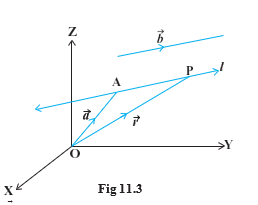
Definition Line in space — A line is uniquely determined by a point on it and its direction, or by two distinct points on it.
Key ideas Direction vector: For a line through a point with position vector a ⃗ \vec a a b ⃗ \vec b b r ⃗ = a ⃗ + λ b ⃗ \vec r=\vec a+\lambda\vec b r = a + λ b Direction ratios: If b ⃗ = a i ^ + b j ^ + c k ^ \vec b=a\hat i+b\hat j+c\hat k b = a i ^ + b j ^ + c k ^ ( a , b , c ) (a,b,c) ( a , b , c ) Two given points: For position vectors a ⃗ \vec a a p ⃗ \vec p p p ⃗ − a ⃗ \vec p-\vec a p − a Direction cosines: The direction cosines ( l , m , n ) (l,m,n) ( l , m , n ) A line through points A A A P P P Parametric and Cartesian forms For a line through ( x 1 , y 1 , z 1 ) (x_1,y_1,z_1) ( x 1 , y 1 , z 1 ) ( a , b , c ) (a,b,c) ( a , b , c ) λ \lambda λ
Forms of the equation of a line
Form Equation Vector r ⃗ = a ⃗ + λ b ⃗ \vec r=\vec a+\lambda\vec b r = a + λ b Parametric x = x 1 + λ a , y = y 1 + λ b , z = z 1 + λ c x=x_1+\lambda a,\quad y=y_1+\lambda b,\quad z=z_1+\lambda c x = x 1 + λa , y = y 1 + λb , z = z 1 + λ c Cartesian (symmetric) x − x 1 a = y − y 1 b = z − z 1 c \frac{x-x_1}{a}=\frac{y-y_1}{b}=\frac{z-z_1}{c} a x − x 1 = b y − y 1 = c z − z 1 Cartesian using direction cosines x − x 1 l = y − y 1 m = z − z 1 n \frac{x-x_1}{l}=\frac{y-y_1}{m}=\frac{z-z_1}{n} l x − x 1 = m y − y 1 = n z − z 1
Writing the line equation Identify a point ( x 1 , y 1 , z 1 ) (x_1,y_1,z_1) ( x 1 , y 1 , z 1 ) ( a , b , c ) (a,b,c) ( a , b , c ) Write the vector equation using the point's position vector and the direction vector.r ⃗ = ( x 1 i ^ + y 1 j ^ + z 1 k ^ ) + λ ( a i ^ + b j ^ + c k ^ ) \vec r=(x_1\hat i+y_1\hat j+z_1\hat k)+\lambda(a\hat i+b\hat j+c\hat k) r = ( x 1 i ^ + y 1 j ^ + z 1 k ^ ) + λ ( a i ^ + b j ^ + c k ^ ) Read off the parametric equations, then eliminate λ \lambda λ x = x 1 + λ a , y = y 1 + λ b , z = z 1 + λ c x=x_1+\lambda a,\quad y=y_1+\lambda b,\quad z=z_1+\lambda c x = x 1 + λa , y = y 1 + λb , z = z 1 + λ c
Worked example
Find the vector and Cartesian equations of the line through ( 5 , 2 , − 4 ) (5,2,-4) ( 5 , 2 , − 4 ) 3 i ^ + 2 j ^ − 8 k ^ 3\hat i+2\hat j-8\hat k 3 i ^ + 2 j ^ − 8 k ^
The line passes through ( 5 , 2 , − 4 ) (5,2,-4) ( 5 , 2 , − 4 ) a ⃗ = 5 i ^ + 2 j ^ − 4 k ^ , b ⃗ = 3 i ^ + 2 j ^ − 8 k ^ \vec a=5\hat i+2\hat j-4\hat k,\quad \vec b=3\hat i+2\hat j-8\hat k a = 5 i ^ + 2 j ^ − 4 k ^ , b = 3 i ^ + 2 j ^ − 8 k ^ Substitute the point and direction vector into the vector equation.r ⃗ = 5 i ^ + 2 j ^ − 4 k ^ + λ ( 3 i ^ + 2 j ^ − 8 k ^ ) \vec r=5\hat i+2\hat j-4\hat k+\lambda(3\hat i+2\hat j-8\hat k) r = 5 i ^ + 2 j ^ − 4 k ^ + λ ( 3 i ^ + 2 j ^ − 8 k ^ ) Use direction ratios ( 3 , 2 , − 8 ) (3,2,-8) ( 3 , 2 , − 8 ) x − 5 3 = y − 2 2 = z + 4 − 8 \frac{x-5}{3}=\frac{y-2}{2}=\frac{z+4}{-8} 3 x − 5 = 2 y − 2 = − 8 z + 4 Answer: Vector equation:
r ⃗ = 5 i ^ + 2 j ^ − 4 k ^ + λ ( 3 i ^ + 2 j ^ − 8 k ^ ) \vec r=5\hat i+2\hat j-4\hat k+\lambda(3\hat i+2\hat j-8\hat k) r = 5 i ^ + 2 j ^ − 4 k ^ + λ ( 3 i ^ + 2 j ^ − 8 k ^ ) . Cartesian equation:
x − 5 3 = y − 2 2 = z + 4 − 8 \frac{x-5}{3}=\frac{y-2}{2}=\frac{z+4}{-8} 3 x − 5 = 2 y − 2 = − 8 z + 4 .
⚠ Common mistake Do not divide by a zero direction ratio in the symmetric form; use the parametric form instead. For example, if a = 0 a=0 a = 0 x = x 1 x=x_1 x = x 1
Angle Between Two Lines
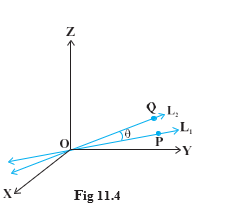
Definition Angle between two lines — The angle between two lines is the acute angle between their direction vectors, independent of where the lines are positioned.
Key ideas Direction vectors: Only the directions matter; parallel copies of lines through the origin have the same angle.Perpendicular lines: Their direction vectors have dot product zero.Parallel lines: Their direction-ratio triples are proportional.Two directions in space and the acute angle between them. Parallel and perpendicular tests For direction ratios ( a 1 , b 1 , c 1 ) (a_1,b_1,c_1) ( a 1 , b 1 , c 1 ) ( a 2 , b 2 , c 2 ) (a_2,b_2,c_2) ( a 2 , b 2 , c 2 )
a 1 a 2 + b 1 b 2 + c 1 c 2 = 0 , ( a 1 , b 1 , c 1 ) = k ( a 2 , b 2 , c 2 ) a_1a_2+b_1b_2+c_1c_2=0,\quad (a_1,b_1,c_1)=k(a_2,b_2,c_2) a 1 a 2 + b 1 b 2 + c 1 c 2 = 0 , ( a 1 , b 1 , c 1 ) = k ( a 2 , b 2 , c 2 )
Finding the angle between two lines Extract a direction vector from each line equation. Substitute the direction ratios into the cosine formula and take the absolute value.cos θ = ∣ b ⃗ 1 ⋅ b ⃗ 2 ∣ b ⃗ 1 ∣ ∣ b ⃗ 2 ∣ ∣ \cos\theta=\left|\frac{\vec b_1\cdot\vec b_2}{|\vec b_1||\vec b_2|}\right| cos θ = ∣ b 1 ∣∣ b 2 ∣ b 1 ⋅ b 2 Apply inverse cosine if the angle itself is required.θ = cos − 1 ( cos θ ) \theta=\cos^{-1}(\cos\theta) θ = cos − 1 ( cos θ )
Worked example
Find the angle between r ⃗ = 3 i ^ + 2 j ^ − 4 k ^ + λ ( i ^ + 2 j ^ + 2 k ^ ) \vec r=3\hat i+2\hat j-4\hat k+\lambda(\hat i+2\hat j+2\hat k) r = 3 i ^ + 2 j ^ − 4 k ^ + λ ( i ^ + 2 j ^ + 2 k ^ ) r ⃗ = 5 i ^ − 2 j ^ + μ ( 3 i ^ + 2 j ^ + 6 k ^ ) \vec r=5\hat i-2\hat j+\mu(3\hat i+2\hat j+6\hat k) r = 5 i ^ − 2 j ^ + μ ( 3 i ^ + 2 j ^ + 6 k ^ )
Read the direction vectors from the line equations.b ⃗ 1 = i ^ + 2 j ^ + 2 k ^ , b ⃗ 2 = 3 i ^ + 2 j ^ + 6 k ^ \vec b_1=\hat i+2\hat j+2\hat k,\quad \vec b_2=3\hat i+2\hat j+6\hat k b 1 = i ^ + 2 j ^ + 2 k ^ , b 2 = 3 i ^ + 2 j ^ + 6 k ^ Calculate the dot product and the vector lengths.b ⃗ 1 ⋅ b ⃗ 2 = 3 + 4 + 12 = 19 , ∣ b ⃗ 1 ∣ = 3 , ∣ b ⃗ 2 ∣ = 7 \vec b_1\cdot\vec b_2=3+4+12=19,\quad |\vec b_1|=3,\quad |\vec b_2|=7 b 1 ⋅ b 2 = 3 + 4 + 12 = 19 , ∣ b 1 ∣ = 3 , ∣ b 2 ∣ = 7 Use the formula for the acute angle between lines.cos θ = ∣ 19 3 ⋅ 7 ∣ = 19 21 \cos\theta=\left|\frac{19}{3\cdot7}\right|=\frac{19}{21} cos θ = 3 ⋅ 7 19 = 21 19 Answer: θ = cos − 1 ( 19 21 ) \theta=\cos^{-1}\left(\frac{19}{21}\right) θ = cos − 1 ( 21 19 ) .
⚠ Common mistake For the acute angle between lines, keep the absolute value in the cosine formula; otherwise, oppositely directed vectors may produce an obtuse angle.
Practice
Find vector and Cartesian equations of the line through A ( 1 , − 2 , 3 ) A(1,-2,3) A ( 1 , − 2 , 3 ) B ( 4 , 0 , − 1 ) B(4,0,-1) B ( 4 , 0 , − 1 )
Hint: Use
A B → \overrightarrow{AB} A B as a direction vector.
Key step: A B → = ( 3 , 2 , − 4 ) \overrightarrow{AB}=(3,2,-4) A B = ( 3 , 2 , − 4 ) .
Solution: Vector equation:
r ⃗ = ( i ^ − 2 j ^ + 3 k ^ ) + λ ( 3 i ^ + 2 j ^ − 4 k ^ ) \vec r=(\hat i-2\hat j+3\hat k)+\lambda(3\hat i+2\hat j-4\hat k) r = ( i ^ − 2 j ^ + 3 k ^ ) + λ ( 3 i ^ + 2 j ^ − 4 k ^ ) . Cartesian equation:
x − 1 3 = y + 2 2 = z − 3 − 4 \frac{x-1}{3}=\frac{y+2}{2}=\frac{z-3}{-4} 3 x − 1 = 2 y + 2 = − 4 z − 3 .
Practice
Find the angle between lines with direction ratios ( 3 , 5 , 4 ) (3,5,4) ( 3 , 5 , 4 ) ( 1 , 1 , 2 ) (1,1,2) ( 1 , 1 , 2 )
Hint: Use the dot-product cosine formula and take the absolute value.
Key step: The dot product is
16 16 16 ; the vector lengths are
50 \sqrt{50} 50 and
6 \sqrt{6} 6 .
Solution: cos θ = 16 50 6 = 8 3 15 \cos\theta=\frac{16}{\sqrt{50}\sqrt{6}}=\frac{8\sqrt{3}}{15} cos θ = 50 6 16 = 15 8 3 , so
θ = cos − 1 ( 8 3 15 ) \theta=\cos^{-1}\left(\frac{8\sqrt{3}}{15}\right) θ = cos − 1 ( 15 8 3 ) .
Quick recap
A point and a non-zero direction vector determine a line in space; two distinct points also determine a line. The vector equation is r ⃗ = a ⃗ + λ b ⃗ \vec r=\vec a+\lambda\vec b r = a + λ b Direction ratios are the components of a direction vector; direction cosines may also serve as direction ratios. The angle between lines depends only on their directions and is found using the dot-product formula. Lines are perpendicular when the direction-vector dot product is zero and parallel when their direction ratios are proportional. The sine formula using direction cosines has squared terms ( l 1 m 2 − l 2 m 1 ) 2 (l_1m_2-l_2m_1)^2 ( l 1 m 2 − l 2 m 1 ) 2 ( m 1 n 2 − m 2 n 1 ) 2 (m_1n_2-m_2n_1)^2 ( m 1 n 2 − m 2 n 1 ) 2 ( n 1 l 2 − n 2 l 1 ) 2 (n_1l_2-n_2l_1)^2 ( n 1 l 2 − n 2 l 1 ) 2
Lecture 3
Shortest Distance Between Two Lines
Reference video · Lecture 3 Shortest Distance Between Two Lines
Shortest Distance and Types of Line Pairs.
Definition Shortest distance — The shortest distance between two lines is the minimum length of a segment joining a point on each line.
Line-pair cases Intersecting lines: Their shortest distance is 0 0 0 Parallel lines: Their shortest distance is the perpendicular distance between them.Skew lines: They do not intersect, are not parallel, and are non-coplanar.Common perpendicular: The shortest segment between skew lines is perpendicular to both.Distance Between Two Skew Lines
Definition Skew lines — Skew lines are non-parallel, non-intersecting lines that lie in different planes.
Key idea Vector forms: Write the lines as r ⃗ = a ⃗ 1 + λ b ⃗ 1 \vec r=\vec a_1+\lambda\vec b_1 r = a 1 + λ b 1 r ⃗ = a ⃗ 2 + μ b ⃗ 2 \vec r=\vec a_2+\mu\vec b_2 r = a 2 + μ b 2 Shortest-segment direction: It is parallel to b ⃗ 1 × b ⃗ 2 \vec b_1\times\vec b_2 b 1 × b 2 Projection: The distance is the magnitude of the projection of the joining vector a ⃗ 2 − a ⃗ 1 \vec a_2-\vec a_1 a 2 − a 1
Find the distance between skew lines Identify a point vector and direction vector from each line.a ⃗ 1 , b ⃗ 1 , a ⃗ 2 , b ⃗ 2 \vec a_1,\vec b_1,\vec a_2,\vec b_2 a 1 , b 1 , a 2 , b 2 Find the cross product of the direction vectors.b ⃗ 1 × b ⃗ 2 \vec b_1\times\vec b_2 b 1 × b 2 Dot this cross product with the joining vector, take the absolute value, and divide by the cross-product magnitude.d = ∣ ( b ⃗ 1 × b ⃗ 2 ) ⋅ ( a ⃗ 2 − a ⃗ 1 ) ∣ ∣ b ⃗ 1 × b ⃗ 2 ∣ d=\frac{|(\vec b_1\times\vec b_2)\cdot(\vec a_2-\vec a_1)|}{|\vec b_1\times\vec b_2|} d = ∣ b 1 × b 2 ∣ ∣ ( b 1 × b 2 ) ⋅ ( a 2 − a 1 ) ∣
Worked example
Find the shortest distance between r ⃗ = i ^ + j ^ + λ ( 2 i ^ − j ^ + k ^ ) \vec r=\hat i+\hat j+\lambda(2\hat i-\hat j+\hat k) r = i ^ + j ^ + λ ( 2 i ^ − j ^ + k ^ ) r ⃗ = 2 i ^ + j ^ − k ^ + μ ( 3 i ^ − 5 j ^ + 2 k ^ ) \vec r=2\hat i+\hat j-\hat k+\mu(3\hat i-5\hat j+2\hat k) r = 2 i ^ + j ^ − k ^ + μ ( 3 i ^ − 5 j ^ + 2 k ^ )
Find the shortest distance between the given lines.r ⃗ = i ^ + j ^ + λ ( 2 i ^ − j ^ + k ^ ) , r ⃗ = 2 i ^ + j ^ − k ^ + μ ( 3 i ^ − 5 j ^ + 2 k ^ ) \vec r=\hat i+\hat j+\lambda(2\hat i-\hat j+\hat k),\qquad \vec r=2\hat i+\hat j-\hat k+\mu(3\hat i-5\hat j+2\hat k) r = i ^ + j ^ + λ ( 2 i ^ − j ^ + k ^ ) , r = 2 i ^ + j ^ − k ^ + μ ( 3 i ^ − 5 j ^ + 2 k ^ ) Identify the point and direction vectors, then find the joining vector.a ⃗ 1 = ( 1 , 1 , 0 ) , b ⃗ 1 = ( 2 , − 1 , 1 ) , a ⃗ 2 = ( 2 , 1 , − 1 ) , b ⃗ 2 = ( 3 , − 5 , 2 ) , a ⃗ 2 − a ⃗ 1 = ( 1 , 0 , − 1 ) \vec a_1=(1,1,0),\quad \vec b_1=(2,-1,1),\quad \vec a_2=(2,1,-1),\quad \vec b_2=(3,-5,2),\quad \vec a_2-\vec a_1=(1,0,-1) a 1 = ( 1 , 1 , 0 ) , b 1 = ( 2 , − 1 , 1 ) , a 2 = ( 2 , 1 , − 1 ) , b 2 = ( 3 , − 5 , 2 ) , a 2 − a 1 = ( 1 , 0 , − 1 ) Calculate the cross product and its magnitude.b ⃗ 1 × b ⃗ 2 = ( 3 , − 1 , − 7 ) , ∣ b ⃗ 1 × b ⃗ 2 ∣ = 59 \vec b_1\times\vec b_2=(3,-1,-7),\quad |\vec b_1\times\vec b_2|=\sqrt{59} b 1 × b 2 = ( 3 , − 1 , − 7 ) , ∣ b 1 × b 2 ∣ = 59 Substitute into the skew-line distance formula.d = ∣ ( 3 , − 1 , − 7 ) ⋅ ( 1 , 0 , − 1 ) ∣ 59 = ∣ 3 + 7 ∣ 59 d=\frac{|(3,-1,-7)\cdot(1,0,-1)|}{\sqrt{59}}=\frac{|3+7|}{\sqrt{59}} d = 59 ∣ ( 3 , − 1 , − 7 ) ⋅ ( 1 , 0 , − 1 ) ∣ = 59 ∣3 + 7∣ Answer: 10 59 \frac{10}{\sqrt{59}} 59 10 units
⚠ Common mistake In the skew-line formula, use the joining vector a ⃗ 2 − a ⃗ 1 \vec a_2-\vec a_1 a 2 − a 1
Distance Between Parallel Lines
Definition Parallel lines — Parallel lines have the same direction and lie in one plane; their distance is the perpendicular distance between them.
Key idea Vector forms: r ⃗ = a ⃗ 1 + λ b ⃗ \vec r=\vec a_1+\lambda\vec b r = a 1 + λ b r ⃗ = a ⃗ 2 + μ b ⃗ \vec r=\vec a_2+\mu\vec b r = a 2 + μ b Joining vector: From a point on the first line to a point on the second, it is a ⃗ 2 − a ⃗ 1 \vec a_2-\vec a_1 a 2 − a 1 Distance: The distance is the magnitude of the component of the joining vector perpendicular to the common direction b ⃗ \vec b b
Find the distance between parallel lines Confirm that the direction vectors are parallel and identify their common direction vector. Subtract the selected point vectors to form the joining vector.a ⃗ 2 − a ⃗ 1 \vec a_2-\vec a_1 a 2 − a 1 Take the cross-product magnitude and divide by the direction-vector magnitude.d = ∣ b ⃗ × ( a ⃗ 2 − a ⃗ 1 ) ∣ ∣ b ⃗ ∣ d=\frac{|\vec b\times(\vec a_2-\vec a_1)|}{|\vec b|} d = ∣ b ∣ ∣ b × ( a 2 − a 1 ) ∣
Worked example
Find the distance between r ⃗ = i ^ + 2 j ^ − 4 k ^ + λ ( 2 i ^ + 3 j ^ + 6 k ^ ) \vec r=\hat i+2\hat j-4\hat k+\lambda(2\hat i+3\hat j+6\hat k) r = i ^ + 2 j ^ − 4 k ^ + λ ( 2 i ^ + 3 j ^ + 6 k ^ ) r ⃗ = 3 i ^ + 3 j ^ − 5 k ^ + μ ( 2 i ^ + 3 j ^ + 6 k ^ ) \vec r=3\hat i+3\hat j-5\hat k+\mu(2\hat i+3\hat j+6\hat k) r = 3 i ^ + 3 j ^ − 5 k ^ + μ ( 2 i ^ + 3 j ^ + 6 k ^ )
Find the distance between the given parallel lines.r ⃗ = i ^ + 2 j ^ − 4 k ^ + λ ( 2 i ^ + 3 j ^ + 6 k ^ ) , r ⃗ = 3 i ^ + 3 j ^ − 5 k ^ + μ ( 2 i ^ + 3 j ^ + 6 k ^ ) \vec r=\hat i+2\hat j-4\hat k+\lambda(2\hat i+3\hat j+6\hat k),\qquad \vec r=3\hat i+3\hat j-5\hat k+\mu(2\hat i+3\hat j+6\hat k) r = i ^ + 2 j ^ − 4 k ^ + λ ( 2 i ^ + 3 j ^ + 6 k ^ ) , r = 3 i ^ + 3 j ^ − 5 k ^ + μ ( 2 i ^ + 3 j ^ + 6 k ^ ) The direction vectors match, so the lines are parallel. Find the joining vector and its cross product with the common direction.a ⃗ 1 = ( 1 , 2 , − 4 ) , a ⃗ 2 = ( 3 , 3 , − 5 ) , b ⃗ = ( 2 , 3 , 6 ) , a ⃗ 2 − a ⃗ 1 = ( 2 , 1 , − 1 ) , b ⃗ × ( a ⃗ 2 − a ⃗ 1 ) = ( − 9 , 14 , − 4 ) \vec a_1=(1,2,-4),\quad \vec a_2=(3,3,-5),\quad \vec b=(2,3,6),\quad \vec a_2-\vec a_1=(2,1,-1),\quad \vec b\times(\vec a_2-\vec a_1)=(-9,14,-4) a 1 = ( 1 , 2 , − 4 ) , a 2 = ( 3 , 3 , − 5 ) , b = ( 2 , 3 , 6 ) , a 2 − a 1 = ( 2 , 1 , − 1 ) , b × ( a 2 − a 1 ) = ( − 9 , 14 , − 4 ) Apply the parallel-line distance formula.d = ( − 9 ) 2 + 14 2 + ( − 4 ) 2 2 2 + 3 2 + 6 2 = 293 7 d=\frac{\sqrt{(-9)^2+14^2+(-4)^2}}{\sqrt{2^2+3^2+6^2}}=\frac{\sqrt{293}}{7} d = 2 2 + 3 2 + 6 2 ( − 9 ) 2 + 1 4 2 + ( − 4 ) 2 = 7 293 Answer: 293 7 \frac{\sqrt{293}}{7} 7 293 units
Practice
Find the shortest distance between r ⃗ = λ ( 1 , 0 , 1 ) \vec r=\lambda(1,0,1) r = λ ( 1 , 0 , 1 ) r ⃗ = ( 0 , 2 , 1 ) + μ ( 0 , 1 , 0 ) \vec r=(0,2,1)+\mu(0,1,0) r = ( 0 , 2 , 1 ) + μ ( 0 , 1 , 0 )
Hint: Use the scalar triple-product formula for skew lines.
Key step: Calculate
( 1 , 0 , 1 ) × ( 0 , 1 , 0 ) = ( − 1 , 0 , 1 ) (1,0,1)\times(0,1,0)=(-1,0,1) ( 1 , 0 , 1 ) × ( 0 , 1 , 0 ) = ( − 1 , 0 , 1 ) , then dot it with the joining vector
( 0 , 2 , 1 ) (0,2,1) ( 0 , 2 , 1 ) .
Solution: d = ∣ ( − 1 , 0 , 1 ) ⋅ ( 0 , 2 , 1 ) ∣ 2 = 1 2 d=\frac{|(-1,0,1)\cdot(0,2,1)|}{\sqrt{2}}=\frac{1}{\sqrt{2}} d = 2 ∣ ( − 1 , 0 , 1 ) ⋅ ( 0 , 2 , 1 ) ∣ = 2 1 units.
Practice
Find the distance between r ⃗ = λ ( 1 , 2 , 2 ) \vec r=\lambda(1,2,2) r = λ ( 1 , 2 , 2 ) r ⃗ = ( 1 , 0 , 0 ) + μ ( 1 , 2 , 2 ) \vec r=(1,0,0)+\mu(1,2,2) r = ( 1 , 0 , 0 ) + μ ( 1 , 2 , 2 )
Hint: Use the common direction vector and the difference between the point vectors.
Key step: ( 1 , 2 , 2 ) × ( 1 , 0 , 0 ) = ( 0 , 2 , − 2 ) (1,2,2)\times(1,0,0)=(0,2,-2) ( 1 , 2 , 2 ) × ( 1 , 0 , 0 ) = ( 0 , 2 , − 2 ) .
Solution: d = 0 2 + 2 2 + ( − 2 ) 2 1 2 + 2 2 + 2 2 = 2 2 3 d=\frac{\sqrt{0^2+2^2+(-2)^2}}{\sqrt{1^2+2^2+2^2}}=\frac{2\sqrt{2}}{3} d = 1 2 + 2 2 + 2 2 0 2 + 2 2 + ( − 2 ) 2 = 3 2 2 units.
Quick recap
Intersecting lines have shortest distance 0 0 0 Skew lines are non-parallel, non-intersecting, and non-coplanar. For skew lines, the common perpendicular is parallel to b ⃗ 1 × b ⃗ 2 \vec b_1\times\vec b_2 b 1 × b 2 Skew-line distance: d = ∣ ( b ⃗ 1 × b ⃗ 2 ) ⋅ ( a ⃗ 2 − a ⃗ 1 ) ∣ ∣ b ⃗ 1 × b ⃗ 2 ∣ d=\frac{|(\vec b_1\times\vec b_2)\cdot(\vec a_2-\vec a_1)|}{|\vec b_1\times\vec b_2|} d = ∣ b 1 × b 2 ∣ ∣ ( b 1 × b 2 ) ⋅ ( a 2 − a 1 ) ∣ Parallel-line distance: d = ∣ b ⃗ × ( a ⃗ 2 − a ⃗ 1 ) ∣ ∣ b ⃗ ∣ d=\frac{|\vec b\times(\vec a_2-\vec a_1)|}{|\vec b|} d = ∣ b ∣ ∣ b × ( a 2 − a 1 ) ∣
Lecture 4
Summary
Reference video · Lecture 4 Summary
Direction Cosines and Direction Ratios
Direction cosine and ratio relations Direction cosines satisfy the unit condition. For direction ratios a , b , c a,b,c a , b , c
l 2 + m 2 + n 2 = 1 , l = a a 2 + b 2 + c 2 , m = b a 2 + b 2 + c 2 , n = c a 2 + b 2 + c 2 l^2+m^2+n^2=1,\qquad l=\frac{a}{\sqrt{a^2+b^2+c^2}},\quad m=\frac{b}{\sqrt{a^2+b^2+c^2}},\quad n=\frac{c}{\sqrt{a^2+b^2+c^2}} l 2 + m 2 + n 2 = 1 , l = a 2 + b 2 + c 2 a , m = a 2 + b 2 + c 2 b , n = a 2 + b 2 + c 2 c
Convert direction ratios to direction cosines Find the length of the direction-ratio vector.a 2 + b 2 + c 2 \sqrt{a^2+b^2+c^2} a 2 + b 2 + c 2 Divide each direction ratio by that length.( a a 2 + b 2 + c 2 , b a 2 + b 2 + c 2 , c a 2 + b 2 + c 2 ) \left(\frac{a}{\sqrt{a^2+b^2+c^2}},\frac{b}{\sqrt{a^2+b^2+c^2}},\frac{c}{\sqrt{a^2+b^2+c^2}}\right) ( a 2 + b 2 + c 2 a , a 2 + b 2 + c 2 b , a 2 + b 2 + c 2 c )
Worked example
Find the direction cosines of a line with direction ratios − 18 , 12 , − 4 -18,12,-4 − 18 , 12 , − 4
Find the direction cosines of a line with direction ratios − 18 , 12 , − 4 -18,12,-4 − 18 , 12 , − 4 Calculate the length of the direction-ratio vector.( − 18 ) 2 + 12 2 + ( − 4 ) 2 = 22 \sqrt{(-18)^2+12^2+(-4)^2}=22 ( − 18 ) 2 + 1 2 2 + ( − 4 ) 2 = 22 Divide each ratio by the length.( − 18 22 , 12 22 , − 4 22 ) = ( − 9 11 , 6 11 , − 2 11 ) \left(-\frac{18}{22},\frac{12}{22},-\frac{4}{22}\right)=\left(-\frac{9}{11},\frac{6}{11},-\frac{2}{11}\right) ( − 22 18 , 22 12 , − 22 4 ) = ( − 11 9 , 11 6 , − 11 2 ) Answer: The direction cosines are
( − 9 11 , 6 11 , − 2 11 ) \left(-\frac{9}{11},\frac{6}{11},-\frac{2}{11}\right) ( − 11 9 , 11 6 , − 11 2 ) .
⚠ Common mistake Do not treat direction ratios as direction cosines automatically; normalize them so their squares sum to 1 1 1
Equations of Lines and Angles Between Lines
Angle between two lines For the acute angle θ \theta θ
cos θ = ∣ l 1 l 2 + m 1 m 2 + n 1 n 2 ∣ = ∣ a 1 a 2 + b 1 b 2 + c 1 c 2 ∣ a 1 2 + b 1 2 + c 1 2 a 2 2 + b 2 2 + c 2 2 \cos\theta=|l_1l_2+m_1m_2+n_1n_2|=\frac{|a_1a_2+b_1b_2+c_1c_2|}{\sqrt{a_1^2+b_1^2+c_1^2}\sqrt{a_2^2+b_2^2+c_2^2}} cos θ = ∣ l 1 l 2 + m 1 m 2 + n 1 n 2 ∣ = a 1 2 + b 1 2 + c 1 2 a 2 2 + b 2 2 + c 2 2 ∣ a 1 a 2 + b 1 b 2 + c 1 c 2 ∣
Find the angle between two lines Read the direction ratios or direction cosines of each line. Substitute them into the angle formula and take the absolute value.cos θ = ∣ d ⃗ 1 ⋅ d ⃗ 2 ∣ ∣ d ⃗ 1 ∣ ∣ d ⃗ 2 ∣ \cos\theta=\frac{|\vec d_1\cdot\vec d_2|}{|\vec d_1||\vec d_2|} cos θ = ∣ d 1 ∣∣ d 2 ∣ ∣ d 1 ⋅ d 2 ∣ Find the acute angle from the resulting cosine.θ = cos − 1 ( cos θ ) \theta=\cos^{-1}(\cos\theta) θ = cos − 1 ( cos θ )
Worked example
Find the acute angle between lines with direction vectors ( 1 , 2 , 2 ) (1,2,2) ( 1 , 2 , 2 ) ( 2 , 1 , 2 ) (2,1,2) ( 2 , 1 , 2 )
Find the acute angle between lines with direction vectors ( 1 , 2 , 2 ) (1,2,2) ( 1 , 2 , 2 ) ( 2 , 1 , 2 ) (2,1,2) ( 2 , 1 , 2 ) Find the dot product and the two vector lengths.( 1 ) ( 2 ) + ( 2 ) ( 1 ) + ( 2 ) ( 2 ) = 8 , ∣ d ⃗ 1 ∣ = ∣ d ⃗ 2 ∣ = 3 (1)(2)+(2)(1)+(2)(2)=8,\qquad |\vec d_1|=|\vec d_2|=3 ( 1 ) ( 2 ) + ( 2 ) ( 1 ) + ( 2 ) ( 2 ) = 8 , ∣ d 1 ∣ = ∣ d 2 ∣ = 3 Use the direction-vector angle formula.cos θ = 8 3 ⋅ 3 = 8 9 \cos\theta=\frac{8}{3\cdot3}=\frac{8}{9} cos θ = 3 ⋅ 3 8 = 9 8 Answer: θ = cos − 1 ( 8 9 ) \theta=\cos^{-1}\left(\frac{8}{9}\right) θ = cos − 1 ( 9 8 ) .
⚠ Common mistake For the acute angle between lines, use the absolute value of the dot product; a negative dot product only reflects the chosen direction of a line.
Shortest Distance Between Skew Lines
Calculate the shortest distance Identify a point on each line and each line's direction vector. Compute the cross product of the direction vectors.d ⃗ 1 × d ⃗ 2 \vec d_1\times\vec d_2 d 1 × d 2 Take the absolute scalar triple product and divide by the cross-product length.∣ ( a ⃗ 2 − a ⃗ 1 ) ⋅ ( d ⃗ 1 × d ⃗ 2 ) ∣ ∣ d ⃗ 1 × d ⃗ 2 ∣ \frac{|(\vec a_2-\vec a_1)\cdot(\vec d_1\times\vec d_2)|}{|\vec d_1\times\vec d_2|} ∣ d 1 × d 2 ∣ ∣ ( a 2 − a 1 ) ⋅ ( d 1 × d 2 ) ∣
Worked example
Find the shortest distance between r ⃗ = λ ( 1 , 0 , 0 ) \vec r=\lambda(1,0,0) r = λ ( 1 , 0 , 0 ) r ⃗ = ( 0 , 1 , 1 ) + μ ( 0 , 1 , 0 ) \vec r=(0,1,1)+\mu(0,1,0) r = ( 0 , 1 , 1 ) + μ ( 0 , 1 , 0 )
Find the shortest distance between r ⃗ = λ ( 1 , 0 , 0 ) \vec r=\lambda(1,0,0) r = λ ( 1 , 0 , 0 ) r ⃗ = ( 0 , 1 , 1 ) + μ ( 0 , 1 , 0 ) \vec r=(0,1,1)+\mu(0,1,0) r = ( 0 , 1 , 1 ) + μ ( 0 , 1 , 0 ) Take a ⃗ 1 = ( 0 , 0 , 0 ) \vec a_1=(0,0,0) a 1 = ( 0 , 0 , 0 ) a ⃗ 2 = ( 0 , 1 , 1 ) \vec a_2=(0,1,1) a 2 = ( 0 , 1 , 1 ) d ⃗ 1 = ( 1 , 0 , 0 ) \vec d_1=(1,0,0) d 1 = ( 1 , 0 , 0 ) d ⃗ 2 = ( 0 , 1 , 0 ) \vec d_2=(0,1,0) d 2 = ( 0 , 1 , 0 ) d ⃗ 1 × d ⃗ 2 = ( 0 , 0 , 1 ) \vec d_1\times\vec d_2=(0,0,1) d 1 × d 2 = ( 0 , 0 , 1 ) Apply the shortest-distance formula.∣ ( 0 , 1 , 1 ) ⋅ ( 0 , 0 , 1 ) ∣ ∣ ( 0 , 0 , 1 ) ∣ = 1 \frac{|(0,1,1)\cdot(0,0,1)|}{|(0,0,1)|}=1 ∣ ( 0 , 0 , 1 ) ∣ ∣ ( 0 , 1 , 1 ) ⋅ ( 0 , 0 , 1 ) ∣ = 1 Answer: The shortest distance is
1 1 1 .
Practice
Show that ( 2 , 3 , 4 ) (2,3,4) ( 2 , 3 , 4 ) ( − 1 , − 2 , 1 ) (-1,-2,1) ( − 1 , − 2 , 1 ) ( 5 , 8 , 7 ) (5,8,7) ( 5 , 8 , 7 )
Hint: Compare the direction vectors from the first point to each of the other points.
Key step: The two direction vectors are scalar multiples.
Solution: ( − 1 , − 2 , 1 ) − ( 2 , 3 , 4 ) = ( − 3 , − 5 , − 3 ) ( -1,-2,1)-(2,3,4)=(-3,-5,-3) ( − 1 , − 2 , 1 ) − ( 2 , 3 , 4 ) = ( − 3 , − 5 , − 3 ) and
( 5 , 8 , 7 ) − ( 2 , 3 , 4 ) = ( 3 , 5 , 3 ) = − 1 ( − 3 , − 5 , − 3 ) (5,8,7)-(2,3,4)=(3,5,3)=-1(-3,-5,-3) ( 5 , 8 , 7 ) − ( 2 , 3 , 4 ) = ( 3 , 5 , 3 ) = − 1 ( − 3 , − 5 , − 3 ) . Hence the points are collinear.
Practice
Find the vector and Cartesian equations of the line through ( 1 , 2 , 3 ) (1,2,3) ( 1 , 2 , 3 ) 3 i ^ + 2 j ^ − 2 k ^ 3\hat i+2\hat j-2\hat k 3 i ^ + 2 j ^ − 2 k ^
Hint: Use the given point as the position vector and the coefficients as direction ratios.
Key step: Substitute the point and direction vector into the line forms.
Solution: Vector form:
r ⃗ = ( i ^ + 2 j ^ + 3 k ^ ) + λ ( 3 i ^ + 2 j ^ − 2 k ^ ) \vec r=(\hat i+2\hat j+3\hat k)+\lambda(3\hat i+2\hat j-2\hat k) r = ( i ^ + 2 j ^ + 3 k ^ ) + λ ( 3 i ^ + 2 j ^ − 2 k ^ ) . Cartesian form:
x − 1 3 = y − 2 2 = z − 3 − 2 \frac{x-1}{3}=\frac{y-2}{2}=\frac{z-3}{-2} 3 x − 1 = 2 y − 2 = − 2 z − 3 .
Quick recap
Direction cosines are axis-angle cosines and satisfy l 2 + m 2 + n 2 = 1 l^2+m^2+n^2=1 l 2 + m 2 + n 2 = 1 Normalize direction ratios by their length to obtain direction cosines. A line through position vector a ⃗ \vec a a b ⃗ \vec b b r ⃗ = a ⃗ + λ b ⃗ \vec r=\vec a+\lambda\vec b r = a + λ b The acute angle between lines follows from the absolute dot product of their direction vectors. Skew lines are non-parallel, non-intersecting lines in different planes. Their shortest distance is the scalar triple product magnitude divided by the cross-product length.