Class 12 PCM . Mathematics . Mathematics Part II . Application of Integrals

Chapter 8: APPLICATION OF INTEGRALS

Ch 8

Mathematics

Class 12 PCM

Lecture 1

Introduction

Reference video · Lecture 1Introduction

Why Use Integrals to Find Area?

  • Limitation: Elementary geometry formulas are inadequate for finding areas enclosed by curves.
  • Application: Integral calculus provides a way to calculate areas involving curves, lines, circles, parabolas and ellipses.

Area Using Thin Strips

Area from Vertical Strips
A=∫aby dx=∫abf(x) dxA=\int_a^b y\,dx=\int_a^b f(x)\,dx

Use when the curve is expressed as y=f(x)y=f(x) and the limits are vertical lines x=ax=a and x=bx=b.

Area from Horizontal Strips
A=∫cdx dy=∫cdg(y) dyA=\int_c^d x\,dy=\int_c^d g(y)\,dy

Use when the curve is expressed as x=g(y)x=g(y) and the limits are horizontal lines y=cy=c and y=dy=d.

Choosing and Setting Up Strips

  1. Choose vertical strips if the curve is easier to write as y=f(x)y=f(x); otherwise use horizontal strips.
    y=f(x)orx=g(y)y=f(x)\quad\text{or}\quad x=g(y)
  2. Identify the limits and the height or width of each strip.
    dA=y dxordA=x dydA=y\,dx\quad\text{or}\quad dA=x\,dy
  3. Integrate the strip area across the full interval.
    A=∫dAA=\int dA

Signed Integral and Geometric Area

Geometric Area for a Curve Crossing the Axis
A=∑i∣∫xi−1xif(x) dx∣A=\sum_i\left|\int_{x_{i-1}}^{x_i}f(x)\,dx\right|

Split the interval at the curve's xx-intercepts and add the magnitudes of the signed areas.

Area of a Circle

Circle Area
A=4∫0aa2−x2 dx=πa2A=4\int_0^a\sqrt{a^2-x^2}\,dx=\pi a^2

For x2+y2=a2x^2+y^2=a^2, the area is four times the first-quadrant area.

Worked example

Find the area enclosed by the circle x2+y2=a2x^2+y^2=a^2.

  1. Find the area enclosed by x2+y2=a2x^2+y^2=a^2 by taking four times the first-quadrant area.
    A=4∫0aa2−x2 dxA=4\int_0^a\sqrt{a^2-x^2}\,dx
  2. Use the antiderivative of a2−x2\sqrt{a^2-x^2}.
    ∫a2−x2 dx=x2a2−x2+a22sin⁡−1(xa)\int\sqrt{a^2-x^2}\,dx=\frac{x}{2}\sqrt{a^2-x^2}+\frac{a^2}{2}\sin^{-1}\left(\frac{x}{a}\right)
  3. Evaluate at the limits and simplify.
    A=4[x2a2−x2+a22sin⁡−1(xa)]0a=4(a2π4)A=4\left[\frac{x}{2}\sqrt{a^2-x^2}+\frac{a^2}{2}\sin^{-1}\left(\frac{x}{a}\right)\right]_0^a=4\left(\frac{a^2\pi}{4}\right)
Answer: πa2\pi a^2

Area of an Ellipse

Ellipse Area
A=4∫0abaa2−x2 dx=πab=4∫0babb2−y2 dyA=4\int_0^a\frac{b}{a}\sqrt{a^2-x^2}\,dx=\pi ab=4\int_0^b\frac{a}{b}\sqrt{b^2-y^2}\,dy

For the standard ellipse, either vertical or horizontal strips give the same result.

Worked example

Find the area enclosed by the ellipse x2a2+y2b2=1\frac{x^2}{a^2}+\frac{y^2}{b^2}=1.

  1. From the ellipse equation, express the first-quadrant curve as a function of xx.
    y=baa2−x2y=\frac{b}{a}\sqrt{a^2-x^2}
  2. Multiply the first-quadrant integral by 44 and substitute the standard integral.
    A=4∫0abaa2−x2 dx=4ba[x2a2−x2+a22sin⁡−1(xa)]0aA=4\int_0^a\frac{b}{a}\sqrt{a^2-x^2}\,dx=\frac{4b}{a}\left[\frac{x}{2}\sqrt{a^2-x^2}+\frac{a^2}{2}\sin^{-1}\left(\frac{x}{a}\right)\right]_0^a
  3. Evaluate at the limits to obtain the full area.
    A=4ba⋅a2π4=πabA=\frac{4b}{a}\cdot\frac{a^2\pi}{4}=\pi ab
Answer: πab\pi ab
⚠ Common mistake

Do not treat a negative definite integral as a negative geometric area: take its absolute value, or split the interval where the curve crosses the axis.

Practice

Find the area between y=−xy=-x, the xx-axis, and x=0x=0 to x=2x=2.

Hint: The curve lies below the xx-axis; use the magnitude of the integral.
Key step: A=∣∫02−x dx∣A=\left|\int_0^2 -x\,dx\right|
Solution: A=∣[−x22]02∣=2A=\left|\left[-\frac{x^2}{2}\right]_0^2\right|=2 square units.
Practice

Find the area bounded by x=y2x=y^2, the yy-axis, y=0y=0 and y=1y=1.

Hint: Use horizontal strips, with width x=y2x=y^2.
Key step: A=∫01y2 dyA=\int_0^1 y^2\,dy
Solution: A=[y33]01=13A=\left[\frac{y^3}{3}\right]_0^1=\frac{1}{3} square units.
Practice

Find the area enclosed by x2+y2=4x^2+y^2=4.

Hint: The circle has radius a=2a=2.
Key step: A=πa2A=\pi a^2
Solution: A=π(2)2=4πA=\pi(2)^2=4\pi square units.

Quick recap

  • A vertical strip under y=f(x)y=f(x) has area y dxy\,dx; a horizontal strip under x=g(y)x=g(y) has area x dyx\,dy.
  • Sum strip areas with a definite integral over the required limits.
  • A definite integral is signed; geometric area below the axis is found using absolute value.
  • If a curve crosses the axis, split the interval at the crossings and add area magnitudes.
  • The area of a circle of radius aa is πa2\pi a^2.
  • The area of an ellipse with semi-axes aa and bb is πab\pi ab.
Lecture 2

Miscellaneous Examples

Reference video · Lecture 2Miscellaneous Examples

Area Using Definite Integrals

Area as a sum of positive regions

If f(x)f(x) changes sign on [a,b][a,b], split the interval at its zeros; the total area is the sum of the absolute areas of the resulting regions.

Area formulas
A=∫ab∣f(x)∣ dx,A=∫cd∣ϕ(y)∣ dy.\begin{aligned} A&=\int_a^b |f(x)|\,dx,\\ A&=\int_c^d |\phi(y)|\,dy.\end{aligned}

Use the x- or y-coordinate as the integration variable according to the given boundaries.

Finding area when the curve crosses an axis

  1. Find where the curve intersects the axis and split the integration interval at those points.
  2. Integrate the function on each subinterval.
    Ai=∫uivif(x) dxA_i=\int_{u_i}^{v_i}f(x)\,dx
  3. Take the absolute value of each signed integral and add the results.
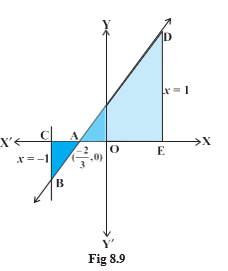
    A=∑i∣Ai∣A=\sum_i |A_i|
A straight line crosses the x-axis; the required area is the sum of the regions on either side.
Worked example

Find the area bounded by y=3x+2y=3x+2, the x-axis, and the lines x=−1x=-1 and x=1x=1.

  1. Find where y=3x+2y=3x+2 meets the x-axis; it is below the axis to the left of this point and above it to the right.
    3x+2=0  ⟹  x=−233x+2=0\implies x=-\frac{2}{3}
  2. Use an antiderivative and evaluate the signed integral on the first interval.
    ∫−1−2/3(3x+2) dx=[3x22+2x]−1−2/3=−16\int_{-1}^{-2/3}(3x+2)\,dx=\left[\frac{3x^2}{2}+2x\right]_{-1}^{-2/3}=-\frac{1}{6}
  3. Evaluate the integral on the second interval and add the positive areas.
    ∫−2/31(3x+2) dx=[3x22+2x]−2/31=256,A=16+256\int_{-2/3}^{1}(3x+2)\,dx=\left[\frac{3x^2}{2}+2x\right]_{-2/3}^{1}=\frac{25}{6},\qquad A=\frac{1}{6}+\frac{25}{6}
Answer: A=133A=\frac{13}{3} square units.
⚠ Common mistake

Do not add signed integrals directly when the curve lies below the axis on part of the interval; split at each crossing and add absolute values.
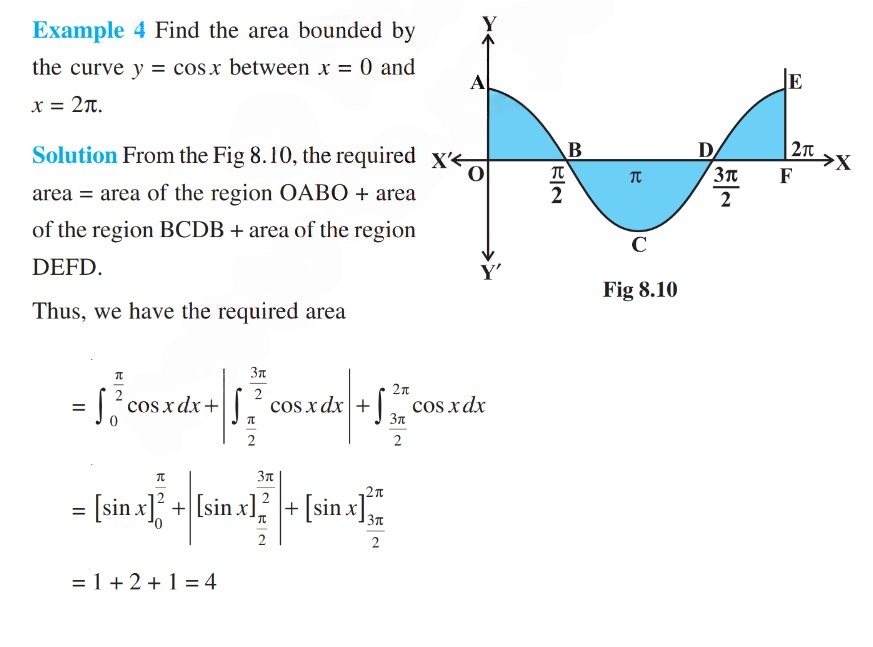
The regions under y=cos x from 0 to 2π illustrate adding separate positive areas.
The regions under y=cos⁡xy=\cos x from 00 to 2π2\pi illustrate adding separate positive areas.
Practice

Find the area bounded by y=x2−1y=x^2-1 and the x-axis for −2≤x≤2-2\le x\le2.

Hint: Split at the roots x=−1x=-1 and x=1x=1; the curve is below the axis between them.
Key step: The central area is ∫−11(1−x2) dx=43\int_{-1}^{1}(1-x^2)\,dx=\frac{4}{3}, and each outer area is ∫12(x2−1) dx=43\int_1^2(x^2-1)\,dx=\frac{4}{3}.
Solution: A=43+2(43)=4A=\frac{4}{3}+2\left(\frac{4}{3}\right)=4 square units.
Practice

Find the area bounded by x=y+1x=y+1, the y-axis, and y=0y=0, y=2y=2.

Hint: Integrate the horizontal width x=y+1x=y+1 with respect to yy.
Key step: A=∫02(y+1) dy=[y22+y]02A=\int_0^2(y+1)\,dy=\left[\frac{y^2}{2}+y\right]_0^2.
Solution: A=4A=4 square units.

Quick recap

  • For a curve y=f(x)y=f(x) and the x-axis, area is found by integrating with respect to xx.
  • For a curve x=ϕ(y)x=\phi(y) and the y-axis, area is found by integrating with respect to yy.
  • If a curve crosses an axis, split the interval at its intercepts.
  • Geometric area is positive: add the absolute values of signed integrals.
  • Choose the integration variable that matches the given boundaries.

Formula sheet

Area from Vertical Strips
A=∫aby dx=∫abf(x) dxA=\int_a^b y\,dx=\int_a^b f(x)\,dx
Area from Horizontal Strips
A=∫cdx dy=∫cdg(y) dyA=\int_c^d x\,dy=\int_c^d g(y)\,dy
Geometric Area for a Curve Crossing the Axis
A=∑i∣∫xi−1xif(x) dx∣A=\sum_i\left|\int_{x_{i-1}}^{x_i}f(x)\,dx\right|
Circle Area
A=4∫0aa2−x2 dx=πa2A=4\int_0^a\sqrt{a^2-x^2}\,dx=\pi a^2
Ellipse Area
A=4∫0abaa2−x2 dx=πab=4∫0babb2−y2 dyA=4\int_0^a\frac{b}{a}\sqrt{a^2-x^2}\,dx=\pi ab=4\int_0^b\frac{a}{b}\sqrt{b^2-y^2}\,dy
Area formulas
A=∫ab∣f(x)∣ dx,A=∫cd∣ϕ(y)∣ dy.\begin{aligned} A&=\int_a^b |f(x)|\,dx,\\ A&=\int_c^d |\phi(y)|\,dy.\end{aligned}

Mathematics — ALL CHAPTERS

1

Relations And Functions

View

2

Inverse Trigonometric Functions

View

3

Matrices

View

4

DETERMINANTS 

View

5

Continuity And Differentiability

View

6

Application Of Derivatives

View

7

Integrals

View

8

APPLICATION OF INTEGRALS

View

9

DIFFERENTIAL EQUATIONS

View

10

VECTOR ALGEBRA

View

11

Three Dimensional Geometry

View

12

Linear Programming

View

13

Probability

View

14

Proofs In Mathematics

View

15

Mathematical Modelling

View