Class 12 PCM . Mathematics . Mathematics Part II . Integrals

Chapter 7: Integrals

Ch 7

Mathematics

Class 12 PCM

Lecture 1

Introduction

Reference video · Lecture 1Introduction

Integral Calculus: Purpose and Forms

What Integration Is Used For

  • Differential calculus studies derivatives, including tangent slopes to function graphs.
  • Integral calculus addresses finding antiderivatives and calculating areas bounded by function graphs.
  • Two forms arise: indefinite integrals find a family of antiderivatives; definite integrals are used to calculate quantities such as bounded area.
  • Connection the Fundamental Theorem of Calculus links indefinite and definite integrals, making definite integrals useful in science, engineering, economics, finance, and probability.
  • Application knowing an object's instantaneous velocity raises the question of recovering its position.

Integration as the Inverse of Differentiation

Definition

Antiderivative (primitive) — A function FF is an antiderivative of ff on an interval II if F′(x)=f(x)F'(x)=f(x) for every x∈Ix\in I.

Definition

Indefinite integral — The indefinite integral represents the entire family of antiderivatives of a function.

Family of antiderivatives

If F′(x)=f(x)F'(x)=f(x) on an interval, then every antiderivative of ff on that interval is F(x)+CF(x)+C, where CC is an arbitrary real constant. Functions with the same derivative differ by a constant.

Indefinite Integral Notation
∫f(x) dx=F(x)+C,F′(x)=f(x)\int f(x)\,dx=F(x)+C,\qquad F'(x)=f(x)

Here f(x)f(x) is the integrand and xx is the variable of integration; CC is the constant of integration.

Integration Terms
Term or notationMeaning
∫f(x) dx\int f(x)\,dxIntegral of ff with respect to xx
f(x)f(x)Integrand
xxVariable of integration
IntegrateFind the integral
An integral of ffA function FF such that F′(x)=f(x)F'(x)=f(x)
Constant of integrationAny real number CC, treated as a constant function

Find an Indefinite Integral

  1. Identify a function whose derivative is the integrand.
  2. Write that function as the antiderivative and include the arbitrary constant.
    ∫f(x) dx=F(x)+C\int f(x)\,dx=F(x)+C
  3. Differentiate the result to check it.
Worked example

Find ∫x2 dx\int x^2\,dx.

  1. Reverse the derivative rule for a power.
    ∫x2 dx=x33+C\int x^2\,dx=\frac{x^3}{3}+C
  2. Check by differentiation.
    ddx(x33+C)=x2\frac{d}{dx}\left(\frac{x^3}{3}+C\right)=x^2
Answer: x33+C\frac{x^3}{3}+C

Standard Indefinite Integrals

Standard Integral Formulae
IntegrandIndefinite integral
xnx^n, n≠−1n\ne -1∫xn dx=xn+1n+1+C\int x^n\,dx=\frac{x^{n+1}}{n+1}+C
11∫dx=x+C\int dx=x+C
cos⁡x\cos x∫cos⁡x dx=sin⁡x+C\int\cos x\,dx=\sin x+C
sin⁡x\sin x∫sin⁡x dx=−cos⁡x+C\int\sin x\,dx=-\cos x+C
sec⁡2x\sec^2 x∫sec⁡2x dx=tan⁡x+C\int\sec^2 x\,dx=\tan x+C
cosec⁡2x\cosec^2 x∫cosec⁡2x dx=−cot⁡x+C\int\cosec^2 x\,dx=-\cot x+C
sec⁡xtan⁡x\sec x\tan x∫sec⁡xtan⁡x dx=sec⁡x+C\int\sec x\tan x\,dx=\sec x+C
cosec⁡xcot⁡x\cosec x\cot x∫cosec⁡xcot⁡x dx=−cosec⁡x+C\int\cosec x\cot x\,dx=-\cosec x+C
11−x2\frac{1}{\sqrt{1-x^2}}∫dx1−x2=sin⁡−1x+C\int\frac{dx}{\sqrt{1-x^2}}=\sin^{-1}x+C
11−x2\frac{1}{\sqrt{1-x^2}}∫dx1−x2=−cos⁡−1x+C\int\frac{dx}{\sqrt{1-x^2}}=-\cos^{-1}x+C
11+x2\frac{1}{1+x^2}∫dx1+x2=tan⁡−1x+C\int\frac{dx}{1+x^2}=\tan^{-1}x+C
exe^x∫ex dx=ex+C\int e^x\,dx=e^x+C
⚠ Common mistake

Do not omit +C+C from an indefinite integral: every constant has derivative zero, so antiderivatives form a family. The power formula requires n≠−1n\ne -1. The sin⁡−1x\sin^{-1}x and −cos⁡−1x-\cos^{-1}x forms are equivalent only with appropriately chosen constants; their constants need not be the same.

Practice

Find ∫sin⁡x dx\int \sin x\,dx.

Hint: Use the derivative of cos⁡x\cos x.
Key step: Since ddx(−cos⁡x)=sin⁡x\frac{d}{dx}(-\cos x)=\sin x, the antiderivative is −cos⁡x-\cos x.
Solution: ∫sin⁡x dx=−cos⁡x+C\int\sin x\,dx=-\cos x+C.
Practice

Find ∫dx1+x2\int \frac{dx}{1+x^2}.

Hint: Recall the derivative of tan⁡−1x\tan^{-1}x.
Key step: ddx(tan⁡−1x)=11+x2\frac{d}{dx}(\tan^{-1}x)=\frac{1}{1+x^2}.
Solution: ∫dx1+x2=tan⁡−1x+C\int\frac{dx}{1+x^2}=\tan^{-1}x+C.

Quick recap

  • Integration reverses differentiation: it finds an antiderivatives from a given derivative.
  • Indefinite integral represents all antiderivatives and includes the constant CC.
  • Same derivative implies two functions differ by a constant on an interval.
  • Standard formulae are obtained by reversing familiar derivative rules.
  • Definite integrals connect to indefinite integrals through the Fundamental Theorem of Calculus.
Lecture 2

Some properties of indefinite integral

Reference video · Lecture 2Some properties of indefinite integral

Indefinite Integrals and Differentiation

Definition

Antiderivative — A function FF is an antiderivative of ff on an interval if F′(x)=f(x)F'(x)=f(x) throughout that interval.

Integration and differentiation are inverse processes

Differentiating an indefinite integral gives its integrand; integrating a derivative recovers the original function up to an arbitrary constant.

ddx(∫f(x) dx)=f(x),∫f′(x) dx=f(x)+C\frac{d}{dx}\left(\int f(x)\,dx\right)=f(x),\qquad \int f'(x)\,dx=f(x)+C

Constant of integration

  • Why CC appears: Functions that differ by a constant have the same derivative, since ddxC=0\frac{d}{dx}C=0.
  • General family: If F′(x)=f(x)F'(x)=f(x), then every antiderivative is F(x)+CF(x)+C, where C∈RC\in\mathbb{R}.
  • Definite value: An extra condition such as F(a)=bF(a)=b determines the particular value of CC.

Equivalent Indefinite Integrals

Equivalence of antiderivatives

If two functions have the same derivative, they differ by a constant. Thus they generate the same family of antiderivatives; this is customarily written as equality of indefinite integrals.

ddx(∫f(x) dx−∫g(x) dx)=0  ⟹  ∫f(x) dx=∫g(x) dx\frac{d}{dx}\left(\int f(x)\,dx-\int g(x)\,dx\right)=0\;\Longrightarrow\;\int f(x)\,dx=\int g(x)\,dx

Meaning of the equality

  • Families: The constants in the two antiderivatives may have different names, but each ranges over all real numbers.
  • Interpretation: Writing ∫f(x) dx=∫g(x) dx\int f(x)\,dx=\int g(x)\,dx means the families are identical, not that two chosen antiderivatives must be literally the same function.

Linearity of Integration

Sum rule

The integral of a sum is the sum of the corresponding integrals.

∫(f(x)+g(x)) dx=∫f(x) dx+∫g(x) dx\int (f(x)+g(x))\,dx=\int f(x)\,dx+\int g(x)\,dx
Constant-multiple rule

A constant factor can be taken outside an indefinite integral.

∫kf(x) dx=k∫f(x) dx\int kf(x)\,dx=k\int f(x)\,dx
Linearity for a finite sum
∫(∑i=1nkifi(x)) dx=∑i=1nki∫fi(x) dx\int \left(\sum_{i=1}^{n} k_i f_i(x)\right)\,dx=\sum_{i=1}^{n} k_i\int f_i(x)\,dx

Use this to integrate a linear combination term by term.

Using linearity

  • Separate terms: Split sums and differences into individual integrals.
  • Keep constants: Pull numerical factors outside their integrals.
  • Final constant: Combine all constants of integration into one arbitrary constant CC.

Integration by Inspection

Definition

Integration by inspection — Finding an antiderivative by recognizing a function whose derivative is the given integrand.

Recognize, integrate, and verify

  1. Look for a familiar derivative or use linearity to separate the integrand.
  2. Apply a suitable antiderivative formula to each term.
  3. Add one arbitrary constant and differentiate the result to check it.
Useful antiderivatives
∫xn dx=xn+1n+1+C  (n≠−1),∫1x dx=ln⁡∣x∣+C,∫ex dx=ex+C\int x^n\,dx=\frac{x^{n+1}}{n+1}+C\;(n\ne-1),\quad \int \frac{1}{x}\,dx=\ln|x|+C,\quad \int e^x\,dx=e^x+C

The power rule applies when n≠−1n\ne-1; the logarithmic formula is valid for x≠0x\ne0.

Useful trigonometric antiderivatives
∫sin⁡x dx=−cos⁡x+C,∫cos⁡x dx=sin⁡x+C,∫sec⁡2x dx=tan⁡x+C,∫sec⁡xtan⁡x dx=sec⁡x+C,∫csc⁡2x dx=−cot⁡x+C,∫csc⁡xcot⁡x dx=−csc⁡x+C\int \sin x\,dx=-\cos x+C,\quad \int \cos x\,dx=\sin x+C,\quad \int \sec^2 x\,dx=\tan x+C,\quad \int \sec x\tan x\,dx=\sec x+C,\quad \int \csc^2 x\,dx=-\cot x+C,\quad \int \csc x\cot x\,dx=-\csc x+C

These standard derivatives also help recognize antiderivatives with scaled arguments and trigonometric products.

Inspection examples

  • Scaled argument: Since ddxsin⁡2x=2cos⁡2x\frac{d}{dx}\sin 2x=2\cos 2x, an antiderivative of cos⁡2x\cos 2x is 12sin⁡2x\frac{1}{2}\sin 2x.
  • Polynomial: An antiderivative of 3x2+4x33x^2+4x^3 is x3+x4x^3+x^4.
  • Reciprocal: For x≠0x\ne0, ddxln⁡∣x∣=1x\frac{d}{dx}\ln|x|=\frac{1}{x}, so ∫1x dx=ln⁡∣x∣+C\int\frac{1}{x}\,dx=\ln|x|+C.

Linearity examples

  • Powers and reciprocals: ∫x3−1x2 dx=∫(x−x−2) dx=x22+1x+C\int\frac{x^3-1}{x^2}\,dx=\int(x-x^{-2})\,dx=\frac{x^2}{2}+\frac{1}{x}+C.
  • Fractional power: ∫(x2/3+1) dx=35x5/3+x+C\int(x^{2/3}+1)\,dx=\frac{3}{5}x^{5/3}+x+C.
  • Exponential and logarithm: ∫(x3/2+2ex−1x) dx=25x5/2+2ex−ln⁡∣x∣+C\int(x^{3/2}+2e^x-\frac{1}{x})\,dx=\frac{2}{5}x^{5/2}+2e^x-\ln|x|+C.

Trigonometric examples

  • Sum: ∫(sin⁡x+cos⁡x) dx=−cos⁡x+sin⁡x+C\int(\sin x+\cos x)\,dx=-\cos x+\sin x+C.
  • Cosecant product: ∫csc⁡x(csc⁡x+cot⁡x) dx=−cot⁡x−csc⁡x+C\int\csc x(\csc x+\cot x)\,dx=-\cot x-\csc x+C.
  • Secant form: ∫1−sin⁡xcos⁡2x dx=∫(sec⁡2x−sec⁡xtan⁡x) dx=tan⁡x−sec⁡x+C\int\frac{1-\sin x}{\cos^2 x}\,dx=\int(\sec^2 x-\sec x\tan x)\,dx=\tan x-\sec x+C.
Worked example

Find FF if F′(x)=4x3−6F'(x)=4x^3-6 and F(0)=3F(0)=3.

  1. Find an antiderivative FF of f(x)=4x3−6f(x)=4x^3-6 given that F(0)=3F(0)=3.
  2. Integrate each term and include the arbitrary constant.
    F(x)=∫(4x3−6) dx=x4−6x+CF(x)=\int (4x^3-6)\,dx=x^4-6x+C
  3. Use the given condition to determine the constant.
    3=F(0)=04−6(0)+C⟹C=33=F(0)=0^4-6(0)+C\quad\Longrightarrow\quad C=3
  4. Substitute the value of the constant.
    F(x)=x4−6x+3F(x)=x^4-6x+3
Answer: F(x)=x4−6x+3F(x)=x^4-6x+3.
⚠ Common mistake

Do not omit +C+C from a general indefinite integral. Add it once at the end; an additional condition may then fix its value.

Limits of Inspection and Variable Choice

Important observations

  • Not every antiderivative is elementary: An antiderivative of e−x2e^{-x^2} cannot be expressed using elementary functions, so inspection with elementary functions does not work.
  • Variable of integration: Use the variable shown in the integral; for example, ∫y4 dy=y55+C\int y^4\,dy=\frac{y^5}{5}+C.
  • Logarithm domain: For x≠0x\ne0, ddxln⁡∣x∣=1x\frac{d}{dx}\ln|x|=\frac{1}{x}, covering both positive and negative xx.
Practice

Evaluate ∫(x2/3+1) dx\int (x^{2/3}+1)\,dx.

Hint: Use linearity and the power rule.
Key step: 23+1=53\frac{2}{3}+1=\frac{5}{3}.
Solution: ∫(x2/3+1) dx=35x5/3+x+C\int (x^{2/3}+1)\,dx=\frac{3}{5}x^{5/3}+x+C.
Practice

Evaluate ∫(sin⁡x+cos⁡x) dx\int (\sin x+\cos x)\,dx.

Hint: Integrate each trigonometric term separately.
Key step: ∫sin⁡x dx=−cos⁡x\int\sin x\,dx=-\cos x and ∫cos⁡x dx=sin⁡x\int\cos x\,dx=\sin x.
Solution: −cos⁡x+sin⁡x+C-\cos x+\sin x+C.
Practice

Find F(x)F(x) if F′(x)=1xF'(x)=\frac{1}{x} for x>0x>0 and F(1)=2F(1)=2.

Hint: Integrate, then use the given value to determine CC.
Key step: F(x)=ln⁡x+CF(x)=\ln x+C and F(1)=2F(1)=2 gives C=2C=2.
Solution: F(x)=ln⁡x+2F(x)=\ln x+2.

Quick recap

  • Differentiation and indefinite integration undo each other, with integration introducing an arbitrary constant.
  • Antiderivatives with the same derivative differ only by a constant and represent the same family.
  • Integration is linear: sums separate and constant factors can be taken outside.
  • Integration by inspection recognizes antiderivatives from familiar derivative formulas, including scaled and trigonometric forms.
  • Use one final CC for a general indefinite integral; an additional condition can determine its value.
  • Some functions, such as e−x2e^{-x^2}, have no antiderivative expressible in elementary functions.
Lecture 3

Methods Of Integration

Reference video · Lecture 3Methods Of Integration

Overview of Integration Methods

  • Purpose: Integration methods reduce a given integral to standard forms that can be evaluated.
  • Techniques: The chapter develops substitution, partial fractions, and integration by parts.

Integration by Substitution

Definition

Integration by substitution — A method that changes the variable to simplify an integral, usually by substituting an inner function whose derivative also occurs in the integrand.

Change of variable

If x=g(t)x=g(t), then dx=g′(t) dtdx=g'(t)\,dt and ∫f(x) dx=∫f(g(t))g′(t) dt\int f(x)\,dx=\int f(g(t))g'(t)\,dt. Choose a substitution that transforms the integrand into a standard form.

Substitution steps

  1. Identify an inner function whose derivative is present, possibly up to a constant factor.
  2. Set the inner function equal to a new variable and find its differential.
    u=g(x),du=g′(x) dxu=g(x),\qquad du=g'(x)\,dx
  3. Rewrite the entire integrand using the new variable, integrate, and substitute back.
Useful substitution examples
∫sin⁡(mx) dx=−1mcos⁡(mx)+C∫2xsin⁡(x2+1) dx=−cos⁡(x2+1)+C∫sin⁡(tan⁡−1x)1+x2 dx=−cos⁡(tan⁡−1x)+C\begin{aligned}\int\sin(mx)\,dx&=-\frac{1}{m}\cos(mx)+C\\\int 2x\sin(x^2+1)\,dx&=-\cos(x^2+1)+C\\\int\frac{\sin(\tan^{-1}x)}{1+x^2}\,dx&=-\cos(\tan^{-1}x)+C\end{aligned}

In each case, substitute the inner function and use its differential.

Useful trigonometric integrals
∫tan⁡x dx=ln⁡∣sec⁡x∣+C∫cot⁡x dx=ln⁡∣sin⁡x∣+C∫sec⁡x dx=ln⁡∣sec⁡x+tan⁡x∣+C∫csc⁡x dx=ln⁡∣csc⁡x−cot⁡x∣+C\begin{aligned}\int\tan x\,dx&=\ln|\sec x|+C\\\int\cot x\,dx&=\ln|\sin x|+C\\\int\sec x\,dx&=\ln|\sec x+\tan x|+C\\\int\csc x\,dx&=\ln|\csc x-\cot x|+C\end{aligned}

These standard results often follow by substitution. Use absolute values in logarithmic antiderivatives.

Worked example

Evaluate ∫tan⁡4x sec⁡2xx dx\int \frac{\tan^4\sqrt{x}\,\sec^2\sqrt{x}}{\sqrt{x}}\,dx.

  1. First set t=xt=\sqrt{x}, so dx=2t dtdx=2t\,dt.
    ∫tan⁡4x sec⁡2xx dx=2∫tan⁡4t sec⁡2t dt\int\frac{\tan^4\sqrt{x}\,\sec^2\sqrt{x}}{\sqrt{x}}\,dx=2\int\tan^4t\,\sec^2t\,dt
  2. Now set u=tan⁡tu=\tan t, so du=sec⁡2t dtdu=\sec^2t\,dt.
    2∫tan⁡4t sec⁡2t dt=2∫u4 du2\int\tan^4t\,\sec^2t\,dt=2\int u^4\,du
  3. Integrate and return to the original variable.
    2∫u4 du=25u5+C=25tan⁡5x+C2\int u^4\,du=\frac{2}{5}u^5+C=\frac{2}{5}\tan^5\sqrt{x}+C
Answer: 25tan⁡5x+C\frac{2}{5}\tan^5\sqrt{x}+C
⚠ Common mistake

Do not change variables in only part of the integrand: transform both the function and the differential, then substitute back after integrating.

Integration Using Trigonometric Identities

Definition

Trigonometric-identity method — A method that rewrites trigonometric powers or products using identities so the integral becomes a sum of standard integrals.

Identities for integration
cos⁡2x=1+cos⁡2x2sin⁡2x=1−cos⁡2xsin⁡xcos⁡y=12(sin⁡(x+y)+sin⁡(x−y))sin⁡3x=3sin⁡x−4sin⁡3x\begin{aligned}\cos^2x&=\frac{1+\cos 2x}{2}\\\sin^2x&=1-\cos^2x\\\sin x\cos y&=\frac{1}{2}\bigl(\sin(x+y)+\sin(x-y)\bigr)\\\sin 3x&=3\sin x-4\sin^3x\end{aligned}

Use power-reduction identities for powers, product-to-sum for products, and multiple-angle identities where useful.

Using identities

  1. Choose an identity that reduces a power or converts a product into a sum.
  2. Rewrite the integrand as simpler terms.
  3. Integrate each term and include one arbitrary constant.
Worked example

Evaluate ∫sin⁡2xcos⁡3x dx\int\sin 2x\cos 3x\,dx.

  1. Use the product-to-sum identity with angles 2x2x and 3x3x.
    sin⁡2xcos⁡3x=12(sin⁡5x−sin⁡x)\sin 2x\cos 3x=\frac{1}{2}(\sin 5x-\sin x)
  2. Integrate each sine term.
    ∫sin⁡2xcos⁡3x dx=12(−15cos⁡5x+cos⁡x)+C\int\sin 2x\cos 3x\,dx=\frac{1}{2}\left(-\frac{1}{5}\cos 5x+\cos x\right)+C
  3. Simplify the result.
    −110cos⁡5x+12cos⁡x+C-\frac{1}{10}\cos 5x+\frac{1}{2}\cos x+C
Answer: −110cos⁡5x+12cos⁡x+C-\frac{1}{10}\cos 5x+\frac{1}{2}\cos x+C
Practice

Evaluate ∫sin⁡3xcos⁡2x dx\int\sin^3x\cos^2x\,dx.

Hint: Separate one factor of sin⁡x\sin x and replace sin⁡2x\sin^2x by 1−cos⁡2x1-\cos^2x.
Key step: Set t=cos⁡xt=\cos x, so dt=−sin⁡x dxdt=-\sin x\,dx.
Solution: ∫(1−cos⁡2x)cos⁡2xsin⁡x dx=−∫(1−t2)t2 dt=−13cos⁡3x+15cos⁡5x+C\int(1-\cos^2x)\cos^2x\sin x\,dx=-\int(1-t^2)t^2\,dt=-\frac{1}{3}\cos^3x+\frac{1}{5}\cos^5x+C.
Practice

Evaluate (a) ∫sin⁡xsin⁡(x+a) dx\int\frac{\sin x}{\sin(x+a)}\,dx and (b) ∫dx1+tan⁡x\int\frac{dx}{1+\tan x}.

Hint: For (a), use t=x+at=x+a; for (b), rewrite the fraction using sine and cosine.
Key step: For (a), expand sin⁡(t−a)\sin(t-a); for (b), split cos⁡x\cos x into equal parts involving cos⁡x+sin⁡x\cos x+\sin x and cos⁡x−sin⁡x\cos x-\sin x.
Solution: (a) Set t=x+at=x+a: ∫sin⁡xsin⁡(x+a) dx=∫(cos⁡a−sin⁡acot⁡t) dt=xcos⁡a−sin⁡aln⁡∣sin⁡(x+a)∣+C\int\frac{\sin x}{\sin(x+a)}\,dx=\int(\cos a-\sin a\cot t)\,dt=x\cos a-\sin a\ln|\sin(x+a)|+C. (b) ∫dx1+tan⁡x=∫cos⁡xcos⁡x+sin⁡x dx=x2+12ln⁡∣cos⁡x+sin⁡x∣+C\int\frac{dx}{1+\tan x}=\int\frac{\cos x}{\cos x+\sin x}\,dx=\frac{x}{2}+\frac{1}{2}\ln|\cos x+\sin x|+C.
Practice

Evaluate (a) ∫cos⁡2x dx\int\cos^2x\,dx and (b) ∫sin⁡3x dx\int\sin^3x\,dx.

Hint: For (a), use the double-angle identity; for (b), write sin⁡3x=(1−cos⁡2x)sin⁡x\sin^3x=(1-\cos^2x)\sin x.
Key step: Use cos⁡2x=1+cos⁡2x2\cos^2x=\frac{1+\cos 2x}{2} in (a), and set t=cos⁡xt=\cos x in (b).
Solution: (a) ∫cos⁡2x dx=x2+14sin⁡2x+C\int\cos^2x\,dx=\frac{x}{2}+\frac{1}{4}\sin 2x+C. (b) ∫sin⁡3x dx=−cos⁡x+13cos⁡3x+C\int\sin^3x\,dx=-\cos x+\frac{1}{3}\cos^3x+C.

Quick recap

  • Choose substitution when an inner function and its derivative occur together in the integrand.
  • Change the differential along with the variable, integrate, and then substitute back.
  • Know the logarithmic antiderivatives of tan⁡x\tan x, cot⁡x\cot x, sec⁡x\sec x and csc⁡x\csc x.
  • Use power-reduction identities for trigonometric powers and product-to-sum identities for products.
  • For sin⁡3x\sin^3x, separate one sine factor and substitute, or use the triple-angle identity.
  • Include an arbitrary constant CC in every indefinite integral.
Lecture 4

Integrals Of Some Particular Functions

Reference video · Lecture 4Integrals Of Some Particular Functions

Standard Forms

Recognise and apply a standard form

  1. Match the integrand to a standard form, identifying the constant and any shifted variable.
    1x2−a2,1a2−x2,etc.\frac{1}{x^2-a^2},\quad\frac{1}{\sqrt{a^2-x^2}},\quad\text{etc.}
  2. Substitute into the matching formula and simplify.
    u=x−hu=x-h
  3. Add the integration constant.
    +C+C
Worked example

Evaluate ∫dxx2−16\int\frac{dx}{x^2-16}.

  1. Rewrite the denominator to match the difference-of-squares form.
    ∫dxx2−16=∫dxx2−42\int\frac{dx}{x^2-16}=\int\frac{dx}{x^2-4^2}
  2. Apply the standard formula with a=4a=4.
    ∫dxx2−42=18ln⁡∣x−4x+4∣+C\int\frac{dx}{x^2-4^2}=\frac{1}{8}\ln\left|\frac{x-4}{x+4}\right|+C
Answer: 18ln⁡∣x−4x+4∣+C\frac{1}{8}\ln\left|\frac{x-4}{x+4}\right|+C

Quadratic Denominators: Complete the Square

Completing the square
ax2+bx+c=a[(x+b2a)2+4ac−b24a2]ax^2+bx+c=a\left[(x+\frac{b}{2a})^2+\frac{4ac-b^2}{4a^2}\right]

For a≠0a\ne0, use this identity to convert a quadratic into a shifted square.

Integrate a reciprocal quadratic

  1. Factor out the coefficient of x2x^2 and complete the square.
    ax2+bx+c=a[(x+b2a)2+k]ax^2+bx+c=a\left[(x+\frac{b}{2a})^2+k\right]
  2. Substitute the shifted variable and keep the factor outside the integral.
    t=x+b2a,dx=dtt=x+\frac{b}{2a},\quad dx=dt
  3. Use the arctangent formula when k>0k>0, or the logarithmic formula when k<0k<0.
    ∫dtt2+r2=1rtan⁡−1tr+C,∫dtt2−r2=12rln⁡∣t−rt+r∣+C\int\frac{dt}{t^2+r^2}=\frac{1}{r}\tan^{-1}\frac{t}{r}+C,\quad\int\frac{dt}{t^2-r^2}=\frac{1}{2r}\ln\left|\frac{t-r}{t+r}\right|+C
Worked example

Evaluate ∫dxx2−6x+13\int\frac{dx}{x^2-6x+13}.

  1. Complete the square in the denominator.
    x2−6x+13=(x−3)2+4x^2-6x+13=(x-3)^2+4
  2. Shift the variable and apply the arctangent form.
    ∫dx(x−3)2+22=12tan⁡−1x−32+C\int\frac{dx}{(x-3)^2+2^2}=\frac{1}{2}\tan^{-1}\frac{x-3}{2}+C
Answer: 12tan⁡−1(x−32)+C\frac{1}{2}\tan^{-1}\left(\frac{x-3}{2}\right)+C

Square Roots of Quadratics

Integrate a reciprocal square root of a quadratic

  1. Factor out the coefficient of x2x^2 from the expression under the root.
    ax2+bx+c=a(x2+bax+ca)ax^2+bx+c=a\left(x^2+\frac{b}{a}x+\frac{c}{a}\right)
  2. Complete the square and shift to a new variable.
    t=x+b2at=x+\frac{b}{2a}
  3. Apply the logarithmic or inverse-sine standard form and restore the original variable.
    ∫dtt2−r2=ln⁡∣t+t2−r2∣+C,∫dtr2−t2=sin⁡−1tr+C\int\frac{dt}{\sqrt{t^2-r^2}}=\ln\left|t+\sqrt{t^2-r^2}\right|+C,\quad\int\frac{dt}{\sqrt{r^2-t^2}}=\sin^{-1}\frac{t}{r}+C
Worked example

Evaluate ∫dx5x2−2x\int\frac{dx}{\sqrt{5x^2-2x}}.

  1. Complete the square inside the radical.
    5x2−2x=5[(x−15)2−(15)2]5x^2-2x=5\left[(x-\frac{1}{5})^2-(\frac{1}{5})^2\right]
  2. Factor out 5\sqrt{5} and use the logarithmic standard form.
    ∫dx5x2−2x=15∫dx(x−15)2−(15)2\int\frac{dx}{\sqrt{5x^2-2x}}=\frac{1}{\sqrt{5}}\int\frac{dx}{\sqrt{(x-\frac{1}{5})^2-(\frac{1}{5})^2}}
  3. Substitute back and simplify the radical.
    15ln⁡∣x−15+x2−2x5∣+C\frac{1}{\sqrt{5}}\ln\left|x-\frac{1}{5}+\sqrt{x^2-\frac{2x}{5}}\right|+C
Answer: 15ln⁡∣x−15+x2−2x5∣+C\frac{1}{\sqrt{5}}\ln\left|x-\frac{1}{5}+\sqrt{x^2-\frac{2x}{5}}\right|+C

Linear Numerator over a Quadratic

Linear numerator split
px+q=A(2ax+b)+Bpx+q=A(2ax+b)+B

Find constants AA and BB by matching coefficients.

Integrate a linear numerator over a quadratic

  1. Let f(x)f(x) be the quadratic denominator and find constants A,BA,B.
    px+q=Af′(x)+Bpx+q=A f'(x)+B
  2. Split the integral into a derivative-over-function part and a reciprocal-quadratic part.
    ∫px+qf(x) dx=A∫f′(x)f(x) dx+B∫dxf(x)\int\frac{px+q}{f(x)}\,dx=A\int\frac{f'(x)}{f(x)}\,dx+B\int\frac{dx}{f(x)}
  3. Integrate each part using substitution and the completed-square method.
    ∫f′(x)f(x) dx=ln⁡∣f(x)∣+C\int\frac{f'(x)}{f(x)}\,dx=\ln|f(x)|+C
Worked example

Evaluate ∫x+22x2+6x+5 dx\int\frac{x+2}{2x^2+6x+5}\,dx.

  1. Express the numerator using the derivative of the denominator.
    x+2=14(4x+6)+12x+2=\frac{1}{4}(4x+6)+\frac{1}{2}
  2. Split the integral into two standard parts.
    ∫x+22x2+6x+5 dx=14∫4x+62x2+6x+5 dx+12∫dx2x2+6x+5\int\frac{x+2}{2x^2+6x+5}\,dx=\frac{1}{4}\int\frac{4x+6}{2x^2+6x+5}\,dx+\frac{1}{2}\int\frac{dx}{2x^2+6x+5}
  3. Integrate the first part by substitution and complete the square in the second.
    14ln⁡∣2x2+6x+5∣+12tan⁡−1(2x+3)+C\frac{1}{4}\ln|2x^2+6x+5|+\frac{1}{2}\tan^{-1}(2x+3)+C
Answer: 14ln⁡∣2x2+6x+5∣+12tan⁡−1(2x+3)+C\frac{1}{4}\ln|2x^2+6x+5|+\frac{1}{2}\tan^{-1}(2x+3)+C

Linear Numerator over a Square Root

Integrate a linear numerator over a square root

  1. Express the numerator as a multiple of the derivative of the quadratic plus a constant.
    px+q=Af′(x)+Bpx+q=A f'(x)+B
  2. For the derivative part, substitute t=f(x)t=f(x).
    ∫f′(x)f(x) dx=2f(x)+C\int\frac{f'(x)}{\sqrt{f(x)}}\,dx=2\sqrt{f(x)}+C
  3. Complete the square in the remaining integral and apply the matching standard form.
    ∫dxf(x)\int\frac{dx}{\sqrt{f(x)}}
Worked example

Evaluate ∫x+35−4x−x2 dx\int\frac{x+3}{\sqrt{5-4x-x^2}}\,dx.

  1. Decompose the numerator using the derivative of the quadratic.
    x+3=−12(−2x−4)+1x+3=-\frac{1}{2}(-2x-4)+1
  2. Split the integral and integrate the derivative part by substitution.
    ∫x+35−4x−x2 dx=−12∫−2x−45−4x−x2 dx+∫dx5−4x−x2\int\frac{x+3}{\sqrt{5-4x-x^2}}\,dx=-\frac{1}{2}\int\frac{-2x-4}{\sqrt{5-4x-x^2}}\,dx+\int\frac{dx}{\sqrt{5-4x-x^2}}
  3. Complete the square for the remaining integral and apply the inverse-sine form.
    5−4x−x2=9−(x+2)25-4x-x^2=9-(x+2)^2
  4. Combine the two antiderivatives.
    −5−4x−x2+sin⁡−1x+23+C-\sqrt{5-4x-x^2}+\sin^{-1}\frac{x+2}{3}+C
Answer: −5−4x−x2+sin⁡−1(x+23)+C-\sqrt{5-4x-x^2}+\sin^{-1}\left(\frac{x+2}{3}\right)+C
⚠ Common mistake

When completing the square, retain the factor outside the quadratic. For instance, 5x2−2x=5[(x−15)2−(15)2]5x^2-2x=5[(x-\frac{1}{5})^2-(\frac{1}{5})^2]; omitting the outer 55 changes the integral.

Practice

Evaluate ∫dx3x2+13x−10\int\frac{dx}{3x^2+13x-10}.

Hint: Factor or complete the square, then reduce to a difference-of-squares form.
Key step: 3x2+13x−10=(3x−2)(x+5)3x^2+13x-10=(3x-2)(x+5).
Solution: 117ln⁡∣3x−2x+5∣+C\frac{1}{17}\ln\left|\frac{3x-2}{x+5}\right|+C
Practice

Evaluate ∫dx2x−x2\int\frac{dx}{\sqrt{2x-x^2}}.

Hint: Complete the square inside the radical.
Key step: 2x−x2=1−(x−1)22x-x^2=1-(x-1)^2.
Solution: sin⁡−1(x−1)+C\sin^{-1}(x-1)+C
Practice

Evaluate ∫dxx2+4\int\frac{dx}{\sqrt{x^2+4}}.

Hint: Use the standard form for x2+a2\sqrt{x^2+a^2}.
Key step: Here a=2a=2.
Solution: ln⁡∣x+x2+4∣+C\ln\left|x+\sqrt{x^2+4}\right|+C

Quick recap

  • Memorise the six standard forms for quadratic denominators and square-root expressions.
  • Complete the square to convert a quadratic into a shifted standard form.
  • For a linear numerator, write it as Af′(x)+BA f'(x)+B and compare coefficients.
  • Use substitution for the derivative part; integrate the remaining part with a standard form.
  • Check that all factors from completing the square and taking square roots are retained.
Lecture 5

Integration by Partial Fractions

Reference video · Lecture 5Integration by Partial Fractions

Rational Functions and Partial Fractions

Improper rational function

If the rational function is improper, division writes it as a polynomial plus a proper rational function: P(x)Q(x)=T(x)+P1(x)Q(x)\frac{P(x)}{Q(x)}=T(x)+\frac{P_1(x)}{Q(x)}.

P(x)Q(x)=T(x)+P1(x)Q(x)\frac{P(x)}{Q(x)}=T(x)+\frac{P_1(x)}{Q(x)}
Common Antiderivatives
∫dxx−a=ln⁡∣x−a∣+C,∫dx(x−a)n=(x−a)1−n1−n+C (n≠1),∫dxx2+a2=1atan⁡−1(xa)+C\int\frac{dx}{x-a}=\ln|x-a|+C,\qquad \int\frac{dx}{(x-a)^n}=\frac{(x-a)^{1-n}}{1-n}+C\ (n\ne 1),\qquad \int\frac{dx}{x^2+a^2}=\frac{1}{a}\tan^{-1}\left(\frac{x}{a}\right)+C

Apply these after decomposition; the quadratic formula shown has a>0a>0.

Decompose and Integrate

  1. If the rational function is improper, divide first to separate its polynomial part.
    P(x)Q(x)=T(x)+P1(x)Q(x)\frac{P(x)}{Q(x)}=T(x)+\frac{P_1(x)}{Q(x)}
  2. Factor the denominator and include a term for every factor and every power of a repeated factor.
  3. Clear denominators, equate coefficients, and solve for the unknown constants.
  4. Integrate the polynomial and each simpler fraction, then combine the results and add the constant of integration.

Useful Substitutions Before Decomposition

  • Even powers: For a rational expression in even powers of xx, set y=x2y=x^2 to find the partial fractions, then substitute back before integrating in xx.
  • Trigonometric form: If the integrand contains cos⁡ϕ dϕ\cos\phi\,d\phi and the remaining terms depend on sin⁡ϕ\sin\phi, set y=sin⁡ϕy=\sin\phi and decompose in yy.
Worked example

Evaluate ∫dx(x+1)(x+2)\int\frac{dx}{(x+1)(x+2)}.

  1. Write a term for each distinct linear factor.
    1(x+1)(x+2)=Ax+1+Bx+2\frac{1}{(x+1)(x+2)}=\frac{A}{x+1}+\frac{B}{x+2}
  2. Clear denominators and equate coefficients.
    1=A(x+2)+B(x+1),A+B=0,2A+B=11=A(x+2)+B(x+1),\qquad A+B=0,\quad 2A+B=1
  3. Solve for the constants and substitute them into the decomposition.
    A=1,B=−1,1(x+1)(x+2)=1x+1−1x+2A=1,\quad B=-1,\qquad \frac{1}{(x+1)(x+2)}=\frac{1}{x+1}-\frac{1}{x+2}
  4. Integrate the logarithmic terms.
    ∫dx(x+1)(x+2)=ln⁡∣x+1∣−ln⁡∣x+2∣+C\int\frac{dx}{(x+1)(x+2)}=\ln|x+1|-\ln|x+2|+C
Answer: ln⁡∣x+1x+2∣+C\ln\left|\frac{x+1}{x+2}\right|+C
Practice

Evaluate ∫x2+1x2−5x+6 dx\int\frac{x^2+1}{x^2-5x+6}\,dx.

Hint: Divide first, then factor the denominator of the proper fraction.
Key step: x2+1x2−5x+6=1−5x−2+10x−3\frac{x^2+1}{x^2-5x+6}=1-\frac{5}{x-2}+\frac{10}{x-3}.
Solution: ∫(1−5x−2+10x−3)dx=x−5ln⁡∣x−2∣+10ln⁡∣x−3∣+C\int\left(1-\frac{5}{x-2}+\frac{10}{x-3}\right)dx=x-5\ln|x-2|+10\ln|x-3|+C.
Practice

Evaluate ∫3x−2(x+1)2(x+3) dx\int\frac{3x-2}{(x+1)^2(x+3)}\,dx.

Hint: Include terms for both powers of the repeated factor and for the distinct factor.
Key step: 3x−2(x+1)2(x+3)=114(x+1)−52(x+1)2−114(x+3)\frac{3x-2}{(x+1)^2(x+3)}=\frac{11}{4(x+1)}-\frac{5}{2(x+1)^2}-\frac{11}{4(x+3)}.
Solution: ∫(114(x+1)−52(x+1)2−114(x+3))dx=114ln⁡∣x+1∣+52(x+1)−114ln⁡∣x+3∣+C\int\left(\frac{11}{4(x+1)}-\frac{5}{2(x+1)^2}-\frac{11}{4(x+3)}\right)dx=\frac{11}{4}\ln|x+1|+\frac{5}{2(x+1)}-\frac{11}{4}\ln|x+3|+C.
Practice

Evaluate ∫x2+x+1(x+2)(x2+1) dx\int\frac{x^2+x+1}{(x+2)(x^2+1)}\,dx.

Hint: Use a constant numerator over the linear factor and a linear numerator over the irreducible quadratic.
Key step: x2+x+1(x+2)(x2+1)=35(x+2)+2x+15(x2+1)\frac{x^2+x+1}{(x+2)(x^2+1)}=\frac{3}{5(x+2)}+\frac{2x+1}{5(x^2+1)}.
Solution: ∫(35(x+2)+2x+15(x2+1))dx=35ln⁡∣x+2∣+15ln⁡(x2+1)+15tan⁡−1x+C\int\left(\frac{3}{5(x+2)}+\frac{2x+1}{5(x^2+1)}\right)dx=\frac{3}{5}\ln|x+2|+\frac{1}{5}\ln(x^2+1)+\frac{1}{5}\tan^{-1}x+C.
⚠ Common mistake

Do not omit terms for powers of a repeated factor: for (x−a)2(x-a)^2, include denominators (x−a)(x-a) and (x−a)2(x-a)^2. For an irreducible quadratic denominator, the numerator must be linear, such as Bx+CBx+C.

Integration by Parts

Definition

Integration by parts — A method for integrating products of functions by transferring differentiation to one factor and integration to the other.

Product Rule

The product rule gives ddx(uv)=udvdx+vdudx\frac{d}{dx}(uv)=u\frac{dv}{dx}+v\frac{du}{dx}; integrating and rearranging yields the integration-by-parts formula.

ddx(uv)=udvdx+vdudx\frac{d}{dx}(uv)=u\frac{dv}{dx}+v\frac{du}{dx}
Integration-by-Parts Formula
∫u dv=uv−∫v du,∫f(x)g(x) dx=f(x)∫g(x) dx−∫[f′(x)∫g(x) dx]dx\int u\,dv=uv-\int v\,du,\qquad \int f(x)g(x)\,dx=f(x)\int g(x)\,dx-\int\left[f'(x)\int g(x)\,dx\right]dx

Use this to integrate a product when choosing one factor to differentiate makes the remaining integral manageable.

Choose Factors and Integrate

  1. Choose uu as the factor that becomes simpler when differentiated, and let the remaining factor be dvdv.
  2. Find dudu by differentiating uu, and find vv by integrating dvdv without adding an integration constant.
  3. Substitute into the formula and evaluate the resulting integral.
    ∫u dv=uv−∫v du\int u\,dv=uv-\int v\,du

Choosing the First Function

  • Polynomials: Usually choose a polynomial or power of xx as uu, since differentiation simplifies it.
  • Logarithmic or inverse-trigonometric factors: Usually choose these as uu when paired with another function.
  • Check the result: Choose factors so the remaining integral is simpler; integration by parts is not useful for every product.
  • Constant of integration: Do not add a constant while finding vv; any such constant cancels in the formula.
Worked example

Evaluate ∫xcos⁡x dx\int x\cos x\,dx.

  1. Choose the polynomial as uu and the trigonometric factor as dvdv.
    u=x,dv=cos⁡x dx,du=dx,v=sin⁡xu=x,\qquad dv=\cos x\,dx,\qquad du=dx,\qquad v=\sin x
  2. Apply integration by parts.
    ∫xcos⁡x dx=xsin⁡x−∫sin⁡x dx\int x\cos x\,dx=x\sin x-\int\sin x\,dx
  3. Evaluate the remaining integral and add the constant.
    ∫xcos⁡x dx=xsin⁡x+cos⁡x+C\int x\cos x\,dx=x\sin x+\cos x+C
Answer: xsin⁡x+cos⁡x+Cx\sin x+\cos x+C
Useful Integration-by-Parts Results
∫ln⁡x dx=xln⁡x−x+C,∫xex dx=ex(x−1)+C,∫exsin⁡x dx=ex2(sin⁡x−cos⁡x)+C\int\ln x\,dx=x\ln x-x+C,\qquad \int xe^x\,dx=e^x(x-1)+C,\qquad \int e^x\sin x\,dx=\frac{e^x}{2}(\sin x-\cos x)+C

These standard results illustrate products that simplify after applying the formula.

⚠ Common mistake

Do not choose factors mechanically: if the new integral is more complicated, reconsider the choice of uu and dvdv. Integration by parts need not produce an elementary antiderivative for every product.

Quick recap

  • A rational function is proper when the degree of its numerator is less than the degree of its denominator.
  • Use long division before partial fractions for an improper rational function.
  • Match decomposition terms to every denominator factor and its multiplicity; use a linear numerator for an irreducible quadratic.
  • Find the constants by clearing denominators and equating coefficients, then integrate the simpler terms.
  • For suitable even-power or trigonometric integrands, substitute first to simplify the partial-fraction decomposition.
  • Integration by parts follows from the product rule: ∫u dv=uv−∫v du\int u\,dv=uv-\int v\,du.
  • Choose the first factor so differentiation simplifies the remaining integral.
Lecture 6

Integral Of The Type

Reference video · Lecture 6Integral Of The Type

Integrals of the Form ∫ex[f(x)+f′(x)] dx\int e^x[f(x)+f'(x)]\,dx

Exponential derivative pattern

By the product rule, ddx[exf(x)]=ex[f(x)+f′(x)]\frac{d}{dx}[e^x f(x)]=e^x[f(x)+f'(x)].

∫ex[f(x)+f′(x)] dx=exf(x)+C\int e^x[f(x)+f'(x)]\,dx=e^x f(x)+C

Recognise the pattern

  1. Choose the function whose derivative also appears in the bracket.
    f(x)+f′(x)f(x)+f'(x)
  2. Apply the direct integration rule.
    ∫ex[f(x)+f′(x)] dx=exf(x)+C\int e^x[f(x)+f'(x)]\,dx=e^x f(x)+C
Worked example

Evaluate ∫ex(tan⁡−1x+11+x2) dx\int e^x\left(\tan^{-1}x+\frac{1}{1+x^2}\right)\,dx.

  1. Take the inverse tangent function as f(x)f(x).
    f(x)=tan⁡−1x,f′(x)=11+x2f(x)=\tan^{-1}x,\qquad f'(x)=\frac{1}{1+x^2}
  2. The integrand matches the exponential derivative pattern.
    ∫ex(tan⁡−1x+11+x2) dx=extan⁡−1x+C\int e^x\left(\tan^{-1}x+\frac{1}{1+x^2}\right)\,dx=e^x\tan^{-1}x+C
Answer: extan⁡−1x+Ce^x\tan^{-1}x+C
Practice

Evaluate ∫x2+1(x+1)2ex dx\int \frac{x^2+1}{(x+1)^2}e^x\,dx.

Hint: Try f(x)=x−1x+1f(x)=\frac{x-1}{x+1}.
Key step: f(x)+f′(x)=x2+1(x+1)2f(x)+f'(x)=\frac{x^2+1}{(x+1)^2}.
Solution: exx−1x+1+Ce^x\frac{x-1}{x+1}+C

Standard Integrals Involving Square Roots

Three standard radical integrals
∫x2−a2 dx=x2x2−a2−a22ln⁡∣x+x2−a2∣+C∫x2+a2 dx=x2x2+a2+a22ln⁡∣x+x2+a2∣+C∫a2−x2 dx=x2a2−x2+a22sin⁡−1(xa)+C\begin{aligned}\int\sqrt{x^2-a^2}\,dx&=\frac{x}{2}\sqrt{x^2-a^2}-\frac{a^2}{2}\ln\left|x+\sqrt{x^2-a^2}\right|+C\\\int\sqrt{x^2+a^2}\,dx&=\frac{x}{2}\sqrt{x^2+a^2}+\frac{a^2}{2}\ln\left|x+\sqrt{x^2+a^2}\right|+C\\\int\sqrt{a^2-x^2}\,dx&=\frac{x}{2}\sqrt{a^2-x^2}+\frac{a^2}{2}\sin^{-1}\left(\frac{x}{a}\right)+C\end{aligned}

Use these standard antiderivatives, where a>0a>0.

Complete the square before integrating

  1. Complete the square in the quadratic under the radical.
    x2+2bx+c=(x+b)2+(c−b2)x^2+2bx+c=(x+b)^2+(c-b^2)
  2. Substitute the shifted variable and use the matching standard formula.
    y=x+b,dy=dxy=x+b,\qquad dy=dx
  3. Rewrite the result in the original variable and include CC.
    y=x+by=x+b
Worked example

Evaluate ∫x2+2x+5 dx\int\sqrt{x^2+2x+5}\,dx.

  1. Complete the square and shift the variable.
    x2+2x+5=(x+1)2+4,y=x+1x^2+2x+5=(x+1)^2+4,\qquad y=x+1
  2. Apply the formula for the square root of a sum of squares.
    ∫y2+4 dy=y2y2+4+2ln⁡∣y+y2+4∣+C\int\sqrt{y^2+4}\,dy=\frac{y}{2}\sqrt{y^2+4}+2\ln\left|y+\sqrt{y^2+4}\right|+C
  3. Substitute back for yy.
    ∫x2+2x+5 dx=x+12x2+2x+5+2ln⁡∣x+1+x2+2x+5∣+C\int\sqrt{x^2+2x+5}\,dx=\frac{x+1}{2}\sqrt{x^2+2x+5}+2\ln\left|x+1+\sqrt{x^2+2x+5}\right|+C
Answer: x+12x2+2x+5+2ln⁡∣x+1+x2+2x+5∣+C\frac{x+1}{2}\sqrt{x^2+2x+5}+2\ln\left|x+1+\sqrt{x^2+2x+5}\right|+C
⚠ Common mistake

When completing the square, shift the entire variable consistently: for example, x+1=yx+1=y means both the radical and the final answer must be rewritten using y=x+1y=x+1.

Practice

Evaluate ∫3−2x−x2 dx\int\sqrt{3-2x-x^2}\,dx.

Hint: Rewrite the radicand as 4−(x+1)24-(x+1)^2.
Key step: Set y=x+1y=x+1 and use the formula for ∫a2−y2 dy\int\sqrt{a^2-y^2}\,dy.
Solution: x+123−2x−x2+2sin⁡−1(x+12)+C\frac{x+1}{2}\sqrt{3-2x-x^2}+2\sin^{-1}\left(\frac{x+1}{2}\right)+C

Definite Integral

Fundamental evaluation rule
∫abf(x) dx=F(b)−F(a)\int_a^b f(x)\,dx=F(b)-F(a)

If FF is an antiderivative of ff on [a,b][a,b], then the definite integral is the difference between the endpoint values.

Limit-of-sums definition
∫abf(x) dx=lim⁡n→∞∑i=1nf(xi∗) Δx\int_a^b f(x)\,dx=\lim_{n\to\infty}\sum_{i=1}^{n}f(x_i^*)\,\Delta x

For a partition into nn subintervals of width Δx\Delta x, the definite integral is the limit of the corresponding sums as the width tends to zero.

Worked example

Evaluate ∫012x dx\int_0^1 2x\,dx using an antiderivative.

  1. An antiderivative of the integrand is x2x^2.
    F(x)=x2F(x)=x^2
  2. Evaluate at the upper and lower limits, then subtract.
    ∫012x dx=F(1)−F(0)=12−02=1\int_0^1 2x\,dx=F(1)-F(0)=1^2-0^2=1
Answer: 11

Quick recap

  • Use ∫ex[f(x)+f′(x)] dx=exf(x)+C\int e^x[f(x)+f'(x)]\,dx=e^x f(x)+C.
  • Know the standard antiderivatives for x2−a2\sqrt{x^2-a^2}, x2+a2\sqrt{x^2+a^2}, and a2−x2\sqrt{a^2-x^2}.
  • Complete the square and shift the variable when a radical contains a general quadratic.
  • For ∫abf(x) dx\int_a^b f(x)\,dx, aa is the lower limit and bb is the upper limit.
  • If F′(x)=f(x)F'(x)=f(x), evaluate a definite integral as F(b)−F(a)F(b)-F(a).
  • A definite integral can also be defined as a limit of sums.
Lecture 7

Fundamental Theorem of Calculus

Reference video · Lecture 7Fundamental Theorem of Calculus

Area Function

Definition

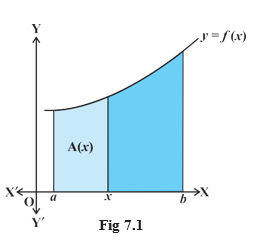
Area function — For continuous ff, the area function gives the accumulated signed area from a fixed lower limit aa to a variable endpoint xx: A(x)=∫axf(t) dtA(x)=\int_a^x f(t)\,dt.

Key idea

  • Variable endpoint: The accumulated area changes as xx changes, so it defines a function.
  • Signed area: Regions below the xx-axis contribute negatively; the definition also applies when ff is not positive.
  • Dummy variable: Use tt inside the integral to distinguish the integration variable from the endpoint xx.
A shaded region under y=f(x) illustrates A(x) from a to the variable endpoint x.
A shaded region under y=f(x)y=f(x) illustrates A(x)A(x) from aa to the variable endpoint xx.

First Fundamental Theorem of Integral Calculus

First Fundamental Theorem

If ff is continuous on [a,b][a,b] and A(x)=∫axf(t) dtA(x)=\int_a^x f(t)\,dt, then AA is differentiable and A′(x)=f(x)A'(x)=f(x) for x∈[a,b]x\in[a,b].

Worked example

If A(x)=∫0x3t2 dtA(x)=\int_0^x 3t^2\,dt, find A′(x)A'(x).

  1. Define the area function for the given integrand.
    A(x)=∫0x3t2 dtA(x)=\int_0^x 3t^2\,dt
  2. Apply the first fundamental theorem.
    A′(x)=3x2A'(x)=3x^2
Answer: A′(x)=3x2A'(x)=3x^2.

Second Fundamental Theorem of Integral Calculus

Second Fundamental Theorem

If ff is continuous on [a,b][a,b] and F′(x)=f(x)F'(x)=f(x), then ∫abf(x) dx=F(b)−F(a)=[F(x)]ab\int_a^b f(x)\,dx=F(b)-F(a)=[F(x)]_a^b.

Key points

  • Use: Evaluate a definite integral by finding an antiderivative and subtracting its lower-limit value from its upper-limit value.
  • Constant: An integration constant is unnecessary because (F(b)+C)−(F(a)+C)=F(b)−F(a)(F(b)+C)-(F(a)+C)=F(b)-F(a).
  • Condition: The integrand must be defined and continuous throughout the interval of integration.
  • Domain check: ∫−23xx2−1 dx\int_{-2}^{3}x\sqrt{x^2-1}\,dx is not a real definite integral because the integrand is undefined for −1<x<1-1<x<1.
Definite integral evaluation
∫abf(x) dx=[F(x)]ab=F(b)−F(a)\int_a^b f(x)\,dx=[F(x)]_a^b=F(b)-F(a)

Here, F′(x)=f(x)F'(x)=f(x).

Evaluate a definite integral using an antiderivative

  1. Find an antiderivative FF of the integrand ff.
  2. Evaluate FF at the upper and lower limits.
  3. Subtract the lower-limit value from the upper-limit value.
    F(b)−F(a)F(b)-F(a)
Worked example

Evaluate ∫23x2 dx\int_2^3 x^2\,dx.

  1. Find an antiderivative of the integrand.
    F(x)=x33F(x)=\frac{x^3}{3}
  2. Apply the second fundamental theorem.
    ∫23x2 dx=F(3)−F(2)=273−83\int_2^3 x^2\,dx=F(3)-F(2)=\frac{27}{3}-\frac{8}{3}
  3. Simplify to obtain the definite integral.
    193\frac{19}{3}
Answer: 193\frac{19}{3}.

Evaluation of Definite Integrals by Substitution

Definition

Substitution — Substitution changes the variable to simplify an integral, often by making the new differential match part of the integrand.

Substitution with original limits

  1. Choose a substitution that simplifies the integrand and compute its differential.
    u=g(x),du=g′(x) dxu=g(x),\qquad du=g'(x)\,dx
  2. Integrate in the new variable, omitting the constant for definite integrals.
  3. Return to the original variable and evaluate at the original limits.

Faster substitution with changed limits

  1. Choose a substitution and rewrite the integrand in the new variable.
    u=g(x)u=g(x)
  2. Convert both original limits into limits for the new variable.
    x=a⇒u=g(a),x=b⇒u=g(b)x=a\Rightarrow u=g(a),\qquad x=b\Rightarrow u=g(b)
  3. Evaluate the transformed definite integral using the new limits; do not substitute back.
Worked example

Evaluate ∫−115x4x5+1 dx\int_{-1}^{1}5x^4\sqrt{x^5+1}\,dx and ∫0π/4sin⁡3(2t)cos⁡(2t) dt\int_0^{\pi/4}\sin^3(2t)\cos(2t)\,dt.

  1. For the radical integral, set u=x5+1u=x^5+1 so the differential matches the factor in the integrand.
    du=5x4 dxdu=5x^4\,dx
  2. Convert the limits: x=−1x=-1 gives u=0u=0, and x=1x=1 gives u=2u=2.
    ∫−115x4x5+1 dx=∫02u du\int_{-1}^{1}5x^4\sqrt{x^5+1}\,dx=\int_0^2\sqrt{u}\,du
  3. Integrate and evaluate with the transformed limits.
    ∫02u du=[23u3/2]02=423\int_0^2\sqrt{u}\,du=\left[\frac{2}{3}u^{3/2}\right]_0^2=\frac{4\sqrt{2}}{3}
  4. For the trigonometric integral, set u=sin⁡2tu=\sin 2t and use du=2cos⁡2t dtdu=2\cos 2t\,dt.
    ∫0π/4sin⁡3(2t)cos⁡(2t) dt=12∫01u3 du\int_0^{\pi/4}\sin^3(2t)\cos(2t)\,dt=\frac{1}{2}\int_0^1 u^3\,du
  5. Evaluate using the transformed limits u=0u=0 and u=1u=1.
    12[u44]01=18\frac{1}{2}\left[\frac{u^4}{4}\right]_0^1=\frac{1}{8}
Answer: The integrals are 423\frac{4\sqrt{2}}{3} and 18\frac{1}{8}, respectively.
Practice

Evaluate ∫01tan⁡−1x1+x2 dx\int_0^1\frac{\tan^{-1}x}{1+x^2}\,dx.

Hint: Use u=tan⁡−1xu=\tan^{-1}x and convert both limits.
Key step: x=0⇒u=0x=0\Rightarrow u=0 and x=1⇒u=π4x=1\Rightarrow u=\frac{\pi}{4}.
Solution: ∫0π/4u du=[u22]0π/4=π232\int_0^{\pi/4}u\,du=\left[\frac{u^2}{2}\right]_0^{\pi/4}=\frac{\pi^2}{32}.
Practice

Evaluate ∫49x(30−x3/2)2 dx\int_4^9\frac{\sqrt{x}}{(30-x^{3/2})^2}\,dx.

Hint: Set u=30−x3/2u=30-x^{3/2}, so du=−32x dxdu=-\frac{3}{2}\sqrt{x}\,dx.
Key step: The new limits are u=22u=22 at x=4x=4 and u=3u=3 at x=9x=9.
Solution: −23∫223u−2 du=23(13−122)=1999-\frac{2}{3}\int_{22}^{3}u^{-2}\,du=\frac{2}{3}\left(\frac{1}{3}-\frac{1}{22}\right)=\frac{19}{99}.
Practice

Evaluate ∫12x(x+1)(x+2) dx\int_1^2\frac{x}{(x+1)(x+2)}\,dx.

Hint: Use partial fractions before applying the second fundamental theorem.
Key step: x(x+1)(x+2)=−1x+1+2x+2\frac{x}{(x+1)(x+2)}=-\frac{1}{x+1}+\frac{2}{x+2}.
Solution: [−ln⁡(x+1)+2ln⁡(x+2)]12=ln⁡(3227)[-\ln(x+1)+2\ln(x+2)]_1^2=\ln\left(\frac{32}{27}\right).
⚠ Common mistake

Do not use the second fundamental theorem if the integrand is not defined and continuous throughout the interval. For substitution, either change both limits to the new variable or substitute back before using the original limits.

Quick recap

  • The area function is A(x)=∫axf(t) dtA(x)=\int_a^x f(t)\,dt and represents accumulated signed area.
  • For continuous ff, the first fundamental theorem gives A′(x)=f(x)A'(x)=f(x).
  • If F′(x)=f(x)F'(x)=f(x), then ∫abf(x) dx=F(b)−F(a)\int_a^b f(x)\,dx=F(b)-F(a); the integration constant cancels.
  • Check that the integrand is defined and continuous over the full interval before applying the theorem.
  • In definite-integral substitution, either restore the original variable or convert both limits to the new variable.
  • With changed limits, evaluate entirely in the new variable and do not substitute back.
Lecture 8

Some Properties of Definite Integral

Basic Properties: Variable, Limits and Intervals

Dummy Variable, Reversed Limits and Interval Addition
∫abf(x) dx=∫abf(t) dt,∫abf(x) dx=−∫baf(x) dx,∫aaf(x) dx=0,∫abf(x) dx=∫acf(x) dx+∫cbf(x) dx\int_a^b f(x)\,dx=\int_a^b f(t)\,dt,\quad \int_a^b f(x)\,dx=-\int_b^a f(x)\,dx,\quad \int_a^a f(x)\,dx=0,\quad \int_a^b f(x)\,dx=\int_a^c f(x)\,dx+\int_c^b f(x)\,dx

Use these identities to simplify limits or split an integral at a convenient point.

Additivity over intervals

For an integrable function, splitting the interval at cc gives the sum of the integrals over the two resulting intervals.

∫abf(x) dx=∫acf(x) dx+∫cbf(x) dx\int_a^b f(x)\,dx=\int_a^c f(x)\,dx+\int_c^b f(x)\,dx

Evaluate by Splitting an Interval

  1. Choose a convenient split point.
    cc
  2. Write the original integral as the sum of integrals over the two subintervals.
    ∫abf(x) dx=∫acf(x) dx+∫cbf(x) dx\int_a^b f(x)\,dx=\int_a^c f(x)\,dx+\int_c^b f(x)\,dx
  3. Evaluate each part, keeping the order of its limits.
    ∫acf(x) dx+∫cbf(x) dx\int_a^c f(x)\,dx+\int_c^b f(x)\,dx
Worked example

Evaluate ∫14(2x+1) dx\int_1^4(2x+1)\,dx by splitting at 22.

  1. Evaluate the integral by splitting at x=2x=2.
    ∫14(2x+1) dx\int_1^4 (2x+1)\,dx
  2. Apply interval addition.
    ∫14(2x+1) dx=∫12(2x+1) dx+∫24(2x+1) dx\int_1^4(2x+1)\,dx=\int_1^2(2x+1)\,dx+\int_2^4(2x+1)\,dx
  3. An antiderivative is x2+xx^2+x; evaluate both parts.
    [x2+x]12=4,[x2+x]24=14\left[x^2+x\right]_1^2=4,\quad \left[x^2+x\right]_2^4=14
Answer: 4+14=184+14=18

Reflection and Symmetry Properties

Reflection Identities
∫abf(x) dx=∫abf(a+b−x) dx,∫0af(x) dx=∫0af(a−x) dx,∫02af(x) dx=∫0a[f(x)+f(2a−x)]dx\int_a^b f(x)\,dx=\int_a^b f(a+b-x)\,dx,\quad \int_0^a f(x)\,dx=\int_0^a f(a-x)\,dx,\quad \int_0^{2a}f(x)\,dx=\int_0^a\left[f(x)+f(2a-x)\right]dx

Pair the original and reflected integrands when their sum or difference simplifies.

Symmetry about the midpoint

On [0,2a][0,2a], a reflected-even integrand doubles the first-half integral, while a reflected-odd integrand cancels completely.

∫02af(x) dx={2∫0af(x) dx,f(2a−x)=f(x)0,f(2a−x)=−f(x)\int_0^{2a}f(x)\,dx=\begin{cases}2\int_0^a f(x)\,dx,&f(2a-x)=f(x)\\0,&f(2a-x)=-f(x)\end{cases}

Use Reflection to Pair Integrands

  1. Let II denote the integral to be evaluated.
    I=∫abf(x) dxI=\int_a^b f(x)\,dx
  2. Reflect the variable using the midpoint substitution.
    x↦a+b−xx\mapsto a+b-x
  3. Add the original and reflected expressions, then simplify the paired integrands.
    2I=∫ab[f(x)+f(a+b−x)]dx2I=\int_a^b\left[f(x)+f(a+b-x)\right]dx
  4. Evaluate the simplified integral and divide by the coefficient of II.
    I=12(2I)I=\frac{1}{2}(2I)
Worked example

Evaluate ∫0π/2log⁡(sin⁡x) dx\int_0^{\pi/2}\log(\sin x)\,dx.

  1. Evaluate I=∫0π/2log⁡(sin⁡x) dxI=\int_0^{\pi/2}\log(\sin x)\,dx and reflect using x↦π2−xx\mapsto\frac{\pi}{2}-x.
    I=∫0π/2log⁡(cos⁡x) dxI=\int_0^{\pi/2}\log(\cos x)\,dx
  2. Add the original and reflected integrals; use sin⁡xcos⁡x=12sin⁡2x\sin x\cos x=\frac12\sin 2x.
    2I=∫0π/2log⁡(sin⁡2x) dx−π2log⁡22I=\int_0^{\pi/2}\log(\sin 2x)\,dx-\frac{\pi}{2}\log 2
  3. Substitute t=2xt=2x. Since sin⁡(π−t)=sin⁡t\sin(\pi-t)=\sin t, the integral from 00 to π\pi is twice the integral from 00 to π2\frac{\pi}{2}.
    2I=12∫0πlog⁡(sin⁡t) dt−π2log⁡2=I−π2log⁡22I=\frac12\int_0^\pi\log(\sin t)\,dt-\frac{\pi}{2}\log 2=I-\frac{\pi}{2}\log 2
  4. Solve for II.
    I=−π2log⁡2I=-\frac{\pi}{2}\log 2
Answer: −π2log⁡2-\frac{\pi}{2}\log 2

Even and Odd Functions

Integrals of Even and Odd Functions
∫−aaf(x) dx={2∫0af(x) dx,f(−x)=f(x)0,f(−x)=−f(x)\int_{-a}^a f(x)\,dx=\begin{cases}2\int_0^a f(x)\,dx,&f(-x)=f(x)\\0,&f(-x)=-f(x)\end{cases}

Apply these rules only when the limits are symmetric about zero.

Even- and odd-function symmetry

For even functions, the integrals over [−a,0][-a,0] and [0,a][0,a] are equal. For odd functions, they are equal in magnitude and opposite in sign.

∫−a0f(x) dx=∫0af(x) dx(even),∫−a0f(x) dx=−∫0af(x) dx(odd)\int_{-a}^0 f(x)\,dx=\int_0^a f(x)\,dx\quad\text{(even)},\qquad \int_{-a}^0 f(x)\,dx=-\int_0^a f(x)\,dx\quad\text{(odd)}
Worked example

Evaluate ∫−11sin⁡5xcos⁡4x dx\int_{-1}^1\sin^5x\cos^4x\,dx.

  1. Evaluate I=∫−11sin⁡5xcos⁡4x dxI=\int_{-1}^1\sin^5x\cos^4x\,dx. Let f(x)=sin⁡5xcos⁡4xf(x)=\sin^5x\cos^4x.
    f(−x)=sin⁡5(−x)cos⁡4(−x)=−sin⁡5xcos⁡4x=−f(x)f(-x)=\sin^5(-x)\cos^4(-x)=-\sin^5x\cos^4x=-f(x)
  2. The integrand is odd and the limits are symmetric about zero.
    ∫−11f(x) dx=0\int_{-1}^1 f(x)\,dx=0
Answer: 00

Absolute-Value Integrals

Integrate an Absolute-Value Expression

  1. Find the zeros of the expression inside the absolute value.
    g(x)=0g(x)=0
  2. Determine the sign of the expression on each resulting subinterval.
    g(x)≥0org(x)<0g(x)\geq 0\quad\text{or}\quad g(x)<0
  3. Split the integral at the sign-change points and replace the absolute value on each part.
    ∣g(x)∣={g(x),g(x)≥0−g(x),g(x)<0|g(x)|=\begin{cases}g(x),&g(x)\geq 0\\-g(x),&g(x)<0\end{cases}
  4. Evaluate the ordinary integrals and add their values.
    ∫ab∣g(x)∣ dx\int_a^b |g(x)|\,dx
Worked example

Evaluate ∫−12∣x3−x∣ dx\int_{-1}^2|x^3-x|\,dx.

  1. The zeros of x3−xx^3-x are −1,0,1-1,0,1. It is nonnegative on [−1,0][-1,0] and [1,2][1,2], and nonpositive on [0,1][0,1].
    x3−x≥0 on [−1,0]∪[1,2],x3−x≤0 on [0,1]x^3-x\geq 0\text{ on }[-1,0]\cup[1,2],\qquad x^3-x\leq 0\text{ on }[0,1]
  2. Split the integral and remove the absolute value using these signs.
    ∫−12∣x3−x∣ dx=∫−10(x3−x) dx+∫01(x−x3) dx+∫12(x3−x) dx\int_{-1}^2|x^3-x|\,dx=\int_{-1}^0(x^3-x)\,dx+\int_0^1(x-x^3)\,dx+\int_1^2(x^3-x)\,dx
  3. Evaluate each part.
    ∫−10(x3−x) dx=14,∫01(x−x3) dx=14,∫12(x3−x) dx=94\int_{-1}^0(x^3-x)\,dx=\frac14,\quad \int_0^1(x-x^3)\,dx=\frac14,\quad \int_1^2(x^3-x)\,dx=\frac94
Answer: 14+14+94=114\frac14+\frac14+\frac94=\frac{11}{4}
⚠ Common mistake

Use even/odd rules only on symmetric limits such as [−a,a][-a,a]. For absolute values, check the sign on each subinterval before removing the bars.

Practice

Evaluate ∫−22(x3+x) dx\int_{-2}^2(x^3+x)\,dx.

Hint: Check the parity of the integrand.
Key step: f(−x)=−f(x)f(-x)=-f(x), so the integrand is odd.
Solution: The limits are symmetric and the integrand is odd, so ∫−22(x3+x) dx=0\int_{-2}^2(x^3+x)\,dx=0.
Practice

Evaluate I=∫0πxsin⁡x1+cos⁡2x dxI=\int_0^\pi\frac{x\sin x}{1+\cos^2x}\,dx.

Hint: Reflect using x↦π−xx\mapsto\pi-x, then substitute t=cos⁡xt=\cos x in the remaining integral.
Key step: Reflection gives 2I=π∫0πsin⁡x1+cos⁡2x dx2I=\pi\int_0^\pi\frac{\sin x}{1+\cos^2x}\,dx.
Solution: With t=cos⁡xt=\cos x, ∫0πsin⁡x1+cos⁡2x dx=∫−11dt1+t2=π2\int_0^\pi\frac{\sin x}{1+\cos^2x}\,dx=\int_{-1}^1\frac{dt}{1+t^2}=\frac{\pi}{2}. Hence I=π24I=\frac{\pi^2}{4}.
Practice

Evaluate I=∫0π/2sin⁡4xsin⁡4x+cos⁡4x dxI=\int_0^{\pi/2}\frac{\sin^4x}{\sin^4x+\cos^4x}\,dx.

Hint: Reflect using x↦π2−xx\mapsto\frac{\pi}{2}-x and add the two expressions for II.
Key step: The reflected numerator is cos⁡4x\cos^4x, so the two numerators add to the denominator.
Solution: 2I=∫0π/21 dx=π22I=\int_0^{\pi/2}1\,dx=\frac{\pi}{2}; therefore I=π4I=\frac{\pi}{4}.

Quick recap

  • Renaming the dummy variable does not change a definite integral.
  • Reversing the limits changes the sign; equal limits give zero.
  • An integral over adjacent intervals equals the sum of the integrals over those intervals.
  • Reflection replaces xx by a+b−xa+b-x on [a,b][a,b] without changing the integral.
  • On [0,2a][0,2a], reflected-even functions double the first-half integral; reflected-odd functions integrate to zero.
  • On [−a,a][-a,a], even functions integrate to twice their integral over [0,a][0,a], while odd functions integrate to zero.
  • For absolute-value integrals, split at zeros and use the sign on each interval.
Lecture 9

Summary

Reference video · Lecture 9Summary

Indefinite Integrals and Standard Results

Linearity of integration

For constants kik_i and functions fif_i, integration distributes over sums and constant multiples.

∫(∑i=1nkifi(x)) dx=∑i=1nki∫fi(x) dx\int\left(\sum_{i=1}^{n} k_i f_i(x)\right)\,dx=\sum_{i=1}^{n}k_i\int f_i(x)\,dx
Core standard integrals
∫xn dx=xn+1n+1+C,n≠−1∫dx=x+C,∫dxx=ln⁡∣x∣+C∫cos⁡x dx=sin⁡x+C,∫sin⁡x dx=−cos⁡x+C∫sec⁡2x dx=tan⁡x+C,∫csc⁡2x dx=−cot⁡x+C∫sec⁡xtan⁡x dx=sec⁡x+C,∫csc⁡xcot⁡x dx=−csc⁡x+C∫dx1−x2=sin⁡−1x+C,∫dx1−x2=−cos⁡−1x+C∫dx1+x2=tan⁡−1x+C,∫ex dx=ex+C∫ax dx=axln⁡a+C\begin{aligned}\int x^n\,dx&=\frac{x^{n+1}}{n+1}+C,\quad n\ne -1\\\int dx&=x+C,\quad \int \frac{dx}{x}=\ln|x|+C\\\int \cos x\,dx&=\sin x+C,\quad \int \sin x\,dx=-\cos x+C\\\int \sec^2x\,dx&=\tan x+C,\quad \int \csc^2x\,dx=-\cot x+C\\\int \sec x\tan x\,dx&=\sec x+C,\quad \int \csc x\cot x\,dx=-\csc x+C\\\int \frac{dx}{\sqrt{1-x^2}}&=\sin^{-1}x+C,\quad \int \frac{dx}{\sqrt{1-x^2}}=-\cos^{-1}x+C\\\int \frac{dx}{1+x^2}&=\tan^{-1}x+C,\quad \int e^x\,dx=e^x+C\\\int a^x\,dx&=\frac{a^x}{\ln a}+C\end{aligned}

Use these results directly when the integrand matches a standard form.

Integrating by standard forms

  1. Split sums and extract constant factors.
    ∫(af(x)+bg(x)) dx=a∫f(x) dx+b∫g(x) dx\int(af(x)+bg(x))\,dx=a\int f(x)\,dx+b\int g(x)\,dx
  2. Match each term to a standard integral and add the results.
    ∫xn dx=xn+1n+1+C\int x^n\,dx=\frac{x^{n+1}}{n+1}+C
  3. Include one arbitrary constant CC in the final answer.
    +C+C
Worked example

Evaluate ∫(3x2+cos⁡x) dx\int(3x^2+\cos x)\,dx.

  1. Integrate each term separately.
    ∫(3x2+cos⁡x) dx=3∫x2 dx+∫cos⁡x dx\int(3x^2+\cos x)\,dx=3\int x^2\,dx+\int\cos x\,dx
  2. Apply the power rule and cosine integral.
    3(x33)+sin⁡x+C=x3+sin⁡x+C3\left(\frac{x^3}{3}\right)+\sin x+C=x^3+\sin x+C
Answer: x3+sin⁡x+Cx^3+\sin x+C

Integration by Partial Fractions

Common partial-fraction forms
Denominator factorsDecomposition form
(x−a)(x−b)(x-a)(x-b), a≠ba\ne bAx−a+Bx−b\frac{A}{x-a}+\frac{B}{x-b}
(x−a)2(x-a)^2Ax−a+B(x−a)2\frac{A}{x-a}+\frac{B}{(x-a)^2}
(x−a)(x−b)(x−c)(x-a)(x-b)(x-c)Ax−a+Bx−b+Cx−c\frac{A}{x-a}+\frac{B}{x-b}+\frac{C}{x-c}
(x−a)2(x−b)(x-a)^2(x-b)Ax−a+B(x−a)2+Cx−b\frac{A}{x-a}+\frac{B}{(x-a)^2}+\frac{C}{x-b}
(x−a)(x2+bx+c)(x-a)(x^2+bx+c), irreducible quadraticAx−a+Bx+Cx2+bx+c\frac{A}{x-a}+\frac{Bx+C}{x^2+bx+c}

Partial-fraction method

  1. If needed, divide the numerator by the denominator first.
    P(x)Q(x)=T(x)+P1(x)Q(x),deg⁡P1<deg⁡Q\frac{P(x)}{Q(x)}=T(x)+\frac{P_1(x)}{Q(x)},\quad \deg P_1<\deg Q
  2. Factor the denominator and write the matching partial-fraction form.
    P1(x)Q(x)=∑iAiQi(x)\frac{P_1(x)}{Q(x)}=\sum_i\frac{A_i}{Q_i(x)}
  3. Find the constants by clearing denominators and comparing coefficients.
  4. Integrate each term using standard results.
Worked example

Evaluate ∫3x+5(x+1)(x+2) dx\int\frac{3x+5}{(x+1)(x+2)}\,dx.

  1. Set up the decomposition and equate coefficients.
    3x+5(x+1)(x+2)=Ax+1+Bx+2,A+B=3,2A+B=5\frac{3x+5}{(x+1)(x+2)}=\frac{A}{x+1}+\frac{B}{x+2},\quad A+B=3,\quad 2A+B=5
  2. Solve for the constants.
    A=2,B=1A=2,\quad B=1
  3. Integrate the resulting terms.
    ∫3x+5(x+1)(x+2) dx=2ln⁡∣x+1∣+ln⁡∣x+2∣+C\int\frac{3x+5}{(x+1)(x+2)}\,dx=2\ln|x+1|+\ln|x+2|+C
Answer: 2ln⁡∣x+1∣+ln⁡∣x+2∣+C2\ln|x+1|+\ln|x+2|+C

Substitution and Special Standard Forms

Trigonometric and special integrals
∫tan⁡x dx=ln⁡∣sec⁡x∣+C,∫cot⁡x dx=ln⁡∣sin⁡x∣+C∫sec⁡x dx=ln⁡∣sec⁡x+tan⁡x∣+C,∫csc⁡x dx=ln⁡∣csc⁡x−cot⁡x∣+C∫dxx2−a2=12aln⁡∣x−ax+a∣+C∫dxa2−x2=12aln⁡∣a+xa−x∣+C∫dxx2+a2=1atan⁡−1xa+C∫dxx2−a2=ln⁡∣x+x2−a2∣+C∫dxa2−x2=sin⁡−1xa+C∫dxx2+a2=ln⁡∣x+x2+a2∣+C\begin{aligned}\int\tan x\,dx&=\ln|\sec x|+C,\quad \int\cot x\,dx=\ln|\sin x|+C\\\int\sec x\,dx&=\ln|\sec x+\tan x|+C,\quad \int\csc x\,dx=\ln|\csc x-\cot x|+C\\\int\frac{dx}{x^2-a^2}&=\frac{1}{2a}\ln\left|\frac{x-a}{x+a}\right|+C\\\int\frac{dx}{a^2-x^2}&=\frac{1}{2a}\ln\left|\frac{a+x}{a-x}\right|+C\\\int\frac{dx}{x^2+a^2}&=\frac{1}{a}\tan^{-1}\frac{x}{a}+C\\\int\frac{dx}{\sqrt{x^2-a^2}}&=\ln|x+\sqrt{x^2-a^2}|+C\\\int\frac{dx}{\sqrt{a^2-x^2}}&=\sin^{-1}\frac{x}{a}+C\\\int\frac{dx}{\sqrt{x^2+a^2}}&=\ln|x+\sqrt{x^2+a^2}|+C\end{aligned}

These forms are useful after substitution or algebraic simplification. Assume a>0a>0 where it appears.

Using standard special forms

  1. Simplify or substitute so the integrand matches a standard form.
  2. Check constants and signs in the denominator or radical.
  3. Apply the matching formula and include CC.
    +C+C
Worked example

Evaluate ∫dxx2+9\int\frac{dx}{x^2+9}.

  1. Match the denominator to the form x2+a2x^2+a^2 with a=3a=3.
    ∫dxx2+9=13tan⁡−1x3+C\int\frac{dx}{x^2+9}=\frac{1}{3}\tan^{-1}\frac{x}{3}+C
Answer: 13tan⁡−1x3+C\frac{1}{3}\tan^{-1}\frac{x}{3}+C

Integration by Parts

Parts formula
∫uv dx=u∫v dx−∫(u′∫v dx)dx\int u v\,dx=u\int v\,dx-\int\left(u'\int v\,dx\right)dx

For functions uu and vv, choose uu to differentiate and integrate vv.

Useful exponential pattern
∫ex(f(x)+f′(x))dx=exf(x)+C\int e^x\left(f(x)+f'(x)\right)dx=e^xf(x)+C

Recognise a function and its derivative together beside exe^x.

Applying integration by parts

  1. Write the integrand as a product and choose the factor to differentiate.
  2. Apply the parts formula.
    ∫uv dx=u∫v dx−∫(u′∫v dx)dx\int u v\,dx=u\int v\,dx-\int\left(u'\int v\,dx\right)dx
  3. Simplify and integrate the remaining integral.
Worked example

Evaluate ∫xex dx\int xe^x\,dx.

  1. Choose u=xu=x and integrate the other factor exe^x.
    ∫xex dx=xex−∫ex dx\int xe^x\,dx=xe^x-\int e^x\,dx
  2. Evaluate the remaining integral.
    ∫xex dx=xex−ex+C=ex(x−1)+C\int xe^x\,dx=xe^x-e^x+C=e^x(x-1)+C
Answer: ex(x−1)+Ce^x(x-1)+C

Quadratics and Radical Integrals

Quadratic transformations
ax2+bx+c=a[(x+b2a)2+ca−b24a2]px+q=A(2ax+b)+B\begin{aligned}ax^2+bx+c&=a\left[\left(x+\frac{b}{2a}\right)^2+\frac{c}{a}-\frac{b^2}{4a^2}\right]\\px+q&=A(2ax+b)+B\end{aligned}

Use these rewrites for integrals involving ax2+bx+cax^2+bx+c and a linear numerator.

Integrals of square roots
∫x2−a2 dx=x2x2−a2−a22ln⁡∣x+x2−a2∣+C∫x2+a2 dx=x2x2+a2+a22ln⁡∣x+x2+a2∣+C∫a2−x2 dx=x2a2−x2+a22sin⁡−1xa+C\begin{aligned}\int\sqrt{x^2-a^2}\,dx&=\frac{x}{2}\sqrt{x^2-a^2}-\frac{a^2}{2}\ln|x+\sqrt{x^2-a^2}|+C\\\int\sqrt{x^2+a^2}\,dx&=\frac{x}{2}\sqrt{x^2+a^2}+\frac{a^2}{2}\ln|x+\sqrt{x^2+a^2}|+C\\\int\sqrt{a^2-x^2}\,dx&=\frac{x}{2}\sqrt{a^2-x^2}+\frac{a^2}{2}\sin^{-1}\frac{x}{a}+C\end{aligned}

The inverse-trigonometric term applies where the radical is real.

Reducing a quadratic integral

  1. Complete the square in the quadratic, if needed.
    ax2+bx+c=a[(x+b2a)2+ca−b24a2]ax^2+bx+c=a\left[\left(x+\frac{b}{2a}\right)^2+\frac{c}{a}-\frac{b^2}{4a^2}\right]
  2. For a linear numerator, match it to the quadratic's derivative plus a constant.
    px+q=A(2ax+b)+Bpx+q=A(2ax+b)+B
  3. Use substitution and the corresponding standard logarithmic, inverse-trigonometric, or radical integral.
Worked example

Evaluate ∫9−x2 dx\int\sqrt{9-x^2}\,dx.

  1. Use the formula for a2−x2\sqrt{a^2-x^2} with a=3a=3.
    ∫9−x2 dx=x29−x2+92sin⁡−1x3+C\int\sqrt{9-x^2}\,dx=\frac{x}{2}\sqrt{9-x^2}+\frac{9}{2}\sin^{-1}\frac{x}{3}+C
Answer: x29−x2+92sin⁡−1x3+C\frac{x}{2}\sqrt{9-x^2}+\frac{9}{2}\sin^{-1}\frac{x}{3}+C

Area Function and Fundamental Theorems

First Fundamental Theorem of Integral Calculus

If ff is continuous on [a,b][a,b] and A(x)=∫axf(t) dtA(x)=\int_a^x f(t)\,dt, then A′(x)=f(x)A'(x)=f(x) for x∈[a,b]x\in[a,b].

A′(x)=f(x)A'(x)=f(x)
Second Fundamental Theorem of Integral Calculus

If F′(x)=f(x)F'(x)=f(x) on [a,b][a,b] and ff is continuous there, evaluate the definite integral using an antiderivative at the limits.

∫abf(x) dx=F(b)−F(a)\int_a^b f(x)\,dx=F(b)-F(a)

Evaluating a definite integral

  1. Find an antiderivative FF of the integrand.
    F′(x)=f(x)F'(x)=f(x)
  2. Evaluate FF at the upper and lower limits.
    F(b)−F(a)F(b)-F(a)
  3. Subtract the lower-limit value from the upper-limit value.
    ∫abf(x) dx=F(b)−F(a)\int_a^b f(x)\,dx=F(b)-F(a)
Worked example

Evaluate ∫023x2 dx\int_0^2 3x^2\,dx.

  1. An antiderivative of 3x23x^2 is x3x^3.
    ∫023x2 dx=[x3]02\int_0^2 3x^2\,dx=[x^3]_0^2
  2. Substitute the limits and subtract.
    23−03=82^3-0^3=8
Answer: 88
⚠ Common mistake

Do not omit CC from an indefinite integral. For a definite integral, use F(b)−F(a)F(b)-F(a); the constants cancel, so no CC appears in the final value.

Practice

Evaluate ∫2x+1x2+x+1 dx\int\frac{2x+1}{x^2+x+1}\,dx.

Hint: The numerator is the derivative of the denominator.
Key step: u=x2+x+1u=x^2+x+1 gives du=(2x+1) dxdu=(2x+1)\,dx.
Solution: Using u=x2+x+1u=x^2+x+1, the integral is ∫duu=ln⁡∣u∣+C=ln⁡(x2+x+1)+C\int\frac{du}{u}=\ln|u|+C=\ln(x^2+x+1)+C.
Practice

Evaluate ∫xcos⁡x dx\int x\cos x\,dx.

Hint: Use integration by parts with u=xu=x.
Key step: ∫xcos⁡x dx=xsin⁡x−∫sin⁡x dx\int x\cos x\,dx=x\sin x-\int\sin x\,dx.
Solution: xsin⁡x+cos⁡x+Cx\sin x+\cos x+C.
Practice

Evaluate ∫121x dx\int_1^2\frac{1}{x}\,dx.

Hint: Use the antiderivative ln⁡∣x∣\ln|x|.
Key step: [ln⁡∣x∣]12=ln⁡2−ln⁡1[\ln|x|]_1^2=\ln 2-\ln 1.
Solution: ln⁡2−0=ln⁡2\ln 2-0=\ln 2.

Quick recap

  • Indefinite integration reverses differentiation; all antiderivatives differ by a constant CC.
  • Use linearity, standard integrals, substitution, partial fractions, and integration by parts to select an efficient method.
  • For rational functions, divide first if improper, then decompose the proper fraction into partial fractions.
  • Complete the square or rewrite the numerator to reduce quadratic integrals to standard forms.
  • The area function A(x)=∫axf(t) dtA(x)=\int_a^x f(t)\,dt satisfies A′(x)=f(x)A'(x)=f(x) when ff is continuous.
  • For continuous ff with antiderivative FF, ∫abf(x) dx=F(b)−F(a)\int_a^b f(x)\,dx=F(b)-F(a).

Formula sheet

Indefinite Integral Notation
∫f(x) dx=F(x)+C,F′(x)=f(x)\int f(x)\,dx=F(x)+C,\qquad F'(x)=f(x)
Linearity for a finite sum
∫(∑i=1nkifi(x)) dx=∑i=1nki∫fi(x) dx\int \left(\sum_{i=1}^{n} k_i f_i(x)\right)\,dx=\sum_{i=1}^{n} k_i\int f_i(x)\,dx
Useful antiderivatives
∫xn dx=xn+1n+1+C  (n≠−1),∫1x dx=ln⁡∣x∣+C,∫ex dx=ex+C\int x^n\,dx=\frac{x^{n+1}}{n+1}+C\;(n\ne-1),\quad \int \frac{1}{x}\,dx=\ln|x|+C,\quad \int e^x\,dx=e^x+C
Useful trigonometric antiderivatives
∫sin⁡x dx=−cos⁡x+C,∫cos⁡x dx=sin⁡x+C,∫sec⁡2x dx=tan⁡x+C,∫sec⁡xtan⁡x dx=sec⁡x+C,∫csc⁡2x dx=−cot⁡x+C,∫csc⁡xcot⁡x dx=−csc⁡x+C\int \sin x\,dx=-\cos x+C,\quad \int \cos x\,dx=\sin x+C,\quad \int \sec^2 x\,dx=\tan x+C,\quad \int \sec x\tan x\,dx=\sec x+C,\quad \int \csc^2 x\,dx=-\cot x+C,\quad \int \csc x\cot x\,dx=-\csc x+C
Useful substitution examples
∫sin⁡(mx) dx=−1mcos⁡(mx)+C∫2xsin⁡(x2+1) dx=−cos⁡(x2+1)+C∫sin⁡(tan⁡−1x)1+x2 dx=−cos⁡(tan⁡−1x)+C\begin{aligned}\int\sin(mx)\,dx&=-\frac{1}{m}\cos(mx)+C\\\int 2x\sin(x^2+1)\,dx&=-\cos(x^2+1)+C\\\int\frac{\sin(\tan^{-1}x)}{1+x^2}\,dx&=-\cos(\tan^{-1}x)+C\end{aligned}
Useful trigonometric integrals
∫tan⁡x dx=ln⁡∣sec⁡x∣+C∫cot⁡x dx=ln⁡∣sin⁡x∣+C∫sec⁡x dx=ln⁡∣sec⁡x+tan⁡x∣+C∫csc⁡x dx=ln⁡∣csc⁡x−cot⁡x∣+C\begin{aligned}\int\tan x\,dx&=\ln|\sec x|+C\\\int\cot x\,dx&=\ln|\sin x|+C\\\int\sec x\,dx&=\ln|\sec x+\tan x|+C\\\int\csc x\,dx&=\ln|\csc x-\cot x|+C\end{aligned}
Identities for integration
cos⁡2x=1+cos⁡2x2sin⁡2x=1−cos⁡2xsin⁡xcos⁡y=12(sin⁡(x+y)+sin⁡(x−y))sin⁡3x=3sin⁡x−4sin⁡3x\begin{aligned}\cos^2x&=\frac{1+\cos 2x}{2}\\\sin^2x&=1-\cos^2x\\\sin x\cos y&=\frac{1}{2}\bigl(\sin(x+y)+\sin(x-y)\bigr)\\\sin 3x&=3\sin x-4\sin^3x\end{aligned}
Completing the square
ax2+bx+c=a[(x+b2a)2+4ac−b24a2]ax^2+bx+c=a\left[(x+\frac{b}{2a})^2+\frac{4ac-b^2}{4a^2}\right]
Linear numerator split
px+q=A(2ax+b)+Bpx+q=A(2ax+b)+B
Common Antiderivatives
∫dxx−a=ln⁡∣x−a∣+C,∫dx(x−a)n=(x−a)1−n1−n+C (n≠1),∫dxx2+a2=1atan⁡−1(xa)+C\int\frac{dx}{x-a}=\ln|x-a|+C,\qquad \int\frac{dx}{(x-a)^n}=\frac{(x-a)^{1-n}}{1-n}+C\ (n\ne 1),\qquad \int\frac{dx}{x^2+a^2}=\frac{1}{a}\tan^{-1}\left(\frac{x}{a}\right)+C
Integration-by-Parts Formula
∫u dv=uv−∫v du,∫f(x)g(x) dx=f(x)∫g(x) dx−∫[f′(x)∫g(x) dx]dx\int u\,dv=uv-\int v\,du,\qquad \int f(x)g(x)\,dx=f(x)\int g(x)\,dx-\int\left[f'(x)\int g(x)\,dx\right]dx
Useful Integration-by-Parts Results
∫ln⁡x dx=xln⁡x−x+C,∫xex dx=ex(x−1)+C,∫exsin⁡x dx=ex2(sin⁡x−cos⁡x)+C\int\ln x\,dx=x\ln x-x+C,\qquad \int xe^x\,dx=e^x(x-1)+C,\qquad \int e^x\sin x\,dx=\frac{e^x}{2}(\sin x-\cos x)+C
Three standard radical integrals
∫x2−a2 dx=x2x2−a2−a22ln⁡∣x+x2−a2∣+C∫x2+a2 dx=x2x2+a2+a22ln⁡∣x+x2+a2∣+C∫a2−x2 dx=x2a2−x2+a22sin⁡−1(xa)+C\begin{aligned}\int\sqrt{x^2-a^2}\,dx&=\frac{x}{2}\sqrt{x^2-a^2}-\frac{a^2}{2}\ln\left|x+\sqrt{x^2-a^2}\right|+C\\\int\sqrt{x^2+a^2}\,dx&=\frac{x}{2}\sqrt{x^2+a^2}+\frac{a^2}{2}\ln\left|x+\sqrt{x^2+a^2}\right|+C\\\int\sqrt{a^2-x^2}\,dx&=\frac{x}{2}\sqrt{a^2-x^2}+\frac{a^2}{2}\sin^{-1}\left(\frac{x}{a}\right)+C\end{aligned}
Fundamental evaluation rule
∫abf(x) dx=F(b)−F(a)\int_a^b f(x)\,dx=F(b)-F(a)
Limit-of-sums definition
∫abf(x) dx=lim⁡n→∞∑i=1nf(xi∗) Δx\int_a^b f(x)\,dx=\lim_{n\to\infty}\sum_{i=1}^{n}f(x_i^*)\,\Delta x
Definite integral evaluation
∫abf(x) dx=[F(x)]ab=F(b)−F(a)\int_a^b f(x)\,dx=[F(x)]_a^b=F(b)-F(a)
Dummy Variable, Reversed Limits and Interval Addition
∫abf(x) dx=∫abf(t) dt,∫abf(x) dx=−∫baf(x) dx,∫aaf(x) dx=0,∫abf(x) dx=∫acf(x) dx+∫cbf(x) dx\int_a^b f(x)\,dx=\int_a^b f(t)\,dt,\quad \int_a^b f(x)\,dx=-\int_b^a f(x)\,dx,\quad \int_a^a f(x)\,dx=0,\quad \int_a^b f(x)\,dx=\int_a^c f(x)\,dx+\int_c^b f(x)\,dx
Reflection Identities
∫abf(x) dx=∫abf(a+b−x) dx,∫0af(x) dx=∫0af(a−x) dx,∫02af(x) dx=∫0a[f(x)+f(2a−x)]dx\int_a^b f(x)\,dx=\int_a^b f(a+b-x)\,dx,\quad \int_0^a f(x)\,dx=\int_0^a f(a-x)\,dx,\quad \int_0^{2a}f(x)\,dx=\int_0^a\left[f(x)+f(2a-x)\right]dx
Integrals of Even and Odd Functions
∫−aaf(x) dx={2∫0af(x) dx,f(−x)=f(x)0,f(−x)=−f(x)\int_{-a}^a f(x)\,dx=\begin{cases}2\int_0^a f(x)\,dx,&f(-x)=f(x)\\0,&f(-x)=-f(x)\end{cases}
Core standard integrals
∫xn dx=xn+1n+1+C,n≠−1∫dx=x+C,∫dxx=ln⁡∣x∣+C∫cos⁡x dx=sin⁡x+C,∫sin⁡x dx=−cos⁡x+C∫sec⁡2x dx=tan⁡x+C,∫csc⁡2x dx=−cot⁡x+C∫sec⁡xtan⁡x dx=sec⁡x+C,∫csc⁡xcot⁡x dx=−csc⁡x+C∫dx1−x2=sin⁡−1x+C,∫dx1−x2=−cos⁡−1x+C∫dx1+x2=tan⁡−1x+C,∫ex dx=ex+C∫ax dx=axln⁡a+C\begin{aligned}\int x^n\,dx&=\frac{x^{n+1}}{n+1}+C,\quad n\ne -1\\\int dx&=x+C,\quad \int \frac{dx}{x}=\ln|x|+C\\\int \cos x\,dx&=\sin x+C,\quad \int \sin x\,dx=-\cos x+C\\\int \sec^2x\,dx&=\tan x+C,\quad \int \csc^2x\,dx=-\cot x+C\\\int \sec x\tan x\,dx&=\sec x+C,\quad \int \csc x\cot x\,dx=-\csc x+C\\\int \frac{dx}{\sqrt{1-x^2}}&=\sin^{-1}x+C,\quad \int \frac{dx}{\sqrt{1-x^2}}=-\cos^{-1}x+C\\\int \frac{dx}{1+x^2}&=\tan^{-1}x+C,\quad \int e^x\,dx=e^x+C\\\int a^x\,dx&=\frac{a^x}{\ln a}+C\end{aligned}
Trigonometric and special integrals
∫tan⁡x dx=ln⁡∣sec⁡x∣+C,∫cot⁡x dx=ln⁡∣sin⁡x∣+C∫sec⁡x dx=ln⁡∣sec⁡x+tan⁡x∣+C,∫csc⁡x dx=ln⁡∣csc⁡x−cot⁡x∣+C∫dxx2−a2=12aln⁡∣x−ax+a∣+C∫dxa2−x2=12aln⁡∣a+xa−x∣+C∫dxx2+a2=1atan⁡−1xa+C∫dxx2−a2=ln⁡∣x+x2−a2∣+C∫dxa2−x2=sin⁡−1xa+C∫dxx2+a2=ln⁡∣x+x2+a2∣+C\begin{aligned}\int\tan x\,dx&=\ln|\sec x|+C,\quad \int\cot x\,dx=\ln|\sin x|+C\\\int\sec x\,dx&=\ln|\sec x+\tan x|+C,\quad \int\csc x\,dx=\ln|\csc x-\cot x|+C\\\int\frac{dx}{x^2-a^2}&=\frac{1}{2a}\ln\left|\frac{x-a}{x+a}\right|+C\\\int\frac{dx}{a^2-x^2}&=\frac{1}{2a}\ln\left|\frac{a+x}{a-x}\right|+C\\\int\frac{dx}{x^2+a^2}&=\frac{1}{a}\tan^{-1}\frac{x}{a}+C\\\int\frac{dx}{\sqrt{x^2-a^2}}&=\ln|x+\sqrt{x^2-a^2}|+C\\\int\frac{dx}{\sqrt{a^2-x^2}}&=\sin^{-1}\frac{x}{a}+C\\\int\frac{dx}{\sqrt{x^2+a^2}}&=\ln|x+\sqrt{x^2+a^2}|+C\end{aligned}
Parts formula
∫uv dx=u∫v dx−∫(u′∫v dx)dx\int u v\,dx=u\int v\,dx-\int\left(u'\int v\,dx\right)dx
Useful exponential pattern
∫ex(f(x)+f′(x))dx=exf(x)+C\int e^x\left(f(x)+f'(x)\right)dx=e^xf(x)+C
Quadratic transformations
ax2+bx+c=a[(x+b2a)2+ca−b24a2]px+q=A(2ax+b)+B\begin{aligned}ax^2+bx+c&=a\left[\left(x+\frac{b}{2a}\right)^2+\frac{c}{a}-\frac{b^2}{4a^2}\right]\\px+q&=A(2ax+b)+B\end{aligned}
Integrals of square roots
∫x2−a2 dx=x2x2−a2−a22ln⁡∣x+x2−a2∣+C∫x2+a2 dx=x2x2+a2+a22ln⁡∣x+x2+a2∣+C∫a2−x2 dx=x2a2−x2+a22sin⁡−1xa+C\begin{aligned}\int\sqrt{x^2-a^2}\,dx&=\frac{x}{2}\sqrt{x^2-a^2}-\frac{a^2}{2}\ln|x+\sqrt{x^2-a^2}|+C\\\int\sqrt{x^2+a^2}\,dx&=\frac{x}{2}\sqrt{x^2+a^2}+\frac{a^2}{2}\ln|x+\sqrt{x^2+a^2}|+C\\\int\sqrt{a^2-x^2}\,dx&=\frac{x}{2}\sqrt{a^2-x^2}+\frac{a^2}{2}\sin^{-1}\frac{x}{a}+C\end{aligned}

Mathematics — ALL CHAPTERS

1

Relations And Functions

View

2

Inverse Trigonometric Functions

View

3

Matrices

View

4

DETERMINANTS 

View

5

Continuity And Differentiability

View

6

Application Of Derivatives

View

7

Integrals

View

8

APPLICATION OF INTEGRALS

View

9

DIFFERENTIAL EQUATIONS

View

10

VECTOR ALGEBRA

View

11

Three Dimensional Geometry

View

12

Linear Programming

View

13

Probability

View

14

Proofs In Mathematics

View

15

Mathematical Modelling

View