Class 12 PCM . Mathematics . Mathematics Part I . Relations and Functions
Chapter 1: Relations And Functions
Ch 1
Mathematics
Class 12 PCM
Introduction
Relations
Relation from A to B — A relation from to is any subset of the Cartesian product .
Key Points
- Relation in A: A relation on a set is a subset of .
- Related notation: If , write ; no real-world connection between and is required.
- Functions: A function is a special kind of relation.
- Examples: Relations can describe sibling links, age or marks comparisons, or living in the same locality.
The first coordinate is chosen from and the second from .
Writing a Relation as Ordered Pairs
- Identify the sets from which the first and second elements are chosen.
- Apply the stated condition to each possible pair.
- List exactly the pairs satisfying the condition.
List the relation on defined by .
- For , use the condition that the second element is one greater than the first.
- Test each first element and keep pairs that belong to .
- The value required for is outside , so it gives no pair.
Empty and Universal Relations
Empty relation — An empty relation on contains no ordered pairs, so no element of is related to any element of .
Universal relation — A universal relation on contains every possible ordered pair from .
The empty and universal relations are also called trivial relations.
Classify the relations “is sister of” and “has a height difference of less than metres” on the students of a boys' school.
- In a boys' school, no student is the sister of any student.
- The height difference of any two students is less than metres, so every pair satisfies the condition.
Reflexive, Symmetric and Transitive Relations
Reflexive relation — A relation on is reflexive if every element is related to itself.
Symmetric relation — A relation on is symmetric if whenever is related to , is related to .
Transitive relation — A relation on is transitive if and together imply .
How to Check
- Reflexive: Check every diagonal pair .
- Symmetric: Check that each pair has its reverse .
- Transitive: Whenever and are in , check that is also in .
- Disprove a property: One counterexample is enough.
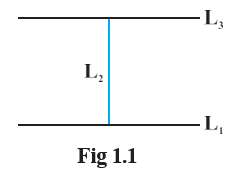
For the relation “is perpendicular to” on all lines in a plane, determine whether it is reflexive, symmetric and transitive.
- Perpendicularity is symmetric: if one line is perpendicular to another, the reverse is also true.
- A line is not perpendicular to itself, so the relation is not reflexive.
- Two lines perpendicular to the same line are parallel, so the relation is not transitive.
Do not infer transitivity just because two links hold; the required pair must also be in .
Equivalence Relations, Classes and Partitions
Equivalence relation — A relation is an equivalence relation if it is reflexive, symmetric and transitive.
Equivalence class — For an equivalence relation on , the class consists of all elements of related to .
An equivalence relation divides into nonempty, mutually disjoint classes that cover . Elements in the same class are related; elements in different classes are not. Distinct classes are disjoint.
Conversely, any partition of defines an equivalence relation by declaring exactly when and belong to the same block. This relation is reflexive, symmetric and transitive.
Important Equivalence Examples
- Triangle congruence: Congruence is reflexive, symmetric and transitive; hence it is an equivalence relation.
- Parity on integers: when groups all even integers together and all odd integers together.
- Modulo 3: when has three classes, corresponding to remainders , and .
- Finite parity: On , the two classes are and .
For the relation if , the classes are the even and odd integers.
Integers are related exactly when they have the same remainder upon division by .
Proving an Equivalence Relation and Finding Its Classes
- Check reflexivity, symmetry and transitivity separately.
- If all three properties hold, collect the elements related to each representative.
- List distinct classes and check that they are disjoint and cover the set.
Show that the relation on defined by if is an equivalence relation, and find its classes.
- On , define when divides . Since every integer differs from itself by zero, the relation is reflexive.
- If divides , it also divides its negative, so the relation is symmetric.
- If divides both differences, it divides their sum, so the relation is transitive.
- The equivalence classes are the even integers and the odd integers; these form a partition of .
On , let . Which of reflexivity, symmetry and transitivity does satisfy?
Show that congruence of triangles in a plane is an equivalence relation.
For the relation on defined by if , state its equivalence classes.
Quick recap
- A relation from to is any subset of ; a relation on is a subset of .
- The empty relation is ; the universal relation is .
- Reflexive means every element relates to itself; symmetric means pairs reverse; transitive means linked pairs compose.
- An equivalence relation is reflexive, symmetric and transitive.
- Equivalence classes partition a set into disjoint subsets that cover it; a partition also defines an equivalence relation by same-block membership.
- Divisibility of by groups integers according to their remainders modulo ; parity gives the even and odd classes.
Types Of Functions
One-One (Injective) Functions
One-one (injective) function — A function is one-one if distinct inputs have distinct images.
If implies for all , then is one-one. Otherwise, it is many-one.
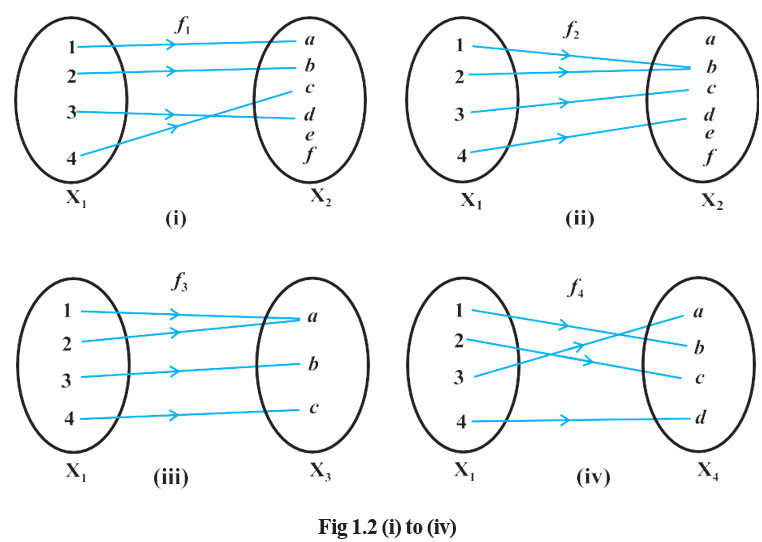
Key points and examples
- One-one: No two distinct domain elements have the same image.
- Many-one: At least two distinct domain elements share an image.
- Roll numbers: Mapping 50 students to their unique roll numbers is one-one, but as a map into it is not onto.
- Natural-number doubling: , , is one-one; it misses odd natural numbers.
- Square function: , , is not one-one because .
Test whether a function is one-one
- Assume two domain inputs have equal images.
- Apply the function rule and simplify the equality.
- If this forces equal inputs, the function is one-one; otherwise, give distinct inputs with equal images.
Show that , , is one-one but not onto.
- Let be defined by . Equate two images.
- Cancel the common factor to obtain equal inputs.
- Thus, is one-one. It is not onto because no natural input maps to .
Onto (Surjective) Functions
Onto (surjective) function — A function is onto if every element of the codomain is the image of at least one element of .
A function is onto exactly when its range equals its codomain.
Key points and examples
- Onto: Every codomain element has a preimage; different domain elements may share an image.
- Not onto: At least one codomain element is not reached.
- Mapping diagrams: and are onto; is not onto because some codomain elements are not images.
- Roll numbers: The map from 50 students to by roll number is not onto; for example, is not an image.
- Square function: , , is not onto because no negative real number is in its range.
Test whether a function is onto
- Take an arbitrary element of the codomain.
- Solve for an input whose image is that element.
- If a domain input exists for every , the function is onto; otherwise, identify an unreachable codomain element.
Show that , where and for , is onto but not one-one.
- Define by the following rule.
- The value is reached from input ; each is reached from input .
- Every natural number is reached, but inputs and share an image.
Bijective Functions
Bijective function — A function is bijective if it is both one-one and onto.
A bijection assigns each domain element a unique codomain element, and every codomain element is reached.
Prove a function is bijective
- Prove injectivity by showing equal outputs force equal inputs.
- Prove surjectivity by finding a preimage for an arbitrary codomain element.
- Conclude that the function is bijective when both properties hold.
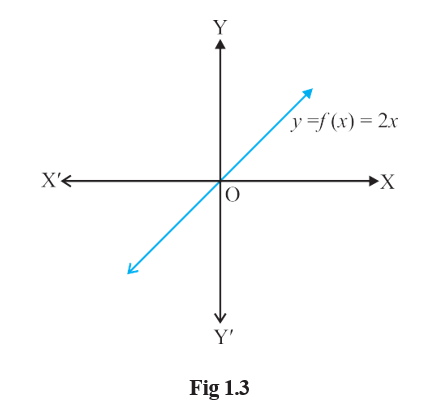
Prove that , , is bijective.
- For , , equal images force equal inputs.
- For any real codomain value , choose the real input .
- Thus, the function is both one-one and onto.
Functions on Finite and Infinite Sets
For every finite set , a one-one function is onto, and an onto function is one-one. These implications need not hold for infinite sets.
Why the finite-set result holds
- One-one on a finite set: inputs give distinct images, so every element of is reached.
- Onto on a finite set: If two inputs shared an image, fewer than distinct images would remain, contradicting onto-ness.
- Infinite sets: Injectivity need not imply surjectivity, and surjectivity need not imply injectivity; and the piecewise map above illustrate these failures.
Additional examples
- Parity rule: The function given by for odd and for even is bijective; it swaps adjacent natural numbers.
- Parity rule—onto: Each odd output comes from input , and each even output comes from input .
- Parity rule—one-one: Inputs of different parity cannot have equal outputs; within either parity, equal outputs force equal inputs.
- Finite example: An onto function must be one-one: if two inputs shared an image, at most two codomain elements would be reached.
- Finite example: A one-one function must be onto because its three inputs have three distinct images.
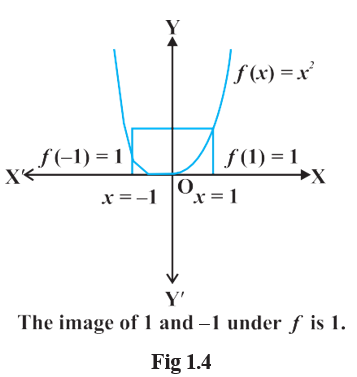
Classify , , as one-one and/or onto.
Show that , with for odd and for even , is bijective.
For a finite set , explain why an onto function must be one-one.
Quick recap
- One-one means equal outputs force equal inputs; otherwise, the function is many-one.
- Onto means every codomain element is reached; equivalently, .
- A bijection is both one-one and onto.
- On a finite set mapped to itself, one-one and onto each imply the other.
- These finite-set implications may fail on infinite sets: is one-one but not onto, while the piecewise natural-number example is onto but not one-one.
- The real function is neither one-one nor onto.
Composition Of Functions And Invertible Function
Composition of Functions
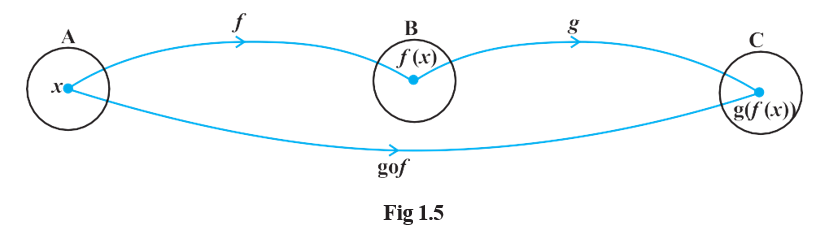
Composition of functions — For functions and , the composition applies first, then .
Key properties
- Order: In , evaluate first, then apply .
- Compatibility: The outputs of must belong to the domain of .
- Non-commutative: In general, .
- Associative: When all compositions are defined, .
Use this rule to evaluate a composition at input .
Evaluating a composition
- Find the output of the inner function.
- Substitute that output into the outer function.
- Simplify and check that each function is defined.
Let , , and , . Find .
- Apply to the output of at input .
- Evaluate the composition at input .
- Evaluate the composition at inputs and .
Composition need not commute
- Example: If and , then while .
- Check: At , the values are and , respectively; hence .
Do not reverse the order: means , not .
Invertible Functions
Invertible function — A function is invertible if there is a function such that and .
Key properties
- Inverse notation: The inverse function is denoted by .
- Bijection test: A function is invertible if and only if it is both one-one and onto.
- One-one: implies .
- Onto: For every , there is some such that .
For an invertible , the inverse reverses the mapping: for each and for each .
Finding an inverse
- Show that the function is one-one and onto, or set the output equal to and solve for the input.
- Express the input in terms of the output; this gives the inverse rule.
- State the inverse's domain and codomain, then verify both identity compositions.
Let be given by , where . Find its inverse.
- Solve the rule for the input in terms of the output .
- Define the inverse on ; by the definition of , its values lie in .
- Verify the composition on the domain.
- Verify the composition on the codomain.
For , remember to divide by : , not .
Relations and Equivalence Relations
Relation on a set — A relation on is any subset of .
| Type | Definition |
|---|---|
| Empty relation | on . |
| Universal relation | . |
| Reflexive | for every . |
| Symmetric | implies . |
| Transitive | implies . |
| Equivalence relation | A relation that is reflexive, symmetric and transitive. |
Equivalence class — For an equivalence relation on , the class consists of all elements of related to : .
If and are equivalence relations on , then is also an equivalence relation: each property (reflexivity, symmetry and transitivity) holds in both relations and therefore in their intersection.
Useful equivalence-relation examples
- Proportional pairs: On ordered pairs of positive integers, when ; this is equality of ratios , so it is reflexive, symmetric and transitive.
- Congruence classes: On , the relation divisible by has classes , and .
- Relation from a function: For any function , defining when gives an equivalence relation.
For a function , define if and only if . Show that is an equivalence relation.
- Every element is related to itself because its function value equals itself.
- Equality of function values is symmetric.
- Equality of function values is transitive.
Counting relations and functions
- One-one maps: An injective function from a finite set of elements to itself is a permutation; there are such functions. For , the number is .
- Finite-set property: For a function from a finite set to itself, one-one is equivalent to onto. This equivalence need not hold for infinite sets.
- Reflexive, transitive but not symmetric: On , a relation containing and must also contain . Exactly three such relations are not symmetric: add neither reverse pair, add only, or add only.
- Equivalence relations containing : On there are exactly two: the classes can be or the single class .
Operations on Functions
Sums need not preserve function properties
- Onto example: The identity is onto, but is not onto , since odd natural numbers are not outputs.
- One-one example: On , both and are one-one, but their sum is not: .
For and , find and . Are they equal?
Show that , defined by , is invertible and find its inverse.
On , and . Are , , and one-one?
Quick recap
- For and , and .
- Composition is associative when defined, but generally not commutative.
- A function is invertible exactly when it is one-one and onto; its inverse composes to identity maps.
- An equivalence relation is reflexive, symmetric and transitive; the intersection of two equivalence relations is also an equivalence relation.
- The relation defined by is an equivalence relation.
- For a finite set mapped to itself, one-one and onto are equivalent; there are bijections on an -element set.
- Adding functions need not preserve onto or one-one properties.
Formula sheet
Mathematics — ALL CHAPTERS
1
Relations And Functions
2
Inverse Trigonometric Functions
3
Matrices
4
DETERMINANTS
5
Continuity And Differentiability
6
Application Of Derivatives
7
Integrals
8
APPLICATION OF INTEGRALS
9
DIFFERENTIAL EQUATIONS
10
VECTOR ALGEBRA
11
Three Dimensional Geometry
12
Linear Programming
13
Probability
14
Proofs In Mathematics
15
Mathematical Modelling