Class 12 PCM . Mathematics . Mathematics Part II . Vector Algebra

Chapter 10: VECTOR ALGEBRA

Ch 10

Mathematics

Class 12 PCM

Lecture 1

Introduction

Reference video · Lecture 1Introduction

Scalars and Vectors

Classifying a quantity

  1. Check whether the quantity is fully specified by its value and unit.
  2. If a direction is also needed, it is a vector; otherwise, it is a scalar.
Worked example

Classify 55 seconds, 1010 newtons and 20 m/s20\,\mathrm{m/s} towards north.

  1. Classify 55 seconds, 1010 newtons and 20 m/s20\,\mathrm{m/s} towards north.
  2. Time has magnitude only; force and northward velocity need direction.
Answer: 55 seconds is a scalar; 1010 newtons and 20 m/s20\,\mathrm{m/s} towards north are vectors.

Directed Line Segments and Vector Magnitude

Magnitude of a position vector
∣OP→∣=x2+y2+z2|\overrightarrow{OP}|=\sqrt{x^2+y^2+z^2}

For a point P(x,y,z)P(x,y,z) measured from the origin, this gives the length of OP→\overrightarrow{OP}.

⚠ Common mistake

A vector's magnitude cannot be negative; therefore, a statement such as ∣a⃗∣<0|\vec{a}|<0 is meaningless.

Position Vector

Position vector and its magnitude
OP→=(x,y,z),∣OP→∣=x2+y2+z2\overrightarrow{OP}=(x,y,z),\qquad |\overrightarrow{OP}|=\sqrt{x^2+y^2+z^2}

Use these relations when the coordinates of PP are known.

Finding the magnitude from coordinates

  1. Read the coordinates (x,y,z)(x,y,z) of the point.
  2. Substitute them into the three-dimensional distance formula.
    ∣OP→∣=x2+y2+z2|\overrightarrow{OP}|=\sqrt{x^2+y^2+z^2}
  3. Simplify to obtain the vector's non-negative length.
Worked example

Find the magnitude of the position vector of P(2,−3,6)P(2,-3,6).

  1. For P(2,−3,6)P(2,-3,6), substitute its coordinates into the magnitude formula.
    ∣OP→∣=22+(−3)2+62|\overrightarrow{OP}|=\sqrt{2^2+(-3)^2+6^2}
  2. Evaluate the sum under the square root.
    ∣OP→∣=4+9+36=49=7|\overrightarrow{OP}|=\sqrt{4+9+36}=\sqrt{49}=7
Answer: ∣OP→∣=7|\overrightarrow{OP}|=7

Direction Angles, Direction Cosines and Direction Ratios

Direction cosines
l=cos⁡α=xr,m=cos⁡β=yr,n=cos⁡γ=zr,l2+m2+n2=1l=\cos\alpha=\frac{x}{r},\quad m=\cos\beta=\frac{y}{r},\quad n=\cos\gamma=\frac{z}{r},\quad l^2+m^2+n^2=1

Here r=∣r⃗∣r=|\vec{r}|; the coordinates of the point are (lr,mr,nr)(lr,mr,nr).

Finding direction cosines and ratios

  1. Find the magnitude rr of the vector.
    r=x2+y2+z2r=\sqrt{x^2+y^2+z^2}
  2. Divide each coordinate by rr to obtain the direction cosines.
    l=xr,m=yr,n=zrl=\frac{x}{r},\quad m=\frac{y}{r},\quad n=\frac{z}{r}
  3. Use the coordinates themselves, or any proportional triple, as direction ratios.
Worked example

Find the direction cosines and one set of direction ratios for the vector from OO to P(2,3,6)P(2,3,6).

  1. For a vector to P(2,3,6)P(2,3,6), first find its magnitude.
    r=22+32+62=7r=\sqrt{2^2+3^2+6^2}=7
  2. Divide each coordinate by the magnitude to get the direction cosines.
    l=27,m=37,n=67l=\frac{2}{7},\quad m=\frac{3}{7},\quad n=\frac{6}{7}
  3. The coordinate triple gives direction ratios proportional to the direction cosines.
    (a,b,c)=(2,3,6)(a,b,c)=(2,3,6)
Answer: Direction cosines: (27,37,67)\left(\frac{2}{7},\frac{3}{7},\frac{6}{7}\right); direction ratios: (2,3,6)(2,3,6).

Types of Vectors

Checking vector relationships

  1. Compare starting points to identify coinitial vectors.
  2. Compare parallelism to identify collinear vectors.
  3. Compare both magnitude and direction to identify equal or negative vectors.
Worked example

Using the stated relationships, identify the equal, collinear and coinitial vectors.

  1. Suppose a⃗\vec{a} and c⃗\vec{c} have the same magnitude and direction, while a⃗\vec{a}, c⃗\vec{c} and d⃗\vec{d} are parallel.
  2. Suppose b⃗\vec{b}, c⃗\vec{c} and d⃗\vec{d} start at the same point.
  3. Apply the definitions to classify each relationship.
    a⃗=c⃗;a⃗,c⃗,d⃗ are collinear;b⃗,c⃗,d⃗ are coinitial\vec{a}=\vec{c};\quad \vec{a},\vec{c},\vec{d}\text{ are collinear};\quad \vec{b},\vec{c},\vec{d}\text{ are coinitial}
Answer: a⃗=c⃗\vec{a}=\vec{c}; a⃗,c⃗,d⃗\vec{a},\vec{c},\vec{d} are collinear; b⃗,c⃗,d⃗\vec{b},\vec{c},\vec{d} are coinitial.

Representing a Displacement

Worked example

Represent graphically a displacement of 40 km40\,\mathrm{km}, 30∘30^\circ west of south.

  1. Choose a scale and draw an arrow of length representing 40 km40\,\mathrm{km}.
  2. Point the arrow 30∘30^\circ from south towards west.
  3. Label the arrow with the displacement magnitude and direction.
    40 km,30∘ west of south40\,\mathrm{km},\quad 30^\circ\text{ west of south}
Answer: Draw a vector of magnitude 40 km40\,\mathrm{km} directed 30∘30^\circ west of south.
Practice

Classify 1000 cm31000\,\mathrm{cm^3}, 30 km/h30\,\mathrm{km/h} and 20 m/s20\,\mathrm{m/s} towards north.

Hint: Check whether direction is needed to describe each quantity.
Key step: 1000 cm31000\,\mathrm{cm^3} and speed have magnitude only; the northward velocity includes direction.
Solution: 1000 cm31000\,\mathrm{cm^3} and 30 km/h30\,\mathrm{km/h} are scalars; 20 m/s20\,\mathrm{m/s} towards north is a vector.
Practice

For a position vector to P(1,2,2)P(1,2,2), find its magnitude and direction cosines.

Hint: Find rr first, then divide each coordinate by rr.
Key step: r=12+22+22=3r=\sqrt{1^2+2^2+2^2}=3; divide (1,2,2)(1,2,2) by 33.
Solution: Magnitude: 33; direction cosines: (13,23,23)\left(\frac{1}{3},\frac{2}{3},\frac{2}{3}\right).
Practice

If AB→\overrightarrow{AB} has magnitude 55, what are the magnitude and direction of BA→\overrightarrow{BA}?

Hint: Reversing the initial and terminal points reverses the vector's direction.
Key step: BA→=−AB→\overrightarrow{BA}=-\overrightarrow{AB}.
Solution: ∣BA→∣=5|\overrightarrow{BA}|=5; its direction is opposite to that of AB→\overrightarrow{AB}.

Quick recap

  • A scalar has magnitude only; a vector has magnitude and direction.
  • A vector is represented by a directed line segment; its magnitude is its length.
  • The position vector of P(x,y,z)P(x,y,z) is OP→\overrightarrow{OP} and has magnitude x2+y2+z2\sqrt{x^2+y^2+z^2}.
  • Direction cosines are l=cos⁡αl=\cos\alpha, m=cos⁡βm=\cos\beta, n=cos⁡γn=\cos\gamma, with l2+m2+n2=1l^2+m^2+n^2=1.
  • Direction ratios are proportional to the direction cosines and are not generally unit-normalised.
  • Zero, unit, coinitial, collinear, equal, negative and free vectors are distinguished by their defining properties.
Lecture 2

Addition of Vectors

Reference video · Lecture 2Addition of Vectors

Geometric Addition and Vector Laws

Definition

Vector addition — Vector addition combines displacements to give a resultant displacement.

Triangle law

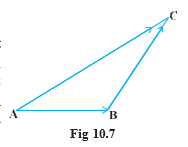
  • Displacement: The vector AB→\overrightarrow{AB} represents displacement from point AA to point BB.
  • Placement: To add two vectors, place the initial point of the second at the terminal point of the first without changing its magnitude or direction.
  • Resultant: The vector from the first vector’s initial point to the second vector’s terminal point is their sum.
The resultant displacement from A to C equals the consecutive displacements from A to B and B to C.
The resultant displacement from AA to CC equals the consecutive displacements from AA to BB and BB to CC.
Triangle law and closed-triangle rule
AB→+BC→=AC→,AB→+BC→+CA→=0⃗\overrightarrow{AB}+\overrightarrow{BC}=\overrightarrow{AC},\qquad \overrightarrow{AB}+\overrightarrow{BC}+\overrightarrow{CA}=\vec{0}

Consecutive displacements add to the direct displacement. Traversing a complete triangle gives zero resultant.

Closed-triangle rule

When the side vectors of a triangle are taken in order, their sum is zero because the path ends where it began.

AB→+BC→+CA→=0⃗\overrightarrow{AB}+\overrightarrow{BC}+\overrightarrow{CA}=\vec{0}
Definition

Vector subtraction — Subtracting b⃗\vec{b} from a⃗\vec{a} means adding the opposite vector −b⃗-\vec{b} to a⃗\vec{a}.

Vector difference
a⃗−b⃗=a⃗+(−b⃗)\vec{a}-\vec{b}=\vec{a}+(-\vec{b})

The vector −b⃗-\vec{b} has the same magnitude as b⃗\vec{b} but the opposite direction.

Add vectors using the triangle law

  1. Draw the first vector, then place the initial point of the second at its terminal point.
  2. Draw the resultant from the first vector’s initial point to the second vector’s terminal point.
  3. For subtraction, reverse the direction of the vector being subtracted, then add it.
    a⃗−b⃗=a⃗+(−b⃗)\vec{a}-\vec{b}=\vec{a}+(-\vec{b})
Worked example

What is the net displacement after travelling from AA to BB and then from BB to CC?

  1. A girl walks from AA to BB, then from BB to CC. Find her net displacement.
  2. Apply the triangle law to the two consecutive displacements.
    AB→+BC→=AC→\overrightarrow{AB}+\overrightarrow{BC}=\overrightarrow{AC}
  3. Thus, the direct displacement from the starting point to the final point is the resultant.
    Resultant=AC→\text{Resultant}=\overrightarrow{AC}
Answer: The net displacement is AC→\overrightarrow{AC}.

Parallelogram Law and Applications

Parallelogram law

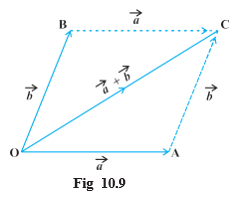
If two vectors from a common point represent adjacent sides of a parallelogram, their sum is represented by the diagonal through that common point.

OA→+OB→=OC→\overrightarrow{OA}+\overrightarrow{OB}=\overrightarrow{OC}
The diagonal from the common point represents the resultant of the two adjacent-side vectors.

Why the two addition laws agree

  • Triangle law: In the parallelogram, travelling along one side and then the parallel side gives the diagonal resultant.
  • Equal opposite sides: The second side of the triangle equals the other adjacent side of the parallelogram as a vector.
  • Result: The triangle law and parallelogram law give the same vector sum.

River-boat example

  • Velocities: A boat crossing perpendicular to a river’s flow is acted on by its engine velocity and the river-current velocity.
  • Resultant motion: Both velocities act simultaneously, so the boat travels with a resultant velocity whose direction generally differs from the engine’s direction.
  • Application: The parallelogram diagonal gives the effective velocity in magnitude and direction.
Resultant velocity
v⃗resultant=v⃗engine+v⃗current\vec{v}_{\text{resultant}}=\vec{v}_{\text{engine}}+\vec{v}_{\text{current}}

The boat’s actual velocity is the vector sum of its engine velocity and the river-current velocity.

Properties of Vector Addition

Commutative property

Changing the order of two vectors does not change their sum.

a⃗+b⃗=b⃗+a⃗\vec{a}+\vec{b}=\vec{b}+\vec{a}
Associative property

Changing the grouping of three vectors does not change their sum, so brackets may be omitted.

(a⃗+b⃗)+c⃗=a⃗+(b⃗+c⃗)(\vec{a}+\vec{b})+\vec{c}=\vec{a}+(\vec{b}+\vec{c})
Additive identity

Adding the zero vector leaves any vector unchanged; hence 0⃗\vec{0} is the additive identity.

a⃗+0⃗=0⃗+a⃗=a⃗\vec{a}+\vec{0}=\vec{0}+\vec{a}=\vec{a}

Multiplication by a Scalar

Definition

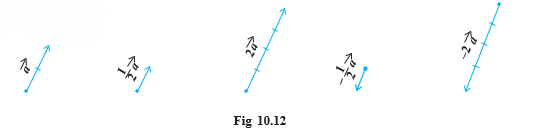
Scalar multiplication — For a scalar λ\lambda and vector a⃗\vec{a}, the product λa⃗\lambda\vec{a} is a vector collinear with a⃗\vec{a}.

Effect of the scalar

  • Direction: If λ>0\lambda>0, the product has the same direction as a⃗\vec{a}; if λ<0\lambda<0, it has the opposite direction.
  • Magnitude: The product’s magnitude is multiplied by the absolute value of the scalar.
  • Zero scalar: Multiplying any vector by 00 gives the zero vector.
Magnitude under scalar multiplication
∣λa⃗∣=∣λ∣ ∣a⃗∣|\lambda\vec{a}|=|\lambda|\,|\vec{a}|

Use the absolute value of the scalar because magnitude cannot be negative.

Scalar multiplication can lengthen, shorten, or reverse a vector, depending on the scalar.
Negative vector and additive inverse

The vector −a⃗-\vec{a} has the same magnitude as a⃗\vec{a} and opposite direction; their sum is the zero vector.

a⃗+(−a⃗)=(−a⃗)+a⃗=0⃗\vec{a}+(-\vec{a})=(-\vec{a})+\vec{a}=\vec{0}
Definition

Unit vector — For a nonzero vector, dividing it by its magnitude gives a unit vector in the same direction.

Unit vector in the direction of a⃗\vec{a}
a^=a⃗∣a⃗∣\hat{a}=\frac{\vec{a}}{|\vec{a}|}

This formula applies only when a⃗≠0⃗\vec{a}\ne\vec{0}.

Zero vector under scalar multiplication

Multiplying the zero vector by any scalar still gives the zero vector.

k0⃗=0⃗k\vec{0}=\vec{0}

Multiply a vector by a scalar

  1. Multiply the vector’s magnitude by the absolute value of the scalar.
    ∣λa⃗∣=∣λ∣ ∣a⃗∣|\lambda\vec{a}|=|\lambda|\,|\vec{a}|
  2. Keep the direction for a positive scalar; reverse it for a negative scalar.
  3. To obtain a unit vector in the direction of a nonzero vector, multiply by the reciprocal of its magnitude.
    a^=1∣a⃗∣a⃗\hat{a}=\frac{1}{|\vec{a}|}\vec{a}
Worked example

Use scalar multiplication to describe the negative vector and the unit vector of a⃗\vec{a}.

  1. Let a⃗≠0⃗\vec{a}\ne\vec{0}. Find the magnitude and direction of −a⃗-\vec{a}, and form the unit vector in the direction of a⃗\vec{a}.
  2. A scalar of −1-1 reverses direction without changing magnitude.
    −a⃗=(−1)a⃗,∣−a⃗∣=∣−1∣ ∣a⃗∣=∣a⃗∣-\vec{a}=(-1)\vec{a},\qquad |-\vec{a}|=|-1|\,|\vec{a}|=|\vec{a}|
  3. Multiply a⃗\vec{a} by the reciprocal of its magnitude; the resulting vector has magnitude 11 and the same direction.
    a^=1∣a⃗∣a⃗,∣a^∣=1\hat{a}=\frac{1}{|\vec{a}|}\vec{a},\qquad |\hat{a}|=1
Answer: −a⃗-\vec{a} has the same magnitude as a⃗\vec{a} and the opposite direction; a^=a⃗∣a⃗∣\hat{a}=\frac{\vec{a}}{|\vec{a}|}.
⚠ Common mistake

Do not use λ\lambda instead of ∣λ∣|\lambda| to find magnitude: a negative scalar reverses direction, but magnitude remains nonnegative.

Practice

Show that the vectors along the sides of a triangle, taken in order, have zero resultant.

Hint: Apply the triangle law to two consecutive sides, then combine with the third side.
Key step: AB→+BC→=AC→\overrightarrow{AB}+\overrightarrow{BC}=\overrightarrow{AC} and CA→=−AC→\overrightarrow{CA}=-\overrightarrow{AC}.
Solution: AB→+BC→+CA→=AC→−AC→=0⃗\overrightarrow{AB}+\overrightarrow{BC}+\overrightarrow{CA}=\overrightarrow{AC}-\overrightarrow{AC}=\vec{0}.
Practice

Express the difference a⃗−b⃗\vec{a}-\vec{b} as a sum and state the direction and magnitude of −b⃗-\vec{b}.

Hint: Use the additive inverse of b⃗\vec{b}.
Key step: a⃗−b⃗=a⃗+(−b⃗)\vec{a}-\vec{b}=\vec{a}+(-\vec{b}).
Solution: a⃗−b⃗=a⃗+(−b⃗)\vec{a}-\vec{b}=\vec{a}+(-\vec{b}); −b⃗-\vec{b} has magnitude ∣b⃗∣|\vec{b}| and direction opposite to b⃗\vec{b}.
Practice

For a⃗≠0⃗\vec{a}\ne\vec{0}, show that 1∣a⃗∣a⃗\frac{1}{|\vec{a}|}\vec{a} is a unit vector in the direction of a⃗\vec{a}.

Hint: Use the scalar-multiplication magnitude rule.
Key step: ∣1∣a⃗∣a⃗∣=1∣a⃗∣∣a⃗∣\left|\frac{1}{|\vec{a}|}\vec{a}\right|=\frac{1}{|\vec{a}|}|\vec{a}|.
Solution: Its magnitude is 11 and its direction is the same as a⃗\vec{a}, so it is the required unit vector: a^=a⃗∣a⃗∣\hat{a}=\frac{\vec{a}}{|\vec{a}|}.

Quick recap

  • The vector AB→\overrightarrow{AB} represents displacement from AA to BB.
  • The triangle law gives AB→+BC→=AC→\overrightarrow{AB}+\overrightarrow{BC}=\overrightarrow{AC}; a closed triangle has zero resultant.
  • The parallelogram diagonal from the common point represents the sum of its adjacent-side vectors.
  • A boat’s resultant velocity is the vector sum of its engine velocity and the river-current velocity.
  • Vector addition is commutative and associative, and 0⃗\vec{0} is its additive identity.
  • Subtraction means adding the opposite vector: a⃗−b⃗=a⃗+(−b⃗)\vec{a}-\vec{b}=\vec{a}+(-\vec{b}).
  • Scalar multiplication scales magnitude by ∣λ∣|\lambda| and reverses direction when λ<0\lambda<0; for a⃗≠0⃗\vec{a}\ne\vec{0}, a^=a⃗∣a⃗∣\hat{a}=\frac{\vec{a}}{|\vec{a}|}.
Lecture 3

Components of a vector

Reference video · Lecture 3Components of a vector

Components of a Vector

Definition

Component form — A vector written as the sum of its parts along the coordinate axes is in component form.

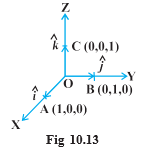
Unit points on the coordinate axes define the three coordinate unit vectors.
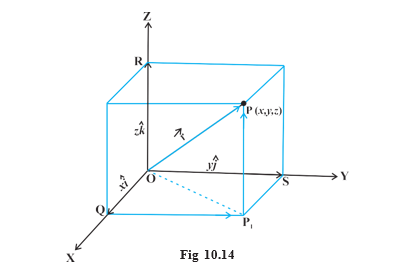
The projections of a point onto the axes give the components of its position vector.

Components and operations

  • Unit vectors: i^,j^,k^\hat{i},\hat{j},\hat{k} point along the positive x,y,zx,y,z axes, respectively; each has magnitude 11.
  • Position vector: A point P(x,y,z)P(x,y,z) has position vector OP→=xi^+yj^+zk^\overrightarrow{OP}=x\hat{i}+y\hat{j}+z\hat{k}.
  • Scalar components: x,y,zx,y,z are the scalar (rectangular) components; xi^,yj^,zk^x\hat{i},y\hat{j},z\hat{k} are the vector components.
  • Direction ratios: For a vector a1i^+a2j^+a3k^a_1\hat{i}+a_2\hat{j}+a_3\hat{k}, its components a1,a2,a3a_1,a_2,a_3 are direction ratios.
Component operations
OperationComponent rule
Additiona⃗+b⃗=(a1+b1)i^+(a2+b2)j^+(a3+b3)k^\vec{a}+\vec{b}=(a_1+b_1)\hat{i}+(a_2+b_2)\hat{j}+(a_3+b_3)\hat{k}
Subtractiona⃗−b⃗=(a1−b1)i^+(a2−b2)j^+(a3−b3)k^\vec{a}-\vec{b}=(a_1-b_1)\hat{i}+(a_2-b_2)\hat{j}+(a_3-b_3)\hat{k}
Scalar multiplicationλa⃗=λa1i^+λa2j^+λa3k^\lambda\vec{a}=\lambda a_1\hat{i}+\lambda a_2\hat{j}+\lambda a_3\hat{k}
Equalitya⃗=b⃗\vec{a}=\vec{b} if and only if a1=b1a_1=b_1, a2=b2a_2=b_2, and a3=b3a_3=b_3.
Scalar laws

For vectors a⃗,b⃗\vec{a},\vec{b} and scalars k,mk,m, scalar multiplication satisfies the following laws.

ka⃗+ma⃗=(k+m)a⃗,k(ma⃗)=(km)a⃗,k(a⃗+b⃗)=ka⃗+kb⃗k\vec{a}+m\vec{a}=(k+m)\vec{a},\quad k(m\vec{a})=(km)\vec{a},\quad k(\vec{a}+\vec{b})=k\vec{a}+k\vec{b}
Magnitude and unit vector
∣r⃗∣=x2+y2+z2,r^=r⃗∣r⃗∣|\vec{r}|=\sqrt{x^2+y^2+z^2},\quad \hat{r}=\frac{\vec{r}}{|\vec{r}|}

Use these for a vector in component form; the unit vector points in the same direction.

Collinear vectors

Two nonzero vectors are collinear exactly when one is a nonzero scalar multiple of the other; in components, each component of one vector is the same multiple of the corresponding component of the other.

b⃗=λa⃗,λ≠0⟺b1=λa1, b2=λa2, b3=λa3\vec{b}=\lambda\vec{a},\quad \lambda\ne 0\quad\Longleftrightarrow\quad b_1=\lambda a_1,\ b_2=\lambda a_2,\ b_3=\lambda a_3
Direction cosines

The direction cosines are the cosines of the angles a vector makes with the positive coordinate axes. For a nonzero vector, each is the corresponding component divided by the magnitude.

l=cos⁡α=a1∣a⃗∣,m=cos⁡β=a2∣a⃗∣,n=cos⁡γ=a3∣a⃗∣,l2+m2+n2=1l=\cos\alpha=\frac{a_1}{|\vec{a}|},\quad m=\cos\beta=\frac{a_2}{|\vec{a}|},\quad n=\cos\gamma=\frac{a_3}{|\vec{a}|},\quad l^2+m^2+n^2=1
Unit vector from direction cosines
li^+mj^+nk^l\hat{i}+m\hat{j}+n\hat{k}

If l,m,nl,m,n are the direction cosines, they are the components of the vector's unit vector.

Worked example

Find the magnitude and unit vector of a⃗=2i^+3j^+k^\vec{a}=2\hat{i}+3\hat{j}+\hat{k}.

  1. Find the magnitude of a⃗=2i^+3j^+k^\vec{a}=2\hat{i}+3\hat{j}+\hat{k}.
    ∣a⃗∣=22+32+12=14|\vec{a}|=\sqrt{2^2+3^2+1^2}=\sqrt{14}
  2. Divide the vector by its magnitude.
    a^=114(2i^+3j^+k^)\hat{a}=\frac{1}{\sqrt{14}}(2\hat{i}+3\hat{j}+\hat{k})
  3. Write the unit vector in component form.
    a^=214i^+314j^+114k^\hat{a}=\frac{2}{\sqrt{14}}\hat{i}+\frac{3}{\sqrt{14}}\hat{j}+\frac{1}{\sqrt{14}}\hat{k}
Answer: ∣a⃗∣=14|\vec{a}|=\sqrt{14} and a^=214i^+314j^+114k^\hat{a}=\frac{2}{\sqrt{14}}\hat{i}+\frac{3}{\sqrt{14}}\hat{j}+\frac{1}{\sqrt{14}}\hat{k}.
⚠ Common mistake

Equal magnitudes do not make vectors equal; equality requires all corresponding components to match.

Vector Joining Two Points

Definition

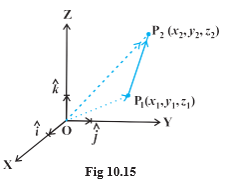
Directed vector between two points — The vector from an initial point to a terminal point is the terminal point's position vector minus the initial point's position vector.

Joining vector and distance
P1P2→=(x2−x1)i^+(y2−y1)j^+(z2−z1)k^,∣P1P2→∣=(x2−x1)2+(y2−y1)2+(z2−z1)2\overrightarrow{P_1P_2}=(x_2-x_1)\hat{i}+(y_2-y_1)\hat{j}+(z_2-z_1)\hat{k},\quad |\overrightarrow{P_1P_2}|=\sqrt{(x_2-x_1)^2+(y_2-y_1)^2+(z_2-z_1)^2}

Subtract initial coordinates from terminal coordinates; the magnitude gives the distance between the points.

Position vectors to two points determine their joining vector by subtraction.

Find a directed vector

  1. Identify the initial and terminal points.
  2. Subtract the initial coordinates from the terminal coordinates in matching positions.
    P1P2→=(x2−x1, y2−y1, z2−z1)\overrightarrow{P_1P_2}=(x_2-x_1,\ y_2-y_1,\ z_2-z_1)
  3. Use the magnitude formula if the distance is also required.
    ∣P1P2→∣=(x2−x1)2+(y2−y1)2+(z2−z1)2|\overrightarrow{P_1P_2}|=\sqrt{(x_2-x_1)^2+(y_2-y_1)^2+(z_2-z_1)^2}
Worked example

Find the vector from P(2,3,0)P(2,3,0) to Q(−1,−2,−4)Q(-1,-2,-4) and its length.

  1. Subtract the coordinates of P(2,3,0)P(2,3,0) from those of Q(−1,−2,−4)Q(-1,-2,-4).
    PQ→=(−1−2)i^+(−2−3)j^+(−4−0)k^\overrightarrow{PQ}=(-1-2)\hat{i}+(-2-3)\hat{j}+(-4-0)\hat{k}
  2. Simplify each component.
    PQ→=−3i^−5j^−4k^\overrightarrow{PQ}=-3\hat{i}-5\hat{j}-4\hat{k}
  3. Find its length if required.
    ∣PQ→∣=(−3)2+(−5)2+(−4)2=50=52|\overrightarrow{PQ}|=\sqrt{(-3)^2+(-5)^2+(-4)^2}=\sqrt{50}=5\sqrt{2}
Answer: PQ→=−3i^−5j^−4k^\overrightarrow{PQ}=-3\hat{i}-5\hat{j}-4\hat{k} and ∣PQ→∣=52|\overrightarrow{PQ}|=5\sqrt{2}.
⚠ Common mistake

For a vector from P1P_1 to P2P_2, subtract initial coordinates from terminal coordinates; reversing the order reverses the vector.

Section Formula

Definition

Section formula — The section formula gives the position vector of a point dividing the line joining two points in a specified ratio.

Ratio convention

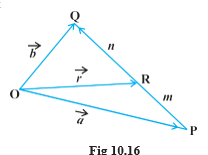
  • Endpoints: Let a⃗=OP→\vec{a}=\overrightarrow{OP} and b⃗=OQ→\vec{b}=\overrightarrow{OQ}.
  • Ratio: If PR:RQ=m:nPR:RQ=m:n, the coefficient of b⃗\vec{b} is mm and that of a⃗\vec{a} is nn.
  • Midpoint: Internal division in the ratio 1:11:1 gives the average of the endpoint position vectors.
Vector diagram for internal division of a segment.
Internal, external, and midpoint formulas
OR→internal=mb⃗+na⃗m+n,OR→external=mb⃗−na⃗m−n,OR→midpoint=a⃗+b⃗2\overrightarrow{OR}_{\mathrm{internal}}=\frac{m\vec{b}+n\vec{a}}{m+n},\quad \overrightarrow{OR}_{\mathrm{external}}=\frac{m\vec{b}-n\vec{a}}{m-n},\quad \overrightarrow{OR}_{\mathrm{midpoint}}=\frac{\vec{a}+\vec{b}}{2}

Use the plus form for internal division and the minus form for external division when PR:RQ=m:nPR:RQ=m:n.

Apply the section formula

  1. Write the position vectors of the endpoints as a⃗\vec{a} and b⃗\vec{b}.
  2. Record the ratio as PR:RQ=m:nPR:RQ=m:n.
  3. Substitute into the internal or external formula, as specified.
Worked example

The position vectors of PP and QQ are 3u⃗−2v⃗3\vec{u}-2\vec{v} and u⃗+v⃗\vec{u}+\vec{v}. Find the position vector of the point dividing PQPQ in the ratio 2:12:1, internally and externally.

  1. Use a⃗=3u⃗−2v⃗\vec{a}=3\vec{u}-2\vec{v}, b⃗=u⃗+v⃗\vec{b}=\vec{u}+\vec{v}, and the ratio 2:12:1 for internal division.
    OR→=2(u⃗+v⃗)+(3u⃗−2v⃗)2+1=53u⃗\overrightarrow{OR}=\frac{2(\vec{u}+\vec{v})+(3\vec{u}-2\vec{v})}{2+1}=\frac{5}{3}\vec{u}
  2. Use the external division formula for the same ratio.
    OR→=2(u⃗+v⃗)−(3u⃗−2v⃗)2−1=4v⃗−u⃗\overrightarrow{OR}=\frac{2(\vec{u}+\vec{v})-(3\vec{u}-2\vec{v})}{2-1}=4\vec{v}-\vec{u}
Answer: Internal: 53u⃗\frac{5}{3}\vec{u}. External: 4v⃗−u⃗4\vec{v}-\vec{u}.
⚠ Common mistake

For PR:RQ=m:nPR:RQ=m:n, keep the coefficients in the correct order: use mm with b⃗\vec{b} and nn with a⃗\vec{a}.

Practice

Find x,y,zx,y,z if a⃗=xi^+2j^+zk^\vec{a}=x\hat{i}+2\hat{j}+z\hat{k} and b⃗=2i^+yj^+k^\vec{b}=2\hat{i}+y\hat{j}+\hat{k} are equal.

Hint: Set corresponding components equal.
Key step: x=2x=2, 2=y2=y, and z=1z=1.
Solution: Equality of corresponding components gives x=2x=2, y=2y=2, and z=1z=1.
Practice

Find the direction ratios and direction cosines of r⃗=i^+j^−2k^\vec{r}=\hat{i}+\hat{j}-2\hat{k}.

Hint: The components are the direction ratios; divide them by the magnitude to find the direction cosines.
Key step: ∣r⃗∣=12+12+(−2)2=6|\vec{r}|=\sqrt{1^2+1^2+(-2)^2}=\sqrt{6}.
Solution: Direction ratios: (1,1,−2)(1,1,-2). Direction cosines: (16,16,−26)\left(\frac{1}{\sqrt{6}},\frac{1}{\sqrt{6}},-\frac{2}{\sqrt{6}}\right).
Practice

Do A(2,−1,−1)A(2,-1,-1), B(1,−3,−5)B(1,-3,-5), and C(3,−4,−4)C(3,-4,-4) form a right-angled triangle?

Hint: Find the squared lengths of all three sides and test the Pythagorean relation.
Key step: ∣AB∣2=21|AB|^2=21, ∣BC∣2=6|BC|^2=6, and ∣CA∣2=19|CA|^2=19.
Solution: No. The squared side lengths are 2121, 66, and 1919; no two add to the third, so the triangle is not right-angled.

Quick recap

  • Write a 3D vector as xi^+yj^+zk^x\hat{i}+y\hat{j}+z\hat{k}; its magnitude is x2+y2+z2\sqrt{x^2+y^2+z^2}.
  • Vector operations act componentwise, and vector equality requires all corresponding components to match.
  • A unit vector is obtained by dividing a nonzero vector by its magnitude; direction ratios are its components.
  • Direction cosines are the components divided by the magnitude and satisfy l2+m2+n2=1l^2+m^2+n^2=1.
  • A vector from one point to another is terminal coordinates minus initial coordinates.
  • For PR:RQ=m:nPR:RQ=m:n, use mb⃗+na⃗m+n\frac{m\vec{b}+n\vec{a}}{m+n} internally and mb⃗−na⃗m−n\frac{m\vec{b}-n\vec{a}}{m-n} externally.
Lecture 4

Product of Two Vectors

Reference video · Lecture 4Product of Two Vectors

Types of Vector Products

Two kinds of multiplication

  • Scalar (dot) product: The result is a scalar.
  • Vector (cross) product: The result is a vector; its properties are studied separately.

Scalar (Dot) Product

Definition

Scalar product — For nonzero vectors, the scalar product is the real number equal to the product of their magnitudes and the cosine of the angle between them.

Dot product and angle
a⃗⋅b⃗=∣a⃗∣∣b⃗∣cos⁡θ,cos⁡θ=a⃗⋅b⃗∣a⃗∣∣b⃗∣,θ=cos⁡−1(a⃗⋅b⃗∣a⃗∣∣b⃗∣)\vec a\cdot\vec b=|\vec a||\vec b|\cos\theta,\qquad \cos\theta=\frac{\vec a\cdot\vec b}{|\vec a||\vec b|},\qquad \theta=\cos^{-1}\left(\frac{\vec a\cdot\vec b}{|\vec a||\vec b|}\right)

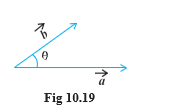
The angle between nonzero vectors satisfies 0≤θ≤π0\leq\theta\leq\pi. The angle cannot be defined if either vector is zero, but the dot product is defined as zero in that case.

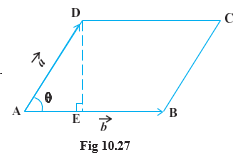
Two vectors with angle θ between them.
Two vectors with angle θ\theta between them.

Key properties

  • Scalar result: a⃗⋅b⃗\vec a\cdot\vec b is a real number, not a vector.
  • Perpendicular vectors: For nonzero vectors, a⃗⋅b⃗=0\vec a\cdot\vec b=0 if and only if a⃗⊥b⃗\vec a\perp\vec b.
  • Same direction: If θ=0\theta=0, then a⃗⋅b⃗=∣a⃗∣∣b⃗∣\vec a\cdot\vec b=|\vec a||\vec b|; in particular, a⃗⋅a⃗=∣a⃗∣2\vec a\cdot\vec a=|\vec a|^2.
  • Opposite directions: If θ=π\theta=\pi, then a⃗⋅b⃗=−∣a⃗∣∣b⃗∣\vec a\cdot\vec b=-|\vec a||\vec b|.
  • Commutative: a⃗⋅b⃗=b⃗⋅a⃗\vec a\cdot\vec b=\vec b\cdot\vec a.
Dot product properties

The dot product distributes over vector addition and allows scalar factors to be taken outside the product.

a⃗⋅(b⃗+c⃗)=a⃗⋅b⃗+a⃗⋅c⃗,(λa⃗)⋅b⃗=λ(a⃗⋅b⃗)=a⃗⋅(λb⃗)\vec a\cdot(\vec b+\vec c)=\vec a\cdot\vec b+\vec a\cdot\vec c,\qquad (\lambda\vec a)\cdot\vec b=\lambda(\vec a\cdot\vec b)=\vec a\cdot(\lambda\vec b)

Unit basis vectors

  • Self-products: i^⋅i^=j^⋅j^=k^⋅k^=1\hat i\cdot\hat i=\hat j\cdot\hat j=\hat k\cdot\hat k=1.
  • Distinct basis vectors: i^⋅j^=j^⋅k^=k^⋅i^=0\hat i\cdot\hat j=\hat j\cdot\hat k=\hat k\cdot\hat i=0.
Component form
a⃗=a1i^+a2j^+a3k^,b⃗=b1i^+b2j^+b3k^,a⃗⋅b⃗=a1b1+a2b2+a3b3\vec a=a_1\hat i+a_2\hat j+a_3\hat k,\quad \vec b=b_1\hat i+b_2\hat j+b_3\hat k,\quad \vec a\cdot\vec b=a_1b_1+a_2b_2+a_3b_3

Multiply corresponding components and add.

Find the angle between vectors

  1. Calculate the dot product, using components if given.
    a⃗⋅b⃗\vec a\cdot\vec b
  2. Find the magnitudes of both vectors.
    ∣a⃗∣,∣b⃗∣|\vec a|,\quad |\vec b|
  3. Use the cosine formula and take the inverse cosine.
    θ=cos⁡−1(a⃗⋅b⃗∣a⃗∣∣b⃗∣),0≤θ≤π\theta=\cos^{-1}\left(\frac{\vec a\cdot\vec b}{|\vec a||\vec b|}\right),\quad 0\leq\theta\leq\pi
Worked example

Find the angle between a⃗=i^+j^−k^\vec a=\hat i+\hat j-\hat k and b⃗=i^−j^+k^\vec b=\hat i-\hat j+\hat k.

  1. For a⃗=i^+j^−k^\vec a=\hat i+\hat j-\hat k and b⃗=i^−j^+k^\vec b=\hat i-\hat j+\hat k, calculate the dot product and magnitudes.
    a⃗⋅b⃗=1−1−1=−1,∣a⃗∣=∣b⃗∣=3\vec a\cdot\vec b=1-1-1=-1,\qquad |\vec a|=|\vec b|=\sqrt{3}
  2. Substitute into the angle formula.
    cos⁡θ=−133=−13\cos\theta=\frac{-1}{\sqrt{3}\sqrt{3}}=-\frac{1}{3}
Answer: θ=cos⁡−1(−13)\theta=\cos^{-1}\left(-\frac{1}{3}\right)

Projection of a Vector on a Line

Definition

Projection vector — The projection vector is the component of a vector along a directed line; it points along or opposite the line according to the sign of the component.

Projection and direction

  • Signed scalar projection: Its sign tells whether the component points along or opposite the directed line.
  • Projection-vector magnitude: If the angle to the line's positive direction is θ\theta, the magnitude is ∣a⃗∣∣cos⁡θ∣|\vec a||\cos\theta|.
  • Special angles: At θ=0\theta=0 or θ=π\theta=\pi, the projection vector equals a⃗\vec a; at θ=π2\theta=\frac{\pi}{2} or θ=3π2\theta=\frac{3\pi}{2}, it is 0⃗\vec 0.
Projection formulas
comp⁡p^a⃗=a⃗⋅p^,comp⁡b⃗a⃗=a⃗⋅b⃗∣b⃗∣,proj⁡b⃗a⃗=a⃗⋅b⃗∣b⃗∣2b⃗\operatorname{comp}_{\hat p}\vec a=\vec a\cdot\hat p,\qquad \operatorname{comp}_{\vec b}\vec a=\frac{\vec a\cdot\vec b}{|\vec b|},\qquad \operatorname{proj}_{\vec b}\vec a=\frac{\vec a\cdot\vec b}{|\vec b|^2}\vec b

For a unit vector p^\hat p along a line, the scalar projection is signed. The vector projection onto nonzero b⃗\vec b includes the direction of b⃗\vec b.

Find the projection onto a vector

  1. Calculate the dot product of the vector being projected and the target vector.
    a⃗⋅b⃗\vec a\cdot\vec b
  2. For scalar projection, divide by the target magnitude; for vector projection, divide by its squared magnitude and multiply by the target vector.
    a⃗⋅b⃗∣b⃗∣,a⃗⋅b⃗∣b⃗∣2b⃗\frac{\vec a\cdot\vec b}{|\vec b|},\qquad \frac{\vec a\cdot\vec b}{|\vec b|^2}\vec b
Worked example

Find the scalar projection of a⃗=2i^+3j^+2k^\vec a=2\hat i+3\hat j+2\hat k onto b⃗=i^+2j^+k^\vec b=\hat i+2\hat j+\hat k.

  1. For a⃗=2i^+3j^+2k^\vec a=2\hat i+3\hat j+2\hat k and b⃗=i^+2j^+k^\vec b=\hat i+2\hat j+\hat k, find the dot product and target magnitude.
    a⃗⋅b⃗=2+6+2=10,∣b⃗∣=1+4+1=6\vec a\cdot\vec b=2+6+2=10,\qquad |\vec b|=\sqrt{1+4+1}=\sqrt{6}
  2. Divide by ∣b⃗∣|\vec b| to find the scalar projection.
    a⃗⋅b⃗∣b⃗∣=106=563\frac{\vec a\cdot\vec b}{|\vec b|}=\frac{10}{\sqrt{6}}=\frac{5\sqrt{6}}{3}
Answer: 563\frac{5\sqrt{6}}{3}

Direction cosines

  • Definition: If α,β,γ\alpha,\beta,\gamma are the angles a vector makes with the positive coordinate axes, their cosines are its direction cosines.
  • Components: For a⃗=a1i^+a2j^+a3k^\vec a=a_1\hat i+a_2\hat j+a_3\hat k, the direction cosines are a1∣a⃗∣,a2∣a⃗∣,a3∣a⃗∣\frac{a_1}{|\vec a|},\frac{a_2}{|\vec a|},\frac{a_3}{|\vec a|}.
  • Axis projections: The scalar projections on the x,y,zx,y,z axes are respectively a1,a2,a3a_1,a_2,a_3.
  • Unit vector: A unit vector with direction cosines cos⁡α,cos⁡β,cos⁡γ\cos\alpha,\cos\beta,\cos\gamma is cos⁡α i^+cos⁡β j^+cos⁡γ k^\cos\alpha\,\hat i+\cos\beta\,\hat j+\cos\gamma\,\hat k.

Magnitude Identities and Inequalities

Magnitude identities
∣a⃗−b⃗∣2=∣a⃗∣2−2(a⃗⋅b⃗)+∣b⃗∣2,∣a⃗+b⃗∣2=∣a⃗∣2+2(a⃗⋅b⃗)+∣b⃗∣2|\vec a-\vec b|^2=|\vec a|^2-2(\vec a\cdot\vec b)+|\vec b|^2,\qquad |\vec a+\vec b|^2=|\vec a|^2+2(\vec a\cdot\vec b)+|\vec b|^2

Expand using distributivity and commutativity of the dot product.

Cauchy–Schwarz inequality

For any vectors, the absolute value of the dot product is no greater than the product of their magnitudes.

∣a⃗⋅b⃗∣≤∣a⃗∣∣b⃗∣|\vec a\cdot\vec b|\leq |\vec a||\vec b|
Triangle inequality

The magnitude of a sum cannot exceed the sum of the magnitudes. Equality holds when the vectors point in the same direction, including the case where either vector is zero.

∣a⃗+b⃗∣≤∣a⃗∣+∣b⃗∣|\vec a+\vec b|\leq |\vec a|+|\vec b|
Worked example

If ∣a⃗∣=2|\vec a|=2, ∣b⃗∣=3|\vec b|=3, and a⃗⋅b⃗=4\vec a\cdot\vec b=4, find ∣a⃗−b⃗∣|\vec a-\vec b|.

  1. Use the difference identity with ∣a⃗∣=2|\vec a|=2, ∣b⃗∣=3|\vec b|=3, and a⃗⋅b⃗=4\vec a\cdot\vec b=4.
    ∣a⃗−b⃗∣2=∣a⃗∣2−2(a⃗⋅b⃗)+∣b⃗∣2|\vec a-\vec b|^2=|\vec a|^2-2(\vec a\cdot\vec b)+|\vec b|^2
  2. Substitute and take the nonnegative square root.
    ∣a⃗−b⃗∣2=22−2(4)+32=5,∣a⃗−b⃗∣=5|\vec a-\vec b|^2=2^2-2(4)+3^2=5,\qquad |\vec a-\vec b|=\sqrt{5}
Answer: ∣a⃗−b⃗∣=5|\vec a-\vec b|=\sqrt{5}

Geometric application: collinearity

  • Length test: If AC→=AB→+BC→\overrightarrow{AC}=\overrightarrow{AB}+\overrightarrow{BC} and ∣AC∣=∣AB∣+∣BC∣|AC|=|AB|+|BC|, then A,B,CA,B,C lie on one straight line in that order.
  • Closed path: AB→+BC→+CA→=0⃗\overrightarrow{AB}+\overrightarrow{BC}+\overrightarrow{CA}=\vec 0 for any three points; this alone does not prove they form a non-degenerate triangle.
Practice

Show that a⃗+b⃗\vec a+\vec b and a⃗−b⃗\vec a-\vec b are perpendicular if a⃗=5i^−j^−3k^\vec a=5\hat i-\hat j-3\hat k and b⃗=i^+3j^−5k^\vec b=\hat i+3\hat j-5\hat k.

Hint: Find both vectors, then test whether their dot product is zero.
Key step: a⃗+b⃗=6i^+2j^−8k^\vec a+\vec b=6\hat i+2\hat j-8\hat k and a⃗−b⃗=4i^−4j^+2k^\vec a-\vec b=4\hat i-4\hat j+2\hat k.
Solution: (a⃗+b⃗)⋅(a⃗−b⃗)=24−8−16=0(\vec a+\vec b)\cdot(\vec a-\vec b)=24-8-16=0, so they are perpendicular.
Practice

If a⃗\vec a is a unit vector and (x⃗−a⃗)⋅(x⃗+a⃗)=8(\vec x-\vec a)\cdot(\vec x+\vec a)=8, find ∣x⃗∣|\vec x|.

Hint: Expand the dot product and use ∣a⃗∣=1|\vec a|=1.
Key step: (x⃗−a⃗)⋅(x⃗+a⃗)=∣x⃗∣2−∣a⃗∣2=8(\vec x-\vec a)\cdot(\vec x+\vec a)=|\vec x|^2-|\vec a|^2=8.
Solution: ∣x⃗∣2−1=8|\vec x|^2-1=8, so ∣x⃗∣2=9|\vec x|^2=9. Since magnitude is nonnegative, ∣x⃗∣=3|\vec x|=3.
Practice

Check whether A=(−2,3,5)A=(-2,3,5), B=(1,2,3)B=(1,2,3), and C=(7,0,−1)C=(7,0,-1) are collinear.

Hint: Find the three displacement vectors and compare their lengths.
Key step: AB→=(3,−1,−2)\overrightarrow{AB}=(3,-1,-2), BC→=(6,−2,−4)\overrightarrow{BC}=(6,-2,-4), and AC→=(9,−3,−6)\overrightarrow{AC}=(9,-3,-6).
Solution: ∣AB→∣=14|\overrightarrow{AB}|=\sqrt{14}, ∣BC→∣=214|\overrightarrow{BC}|=2\sqrt{14}, and ∣AC→∣=314|\overrightarrow{AC}|=3\sqrt{14}. Since ∣AC∣=∣AB∣+∣BC∣|AC|=|AB|+|BC|, the points are collinear.
⚠ Common mistake

Do not confuse scalar projection, a⃗⋅b⃗∣b⃗∣\frac{\vec a\cdot\vec b}{|\vec b|}, with vector projection, a⃗⋅b⃗∣b⃗∣2b⃗\frac{\vec a\cdot\vec b}{|\vec b|^2}\vec b. The scalar projection is signed; its absolute value is the projection length.

Quick recap

  • Vector multiplication has two forms: the dot product gives a scalar; the cross product gives a vector.
  • The dot product is a⃗⋅b⃗=∣a⃗∣∣b⃗∣cos⁡θ\vec a\cdot\vec b=|\vec a||\vec b|\cos\theta; in components, multiply matching coordinates and add.
  • For nonzero vectors, a zero dot product means perpendicular vectors; the dot product is commutative and distributive.
  • Scalar projection onto a unit direction p^\hat p is a⃗⋅p^\vec a\cdot\hat p; vector projection onto b⃗\vec b is a⃗⋅b⃗∣b⃗∣2b⃗\frac{\vec a\cdot\vec b}{|\vec b|^2}\vec b.
  • Direction cosines of a⃗\vec a are a1∣a⃗∣,a2∣a⃗∣,a3∣a⃗∣\frac{a_1}{|\vec a|},\frac{a_2}{|\vec a|},\frac{a_3}{|\vec a|}; its axis projections are its components.
  • Cauchy–Schwarz: ∣a⃗⋅b⃗∣≤∣a⃗∣∣b⃗∣|\vec a\cdot\vec b|\leq|\vec a||\vec b|; triangle inequality: ∣a⃗+b⃗∣≤∣a⃗∣+∣b⃗∣|\vec a+\vec b|\leq|\vec a|+|\vec b|.
Lecture 5

Vector (or cross) Product of two vector

Reference video · Lecture 5Vector (or cross) Product of two vector

Definition and Direction

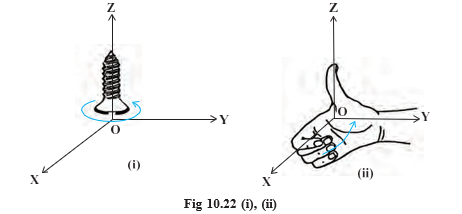
Right-hand rules show the orientation of the axes and the direction of the vector product.

Properties of the Vector Product

Zero and perpendicular cases

For nonzero vectors, a⃗×b⃗=0⃗\vec a\times\vec b=\vec 0 if and only if they are parallel. If they are perpendicular, the cross-product magnitude is the product of their magnitudes.

Cross-product magnitude and angle
∣a⃗×b⃗∣=∣a⃗∣∣b⃗∣sin⁡θ,sin⁡θ=∣a⃗×b⃗∣∣a⃗∣∣b⃗∣|\vec a\times\vec b|=|\vec a||\vec b|\sin\theta,\qquad \sin\theta=\frac{|\vec a\times\vec b|}{|\vec a||\vec b|}

Use these relations to find the magnitude or the angle between two vectors.

Anticommutativity

Reversing the order reverses the direction: a⃗×b⃗=−b⃗×a⃗\vec a\times\vec b=-\vec b\times\vec a. In particular, a⃗×a⃗=0⃗\vec a\times\vec a=\vec 0 and a⃗×(−a⃗)=0⃗\vec a\times(-\vec a)=\vec 0.

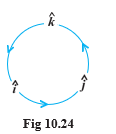
The cyclic order i→ j→ k→ i gives positive unit-vector products.
The cyclic order i^→j^→k^→i^\hat i\to\hat j\to\hat k\to\hat i gives positive unit-vector products.

Unit-vector products

  • Cyclic order: i^×j^=k^\hat i\times\hat j=\hat k, j^×k^=i^\hat j\times\hat k=\hat i, and k^×i^=j^\hat k\times\hat i=\hat j.
  • Reverse order: j^×i^=−k^\hat j\times\hat i=-\hat k, k^×j^=−i^\hat k\times\hat j=-\hat i, and i^×k^=−j^\hat i\times\hat k=-\hat j.
Distributivity and scalar multiplication

The vector product distributes over vector addition and is compatible with scalar multiplication.
a⃗×(b⃗+c⃗)=a⃗×b⃗+a⃗×c⃗,λ(a⃗×b⃗)=(λa⃗)×b⃗=a⃗×(λb⃗)\vec a\times(\vec b+\vec c)=\vec a\times\vec b+\vec a\times\vec c,\qquad \lambda(\vec a\times\vec b)=(\lambda\vec a)\times\vec b=\vec a\times(\lambda\vec b)

Component Formula

Determinant formula
a⃗×b⃗=∣i^j^k^a1a2a3b1b2b3∣=(a2b3−a3b2)i^−(a1b3−a3b1)j^+(a1b2−a2b1)k^\vec a\times\vec b=\begin{vmatrix}\hat i&\hat j&\hat k\\a_1&a_2&a_3\\b_1&b_2&b_3\end{vmatrix}=(a_2b_3-a_3b_2)\hat i-(a_1b_3-a_3b_1)\hat j+(a_1b_2-a_2b_1)\hat k

For a⃗=a1i^+a2j^+a3k^\vec a=a_1\hat i+a_2\hat j+a_3\hat k and b⃗=b1i^+b2j^+b3k^\vec b=b_1\hat i+b_2\hat j+b_3\hat k, expand along the first row.

Compute a cross product from components

  1. Write the vectors as rows beneath i^,j^,k^\hat i,\hat j,\hat k in the determinant.
  2. Expand along the first row, keeping the middle term negative.
    a⃗×b⃗=(a2b3−a3b2)i^−(a1b3−a3b1)j^+(a1b2−a2b1)k^\vec a\times\vec b=(a_2b_3-a_3b_2)\hat i-(a_1b_3-a_3b_1)\hat j+(a_1b_2-a_2b_1)\hat k
  3. If a unit vector is required, divide the resulting nonzero vector by its magnitude.
    n^=a⃗×b⃗∣a⃗×b⃗∣\hat n=\frac{\vec a\times\vec b}{|\vec a\times\vec b|}
Worked example

Find ∣a⃗×b⃗∣|\vec a\times\vec b| for a⃗=2i^+j^+3k^\vec a=2\hat i+\hat j+3\hat k and b⃗=3i^+5j^−2k^\vec b=3\hat i+5\hat j-2\hat k.

  1. Find ∣a⃗×b⃗∣|\vec a\times\vec b| for a⃗=2i^+j^+3k^\vec a=2\hat i+\hat j+3\hat k and b⃗=3i^+5j^−2k^\vec b=3\hat i+5\hat j-2\hat k.
  2. Set up and expand the determinant.
    a⃗×b⃗=∣i^j^k^21335−2∣=−17i^+13j^+7k^\vec a\times\vec b=\begin{vmatrix}\hat i&\hat j&\hat k\\2&1&3\\3&5&-2\end{vmatrix}=-17\hat i+13\hat j+7\hat k
  3. Take the magnitude of the resulting vector.
    ∣a⃗×b⃗∣=(−17)2+132+72=507=133|\vec a\times\vec b|=\sqrt{(-17)^2+13^2+7^2}=\sqrt{507}=13\sqrt{3}
Answer: 13313\sqrt{3}

Areas Using the Vector Product

Area formulas

  • Triangle: If a⃗\vec a and b⃗\vec b are adjacent sides, its area is 12∣a⃗×b⃗∣\frac12|\vec a\times\vec b|.
  • Parallelogram: If a⃗\vec a and b⃗\vec b are adjacent sides, its area is ∣a⃗×b⃗∣|\vec a\times\vec b|.
The magnitude of the cross product gives the area of a parallelogram built from the two adjacent vectors.
Practice

Find a unit vector perpendicular to both a⃗+b⃗\vec a+\vec b and a⃗−b⃗\vec a-\vec b, where a⃗=i^+j^+k^\vec a=\hat i+\hat j+\hat k and b⃗=i^+2j^+3k^\vec b=\hat i+2\hat j+3\hat k.

Hint: Take (a⃗+b⃗)×(a⃗−b⃗)(\vec a+\vec b)\times(\vec a-\vec b), then normalize.
Key step: (a⃗+b⃗)×(a⃗−b⃗)=−2i^+4j^−2k^(\vec a+\vec b)\times(\vec a-\vec b)=-2\hat i+4\hat j-2\hat k and its magnitude is 262\sqrt6.
Solution: A unit vector is −i^+2j^−k^6\frac{-\hat i+2\hat j-\hat k}{\sqrt6}. Its negative is also perpendicular.
Practice

Find the area of the triangle with vertices A(1,1,1)A(1,1,1), B(1,2,3)B(1,2,3), and C(2,3,1)C(2,3,1).

Hint: Form AB→\overrightarrow{AB} and AC→\overrightarrow{AC}, then use half the cross-product magnitude.
Key step: AB→=j^+2k^\overrightarrow{AB}=\hat j+2\hat k, AC→=i^+2j^\overrightarrow{AC}=\hat i+2\hat j, and AB→×AC→=−4i^+2j^−k^\overrightarrow{AB}\times\overrightarrow{AC}=-4\hat i+2\hat j-\hat k.
Solution: The cross-product magnitude is 21\sqrt{21}, so the triangle's area is 212\frac{\sqrt{21}}{2} square units.
Practice

Find the area of a parallelogram with adjacent sides a⃗=3i^+j^+4k^\vec a=3\hat i+\hat j+4\hat k and b⃗=i^−j^+k^\vec b=\hat i-\hat j+\hat k.

Hint: The parallelogram area is ∣a⃗×b⃗∣|\vec a\times\vec b|.
Key step: a⃗×b⃗=5i^+j^−4k^\vec a\times\vec b=5\hat i+\hat j-4\hat k.
Solution: The area is 52+12+(−4)2=42\sqrt{5^2+1^2+(-4)^2}=\sqrt{42} square units.
⚠ Common mistake

Do not assume a⃗×b⃗=b⃗×a⃗\vec a\times\vec b=\vec b\times\vec a: reversing the order changes the sign. In determinant expansion, the j^\hat j term also carries a minus sign.

Quick recap

  • The vector product is perpendicular to both input vectors, with magnitude ∣a⃗∣∣b⃗∣sin⁡θ|\vec a||\vec b|\sin\theta.
  • The right-hand rule determines its direction.
  • For nonzero vectors, the cross product is zero exactly when the vectors are parallel.
  • Reversing the order reverses the result: a⃗×b⃗=−b⃗×a⃗\vec a\times\vec b=-\vec b\times\vec a.
  • Use the determinant formula to calculate cross products from components.
  • Cross-product magnitude gives parallelogram area; half that magnitude gives triangle area.
Lecture 6

Miscellaneous Examples

Reference video · Lecture 6Miscellaneous Examples

Unit Vectors in the XY-Plane

All unit vectors in the XY-plane
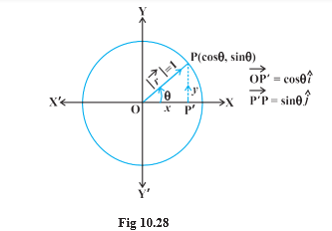
cos⁡θ i^+sin⁡θ j^,0≤θ<2π\cos\theta\,\hat{\mathbf i}+\sin\theta\,\hat{\mathbf j},\qquad 0\leq\theta<2\pi

Use this form for any direction in the plane.

The unit circle shows how the cosine and sine components specify each direction.
Worked example

Find the unit vector at an angle of π6\frac{\pi}{6} to the positive xx-axis.

  1. Find the unit vector whose direction makes an angle of π6\frac{\pi}{6} with the positive xx-axis.
    θ=π6\theta=\frac{\pi}{6}
  2. Substitute the angle into the general unit-vector form.
    u⃗=cos⁡(π6)i^+sin⁡(π6)j^\vec u=\cos\left(\frac{\pi}{6}\right)\hat{\mathbf i}+\sin\left(\frac{\pi}{6}\right)\hat{\mathbf j}
  3. Evaluate the trigonometric components.
    u⃗=32i^+12j^\vec u=\frac{\sqrt{3}}{2}\hat{\mathbf i}+\frac{1}{2}\hat{\mathbf j}
Answer: 32i^+12j^\frac{\sqrt{3}}{2}\hat{\mathbf i}+\frac{1}{2}\hat{\mathbf j}

Angle and Collinearity of Vectors

Angle and position-vector formulas
AB→=r⃗B−r⃗A,cos⁡θ=u⃗⋅v⃗∣u⃗∣∣v⃗∣\overrightarrow{AB}=\vec r_B-\vec r_A,\qquad \cos\theta=\frac{\vec u\cdot\vec v}{|\vec u||\vec v|}

Use the dot-product formula to find the angle between nonzero vectors.

Worked example

Find the angle between AB→\overrightarrow{AB} and CD→\overrightarrow{CD} and determine whether they are collinear.

  1. The position vectors of A,B,C,DA,B,C,D are given. Find the angle between AB→\overrightarrow{AB} and CD→\overrightarrow{CD}, and determine whether they are collinear.
    r⃗A=i^+j^+k^,r⃗B=2i^+5j^,r⃗C=3i^+2j^−3k^,r⃗D=i^−6j^−k^\vec r_A=\hat{\mathbf i}+\hat{\mathbf j}+\hat{\mathbf k},\quad \vec r_B=2\hat{\mathbf i}+5\hat{\mathbf j},\quad \vec r_C=3\hat{\mathbf i}+2\hat{\mathbf j}-3\hat{\mathbf k},\quad \vec r_D=\hat{\mathbf i}-6\hat{\mathbf j}-\hat{\mathbf k}
  2. Subtract each initial position vector from its terminal position vector.
    AB→=r⃗B−r⃗A=i^+4j^−k^,CD→=r⃗D−r⃗C=−2i^−8j^+2k^\overrightarrow{AB}=\vec r_B-\vec r_A=\hat{\mathbf i}+4\hat{\mathbf j}-\hat{\mathbf k},\quad \overrightarrow{CD}=\vec r_D-\vec r_C=-2\hat{\mathbf i}-8\hat{\mathbf j}+2\hat{\mathbf k}
  3. Find the magnitudes and dot product.
    ∣AB→∣=32,∣CD→∣=62,AB→⋅CD→=−36|\overrightarrow{AB}|=3\sqrt{2},\quad |\overrightarrow{CD}|=6\sqrt{2},\quad \overrightarrow{AB}\cdot\overrightarrow{CD}=-36
  4. Apply the angle formula and use the allowed range of the angle.
    cos⁡θ=−36(32)(62)=−1,0≤θ≤π⟹θ=π\cos\theta=\frac{-36}{(3\sqrt{2})(6\sqrt{2})}=-1,\quad 0\leq\theta\leq\pi\Longrightarrow\theta=\pi
  5. The scalar-multiple relation also confirms collinearity.
    AB→=−12CD→\overrightarrow{AB}=-\frac{1}{2}\overrightarrow{CD}
Answer: The angle is π\pi radians, and the vectors are collinear.
⚠ Common mistake

Opposite vectors are still collinear: one is a negative scalar multiple of the other.

Magnitude of a Sum with Perpendicularity Conditions

Squared magnitude of the sum
∣a⃗+b⃗+c⃗∣2=∣a⃗∣2+∣b⃗∣2+∣c⃗∣2|\vec a+\vec b+\vec c|^2=|\vec a|^2+|\vec b|^2+|\vec c|^2

Apply when each vector is perpendicular to the sum of the other vectors.

Worked example

Find the magnitude of the sum of three vectors of magnitudes 3,4,53,4,5, each perpendicular to the sum of the other two.

  1. Given vector magnitudes 3,4,53,4,5, with each vector perpendicular to the sum of the other two, find the magnitude of their sum.
    ∣a⃗∣=3,∣b⃗∣=4,∣c⃗∣=5|\vec a|=3,\quad |\vec b|=4,\quad |\vec c|=5
  2. Square the required magnitude and expand using the dot product.
    ∣a⃗+b⃗+c⃗∣2=(a⃗+b⃗+c⃗)⋅(a⃗+b⃗+c⃗)|\vec a+\vec b+\vec c|^2=(\vec a+\vec b+\vec c)\cdot(\vec a+\vec b+\vec c)
  3. The perpendicularity conditions remove the mixed terms.
    ∣a⃗+b⃗+c⃗∣2=∣a⃗∣2+∣b⃗∣2+∣c⃗∣2=9+16+25=50|\vec a+\vec b+\vec c|^2=|\vec a|^2+|\vec b|^2+|\vec c|^2=9+16+25=50
  4. Take the nonnegative square root.
    ∣a⃗+b⃗+c⃗∣=50=52|\vec a+\vec b+\vec c|=\sqrt{50}=5\sqrt{2}
Answer: 525\sqrt{2}

Dot Products When Three Vectors Sum to Zero

Sum of pairwise dot products
a⃗⋅b⃗+b⃗⋅c⃗+c⃗⋅a⃗=−∣a⃗∣2+∣b⃗∣2+∣c⃗∣22\vec a\cdot\vec b+\vec b\cdot\vec c+\vec c\cdot\vec a=-\frac{|\vec a|^2+|\vec b|^2+|\vec c|^2}{2}

Use when the three vectors sum to the zero vector.

Worked example

Evaluate the sum of pairwise dot products when three vectors sum to zero and their magnitudes are 3,4,23,4,2.

  1. Given a⃗+b⃗+c⃗=0⃗\vec a+\vec b+\vec c=\vec 0 and magnitudes 3,4,23,4,2, find the sum μ\mu of the pairwise dot products.
    ∣a⃗∣=3,∣b⃗∣=4,∣c⃗∣=2,μ=a⃗⋅b⃗+b⃗⋅c⃗+c⃗⋅a⃗|\vec a|=3,\quad |\vec b|=4,\quad |\vec c|=2,\quad \mu=\vec a\cdot\vec b+\vec b\cdot\vec c+\vec c\cdot\vec a
  2. Dot the zero-sum condition with each vector and add the equations.
    2μ=−(∣a⃗∣2+∣b⃗∣2+∣c⃗∣2)2\mu=-\left(|\vec a|^2+|\vec b|^2+|\vec c|^2\right)
  3. Substitute the squared magnitudes and solve.
    2μ=−(9+16+4)=−29,μ=−2922\mu=-(9+16+4)=-29,\quad \mu=-\frac{29}{2}
Answer: −292-\frac{29}{2}

Resolving a Vector into Parallel and Perpendicular Components

Parallel and perpendicular components
β⃗1=β⃗⋅α⃗∣α⃗∣2α⃗,β⃗2=β⃗−β⃗1\vec\beta_1=\frac{\vec\beta\cdot\vec\alpha}{|\vec\alpha|^2}\vec\alpha,\qquad \vec\beta_2=\vec\beta-\vec\beta_1

For α⃗≠0⃗\vec\alpha\ne\vec 0, the parallel component is the projection of β⃗\vec\beta onto α⃗\vec\alpha.

Resolve into Parallel and Perpendicular Parts

  1. Assume the parallel component is a scalar multiple of the given vector.
    β⃗1=λα⃗\vec\beta_1=\lambda\vec\alpha
  2. Subtract it from the original vector to obtain the perpendicular component.
    β⃗2=β⃗−λα⃗\vec\beta_2=\vec\beta-\lambda\vec\alpha
  3. Set the dot product of the perpendicular component with the given vector to zero and solve for λ\lambda.
    α⃗⋅β⃗2=0\vec\alpha\cdot\vec\beta_2=0
  4. State both components and verify that their sum is the original vector.
    β⃗=β⃗1+β⃗2\vec\beta=\vec\beta_1+\vec\beta_2
Worked example

Resolve 2i^+j^−3k^2\hat{\mathbf i}+\hat{\mathbf j}-3\hat{\mathbf k} into parts parallel and perpendicular to 3i^−j^3\hat{\mathbf i}-\hat{\mathbf j}.

  1. Resolve β⃗\vec\beta into parts parallel and perpendicular to α⃗\vec\alpha.
    α⃗=3i^−j^,β⃗=2i^+j^−3k^\vec\alpha=3\hat{\mathbf i}-\hat{\mathbf j},\quad \vec\beta=2\hat{\mathbf i}+\hat{\mathbf j}-3\hat{\mathbf k}
  2. Let the parallel component be a scalar multiple and subtract it from β⃗\vec\beta.
    β⃗1=λα⃗,β⃗2=(2−3λ)i^+(1+λ)j^−3k^\vec\beta_1=\lambda\vec\alpha,\quad \vec\beta_2=(2-3\lambda)\hat{\mathbf i}+(1+\lambda)\hat{\mathbf j}-3\hat{\mathbf k}
  3. Apply the perpendicularity condition to find λ\lambda.
    α⃗⋅β⃗2=3(2−3λ)−(1+λ)=0,λ=12\vec\alpha\cdot\vec\beta_2=3(2-3\lambda)-(1+\lambda)=0,\quad \lambda=\frac{1}{2}
  4. Substitute the scalar to obtain both components.
    β⃗1=32i^−12j^,β⃗2=12i^+32j^−3k^\vec\beta_1=\frac{3}{2}\hat{\mathbf i}-\frac{1}{2}\hat{\mathbf j},\quad \vec\beta_2=\frac{1}{2}\hat{\mathbf i}+\frac{3}{2}\hat{\mathbf j}-3\hat{\mathbf k}
Answer: β⃗1=32i^−12j^\vec\beta_1=\frac{3}{2}\hat{\mathbf i}-\frac{1}{2}\hat{\mathbf j} and β⃗2=12i^+32j^−3k^\vec\beta_2=\frac{1}{2}\hat{\mathbf i}+\frac{3}{2}\hat{\mathbf j}-3\hat{\mathbf k}.

Core Vector Formula Review

Position vectors, components, and direction cosines

  • Position vector: For P(x,y,z)P(x,y,z), OP→=xi^+yj^+zk^\overrightarrow{OP}=x\hat{\mathbf i}+y\hat{\mathbf j}+z\hat{\mathbf k} and ∣OP→∣=x2+y2+z2|\overrightarrow{OP}|=\sqrt{x^2+y^2+z^2}.
  • Scalar components: The components along the coordinate axes are the direction ratios and represent the projections on those axes.
  • Direction cosines: If the components are a,b,ca,b,c and the magnitude is rr, then l=arl=\frac{a}{r}, m=brm=\frac{b}{r}, and n=crn=\frac{c}{r}.
Triangle rule

The vector sum of the three directed sides of a triangle taken in order is 0⃗\vec 0.

Parallelogram law

The sum of two coinitial vectors is represented by the diagonal of the parallelogram formed by those vectors.

Scalar multiplication

Multiplying a vector by λ\lambda changes its magnitude by the factor ∣λ∣|\lambda|; its direction stays the same for λ>0\lambda>0 and reverses for λ<0\lambda<0.

Unit vector in a given direction
a⃗^=a⃗∣a⃗∣\hat{\vec a}=\frac{\vec a}{|\vec a|}

For nonzero a⃗\vec a, this gives the unit vector in its direction.

Section formula
r⃗internal=na⃗+mb⃗m+n,r⃗external=mb⃗−na⃗m−n\vec r_{\mathrm{internal}}=\frac{n\vec a+m\vec b}{m+n},\qquad \vec r_{\mathrm{external}}=\frac{m\vec b-n\vec a}{m-n}

If a point divides the segment between points with position vectors a⃗\vec a and b⃗\vec b in the ratio m:nm:n, use the appropriate form below.

Scalar product
a⃗⋅b⃗=∣a⃗∣∣b⃗∣cos⁡θ=a1b1+a2b2+a3b3\vec a\cdot\vec b=|\vec a||\vec b|\cos\theta=a_1b_1+a_2b_2+a_3b_3

The scalar product depends on the angle between the vectors; in components, multiply corresponding components and add.

Cross product
a⃗×b⃗=∣a⃗∣∣b⃗∣sin⁡θ n^,a⃗×b⃗=∣i^j^k^a1a2a3b1b2b3∣\vec a\times\vec b=|\vec a||\vec b|\sin\theta\,\hat{\mathbf n},\qquad \vec a\times\vec b=\begin{vmatrix}\hat{\mathbf i}&\hat{\mathbf j}&\hat{\mathbf k}\\a_1&a_2&a_3\\b_1&b_2&b_3\end{vmatrix}

The cross product is perpendicular to the plane containing a⃗\vec a and b⃗\vec b; its direction is chosen so a⃗,b⃗,n^\vec a,\vec b,\hat{\mathbf n} form a right-handed system.

Component operations
a⃗+b⃗=(a1+b1)i^+(a2+b2)j^+(a3+b3)k^λa⃗=λa1i^+λa2j^+λa3k^\begin{aligned}\vec a+\vec b&=(a_1+b_1)\hat{\mathbf i}+(a_2+b_2)\hat{\mathbf j}+(a_3+b_3)\hat{\mathbf k}\\\lambda\vec a&=\lambda a_1\hat{\mathbf i}+\lambda a_2\hat{\mathbf j}+\lambda a_3\hat{\mathbf k}\end{aligned}

For component vectors, add corresponding components and multiply each component by the scalar.

★ Remember
  • Unit direction: Normalize a nonzero vector by dividing it by its magnitude.
  • Triangle rule: Add the three directed sides taken in order to get the zero vector.
  • Scalar multiplication: A negative scalar reverses the vector’s direction; a positive scalar preserves it.
Practice

Find the angle between u⃗=2i^−j^+2k^\vec u=2\hat{\mathbf i}-\hat{\mathbf j}+2\hat{\mathbf k} and v⃗=i^+2j^+2k^\vec v=\hat{\mathbf i}+2\hat{\mathbf j}+2\hat{\mathbf k}.

Hint: Calculate the dot product and both magnitudes.
Key step: u⃗⋅v⃗=4\vec u\cdot\vec v=4 and ∣u⃗∣=∣v⃗∣=3|\vec u|=|\vec v|=3.
Solution: cos⁡θ=49\cos\theta=\frac{4}{9}, so θ=cos⁡−1(49)\theta=\cos^{-1}\left(\frac{4}{9}\right).
Practice

If a⃗+b⃗+c⃗=0⃗\vec a+\vec b+\vec c=\vec 0 and ∣a⃗∣=2|\vec a|=2, ∣b⃗∣=3|\vec b|=3, ∣c⃗∣=4|\vec c|=4, find a⃗⋅b⃗+b⃗⋅c⃗+c⃗⋅a⃗\vec a\cdot\vec b+\vec b\cdot\vec c+\vec c\cdot\vec a.

Hint: Use the sum of pairwise dot products formula.
Key step: 2μ=−(4+9+16)=−292\mu=-(4+9+16)=-29.
Solution: μ=−292\mu=-\frac{29}{2}.
Practice

Resolve β⃗=4i^+2j^+k^\vec\beta=4\hat{\mathbf i}+2\hat{\mathbf j}+\hat{\mathbf k} into parts parallel and perpendicular to α⃗=i^+j^\vec\alpha=\hat{\mathbf i}+\hat{\mathbf j}.

Hint: The parallel part is β⃗⋅α⃗∣α⃗∣2α⃗\frac{\vec\beta\cdot\vec\alpha}{|\vec\alpha|^2}\vec\alpha.
Key step: β⃗⋅α⃗=6\vec\beta\cdot\vec\alpha=6 and ∣α⃗∣2=2|\vec\alpha|^2=2, so the parallel component is 3i^+3j^3\hat{\mathbf i}+3\hat{\mathbf j}.
Solution: β⃗1=3i^+3j^\vec\beta_1=3\hat{\mathbf i}+3\hat{\mathbf j} and β⃗2=i^−j^+k^\vec\beta_2=\hat{\mathbf i}-\hat{\mathbf j}+\hat{\mathbf k}; their sum is β⃗\vec\beta and α⃗⋅β⃗2=0\vec\alpha\cdot\vec\beta_2=0.

Quick recap

  • Every unit vector in the XYXY-plane has the form cos⁡θ i^+sin⁡θ j^\cos\theta\,\hat{\mathbf i}+\sin\theta\,\hat{\mathbf j}.
  • A directed segment vector is terminal position vector minus initial position vector; use the dot product to find the angle.
  • Collinear vectors are scalar multiples, including negative multiples that point in opposite directions.
  • Two coinitial vectors add to the diagonal of their parallelogram; the directed sides of a triangle taken in order sum to zero.
  • Scalar components are direction ratios and projections on the coordinate axes; direction cosines are components divided by magnitude.
  • The cross product has magnitude ∣a⃗∣∣b⃗∣sin⁡θ|\vec a||\vec b|\sin\theta and points perpendicular to the vectors’ plane according to the right-hand orientation.
  • Use dot products to handle perpendicularity, zero-sum vector relations, and parallel-perpendicular decomposition.

Formula sheet

Magnitude of a position vector
∣OP→∣=x2+y2+z2|\overrightarrow{OP}|=\sqrt{x^2+y^2+z^2}
Position vector and its magnitude
OP→=(x,y,z),∣OP→∣=x2+y2+z2\overrightarrow{OP}=(x,y,z),\qquad |\overrightarrow{OP}|=\sqrt{x^2+y^2+z^2}
Direction cosines
l=cos⁡α=xr,m=cos⁡β=yr,n=cos⁡γ=zr,l2+m2+n2=1l=\cos\alpha=\frac{x}{r},\quad m=\cos\beta=\frac{y}{r},\quad n=\cos\gamma=\frac{z}{r},\quad l^2+m^2+n^2=1
Triangle law and closed-triangle rule
AB→+BC→=AC→,AB→+BC→+CA→=0⃗\overrightarrow{AB}+\overrightarrow{BC}=\overrightarrow{AC},\qquad \overrightarrow{AB}+\overrightarrow{BC}+\overrightarrow{CA}=\vec{0}
Vector difference
a⃗−b⃗=a⃗+(−b⃗)\vec{a}-\vec{b}=\vec{a}+(-\vec{b})
Resultant velocity
v⃗resultant=v⃗engine+v⃗current\vec{v}_{\text{resultant}}=\vec{v}_{\text{engine}}+\vec{v}_{\text{current}}
Magnitude under scalar multiplication
∣λa⃗∣=∣λ∣ ∣a⃗∣|\lambda\vec{a}|=|\lambda|\,|\vec{a}|
Unit vector in the direction of a⃗\vec{a}
a^=a⃗∣a⃗∣\hat{a}=\frac{\vec{a}}{|\vec{a}|}
Magnitude and unit vector
∣r⃗∣=x2+y2+z2,r^=r⃗∣r⃗∣|\vec{r}|=\sqrt{x^2+y^2+z^2},\quad \hat{r}=\frac{\vec{r}}{|\vec{r}|}
Unit vector from direction cosines
li^+mj^+nk^l\hat{i}+m\hat{j}+n\hat{k}
Joining vector and distance
P1P2→=(x2−x1)i^+(y2−y1)j^+(z2−z1)k^,∣P1P2→∣=(x2−x1)2+(y2−y1)2+(z2−z1)2\overrightarrow{P_1P_2}=(x_2-x_1)\hat{i}+(y_2-y_1)\hat{j}+(z_2-z_1)\hat{k},\quad |\overrightarrow{P_1P_2}|=\sqrt{(x_2-x_1)^2+(y_2-y_1)^2+(z_2-z_1)^2}
Internal, external, and midpoint formulas
OR→internal=mb⃗+na⃗m+n,OR→external=mb⃗−na⃗m−n,OR→midpoint=a⃗+b⃗2\overrightarrow{OR}_{\mathrm{internal}}=\frac{m\vec{b}+n\vec{a}}{m+n},\quad \overrightarrow{OR}_{\mathrm{external}}=\frac{m\vec{b}-n\vec{a}}{m-n},\quad \overrightarrow{OR}_{\mathrm{midpoint}}=\frac{\vec{a}+\vec{b}}{2}
Dot product and angle
a⃗⋅b⃗=∣a⃗∣∣b⃗∣cos⁡θ,cos⁡θ=a⃗⋅b⃗∣a⃗∣∣b⃗∣,θ=cos⁡−1(a⃗⋅b⃗∣a⃗∣∣b⃗∣)\vec a\cdot\vec b=|\vec a||\vec b|\cos\theta,\qquad \cos\theta=\frac{\vec a\cdot\vec b}{|\vec a||\vec b|},\qquad \theta=\cos^{-1}\left(\frac{\vec a\cdot\vec b}{|\vec a||\vec b|}\right)
Component form
a⃗=a1i^+a2j^+a3k^,b⃗=b1i^+b2j^+b3k^,a⃗⋅b⃗=a1b1+a2b2+a3b3\vec a=a_1\hat i+a_2\hat j+a_3\hat k,\quad \vec b=b_1\hat i+b_2\hat j+b_3\hat k,\quad \vec a\cdot\vec b=a_1b_1+a_2b_2+a_3b_3
Projection formulas
comp⁡p^a⃗=a⃗⋅p^,comp⁡b⃗a⃗=a⃗⋅b⃗∣b⃗∣,proj⁡b⃗a⃗=a⃗⋅b⃗∣b⃗∣2b⃗\operatorname{comp}_{\hat p}\vec a=\vec a\cdot\hat p,\qquad \operatorname{comp}_{\vec b}\vec a=\frac{\vec a\cdot\vec b}{|\vec b|},\qquad \operatorname{proj}_{\vec b}\vec a=\frac{\vec a\cdot\vec b}{|\vec b|^2}\vec b
Magnitude identities
∣a⃗−b⃗∣2=∣a⃗∣2−2(a⃗⋅b⃗)+∣b⃗∣2,∣a⃗+b⃗∣2=∣a⃗∣2+2(a⃗⋅b⃗)+∣b⃗∣2|\vec a-\vec b|^2=|\vec a|^2-2(\vec a\cdot\vec b)+|\vec b|^2,\qquad |\vec a+\vec b|^2=|\vec a|^2+2(\vec a\cdot\vec b)+|\vec b|^2
Cross-product magnitude and angle
∣a⃗×b⃗∣=∣a⃗∣∣b⃗∣sin⁡θ,sin⁡θ=∣a⃗×b⃗∣∣a⃗∣∣b⃗∣|\vec a\times\vec b|=|\vec a||\vec b|\sin\theta,\qquad \sin\theta=\frac{|\vec a\times\vec b|}{|\vec a||\vec b|}
Determinant formula
a⃗×b⃗=∣i^j^k^a1a2a3b1b2b3∣=(a2b3−a3b2)i^−(a1b3−a3b1)j^+(a1b2−a2b1)k^\vec a\times\vec b=\begin{vmatrix}\hat i&\hat j&\hat k\\a_1&a_2&a_3\\b_1&b_2&b_3\end{vmatrix}=(a_2b_3-a_3b_2)\hat i-(a_1b_3-a_3b_1)\hat j+(a_1b_2-a_2b_1)\hat k
All unit vectors in the XY-plane
cos⁡θ i^+sin⁡θ j^,0≤θ<2π\cos\theta\,\hat{\mathbf i}+\sin\theta\,\hat{\mathbf j},\qquad 0\leq\theta<2\pi
Angle and position-vector formulas
AB→=r⃗B−r⃗A,cos⁡θ=u⃗⋅v⃗∣u⃗∣∣v⃗∣\overrightarrow{AB}=\vec r_B-\vec r_A,\qquad \cos\theta=\frac{\vec u\cdot\vec v}{|\vec u||\vec v|}
Squared magnitude of the sum
∣a⃗+b⃗+c⃗∣2=∣a⃗∣2+∣b⃗∣2+∣c⃗∣2|\vec a+\vec b+\vec c|^2=|\vec a|^2+|\vec b|^2+|\vec c|^2
Sum of pairwise dot products
a⃗⋅b⃗+b⃗⋅c⃗+c⃗⋅a⃗=−∣a⃗∣2+∣b⃗∣2+∣c⃗∣22\vec a\cdot\vec b+\vec b\cdot\vec c+\vec c\cdot\vec a=-\frac{|\vec a|^2+|\vec b|^2+|\vec c|^2}{2}
Parallel and perpendicular components
β⃗1=β⃗⋅α⃗∣α⃗∣2α⃗,β⃗2=β⃗−β⃗1\vec\beta_1=\frac{\vec\beta\cdot\vec\alpha}{|\vec\alpha|^2}\vec\alpha,\qquad \vec\beta_2=\vec\beta-\vec\beta_1
Unit vector in a given direction
a⃗^=a⃗∣a⃗∣\hat{\vec a}=\frac{\vec a}{|\vec a|}
Section formula
r⃗internal=na⃗+mb⃗m+n,r⃗external=mb⃗−na⃗m−n\vec r_{\mathrm{internal}}=\frac{n\vec a+m\vec b}{m+n},\qquad \vec r_{\mathrm{external}}=\frac{m\vec b-n\vec a}{m-n}
Scalar product
a⃗⋅b⃗=∣a⃗∣∣b⃗∣cos⁡θ=a1b1+a2b2+a3b3\vec a\cdot\vec b=|\vec a||\vec b|\cos\theta=a_1b_1+a_2b_2+a_3b_3
Cross product
a⃗×b⃗=∣a⃗∣∣b⃗∣sin⁡θ n^,a⃗×b⃗=∣i^j^k^a1a2a3b1b2b3∣\vec a\times\vec b=|\vec a||\vec b|\sin\theta\,\hat{\mathbf n},\qquad \vec a\times\vec b=\begin{vmatrix}\hat{\mathbf i}&\hat{\mathbf j}&\hat{\mathbf k}\\a_1&a_2&a_3\\b_1&b_2&b_3\end{vmatrix}
Component operations
a⃗+b⃗=(a1+b1)i^+(a2+b2)j^+(a3+b3)k^λa⃗=λa1i^+λa2j^+λa3k^\begin{aligned}\vec a+\vec b&=(a_1+b_1)\hat{\mathbf i}+(a_2+b_2)\hat{\mathbf j}+(a_3+b_3)\hat{\mathbf k}\\\lambda\vec a&=\lambda a_1\hat{\mathbf i}+\lambda a_2\hat{\mathbf j}+\lambda a_3\hat{\mathbf k}\end{aligned}

Mathematics — ALL CHAPTERS

1

Relations And Functions

View

2

Inverse Trigonometric Functions

View

3

Matrices

View

4

DETERMINANTS 

View

5

Continuity And Differentiability

View

6

Application Of Derivatives

View

7

Integrals

View

8

APPLICATION OF INTEGRALS

View

9

DIFFERENTIAL EQUATIONS

View

10

VECTOR ALGEBRA

View

11

Three Dimensional Geometry

View

12

Linear Programming

View

13

Probability

View

14

Proofs In Mathematics

View

15

Mathematical Modelling

View