Class 8 . Science . Curiosity . Exploring the Investigative World of Science
Chapter 1: Exploring the Investigative World of Science
Ch 1
Science
Class 8
Exploring the Investigative World of Science Part-1
How Scientific Investigation Works
Scientific investigation — A focused process of asking questions, observing carefully, testing ideas and using evidence to improve explanations.
An investigation
- Ask a focused question about something observed.
- Plan observations or a simple experiment to explore it.
- Record observations and use them to explain or refine your understanding.
Key idea
- Curiosity starts science with questions about the world.
- Evidence from observation and experiments helps build explanations.
- Scientific understanding can improve as new questions are explored.
Topics in the Investigative Journey
Microorganisms and health
- Microorganisms include tiny living things that may be invisible to the unaided eye.
- Benefits and harms: some help digestion or produce medicines; others can cause infections.
- Staying healthy involves nutritious food, exercise, medicines and vaccines, which help protect the body and fight infections.
Electricity and its effects
- Heating effect: electric current can produce heat in appliances such as heaters and irons.
- Magnetic effect: electric current can produce magnetism, helping motors and machines work.
Forces, pressure and weather
- Force can make objects speed up, slow down or change direction.
- Examples: gravity brings a ball thrown upwards back to the ground; brakes make a car stop.
- Pressure describes how force is distributed over an object.
- Air pressure differences move air: smaller differences can create breezes, while stronger differences can produce strong winds and cyclones.
Particles and materials
- Particle model: materials are made of tiny particles whose movement differs between states.
- Solids: particles cannot move much; gases: particles move freely.
- Liquids: particles are dispersed throughout the liquid, as shown in the particle model.
- Why particles matter: their nature and movement help explain material behaviour, such as air exerting pressure and water boiling.
| Type | What it is |
|---|---|
| Element | A pure substance. |
| Compound | A substance made of two or more elements bonded together. |
| Mixture | A combination of substances that can be separated physically. |
Mixtures and solutions
- Solution: a mixture in which one substance is dissolved in another.
- Example: sugar dissolves in tea, making the tea sweet.
Light and the Moon
- Reflection: light reflects from flat and curved mirrors, rough surfaces and the Moon.
- Refraction: light bends when it passes through lenses; this helps explain corrective glasses and images seen in objects such as shiny spoons.
- Moon phases: the relative positions of the Earth, Moon and Sun change which part of the Moon is illuminated and visible to us.
Quick recap
- Scientific investigation uses focused questions, careful observation and experiments to build explanations.
- Microorganisms can be helpful or harmful; food, exercise, medicines and vaccines support health.
- Electric current has heating and magnetic effects.
- Forces change motion; pressure differences in air can lead to winds and cyclones.
- Materials are made of particles and are classified as elements, compounds or mixtures.
- Reflection, refraction and changing illumination explain several effects of light, including Moon phases.
Exploring the Investigative World of Science Part-2
Natural Cycles and Calendars
Calendar — A system for organising days and longer periods, which can be based on observations of natural cycles.
How natural cycles help mark time
- Sunrise and sunset: Their repeated daily patterns help mark the passage of time.
- Moon phases: Observing the Moon’s periodic phases helped people develop some of the earliest calendars.
- Example: The Chaitra calendar shown covers March 22–April 20, 2025; numbers in parentheses show a smaller secondary date system.
Ecosystems and Conditions for Life
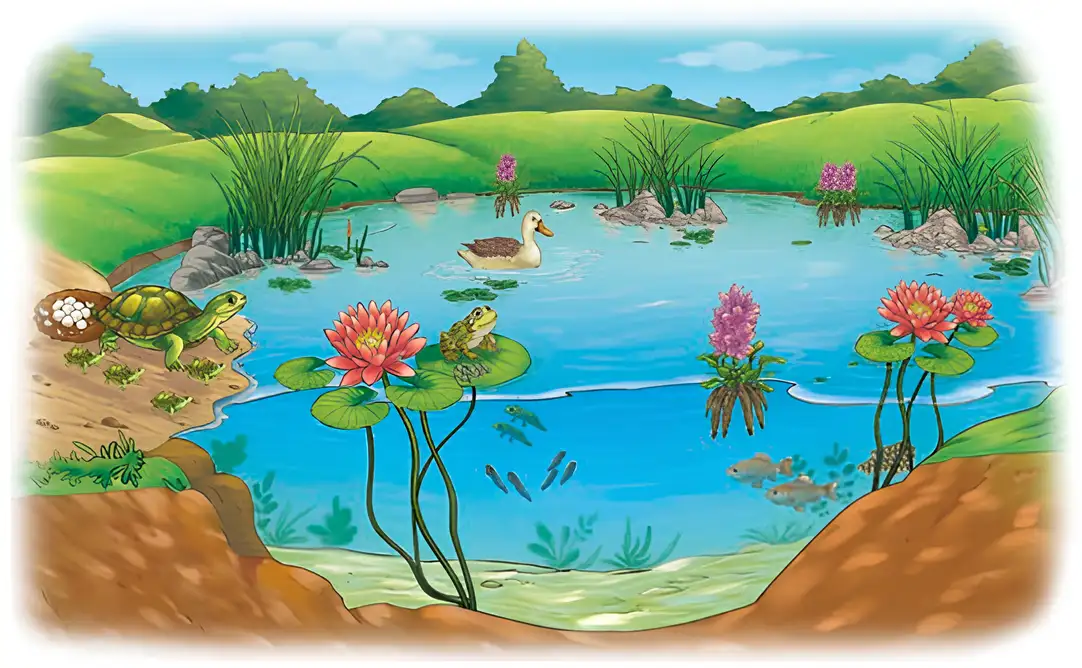
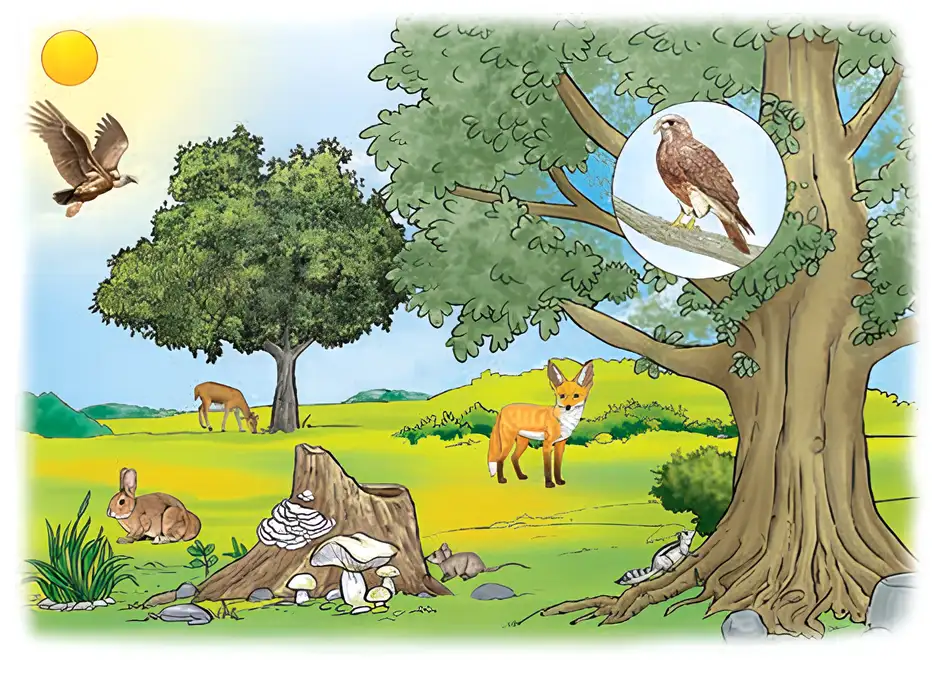
Ecosystem — A community of living organisms interacting with one another and with their surroundings.
Earth’s support for life
- Interdependence: Living things depend on and respond to air, water, sunlight and other organisms.
- Distance from the Sun: Earth is at a distance that allows water to remain liquid.
- Atmosphere: It provides the oxygen we breathe and shields Earth from harmful ultraviolet rays.
- Climate risk: Human activities can change Earth’s temperature, disrupt climate patterns and cause dangerous consequences.
Science and protecting Earth
- Human role: People influence Earth’s climate, but can also use science to understand changes and guide actions.
- Scientific approach: Careful observation, measurement and experimentation help us understand and protect the balance that supports life.
Investigating Why Puri Puffs Up
Starting with curiosity
- Science is everywhere: A kitchen can be a place to observe, ask questions and investigate; a laboratory is not essential.
- Phenomena to question: Puri or batura puffs up in hot oil, and phulka swells over a flame.
- Investigation question: What changes affect how a puri puffs, and why can one side be thinner than the other?
- Open question: The swelling of a puri is not yet completely understood by scientists.
| Investigation part | Examples |
|---|---|
| Factors to change or control | Dough thickness or size; type of flour; oil temperature; how the dough is placed in the oil |
| Outcomes to observe or measure | Whether the puri puffs up (yes/no); time taken to puff (seconds); whether a thick dough layer still produces a thin side |
| Other observations | Whether the oil splatters, smells or smokes |
Making a fair comparison
- One factor at a time: Change only the factor being tested and keep other conditions the same.
- Example: To compare oil temperatures, use dough circles of the same thickness and place them in the same way.
- Record observations: Keep notes of what you see and sense during each trial; observations may lead to further questions.
Systematic Investigation
- Ask a clear question about a phenomenon.
- Choose a factor to change and outcomes to observe or measure.
- Keep other conditions the same and test one factor at a time.
- Record observations, compare results and ask follow-up questions.
Follow-up questions
- Dough: Do puris puff better when made with fresh dough or stored dough?
- Puncture: What happens if a hole is made in the puri before frying?
- Broader idea: Careful observation can guide investigations of everyday events as well as natural cycles, such as the bright part of the Moon shrinking after purnima.
How can an investigation of puri puffing be made fair?
Quick recap
- Observations of sunrise, sunset and Moon phases contributed to the development of calendars.
- Ecosystems are formed by interactions between living organisms and their surroundings.
- Earth’s distance from the Sun allows liquid water; its atmosphere provides oxygen and blocks harmful ultraviolet rays.
- Human activities can alter temperature and disrupt climate patterns, while science can help guide protective action.
- Investigations identify factors to change and outcomes to observe or measure.
- A fair test changes one factor at a time, keeps other conditions the same and records observations.
Science — ALL CHAPTERS
1
Exploring the Investigative World of Science
2
The Invisible Living World: Beyond Our Naked Eye
3
Health: The Ultimate Treasure
4
Electricity: Magnetic and Heating Effects
5
Exploring Forces
6
Pressure, Winds, Storms, and Cyclones
7
Particulate Nature of Matter
8
Nature of Matter: Elements, Compounds, and Mixtures
9
The Amazing World of Solutes, Solvents, and Solutions
10
Light: Mirrors and Lenses
11
Keeping Time with the Skies
12
How Nature Works in Harmony
13
Our Home: Earth, a Unique Life Sustaining Planet