Class 8 . Science . Curiosity . Keeping Time with the Skies
Chapter 11: Keeping Time with the Skies
Ch 11
Science
Class 8
Introduction
Observing the Moon
What Meera noticed
- Daytime Moon: Meera saw the Moon shining in the daytime during the kite festival in Ahmedabad.
- Changing appearance: The Moon did not look like a full circle; Meera knew its visible shape changed from night to night.
- Moon’s nature: The Moon is spherical and shines by reflecting sunlight.
- Eclipses: Meera wondered if a lunar eclipse explained the Moon’s appearance, but eclipses are rare and brief.
- Cause: The Moon’s shape appears to change because, as it revolves around Earth, we see different portions of its sunlit half.
Questions About Time and the Sky
- Timekeeping: How could time be measured without clocks or calendars?
- Lunar time: What would a day, month, or year mean if people lived on the Moon?
- The night sky: How might having two moons instead of one change the night sky?
- Observation: Why can the Moon sometimes be seen while the Sun is up?
Quick recap
- The Moon was observed shining in the daytime.
- The Moon is spherical and shines by reflecting sunlight.
- Its visible shape changes from night to night.
- Lunar eclipses are rare and brief.
- The cause of the Moon’s changing shape is left as a question in this introduction.
- The lecture raises questions about timekeeping and observing the sky.
How Does the Moon’s Appearance Change and Why Part-1
Phases of the Moon
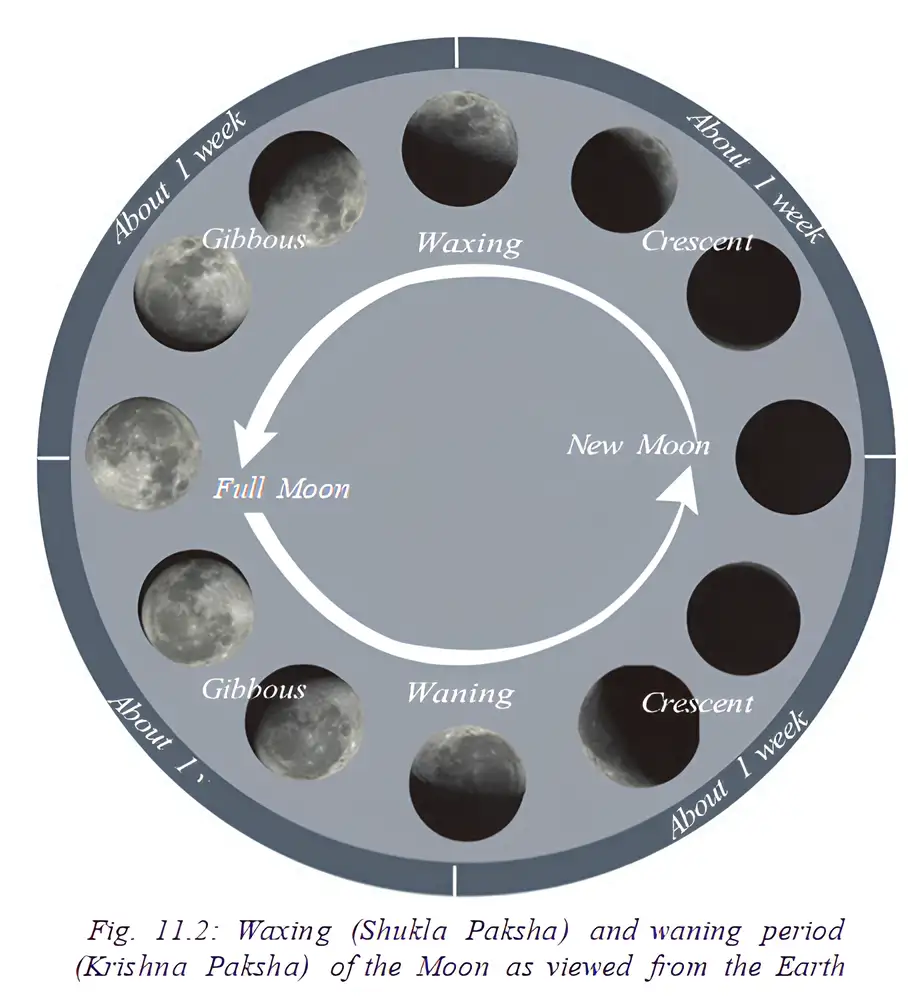
Phases of the Moon — The changing shapes of the Moon’s bright portion as seen from Earth on different days are called its phases.
The monthly cycle
- Waning: After a full Moon, the visible bright portion decreases from a full circle to a half circle in about a week, then disappears over the following week.
- Waxing: After the new Moon, the bright portion grows to a half circle in about a week and to a full circle in another week.
- Full Moon day (Purnima): The Moon appears as a full bright circle.
- New Moon day (Amavasya): The Moon is not visible to us.
- Indian names: The waning period is Krishna Paksha; the waxing period is Shukla Paksha.
- Cycle length: Waning followed by waxing repeats; one full Moon to the next takes about a month.
Locating the Moon
Phase and position in the sky
- Full Moon: It is nearly opposite the Sun; at sunrise, the Sun is rising in the east while the Moon is almost setting in the west.
- After full Moon: On successive mornings, as the Moon wanes, it appears closer to the Sun in the sky.
- Half Moon while waning: The Moon is overhead at sunrise.
- Waning crescent: A few days later, it appears even closer to the Sun.
- Best time to look: A waxing Moon is easiest to spot at sunset; a waning Moon is easiest to spot at sunrise.
- Rising and setting: The Moon rises and sets at times different from the Sun, and its position changes from day to day.
Moonrise times
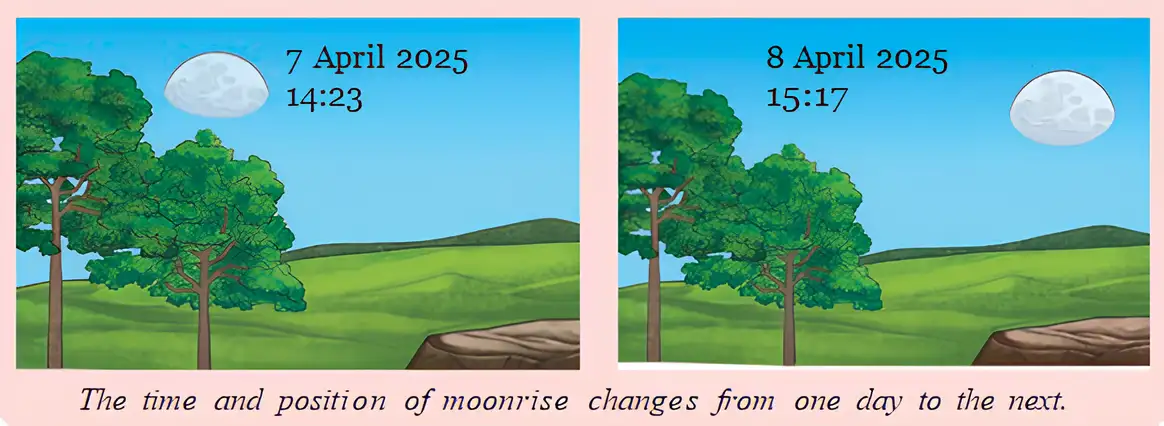
- Daily shift: The Moon rises about 50 minutes later each day.
- Daylight visibility: Moonrise can occur in the afternoon, around 2:00–4:00 p.m.; the Moon may then be visible in the eastern sky during daylight.
- Seeing it rise: It may take about 30 minutes after moonrise for the Moon to climb high enough to be seen.
Why the Moon’s Appearance Changes
Sunlight and the visible portion
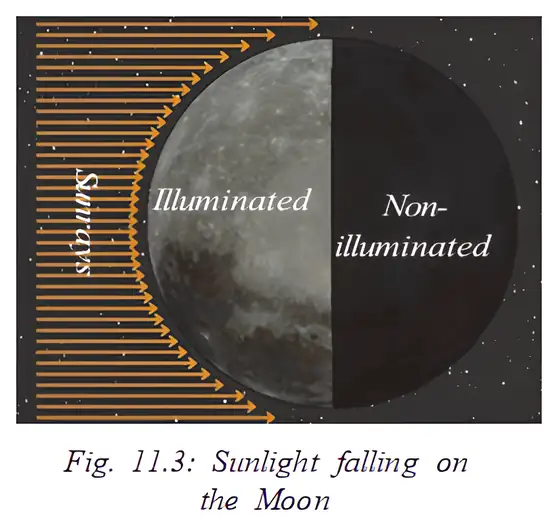
- Moonlight: The Moon does not produce its own light; it shines by reflecting sunlight.
- Illumination: The half of the Moon facing the Sun is lit, while the half facing away from the Sun is dark.
- Revolution: The Moon revolves around Earth, and the same half of the Moon always faces Earth.
- Changing view: As the Moon moves around Earth, the part of its sunlit half visible from Earth changes.
- New Moon: The non-illuminated side faces Earth, so we cannot see the Moon’s illuminated portion.
- Key idea: The Moon’s actual shape does not change; only the visible portion of its illuminated half changes.
Do not think the Moon itself changes shape or gives off light: its shape stays the same, and its changing phases result from how much of the sunlit half we can see.
What are the phases of the Moon?
Why does the Moon appear different on different days?
Quick recap
- Phases are the changing shapes of the Moon’s bright portion seen from Earth.
- Waning follows full Moon; waxing follows new Moon.
- Purnima is full Moon day; Amavasya is new Moon day.
- Moon position shifts relative to the Sun; waxing is easiest to see at sunset and waning at sunrise.
- Moonrise occurs about 50 minutes later each day.
- Cause of phases: the Moon reflects sunlight, and we see different portions of its illuminated half.
How Does the Moon’s Appearance Change and Why Part-2
Why the Moon’s Visible Shape Changes
Phases of the Moon — The phases of the Moon are the changing shapes of its illuminated portion that we can see from Earth.
How the phases form
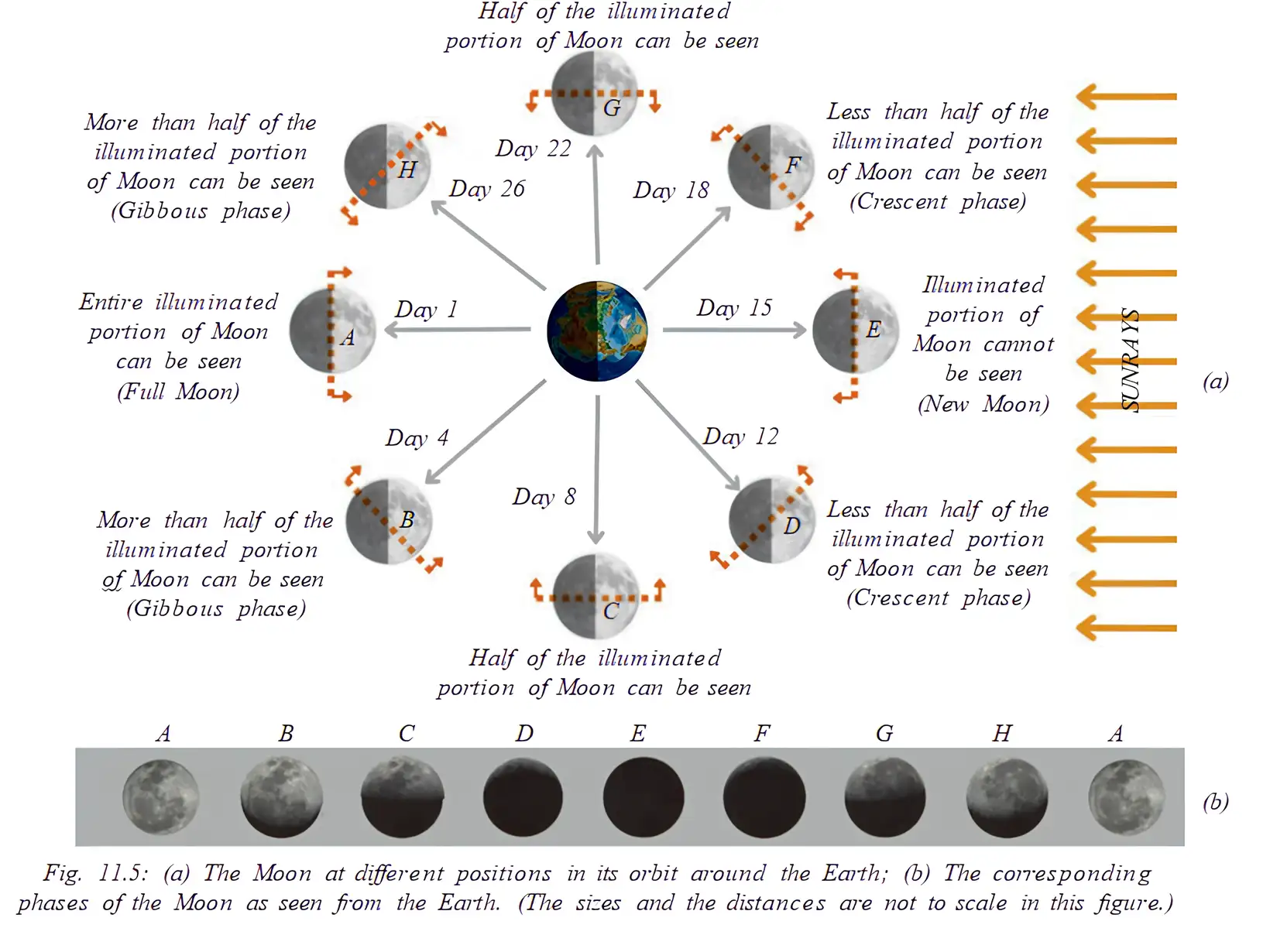
- Sunlit side: The side of the Moon facing the Sun is always illuminated.
- Earth-facing side: We see only the illuminated part of the Moon’s side that faces Earth.
- Changing view: As the Moon revolves around Earth, the fraction of its illuminated side visible from Earth changes.
- Moon’s cycle: The Moon travels through positions A to H and back to A in about one month.
| Moon position | What is seen from Earth |
|---|---|
| A | Full Moon: the visible face is fully illuminated; the Moon appears farthest from the Sun. |
| B and H | Gibbous phase: more than half of the visible face is illuminated. |
| D and F | Crescent phase: less than half of the visible face is illuminated. |
| E | New Moon: the visible face is not illuminated; the Moon appears closest to the Sun. |
Waning and waxing
- A → C → E: waning phase; the visible illuminated portion decreases.
- E → G → A: waxing phase; the visible illuminated portion increases.
What people on Earth see
- Nearly the same phase: Earth rotates once in one day, much faster than the Moon completes its revolution in nearly a month. So people in different places on Earth see nearly the same Moon phase on a given day.
The Moon’s Changing Position in the Sky
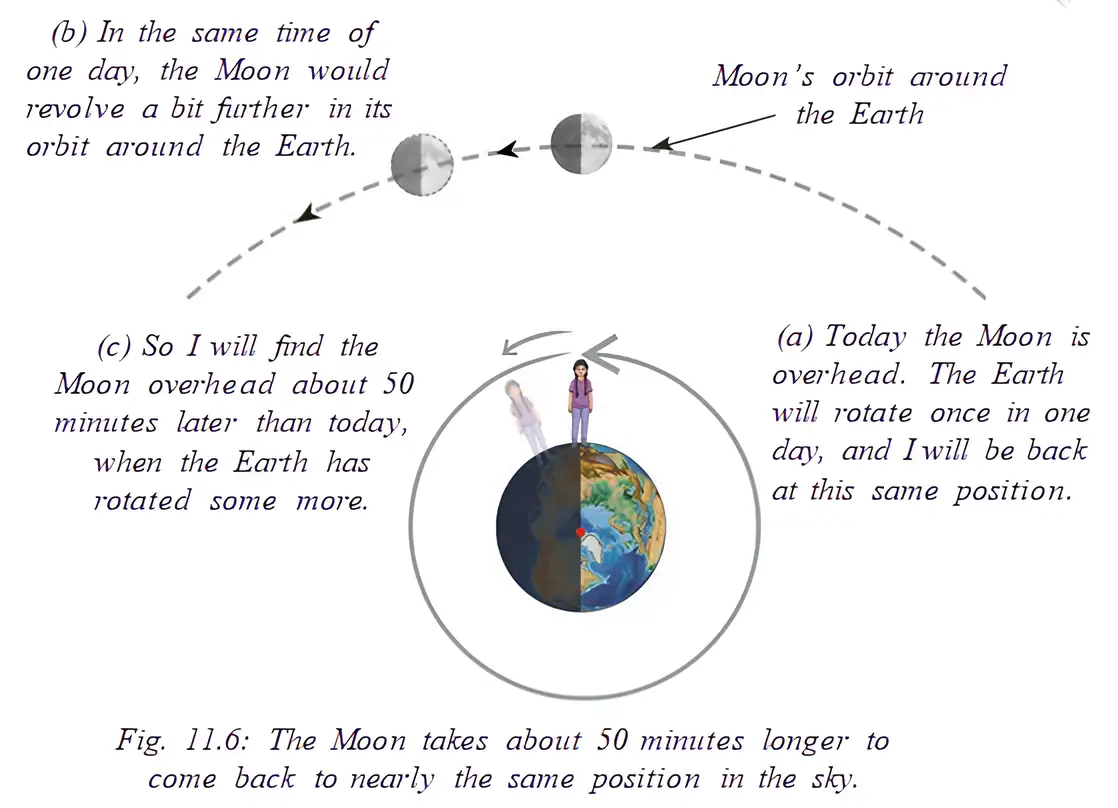
- Daily shift: The Moon moves ahead in its orbit while Earth completes one rotation in 24 hours.
- Later appearance: Earth must rotate a little more for the Moon to return to nearly the same position in the sky, so it appears overhead about 50 minutes later each day.
Moon Phases and Eclipses
| Point | Moon phases | Eclipses |
|---|---|---|
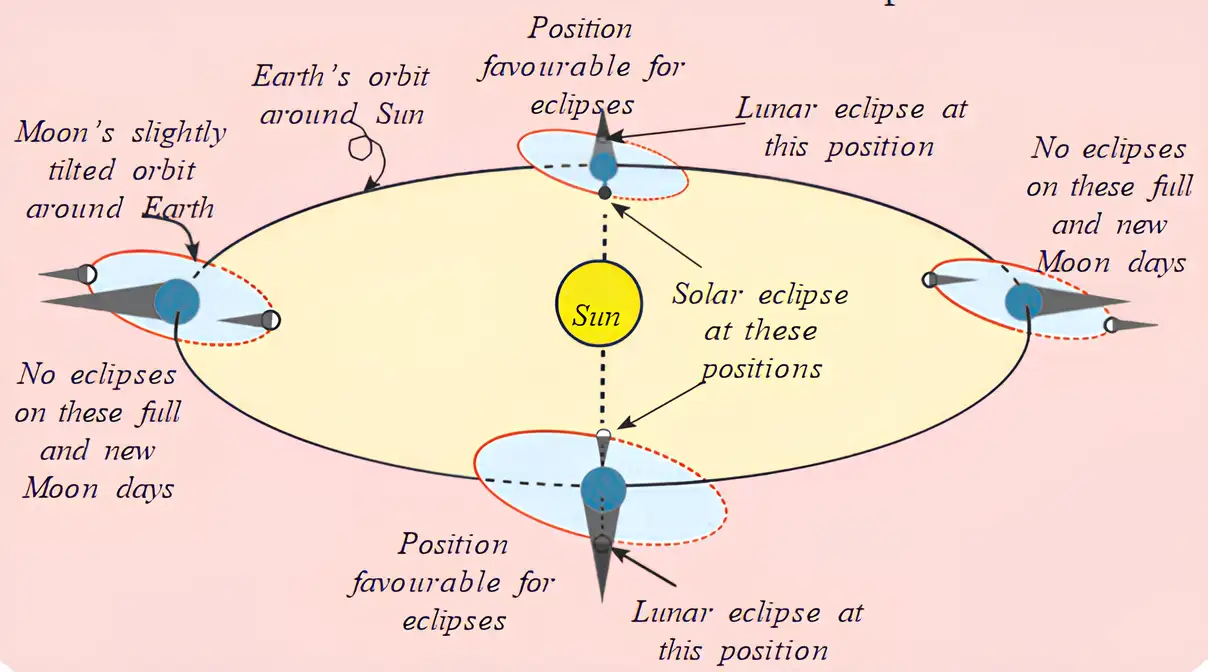
| Cause | The changing relative orientation of the Sun, Moon and Earth as the Moon revolves around Earth. | An eclipse occurs when the Sun, Earth and Moon line up so that a shadow falls. |
| Earth’s shadow | Does not cause the Moon’s phases. | Earth’s shadow on the Moon causes a lunar eclipse. |
| Possible Moon day | Phases change through the Moon’s cycle. | Lunar eclipses can occur only on a Full Moon; solar eclipses only on a New Moon. |
| Why not monthly? | The changing phases repeat in a cycle of almost a month. | The Moon’s orbit is slightly tilted relative to Earth’s orbit around the Sun, so eclipses do not occur every month. |
Do not explain Moon phases as Earth’s shadow falling on the Moon. That shadow causes a lunar eclipse; phases result from the changing view of the Moon’s sunlit side.
Using the Moon to Keep Time
Periodic event — An event that repeats at regular intervals.
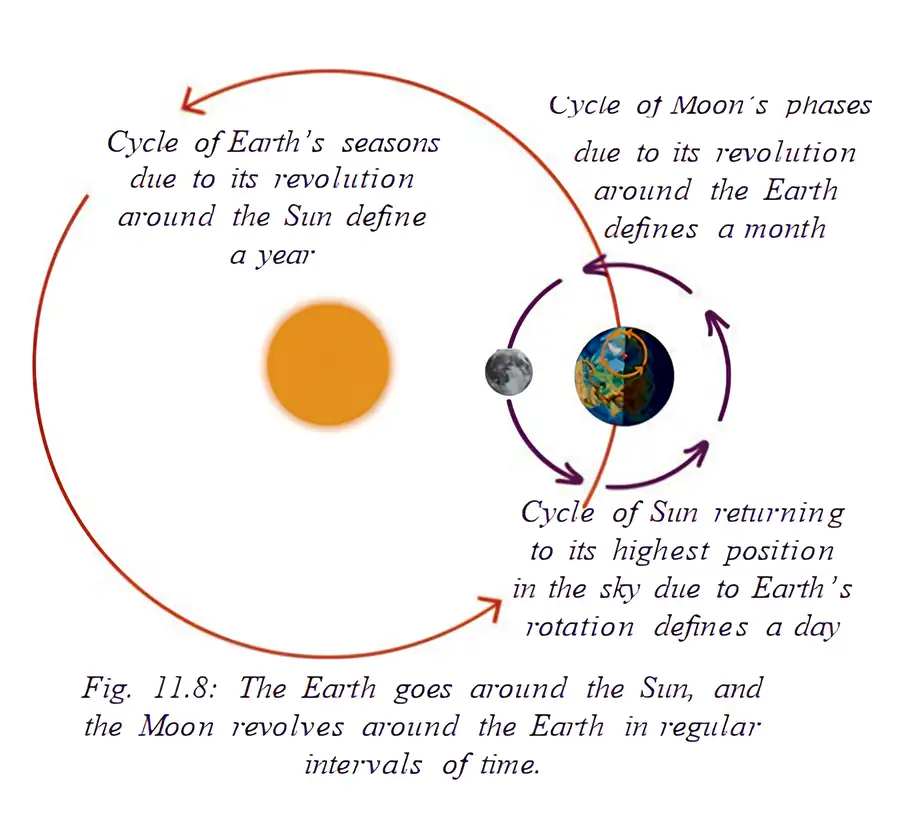
- Timekeeping: The Moon’s changing phases form a natural cycle of almost a month and can be used to keep time.
- Other natural cycles: Day and night and the changing seasons are also periodic events.
Why does the Moon’s visible shape change during the month?
Why do eclipses not occur every month?
Quick recap
- Moon phases show the changing fraction of the Moon’s sunlit side visible from Earth.
- A is Full Moon; E is New Moon; B and H are gibbous; D and F are crescent.
- From A through C to E, the Moon wanes; from E through G back to A, it waxes.
- The Moon appears overhead about 50 minutes later each day because it moves along its orbit.
- Earth’s shadow causes lunar eclipses, not Moon phases; eclipses do not happen monthly because the Moon’s orbit is tilted.
- The Moon’s phase cycle lasts almost a month and can be used for timekeeping.
How Did Calendars Come into Existence Part-1
Natural Cycles and the Day
The Moon’s Phases and the Solar Year
Lunar Calendars
- Lunar calendar: It uses the Moon’s phases to count days and months.
- Lunar month: One cycle of Moon phases lasts about 29.5 days; 12 lunar months make a year of about 354 days.
- Seasonal shift: A lunar year is shorter than the solar year, so its months do not stay aligned with the same seasons.
Solar Calendars and Leap Years
- Solar calendar: It is based on the cycle of seasons and is arranged to match the solar year.
- Gregorian calendar: Its months add up to 365 days, with months of 30 or 31 days and February usually having 28.
- Leap year: An extra day is added about every four years to account for the extra quarter-day in Earth’s yearly revolution.
Tropical Year and Sidereal Year
Why do lunar calendars gradually lose alignment with the seasons?
Why does the Gregorian calendar add a leap day?
Quick recap
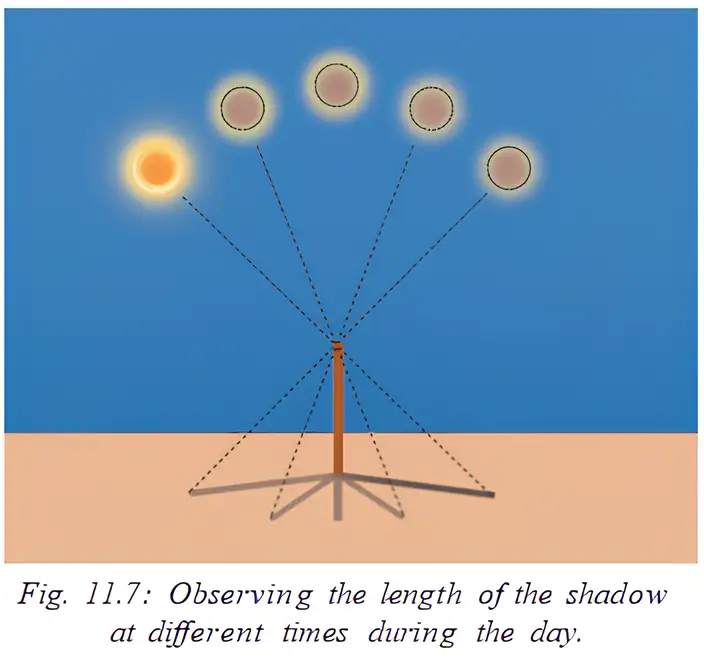
- Earth’s rotation causes the Sun’s apparent daily motion; a mean solar day is 24 hours.
- The Moon’s phase cycle takes about 29.5 days; 12 lunar months make a year of about 354 days.
- A solar year follows Earth’s seasonal cycle and lasts about 365.25 days.
- Lunar calendars drift against seasons because their years are shorter than seasonal years.
- The Gregorian calendar uses leap years to account for the extra quarter-day in Earth’s orbit.
- A tropical year is measured between spring equinoxes; a sidereal year is about 20 minutes longer.
How Did Calendars Come into Existence Part-2
Observing the Sky to Track the Year
Sky observations and seasonal cycles
- Careful observation: Ancient people, including people in India, tracked repeating patterns in the sky and nature without modern instruments or knowledge of Earth's revolution around the Sun.
- Length of the year: These observations helped people estimate a year as approximately 365 days and develop calendars.
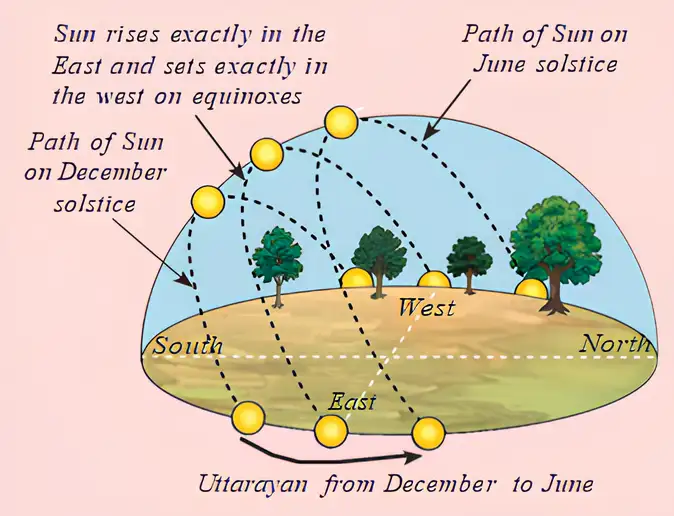
- Sunrise position: The Sun rises slightly north of east in summer and slightly south of east in winter; these extreme positions occur at the solstices.
- Solstice dates: The June and December solstices occur around June 21 and December 21, respectively.
- Apparent motion: The Sun's apparent northward movement from December to June is Uttarayan; its apparent southward movement from June to December is Dakshinayan.
- Seasonal link: Uttarayan and Dakshinayan repeat each year and are closely connected with changing seasons.
Traditional records of the Sun's movement
- Taittiriya Samhita: Records the idea that the Sun moves southward for six months and northward for six months.
- Star patterns: Equinoxes and solstices were also tracked by noting which stars rose at sunset.
- Surya Siddhanta: Describes Uttarayan as beginning when the Sun enters Capricorn (Makar) and Dakshinayan when it enters Cancer.
- Ancient observation: The text notes that Capricorn was in the background of the Sun around the winter solstice in ancient times.
Luni-solar Calendars
Luni-solar calendar — A calendar that counts days and months mainly using the Moon's phases, while making adjustments to stay aligned with the seasons.
Why an extra month is added
- Lunar year: Twelve lunar months total about 354 days, nearly 11 days shorter than a solar year.
- Growing difference: The yearly shortfall accumulates and becomes close to one month after about 2–3 years.
- Correction: Some calendars add an extra month, called Adhika Maasa or an intercalary month, every few years.
- Purpose: This adjustment keeps the lunar months in step with the solar year and the seasons.
| System | When the month begins | When the month ends |
|---|---|---|
| Amant | The day after the new Moon | The day of the new Moon |
| Purnimant | The day after the full Moon | The full Moon |
Traditional month names
- Months: Chaitra, Vaisakha, Jyeshtha, Ashadha, Shravana, Bhadrapada, Ashwin, Kartika, Margashirsha (or Agrahayan), Pausha, Magha and Phalguna.
- Use: Different luni-solar calendars are followed in various parts of India, including for marking festivals.
The Indian National Calendar
Indian National Calendar — A solar calendar used by the Government of India alongside the Gregorian calendar for official purposes.
Structure and dates
- Year length: It has 365 days in a regular year and begins on March 22, the day after the spring equinox.
- Month lengths: Months have 30 or 31 days. In a regular year, months 2–6 have 31 days; the remaining months have 30 days.
- Month names: Its month names come from traditional Indian calendars.
- Leap year: Leap years match the Gregorian calendar; one day is added to Chaitra, so the year begins on March 21.
- Example: In 2025 (Shaka Era 1947), Chaitra runs from March 22 to April 20, Vaisakha from April 21 to May 21, and Jyeshtha from May 22 to June 21.
Calendar Reform
- 1952The Government of India set up the Calendar Reform Committee (CRC) to review existing calendars and recommend an accurate, uniform national calendar.
- 21 March 1956 CEThe recommended Unified National Calendar came into use; this date was 1 Chaitra 1878 Saka.
Calendar Reform Committee
- Recommendation: The CRC proposed a Unified National Calendar for use across India.
- Basis: The Indian National Calendar follows the general principles of the Surya Siddhanta.
- Meghnad Saha: The Indian astrophysicist who studied stars and their temperatures chaired the CRC; the Saha equation is named after him.
Why do some luni-solar calendars add an extra month?
How is the Indian National Calendar adjusted in a leap year?
Quick recap
- Sky cycles: Ancient observations of the Sun and stars helped people estimate a year as about 365 days.
- Sun's movement: Uttarayan is the apparent northward movement from December to June; Dakshinayan is southward from June to December.
- Luni-solar calendars: They use lunar months and add Adhika Maasa periodically to stay aligned with the seasons.
- Month systems: Amant months end at the new Moon; Purnimant months end at the full Moon.
- National calendar: This solar calendar has 30- or 31-day months and begins on March 22 in a regular year.
- Calendar reform: The CRC was formed in 1952, and its Unified National Calendar came into use on 21 March 1956.
Are Festivals Related to Astronomical Phenomena
Festivals and Lunar Calendars
- Lunar dates: Many Indian festivals are set by the Moon’s phases and follow lunar or luni-solar calendars.
- Examples: Diwali is celebrated on Kartika’s new Moon, while Holi and Buddha Purnima fall on full Moon days.
- Changing dates: These festivals can fall on different Gregorian dates in successive years.
Solar Sidereal Calendars and Festival Dates
- Luni-solar calendars: They use the Moon’s phases to count months while making adjustments to stay aligned with the seasons.
- Date shifts: The Gregorian dates of festivals based on these calendars can shift, generally by less than a month.
- Intercalary month: Adding an extra month every few years helps keep the lunar cycle and solar year in step.
Regional Festival Dates and the Rashtriya Panchang
- Regional variation: Festival dates can differ by a day between eastern and western India because sunrise occurs at different times.
- Rashtriya Panchang: The Government of India’s Positional Astronomy Centre publishes it annually using calculated positions of the Sun and Moon.
- Purpose: Its calculations help provide advance festival dates for Government of India holiday declarations.
The Moon and Indian Culture
Why do luni-solar festivals generally shift by less than a month in the Gregorian calendar?
Why can a Moon-based festival fall on different dates in Eastern and Western India in the same year?
Quick recap
- Many Indian festivals follow lunar phases; their Gregorian dates vary from year to year.
- Luni-solar calendars add an intercalary month to correct the lunar–solar difference; purely lunar calendars do not.
- Solar sidereal festivals stay near the same Gregorian date but slowly shift relative to solstices and equinoxes.
- Makar Sankranti moves ahead by about one day every 71 years in the tropical calendar.
- Sunrise timing can create a one-day regional difference; the Rashtriya panchang supports national uniformity.
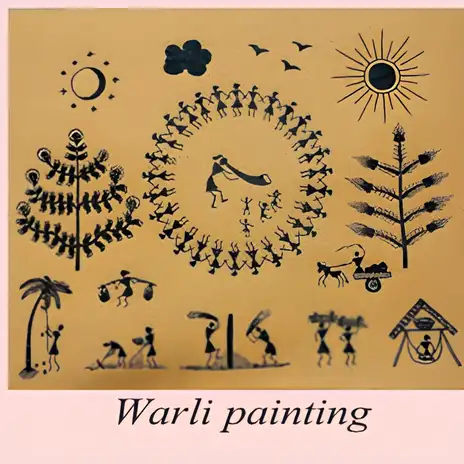
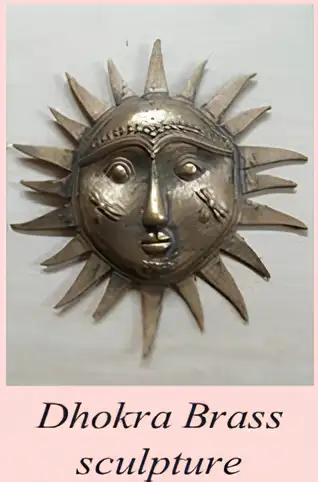
- The Moon and Sun are prominent themes in Indian music, dance, painting and other arts.
Why Do We Launch Artificial Satellites in Space
Artificial Satellites
Artificial satellite — A human-made object launched into space to orbit Earth or another celestial body.
Orbits and uses
- Natural satellite: The Moon is Earth’s natural satellite and orbits Earth.
- Artificial satellites: Satellites launched by different countries also orbit Earth; they can appear as tiny moving specks in the night sky.
- Typical orbit: Many orbit about 800 km above Earth’s surface and take roughly 100 minutes to complete one orbit.
- Uses: They support communication, navigation, weather monitoring, disaster management and scientific research.
Spotting satellites
- Appearance: A satellite may look like a point of light with steady or flickering brightness, moving quickly across the sky.
- Visibility: It may be seen with the naked eye or binoculars, especially shortly before sunrise or after sunset.
Indian Satellites and Space Missions
ISRO’s contributions
- ISRO: The Indian Space Research Organisation has launched many satellites that support practical services and scientific research.
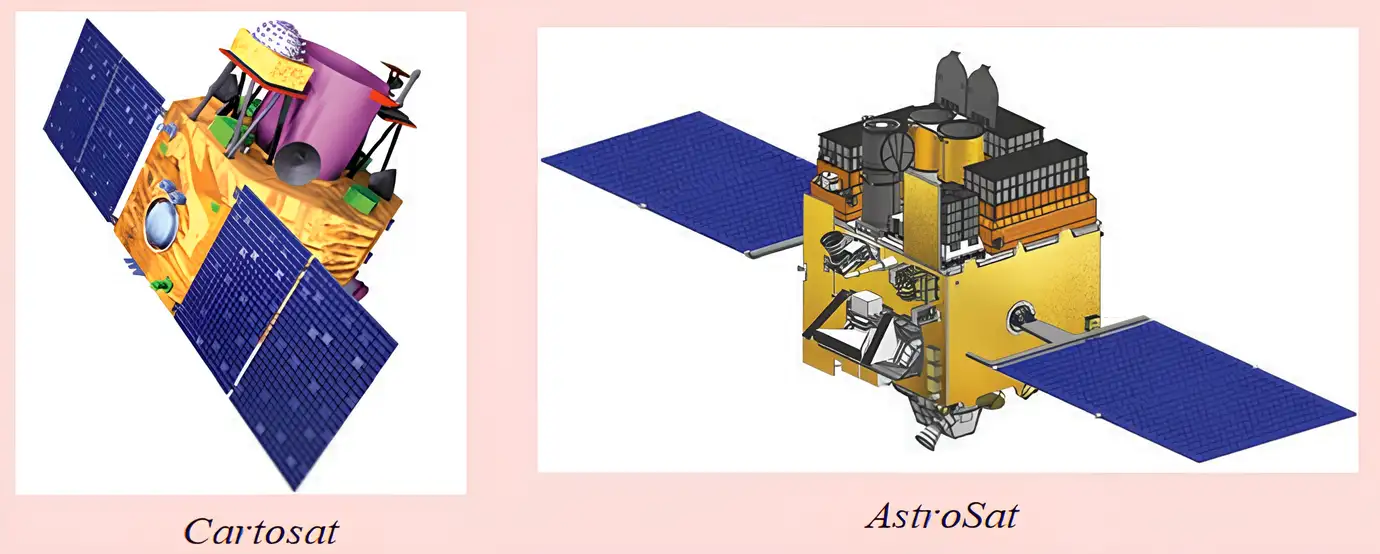
- Cartosat: This satellite series captures high-quality images of Earth to improve maps, plan cities and help manage natural disasters in India.
- Bhuvan: This mapping platform uses satellite images to display terrain, soil, land use, vegetation and other features.
- AstroSat: It makes scientific observations of stars and other celestial objects.
| Mission | Destination or purpose |
|---|---|
| Chandrayaan 1, 2 and 3 | The Moon |
| Aditya L1 | Study of the Sun |
| Mangalyaan | Mars |
| AzaadiSat, InspireSat-1 and Jugnu | Small satellites built and launched with participation from Indian students |
Space Debris
Space debris — Unused satellites and rocket parts left in space after their useful life.
Effects of space debris
- Satellites and rocket parts outlive their useful life → they become space debris.
- Debris crowds space → it may collide with working satellites.
- Small debris falling towards Earth → it burns up in the atmosphere.
- Large debris falling towards Earth → it can crash on the ground.
- The collision and crash risks → countries are working together to remove dangerous debris.
Vikram Sarabhai and India’s Space Programme
- Vikram Ambalal Sarabhai (1919–1971): Known as the Father of the Indian Space Programme; he pioneered efforts to launch India’s first artificial satellites.
- Vikram Sarabhai Space Centre (VSSC): Located in Thiruvananthapuram, it develops rockets and launch-vehicle technology and is named after Sarabhai.
Why are artificial satellites launched?
What are Cartosat and AstroSat used for?
Quick recap
- The Moon is a natural satellite; human-made satellites orbit Earth too.
- Many artificial satellites orbit about 800 km above Earth and take roughly 100 minutes per orbit.
- Satellites support communication, navigation, weather monitoring, disaster management and research.
- Cartosat helps map and manage land; AstroSat observes celestial objects.
- Space debris can collide with working satellites; small falling pieces burn up, while larger pieces may reach the ground.
- Vikram Sarabhai pioneered India’s satellite-launch efforts; VSSC develops rockets and launch-vehicle technology.
Snapshots
Phases of the Moon
- Phases: The Moon’s visible illuminated portion changes shape as the Moon moves around Earth.
- Cycle: The sequence includes new Moon, crescent, half, gibbous, and full Moon phases.
- Cause: We see different fractions of the Moon’s sunlit half from Earth; the phases are not caused by Earth’s shadow.
Calendars and Natural Cycles
- Natural cycles: The apparent daily motion of the Sun, the Moon’s phases, and the cycle of seasons provide ways to measure time.
- Calendar systems: Lunar calendars follow Moon phases, solar calendars follow the seasons, and luni-solar calendars combine both.
- Time units: These cycles underpin the day, month, and year.
Artificial Satellites
- Definition: Artificial satellites are human-made objects launched from Earth into orbit.
- Orbit: Many orbit about 800 km above Earth and complete an orbit in roughly 100 minutes.
- Uses: Satellites support communication, navigation, weather monitoring, disaster management, and scientific research.
- Indian examples: ISRO’s Cartosat satellites help with mapping, while AstroSat studies stars and other celestial objects.
Quick recap
- The Moon’s illuminated appearance changes through phases, including new, crescent and full Moon.
- We see different portions of the Moon’s illuminated part as it moves around Earth.
- A full phase cycle takes about a month.
- Calendars are based on recurring natural cycles.
- Lunar calendars follow the Moon; solar calendars follow the seasons; luni-solar calendars use both.
- Artificial satellites are human-made and provide useful information for well-being and space science.
Science — ALL CHAPTERS
1
Exploring the Investigative World of Science
2
The Invisible Living World: Beyond Our Naked Eye
3
Health: The Ultimate Treasure
4
Electricity: Magnetic and Heating Effects
5
Exploring Forces
6
Pressure, Winds, Storms, and Cyclones
7
Particulate Nature of Matter
8
Nature of Matter: Elements, Compounds, and Mixtures
9
The Amazing World of Solutes, Solvents, and Solutions
10
Light: Mirrors and Lenses
11
Keeping Time with the Skies
12
How Nature Works in Harmony
13
Our Home: Earth, a Unique Life Sustaining Planet